Radiative and nonradiative decay rates of a molecule close to a metal
particle of complex shape
Oliviero Andreussia)
Scuola Normale Superiore di Pisa, Piazza dei Cavalieri 7, 56125 Pisa, Italy
Stefano Corni
INFM Center on nanoStructure and bioSystems at Surfaces, Dipartimento di Fisica, Universita` di Modena e Reggio Emilia, via Campi 213/A, 41100 Modena, Italy
Benedetta Mennucci and Jacopo Tomasi
Dipartimento di Chimica e Chimica Industriale, Universita` di Pisa, 56126 Pisa, Italy
共Received 13 April 2004; accepted 24 August 2004兲
We present a model to evaluate the radiative and nonradiative lifetimes of electronic excited states of a molecule close to a metal particle of complex shape and, possibly, in the presence of a solvent. The molecule is treated quantum mechanically at Hartree–Fock 共HF兲or density-functional theory
共DFT兲level. The metal/solvent is considered as a continuous body, characterized by its frequency dependent local dielectric constant. For simple metal shapes 共planar infinite surface and spherical particle兲a version of the polarizable continuum model based on the integral equation formalism has been used, while an alternative methodology has been implemented to treat metal particles of arbitrary shape. In both cases, equations have been numerically solved using a boundary element method. Excitation energies and nonradiative decay rates due to the energy transfer from the molecule to the metal are evaluated exploiting the linear response theory共TDHF or TDDFT where TD—time dependent兲. The radiative decay rate of the whole system共molecule⫹metal/solvent兲is calculated, still using a continuum model, in terms of the response of the surrounding to the molecular transition. The model presented has been applied to the study of the radiative and nonradiative lifetimes of a lissamine molecule in solution 共water兲 and close to gold spherical nanoparticles of different radius. In addition, the influence of the metal shape has been analyzed by performing calculations on a system composed by a coumarin-type molecule close to silver aggregates of complex shape. © 2004 American Institute of Physics. 关DOI: 10.1063/1.1806819兴
I. INTRODUCTION
It is well known that the presence of a metal body can strongly affect the response properties of a molecule placed in its close proximity.1Molecular optical properties are prob-ably the most significative example of how strong the metal influence can be: this is the main cause, for example, of the well-known surface enhanced Raman scattering共SERS兲,2for which enhancement factors of more than ten orders of mag-nitude has been reported.3The metal influence is responsible also for many other surface enhanced 共SE兲optical effects,2 such as second harmonic 共SE兲 generation, SE two-photon absorption, or SE fluorescence. Nevertheless, as far as con-cerns the excited state properties, the presence of the metal can have an opposite effect and it is responsible, in many cases, for a decrease of the molecular responses. This result is due to the fact that the excitation energy of the molecule can be efficiently transferred to the metal body共for example, via a resonant energy transfer, or RET, or via the formation of a charge transfer state兲and can undergo, inside this me-dium, several dissipation processes.
With this work we present a model to treat radiative and
nonradiative decay rates of a molecule close to a metal par-ticle of arbitrary shape, thus allowing the study of different kinds of interesting physical systems. In fact, both the fluo-rescence enhancement and the fluofluo-rescence quenching are the basis of many recent experimental works and technologi-cal developments, starting from RET 共Refs. 4 and 5兲 and fluorescence hyperquenching near spherical 共or quasispheri-cal兲nanoparticles and arriving to fluorescence enhancement near fractal aggregates6,7or near the tip of a scanning near-field optical microscope 共SNOM兲.8 –10
Many of the models used to treat these effects consider the molecule as a polarizable pointlike dipole:11–14 neverthe-less, for metal-molecule distances less than few nanometers
共a situation that often occurs in many experimental situa-tions兲 this approximation can be too rough and a quantum mechanical 共QM兲 description of the whole molecule would be instead necessary. On the other side, for many of the physical systems of interest the metal shape is one of the most important factors and a proper description of this aspect is compulsory. For both these reasons we have formulated a method that treats the molecule at a high level of accuracy and at the same time can explicitly consider metal particle of complex shape.
The paper is organized as follows: in Sec. II we present the main features of the proposed QM model to calculate
a兲Author to whom correspondence should be addressed; Electronic mail:
10190
radiative and nonradiative lifetimes for a molecule placed near a metal particle. In Sec. III a comparison with experi-mental results is reported together with an investigation on the importance of the metal shape and of the geometrical configuration of the system 共position, orientation, and dis-tance of the molecule with respect to the metal surface兲 in the enhancement or decrease of the molecular response.
II. THEORY
The starting point of the present work is the theoretical model that has been recently proposed15,16for the calculation of dynamic response properties of a molecule in close prox-imity to metal bodies and possibly in the presence of a sol-vent. This model is based on a hierarchical principle: the main part of the system under study is treated using a high level of accuracy while the remaining objects are treated only considering the features important in the interaction with the interesting part. Thus, the molecule, that in the stud-ied phenomena has the main role, is treated at a quantum mechanical level 共Hartree–Fock, HF, or within the density-functional theory, DFT兲, whereas the metal共and the solvent, if present兲is considered as a continuous body characterized by its response properties to electric fields, both the ones imposed on the system from outside and the ones arising from the molecular charge distribution.
In the previous works,16 only semi-infinite metals with planar 共possibly rough兲 surfaces were considered. In the present work, we extend the theory of Ref. 16 by considering nanoparticles of complex shape. In particular, we model the metal as a sphere or as a complex body of irregular geom-etry, obtained as the union of different interlocking spheres. The metal response to the electric fields has been described using the same assumptions used previously: the metal be-haves as a perfect conductor for static fields and as a dielec-tric for time dependent fields. In the latter case, the frequency dependent permittivity experimentally measured is used, possibly modified to take into account quantum size effects
共in particular, the reduced mean free path of the metal elec-trons in the nanoparticle兲on the response of the metal body. The solvent is described as a continuum dielectric which occupies all the space free from the metal specimen and the molecular shaped cavity hosting the molecule. The metal-molecule and solvent-metal-molecule interactions have been treated through the polarizable continuum model共PCM兲,17,18 implemented in two complementary versions. Considering the metal/solvent as continuous media and exploiting classic electrodynamic treatments it is possible to describe the inter-action between the molecule and the surrounding 共metal/ solvent兲in terms of the interaction of the molecule with an apparent surface charge density spread only on the system interfaces. In this way the original three-dimensional prob-lem is reduced to a simpler two-dimensional probprob-lem defined only at the boundaries of the system. The set of equations that determine the apparent surface density have been nu-merically solved by a boundary element method共BEM兲:19in this respect, our model can be so referred to the apparent surface charge methods共Ref. 18兲widely used in continuum solvation models.
In previous works,16we described a procedure to calcu-late metal induced nonradiative decay rates based on time dependent DFT共TDDFT兲or time dependent HF共TDHF兲in the random phase approximation-like formulation.20 In the present work, this procedure will be extended to more com-plex metal shapes 共as said above兲. Moreover, we will also present the theory for the calculation of metal-induced radia-tive decay rate, again in the TDDFT/TDHF framework, that was not present in our previous works on the subject.
In the next few sections, we shall discuss how to calcu-late the apparent charges mentioned above for 共 complex-shaped兲nanoparticles and how the radiative and nonradiative metal-induced lifetimes are computed. We shall also describe a method to calculate the dynamic polarizability of complex shape nanoparticles that will be useful in rationalizing some of the numerical results obtained in the Numerical Applica-tions section.
A. The calculation of the apparent charges: Spherical particles
As said above, the total electrostatic potential acting on the molecule due to the metal/solvent polarization is calcu-lated from a set of apparent charges placed on the interfaces of the system. These charges共evaluated, in this case, by con-sidering the dynamic dielectric response of metal and sol-vent兲 also appear in the equations that determine excitation energies and lifetimes, as discussed in Secs. II C and II D.
The apparent surface charges can be obtained by exploit-ing two different methodologies. For simple shapes it is more useful and time saving to exploit the integral equation for-malism 共IEF兲 version of the PCM model 关IEF-PCM 共Ref. 21兲兴, already applied to the study of excitation energies and lifetimes of a molecule close to a metal planar infinite surface.16 With this procedure, the metal-molecule and solvent-molecule interactions are reduced to the interaction with a fictitious charge density spread on the molecular cav-ity surface only.
B. The calculation of the apparent charges: Complex-shaped particles
With the purpose of treating systems characterized by a complex and arbitrary shape, for which it is not available, numerically or analytically, a Green’s function, here we have chosen to revert to the original version of the PCM共Refs. 17 and 18兲 also known as DPCM 共where D stands for dielec-tric兲.
Based on elementary electrostatic considerations, this version of the PCM treats explicitly all the different inter-faces present in the system: in the case under study, these interfaces are the surface of the metal body and, in case of the presence of a solvent, the molecular cavity. This model has been already used in previous works for the character-ization of metal-molecule interactions.15As for IEF, the re-sulting equations are numerically solved by a BEM, dis-cretizing all the surfaces. For the generation of the metal specimen, an algorithm similar to the one defined for the molecular cavity is used: the metal body is built as the union of interlocking spheres of arbitrary radius and position. Play-ing with these two parameters and the total number of spheres generated, it is possible to control the exact shape of the metal surface and to reproduce several systems.
The main equation to be solved to calculate the apparent charges spread on all the interfaces is of the form
DA⫺1q⫽En0, 共1兲
where A is the diagonal matrix of the tessera areas, D is the characteristic matrix of DPCM共Ref. 17兲, and En0 is the com-ponent normal to the tesserae surfaces of the electric field generated by the solvated molecule.
C. Excitation energies and nonradiative lifetimes
For the sake of brevity, we do not present here the deri-vation of the expressions for the nonradiative lifetimes and excitation energies from the TDDFT equations,23since such derivation has been already given in Ref. 16. It is sufficient to recall that the metal/solvent effects are taken into account by including in the TD equations a polarization term Kst,upolv() which can be written as
Kst,upolv共兲⫽
兺
i
q共si,关s*t兴兲V共si,关u*v兴兲. 共2兲
In Eq.共2兲, V(si,关u*v兴) is the electrostatic potential gener-ated by the distribution of charge u*v (u and v are
molecular orbitals兲 at the point si on the cavity surface.
q(si,关s*t兴) is the apparent charge placed in sidue to the
metal/solvent polarization induced by s*t and calculated exploiting the methodologies resumed in the previous sec-tions. These charges are evaluated considering the response of the metal at the frequency . Since such a response is described by a complex dielectric constant, the charges are complex and Kst,upolv() is complex as well. Thus, also the poles of the response function are complex. We associated their real part to the excitation energies 共such as for purely real response function兲, and their imaginary part with the metal-induced nonradiative decay rate ⌫M etnonrad 共i.e., to the nonradiative lifetimes nonradM et ⫽1/⌫M etnonrad).
We would also like to recall that the lifetimes so ob-tained are related, strictly speaking, to the absorption process and not to the emission one, i.e., we are considering the transition between the ground state and an excited state, not vice versa. Due to the presence of the metal solvent sur-rounding, this is just an approximation; nevertheless, it has been already noted16 that, in general共and this is the case of the systems analyzed in the numerical section兲, the impor-tance of the presence of the metal/solvent on the molecular transition density is quite limited and it can in many cases be neglected.
D. Radiative lifetimes
Besides the nonradiative process, that has been analyzed above, another way of dissipating the molecular excitation energy is the radiative one. The molecular excited state of interest may undergo processes of fluorescence. In Ref. 16, the radiative processes were considered by reverting on the classical electrodynamics model by Chance, Prock, and Silbey.24 In the present work, we present a methodology to calculate radiative lifetimes within the same model used for the computations of nonradiative lifetimes. Thus, both radia-tive and nonradiaradia-tive decay rates are calculated in a coherent way, taking explicitly into account the presence of the metal and the solvent surrounding the molecule. The fluorescence rate for an isolated molecule can be written as
⌫rad,fl⫽4
3
3បc3兩ជK0兩
2, 共3兲
where is the fluorescence frequency corresponding to the transition under study共it corresponds to the real part of the pole of the response function兲andជK0is the molecular
tran-sition dipole between the excited state K and the ground state. When the whole system, instead of the single molecule, is considered, the transition dipoleជK0tot must be used instead of ជK0 and the refraction index n1 of the medium in which emission takes place has to be inserted in the numerator of Eq. 共3兲. Following a theoretical approach similar to the one exploited to describe the effects of an applied electric field on a solvated molecule共see Refs. 16 and 25兲it is possible to write ជtot共let us omit the indication of electronic states for simplicity兲as
ជtot⫽ជ0⫹˜ជ, 共4兲 whereជ0is the transition dipole moment of the molecule in
the complex environment while ˜ជ is the dipole induced in the metal/solvent by the molecular transition. Such an in-duced dipole moment can be obtained from the knowledge of the PCM characteristic matrix D and of the electrostatic po-tential generated by the transition charge density Vtr. Indeed, the interaction between the dipole induced by the molecule on the metal/solvent and an external field Eជex can be rewrit-ten in terms of the interaction between the charge induced by the external field on the metal/solvent and the molecular electrostatic potential Vtr,
where the charge qex induced by the external field are given by Eq. 共1兲, namely,
qex⫽AD⫺1共Eជex•nˆ兲. 共6兲
In Eq.共6兲nˆ contains the direction of the unit vectors
perpen-dicular to the tesserae surface.
Thus, exploiting Eqs. 共5兲 and共6兲, the ith component of the induced dipole can be written as
˜i⫽⫺共q
exVtr兲
Eiex ⫽⫺ qex
EiexV
tr⫽⫺共AD⫺1n
i兲V
tr. 共7兲
E. The metal polarizability
Similarly to what has been done to obtain the dipole induced on the metal particle by the molecular transition, it is possible to calculate the response of the metal particle alone. This kind of calculation can be easily done still exploiting the DPCM procedure as follows.
The elements of the metal polarizability tensor can be written as
␣i j M et⫽i
M et
Eexj , 共8兲
wherei M et
and Ej ex
are the components, respectively, of the electric dipole induced on the metal particle and of the ex-ternal electric field acting on the particle. In a similar way to what has been done in the preceding section, the metal in-duced dipole can be written in term of a set of apparent charges as
ជM et⫽
兺
n苸M etqnexrជn⫽qexrᠬ, 共9兲
where the summation is only on the tesserae belonging to the metal and the array of vectors rᠬcontains the positions of the metallic tesserae. Then, using Eqs. 共8兲 and 共9兲, the metal polarizability can be obtained as
␣i j
M et⫽
冉
q exEj
ex
冊
ri⫽共AD ⫺1nj兲ri 共10兲
with all the matrices 共D, nˆ, rᠬ, etc.兲defined only for tesserae belonging to the metal surface.
III. NUMERICAL APPLICATIONS
Numerical applications can be of different types: first of all, it is necessary to estimate the numerical precision of the results obtained with the method proposed, varying the inter-nal parameters; in addition, and this is one of the aims of our work, it is possible to address real systems and compare theoretical results with the experimental ones; finally, for all those cases for which experiments are not yet available, it is possible to use the model proposed to theoretically estimate the behavior of the system. All these applications will be analyzed in the following sections.
A. Computational details
The theory presented in Sec. II has been implemented in a local version of the Gaussian suite of programs.26
Calcula-tions have been made using different molecules: while in the comparison with experiments and for theoretical studies of realistic system complex molecules 共lissamine and cou-marin兲have been used, for testing the model numerical sta-bility a simpler system has been chosen. With the purpose of repeating a great number of rapid calculations, we have cho-sen to use a formaldehyde molecule, placed with the main axis perpendicular to the metal surface and with the oxygen atom the closest to the metal. For this small system, the calculation have been made at the HF level, using the 6-31G basis set. On the contrary, for the other calculations a DFT level of theory has been considered, exploiting the B3LYP hybrid functional27 and using the 6-31⫹G*basis set.
For calculations in solution, we built a cavity around the molecule done by interlocking spheres centered on atoms. The radii of the spheres are obtained by multiplying by a cavity size factor共␣⫽1.2兲the radii specific of the atoms共1.2 Å for H not linked to C atoms, 1.7 Å for C, 1.9 Å for CHx
group, 1.56 Å for O, 1.6 Å for N, and 1.8 Å for S兲. In addition, spheres have been added, if necessary, to simulate the solvent excluded volume. As for the solvent, for all the calculations we considered water, characterized by a static dielectric constant ⑀0 of 78.39 and an optical dielectric con-stant ⑀o pt of 1.776.
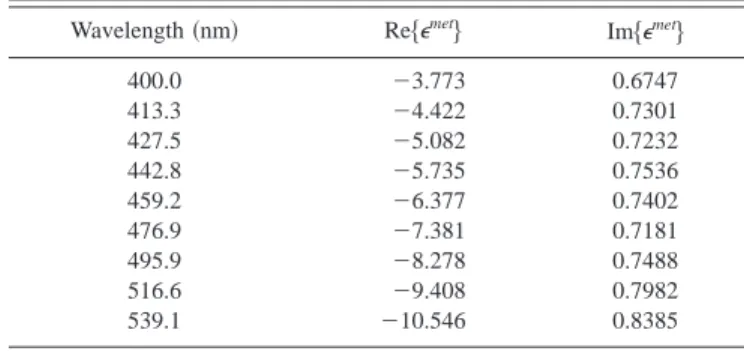
For the metallic part of the system only silver and gold have been considered, with the aim of remaining as close as possible to the most common experimental situations. The values for the dielectric constant of the metals at the different frequencies considered in our calculations have been taken from the handbook of Palik:28for gold a single frequency has been analyzed 共namely, 595 nm兲 for which we have used Re兵⑀met其⫽⫺10.22 and Im兵⑀met其⫽0.999 while for silver the interval 400–540 nm has been analyzed, the corresponding values for the real and the imaginary part of the permittivity are reported in Table I.
B. Comparison between different numerical approaches: IEF and DPCM for a spherical particle
Numerical tests,29not reported here, have confirmed the stability of the method with respect to changes in the most important parameters and the convergence of the results with those obtained with simpler models for which an analytical expression is available.
Here we report, instead, another important test: the com-parison between the two different numerical procedures we TABLE I. Experimental dielectric constant for silver. Data are taken from Palik共Ref. 28兲.
Wavelength共nm兲 Re兵⑀met其
Im兵⑀met其
400.0 ⫺3.773 0.6747
413.3 ⫺4.422 0.7301
427.5 ⫺5.082 0.7232
442.8 ⫺5.735 0.7536
459.2 ⫺6.377 0.7402
476.9 ⫺7.381 0.7181
495.9 ⫺8.278 0.7488
516.6 ⫺9.408 0.7982
have described in Sec. II共namely, the IEF-PCM and the here developed DPCM兲 to compute the apparent charges. With respect to the IEF-PCM, which has been already tested in details for metallic planar surfaces, the procedure based on DPCM has more numerical sources of possible instability: the ones coming from the tessellation of the molecular cav-ity, that are also present in the IEF case, plus the ones char-acteristic of the metallic part of the system. Thus, the agree-ment of the results obtained with the two procedures is an implicit check for the stability of the proposed method.
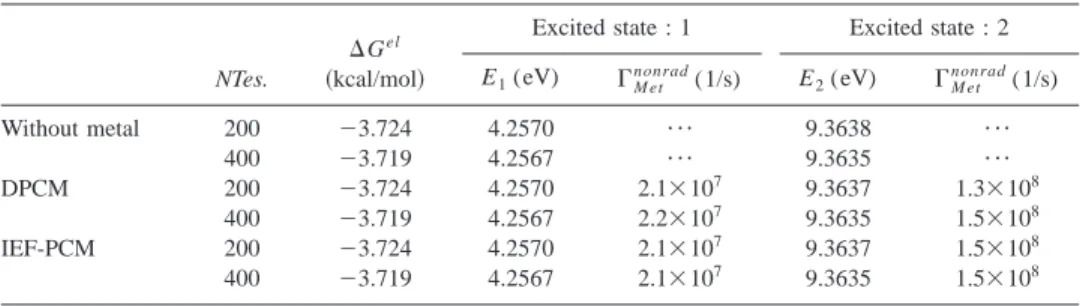
For the case of a perfectly spherical metal particle, both methods can be exploited and the results can be directly compared. The system chosen for this comparison is com-posed by a formaldehyde molecule placed in proximity of a silver sphere with a radius of 50 Å. Calculations have been performed both in vacuo and in solvent共water兲and the first two excited singlets have been examined. In each case, two different distances共3 Å and 8 Å兲between the metal and the molecule have been used. The wavelength for which re-sponse of the system has been calculated is 520 nm, with the purpose of considering a spectral region in which the metal behaves in a known and characteristic way. This choice has been made without considering the real molecular transition wavelengths of formaldehyde: at this stage of the calculation, in fact, it is not necessary that the results have a direct physi-cal meaning, since this is only an analysis of numeriphysi-cal ac-curacy.
The results, reported in Tables II and III, show a very good agreement between the two procedures especially for calculations in solution, for which the differences between IEF-PCM and DPCM are negligible if compared with the ones due to the different tessellations of the molecular cavity
共a step common to both procedures and to PCM for homo-geneous solutions兲.
C. Radiative and nonradiative lifetimes of a lissamine fluorescent dye near gold spherical nanoparticles of different sizes
As said in the Introduction, a first application of the method proposed is to simulate the energy transfer between a molecule in an excited state and a spherical metal particle. In particular, a recent article on this subject examines the case of a lissamine molecule in solution共water兲and in close prox-imity of a gold sphere of known radius.4Varying the radius of the metal particle 共1, 10, 15, and 30 nm兲, the system behavior is analyzed: both radiative and nonradiative life-times have been experimentally determined and a remarkable fluorescence quenching has been reported also for the small-est particles. In addition, in the same article, experimental results have been compared with calculations based on the Gersten–Nitzan 共GN兲 model;11 this is a quasielectrostatic model that treats the emitting molecule as a pointlike dipole TABLE II. Electrostatic interaction free energy⌬Gelobtained from the difference between the free energy of
the molecule interacting with the dielectric surrounding共metal兲 and the energy of the isolated molecule. Energies (E1 and E2) and nonradiative decay rates (⌫M et
nonrad
) for the two lowest singlet excited states of a formaldehyde molecule in vacuum and interacting with a silver spherical particle of radius r⫽5 nm. Calcula-tions have been performed with the IEF-PCM procedure and with the DPCM one. In both cases two distances (D⫽0.3 nm and D⫽0.8 nm) between the molecule and the metal surface have been considered.
⌬Gel
共kcal/mol兲
Excited state : 1 Excited state : 2
E1(eV) ⌫M et
nonrad(1/s) E
2(eV) ⌫M et nonrad(1/s)
Without metal ¯ 4.1094 ¯ 9.1468 ¯
DPCM (D⫽0.8 nm) ⫺1.44⫻10⫺2 4.1099 1.15⫻107 9.1474 1.4⫻108
IEFPCM (D⫽0.8 nm) ⫺1.51⫻10⫺2 4.1099 1.12⫻107 9.1474 1.3⫻108
DPCM (D⫽0.3 nm) ⫺1.80⫻10⫺2 4.1174 1.36⫻109 9.1563 3.3⫻109
IEFPCM (D⫽0.3 nm) ⫺1.83⫻10⫺2 4.1175 1.37⫻109 9.1565 3.4⫻109
TABLE III. Electrostatic interaction free energy⌬Gelobtained from the difference between the free energy of
the molecule interacting with the dielectric surrounding共metal⫹solvent兲and the energy of the isolated mol-ecule. Energies (E1and E2) and nonradiative decay rates (⌫M et
nonrad) for the two lowest singlet excited states of
a formaldehyde molecule in solution 共water兲 and interacting with a silver spherical particle of radius r ⫽5 nm. NTes. values correspond to the approximate number of tesserae generated for each sphere used for building the molecular cavity. Calculations have been performed with the IEF-PCM procedure and with the DPCM one. Only the values obtained for a metal-molecule distance D⫽0.8 nm are reported.
NTes.
⌬Gel
共kcal/mol兲
Excited state : 1 Excited state : 2
E1(eV) ⌫M et nonrad
(1/s) E2(eV) ⌫M et
nonrad
(1/s)
Without metal 200 ⫺3.724 4.2570 ¯ 9.3638 ¯
400 ⫺3.719 4.2567 ¯ 9.3635 ¯
DPCM 200 ⫺3.724 4.2570 2.1⫻107 9.3637 1.3⫻108
400 ⫺3.719 4.2567 2.2⫻107 9.3635 1.5⫻108
IEF-PCM 200 ⫺3.724 4.2570 2.1⫻107 9.3637 1.5⫻108
immersed in a dielectric representing the solvent and consid-ers metal particles of spherical shape and characterized by a local response.
The system under study is the one resumed in Fig. 1: the lissamine molecule is attached to the metal particle via a thioether group and the distance between the principal three-ring system of the molecule and the metal surface is almost equal to 1 nm. The fluorescence signal coming from the mol-ecule is at a wavelengthem⫽595 nm and it is greatly influ-enced by the presence of the metal particle. The presence of a surface plasmon peak for the gold sphere at a wavelength of 520 nm has been experimentally observed.
We note that as here effects on the response properties due to the specific chemical interactions between the mol-ecule and the metal 共for example, possible chemical bonds between the molecule and the metal or formations of charge transfer states, or more in general, and in analogy with SERS, the ‘‘chemical effects’’兲are not considered, the sys-tem reported in Fig. 2共a兲 is, in the limit of our method, equivalent to the real lissamine. The study of the lowest mo-lecular transitions of the system in water, without the metal, shows that such transitions mainly involve the condensed three-ring aromatic system and only marginally the fourth aromatic ring. Because of this, it seems to be useless to treat the whole molecule under study and thus, instead of consid-ering the whole lissamine molecule, a simplified model sys-tem, named ‘‘Antra,’’ has been considered 共see Fig. 2兲.
The calculations we have done on this system and on the reference system 共in the following named ‘‘Lissa’’兲 in gas
phase and in solution 共but without the metal兲 are resumed, respectively, in Tables IV and V.
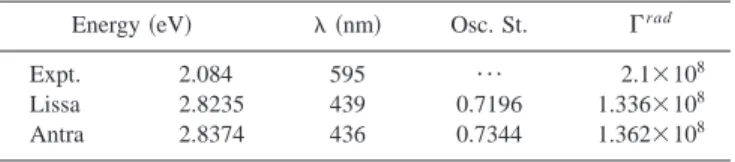
The results reported in the two tables clearly show that the Antra model represents a reliable substitute of the by far more computationally expensive system Lissa both in gas phase and in solution.
In order to reduce the effects of all the intrinsic inaccu-racies of the model共still present for a molecule in vacuum or in solution and without the metal兲 and to limit the conse-quence of using a molecule different from the experimental one, the calculated value of the molecular radiative decay rate without the metal but in the presence of the solvent has been scaled to the one experimentally found and all the re-sults obtained with the metal, both for radiative and nonra-diative processes, have been multiplied by this scaling factor. In addition, the whole nonradiative lifetimes, that include both the contribution from the metal-molecule interaction and the contribution from other possible processes (⌫nonrad
⫽⌫M et nonrad⫹⌫
0
nonrad), has been calculated approximating the
latter term (⌫0
nonrad
) with the experimental value of the non-radiative lifetimes obtained for the system without the metal
关⌫nonrad,Ex pt.⫽0.43⫻109s⫺1 共Ref. 4兲兴.
To reproduce the experimental results, we have chosen to use the geometrical configuration of the different parts of the system as reported in Ref. 4. Thus, the model molecule has been placed with the three-ring system ⬇1 nm far from the metal surface and oriented as shown in Fig. 1.
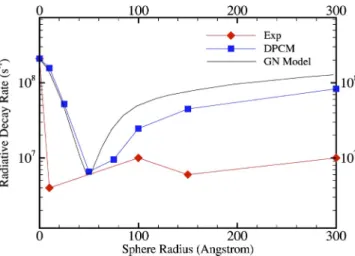
The results corresponding to this system are reported in Figs. 3 and 4 for the radiative and the nonradiative decay rate, respectively.
As far as concerns the radiative decay rate, the results we have obtained and the ones obtained in Ref. 4 with the GN model are quite similar: they show qualitative agreement with the experimental data but they quantitatively differ from the experiments, especially for the largest values of the metal radii. On the contrary, exploiting either the DPCM or the IEF-PCM procedures outlined above, the nonradiative decay rates are almost one order of magnitude closer to the experi-mental results than those obtained using the GN method.4 However, the results are still one order of magnitude far from
FIG. 1. Representation of the system under study. The lissamine molecule is attached to a spherical gold nanoparticle of known radius共varying between 10 and 300 Å兲. The average distance between the three ring aromatic system and the metal surface is equal to 10 Å.
FIG. 2. Representation of the structures of the two systems used to calculate lissamine decay rates.
TABLE IV. Excited state properties of the two systems reported in Fig. 2, in vacuum and without the metal. The calculated wavelengths refer to the excitation process.
Energy共eV兲 共nm兲 Osc. St. ⌫rad
Lissa 3.0426 408 0.4233 5.47⫻107
Antra 3.0228 410 0.1738 2.26⫻107
TABLE V. Excited state properties of the two systems reported in Fig. 2 in solution and without the metal. Experimental values for the lissamine mol-ecule are also reported; the experimental wavelength reported is referred to the emission process, while the calculated values refer to the excitation one.
Energy共eV兲 共nm兲 Osc. St. ⌫rad
Expt. 2.084 595 ¯ 2.1⫻108
Lissa 2.8235 439 0.7196 1.336⫻108
the experimental ones. We note that the small oscillations on the computed nonradiative decay rates for the smallest par-ticles are probably due to numerical errors, since they are less intense for the IEF based procedure.
There are several possible effects that may be the cause of the discrepancies between the calculated values共both with the model presented in this paper and with the GN model兲 and the experimental ones. For example, both the theoretical models do not take into account nonlocal metal response effects and ‘‘chemical effects.’’ Moreover, results have been obtained considering only one of the possible geometrical configurations of the system, while other molecular orienta-tions and values of the metal-molecule distance could be considered.
As far as concerns the nonlocal behavior of the metal, it has been recently shown that using different kinds of nonlo-cal dielectric constants can either increase or decrease the nonradiative molecular decay rates with respect to what ob-tained using a local response for the metal body. In particu-lar, it has been calculated that the use of the hydrodynamic dielectric constant decreases the nonradiative decay rates for a molecule close to an infinite planar surface 共see Ref. 16兲. On the other side, exploiting for the same system the more complex and reliable Lindhard–Mermin dielectric constant, that takes into account nonlocal effects omitted in the hydro-dynamic theory共in particular, the excitation of electron-hole pairs兲, one obtains an increase of the nonradiative decay rates. Thus, it is difficult to predict the effect of nonlocality on the calculated decay rates. If we assume for the spherical
particle a behavior similar to the one reported for the planar surface, it seems that by describing in a proper way the non-local behavior of the metal, the agreement between theoret-ical and experimental results becomes worse, contrary to what suggested in Ref. 4.
Similarly, taking into account the chemical effects, such as the formation of a charge transfer state between the metal and the molecule, would further increase the deviation of the theoretical values from the experimental ones, since these phenomena represent new ways for the molecule to undergo a nonradiative decay.
Another factor which could be tested is the inclusion of quantum size effect in the description of the dielectric con-stant. For the dimensions of the systems under study, the main correction is that due to the variation in the electron mean free path with respect to the bulk metal. This effect has not been considered in the results reported in Figs. 3 and 4; as a matter of fact, it can be included in the model as shown in Ref. 15 but the variation we obtain is just a slight increase of both the radiative and the nonradiative decays for the smallest particles.
In order to explore the effects of the relative metal-molecule geometry, calculations have been performed on the same system, but varying the geometrical parameters and the relative metal-molecule configuration. Results obtained for different values of the metal-molecule distance are resumed in Table VI, while the radiative and nonradiative decay rate obtained considering an orientation of the molecule perpen-dicular to the metal surface are reported in Table VII. FIG. 4. Calculated共DPCM and IEF-PCM兲and experimental共Expt.兲 nonra-diative decay rates with respect to the sphere radius; a radius equal to zero indicates the system without the metal specimen. A qualitative behavior of the nonradiative decay rates calculated using the Gersten–Nitzan 共GN兲 model共Ref. 11兲,共from Ref. 4兲is also reported.
FIG. 3. Calculated共DPCM兲and experimental共Expt.兲radiative decay rates with respect to the sphere radius; a radius equal to zero indicates the system without the metal specimen. The behavior of the radiative decay rates cal-culated using the Gersten–Nitzan共GN兲model共Ref. 11兲 共from Ref. 4兲is also reported.
TABLE VI. Radiative and nonradiative decay rates for the lissamine molecule共model Antra兲as a function of the distance between the three ring aromatic system and the metal surface. The values reported have been obtained for a metal radius of 100 Å.关The correction for the electron mean free path has been taken into account共Ref. 15兲兴.
Distance共Å兲 7.0 8.0 9.0 10.0 10.5 13.0
⌫rad
(s⫺1) 4.41⫻107 3.76⫻107
3.20⫻107 2.59⫻107 2.50⫻107 1.64⫻107 ⌫nonrad(s⫺1)
The variations of the decay rates with respect to these geometrical parameters are large: thus, a statistical averaging of the quantities examined, that takes into account all the possible configurations of the system, can be important and it can be suggested as an element to consider in future devel-opments. In addition, differently to all the other sources of discrepancies共such as charge transfer effects or the molecu-lar orientation兲, increasing the value of the metal-molecule distance makes possible to improve the agreement with the calculated results: it is sufficient to consider a chromophore placed at a distance of ⬃20 Å from the metal surface to obtain results in almost quantitative agreement with the ex-perimental ones. Thus, it is possible that the exex-perimental values refer, for example, to a system in which the molecule is attached to a nonmetallic layer covering the gold spheres. Another possibility is that the measured signal came from lissamine molecules close to the metal particle but not di-rectly attached to it, maybe placed on a second molecular layer. In fact in our calculations we have seen that an hypo-thetical second layer presents a slower de-excitation rate, which may dominate the experimental measure.
D. Lifetimes and quantum yields of a coumarin dye near complex metal nanoparticles
In addition to the dimension of the metal particle, the model has been used to test the influence of the metal shape on the excited state properties, with the purpose of finding suitable configurations that enhance or decrease such prop-erties. As far as we know, no experimental results are avail-able about this subject and we have, thus, decided to con-sider an arbitrary system, trying to remain as general as possible. In particular, in this section we shall examine the influence of a complex shaped metal particle on the excited state properties of a coumarin-type molecule. The test mol-ecule chosen for this series of calculation is derived from the coumarin 1, although its structure共reported in Fig. 5兲is com-mon to many other coumarin-type compounds.
This molecule has been chosen because it is small enough to be treated with high accuracy and because it shows an intense fluorescence signal at a relative high wave-length 共the peak of fluorescence emission for coumarin 1 in water is⬃465 nm, as reported in Ref. 30兲. Calculations have been performed in solution to match with the most common experimental situations. Two different orientations of the coumarin molecule with respect to the metal surface have been used: since the molecular transition dipole moment is oriented along the main axis of the aromatic two-ring
sys-tem, a configuration with the transition dipole perpendicular and one with the dipole tangent to the metal surface have been considered.
Calculations have been performed considering silver as the metal共the correction for the electron mean free path has been taken into account15兲 and using three different shapes for the particle: these have been generated as the union of two or three spheres of radius equal to 50 Å.
Let us now pass to analyze the three different aggregates separately, starting from the simplest one.
1. Two-sphere aggregate
The first aggregate that we have analyzed is the one composed by two identical interlocking silver spheres with centers placed at a distance of 50 Å 共i.e., equal to their ra-dius兲.
To have a more immediate analysis of the effects of the metal aggregate on the decay of coumarin, in Fig. 6 we have plotted the coumarin fluorescence quantum yield ⌽fl, M et for two different orientations: one 共a兲in which its transition di-pole moment is directed perpendicular to the metal surface and one 共b兲 in which the same moment is tangent to the metal surface.
We recall that the fluorescence quantum yield⌽fl, M etof a molecule near the metal particle is defined as
⌽fl, M et⫽ ⌫
rad,fl
⌫rad,fl⫹⌫ M et nonrad⫹⌫
0
nonrad 共11兲
where⌫rad,fland⌫M etnonradare the quantities already examined in previous sections, while⌫0nonrad refer to all the nonradia-tive processes not related to the presence of the metal body. Starting form the knowledge of the fluorescence quantum yield for the molecule in solution without the metal 共 ob-tained, for example, from experimental results兲
⌽fl,0⫽ ⌫0
rad,fl
⌫0
rad,fl⫹⌫
0
nonrad 共12兲
and considering for⌫0rad,flthe expression reported in Eq.共3兲, it is easy to find an indicative estimate for ⌫0nonrad. For the case under study, using the experimental values of ⌽fl,0
⫽0.055 for the coumarin 1 in water共as reported in Ref. 30兲 and the already mentioned value of⌫0rad,fl⯝108s⫺1, a mag-nitude of ⌫0nonrad⯝109s⫺1 is obtained. As will be clear in TABLE VII. Radiative and nonradiative decay rates for the lissamine
mol-ecule共model Antra兲as a function of the orientation of the three ring aro-matic system with respect to the metal surface. The values reported have been obtained for a metal radius of 100 Å and for a metal-molecule distance of 10 Å.关The correction for the electron mean free path has been taken into account共Ref. 15兲兴.
Orientation Tangent Perpendicular
⌫rad(s⫺1) 2.59⫻107 3.22⫻109
⌫nonrad(s⫺1)
2.78⫻1011 2.50⫻1012
the following, this value is much lower than the calculated nonradiative decay rates due to the metal, ⌫M et
nonrad
.
Due to the symmetry of the system, the grid of points used to plot the quantum yield has been obtained considering quadrants of spheres having the same center of one of the two spheres forming the aggregate but with larger radii: namely, the points used have distances from the metal sur-face of 7, 14, 28, and 56 Å, respectively. The quantum yields calculated in this way are reported for both orientations in Fig. 6. A color scale has been used to represent the results
共blue: low yields, red: high yields兲, and the positions of the molecule for which the calculations have been performed are indicated with white squares 共the color in the rest of the space is obtained from linear interpolation of the calculated results兲. The depicted values show the characteristic behavior of RET processes, with a quenching of the molecular fluo-rescence near the metal particle and a gradual recovery of the normal quantum yield in solution as the molecule-metal dis-tance increases. On the other side, a strong dependence from the molecular orientation and position is observed: in the case of the perpedicular orientation关Fig. 6共a兲兴, the different behavior as a function of the different molecular locations
共along the particle main axis or on the X⫽0 line兲is evident. In particular, it seems that the quenching effects of the metal are longer ranged along the main axis than along the X⫽0 line. Moreover, the fluorescence quenching for the tangent orientation 关Fig. 6共b兲兴 is bigger than for the perpendicular one 关Fig. 6共a兲兴 at all the considered coumarin-metal dis-tances.
To better understand where this orientation dependence comes from, we discuss here the behavior of the two decay rates共radiative and nonradiative兲separately. The influence of the orientation of the molecule with respect to the metal particle seems to be only of secondary importance on the calculation of nonradiative decay rates: in fact, we obtain results showing a strong dependence only on the metal-molecule distance 共with a decrease of two orders of magni-tude, from 1012 to 1010s⫺1, passing from a metal-molecule distance of 5 Å to a distance of 50 Å兲.
On the contrary, the radiative decay rate strongly de-pends on the orientation of the molecule. In particular, when the molecular transition dipole moment is oriented along the
main axis of the metal particle, the radiative decay rate is largely increased with respect to the case without the metal. By contrast, when the molecular dipole is directed along the second orientation considered 共orthogonal to the metal par-ticle main axis兲the radiative decay rate is decreased in prox-imity of the metal. In both cases, for metal-molecule dis-tances greater than 50 Å the influence of the metal on the radiative process becomes almost negligible.
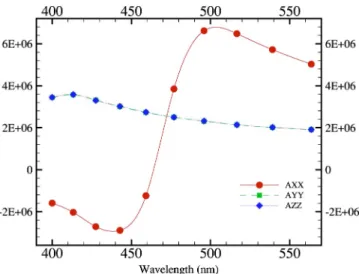
These opposite results for the two different orientations can be explained in terms of the imaginary and real compo-nents of the polarizability tensor of the metal aggregate 关see Eq. 共10兲兴. These components are reported in Figs. 7 and 8, respectively.
As it can be seen from the graphs, a typical resonance behavior is found around 460 nm for the diagonal component along the main axis of the metal particle共the x component in the coordinate system used for the calculation兲, i.e., exactly in the region of the coumarin fluorescence emission 共⬃465 nm兲. This resonance is due to the excitation of a surface plasmon of the complex shaped metal particle, and the fre-FIG. 6. Fluorescence quantum yields for the coumarin-type molecule reported in Fig. 5共b兲near a silver aggregate composed by two identical interlocking spheres. Results are depicted by using a color scale. The white squares indicate the molecule positions for which calculations have been performed共cartesian axes are in Å兲. Two orientations of the molecule are shown:共a兲with the molecular transition dipole moment directed perpendicular to the metal surface;共b兲 with the molecular transition dipole moment tangent to the metal surface and coming out from the plane of the picture.
FIG. 7. Imaginary part of the diagonal component (AXX⫽␣xx M et, AY Y
⫽␣y y M et
, AZZ⫽␣zz M et
quency of such resonance is the result of the combination of the values of the frequency dependent permittivity of the metal and the shape of the aggregate. The surface plasmon excited at this frequency is that having charge density oscil-lations along the main axis of the particle, since the reso-nance behavior is observed for the diagonal polarizability component oriented along this axis. Clearly, such a reso-nance will have a great influence on the molecular decay rates. Indeed, when the molecular transition dipole moment is oriented along the main axis of the metal particle, we observe an increase of two orders of magnitude in the radia-tive decay rate with respect to the case without the metal (⌫rad,fl⬃1010s⫺1 for a metal molecule distance of 5 Å ver-sus⌫0rad,fl⬃108s⫺1 for the molecule alone in water兲: this is due to the large contribution of the dipole induced on the
metal 关ជ˜ of Eq. 共7兲兴 to the total transition dipole ជtot. The same effect cannot be found for the other orientation as, in this case, the real part of the polarizability diagonal compo-nents to be considered (y y and zz) are out of resonance and negative. Thus the induced dipole is opposite 共and compa-rable in magnitude兲 to that of the molecule, the total transi-tion dipole ជtot is smaller than the molecular one and the radiative decay rate decreases.
2. Linear three-sphere aggregate
The second kind of aggregate that we have considered is the one composed by three spherical particles, the centers of which are placed on a straight line at a distance of 50 Å. This particular shape has been chosen in order to try to maximize the enhancement of the molecular fluorescence: it has been already tested共see Ref. 15兲that, for a linear configuration of the metal spheres, increasing the number of spheres give an enhancement of the strength of the metallic plasmon reso-nances along the main axis of the aggregate. However, by changing the aspect ratio of the nanoparticle, also the fre-quency of the surface plasmon resonance will change. In-deed, we have found that even if the elements of the
polar-izability calculated with Eq.共10兲are greater, in general, than the ones calculated for the previous aggregate 共about twice the ones reported in Figs. 7 and 8兲, the plasmon resonance has its peak quite redshifted from the molecular fluorescence wavelength (M et⫽540 nm). The effects of these two
phe-nomena共redshifting of the plasmon resonance and increasing of the resonance strength兲almost annihilate each other at the wavelength of coumarin fluorescence emission 共⬇465 nm兲: the value of 兩␣xx
M et兩
for the three-sphere aggregate (⬇7
⫻106a.u.) at this wavelength is similar to that for the two-sphere aggregate (⬇9⫻106a.u.). However, while in the case of the two-sphere aggregate ␣xx
M et
at 465 nm is almost purely imaginary 共see Figs. 7 and 8兲, for the three-sphere case␣xxM et has real and imaginary parts of comparable mag-nitude (Re关␣xxMet兴⬇⫺5⫻106a.u. and Im关␣xxMet兴⬇5⫻106a.u.). The negative sign of Re关␣xxMet兴means that the real part of the dipole induced in the metal particle oscillates with a phase, which is opposite to that of the molecular transition dipole
共i.e., it is negative when the molecular dipole is positive and vice versa兲. This creates a peculiar nonmonotonic trend for the radiative decay rate as a function of the distance for the molecule共radial orientation of the transition dipole兲moving along the direction of the aggregate main axis. Such trend is documented in Fig. 9, where the values of radiative decay rate is depicted by exploiting a color scale. The minimum of the radiative decay rate along the direction of the particle main axis is clearly visible at a metal-molecule distance of about 30 Å. Such minimum occurs when the out-of-phase dipole induced in the metal 共whose value depends on the molecule-metal distance兲 compensates for the molecular transition dipole, giving a very small total dipole.
The resulting quantum yields for both the orientations are reported in Fig. 10.
The peculiar nonmonotonic trends of the radiative rate for the radial molecular orientation is not transfered to the corresponding quantum yield关Fig. 10共a兲兴that shows instead a monotonic behavior as a function of the metal-molecule distance. The reason of such difference is that in determining the quantum yield, the monotonic behavior of the nonradia-tive decay rate 共not shown兲 prevails on the nonmonotonic one of the radiative rate. Note that differently from the two-FIG. 8. Real part of the diagonal component (AXX⫽␣xx
M et
, AY Y⫽␣y y M et
,
AZZ⫽␣zz M et
) of the polarizability tensor 共in a.u.兲for the metal aggregate composed by two identical interlocking spheres. The metal particle main axis is directed along x.
FIG. 9. Radiative decay rate共in s⫺1兲for the coumarin-type molecule
sphere aggregate 关Fig. 6共a兲兴, here the effects of the metal particle on the quantum yield are shorter ranged on the main axis than on the X⫽0 line.
3. Triangular three-sphere aggregate
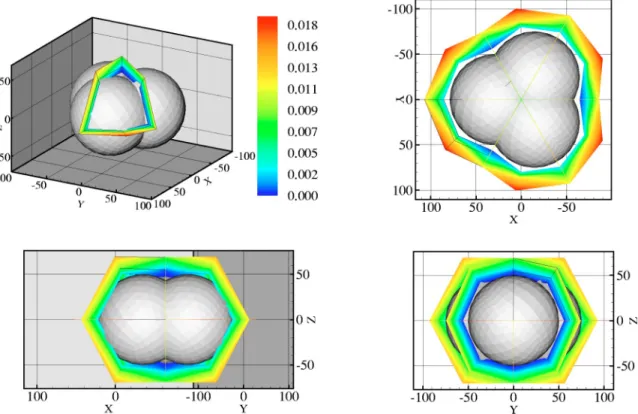
Finally, we analyzed a more complex aggregate, ob-tained from three spheres placed on the vertex of an equilat-eral triangle of sides equal to the spheres radius共50 Å兲. This particle does not show the cylindrical symmetry characteris-tic of the two previous shapes and, for this reason, not just a two-dimensional plane but the whole three-dimensional vol-ume outside the metal must be considered. For the same reason, only the first molecular orientation with respect to the metal surface has an univocal definition and, thus, can be reported and analyzed in a simple way.
An analysis of the metal response shows that the two diagonal components of the polarizability that lie on the metal particle plane 共the one containing the centers of the spheres兲are equal. They have a resonance at the wavelength
M et⫽450 nm close to the one of the two spheres reported in
Figs. 7 and 8. These components of the polarizability should be equal due to the symmetry of the aggregate and the fact that they are indeed equal in our calculations is a further proof of the quality of the implemented numerical treatment. As expected, the radiative decay rate is enhanced for the molecule placed near the three vertices of the triangle while it decreases for the molecule placed on top of the center of the aggregate, where its transition dipole is oriented along the direction perpendicular to the particle plane. As for the cases examined above, the nonradiative decay rate is sub-stantially unaltered by changing the position and the orienta-tion of the molecule with respect to the metal surface but it essentially depends on the metal-molecule distance.
The fluorescence quantum yield obtained only for values of metal molecule distance less than 30 Å and for the orien-tation considered is reported in Fig. 11.
The behavior is similar to the one reported for the two-spheres aggregate and reflects the trend of the radiative de-cay rate: a high fluorescence quenching is obtained for the molecule placed on the intersection of two spheres or on the
center of the aggregate while only a low fluorescence quenching is reported for the molecule placed on the vertices of the triangle.
IV. CONCLUSIONS
In this paper we have presented a methodology to evalu-ate the influence of a metal particle of complex shape on the decay rates of an excited molecule in its close proximity. With respect to other alternative theories, the one outlined in this paper makes it possible to characterize the molecular response at an accurate QM level, paying attention to both the radiative and the nonradiative processes. At the same time, the proposed model has a large flexibility in the defi-nition of the shape of the metal body and thus it allows us to consider a large class of systems and to compare to many different experiments.
The preliminary comparisons with experimental results show that the model is in qualitative agreement with the experiments but there are still sources of inaccuracy. The causes of these discrepancies have been shortly analyzed. Some of the effects neglected in the present work, in particu-lar, the nonlocal behavior of the metal body, can be included in the theory and will be part of future developments.
The decay rates and the quantum yields of coumarine close to nanoparticles have been studied as a function of various geometrical parameters of the system 共the molecule position and orientation, the shape of the nanoparticle兲. We found that when the transition dipole of the molecule is per-pendicular to the particle surface, quantum yields are quite sensitive to the molecule position relative to the particle. We remark that for the systems considered in the present article, only quenching of the fluorescence was observed: for such small nanoparticles, we did not observe ‘‘hot spots’’ able to enhance the molecular fluorescence. Remarkably, a kind of ‘‘cold spot’’ for the radiative decay rate was instead observed for the linear three-sphere aggregate at about 30 Å from the metal surface. The presence of such behavior at the proper molecular emission frequency is related to the complex shape of the aggregate that allows to modulate the surface plasmon resonances.
The work we have presented is a first step to model complex systems. Starting from what has been shown above, it is possible to consider metallic aggregates bigger and more complex than the ones examined. In fact, according to the hierarchical principle exploited in the theoretical section, a large metallic aggregate can be decomposed in the region closest to the molecule共the most important one兲, that can be treated with the model discussed in this paper, and the re-mainder of the aggregate that can be described with a more approximate method 共such as a coarse-grained discrete di-pole approximation, or DDA兲. As it has been done for SERS near fractal aggregates,15using this approach it is possible to exploit the implemented method to calculate enhancement factors for the fluorescence of a molecule in close proximity of a metallic fractal aggregate. Also the effects of metallic fractal surfaces on excited states properties can be analyzed starting from what reported in this paper.
The complex system composed by the metallic tip of a SNOM interacting with a single molecule also be treated by the model presented in this work. For this system it is pos-sible to include in the QM molecular equations only the metal part closest to the molecule and to describe the remain-ing part of the tip usremain-ing, for examples, the DDA model. In this case, due to the macroscopic dimension of the consid-ered device, a whole electrodynamic treatment, instead of exploiting a quasistatic approximation, would be necessary. In addition, in order to reproduce experimental situations, the description of the dielectric surrounding must include the medium on which the molecule is deposited. We reserve such studies for future communications.
APPENDIX: GREEN’S FUNCTION FOR A SPHERICAL PARTICLE
Let us consider a system constituted by a metallic spherical particle of radius a and dielectric constant ⑀met placed on the origin of coordinates and surrounded by a sol-vent of dielectric constant⑀sol. The Green’s function for the space external to the sphere can be written, in terms of Leg-endre’s functions Pn(x), as共Ref. 31兲
GE共rជ,rជ
⬘兲⫽
1 ⑀sol1
兩rជ⫺rជ
⬘
兩⫹n兺
⫽0⬁ 1
⑀soldn⫹1
⫻a
2n⫹1
cn⫹1
冋
n共⑀sol⫺⑀met兲
n⑀sol⫹共n⫹1兲⑀met
册
Pn共cos兲, 共A1兲
where rជ⫽crˆ, rជ
⬘⫽
drˆ⬘
and is the angle between rជ and rជ⬘
. Equation共A1兲reduces to the simpler expressionGE共rជ,rជ
⬘
兲⫽ 1⑀sol
冋
1 兩rជ⫺rជ
⬘
兩⫺a
d
冏
rជ⫺a 2d rˆ
⬘
冏
⫹ a
d兩rជ兩
册
共A2兲when the metal behaves as a perfect conductor 共i.e., for ⑀met→⬁).
The series that appear in the second member of Eq.共A1兲 must be truncated to a finite order N for the numerical cal-culation. For evaluating the best procedure to calculate GEit is necessary to consider one by one all the different possible situations.
共a兲 For dⰇa 共or cⰇa) the contribution to GEdue to the presence of the sphere becomes small and the error due to the truncation of the series becomes small too: each term of the series is, in fact, at least a/d times less than the previous one. Thus, analyzing the quantity (a/d)n it is possible to define a criterion for choosing the number of term N to in-clude in the expression.
共b兲 On the other side, for rជ and rជ
⬘
very close to the metal ((d⫺a)/a⬇0,(c⫺a)/a⬇0) the problem reduces to the one of a planar infinite surface, and the almost exact Green’s function is that of the infinite metal planeGE共r,r
⬘
兲⫽ 1 ⑀sol兩rជ⫺rជ⬘
兩⫺⑀met⫺⑀sol
⑀met⫹⑀sol
1 ⑀sol兩rជ⫺Rជ共rជ
⬘
兲兩,
共A3兲
where Rជ(rជ
⬘
) is the symmetric of rជ⬘
with respect to the me-tallic plane. The difference between the two Green’s func-tions can be evaluated by expressing the second quantity in the right side of Eq. 共A3兲in terms of Legendre’s functions and by subtracting its contribution from the series of Eq.共A1兲. For the cases examined ((d⫺a)/a⬇0) the terms of the series arising from this subtraction are small and the trun-cation error is small too.
共c兲 The intermediate situations have been referred, in the present work, to the closest of the two extreme cases considered above. In such intermediate situations, the num-ber of series terms to be summed can be quite large, and the calculation of GE can become computationally demanding. Note, however, that in realistic applications we are often in the case d⫺a/aⰆ1 共i.e., metallic particles much larger than the molecule and the metal-molecule distance兲. Although it has not been implemented in present work, an alternative expression can be exploited: it is possible to show that32,33
兺
n⫽0⬁ 1
⑀soldn⫹1
a2n⫹1
cn⫹1
冋
n共⑀sol⫺⑀met兲
n⑀sol⫹共n⫹1兲⑀met
册
Pn共cos兲
⫽⑀sol⫺⑀met
⑀sol⫹⑀met
冋
a
d
冏
r⫺a 2d rˆ
⬘
冏
⫺⑀ ⑀sol sol⫹⑀met
冕
0a2/d
冉
a2 dx冊
共⑀met/⑀sol⫹⑀met兲 1
兩rជ⫺xrˆ
⬘
兩dx册
.共A4兲
In Eq. 共A4兲, the series is divided in two different contribu-tions, the first arising from an ‘‘image charge,’’ similar to the
one obtained in the case of a conductor sphere, and the sec-ond one arising from a continuos linear distribution of charge. Thus, the series is transformed in an integral that can be numerically calculated.
1H. Metiu, Prog. Surf. Sci. 17, 153共1984兲.
2M. Moskovits, Rev. Mod. Phys. 57, 783共1985兲; A. Otto, I. Mrozek, H.
Grabhorn, and W. Akeman, J. Phys.: Condens. Matter 4, 1143共1992兲; A. Campion and P. Kambhampati, Chem. Soc. Rev. 27, 241共1998兲; G. C. Schatz and R. P. Van Duyne, in Handbook of Vibrational Spectroscopy, edited by J. Chalmers and P. R. Griffiths共Wiley, New York, 2002兲.
3K. Kneipp, H. Kneipp, I. Itzkan, R. R. Dasari, and M. S. Feld, Chem. Rev.
共Washington, D.C.兲99, 2957共1999兲.
4
E. Dulkeith, A. C. Morteani, T. Niedereichholz et al., Phys. Rev. Lett. 89, 203002共2002兲.
5C. Fan, S. Wang, J. W. Hong, G. C. Bazan, K. W. Plaxco, and A. J.
Heeger, Proc. Natl. Acad. Sci. U.S.A. 100, 6297共2003兲.
6C. D. Geddes, H. Cao, I. Gryczynski, Z. Gryczinsky, J. Fang, and J. R.
Lakowicz, J. Phys. Chem. A 107, 3443共2003兲.
7A. Parfenov, I. Gryczinski, J. Malicka, C. D. Geddes, and J. R. Lakowicz,
J. Phys. Chem. B 107, 8829共2003兲.
8G. T. Shubeita, S. K. Sekatskii, M. Chergu, G. Dietler, and V. S.
Letokhohu, Appl. Phys. Lett. 74, 3453共1999兲.
9
A. Dereux, C. Girard, and J. C. Weeber, J. Chem. Phys. 112, 7775共2000兲.
10J. Michaelis, C. Hettich, J. Mlynek, and V. Sandoghdar, Nature共London兲
405, 325共2000兲.
11J. Gersten and A. Nitzan, J. Chem. Phys. 75, 1139共1981兲. 12
W. Eckardt and Z. Penzar, Phys. Rev. B 34, 8444共1986兲.
13P. T. Leung, Phys. Rev. B 42, 7622共1990兲; P. T. Leung and M. H. Hider,
J. Chem. Phys. 98, 5019共1993兲.
14C. Girard, O. J. F. Martin, and A. Dereux, Phys. Rev. Lett. 75, 17共1995兲. 15S. Corni and J. Tomasi, J. Chem. Phys. 114, 3739共2001兲; S. Corni and J.
Tomasi, Chem. Phys. Lett. 342, 135共2001兲; S. Corni and J. Tomasi, J. Chem. Phys. 116, 1156共2002兲.
16S. Corni and J. Tomasi, J. Chem. Phys. 117, 7266 共2002兲; 118, 6481
共2003兲.
17
S. Miertusˇ, E. Scrocco, and J. Tomasi, Chem. Phys. 55, 117共1981兲; R. Cammi and J. Tomasi, J. Comput. Chem. 16, 1449共1995兲.
18J. Tomasi and M. Persico, Chem. Rev. 共Washington, D.C.兲 94, 2027
共1997兲; C. J. Cramer and D. G. Truhlar, ibid. 99, 2161共1999兲.
19D. E. Beskos, Boundary Element Methods in Mechanics共North-Holland,
Amsterdam, 1997兲.
20R. McWeeny, Methods of Molecular Quantum Mechanics 共Academic,
London, 1992兲.
21E. Cance`s and B. Mennucci, J. Math. Chem. 23, 309共1998兲; E. Cance`s, B.
Mennucci, and J. Tomasi, J. Chem. Phys. 107, 3032共1997兲; B. Mennucci, E. Cance`s, and J. Tomasi, J. Phys. Chem. B 101, 10506共1997兲.
22R. Fuchs and R. G. Barrera, Phys. Rev. B 24, 2940共1981兲; R. Fuchs and
F. Claro, ibid. 35, 3722共1987兲.
23R. E. Stratmann, G. E. Scuseria, and M. J. Frisch, J. Chem. Phys. 109,
8218共1998兲.
24R. R. Chance, A. Prock, and R. Silbey, Adv. Chem. Phys. 37, 1共1978兲. 25R. Cammi, C. Cappelli, S. Corni, and J. Tomasi, J. Phys. Chem. A 104,
9874共2002兲; 106„E…, 6426共2002兲.
26
M. J. Frisch, G. W. Trucks, H. B. Schlegel et al.,GAUSSIAN2003共Gaussian
Inc., Pittsburgh, PA, 2003兲.
27A. D. Beckle, J. Chem. Phys. 98, 5648共1993兲.
28E. D. Palik, Handbook of Optical Costants of Solids共Academic, Orlando,
1985兲, Vol. 1.
29
O. Andreussi, Thesis of Laurea, Pisa University, 2003.
30G. A. Ozin, F. Hugues, and S. M. Mattar, J. Phys. Chem. 89, 300共1985兲. 31C. Bo¨ttcher, Theory of Elettric Polarization共Elsevier, Amsterdam, 1973兲. 32R. Messina, J. Chem. Phys. 117, 11062共2002兲.