Part 1
14
Part 2
Table of Contents
Introduction to HRM 7
Chapter 1: The HRM Framework
Introduction 8 Concept of HRM 8
Main components of the HRM system 10
Chapter 2: Role of HRM in Financial institutions
Introduction 12
Need for Human Resource Department (HRD) and HR Management in Banks 13 Building efficiency in Banks With The Help of HRM Human Resource Management In Practice 14
Chapter 3: Global View of HRM
Introduction 19
What is The Global Village? 19
Workforce Diversity 21 The Implications for HRM 21 Changing Skills Requirements 22 Corporate Downsizing 23
The Rationale Behind Downsizing 24 The HRM Implications 26
•XM-JWOTK
Functions of HRM 25
Chapter 1: Functions of HRM Introduction 28 Selection and Placement 28 Performance Appraisals 28
Compensation and Benefits 29 Training and Development 30 Employee and Labor Relations 31 Safety and Health 31 Human Resource Research 31
m
Human Resource Manaaement and Orcianizational Behavior I Reference Book 2Part 3
Part 4
The HRM Strategy 30
Chapter 1: Planning and Budgeting
Human Resource Planning 33 The Demand for Human Resources
35 Forecasting Techniques 37 Human Resource Requirements 40 Human Resource Audits 42 Implementation of Human Resource Plans 45
Chapter 2: Setting the Budget
Introduction 49
How HR Programs Save Money 50
£cr^^vava;-:R«iaftaB»cc6«««Qora»owc»«c««wc«go«»Mg»»oo«mg^^ j Z
The HRM Process
Chapter 1: Preparation and Selection
Introduction to Collection of Job Analysis Information 54 Collection of Job Analysis Information 55
Application of Job Analysis Information 58 Overview of Job Design 59
Techniques of Job Redesign 60 Recruitment and Selection 61 The Recruitment Process 61 Channels of Recruitment 62
Constraints on and challenges of recruitment 65 The Selection Process, 66
Steps in The Selection Process 70
Chapter 2: Development and Evaluation
131
139
158
164
Part 5
5 Chapter 3: Compensation and Protection
Protection 118 Compensation Management
123 Wage and Salary Surveys
130
Pricing Jobs
Incentives and Gain Sharing
133
Incentive System 135 Gainsharing Approaches
Chapter 4: Employee Relations and Assessment
Employee Relations ChaI lenges 142
Union-Management Relations Introduction 152 Labor Unions and HR Management 154
Why Are Unions Formed?
Chapter 5: Employee Skill Management
Introduction 163 Training 163
The Approach to Learning and Learning Styles Why Training Should Be Carried Out 167
HRM Challenges
Chapter 1: Workplace Diversity
Workplace Diversity 173 Employee Engagement 174 Talent Management 177 Succession planning
181
Chapter 2: Motivational Approaches
What is motivation? 182
Three Different Approaches to Motivation 182 Maslow’s Hierarchy of Needs 183
Implications of Maslovv’s Theory For Organizations 184 Herzberg’s Two Factor Theory 185
McClelland’s Theory 186
The Complex Man View or Process Theories 188 Porter and Lawler’s Expectancy Theory 188 Practical Applications of Motivation 189
6 Business Ethics and Organizational Codes of Conduct
Human Resource Management and Organizational Behavior | Reference Hook 2
197
211
233
Chapter 1: Business Ethics
Introduction — What is Ethics? 192 Business Ethics 194
Levels of Accountabi I ity 195 Fiduciary Responsibility 196
Ethical Standards in a Global Economy 196 Social and Eth ical Objectives of Companies Ethical Stance 198
Absolutism and Relativism 199 Conflicts of interest 201
Chapter 2: Organizational Code of Conduct
Codes of Practice, Conduct and Ethics 207 Safeguards 209
Codes of Practice, Conduct and Ethics Work? Corporate Codes 211
7 Organizational Behavior Concepts
Chapter 1: Organizational Behavior Concepts
Introduction 215 Vision and Mission 216
Developing an OB Model 219 Decision Making 224 Leadership 230
Part 1
e ^r is Part
Introduction to HRM
Chapter 1: The HRM Framework
Introduction Concept of HRM
Main components of the HRM system
Chapter 2: Role of HRM in Financial Institutions
Introduction
Need for Human Resource Department (HRD) and HR Management in Banks
Building efficiency in Banks With The Help of HRM Human Resource Management In Practice
Chapter 3: Global View of HRM
Introduction
What is The Global Village?
Workforce Diversity
The Implications for HRM
Changing Skills Requirements
Corporate Downsizing
The Rationale Behind Downsizing
ToK^AssrasssseemsexnMassaTSSR-.
Human Resource Manaoempnt anH .
Part 1
Introduction
Concept of HRM
The HRM framework
Chapter 1
v&fBsrjwnit£tiM/rBaas&
Learning Outcome By the end of this chapter you should be able to:
* Explain the concept of the HRM framework in an organizational setup
■ List and briefly explain five most important components of the HRM framework
Human Resource Management (HRM) is the organization and control of a firm’s employees. An organization’s success is dependent on the effective management of its human resources. For success, it is prudent that personnel policies and procedures of the firm are in line with and contribute greatly to the achievement of the firm’s corporate goals and strategic plans.
A company’s culture, values, its environment and managerial behavior stemming from its culture affect the firm’s operational excellence greatly. Therefore, an organization’s culture and values must be revised, reinforced, improved and implemented to achieve excellence, with the efforts of every member of the firm from top to bottom. HRM involves integration where every member of the organization works to achieve a common goal.
Human Resource Management and Organizational Behavior I Reference Book 2
Briefly, the concept of HRM has three connotations:
1. Manpower of an organization is highly valuable for a corporation’s proper functioning thus making it important to devote time and effort in their development.
2. Human resources cannot be treated like material resources as they have special characteristics. The strategy is to make an organization more humanistic by establishing human values in it.
3. Human resource also highlights the social realities, units and processes in an organization of an employee apart from him being an individual. This incorporates the roles of an employee in the organization, the dyadic unit-includes the person and his superior, many teams in which people work, inter-team processes and the entity of the entire organization.
Apart from being the most innovative and excelling approach of managing ihc people in workplace, and apart from being the best qualitative approach for the improvement of human beings, HRM is a broader and a comprehensive version of behavioral sciences and personnel management. It is a persistent cycle that enables the employees to enhance their potential and skills in performing their present as well as future roles in the organization, thus more efficiently fulfilling the objectives of the organization and the needs of the employees. HRM Model, beinga personnel managementproduction model approach, is an employee oriented approach where motivation, development and
■ increased involvement ofemployees leads to high levels of commitment _ ,jr ' towards the company’s strategic goals. Being an asset to be valued and
to be used to its fullest capacity, it concentrates on both the structure of I i-'cc , it the work and the employee practices required for performing that work.
—v . rustic HRM is not solely about the Human resources, but the management of
people and their work, thus committing to managing people in both collective and individual basis. Traditional personnel management is non-strategic, short-term, reactive, separate from business and constricted by its limited dealings with mostly unionized or low level employees. HRM being more preventive focuses on the development of -*■— people and their expertise w^hile traditional personnel function being
curative only focuses on personnel management.
HRM, with its differentiating role of strategic management, attempts to ^ fulfill and carry out the functions traditional personnel management
MaijLComponents of The HRM System Li.
i&KsC'.Y
human resource information are integrated into one major super set of HRM. Under HRM, the following major assumptions are taken into account, which are different from traditional approach of personnel management:
1. An organization's members are considered the occans of untapped ^resources. 2. These resources have immeasurable development capacity.
3. It is more fruitful to groom oneself from the inside (self development) than from the outside.
4. The organization side by side goes through development with overall benefits and with development of the members.
1. The culture the corporation develops majorly focuses on synchronized superior-subordinate relations, cooperation, and collaboration among different groups of individuals, open communication, and most importantly, incorporation of the goals of the organization with the needs of the employees.
2. Top management takes the initiating step for HRM, devises crucial procedures and tactics and finally creates an environment required for the implementation of those plans.
An efficient HRM is a combination of flourishing partnership among line managers, senior?nanagem^frt-arrd HR function and suitable HR policies, procedures and recruitment strategies. The following precisely highlights why these components are important:
One of the most crucial and prudent components is line managers as they are practically involved
in all the HRM processes and lead a few as well.
Senior management consists of Executive Directors and members of the Management Team. They provide
both organizational leadership and management and act as role models for line managers and employees.
Their job involves making key HRM decisions which includes appointment and promotions related
decisions that majorly affect others in the organization.
HR Function includes regional HR advisers, their units and the HR staff. This needs to have HR
Professionals with the frame of mind, skills, structure and systems that collaborate and go in line with HR policies and strategies and they should be more of client-oriented in order to effectively provide HR
services.
HR’s regulations, policies and tools should be rational, simple and consistent with the organization’s
Human Resource Management and Organizational Behavior I Reference Book 2
Staffing/recruitment strategy provides a structure that ensures that the right staff is available at the right
place in the right quantity and follows the organization’s strategic priorities. It ensures that the workforce
2SSSS>:«iCOT7
Human Resource Management and Organizational Behavior | Reference Book 2
Part 1
Chapter 2
Role of HRM in financial
institutions
Learning Outcome By the end of this chapter you should be able to:
■ Describe the role of HRM in a financial institution setup
■ Explain how the role of HRM in a financial institution differs from its role in other organizations
<mw»acacggss8BBSiMSW^A»j/<afti^^(Wffii!i^flaamc«ffloaiW
Introduction As Human Resources represent the wealth of a country, they are the most important natural resource for the economy and play a vital role in the banking system. For a bank to be successful, efficient Human Resource Management is essential. Human Resource Management is the employment of human resources with proper strategic selection, training and development.
Due to the major overall transformations in the world economy and in the financial structure of economies, since rgyos, a large change has been seen in the w'avs banks contend, shape their corporations and administer their human resources. Banks, based on the new situation now' are revising its role. The financial sector in various countries is now analyzing with deregulation and liberalization, a collection of external and internal forces causing the competition of the sector to build up, thus causing rivalry in the sector. The essential reformation in the division of labor and the latest stress on the decentralization of functions and administrative responsibilities are some of the demands created by the pressures of external forces of change and the means with which financial functions are presented to customers. Therefore, it is generally observed that banks all around the world invest more in HRM problems and school the employees to commence a wide range of errands, especially the employees more inclined towards service delivery aiming to provide their clients a high quality service to satisfy their needs.
Human Resource Management and Organizational Behavior I Reference Book 2
Need for ->uman Resource Apartment (HRD) z - R Management in Banks
.J/Q V
rr
v
H
: i of HRM in Financial Institutions
through some changes in their rankings country wise and globally- taking into consideration both the performance and turnover. On the other hand, in certain situations the major players of a market remain the same but their position in the significant markets have drastically changed.
HRM is an approach that manages, develops, trains and motivates an organization's human resource. It creates a proper corporate culture, ensures the company’s success and brings out programs reflecting the organization’s core principles. HRM is proactive and believes in immediate actions in handling employee relation problems and other tasks that come under HRM (recruitment, training). Manpower planning, performance appraisal, selection, salary administration, management development and other personnel management related functions are included in the implementation techniques of HRM and will be executed through special programs designed to improve communication system, commitment and productivity.
For the growth and competitive performance of a firm, it is necessary that its HR department functions efficiently, especially in case of banks.
Following are the reasons why the need of an effective HRD is of vital importance for banks:
Due to the increasing new entries of private sector banks in the financial market and the emerging global developments, the banking pattern has gone through various qualitative changes thus making it prudent for banks to recruit, train and organize people at all the stages of an organization for a more effective performance and success. This function is what HRD is all about and is derived from HRM.
Recently, the political scenario and situation has drastically changed, causing the banking industry to anticipate heavy changes in the near future. After all the mergers and amalgamations, only a few banks will be left behind in the banking sector. This change will not only be seen in the Pakistani market but also in the world market having a global affect.
Building Efficiency in Banks With The Help of HRM
Human Resource Management In Practice
.'O' \c
A protracting and ongoing upsurge of skills, knowledge, education and attitudes among people working in the banks, especially the frontline staff and employees of the branches of the bank, are some of the most essential factors for triumphant banking.
■ Building efficiency in banks through HRM is achievable by bringing in professionalism in an organization which is an internal part of HRM. In order to achieve personal growth and contribute to the overall organization’s growth, it is. vital to motivate and encourage staff to adopt professional practices thus encouraging the prevalence of professionalism.
■ A preeminent selection process implemented by the HR department is the key to building efficiency in banking. To successfully manage an already available HR, it is vital that skills are developed within an organization.
■ The fundamental role of HR is the effective management of the numerous disciplines like technology, law, operations, foreign exchange, administration, etc., in which the immense human resources available to the bank specialize, for its continuing success.
The following processes are followed by the HRM in banks for further development:
■ Focus pn job description and job assignment
■ Response to prospective risks and perils.
A Case Study of State Bank of Pakistan
By: Dr. Ishrat Husain
Chief Guest address at the National Conference on Human Resources held at
Karachi on October iS, 2003
‘Without being self serving, I would like to share the lessons we have learnt
during the last four years in bringing about changes in the HR policies and
practices at the State Bank of Pakistan (SBP). I hope that these will provide
food for thought for all of you.
First, Human Resource Management should be derived from the vision, mission
statement and Strategy andflowfrom the business plan of the organization. In
absence of such integration and flow there is bound to be a tension between the
achievement of business objectives and optimal utilization of human resources.
In the SBP, the vision. mission statement, values and business plan were
,vJ Li L V. C-A yr '.W .A A* A
f/ie assumption of the ownership of the change program by the rank and file, thus improving the chances of successful implementation of the new Human
Resource policies and programs.
Second, the management responsibilities for Human Resource management in
SBP have been given to a group of highly motivated and qualified HR
professionals. The practice of manning these departments with rejects from the
core departments have done a great deal of disservice to the nurturing of human
resources. We have, therefore, brought in experts from outside to assist us,
train the younger officers in the tools and techniques of HR management and also strengthened the department by attracting the talent from the core
departments. The respectability and acceptance of this department by the staff
will reinforce credibility in the system.
Third, the attraction, retention and motivation of high caliber persons are key to
success. SBP recruits 50 young men and women from all over Pakistan out of
11,0 applicants through a highly competitive process. Middle
level managers and professionals such as Chartered Accountants have also been
inducted in the organization. New skills for which there is emerging demand are
appointed on fixed-term contracts and external advisers and consultants are hired for
short durations to set up systems and train the staff. The retention and motivation of
the staff is a difficult challenge as the market offers higher remuneration to those who
have acquired experience at the SBP.
Fourth, a process of continuous trainine and skill up-eradation has been put in place whereby all
officers receive post-induction, foundation, intermediate, advanced training in
central banking, management and soft skills. About 300 officers out of 800 have
so far been sent abroad for overseas training, attachment, study tours,
seminars, etc. On their return, each participant is expected to share and disseminate his learning
with the larger group to which he/she belongs. Liberal policies for study leave, deputation, advanced
degree courses encourage the staff to acquire knowledge and keep themselves abreast of
developments in their professional fields.
Fifth, the Performance Management System (PMS) has been completely revamped incorporating a
competencies based model in which achievements, behavior, professional growth and assessment of
potential are the essential ingredients for measuring uejformance and career progression
path. The \p appraisal is carried out by two supervisors on the basis of an objective scoring
A \ y)
^ model and the findings aredfsafssed with the staff member. The PMS is utilized
5
^ for the individual’s development plan in which the training needs are identified and planned.
/ r
Sixth, the compensation policies have been revised to reflect the comparator norms and
organization, we cannot pay as much as the private sector does, the relative security and prestige
of thinking at the Central Bank do, to some extent, make up the shortfall. A reward and recognition
system has also been put in place which ranges from a simple thank you note to a monetary reward
for innovative ideas, product development and process re-engineering.
Seventh, a pro-active succession-planning program has been introduced under which managerial
jobs are internally posted and applicants are screened, interviewed and short-listed. Those who make the final list are sent for on-the- job training, rotational assignment and managerial training. The successful candidates from this process are then given management positions. This plan is
essential for preparing the managers of the future.
Eighth, the SBP has a severance package for early retirement that allows the individuals to exit the
organization with full monetary benefits. This package enables us to recharge the organization
with new skills that are needed and to let go those whose skills are no longer in demand. This
continuous rebalancing of skills will keep the organization in good shape in responding to new
challenges.
Ninth, an HR audit was carried out by an externaljconsulting firm under which job descriptions were prepared for each job describing the content and competencies required. This was followed by
the preparation of an inventory of skills present in the SBP. Jobs and skills were matched and
mismatches identified. .4 rotation policy has attempted to reduce these mismatches but a more
aggressive policy can result in disruption of the Bank’s business and operational activities.
Tenth, each organization has to develop and practice its own value system. The SBP staff has adopted integrity, trust, teamwork, openness, courage, commitment to excellence and problem
solving approach as its rallies and each staff member is committed to practice these values in every
day work. But for these values to sink in, the top leadership has to demonstrate the role model
behavior which can than be followed down the line. If there is a disconnect between the values and
behavior of the Head of the organization. the results are an abandonment of the value system by the staff and reversal of the change process.
Eleventh, it is incumbent upon the head of the organization to keep in touch with the staff on the
shop floor and communicate with them at regular intervals. I meet with the staff of every
department each quarter, listen to their problems, issues, grievances, suggestions and respond to
their questions, concerns and reservations. I try to explain to them the rationale and logic behind
the decisions taken or policies adopted. At the same time, any staff member can send me an email
or come and see me. The easy accessibility of the top leader to the ordinary staff member, even if it
is not used, reinforces confidence and trust in the organization. Internal stakeholder surveys are
conducted every year to ascertain the views of the staff members in a more systematic manner. Twelfth, we have delegated powers to various tiers of the organization and institutionalized
decision-making process. A Corporate Management Team (CMT), with the Governor as its
Chairman, meets every Monday morning, considers and makes decisions on policy matters and the
minutes of the Meeting are posted on the internal electronic notice board for the information of all
staff. Similarly, Group Management Teams and Departmental Management Teams act as the
collective decision making vehicles at the lower tiers. Individual discretion has, therefore, been
curtailed and consensus building given more scope.
by the organization does provide a strong feedback to the managers and enables them to take
corrective actions. The CMT meets at six-monthly intervals to monitor the progress in the
implementation of business plans while the CMT and Heads of Departments meet once a month. A
Change Management Conference is held every year at which the managers take stock of the
progress and set the goals for the next year.
Fourteenth, the use of information technology across the spectrum has improved the efficiency of
our operations. There was no PC with any of our staff members in /999- Today, we have at least Soo workstations with desktops. E-mailing and access to internet, use of website and electronic
data have become the ordinary tools of business. When data warehousing is completed, the banks
will no longer have to send thousands of pages of reports and returns to the SBP. Data acquisition
will be done electronically and the required variables will be downgradedf rom the data marts to
generate the reports. The real time on-line surveillance of banks will improve the enforcement
capability of SBP and detect weaknesses and variances promptly.
Finally, we had to remodel our offices to upgrade the physical environment in which the staff
spends most of their day. Almost all the floors of the SBP will be remodeled by end of December this
year. The staff who has occupied the new floors report that their morale has gone up and they
eagerly look forward to coming to work.
The above cataloging of changes that have been introduced in the last few years, by no means,
suggests that we have reached the state of perfection. We have a long way to go in changing the
organizational culture that is strongly entrenched in history and traditions but the human beings
are quite rational in thinking and approach. /15 long as they are convinced that the change is in their larger interest the resistance breaks down and a slow and gradual movement begins. This
Case Study of SBP shows that, contrary to the popular belief that
m
the public sector organizations are hard to turn around, it is possible to bring about transformation
- structural and behavioral - provided there is a broad- ftased ownership.
We would like the human resource practitioners to look at the SBP and make suggestions as to how
19
Global view of HRM
By the end of this chapter you should be able to:
• Explain the global view of HRM
■ Explain the impact of changing global human resource practices on
day to day HRM activities
All over the world, organizations arc going through immense operational changes. The most common changes experienced are deregulation, internationalization and the prevailing use of information technology. Business conformation and-other aspects ranging from the production of services to customer support, sales and product development experience sweeping implications of the changes mentioned above. Such functions stress on the continuous restructuring in the division of labor together with the focus on decentralization of functions and decision making power. However, the capability of a corporation's human resources in dealing with and promoting internal change is the key to a firm’s capacity in effecting changes and striving in such a wavering environment.
What is The Due fo increasing multinational and transnational corporations, new7 Global
Village? requirements of Human Resource Managers have come under the limelight, thus explaining the term “Global Village" as a reflection of the global situation of businesses. An example can be the requirement for HR Managers to ensure that the employees responsible for global assignments must possess suitable abilities for the efficient handling of the task.
The employees thus need to be trained by HR to face the various perils of the global village. Primarily, the language barrier should be removed by providing language training to the employees, making them learn the language of the place they will work in. There have been many problems faced due to language differences, major one being misinterpretation of message thus creating embarrassing situations and loss of important business deals.
Communication programs for employees stems from the language requirements of the employees. For effective communication, it is
'V'
/ /
prudent that the message is understood completely thus ensuing the necessity of learning the required languages. When employing a person apt in communication, it must be made sure that he\she can speak and understand the required foreign languages for effective „ N global communication. Moreover, if a foreigner possessing the required •yf r\^Vw skills for a job is employed, HR must make sure that they are assisted
in learning the local language. For more effective communication, ^ messages sent to employees must be in more than one language and in
the languages spoken and understood by the employees ensuring the 5 message seeps through.
^ -
Every country has a different culture, values, laws, customs and moral U'
standards. For employees of a company going overseas, it is crucial that ^ they understand and know the culture of the host-country. This is highly
X* essential as the employees would need to be aware of their cultural issues,
?> ^. 1 taboos, their rules, regulations and how their society functions in order y \» to comfortably work in that environment. This training would help
NJ J y increase the adaptability of employees. It is also prudent that human
V. -ri
. r\ n/.- resource managers must understand how the host country would react to these mobile emplovees.
2 O' jJS.
v'- . .\P Therefore, successful global businesses are highly dependent on cultural [f considerations. However, we do not expect to provide the complete range <-!
\j of cultural issues addressed enabling an employee to go to any country, ^ but we do admit that there are certain likenesses. Through research, ^ 'Aa\ we were able to make sets of countries according to the variables like
O' /V/
^ status differentiation, societal uncertainty, and assertiveness. They help in understanding the way a country deals with its people and how do the people see themselves. For instance an individualistic society shows that people are concerned only with their family, while in a collective society, people take care of everyone around them. Managers going abroad must possess the qualities of flexibility and adaptability, thus making it essential for those in human resources to understand the working environments and global social system for the counseling of administration and problems over the national frontier.
For multicultural individuals to effectively work in collaboration, HRM ■ H iK> ' "^should develop certain mechanisms. As the custom and age differences Ci"
f\ widen within the employees of an organization, conflict arising becomes ^ ' ^inevitable. To eradicate this problem, FIRM must accustom different . * L groups with each other and discover methods to form teams.
. h The final point related to globalization stems from the following idea. \J> K y
20
.. ."o' is the understanding of cultural environments. However, to achieve the x
desired results, training employees in understanding these environments
workforce Diversity
-■
.Si* J
plications Due to an increase in the organization’s female workforce, and them for HRM becoming the dominant part of the workforce, HRM had to change its practices and struggle harder to maintain and appeal a diversified workforce. This can be achieved through the corporation’s benefit bundle that incorporates the HRM offerings of a family-friendly organization. This is a type of an organization that provides flexible working conditions and other employee benefits to workforce like
is not enough. Companies like Engro Corporation, Pfizer, and Hewlett- Packard to eradicate this problem are hiring nationals of the countries in which they operate. The one benefit this has is the readymade supply V-- of employees already well accustomed to their home countries culture and
language. Another benefit is the spillover effect through training as individuals from different backgrounds work together, learning JN differences between themselves and their cultures. In compliance to this strategy, managers need to be taught flexibility as they will have to deal with workers from different nationalities, race, colors and cultures etc; this will help them to keep a flexible attitude and ways of dealing writh staff Thus training managers to recognize differences in workers and celebrate, acknowledge those differences according to the workers’ many requirements based on different cultural backgrounds, customs, and work schedules. A positive outcome can be achieved through compulsive training for identifying these differences and changing the way managers think about people unlike themselves.
Forty years back, human resource management was a simple task considering the available homogenous workforce available at that time. Human resource management was then a simple task of getting the employees in the door, signing them up, informing them about the uniform benefit program and organizing the corporation’s annual function. At the time of retirement, HRM was responsible to present the retiring employee a gold watch at its gala event. However, with time, the type of workforce changed.
..r1
The rigorous government policies related to employment discrimination
r
Human Resource Management and Organizational Behavior I Reference Book 2
Changing Skills Requirements
childcare. For these groups to be productive and remain committed to an organization, family-friendly benefits are necessary, even in organizations that use part time workers.
Age differences in the workforce apart from nationality and gender also donate diversity and ought to be recognized by HRM. Our workforce can be divided into four groups:
1. Mature workers: They are committed to work ethics and are security-oriented. They are conventionally considered the basis of the workforce. However, young generation considers them to be inflexible and have obsolete expertise.
2. Baby Boomers: This is the largest group of the workforce. The organizational growth during the commencing years of baby boomers’ employment was unparalleled reflecting the rapid advancement in their careers, thus making them career-climbers. Despite this, they are considered workhorses and are said to have naive views.
3. Generation X: This generation came into being after the Western post Second World War baby boom ended. With them came some new perceptions into the workforce. They were less committed, less rule-bound, more into self fulfillment and personal gratification and prejudiced towards baby boomers and their attitudes.
4. Generation Y: This is the current generation. They arc said to be the children of baby boomers. The individualities ofthis generation differ according to the region, liable to the social and economic conditions. On the other hand they are more accustomed to communications, media and digital technologies. Additionally, the increase in a neoliberal methodology towards economics and politics has largely affected the upbringing of this generation.
Thus, HRM, being a successful associate in blending in these groups together, reflects that HR would need to train these groups on how to efficiently cope up with each other and how to celebrate and accept diverse ideas and opinions of each other.
On the other hand, when in such situations work attitude conflict occurs, due to the diverse views, participative approach to FIRM is the most effective as it helps
keep the problem to the minimum.
the community. With time, technology entered the world. During the industrial revolution, commencement of machine power, assembly lines and mass production led the people to move into cites and work in factories. For a few generations, the economies flourished with high quality production by workers. Now, machines have replaced humans up to a great extent being more cost effective and the economy is more prevalent towards the use of services rather than manufacturing.
According to the jobs of the twenty-first century, the workforce available lacks the required skills. In some cases, the new entrants are not
adequately prepared. The high-school alumnae applying for the high- tech jobs at present are at some times deficient in the required reading, .Writing and mathematic skills for the jobs. Additionally, other members
i ■»
of the workforce are computer illiterate. Visualize a future aerospace ^ engineer who is unable to decipher a blue print and elucidate how the wind icing affect lifts an airplane. This could have severe consequences and connotations for many of the industries and public services future operational safety and efficiency. A massive loss experienced by an organization due to poor work quality, lower productivity and rising employee accidents which further stems into customer complaints and finally loss of customer is called Skill deficiency. This is a massive problem that needs to be addressed as it can lead to a loss of billions of dollars and would need more than one entity to other than the organization itself. The remedy for the eradication of functional illiteracy is the collaborative use of the companies’ and the gove rn men t ageneies^-resou rces.
---
An instance explaining this situation is the course offered by ABC Life for the inner city residents for enhancing their clerical and mathematic skills, just to ensure a productive workforce. ABC Life states that this implementation of the course has led to significant improvement in the productivity of its employees. However, considering that a substantial portion of training budget is allocated for training the functionally illiterate, this program is quite expensive.
Corporate Downsizing is the reorganization, economization and de-layering Downsizing activity where corporations decide or are imposed on to undertake in order to remove certain superfluous jobs. Organizations have been strained to prune the inefficient parts of their ranks due to deregulation in majority of industries, foreign competition and increasing mergers and takeovers. Alas, development patterns exemplified Pakistani industries prior to the 2007 changes. Hiring of people was disorganized, jobs were frequently ill-defined and swarming middle-management
The Rationale Behind Downsizing
positions were produced. The cost of these measures was transferred to the consumers in the form of hidden cost additions who took them for granted. However, the changed corporate industry milieu can now be seen due to wavering world economies, increasing inflation at home and reducing profit levels. This compelled the organizations like NAFA, PTCL and Indus Motors to reduce the number of jobs and reassign 'employees for efficient functioning
of their firm.
An organization performs de-layering in order to achieve higher levels of efficiency. Efficiency exemplifies the foundation of downsizing as it means getting maximum output from minimum input. Main purpose of downsizing is reducing the number of employees taken in the organization. However, recently downsizing is majorly being practiced on the managerial positions despite the fact that workers producing the goods and services are not impervious to layoffs as well. Organizations began this practice after taking into consideration the additional value to productivity contributed by management and how contracted management affects the organization’s level of productivity, thus reflecting the organizations’ use of a greater span of control.
Span of control is the amount of employees a manager can efficiently handle. A simple related assumption could be that an efficient manager is apt at handling a greater number of employees. Figures 3-1 and 3-2 highlight two types of span of control-prior economization and post downsizing. Figure 3-1 shows a span of control of four employees showing that four employees come under each manager’s control, thus making it six layers of management, total 1,365 managers and 4096 employces-people producing goods and services. However, this indicates an inefficient span of control as can be seen through the managers to employees’ ratio, thus signifying the company’s decision to double the span to eight.
Figure 3-1: Span of Control before Downsizing V,CC Pres,it*enl2S6 Middle Management
The result of downsizing has been shown in Figure 3-2. After downsizing, the organization has four layers of management, with 585 managers controlling 4,096 employees. This helped the company cut down two layers of management and reduce 780 positions. Moreover, considering an average pay scale of PKR 600,000, the company successfully saved more than PKR 468 million in direct pay. This massive reduction in cost is an immense achievement and relief for a company facing financial ill-health.
Figure 3-2: Span of Control after Downsizing
t, President ^ Vice President 64 Middle Management S12 First-line Supervisors 4096 Employees
Although downsizing helps the organization in cost saving, it brings out certain issues with it as well. Downsizing has caused the job of the managers to double as now the managers who prior th is change handled four employees now have eight employees under their responsibility. Moreover, downsizing does not only affect the managers but also influence the employees. Consequently, it is plausible that majority employees nowadays are expected to generate an output equal to the output produced by three employees in the past. So, restructuring of the organization (downsizing) without proper revamping of jobs and training of employees is more of an expense increaser than a cost saver, resulting in failure to achieve the goal of cost saving. Moreover, this change is implemented by Lhe companies without considering the interests of the people working.
Human Resource Management and Organizational Behavior I Reference Book 2
The HRM Implications
So how can Human Resource Management make downsizing successful? Human resources should provide their input into the downsizing process if they are related to the organization's premeditated direction. Appropriate communications should be ensured during this period. They should ensure the minimization of negative effects caused by rumors and the availability of all the related factual information to the people. Moreover, HRM must also handle the actual layoffs and should conduct and commence programs for helping the employees been laid off. For instance, when employees are delivered the news of their lay off, they usually face the aroma of uncertainty and are struck with the concern of coping with this change. In such a situation, anticipating the answers of the following questions might help the organization in achieving and implementing such assisting programs successfully:
■ Will they be paid any compensation and in what form?
■ How will the health insurance plan be handled?
■ Will they be given any retirement benefits and in what form?
In short, neither can an organization ignore human resource management when conducting the downsizing discussion nor can it abandon its obligation towards employees. However, when human resource managers are themselves influenced by the cutback, this becomes difficult to happen. Despite being susceptible to this action, HR managers should remain poised during the whole process.
Functions of HRM
Chapter 1: Functions of HRM
Introduction Selection and Placement Performance Appraisals
Compensation and Benefits Training and Development Employee
Part 2
&/ssEJiaasariBEsusi£!/f3Bf&8mx(SBSittiat£SSuz.
Selection and Placement
Performance Appraisals
28
/ •'J
Functions of HRM
Chapter 1
mass^/aaexesfn.'jtcaiitnf&afa'.
Learning Outcome By the end of this chapter you should be able to:
■ List and explain the functions of HRM
V8BiUB&jnsstsisrw&2asvaitfX!&taz/*tz£$tma&ismomu0&mif&&#WiSftu2zm!2anuiSf//t£atttei£ti?2ti&£BE
Introduction An HR department is responsible for the provision and maintenance of a suitable workforce for the organization. Selection and placement, training and development, compensation and benefits, employee and labor relations, performance appraisals, safety and health, and human resource research come under the functions of HR department. Given below is a brief synopsis of the following functions:
The HR department is responsible for enticing the qualified candidates for a job with the required skills through job postings and different types of advertising as well as screening the resumes of those candidates and short listing the candidates most suitably qualified for the interview. l ine managers usually take the final employment decision of the candidates. Planning of the new and changing positions and evaluating the current job analysis and job description to make sure that they precisely reflect the current position are some other continuing recruitment responsibilities.
For staff selection process, job specifications and job descriptions are the most useful tools. The need to employ a new worker is identified by someone (like the department manager) or by some event (like resignation of an employee) within an organization. Large corporations carry out this process by submitting an employee requisition to the HR department mentioning the job title, the department and the date the employee is required. This requisition can then be helpful in creating the job description which can be referred for the specific job-related qualifications for advertising the details of the position both internally and externally.
Another role of HRM after the employment ofthe suitable candidates is to create a motivating and acknowledging environment, where employees’ exemplary performance is rewarded. The employee performance is
evaluated firstly by a formal periodic review, usually annually, which ' jailed performance appraisal. Customarily, line managers conduct :nese assessments as they are in continuous contact with the employees 'in daily basis and thus are best evaluators. Subordinates, peers, group, ind self or a combination of one or more of these are some of the other employee performance evaluators. Depending on the job being assessed, irious appraisal methods can be used.
Following are a few appraisal systems used by corporations: 1. Group ranking of all recruits
2. Above average, average and below average performance assessed using rating scales
3. Critical incidents-recording of favorable and unfavorable performance 4. MBO-Managing By Objectives
Various roles are played by performance appraisals:
1. Conducting human resource actions like hiring, firing and promoting 2. Presenti ng bonuses, promotions and other such rewards to employees
3. Providing feedback and criticism and highlighting areas for improvement 4. In order to enhance an individual’s job performance, classifying the
.individual’s training and development needs
5. To assist human resource planning, providing job-related information
Compensation (hourly wage and annual salary payment) and benefits •eaefits insurance, pensions, vacation, modified workweek, sick leaves, stock options, etc.) can have a major influence on a personnel’s performance. When an employee is satisfied with his/her pay scale, believes that he/ she gets enough benefits and are to some extent intrinsically satisfied good work environment, interesting work, etc.), it is considered an ideal situation. Compensation must be authorized and ethical, passable, encouraging, just and impartial, cost-effective, and able to offer employment security.
30
Training and Development
compensation and benefits and it helps individuals discover the various methods of improving their current positions as well as prepare for future prospects and opportun ities. Training and development programs are now highly required as the organizations go on to changing their corporations’ structure through downsizing. One of the elements of the HRM function of training and development is the facilitation of developing new skills or enhancing the existing skills.
The difference between training and development can be explained in the following way: major focus of training is learning the skills, knowledge and attitudes needed for the initial performance of a job or improving one’s performance in the current position. On the other hand, development focuses on broadening the employees’ horizons and is not job related. Training and development also includes education acquired to learn new skills, knowledge and attitudes to be used in future works.
As current jobs are the major highlight here, we will discuss only training and development. Training can be utilized in the following
ways:
1. Orienting and informing recruits
2. Developing desired expertise
3. Safety training for preventing accidents
4. Providing technical and professional education
5. Supplying managerial training and executive education
All the methods mentioned above not only benefit the employees but also benefit the organization. Lessening the learning time for new recruits, educating employees about the proper usage of updated technology and how to use it, trimming down the costs of accidents as employees are well aware of how to use the machines properly, providing improved customer service, improving quality and quantity of output produced and making management participation prudent in the training process are some of the benefits of training. Managers’ participation in training reflects their serious attitude towards training goals and their commitment to human resource development.
ious for ams heir ts of in of
lined skills, a job other is and catio n sed in
s only lowin g
Employee and -abor Relations
_
r ;.rr? done for ' updated accidents [property, i quantity i pruden: Managen Is training e financial will go elopment's help then: >me of the
types of development opportunities are mentoring, career counseling, management and supervisory development, and job training.
Workers within an organization may create groups called union.' v communicate and resolve employee related problems in the same way as HR developers ensure proper employee training. People join unions for two reasons; to increase salaries and/or to exterminate unjust working conditions. Improved medical plans, augmented wages and extended vacation time are a few ending products of union involvement. HR managers handle the contracts, collective bargaining issues, along with the responsibility to deal with the unions. This contract covers aspects like compensation and benefits, working conditions, job securit;.. disciplinary procedures, individuals’ rights, management’s rights, and contract length. Collective bargaining is a peaceful resolution of employee related issues before the employees retaliate or besiege and or the management administer a shut out.
-salth An organization is responsible for providing a safe and healthy working
environment along with the protection of the employees’ rights. Safety here means safeguarding the employees from the injuries caused in work related accidents while health means keeping employees away from physical and emotional sickness.
Effects of smoking, alcohol and drug/ substance abuse, AIDS, stress. and burnout are some of the problems experienced at the workplace. .According to employee assistance programs (EAPs), emotionally distressed employees are given as much attention as physically disabled employees.
Part 3
In This Part
The HRM Strategy
«ga»Ofteo«BMO-xvowgm/xwiBrocgBO»»CTras^.r.wqcTO.y>»Aa«o<OTg?oc<w«CTjravinMreg^^
Chapter 1: Planning and Budgeting
Human Resource Planning The Demand for
Human Resources Forecasting Techniques
Human Resource Requirements Human
Resource Audits Implementation of Human
Resource Plans
Chapter 2: Setting the Budget
Introduction
Outcome
Resource Planning
Planning and Budgeting
By the end of this chapter you should be able to:
■ Explain the concept of demand as applied in HR
■ Measure the HR demand in a particular organization
■ Evaluate different HR sourcing alternatives in a given situation
Human resource planning (HRP) involves the methodical anticipation of the organization’s definite future demand and supply of employees. The HR department’s plans of recruitment, selection, training, career planning, and other activities are highly dependent on the estimation of the number and type of employees required by the organization. The human resource planning permits the organization to employ the most appropriate people required at the right time. An efficient HRP system not only helps the organization to achieve their affirmative targets but also assists the HR department’s capability to proactively respond to the various challenges it faces.
However, the organization’s plans may turn out to be a failure if the people hired are not the right type and in the right number. Some other foundation plans for an organization's appropriate strategy planning are the production, marketing and financial plans. Thus, majority of the managers agree that well-envisaged HRPs are the foundation stone as competent people can make the accomplishment of any area's goals easier with efficient plans. For instance, high technology firms like IBM and Motorola when decide to develop a new product or enter a new market highly consider the availability of qualified technical and support people. The prospective markets can be lost to organizations with more competitive and appropriate workforce if ample engineering talent is not available.
divisions. The responsibility of developing functional plans into divisional plans is upon the line managers. On the other hand, HR is responsible to oversee these divisional plans before they are sent to the final corporate division. Despite the line managers’ broad latitude of tackling with the human resource problems, the proactive experts who work closely and directly with the divisional managers press the necessity of human resource involvement in business plans. This is because the business plan before being finalized is reviewed for HR purposes.
Preferably, human resource planning should be used by organizations to discover their short-run and long-run employee needs. Short range plans highlight the vacancies that should be filled within the upcoming year. While long-range plans estimate the future human resource conditions in the next two, five or traditionally ten years.
Human resource planning is prevalent in large organizations as it helps them to:
1. Utilize the available human resources efficiently
2. Effectively match personnel activities with the organization’s anticipated goals
3. Achieve large scale production benefits in the employment of new workers
4. Enlarge the base of personnel management programs for helping other organizational entities and some other personnel activities
5. Successfully make key demands on local labor markets
Synchronize variable personnel management programs like employment needs and affirmative action plans.
This same range of benefits can be enjoyed by small corporations as well. However the effectiveness of these benefits is relatively less as the situation is less intricate. Considering different situations experienced by a small and large-city government, it can be concluded that the gains of human resource planning experienced by small firms do not substantiate time and costs.
In Karachi, one of the fast food chains recruits 20 workers and is expanding at a rate of 10 percent annually, meaning the addition of two new employees every year. On the other hand, the contending franchise employs around 8000 employees and is growing at a rate of 5 percent, meaning 400 new employees in addition to the surrogates of leaving workers. Considering that hiring one usual employee costs around 5000 rupees, the local restaurant for hiring 2 new employees will spend
*-T«£-:d for Sescurces
spend around 2,000,000 rupees. Therefore, detailed planning efforts for 2.500 rupees cannot he rationalized by the local food chain manager if the employment planning saves 25 percent. On the other hand, the organization can still afford an expert for 500,000 rupees and after removing the planning expenses can still save a large amount of money.
/
Yet for HR specialists, human resource planning is still crucial in both the small and large organizations. HRP shows small employers the importance of human resource consideration in case they expand rapidly. For large organizations, HRP is beneficial as it helps organizations like IBM, which struggles to avoid layoffs, to identify the different ways of making personnel function more efficient. This chapter focuses on two aspects of human resource planning; starting from the ways organizations find and identify future job opportunities and concluding with the way FIR experts recognize the prospective sources of employees to match with the vacancies available.
Analysis offuture demand of employees is one of the major components of human resource planning. Majority organizations, without considering the supply of employees, anticipate the future requirements of employment (formally and informally). The forecasting methods of this demand and the risks in determining it are worth a small review.
Causes of demand
The crucial challenges affecting the human resource demand include the changing environment, organization and workforce. These factors not only affect the short-range plans but also influence long-range plans of employment. Moreover the organization is able 10 manage some of these factors while is unable to handle the others.
External challenges
The anticipation by HR specialists of an organization’s environmental developments is hard in the short run while sometimes immensely impossible in the long run. On the other hand, the estimation of other economic developments is difficult yet has obvious affects. Examples of such developments are inflation, unemployment and interest rates that restrain construction and the relative need of construction workers.
In contrast, social, political and legal challenges have rarely clear connotations while are easily predictable. For better understanding and elucidation of these challenges, majority organizations have affirmative action plans and compliance departments.
I
Human Resource Management and Organizational Behavior | Reference Book 2
ive can see that information technolog)’ is the fastest growing industry and employs a huge number of employees both directly and indirectly. Technology makes human resource planning intricate as it tends to reduce employment in one department (like bookkeeping) while i ncrcase employment in another department (1 ike computer operations).
One other external challenge that influences the organization’s demand for human resources is competitors. Foreign competition is partially responsible for hardly any growth in employment in the automobile and steel industries. However, electronic industries experience lower prices, larger markets and increasing employment due to competition.
Organizational decisions
The demand for human resources is largely affected by major organizational decisions. The corporation’s strategic plan is the most prominent in this area as it helps the organization achieve its long-range objectives like growth rates and new products, markets or services. The type and number of employees required in the future are anticipated using these objectives. In order to achieve the long-term objectives, HR experts need to develop long-range human resource plans in order to accommodate and match the strategic plan. Planners have discovered that strategic plans operate in the form of budgets in short run. The
W* Vwi W&an Te'sovvcce requirements are budget increases and cuts
Sales and production forecasts help identify the short-run changes faster despite the fact that they are not as accurate as budgets.
An HR manager discovered a significant fall in the sales due to the recession in his nationwide furniture chain outlets. The manager in reaction to this dismissed the current short-run FIR plan and impeded and halted the employment plans on all its outlets.
An organization when fail to accommodate to the changed employment demand might need to cut down its workforce and layoff workers.
Changing human resource demands stem from a new venture. The planners might produce a short-run and long-run employment plan in the lead time at the very beginning of the project. However new ventures formed by mergers and acquisitions may instantly modify human resource demands and may lead to a new corporation and job design. After the merger or acquisition, restructuring the organization will bring a drastic change in human resource needs. In the same way, the revamping of jobs would alter the required expertise for future employees. During the continuous change in the organization’s structure, caused by obtaining, merging, and spinning off divisions, entering new businesses, and leaving old ones, the administration must
may include the matching of skills with jobs, keeping key personnel after a merger, and solving the human problems that arise from introducing new technology or closing a plant.
Workforce factors
Employee actions like retirement, resignation, termination, death, and annual leave causes the human resource demand to change. Past experience is a very powerful tool that can be used as a trainer when an organization has a huge workforce. Although, this means that HR officials using this tool might be susceptible to changes that caused disruption in the past.
f*r?cisting The organization’s efforts of anticipating the future demand of "♦S-TT- cues
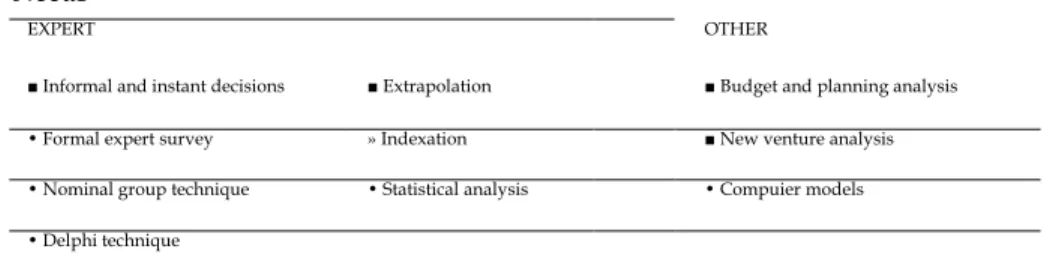
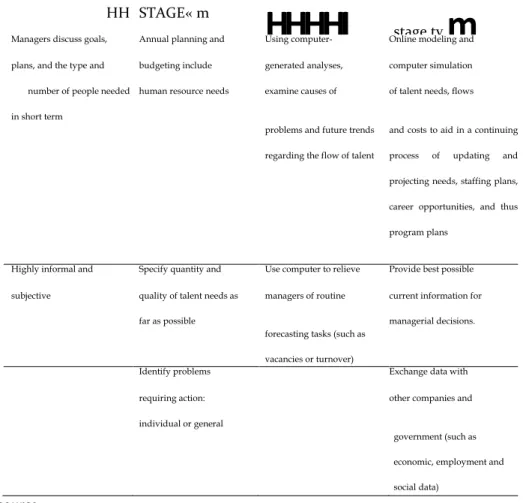
employees is called human resource forecasts. As shown in Figure 3-1, the forecasting techniques range from informal to sophisticated and proper techniques. However, the sophisticated needs are not always precise and are thus considered estimations. Majority of the firms carry out estimations in an informal way. The organizations may possibly use more sophisticated techniques (if they can use specialized staff) using their experience of forecasting human resource needs. The forecasting methods mentioned in Figure 3-r are explained below.
Figure 3-1: Forecasting Techniques for Estimating Future Human Resource
Needs
Expert forecasts
People who are erudite in identifying the future human resource requirements pass judgments based on which expert forecasts are carried out. Human resource planners must identify the employment needs of the line managers as they pass the final employment decisions. The operations directors or the personnel managers are fully equipped with this information in small organizations. While in large organizations, 'urveys are conducted as these managers arc the most knowledgeable about their department’s future employment needs.
As:
A survey can be in various forms; it can be an informed poll, a written questionnaire or a nominal group technique (NGT) being used for a focused discussion. NGT is a technique that
EXPERT OTHER
■ Informal and instant decisions ■ Extrapolation ■ Budget and planning analysis
• Formal expert survey » Indexation ■ New venture analysis
• Nominal group technique • Statistical analysis • Compuier models
presents a group of managers with a problem statement, for instance “What will result in a change in our future staffing needs?” After this all the members write down the answers to this question that he/she can think of. Following this, these ideas are presented in front of everyone in a round-robin manner until the written ideas and the newly discovered ideas are recorded. These ideas are further discussed and categorized by getting the five most important ideas voted by the members in the meeting.
In case the nominal group technique turns out to be a failure, the organization could add more classiness to the survey by using the Delphi technique. This technique implores estimation from a group of professionals, typically managers. After this the H R department planners act as intermediaries, abridge the numerous responses and report the discoveries back to connoisseurs. The experts are surveyed again even after the receiving feedback from employees. These summaries and surveys are continuously conducted until the experts consent with the idea of future development (mostly four or five surveys) for instance, HR might continuously survey production supervisors and administrators until they sign an agreement on the number of substitutes required in the coming year.
Trend projection forecasts
This is the most rapidly fast anticipation systems for projecting the past trends or patterns. Extrapolation and indexation are the two uncomplicated methods for this purpose.
Extrapolation is the expansion of the past gradient into the future. For instance, an organization usually hiring 20 workers into the organization when extrapolate this rate into the future would append approximately 240 new employees in the coming year.
Indexation, on the other hand, involves approximating the future employment needs by bringing employment growth in line with some type of index. The usually example of this matching is the ratio of employees to sales. For instance, planners may identify the production department’s need of ten new assemblers on every million dollars increase in sales.
These two methods are just basic estimations in the short run on the assumption that the causes of demand, like external, organizational and workforce factors, remain unchanged, which happens rarely. However, these methods are not suitable for long-ranged human resource projections. More sophisticated statistical analysis creates a situation for changing basic and core foundations of demand.
Other forecasting methods
Planners can estimate the future demand for human resources with many other methods, one of which is through budget. Human resource planning is required by the organizations with comprehensive budgets and long-range plans. Studying the department brings into light a need for financial agreement for more employees. The human resource needs can be estimated for short-run using these forecasting methods and extrapolation of workforce changes. For long-term estimates, departments and divisions long-range plans can be utilized.