M A J O R A R T I C L E
The Journal of Infectious Diseases
Received 12 September 2019; editorial decision 9 October 2019; accepted 12 October 2019; published online October 20, 2019.
Correspondence: Roberto Mateo, PhD, Vaxart, Inc., 385 Oyster Point Blvd., Suite 9A, South San Francisco, CA 94080 ([email protected]).
aR. M. and L. C. L. contributed equally to this work. The Journal of Infectious Diseases® 2020;221:919–26
© The Author(s) 2019. Published by Oxford University Press for the Infectious Diseases Society of America.
This is an Open Access article distributed under the terms of the Creative Commons Attribution License (http://creativecommons.org/licenses/by/4.0/), which permits unrestricted reuse, distribution, and reproduction in any medium, provided the original work is properly cited. DOI: 10.1093/infdis/jiz540
Production and Clinical Evaluation of Norwalk GI.1 Virus
Lot 001-09NV in Norovirus Vaccine Development
Roberto Mateo,1,a Lisa C. Lindesmith,2,a Shaily J. Garg,1 Keith Gottlieb,1 Karen Lin,1 Sara Said,1 Juan S. Leon,3 Amy C. Sims,2 David J. Weber,4
Ralph S. Baric,2 Sean N. Tucker,1 and David N. Taylor1
1Vaxart, Inc., South San Francisco, California, USA, 2Department of Epidemiology, University of North Carolina, Chapel Hill, North Carolina, USA, 3Hubert Department of Global Health, Rollins
School of Public Health, Emory University, Atlanta, Georgia, USA, 4Division of Infectious Diseases, University of North Carolina, Chapel Hill, North Carolina, USA
Background. Human noroviruses (HuNoV) are the leading cause of gastroenteritis. No vaccine is currently available to prevent norovirus illness or infection. Safe, infectious challenge strains are needed to assess vaccine efficacy in the controlled human infec-tion model (CHIM).
Methods. A stock of HuNoV strain Norwalk virus ([NV] GI.1) was prepared. Healthy, genetically susceptible adults were inocu-lated with NV Lot 001-09NV and monitored for infection, gastroenteritis symptoms, and immune responses.
Results. Lot 001-09NV induced gastroenteritis in 9 (56%) and infection in 11 (69%) of 16 genetically susceptible subjects. All infected subjects developed strong immune responses to GI.1 with a 30-fold (geometric mean titer) increase in blocking titers (BT50)
and a 161-fold increase in GI.1-specific immunoglobulin (Ig)G titers when compared with baseline. GI.1-specific cellular responses in peripheral blood were observed 9 days postchallenge with an average of 3253 IgA and 1227 IgG antibody-secreting cells per mil-lion peripheral blood mononuclear cells.
Conclusions. GI.1 Lot 001-09NV appears to be similar in virulence to previous passages of NV strain 8fIIa. The safety profile, attack rate, and duration of illness make GI.1 Lot 001-09NV a useful challenge strain for future vaccine studies aimed at establishing immune correlates.
Keywords. antibody-secreting cells; blockade antibody; controlled human infection model; human challenge study; human norovirus.
Diarrhea is a leading cause of morbidity and mortality in children under 5 years of age [1]. Human norovirus (HuNoV) is the leading cause of acute gastroenteritis, causing an esti-mated 200 000 deaths per year, mostly in young children and older adults [2]. This high disease burden is facilitated by exten-sive antigenic diversity between the >30 genotypes of HuNoV coupled with antigenic drift within the predominant genotype, GII.4 [3]. Antigenic drift among GII.4 strains has resulted in serial pandemic waves of disease in 2- to 7-year cycles over the past 3 decades [3, 4]. Strains outside the GII.4 genotype are as-sociated with endemic disease and are primarily detected in young children [5]. Substantial antigenic diversity and limited cross-reactivity between genotypes have hampered the develop-ment of HuNoV vaccines. With the successful impledevelop-mentation
of the rotavirus vaccine program in children, vaccines to HuNoV are now a high priority [6].
Most HuNoV disease is caused by strains within 2 genogroups (G), GI and GII. Genetic susceptibility to HuNoV infection is mediated by enzymes of the ABO, Lewis, and secretor histoblood group antigen (HBGA) pathways [7]. Human norovirus-HBGA interaction is genotype specific. Cross-genogroup immunity is limited among infected children [5] and vaccinated mice [8], whereas vaccination in adults, in the short-term, boosts anti-bodies able to broadly block binding of strains to HBGAs in a surrogate neutralization assay [9]. These blockade antibodies correlate with protection from infection and are a leading metric for vaccine immunogenicity studies [10, 11]. Other cor-relates of protection include mucosal immunoglobulin (Ig)A, serum IgA, and memory IgG B cells [12]. Individuals who do not have a functional secretor enzyme are genetically resistant to GI.1 infection [13, 14], yet GII.2 infection is independent of secretor type [15]. How genetic susceptibility and the immunity it shapes impacts vaccine response is not yet fully understood.
Controlled human infection models (CHIM) are being used with increasing frequency to evaluate vaccine candidates, thus methods to isolate and purify noncultivatable/recalcitrant vir-uses, such as HuNoV, are needed. This study was designed to develop a methodological pipeline to manufacture high-quality stocks of HuNoV for application in CHIM to elucidate the
mechanisms of HuNoV susceptibility, immunity, and vaccine efficacy. After this pipeline, we prepared a stock of Norwalk virus (NV), traced its stability and sterility over a 10-year period, and demonstrated infectivity in humans of GI.1 Lot 001-09NV (NV). The development protocol yielded enough virus to generate robust immune responses in healthy adults. A similar purification approach could be applied to develop standardized, high-quality infectious virus stocks to other en-teric viruses lacking high-throughput cell culture systems.
METHODS
Regulatory and Ethics Statement
Protocols for the source fecal sample collections and proc-essing for challenge virus were approved by the Institutional Review Board (IRB) at the University of North Carolina Chapel Hill (no. GCRC-2355) and awarded Investigational New Drug Application (IND) 14697. The clinical trial was conducted by West Coast Clinical Trials ([WCCT] Costa Mesa, CA) under IND 18352. The clinical protocol was reviewed and approved by Aspire IRB (Santee, CA). Written informed con-sent was obtained from all subjects before any study related assessments. The study was registered at clinicaltrials.gov (NCT03721549).
Preparation of Challenge Strain Virus Stocks
The challenge virus stock was prepared from a healthy donor challenged with GI.1 NV in 1999 [13] at the University of North Carolina Chapel Hill General Clinical Research Center (Supplementary Tables 1 and 2).
Thirty-two grams of GI.1 (1.8 × 10⁸ genome copies [GC]/
mL) stool sample were diluted 1/5 in sterile water, vortexed for 5 minutes, centrifuged for 10 minutes at 9400 relative centrif-ugal force (RCF), the supernatant was removed, and the pellet was resuspended in sterile water in a washing process repeated 4 more times. The washed supernatants were pooled and centri-fuged for an additional 60 minutes at 9400 RCF (Pre-Filtrate), followed by 0.22-µm filtration (Filtrate 1), and a second 0.22-µm filtration (purified bulk harvest [PBH]). Purified bulk harvest was stored at 4°C, whereas the virus titer (GC) was determined by quantitative reverse-transcription polymerase chain reaction (qRT-PCR) at Emory University [16]. The room was cleared of supplies, disinfected, and environmental monitoring repeated. A portion of the PBH was then diluted to the desired GC per mL (0.5–1.2 × 10⁶) and aliquoted into ~500 1-mL doses as the final fill
and stored at less than −60°C. The remaining PBH was aliquoted and stored at less than −60°C for future packaging of sublots. Approximately, 45% (G1.1) and 72% (GII.2) of the total PBH was needed to complete the safety testing protocols described in Supplementary Table 2. The PBH and final fill were sterile, and no adventitious viruses were detected in virus-specific assays, MRC-5, VERO or HeLa cell lines, embryonic Hen eggs, or adult and newborn mice (Supplementary Table 2).
Study Design Using the Manufactured Challenge Strain Virus Stocks
Healthy men and women between 18 and 49 years of age were recruited. A total of 40 secretor-positive, blood group O or A subjects were screened to identify 16 eligible subjects. Initially, 8 eligible subjects were assigned to the low-dose chal-lenge (3.6 × 10⁵ GC of NV) and admitted to a private room at
the inpatient challenge facility (WCCT) on the day before chal-lenge. On the day of challenge, the 8 study subjects in this co-hort were given 100 mL bicarbonate buffer (1.3% NaHCO3)
solution to neutralize stomach acid after an overnight fast. Approximately 1 minute later, the subjects ingested the NV in-oculum suspended in 100 mL distilled water.
After viral challenge, study subjects were assessed for symp-toms and signs of gastroenteritis every 2 hours while awake for the first 48 hours and then every 8 hours on Day 3 through the 5-day inpatient period (+1 day if still symptomatic). All fecal and emesis samples were collected and were weighed, graded (fecal samples), and processed for NV infection using qRT-PCR [17, 18]. Saliva and blood samples were also collected at prespecified timepoints. Subjects were assessed by the nursing staff for anticipated subjective symptoms of NV illness (diar-rhea, vomiting, headache, nausea, fever, abdominal cramps or pain, abdominal burgling or bloating and myalgia), as well as unsolicited adverse events (AEs).
Once all subjects in Cohort 1 (low dose) had completed their Day 14 visits, the second group of 8 subjects were challenged with a higher dose of approximately 1 × 10⁶ GC (high dose) and
followed as described above.
Illness Definitions
Acute gastroenteritis (AGE) was defined according to the cri-teria of Bernstein [19] as follows: (1) diarrhea (≥3 loose or liquid stools or >400 grams of loose or liquid stools produced in any 24-hour period) or (2) vomiting (≥2 vomiting episodes in any 24-hour period), or (3) 1 vomiting episode plus any loose or liquid stool in any 24-hour period, or (4) 1 vomiting episode plus at least 2 of the following 5 events: nausea, oral temperature ≥37.6°C, abdominal cramps or pain, abdominal gurgling or bloating, or myalgia in any 24-hour period during the postchallenge sequestration period. Norwalk virus infection was confirmed by fecal virus excretion detected by qRT-PCR on any day postchallenge. Norwalk virus AGE met both criteria. The modified Vesikari (17 point) scale was also used to grade the severity of illness [20].
Secretor Assay
Saliva specimens were evaluated for H type-1 antigens secretor status by enzyme-linked immunosorbent assay (ELISA) at the Cincinnati Children’s Hospital Medical Center (CCHMC) [21, 22].
Norwalk Virus Detection
Statistical Analysis
Frequency of NV disease and infection were compared between the low- and high-dose groups by means of Fisher’s exact test. The dates of onset and resolution of AGE were determined by reviewing the subject’s clinical onset and duration of diarrheal stool (grade 3 or greater).
Blockade Antibody Assay (BT50)
Serum samples were obtained at baseline (Day 1) prechallenge and 28 days postchallenge. In brief, biotinylated Leb (Glycotech)
at 2.5 µg/mL was used to coat Neutravidin-coated plates (Thermo Fisher Scientific). Two-fold dilutions of serum with GI.1 virus-like particle (VLP) were incubated at 37°C for 1 hour. The mixture of VLP and serum samples was added to HBGA-coated plates and incubated at 4°C for 2 hours. After washing, rabbit anti-GI.1 VLP polyclonal antisera (custom made by Thermo Fisher Scientific) was added and incubated at 4oC for 1 hour. Goat antirabbit IgG(H+L)-horseradish
per-oxidase (HRP) (A120-101P; Bethyl Laboratories) was used to detect bound rabbit antibody (4°C for 1 hour). With the starting dilution of 1:25, a negative value was set equal to 12.5 [11, 23].
Peripheral Blood Mononuclear Cell Isolation and Cryopreservation
Peripheral blood mononuclear cells (PBMCs) were obtained before and at days 6 and 9 after challenge for the detection of IgA and IgG antibody-secreting cells (ASCs). Blood was col-lected in K2 EDTA Vacutainer tubes (BD), and PBMCs were isolated the same day using Lymphoprep tubes (Cosmo Bio USA, Carlsbad). The PBMCs were frozen and thawed using serum-free reagents according to the manufacturer’s instruc-tions (Cellular Technology Ltd).
Antibody-Secreting Cells and Enzyme-Linked Immunosorbent Assay Serum Antibodies
Antibody-secreting cells were measured using cryopreserved PBMCs and enzyme-linked immunosorbent (ELISpot) kits for IgG and IgA secreting B cells according to manufacturer’s in-structions (Mabtech). Cells were cultured in triplicate with anti-IgG- or IgA-coated wells in CTL-Test Medium overnight. GI.1 VLPs made in HEK293 cells (AscentGene, Gaithersburg, MD) were biotinylated and quantitated using a biotinylation kit and BCA kit (Pierce). Spots were developed using biotinylated GI.1 VLP and streptavidin-HRP and counted at ZellNet Consulting Inc. (Fort Lee, NJ).
Immunoglobulin G Titer Determination
Serum IgG titers were determined using a MESO QuickPlex SQ 120 instrument (Rockville, MD) following the manufacturer’s instructions and reagents. In brief, Meso Scale Discovery (MSD) Gold Streptavidin plates were blocked with 150 µl of 3% blocker B blocking solution made in phosphate-buffered tween (PBST) for 30 minutes while shaking. Plates were then washed 3 times with PBST and coated with G1.1 VLP-biotin at 0.1 µg/mL
in 1% blocker B and incubated for 1 hour while shaking. Serum sample dilutions were made starting at 1:100 in 1% blocker B in PBST and diluted 1:4 down the plate. After washing, serum sample dilutions were added to the plates and incubated for 2 hours while shaking at room temperature. Plates were then washed 3 times with PBST. A total of 1 µg/mL SULFO-TAG anti-IgG antibodies, diluted in 1% blocker B, was then added to the plates and incubated for 1 hour shaking at room tempera-ture. Plates were then washed and read after addition of 2× read buffer diluted in H2O.
RESULTS
Virus Lot Purification and Isolation
The milestones for development of the stool-derived virus stock 001-09NV is outlined in Supplementary Figure 1. A single stool sample from 1 GI.1-infected [13] donor was subjected to 5 rounds of sterile water dilution and centrifugation, and the supernatants were pooled (Pre-Filtrate) before being sterile fil-tered (Filtrate 1) twice to generate the PBH. Aliquots before the filtration step contained bacteria and fungi. The postfiltration samples were free of bacteria and fungi and all other tested pathogens (Supplementary Table 2). A portion of the PBH was further diluted and vialed in 1-mL doses, recorded as Lot 001-09NV (GI.1). The remainder of the PBH was stored in bulk for future sublots. As expected, the stool-derived product contained endotoxin, although at levels 3- to 8-fold less than GI.1 8FIIb, a HuNoV strain used in previous CHIM [13] (Supplementary Table 2). The virus stock was stable, sterile, and infectious in storage as tested over the past 10 years (Table 1). A request for use of 001-09NV virus stock in CHIM was submitted and ap-proved to the US Food and Drug Administration (FDA), under an IND (14697).
Clinical Outcome
All subjects enrolled in the challenge study were healthy men and women 18–49 years old that were secretor-positive and blood group O or A. The mean age of the subjects was 33 years old in the low-dose group and 40 years old in the high-dose group (Table 2). No unexpected/unsolicited AEs or serious AEs were reported. Unexpected/unsolicited AEs exclude gastroen-teritis symptoms because gastroengastroen-teritis is expected after inges-tion of live norovirus. Expected/solicited AEs included nausea, diarrhea, vomiting, abdominal pain, fever, muscle aches, head-ache, and chills. In previous studies, norovirus challenge strains have been safely administered [19, 20, 24].
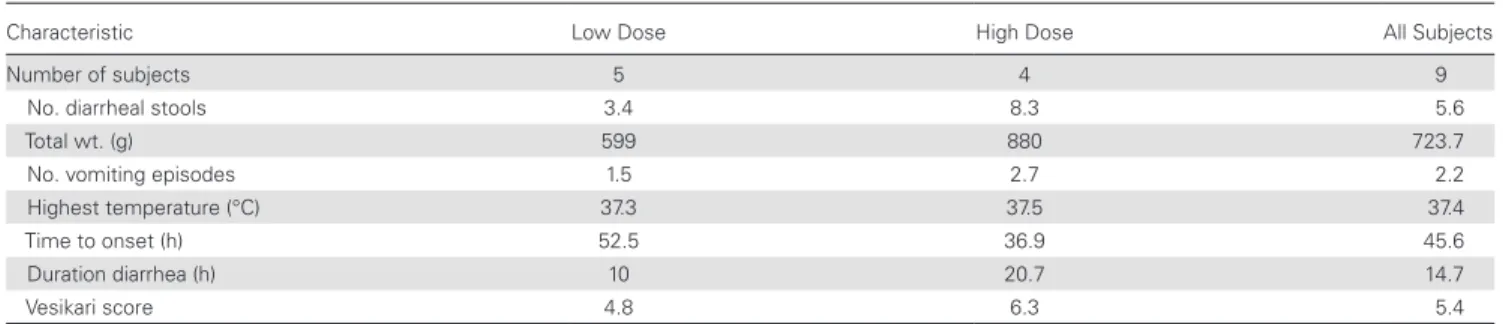
both NV GI.1, GII.4, and other enteric pathogens (data not shown). Overall, there were no statistical differences in out-come among treatment groups. Among those subjects who had AGE and were NV positive, the illness appeared more severe in the high-dose group as measured by diarrheal stool output and vomiting. The onset of illness was shorter, and the duration of illness was longer in the high-dose group. The Vesikari score was also higher in the high-dose group compared with the low-dose group (6.3 vs 4.8), and the mean maximum body temper-ature was also slightly higher in the high-dose group (Table 4). None of the differences between dose groups was statistically significant. The symptoms recorded among the 9 subjects with AGE and who were NV positive were in general mild to mod-erate in nature (data not shown).
Norwalk virus shedding was highly correlated with diar-rheal stool (grade 3 or greater). In the low-dose group, shed-ding ranged from 105 to 1010 GC/gram of stool. Virus was also
detected in emesis in 1 of 2 subjects. Similar results were ob-served in the high-dose group. The level of viral shedding did
not correlate with the amount of diarrheal stool. Norwalk virus was detected in 3 of 16 subjects on day 9.
Immunological Responses
Serological and cellular assays were used to evaluate the immu-nological responses to norovirus challenge. Subjects that were positive for NV shedding were further subclassified into posi-tive or negaposi-tive for AGE (Table 5), and their immune responses were compared.
BT50Blockade Assays
Blockade assays were used as the primary endpoint to test for subject seroconversion after viral challenge. Subjects with a geometric mean fold rise (GMFR) >4 from baseline titer were considered successfully seroconverted for blockade antibody. On day 28, all subjects that were positive for norovirus had an average BT50 titer of 1205, which represented a GMFR >30-fold from day 1 with a 100% seroconversion rate (11 of 11). It is re-markable that, within the AGE group, 4 of 16 subjects (25%) and 2 of 16 subjects (12.5%) had a 32- and a 64-fold increase in BT50
titer by day 28, respectively. In contrast, none of the subjects negative for NV seroconverted for blockade antibody by day 28, only showing a 1.3-fold BT50 titer increase from day 1.
Serum Immunoglobulin G Titer Determination
GI.1-specific IgG responses closely matched the trends ob-served in BT50 assays. Norwalk virus-positive subjects, with a range of titers between 204 800 and 3 276 800 on day 28, had an average 136-fold GMFR from baseline in ELISA titers, as
Table 1. Virus Stock Stability and Sterility Over Timea
001-09NV
Year GC/mL Sterility Endotoxin EU/mL
2009 Manufacture 5 × 10⁵ Negative for growth 235
2011 IND 6 × 10⁵ Negative for growth N/D
2018 001-09NV Trial 3.6 × 10⁵ Negative for growth 165
2019 001-09NV Trial 1.4 × 10⁵ Negative for growth 155
Abbreviations: EU, endotoxin units; GC, genome copies; IND, Investigational New Drug; N/D, not determined.
aHuman noroviruses final fill lots were tested for virus stability (mean GC per mL), sterility, and endotoxin at manufacture, US Food and Drug Administration IND Application submission,
initiation of studies, and annually during ongoing studies. Testing was not performed during years of nonhuman use.
Table 2. Demographic Characteristics by Dose Cohort
Dose Cohorta
Low High All
Baseline demographics n = 8 n = 8 n = 16
Mean age (years) 32.5 39.9 36.3
Gender
Female 3 (37) 4 (50) 7 (44)
Male 5 (63) 4 (50) 9 (56)
Ethnicity
Hispanic 2 (25) 4 (50) 6 (38)
Not Hispanic 6 (75) 4 (50) 10 (63)
Race
White 4 (50) 5 (63) 9 (56)
Black 4 (50) 2 (25) 6 (38)
Asian 0 1 (13) 1 (6)
Body mass index (mean) 25.7 27.1 26.4
Blood Type
A 3 (37) 5 (63) 8 (50)
O 5 (63) 3 (37) 8 (50)
Secretor status positive 8 (100) 8 (100) 16 (100)
Table 3. Summary of the Correlation Between Acute Gastroenteritis and NV Positivity by Cohort
Dose Cohort
Category Low High All
Illness Infection n = 8 n = 8 n = 16
AGE NV+ 5 (62.5) 4 (50) 9 (56.3)
Well NV+ 0 2 (25) 2 (12.5)
AGE NV− 0 1 (12.5) 1 (6.3)
Well NV− 3 (37.5) 1 (12.5) 4 (25)
measured by MSD. Within the AGE group, 4 of 16 subjects (25%) and 1 of 16 subjects (6.25%) had a 256-fold and a 1024-fold increase in serum IgG titer by day 28, respectively. Only 1 subject that did not meet the criteria to be considered posi-tive for AGE responded with a 64-fold increase in ELISA titers by day 28. However, none of the subjects who were negative for AGE seroconverted. As expected, there was a high posi-tive correlation between serum BT50 and NV-VLP IgG ELISA
titers both at baseline (Pearson r = 0.91) and at day 28 (Pearson r = 0.88).
Antibody-Secreting Cell Assays
Antibody-secreting cell responses (IgA and IgG) were measured in all subjects at 3 different timepoints: day 1 (prechallenge), day 6 and day 9 (5 and 8 days after challenge, respectively). Counts were low/negligible on days 1 and 6 but rose to high ASC
numbers on day 9 in NV-positive subjects (Table 5). On average, NV-positive subjects with AGE had 3253 IgA ASC and 1227 IgG ASC spot counts per 1 × 10⁶ PBMCs on day 9, showing a bias
to-ward IgA versus IgG. It is remarkable that 8 of 16 subjects (50%) had IgA ASC spot counts ≥2000 on day 9. Immunoglobulin A ASC counts were approximately 50% higher among subjects who were ill compared with the 2 subjects who were asympto-matic (Table 5). As expected, subjects that were negative for NV had negligible ASC spot counts on any day.
All 11 NV-positive subjects showed strong serum and ASC responses, whereas the 5 subjects who were NV negative had no detectable immune responses (Table 5). Three of 16 subjects (19%) had baseline BT50 GI.1 titers of ≥1:200 and showed no NV-related symptoms, supporting previous observations indicating that blockade antibody titer correlates with protec-tion from symptomatic norovirus infecprotec-tion [10, 11]. Two other
Table 4. Characterization of Diarrhea in Subjects With Acute Gastroenteritis and NV Positivity by Cohort (by Mean)
Characteristic Low Dose High Dose All Subjects
Number of subjects 5 4 9
No. diarrheal stools 3.4 8.3 5.6
Total wt. (g) 599 880 723.7
No. vomiting episodes 1.5 2.7 2.2
Highest temperature (°C) 37.3 37.5 37.4
Time to onset (h) 52.5 36.9 45.6
Duration diarrhea (h) 10 20.7 14.7
Vesikari score 4.8 6.3 5.4
Abbreviations: h, hours; NV, Norwalk virus; wt, weight.
Table 5. Cellular and Serological Immune Responses Analyzed by Clinical Outcome
All NV+ NV+/AGE NV+/Well NV Negativea
No. of Subjects n = 11 n = 9 n = 2 n = 5
BT50 (GMT)
Day 1 39 35 59 100
Day 28 1205 1048 2263 130
GM fold increase 31 30 38 1.3
≥4-fold increase 11 9 2 0
Serum IgG (GMT)
Day 1 3200 2743 6400 18 102
Day 28 436 241 442 392 409 600 18 102
GM fold increase 136 161 64 0.9
≥4-fold increase 11 9 2 0
IgA ASC (Avg)
Day 1 1 1 1 1
Day 6 4 4 2 3
Day 9 3011 3253 1920 6
IgG ASC (Avg)
Day 1 0 0 0 0
Day 6 1 2 0 1
Day 9 1288 1227 1564 2
Abbreviations: ASC, antibody-secreting cells; Avg, average; GM, geometric mean; GMT, GM titer; Ig, immunoglobulin; NV, Norwalk virus;
NV-negative, asymptomatic subjects had BT50 titers of 25 and
50, respectively, suggesting additional, as yet undefined, mech-anisms of norovirus illness protection.
DISCUSSION
Vaccine efficacy studies using a human challenge design require large quantities of well characterized virus stocks that meet FDA sterility and purity requirements for use in humans. Using a sample collected during our previous HuNoV infectivity study, we prepared virus stock for the genogroup I protype strain, GI.1 NV [13]. These strains are good HuNoV vaccine testing candi-dates because they circulate in the population and the environ-ment but are typically not associated with pandemic levels of disease [3, 18]. Unlike the pandemic GII.4 HuNoV strains [25], the results of challenge studies with GI.1 and GII.2 are less likely to be complicated by high levels of either community-acquired infections or herd immunity within the test population, while providing key information on strain susceptibility and vaccine-induced breadth of immunity.
This study describes the infectivity of the GI.1 NV Lot 001-09NV in humans, initially developed as a tool to better characterize and standardize immune responses generated by CHIM infections. The data presented here support that 001-09NV infectivity has been maintained over time after extensive passaging in healthy human volunteers and, more importantly, is similar to that of its parent strain, 8FIIa, pre-viously tested in several trials [13, 26]. In the current study, all subjects that were positive for stool NV had a strong sero-logical and cellular immune response to NV. Specifically, sub-stantial increases in serum antibody responses were observed, with a GMFR from baseline of 31 in BT50 and 136 in IgG titers measured on day 28 postchallenge. Previous studies with Vaxart’s oral norovirus vaccine have shown that such immuni-zation elicited a cellular response that was skewed toward IgA with an average IgA ASC spot count of 561 per 1 × 10⁶ PBMCs
(0–1600) among subjects who received the highest dose at day 7 postimmunization [23]. In the present study, chal-lenged subjects also showed a stronger cellular IgA response, although with a higher variability in magnitude, and an av-erage IgA ASC spot count of over 2000 (range, 0 to 6800) on day 9 postchallenge, suggesting that responses to NV infection are considerably higher than those elicited by vaccination. For varicella-zoster virus (VZV), the antibody responses after im-munization with the VZV vaccine (live-attenuated), while still protective, have been estimated >10-fold lower than those elicited after natural infection [27]. In our study, all 11 subjects that were infected with NV and ill had a 4-fold increase in BT50 titers from baseline by day 28, consistent with previous
challenge studies with other GI.1 inoculums [11]. The magni-tude of the BT50 titers on day 28 was similar to that reported
in some previous challenge studies [11, 28]. Overall, our data show that the seroresponses observed after NV challenge are
comparable to those observed in previous controlled human infection studies with similar strains of genogroup GI.1 [20].
The present study provides a robust platform and a pipeline for studies with other noncultivable enteric viruses of impor-tance to human and veterinary health such as sapovirus, re-ovirus, or adenovirus. Our approach furthers other vaccine studies because it opens the possibility to use Lot 001-09NV for studying protective immunity markers against norovirus in-fections. Virus neutralization assays are not available for NV. Historically, BT50 titers have been regarded as one such protec-tive immunity marker. In this study, 3 subjects had baseline BT50
titers of ≥200 and did not develop NV-related gastroenteritis, although one of them had an increase in antibody responses postchallenge. Elevated baseline titers were also associated with a lower risk of illness in a previous challenge study, particularly in placebo subjects [11, 29].
CONCLUSIONS
In summary, we have found that Lot 001-09NV is similar in vir-ulence to previous passages of NV strain 8FIIa, with a similar safety profile, time to disease onset, and duration of illness in challenged subjects. All of these attributes make this lot a very useful challenge isolate to compare and standardize immune response levels and efficacy of various vaccine candidates. The large number of high virus titer stool samples collected here could serve as valuable sources of virus to pilot development of the human intestinal enteroid in vitro cell culture system, which allows for NV replication in an isolate-specific manner [30, 31].
Supplementary Data
Supplementary materials are available at The Journal of Infectious
Diseases online. Consisting of data provided by the authors to
benefit the reader, the posted materials are not copyedited and are the sole responsibility of the authors, so questions or com-ments should be addressed to the corresponding author.
Notes
Acknowledgments. We thank Patty Orozco-Cronin (Vaxart); the clinical staff at West Coast Clinical Trials (WCCT); Monica McNeal, Weiming Zhong, and Xi Jason Jiang (Cincinnati Children’s Hospital Medical Center); and Christine L. Moe, Marina Fernandez, and Pengbo Liu (Emory University).
S. J. G., and D. N. T. wrote the manuscript with input from all authors.
Financial support. This work was funded by Vaxart
Biosciences, Inc., and grants from the National Institutes of Health (56AI106006, U19 AI109761; Centers of Excellence for Translational Research AI056351 [to R. S. B.]; AI23946, RR00046, and GM63228 [UNC General Clinical Research Center]), the Wellcome Trust (203268/Z/16/Z; to R. S. B.), and the US Department of Agriculture-National Institute of Food and Agriculture (2018-07410; to J. S. L.).
Potential conflicts of interest. Vaxart purchased the chal-lenge virus from UNC. R. S. B., D. J. W., L. C. L., and A. C. S. are employees of UNC. Vaxart analyzed the immune responses after the WCCT challenge study. R. M., S. J. G., K. G., K. L., S. S., S. T., and D. N. T. are employees of Vaxart. All authors have submitted the ICMJE Form for Disclosure of Potential Conflicts of Interest. Conflicts that the editors consider relevant to the content of the manuscript have been disclosed.
References
1. GBD Diarrhoeal Diseases Collaborators. Estimates of global, regional, and national morbidity, mortality, and aetiologies of diarrhoeal diseases: a systematic analysis for the Global Burden of Disease Study 2015. Lancet Infect Dis
2017; 17:909–48.
2. Patel MM, Widdowson MA, Glass RI, Akazawa K, Vinjé J, Parashar UD. Systematic literature review of role of noroviruses in sporadic gastroenteritis. Emerg Infect Dis
2008; 14:1224–31.
3. Atmar RL, Ramani S, Estes MK. Human noroviruses: recent advances in a 50-year history. Curr Opin Infect Dis 2018; 31:422–32.
4. Mallory ML, Lindesmith LC, Graham RL, Baric RS. GII.4 human norovirus: surveying the antigenic landscape. Viruses 2019; 11:177.
5. Cannon JL, Lopman BA, Payne DC, Vinjé J. Birth cohort studies assessing norovirus infection and immunity in young children: a review. Clin Infect Dis 2019; 69:357–65. 6. McAtee CL, Webman R, Gilman RH, et al. Burden of
noro-virus and rotanoro-virus in children after rotanoro-virus vaccine intro-duction, Cochabamba, Bolivia. Am J Trop Med Hyg 2016; 94:212–7.
7. Nordgren J, Svensson L. Genetic susceptibility to human norovirus infection: an update. Viruses 2019; 11:226. 8. LoBue AD, Lindesmith L, Yount B, et al. Multivalent
noro-virus vaccines induce strong mucosal and systemic blocking antibodies against multiple strains. Vaccine 2006; 24:5220–34. 9. Lindesmith LC, Ferris MT, Mullan CW, et al. Broad blockade antibody responses in human volunteers after immuniza-tion with a multivalent norovirus VLP candidate vaccine: immunological analyses from a phase I clinical trial. PLoS Med 2015; 12:e1001807.
10. Malm M, Uusi-Kerttula H, Vesikari T, Blazevic V. High serum levels of norovirus genotype-specific blocking anti-bodies correlate with protection from infection in children. J Infect Dis 2014; 210:1755–62.
11. Reeck A, Kavanagh O, Estes MK, et al. Serological correlate of protection against norovirus-induced gastroenteritis. J Infect Dis 2010; 202:1212–8.
12. Kocher JF, Debbink K, Lindesmith LC, et al. Noroviurs vac-cines. In: Plotkin S, Orenstein W, Offit P, Edwards KM, eds. Plotkin’s Vaccines. 7th ed. Philadelphia, PA: Elsevier; 2018: pp 698–703.
13. Lindesmith L, Moe C, Marionneau S, et al. Human suscep-tibility and resistance to Norwalk virus infection. Nat Med
2003; 9:548–53.
14. Hutson AM, Airaud F, LePendu J, Estes MK, Atmar RL. Norwalk virus infection associates with secretor status genotyped from sera. J Med Virol 2005; 77:116–20. 15. Lindesmith L, Moe C, Lependu J, Frelinger JA, Treanor J,
Baric RS. Cellular and humoral immunity following Snow Mountain virus challenge. J Virol 2005; 79:2900–9. 16. Liu P, Hsiao HM, Jaykus LA, Moe C. Quantification of
Norwalk virus inocula: comparison of endpoint titration and real-time reverse transcription-PCR methods. J Med Virol 2010; 82:1612–6.
17. Hill VR, Mull B, Jothikumar N, Ferdinand K, Vinje J. Detection of GI and GII noroviruses in ground water using ultrafiltration and TaqMan real-time RT-PCR. Food and Environmental Virology. Vol. 2. Springer; 2010: pp 218–24. 18. Cannon JL, Barclay L, Collins NR, et al. Genetic and epi-demiologic trends of norovirus outbreaks in the United States from 2013 to 2016 demonstrated emergence of novel GII.4 recombinant viruses. J Clin Microbiol 2017; 55:2208–21.
19. Bernstein DI, Atmar RL, Lyon GM, et al. Norovirus vaccine against experimental human GII.4 virus illness: a challenge study in healthy adults. J Infect Dis 2015; 211:870–8. 20. Atmar RL, Bernstein DI, Harro CD, et al. Norovirus vaccine
against experimental human Norwalk virus illness. N Engl J Med 2011; 365:2178–87.
21. Huang P, Farkas T, Marionneau S, et al. Noroviruses bind to human ABO, Lewis, and secretor histo-blood group antigens: identification of 4 distinct strain-specific patterns. J Infect Dis 2003; 188:19–31.
22. Tan M, Jin M, Xie H, Duan Z, Jiang X, Fang Z. Outbreak studies of a GII-3 and a GII-4 norovirus revealed an associ-ation between HBGA phenotypes and viral infection. J Med Virol 2008; 80:1296–301.
23. Kim L, Liebowitz D, Lin K, et al. Safety and immunoge-nicity of an oral tablet norovirus vaccine, a phase I random-ized, placebo-controlled trial. JCI Insight 2018; 3.
group antigens is blocked by antisera from infected human volunteers or experimentally vaccinated mice. J Virol 2002; 76:12335–43.
25. Frenck R, Bernstein DI, Xia M, et al. Predicting suscep-tibility to norovirus GII.4 by use of a challenge model involving humans. J Infect Dis 2012; 206:1386–93. 26. Graham DY, Jiang X, Tanaka T, Opekun AR, Madore HP,
Estes MK. Norwalk virus infection of volunteers: new insights based on improved assays. J Infect Dis 1994; 170:34–43. 27. Krah DL. Assays for antibodies to varicella-zoster virus.
Infect Dis Clin North Am 1996; 10:507–27.
28. Czakó R, Atmar RL, Opekun AR, Gilger MA, Graham DY, Estes MK. Experimental human infection with Norwalk
virus elicits a surrogate neutralizing antibody response with cross-genogroup activity. Clin Vaccine Immunol 2015; 22:221–8.
29. Ramani S, Neill FH, Opekun AR, et al. Mucosal and cel-lular immune responses to Norwalk virus. J Infect Dis 2015; 212:397–405.
30. Ettayebi K, Crawford SE, Murakami K, et al. Replication of human noroviruses in stem cell-derived human enteroids. Science 2016; 353:1387–93.