Master Thesis Clinical Neuropsychology
Faculty of Behavioral and Social Sciences – Leiden University July 2017
Student number: 1364146
Daily Supervisor: Dr. C.J.M. van der Ham, Department of Health, Medical and Neuropsychology; Leiden University
CNP-co-evaluator: Drs. I. Schuitema, Department of Health, Medical and Neuropsychology; Leiden University
game training performance
Abstract
Navigation ability is indispensable. It enables us to function adequately and independently in daily life. Patients with brain disorders often report navigation problems, however, treatment programs for navigation problems are scarce. Moreover, gender differences are not taken into account at all in the existing treatment programs, although there are clear differences in navigation strategy and navigation performance. In the current study, we investigated if a training game could influence the navigation strategy people use and particularly we examined what the influence was of gender on this navigation training. The Starmaze task was used to determine participants preference of navigation strategy (egocentric vs. allocentric). The study consisted of two sessions. During both sessions, navigation ability was assessed using an adapted version of the Virtual Tübingen Test (VT test). Between the two sessions, the participants played a navigation training game at home. There were two types of training games. One training game trained egocentric navigation skills and the other training game trained allocentric navigation skills. Participants had to train their allocentric navigation skills if they preferred an egocentric navigation strategy on the Starmaze task, and vice versa. The results showed no gender differences in remembering directions with or without availability of landmarks. Thus, the diagnostic tool in this study shows to have some characteristics very useful for clinical use while it serves both gender types equally. Furthermore, both the egocentric and allocentric training games caused a reduction in remembering direction with availability of landmarks from an allocentric perspective. Additional (positive) effects of the training types on the performance were not seen. However, this study gave us more information about the factors that seem to be involved in the effectiveness of the training, namely number of training hours, degree of personal guidance and degree of satisfaction in personal needs of the patients. Moreover, there was no influence of gender on both navigation training games. Apparently, the influence of gender is more nuanced than we thought. Whereby separate training types for males and females is not necessary, since both training games serve both gender types equally. Lastly, task type and characteristics of the participants seemed also to influence navigation ability. More research for the above findings is needed, as research in navigation training and the influence of gender is still scarce. However, we made a provided the first step.
Keywords: Egocentric and allocentric navigation strategy training; Gender differences;
Contents
Abstract ... 2
Introduction ... 4
Methods ... 8
Participants ... 8
Tasks ... 9
Starmaze task. ... 9
Virtual Tübingen Test. ... 10
Design and procedure ... 12
Procedure first session. ... 13
Procedure game training at home. ... 13
Procedure second session. ... 16
Analysis ... 16
Results ... 18
Gender effect ... 18
Training effect ... 18
Gender influence on the training ... 20
Other effects ... 22
Discussion ... 23
Introduction
Without realizing it, you often make an appeal on your navigational ability. For example, while finding your way from one location to another, finding your way within a building (Claessen & van der Ham, 2017; Postma & van der Ham, 2017,) or monitoring your position (Wolbers & Hegarty, 2010). Navigation concerns familiar environments, for example shopping in the supermarket at the corner of the street. As well as unfamiliar environments, for example when you are on a vacation (Claessen & van der Ham 2017). In a nutshell, we make an appeal on our navigation ability for any goal that requires us to physically move around to reach it (Postma & van der Ham, 2017).
Most people experience little or no problems with navigation, some people however do experience difficulties. For example, 30% of people who had a stroke report navigation problems (van der Ham, Kant, Postma & Visser-Meily, 2013). These problems interfere with their adequate and independent daily life functioning (van der Ham, van Zandvoort, Meilinger, Bosch, Kant & Postma, 2010; Claessen, van der Ham, Jagersma & Visser-Meiley, 2016). Moreover, navigation problems negatively influence their quality of life (van der Ham et al., 2013). Yet, navigation impairment is not only present after a stroke, but also occurs in patients suffering from other neuropsychological disorders, such as mild cognitive impairment (Hort et al., 2007), Alzheimer’s disease (Pai & Jacobs, 2004; Cushman, Stein & Duffy, 2008) and Korsakoff’s syndrome (Oudman et al., 2016). Brain disorders can negatively affect navigation ability as it requires multiple and complex cognitive components (Wolbers & Hegarty, 2010; Postma & van der Ham, 2017). Therefore, navigation ability is highly vulnerable to brain disorders and often causes navigation problems. For this reason, it is very important to develop an appropriate treatment for these patients (van der Ham et al., 2013; Claessen et al., 2016).
can influence the navigation strategy people use. In particular, we focus on gender as a potential contributor to training success.
Van der Ham and van der Kuil (in preparation) developed a navigation training in which the participants can train themselves by playing a serious game consisting of spatial exercises. The training consists of two types of games. They have based these two types on the distinction of the two navigation strategies; the egocentric navigation strategy and the allocentric navigation strategy. Egocentric navigation strategy concerns environmental information relative to one self (Klatzky, 1998; Neggers, Schölvinck, van der Lubbe & Postma, 2005; Nowak, Murali & Driscoll, 2015; Postma & van der Ham, 2017). Navigators using this strategy navigate based on self-landmark relationships. This includes bodily left and right turns (Nowak et al., 2015; Postma & van der Ham, 2017), landmark-action associations (van der Ham et al., 2010; Claessen et al., 2017) and the sequence one crosses locations or landmarks (van der Ham et al., 2010; Claessen et al., 2017). Allocentric navigation strategy concerns environmental information relative to units outside the observer (Klatzky, 1998; Neggers et al., 2005; Nowak et al., 2015; Postma & van der Ham, 2017). Different cues can be used in an allocentric reference frame, namely single objects, relations between multiple external objects, landmarks and the geometry of an extended surface or boundary (Postma & van der Ham, 2017). Hereby, one can build a cognitive map of the environment and make use of this while navigating (Klatzky, 1998). Based on this theoretical model of egocentric and allocentric navigation strategies, van der Ham & van der Kuil (in preparation) developed one game to train egocentric navigation skills and one game to train allocentric navigation skills. They are testing the games on healthy participants. Participants with a preference for the allocentric navigation strategy receive the egocentric training game to train their egocentric navigation strategy and vice versa.
al., 1998), but they have more preference for using geometric information or Euclidean properties (Lawton 1994; Dabbs et al., 1997; Sandstrom et al., 1998; Saucier et al., 2002; Coluccia & Louse, 2004). Geometric information or Euclidean properties include descriptors such as cardinal directions and exact distances (Saucier et al., 2002). Moreover, they maintain their sense of position in relation to the environment.
There are also gender differences in navigational performance on certain tasks. Coluccia & Louse (2004) wrote in their review how the type of task used to measure spatial orientation abilities, affects male and female performance on a task. They described this based on the four most frequently used tasks to measure spatial orientation abilities namely pointing, wayfinding, distance estimation and map drawing tasks. Males are generally better in pointing and wayfinding tasks than females (Kirasic, Allen, & Siegel, 1984;Holding & Holding, 1989; Galea & Kimura, 1993; Lawton, 1996; Lawton, Charleston & Zieles, 1996;Moffat, Hampson & Hatzipantelis, 1998; Lawton & Morrin, 1999; Malinowski & Gillespie, 2001; Waller, Knapp & Hunt, 2001; Saucier et al., 2002; Coluccia & Louse, 2004). However, in some situations males and females are performing equally (Kirasic et al., 1984; Sandalla & Montello, 1989; Montello & Pick, 1993; Saucier et al., 2002; Devlin & Bernstein, 1995; Lawton et al., 1996; Coluccia & Louse, 2004), but females never perform better on pointing or wayfinding tasks than males. On distance estimation tasks, gender differences do not emerge in most of the cases (Holding & Holding, 1989; Galea & Kimura, 1993; Coluccia & Louse, 2004), but in some cases males outperform females (Holding & Holding, 1989; Coluccia & Louse, 2004). On one type of task, females sometimes seem to outperform males, namely on map drawing tasks (McGuinnes & Sparks, 1983; Coluccia & Louse, 2004). This phenomenon could be explained by the fact that most of these tasks concern landmarks and map elements. As described above females tend to make more use of this (Coluccia & Louse, 2004). Yet, we must note that females do not often outperform males in map drawing tasks. In more than half of the cases no gender differences appear on map drawing tasks (Taylor & Tversky, 1992b; O’laughlin & Brubaker, 1998; Coluccia & Louse, 2004). So, it really depends on the type of task in relation to the navigation performances of males and females. We will take this into account in the current study. Contrasting tasks are used to investigate the effect of gender on the training. During one task, participants will have to remember directions without landmarks. In the other task, participants will have to remember directions with availability of landmarks.
while navigating (Lawton 1994; Dabbs et al., 1997; Sandstrom et al., 1998; Saucier et al., 2002; Coluccia & Louse, 2004). Oppositely, we expect females are better at remembering directions with availability of landmarks than males, because females prefer environmental information while navigating (Lawton 1994; Dabbs et al., 1998; Sandstrom et al., 1998; Saucier et al., 2002; Coluccia & Louse, 2004). Moreover, females sometimes outperform males on tasks which concern landmark information (McGuinnes & Sparks, 1983; Coluccia & Louse, 2004). Secondly, we expect that the training developed by van der Ham & van der Kuil (in preparation) is effective, because the navigation strategy people use can be influenced after a short training procedure (Claessen et al., 2016). More precisely, we predict the egocentric training will improve the competence in remembering directions with availability of landmarks, because the egocentric training focuses on improving egocentric navigation skills. These skills are mainly required for remembering directions with availability of landmarks. Also, we consider that the allocentric training will improve the competence in remembering directions without landmarks. In line with the above reasoning, the allocentric training focuses on improving allocentric navigation skills. These skills are predominantly required for remembering directions without landmarks. Finally, we hypothesize that males who followed the egocentric training show more progression on remembering directions with availability of landmarks than females who followed the allocentric training. This is assumed because we think that there is more opportunity for progression of egocentric skills in males. Contrariwise, we expect that females who follow the allocentric training show more progression in remembering directions without landmarks than males who follow the allocentric training, because we think that there is more opportunity for progression of allocentric skills in females.
Methods
As mentioned above, this study is part of a larger study. Therefore, only the relevant tasks for this study are described in the methods below.
Participants
The participants were recruited via SONA systems, flyers, posters and Facebook. The inclusions criteria were respectively: age between 18-35, an educational level of Verhage 6 or 7 (Verhage, 1964), Dutch speaking, in possession of a computer or MAC and motivated to practise the navigation game at home. Participants were not allowed to have a psychiatric disorder or to have received treatment for a psychiatric disorder.
We made a distinction between gender (males vs. females) and preferred navigation strategy (egocentric vs. allocentric). Beforehand, we determined the group sizes to make statistically sound comparisons. The determined group sizes are shown in table 1. In which group the participants were classified is based on their gender type and the outcome of the Starmaze task (Iglói et al, 2009; Fouqet et al., 2010). We tested a total of 113 participants. However, 72 participants were excluded from the analysis, because of several reasons. First, the control (N = 24) and psycho-education (N = 24) groups were not included, since only the training groups were analysed in our study. Secondly, 4 participants did not show up to the second session. Whereby no comparisons between pre-test and post-test could be made. Lastly, the investigation was ended when 20 participants were included. The outcome of the Starmaze task classified the additional participants as requiring allocentric training, but the groups of allocentric training were already full. Thus, 41 participants were analysed in total (Mean Age = 21.95, SD = 2.683, Range = 18-30). Characteristics of the participants are described in table 2.
Table 1
Pre-established group sizes
Training Type Gender Egocentric Allocentric
Males 10 10
Females 14 14
Table 2
Characteristics of the participants (N = 41)
Training Type
Gender Egocentric Allocentric
Males
n 9 9
Average Age 24.44 (3.40) 21.56 (2.13)
Range 20-30 19-25
Average Education level
6.67 (.50) 6.33 (.50)
Females
n 10 13
Average Age 21.10 (1.52) 21.15 (2.34)
Range 18-23 18-35
Average Education level
6.40 (.52) 6.77 (.44)
Note. Average Age and Range are expressed in years. Education level is expressed in Verhage score. Standard deviations are in parentheses. n = number of participants.
Tasks
Participants completed two tasks during the investigation. These tasks are described below. Starmaze task.
used the learned route to the invisible goal, finished in the incorrect arm. They were identified as preferred egocentric navigators. Participants who made use of the environmental landmarks, finished in the correct arm. They were categorised as preferred allocentric navigators. Both arms were rewarded with a “Bravo” signal in this probe trial.
There were two versions of the Starmaze task, version A and version B. It was counterbalanced which version the participants had to complete. Participants completed the Starmaze task only during the first session.
Virtual Tübingen Test.
Navigation ability is assessed using an adapted version of the Virtual Tübingen Test (VT test) (van Veen et al., 1998; Claessen et al, 2016). First the participants watched a short video of a route through the virtual village Tübingen. They were instructed to pay attention to the environment, route and orientation while watching the video. The duration of the video was between four to eight minutes, depended on which version the participants got to see. There were four different routes; red, purple, blue and green. There were also two perspectives of the video, namely an egocentric perspective and an allocentric perspective. From the egocentric perspective, it seemed that the participants were walking through the village by themselves (see figure 1, II-Ego). At the allocentric perspective, the participants saw the route from above with a panoramic perspective. They had to follow an arrow, which marked the route (see figure 1, II-Allo). After watching the video, the participants completed two tasks. Descriptions and scoring methods of the subtasks will be discussed below.
The participants completed the VT test four times in total. Two times during session one and two times during session two. In the end, the participants had seen all four routes (red, purple, blue and green). It was counterbalanced in which order the participants got to see the routes, to prevent any sequential effects.
Remembering directions without landmarks (No Landmark task).
saw the video from an egocentric perspective, they completed the egocentric version of the task. For both versions, the participants got to see the same table (see figure 1) and received the same instructions. They were instructed to indicate what action (straight ahead, left or right) was performed on each decision point. They had to indicate this from an egocentric perspective. So, for the egocentric version, this was from the perspective the participants saw the video. For the allocentric version they had to indicate what action was performed from the perspective of the arrow. Thus, the participants had to imagine the perspective of the arrow first, before giving their response (see figure 1). The participants gave their response by pressing a button in the table. They could press only one button on each decision point. The score on this task was the percentage of correct responses to all eight trials. The percentage to randomly have all responses correct was 33% for all the four routes and both perspectives. Since this subtask did not include any landmarks and only concerns directional information we considered this task as a task without landmarks.
Remembering directions with availability of landmarks (Landmark task).
This task was also performed on a computer. The participants were shown a screenshot of a scene prior to a decision point. The participants had to indicate again what action (straight ahead, left of right) was performed on each decision point. They had to indicate this from an egocentric perspective, just like described above (see figure 1). The participants gave their response by using the arrow buttons on the keyboard. Similar as the No Landmark task, there was an allocentric version and an egocentric version of the task. At the allocentric version, a screenshot from above with a panoramic perspective was shown (see figure 1-II-Allo). At the egocentric version, a screenshot from the perspective of how the participants saw the video was shown (see figure 1-II-Ego). In both versions, the same decision points were shown. Which version the participants completed, depended on the perspective of the video they had seen. The task consisted of eight trials in total. The score was determined by percentage of correct responses on eight trials. The percentages to randomly have all the responses correct for the red, purple, blue and green route were respectively 47,9 %, 43,6 %, 47,9 % and 47,9 %. The average percentage to have all the response correct was 46,8 %. These percentages applied for the egocentric and allocentric perspective, because answer modalities were the same for each trial (see figure 1-II).
I.
II.
Figure 1. A representation of the No Landmark task (I) and Landmark task (II). At both tasks, participants had to indicate what action was performed on each decision point from an egocentric perspective. So, for the egocentric version, this was from the perspective the participants saw the video (see II-Ego). For the allocentric version they had to indicate what action was performed from the perspective of the arrow (see II-Allo).
Design and procedure
(landmark vs. no landmark). The study was conducted according to the guidelines of the declaration of Helsinki (World Medical Association, 2013).
Below, the procedure of each session and game training at home is discussed. The study consisted of two sessions. There were 14 to 21 days between the first and second session. In this meantime, all of the participants played a navigation training game at home.
Procedure first session.
First, the participants were informed about how the examination looked like and what the possible risks were. Thereafter, the participants signed an informed consent to confirm that they were informed about the examination and ratified with it. The Starmaze task and the VT test were examined hereafter. An account to play the training game at home was created at the end of the session. There were two types of training games. One training game trained the egocentric navigation skills and one training game trained the allocentric navigation skills. Which game the participants had to play depended on what the participants preferred navigation strategy on the Starmaze task was. If participants preferred an egocentric navigation strategy, then the participants had to train their allocentric navigation skills and vice versa. After a personal account was created, the participants were informed about how to use the game.
Procedure game training at home.
The training is inspired by the training of Claessen et al. (2016). The default number of training sessions was set to four fifteen minute’s sessions in two to three weeks. The participants were reminded to practise through an email. The two types of training are described below.
Egocentric training.
the keyboard. Participants could click on a button in the upper right corner to get one or two hints while playing the game. They were explicitly asked to use a certain strategy. The three mini games of the egocentric training are described below.
Remembering a sequence of bodily turns.
In this mini game, the participants trained to remember which action (right or left) they performed on each decision point. The participants were placed in a labyrinth. First, the participants saw a route through the labyrinth and were instructed to remember this route. After seeing the route, participants were placed at the starting point of the route. They had to find their way to the ending point of the route. If they followed the correct route, they found golden coins. However, each time the participants made a wrong action at a decision point, they lost one coin. The participants were instructed to remember the sequence of bodily turns (e.g. left, left, right, left). Each training session consisted of three rounds. So, the participants practiced with three routes through the labyrinth each practice session.
Maintaining a sense of direction toward a starting point.
The participants trained to maintain a sense of direction toward the departing point. The participants were placed in a pyramid with two rooms and between these rooms a labyrinth. They had to walk from one room to the other room. Meanwhile, at every turning point of the route, the participants were asked to point to the starting point. An arrow appeared on the screen and with the arrow buttons on the keyboard the participants could rotate. With the space bar the participants could confirm their answer. After they gave a response, the walls of the pyramid changed to transparent. Hereby, the participants saw where they had pointed to and where the actual starting point was. The better the participants pointed to the starting position, the more coins they earned. The participants were instructed to imagine at all times where the starting point was and to focus more on this than following the route. Each training session consisted of three rounds. So, the participants walked through the labyrinth three times. Moreover, each round consisted of ten points at which the participants were asked to point to the starting position.
Remembering landmark-action associations.
decision point (e.g. go to the right when you see a harp). After seeing the route, participants were placed at the starting point of the route and again, they had to find their way to the ending point of the route. If they followed the correct route, they found golden coins. However, each time the participants made a wrong action at a decision point, they lost one coin. The participants were instructed to remember landmark-action associations. However, they had not to remember the sequence in which they saw it. Each training session consisted of three rounds, meaning the participants practiced with three routes through the labyrinth each practice session.
Allocentric training.
In principal the allocentric training was similar to the egocentric training. Only different mini games were used. These mini games are described below.
Using local landmarks to determine locations in space.
The participants trained to use local landmarks as aid in finding new locations. Participants had to find an invisible target in a round playing field with three pillars in it. The pillars had three colors; red, green and blue. In the first part of the mini game, the participants saw a map of the round playing field, the three pillars and where the invisible target was located. In the second part, participants were placed in the playing field and had to find the invisible target. It was important that they used the shortest route, because with every step the participants took, they lost coins. The participants were instructed to take time to remember the map. Then, when placed in the playing field, the recommended first step was to orientate where in the playing field they were by performing rotations. To indicate the shortest way to the invisible target, participants received the hint to use the colored pillars. Each training session consisted of nine rounds. Thus, the participants had to find nine times an invisible target in the round playing field.
Using distal landmarks to determine locations in space.
Each training session consisted of nine rounds. Thus, the participants had to find an invisible target nine times in the round playing field.
Using map information for way finding.
Participants trained how to use a map effectively. Participants were placed in a labyrinth. In this labyrinth, there were several rooms. In some of these rooms, murals were present which served as landmarks. Participants were placed in one of the rooms and had to find their way to another room, the end location. First, participants saw a map of the labyrinth, the starting location, the end location and the murals in some rooms. Second, the participants were placed in the labyrinth and had to find the end location. The game consisted of three rounds. In the first round, participants saw two parts on their computer screen. They saw the labyrinth from an egocentric perspective (see figure 1-II-ego). Secondly, they saw a map of the labyrinth upon which they could see where they were. This location changed when they were walking through the labyrinth. In the second round, the participants saw the same computer screen. However, the participants could only see their starting point and the location did not change when they were walking through the labyrinth. In de last round, participants only saw the labyrinth of an egocentric perspective on their computer screen. The map of the labyrinth was not shown in this round. It was important that they used the shortest route, because with every room the participants entered, they lost a coin. The less rooms the participants entered, the more coins were left over. Moreover, some rooms had a red mural. If participants entered these rooms they lost two coins. Participants were instructed to take their time to remember the map and to make a plan how to get to the end location. Moreover, they were recommended to connect the information of the map to the image that they saw when they were walking through the labyrinth.
Procedure second session.
Navigation ability was reassessed with the VT test. Afterwards, we gave the participants a debriefing about the study. The data of the participants is analysed anonymously.
Analysis
egocentric and allocentric versions of both tasks. For each analysis two values of the raw score of the Landmark task and two values of the raw score of the No Landmark task were available, because participants completed an egocentric and an allocentric version of both tasks. We expected males to perform better on the No Landmark tasks than females. Moreover, females were expected to perform better on Landmark tasks than males. Secondly, we analysed the effect of the training on navigation performance. We expected the egocentric training would improve the performance on the Landmark tasks. We analyzed this with a 2 (time) x 2 (perspective) x 2 (task type) Repeated Measures General Linear Model. The within subject factors were time (pre vs. post), perspective (egocentric vs. allocentric) and task type (No Landmark vs. Landmark). The between subject factor was training type (egocentric). We used the four raw scores of the Landmark tasks and the No Landmark tasks as the value of navigation performance. Furthermore, we predicted that the allocentric training would improve the performance on the No landmark tasks. We used the same type of analysis as described above, only the training type changed. Thus, we used a 2 (time) x 2 (perspective) x (task type) Repeated Measures General Linear Model. The within subject factors were time (pre vs. post), perspective (egocentic vs. allocentric) and task type (No Landmark vs. Landmark). The between subject factor was training type (allocentric). We used the four raw scores of the Landmark tasks and the No Landmark tasks as the value of navigation performance. Lastly, we analysed the interaction effect of gender and training on navigation progression. We thought that males who followed the egocentric training showed more progression on the Landmark tasks than females who followed the egocentric training. Furthermore, we hypothesized that females who followed the allocentric training showed more progression on the No Landmark tasks than males who followed the allocentric training. We investigated whether this hypothesis was correct by using a 2 (task type) x 2 (task perspective) x 2 (gender) x 2 (training type) Manova. First, we calculated the progression scores of the No Landmark task from an egocentric perspective, Landmark task from an egocentric perspective, No Landmark task from an allocentric perspective and Landmark task from an allocentric perspective by dividing the score of the second session by the score of the first session. These were our dependent variables. Our fixed variables were gender and training type.
Results
Gender effect
We tested our first hypothesis with a 2 (gender; males vs. females) x 2 (task type; landmark vs. no landmark) Manova. The assumptions of outliers, normality and homogeneity of variance were confirmed. The results showed no gender differences for the Landmark task and neither for the No Landmark task (Landmark task: F(1,39) = .24, p = .629, ƞp2 = .01; No Landmark
task: F(1,39) = 1.69, p = .201, ƞp2 = .04). Figure 2gives a schematic view of the performance
of males and females on the two tasks.
Figure 2.Performance of males and females on the Landmark and No Landmark tasks. Error bars represent standard errors.
Training effect
A two-way Repeated Measures Anova is performed to analyze our second hypothesis. The assumptions for normality and homogeneity of variance were not confirmed. However, since there is no non-parametric test for a two-way Repeated Measures Anova we decided to continue the analysis. Table 3describes the average scores on the tasks per training.
50 60 70 80 90 100
Landmark task No Landmark task
P
er
for
am
n
ce
(%
)
Average scores on the tasks per training
Note. Scores are expressed in % correct. Standard deviations are in parentheses.
Allocentric training Task type
Landmark No Landmark
Egocentric perspective Allocentric perspective Total Egocentric perspective Allocentric perspective Total
Gender Pre-test Post-test Pre-test Pre-test Post-test Pre-test Post-test Pre-test Post-test Pre-test Post-test Pre-test
Males 69.44
(17.80) 62.50 (21.65) 79.17 (18.75) 47.22 (27.08) 74.31 (16.07) 54.86 (18.95) 47.22 (19.54) 66.67 (29.97) 59.72 (25.60) 62.50 (23.39) 53.74 (14.36) 64.58 (20.96)
Females 61.54
(20.70) 69.23 (13.13) 80.77 (17.39) 77.89 (26.10) 71.15 (16.04) 73.56 (15.13) 73.08 (25.44) 75.00 (19.76) 70.19 (22.56) 71.15 (26.70) 71.63 (15.65) 73.08 (18.11)
Total 64.77
(19.53) 66.47 (16.98) 80.11 (17.53) 65.34 (30.11) 72.44 (15.75) 65.90 (18.87) 62.50 (26.16) 71.59 (24.15) 65.91 (23.84) 67.61 (25.20) 64.20 (17.38) 69.60 (19.32) Egocentric training Task type
Landmark No Landmark
Egocentric perspective Allocentric perspective Total Egocentric perspective Allocentric perspective Total
Gender Pre-test Post-test Pre-test Pre-test Post-test Pre-test Post-test Pre-test Post-test Pre-test Post-test Pre-test
Males 66.67
(17.68) 81.94 (19.87) 91.67 (8.84) 75.00 (27.95) 79.17 (12.50) 78.47 (12.54) 52.78 (31.73) 83.33 (25.77) 76.39 (23.75) 61.11 (29.61) 64.58 (17.11) 72.22 (23.41)
Females 75.00
(23.57) 72.50 (22.67) 86.25 (9.22) 61.25 (27.29) 80.63 (13.96) 66.88 (14.45) 66.25 (37.75) 68.75 (25.85) 71.25 (28.90) 68.75 (25.85) 68.75 (30.19) 68.75 (13.50)
Total 71.05
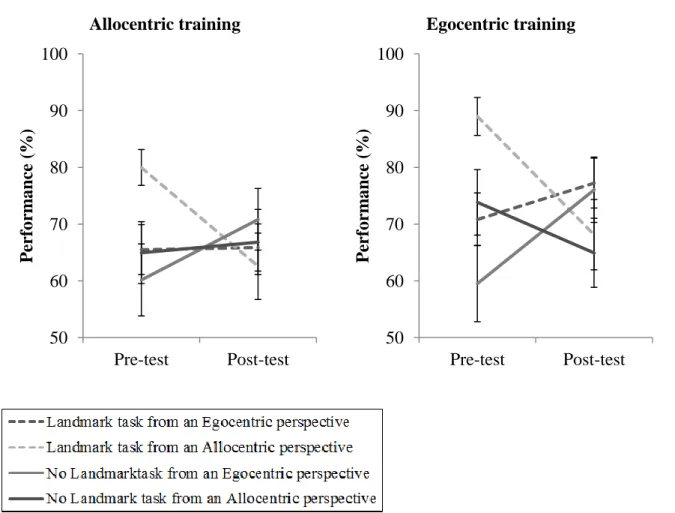
pre- and post-test per training type.
Even though post hoc tests are not allowed when the interaction effect is not significant, the hypothesis is specific and thus post hoc tests were performed. The allocentric training showed a decline in performance on the Landmark tasks from an allocentric perspective (p = .043; see table 3). The egocentic training showed also a decline in performance on the Landmark task from an allocentric perspective (p = .007; see table 3). Other significant effects for the egocentric and allocentric were not found.
Figure 3. Performance on the tasks on the pre-test and post-test per training type. Error bars represent standard errors.
Gender influence on the training
We tested our third hypothesis with a 2 (task type; Landmark vs. No Landmark) x 2 (perspective; egocentric vs. allocentric) x 2 (gender: males vs. females) x 2 (training type: egocentric vs. allocentric) Manova. First, we checked the assumptions again and we decided
50 60 70 80 90 100
Pre-test Post-test
P
er
for
m
an
ce
(%
)
Allocentric training
50 60 70 80 90 100
Pre-test Post-test
P
er
for
m
an
ce
(%
)
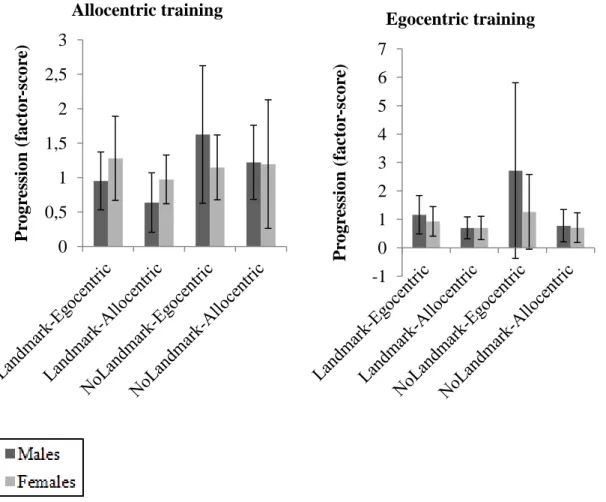
to continue the analysis. The results showed no interaction effect of gender and training type on the progression on the four tasks (Progression on No Landmark task from an egocentric perspective: F(1,39) = .86, p = .360, ƞp2 = .02; Progression on Landmark task from an
egocentric perspective: F(1,39) = 2.44, p = .127, ƞp2 = .06; Progression on No Landmark task
from an allocentric perspective: F(1,39) = .01, p = .922, ƞp2 < .001; Progression on Landmark
task from an allocentric perspective: F(1,39) = 1.88, p = .179, ƞp2 = .05). See figure 4 for a
schematic view.
Figure 4. Progression on the task per training type and per gender. Error bars represent standard errors.
However, there was a significant effect of training type on the progression on the No Landmark task from an allocentric perspective (F(1,39) = 4.58, p = .039, ƞp2 = .11). Further
analysis showed that participants who followed the allocentric training (M = 1.21; SE = .15) showed significantly (p = .039) more progression on the No Landmark task from an allocentric perspective than participants who followed the egocentric training (M = .73; SE = .16). No other effects of training type on navigation progression were found.
Furthermore, an effect on trend level of gender on the progression on No Landmark task from an egocentric perspective was found (F(1,39) = 3.36, p = .075, ƞp2 = .08). Post hoc
analysis showed that males (M = 2.17, SE = .39) showed on trend level (p = .075) more progression on the No Landmark task from an egocentric perspective than females (M = 1.20, SE = .35). No more effects of gender on navigation progression were found.
Other effects
Out of the 2 (time) x 2 (perspective) x 2(task type) x 2(gender) x 2 (training type) two-way Repeated Measures Anova more significant effects and effects on trend level showed up. There was a significant main effect of task type (p = .032; ƞp2 = .12). Participants had a higher
score on the Landmark task (M= 72.38; SE = 1.71) than on the No Landmark task (M= 61.13; SE = 2.49). Moreover, there were significant interaction effects of time x perspective (p < .001; ƞp2 = .30) and time x task type (p = .024; ƞp2 = .13).
A follow up test on the interaction of time x perspective shows that participants had a significant (p < .001) higher score on allocentric perspective tasks (M = 76.93; SE = 2.23) than on egocentric perspective tasks (M = 64.00; SE = 3.07) on the first session. Contrasting, on the second session, participants had a significant (p = .05) higher score on egocentric perspective tasks (M = 72.49; SE = 2.53) than on allocentric perspective tasks (M = 65.61; SE = 2.82). Participants showed a significant (p = .034) improvement of performance on the egocentric perspective tasks (Msession 1 = 64.00; SEsession 1 = 3.07; Msession 2= 72.49; SEsession 2=
2.53) and they show a significant (p < .001) decline of performance on the allocentric perspective tasks (Msession 1 = 76.93; SEsession 1 = 2.23; Msession 2 = 65.61; SEsession 2 = 2.82).
A follow up test on the interaction of time x task type proves that participants had a significant (p = .003) higher score on the Landmark tasks (M = 76.31; SE = 2.35) than on the No Landmark tasks (M = 64.61; SE = 3.19) on the first session. Furthermore, participants show a significant (p = .024) decline of performance on the Landmark tasks (Msession 1 = 76.31;
SEsession 1 = 2.35; Msession 2= 68.44; SEsession 2= 2.43).
There were also four effects on trend level, namely training type x gender (p = .079; ƞp2 = .08), time x training type x gender (p = .072; ƞp2 = .09), time x perspective x gender (p
= .053; ƞp2 = .10) and perspective x task type x training type x gender (p = .095; ƞp2 = .07).
(p = .038) higher on the subtasks than males who followed the allocentric training (M = 61.81; SE = 3.77).
Further analysis on the interaction of time x training type x gender showed that females of the allocentric training (M = 73.32; SE = 3.85) scored significant (p = .035) higher on the tasks on the second session than males of the allocentric training (M = 59.72; SE = 4.62). No more significant post hoc effects of this interaction are found.
Follow up tests on the interaction of time x perspective x gender presented that males showed a significant (p = .016) increase of performance on egocentric perspective tasks (Msession 1 = 59.03; SEsession 1 = 4.478; Msession 2 = 73.61; SEsession 2 = 3.95) and a significant (p
= .001) decrease of performance on allocentric perspective tasks (Msession 1 = 76.74; SEsession 1
= 3.46; Msession 2 = 61.46; SEsession 2 = 4.32). Females showed on trend level (p = .084) an
increase in performance on allocentric perspective tasks (Msession 1 = 76.90; SEsession 1 = 3.06;
Msession 2= 70.38; SEsession 2= 3.82). No more significant post hoc effects of this interaction are
found.
Lastly, post hoc tests on the interaction of perspective x task type x training type x gender illustrated that females who followed the allocentric training (M = 74.038; SE = 5.323) scored marginal significant (p = .053) higher on the No Landmark task from an egocentric perspective tasks, than males who followed the allocentric training (M = 56.94; SE = 6.40). Also, females who followed the allocentric training were on trend level (p = .098) better in Landmark tasks (M= 79.33; SE = 4.77) than in No Landmark tasks (M= 70.67; SE = 4.56), but only from an allocentric perspective. Lastly, males who followed the egocentric training were on trend level (p = .080) better Landmark tasks (M= 68.75; SE = 6.73) than in No landmark tasks (M= 68.75; SE= 6.73), but only from an allocentric perspective.
Discussion
First, we expected males were better in remembering directions without landmarks than females. Contrariwise, we expected females were better in remembering directions with availability of landmarks than males. However, these hypotheses were not supported. It appeared that there were no gender differences in remembering directions with or without landmarks. This is a very useful finding, because it indicates that the tasks we used as diagnostic tool have some characteristics which we can use for clinical usage. While the diagnostic tool did not distinguish between gender. However, our findings are not in line with the literature. Nonetheless, a possible explanation why there were no gender differences in remembering directions without landmarks could be that the tasks which measured this, did not specifically require the ability of using geometric or Euclidean properties to complete the tasks. One could also complete the tasks by remembering actions sequence (first left, then right etc.). Furthermore, we did not find gender differences in remembering directions with availability of landmarks. One reason could be that males have a preference for using geometric information or Euclidean properties while navigating, (Lawton 1994; Dabbs et al., 1997; Sandstrom et al., 1998; Saucier et al., 2002; Coluccia & Louse, 2004), but they also tend to use landmark or environmental information (Sandstrom et al., 1998), just like females Furthermore, perhaps the characteristics of our tasks did not cause gender differences. As described in the introduction, it really depends on the characteristics of the task how the navigation performance of males and females is (Coluccia & Louse, 2004). For instance, females sometimes outperform males only on map drawing tasks (McGuinnes & Sparks, 1983; Coluccia & Louse, 2004). However, our tasks measured directional memory. The conclusion is that there are no gender differences in directional memory tasks, just like there are no gender differences in distance estimation tasks (Holding & Holding, 1989; Coluccia & Louse, 2004).
Additional (positive) influences of the training games on the performance were not seen. This is in contrast with the conclusions of Claessen and colleagues (2016), where this hypothesis is based on. This could be because they used a different study design. For example, Claessen and colleagues (2016) used ten subtasks of the VT test and they based their conclusion on all these subtasks. Nonetheless, if we only evaluate the two subtasks that corresponded with our tasks (route sequence is equal to our No Landmark task and route continuation is equal to our Landmark task), only two of the six patients showed improvement. Moreover, the patients in the study of Claessen and colleagues (2016) followed a more intensive training than our participants. Their training sessions were longer, they received personal guidance during the training and the training was based on their personal needs. All participants in our study received the same exercises per training game and got no personal guidance during the training. We can consider whether we should make the training more personal and with more guidance. However, this is against the economic advantage of our study. Since patients can train themselves at home and less personal guidance is necessary. This saves time and money. Another possible explanation why both training games did not seem to be effective is that we did not check whether our participants actually trained 4 times for 15 minutes. Moreover, some participants mentioned that they had problems with one or more mini games. Some participants reported that a few games discontinued. However, this is due to their computer and not due to the mini game. Participants also reported that they fell through the ground while playing the game. This could be caused by the system on their computer. If the GPU is not good enough, the load order is sometimes incorrect. These two problems are not due to the mini game itself. Despite, there was a bug in trial 2 of level four of the mini game “maintaining a sense of direction toward a starting point”. Because of this, some participants could not complete this mini game. Through these described reasons, some participants were not able to practice one or more mini games. This could also have an influence on our results. Unfortunately, we did not systematically measure these problems, so it was impossible to control this. In summary, factors that seem to be involved in the effectiveness of the training are training hours, personal guidance and personal needs of the patients. Further research should improve their design to systematically measure for actual training sessions and problems in the mini games.
landmarks than males who followed the allocentric training. However, these hypotheses were not confirmed. Apparently, the influence of gender is more nuanced than we thought. It is interesting to investigate when gender differences will be expressed. Yet, it is a very favorable finding that gender does not influence both training games. Since this means that both training games serve both gender types equally and we do not have to develop separate training games for males and females.
In addition to these conclusions, we have discovered more findings. First of all, on the tasks we used in this study, it appeared that type of task (Landmark vs. No Landmark) and type of perspective of the task (egocentric vs. allocentric) influenced navigation performance. This confirms that navigation ability is very complex and that many components are involved. Further research should therefore keep this in mind when considering which task they will use to measure navigation ability. Also there is a relation between the characteristics of the participants and their navigation ability. Gender, preferred navigation strategy and a combination of both seemed to affect navigation ability. Further research can focus on what predicts good navigators; preferred navigation strategy, gender or a combination of both?
When interpreting all the above findings, we have to bear in mind that there were some limitations on this study. The size per group is a first limitation. There were not many participants per group. Because of this, the normality check could not be confirmed. Mainly the data in remembering directions without landmarks was not normally distributed. We actually saw two groups in remembering directions. One group performed around average on the task. The other group performed excellent on the task and had all the trials correct. This is interesting, because it means that one group did remember the sequences of actions from themselves and the other group did not. So there seems to be differences what people are focusing on while watching a route. This is equivalent with the theory of egocentric and allocentric navigation strategies (Klatzky, 1998; Neggers, Schölvinck, van der Lubbe & Postma, 2005; Nowak, Murali & Driscoll, 2015; Postma & van der Ham, 2017). Even though normality was not confirmed, we did our analysis. This influenced the power of our findings and as a consequence does not allow us to draw firm conclusions.
result on the method how we determined the preference of navigation strategy. As described in the method, we did this by using the Starmaze Task. It is questionable whether the Starmaze Task is a good method to determine one’s preference of navigation strategy. The task consists of six trails, whereof five training trials and one probe trial. It is discussable whether these are too many trials. Laziness could appear among the participants in the last trials, while they had to walk the same route every time. This can result in less attention on the probe trial. On the other hand, there had to be enough training trials to learn the participants the correct goal-location. Further research could take this into consideration. Moreover, a critical evaluation of the Starmaze Task is necessary to conclude if it is a good method to determine the preferred navigation strategy.
References
Bell, S., & Saucier, D. (2004). Relationship among environmental pointing accuracy, mental rotation, sex and hormones. Environment and behavior, 36(2), 251-265. doi:
10.1177/0013916503251470
Boccia, M., Nemmi, F., & Guariglia, C. (2014). Neuropsychology of environmental navigation in humans: Review and meta-analysis of fMRI studies in healthy participants. Neuropsychology Review, 24(2), 236- 251. doi:
10.1007/s11065-014-9247-8
Burgess, N. (2006). Spatial memory: How egocentric and allocentric combine. Trends in cognitive sciences, 10(12), 551-557. doi: 10.1016/j.tics.2006.10.005.
Burgess, N. (2008). Spatial cognition and the brain. Annals of the New York Academy of Sciences,1124, 77-97. doi: 10.1196/annals.1440.002
Burkitt J., Widman, D., & Saucier, D. M. (2007). Evidence for the influence of testosterone in the performance of spatial navigation in a virtual water maze in women but not in men.
Hormones and behavior, 51(5), 649-654. doi: 10.1016/j.yhbeh.2007.03.007
Chabanne, V., Peruch, P., Thinus-Blanc, C. (2004). Sex differences and women's hormonal cycle effects on spatial performance in a virtual environment navigation task. Current psychology of cognition, 22(3), 351-375.
Claessen, M. H. G., & van der Ham, I. J. M. (2017). Classification of navigation impairment: A systematic review of neuropsychological case studies. Neuroscience and
Biobehavioral Review, 73, 81-97. doi: 10.1016/j.neubiorev.2016.12.015
Claessen, M. H. G., & van der Ham, I. J. M., Jagersma, E., & Visser-Meily, J. M. A. (2016). Navigation strategy training using virtual reality in six chronic stroke patients: A novel and explorative approach to the rehabilitation of navigation impairment.
Neuropsychological Rehabilitation, 26(5-6), 822-846. doi: 10.1080/09602011.2015.1045910
Coluccia, E., & Louse. G. (2004). Gender differences in spatial orientation: A review. Journal of Environmental Psychology, 4(3), 329-340. doi: 10.1016/j.jenvp.2004.08.006 Cushman., L. A., Stein, K., Duffy, C. J. (2008). Detecting navigational deficits in cognitive
Dabbs, J. M., Chang, E., Strong, R. A., & Milun. R. (1998). Spatial Ability, navigation strategy and geographic knowledge among men and women. Evolution and Human Behavior, 19(2), 89-98. doi: 10.1016/S1090-5138(97)00107-4
Devlin, A. S., & Bernstein, J. (1995). Interactive wayfinding: Use of cues by men and women. Journal of Environmental Psychology,15(1) , 23–38. doi:
10.1016/0272-4944(95)90012-8
Fouqet, C., Tobin, C., & Rondi-Reig, L. (2010). A new approach for modeling episodic memory from rodents to humans: The temporal order memory. Behavioral Brain Research, 215(2), 172-179. doi: 10.1016/j.bbr.2010.05.054
Galea, L. A. M., & Kimura, D. (1993). Sex differences in route learning. Personality and Individual Differences, 14(1), 53–65. doi: 10.1016/0191-8869(93)90174-2
Holding, C. S., & Holding, D. H. (1989). Acquisition of route network knowledge by males and females. The Journal of General Psychology, 116(1), 29–41.
Hort, J., Laczó, J., Vyhnálek, M., Bojar, M., Bures, J., & Vlcek, K. (2007). Spatial navigation deficit in amnestic mild cognitive impairment. Proceedings of the National Academy of Sciences of the United States of America, 104(10), 4042-4047. doi:
10.1073/pnas.0611314104
Iglói, K., Zaoui, M., Berthoz, A., & Rondi-Reig, L. (2009). Sequential egocentric strategy is acquired as early allocentric strategy: Parallel acquisition of these two navigation strategies. Hippocampus, 19(12), 1199-1211. doi: 10.1002/hipo.20595
Kirasic, K. C., Allen, G. L., & Siegel, A. W. (1984). Expression of configurational knowledge of large-scale environments: Students’ performance of cognitive tasks. Environment and Behavior, 16(6), 687–712. doi: 10.1177/0013916584166002
Klatzky, R. L. (1998). Allocentric and egocentric spatial representations: Definitions, distinctions and interconnections. In: Freksa, C., Habel, C., Wender, K. F. (Eds.), Spatial cognition: An interdisciplinary approach to representing and processing
spatial knowledge (pp. 1-17). Germany: Springer.
Lawton, C. A. (1994). Gender differences in way-finding strategies: Relationship to spatial ability and spatial anxiety. Sex Roles, 30(11-12), 765- 779. doi: 10.1007/BF015442 Lawton, C. A. (1996). Strategies for indoor way-finding: The role of orientation. Journal of
Environmental Psychology, 16, 137–145. doi: 10.1006/jevp.1996.0011
Lawton, C. A., & Morrin, K. A. (1999). Gender differences in pointing accuracy in computer simulated 3D mazes. Sex Roles, 40(1/2), 73–92. doi: 0.1023/A:1018830401088
Malinowski, J. C., & Gillespie, W. T. (2001). Individual differences in performance on a large scale, real word wayfinding task. Journal of Environmental Psychology, 21, 73–82. doi: 10.1006/jevp.2000.0183
McGuinness, D., & Sparks, J. (1983). Cognitive style and cognitive maps: Sex differences in representations of a familiar terrain. Journal of Mental Imagery, 7(2), 91–100.
Moffat, S. D., Hampson, E., & Hatzipantelis, M. (1998). Navigation in a virtual maze: Sex differences and correlation with psychometric measures of spatial ability in humans.
Evolution and Human Behavior, 19, 73–87. doi: 10.1016/S1090-5138(97)00104-9 Montello, D. R., & Pick, H. L. (1993). Integrating knowledge of vertically aligned large-scale
spaces. Environment and Behavior, 25(4), 457–484. doi: 10.1177/0013916593253002 Neggers, S. F. W., Schölvinck, M. L., van der Lubbe, R. H. J., & Postma, A. (2005).
Quantifying the interactions between allo- and egocentric representations of space. Acta Psychologica, 118 (1-2), 25-45. doi: 10.1016/j.actpsy.2004.10.002
Nowak, N. T., Murali, A., & Driscroll, I. (2015). Factors related to differences in navigating a computerized maze. Journal of Environmental Psychology, 43, 136-144.
doi: 10.1016/j.jenvp.2015.06.007
O’Laughlin, E. M., & Brubaker, B. S. (1998). Use of landmarks in cognitive mapping: Gender differences in self report versus performance. Personality and Individual Differences, 24(5), 595–601. doi: 10.1016/S0191-8869(97)00237-7
Oudman, E., Van der Stigchel, S., Nijboer, T.C.W., Wijnia, J.W., Seekles, M.L., & Postma, A. (2016). Route learning in Korsakoff's syndrome: Residual acquisition of spatial
memory despite profound amnesia. Journal of Neuropsychology, 10(1), 90-103. doi: 10.1111/jnp.12058
Pai, M.C., & Jacobs, W.J. (2004). Topographical disorientation in community-residing
patients with Alzheimer’s disease. International Journal of Geriatric Psychiatry, 19(3), 250-255. doi: 10.1002/gps.1081
Postma, A. P., & van der Ham, I. J. M. (2017). Neuropsychology of space (First edition). Cambridge, MA: Elsevier Academic Press.
Sandstrom, N. J., Kaufman, J., & Huettel, S. A. (1998). Males and females use different distal cues in a virtual environment navigation task. Cognitive Brain Research, 6(4),
351-360. doi: 10.1016/S0926-6410(98)00002-0
Saucier, D. M., Green, S. M., Leason, J., MacFadden, A., Bell, S., & Elias, L. J. (2002). Are sex differences in navigation caused by sexually dimorphic strategies or by differences in the ability to use the strategies? Behavioral Neuroscienc, 116(3), 403-410.
doi: 0.1037//0735-7044.116.3.403
Taylor, H. A., & Tversky, B. (1992b). Spatial mental models derived from survey and route descriptions. Journal of Memory and Language, 31(2), 261–292. doi: 10.1016/0749-596X(92)90014-O
Van Veen, H. A. H. C., Distler, H. K., Braun, S. J., & Bülthoff, H. H. (1998). Navigating through a virtual city: Using virtual reality technology to study human action and perception. Future Generation Computer Systems, 14(3-4), 231-242.
doi: 10.1016/S0167-739X(98)00027-2
Van der Ham, I. J. M., Kant, N., Postma, A., & Visser-Meily, J. M. A. (2013). Is navigation ability a problem in mild stroke patients? Insights from self-reported navigation measures. Journal of Rehabilitation Medicine, 45(5), 429-433.
doi: 10.2340/16501977-1139
Van der Ham, I. J. M., van Zandvoort, M. J. E., Meilinger, T., Bosch, S. E., Kant, N., & Postma, A. (2010). Spatial and temporal aspects of navigation in two neurological patients. Cognitive neuroscience and neuropsychology, 21(10), 685-689.
doi: 10.1097/WNR.0b013e32833aea78
Verhage, F. (1964). Intelligentie en leeftijd: onderzoek bij Nederlanders van twaalf tot zevenzeventig jaar. Assen: van Gorcum.
Waller, D., Knapp, D., & Hunt, E. (2001). Spatial representations of virtual mazes: The role of visual fidelity and individual differences. Human Factor, 43(1), 147–158. doi: 10.1518/001872001775992561
Wolbers, T., & Hegarty, M. (2010). What determines our navigational abilities? Trends in Cognitive Sciences, 14(3), 138- 146. doi: 10.1016/j.tics.2010.01.001