Coding Freedom
THE ETHICS AND AESTHETICS
OF HACKING
••
E . G A B R I E L L A C O L E M A N
Creative Commons Attribution- NonCommercial- NoDerivs CC BY- NC- ND
Requests for permission to modify material from this work should be sent to Permissions, Princeton University Press
Published by Princeton University Press, 41 William Street, Princeton, New Jersey 08540
In the United Kingdom: Princeton University Press, 6 Oxford Street, Woodstock, Oxfordshire OX20 1TW
press.princeton.edu
All Rights Reserved
At the time of writing of this book, the references to Internet Web sites (URLs) were accurate. Neither the author nor Princeton University Press is responsible for URLs that may have
expired or changed since the manuscript was prepared.
Library of Congress Cataloging-in-Publication Data Coleman, E. Gabriella, 1973–
Coding freedom : the ethics and aesthetics of hacking / E. Gabriella Coleman. p. cm.
Includes bibliographical references and index.
ISBN 978-0-691-14460-3 (hbk. : alk. paper)—ISBN 978-0-691-14461-0 (pbk. : alk. paper) 1. Computer hackers. 2. Computer programmers. 3. Computer programming—Moral and ethical aspects. 4. Computer programming—Social aspects. 5. Intellectual freedom. I. Title.
HD8039.D37C65 2012
174’.90051--dc23 2012031422
British Library Cataloging- in- Publication Data is available
This book has been composed in Sabon
Printed on acid- free paper. ∞
Printed in the United States of America
1 3 5 7 9 10 8 6 4 2
This book is distributed in the hope that it will be useful, but WITHOUT ANY WARRANTY; without even the implied warranty of
We must be free not because we claim freedom, but because we practice it.
— William Faulkner, “On Fear: The South in Labor”
Without models, it’s hard to work; without a context, diffi cult to evaluate; without peers, nearly
impossible to speak.
••
Acknowledgments ix
Introduction
A Tale of Two Worlds 1
PART I HISTORIES Chapter 1
The Life of a Free Software Hacker 25
Chapter 2
A Tale of Two Legal Regimes 61
PART II
CODES OF VALUE Chapter 3
The Craft and Craftiness of Hacking 93
Chapter 4
Two Ethical Moments in Debian 123
PART III
THE POLITICS OF AVOWAL AND DISAVOWAL Chapter 5
Code Is Speech 161
Conclusion
The Cultural Critique of Intellectual Property Law 185
Epilogue
Notes 211
References 225
••
T
his project marks the culmination of a multiyear, multicity endeavor that commenced in earnest during graduate school, found its fi rst stable expression in a dissertation, and has, over a decade later, fully realized it-self with this book. During this long period, over the various stages of this project, many people have left their mark in so many countless ways. Their support, interventions, comments, and presence have not only improved the quality of this work but also simply made it possible. This book could not have been written without all of you, and for that I am deeply grateful.In 1996, at the time of my fi rst exposure to Linux, I was unable to glean its signifi cance. I could not comprehend why a friend was so enthused to have received a CD in the mail equipped with Slackware, a Linux distri-bution. To be frank, my friend’s excitement about software was not only incomprehensible; it also was puzzling. Thankfully about a year later, this person clued me in as to what makes this world extraordinary, doing so initially via my interest at the time: intellectual property law. If it were not for Patrick Crosby, who literally sat me down one day in 1997 to describe the existence of a novel licensing agreement, the GNU General Public License (GPL), I would have likely never embarked on the study of free software and eventually hackers. I am thrilled he decided that some-thing dear to him would be of interest to me. And it was. I was fl oored to discover working alternatives to existing intellectual property instruments. After months of spending hour after hour online, week after week, read-ing about the fl urry of exciting developments reported on Linux Weekly News, Kuro5hin, and Slashdot, it became clear to me that much more than the law was compelling about this world, and that I should turn this distractingly fascinating hobby into my dissertation topic or run the risk of never fi nishing graduate school. Now I not only know why Patrick was happy to have received the Slackware CD back in 1996— and I found he was not alone, because many people have told me about the joy of discov-ering Slackware— but also hope I can convey this passion for technology to others in the pages of this book.
anthropology department (they were right). Members of my dissertation committee have given invaluable insight and support. My cochairs, Jean Comaroff and John Kelly, elongated my project in the sense that they always asked me to think historically. Jean has also inspired me in so many ways, then and now. She is everything a scholar should be, so I thank her for be-ing such a great mentor. Nadia Abu El- Haj encouraged me to examine the sociocultural mechanisms by which technoscience can act as the basis for broader societal transformation. I was extremely fortunate to have Gary Downey and Chris Kelty on board. In 1999, I was inspired by a talk that Gary gave at the American Anthropological Association meetings on the importance of positive critique, and I hope to have contributed to such a project here.
Chris, a geek anthropologist extraordinaire, has added to this project in innumerable ways. Because of his stellar work on free software, his com-ments have been breathlessly on target, and more than any other person, he has pushed this project to fi rmer, more coherent ground. His insistence on not only understanding the world but also (re)shaping it is inspiring, and I hope that I can one day follow in his footsteps. Although Patrice Riemens was not an offi cial adviser, he nonetheless, like any hacker would, shared freely. His advice, especially pertaining to hacker politics, was as indispens-able as the guidance from my offi cial committee members.
Fieldwork, of course, is where the bulk of anthropological research oc-curs. For me, most of that took place in San Francisco, with a short stint in the Netherlands, and throughout copious time was spent online. While there were countless people who made my fi eldwork possible, I have to single out three who really went out on a limb for me, over and over again: Seth Schoen, Praveen Sinha, and Zack Brown. I think each one of you knows how much you have helped me start, proceed with, and fi nish this project, and I am grateful from the bottom of my heart.
Many others have helped me understand with much greater depth what drives people to write free and open- source software (F/OSS). Among those in the Bay Area, I would like to especially thank Brian Behlendorf, Rick Moen, Karsten Self, Don Marti, Mike Higashi, and Evan Prodromou. Also, all the folks at the Electronic Frontier Foundation and Online Policy Group provided me with the invaluable opportunity of interning at their respec-tive organizations. Will Doherty, in particular, deserves a special nod (even though he worked me so hard). Quan Yin also gave me the opportunity to volunteer at its acupuncture clinic, and perhaps more than any other experi-ence, this one kept everything in place and perspective. My Bay Area room-mates, Linda Graham and Nikki Ford, supplied me with an endless stream of support.
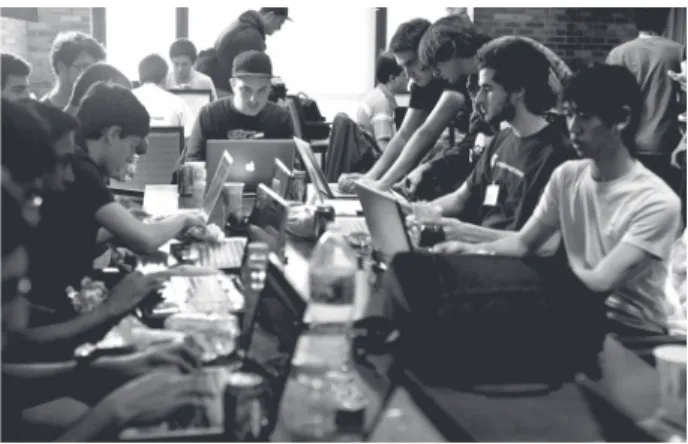
They also organize the best darn hacker conferences in the world, and a big thanks to them (and all the other volunteers) for putting in so much effort to ensure that others can have an amazing time. Niels Hatzmann was a gra-cious host, great biking partner, and now good friend.
A bulk of my work was with Debian and its developers. Ican’t thank these developers enough. Words can’t capture how much I admire the ways in which you have managed to not only produce an operating system (OS) but also a stunningly vibrant online community— a word I rarely use for the Internet, and yet one that absolutely pertains to the case of Debian. I have thoroughly enjoyed my time with everyone as well, whether in person; on Internet Relay Chat (IRC), where countless folks have helped me answer questions and get through the many stages of writing and editing; and most especially, at the various Debconfs I have attended from Edinburgh to Porto Alegre. And after helping to organize Debconf10 in New York City, I was able to fully experience the unmistakable pride that swells when a collec-tive works to conjure something into being. I am deeply grateful for the opportunity to have participated and look forward to attending many more in future times.
Though there are many developers who have taken the time to share their thoughts about Debian and other F/OSS projects, Benjamin “mako” Hill, in particular, has been a close friend and collaborator. I wish him well as he embarks on his own academic career and look forward to future col-laborations. Martin Kraft, Clint Adams, Paul Wise, “vagrant,” Joey Hess, Erinn Clark, and Daniel Khan Gilmore have also been great friends as well as teachers over this journey.
or may have forgotten). Many other professors in and out of the workshop system also read a few of the chapters and offered feedback, especially Tan-ya Luhrmann and Patchen Markell, who provided excellent advice on vari-ous chapters. Susan Gal, Manuela Carneiro Da Cunha, Michael Silverstein, Jessica Cattelinno, Joe Masco, and Judith Farquar at different points also read portions and provided helpful suggestions.
The dissertation formed the bulk of what became this book, which was written in diverse places and weather climates, from scorching summers in San Juan, Puerto Rico, to one of the coldest North American cities, Edmon-ton, Canada. While a postdoctoral fellow at the Center for Cultural Analysis at Rutgers University, I received useful comments from Meredith McGill, Michael Warner, Greg Lastowka, Paula McDowell, Ellen Goodman, Daniel Fisher, and especially Lisa Gitelman, and was also afforded a lively context from which to learn about intellectual property law from the angle of book history. At the University of Alberta, Rob Wilson, Kathleen Lowery, and my offi ce mate Jeff Kochan also read various sections and chapters of the book. I fi nished a good chunk of the book thanks to the support (and amaz-ing peace and quiet) provided by the Institute for Advanced Study. I would like to especially thank Didier Fassin and Tanya Erzen, whose insights have made their way into this book.
There are a few people who also have given important feedback on por-tions of this book, presented at conferences or other venues: Jelena Kara-novic, Kathy Mancuso, Andrew Leonard, Nanodust, Martin Langhoff, Bill Sterner, Margot Browning, Jonas Smedegaard, Danny O’Brien, Cory Docto-row, Graham Jones, Thomas, Malaby, Alan Toner, Samir Chopra, Scott Dex-ter, Jonah Bossewitch, Marc Perlman, and Patrick Davison. Quinn Norton, whose expansive creativity and deep insight into all things geek aided me in toning down the academese, supplied great nuggets of wisdom and insight. Mary Murrell was kind enough to read the entire manuscript, and provide substantive insight and feedback on my arguments and the book’s structure. I am so fortunate that I was able to teach material related to this topic and, especially, to such engaged students (and offer a hat tip to Parker Higgins, Max Salzberg, and Kevin Gotkin, in particular). Everyone in my “home away from home,” #techfed, provided me with essential support through-out this process— humor— and many also offered their suggestions. Even if IRC has been known to draw my attention from writing, I could not have fi nished this book without it.
For my fi rst academic teaching position, I had the amazing fortune of landing at the Department of Media, Culture, and Communication at New York University— fortunate for the collegiality, commitment to excellence, and resources provided to junior faculty. I would like to thank my two chairs, Ted Magder and Marita Sturken, who went to bat for me many times, making New York University such a hospitable home from which to work. My New York University colleague Michael Ralph was one of the most engaging sounding boards, providing invaluable feedback espe-cially on the question of cunning and craft among hackers. My research assistants, James Hodges, Parker Higgins, and especially Matthew Powers, helped enormously with making this book happen.
Various organizations provided me with generous funding, which has been essential for carrying out this research and writing. I graciously ac-knowledge support from the National Science Foundation Grant for a dis-sertation research grant, the Social Science Research Council for a research grant for the study of nonprofi ts, and the Woodrow Wilson National lowship Foundation’s Charlotte W. Newcombe Doctoral Dissertation Fel-lowship for the study of religious and ethical values.
Parts of this book have also been published elsewhere, and have benefi ted tremendously from the anonymous reviewers and journal editors. The last section in chapter 1 was published as “Hacking in Person: The Ritual Char-acter of Conferences and the Distillation of a Lifeworld,” Anthropological Quarterly 83 (1): 47– 72. An earlier version of chapter 5 was published as “Code Is Speech: Legal Tinkering, Expertise, and Protest among Free and Open- Source Software Developers,” CulturalAnthropology 24 (3): 420– 54. Sections of the conclusion can be found in “The Political Agnosticism of Free and Open- Source Software and the Inadvertent Politics of Contrast,”
AnthropologyQuarterly 77 (3): 507– 19.
I am extraordinarily fortunate that my book landed with Princeton Uni-versity Press and Fred Appel. Fred has been such a lively editor and adviser, and I have so enjoyed our many chats over coffee and drinks, and look forward to many more in the future. To the anonymous reviewers: thank you for the kindness, generosity, and fi nely tuned comments that have been essential to completing this book.
One person has had the opportunity to see me through every last step of brainstorming, drafting, writing, rewriting, and complaining: Micah Ander-son. For better and worse, he has experienced the public and private face of this project, graciously showering the pages with perceptive, lively, and espe-cially humorous comments and edits on every last page, all the while provid-ing steadfast support as we tromped from city to city under conditions that were for so many years often challenging. My gratitude is beyond words.
A Tale of Two Worlds
••
F
ree and open- source software (F/OSS) refers to nonproprietary but li-censed software, much of which is produced by technologists located around the globe who coordinate development through Internet- based proj-ects. The developers, hackers, and system administrators who make free software routinely include the following artifact in the software they write:This program is distributed in the hope that it will be useful, but WITHOUT ANY WARRANTY; without even the implied warranty of MERCHANTABIL-ITY or FITNESS FOR A PARTICULAR PURPOSE. See the GNU General Public License for more details.
While seemingly insignifi cant, this warning is quite meaningful for it reveals something important about the nature of free software and my subsequent representation of it. This legal notice is no doubt serious, but it also contains a subtle irony available to those who know about free software. For even if developers cannot legally guarantee the so- called FITNESS of software, they know that in many instances free software is often as useful as or in some cases superior to proprietary software. This fact brings hackers the same sort of pleasure, satisfaction, and pride that they derive when, and if, they are given free reign to hack. Further, even though hackers distribute their free software WITHOUT ANY WARRANTY, the law nevertheless en-ables them to create the software that many deem superior to proprietary software— software that they all “hope [ . . . ] will be useful.” The freedom to labor within a framework of their own making is enabled by licenses that cleverly reformat copyright law to prioritize access, distribution, and circulation. Thus, hackers short- circuit the traditional uses of copyright: the right to exclude and control.
When we speak of free software, we are referring to freedom, not price. Our General Public Licenses are designed to make sure that you have the freedom to distribute copies of free software (and charge for this service if you wish), that you receive source code or can get it if you want it, that you can change the software or use pieces of it in new free programs; and that you know you can do these things.1
This type of language spills far beyond licensing agreements. It is routinely voiced in public discourse and everyday conversation. Such commitments to freedom, access, and transparency are formalized in a Linux distribution known as Debian, one of the most famous free software projects. These values are refl ected in a pair of charters— the Debian Constitution and the Debian Social Contract— that articulate an organizational vision and for-mulate a set of promises to the wider free software community. These char-ters’ names alone unmistakably betray their liberal roots, even if they were not explicitly created with the goal of “advancing” liberal ideals.
By liberalism, I do not mean what may fi rst come to mind: a political party in Europe usually associated with politicians who champion free market solutions, or in the United States, a near synonym for the Demo-cratic Party. Nor is it just an identity that follows from being a proud, card- carrying member of the American Civil Liberties Union or Electronic Fron-tier Foundation, although these certainly can be markers.
Here I take liberalism to embrace historical as well as present- day moral and political commitments and sensibilities that should be familiar to most readers: protecting property and civil liberties, promoting individual auton-omy and tolerance, securing a free press, ruling through limited government and universal law, and preserving a commitment to equal opportunity and meritocracy. These principles, which vary over time and place, are realized institutionally and culturally in various locations at different times. Perhaps the most famous of these are the institutions of higher education, market policies set by transnational institutions, and the press, but they are also at play on the Internet and with computer hackers, such as those who develop free software.2
relationship between hacking and liberalism, and the transformations and tensions evident within the liberal tradition and computer hacking.
A LI B E R A L CR I T I Q U E W I T H I N LI B E R A L I S M
The terms free and open as applied to software are distinct yet often come paired. This is in part because they designate the same alternative licenses and collaborative methodologies, but they differ in their moral orientation: the term free software foremost emphasizes the right to learn and access knowl-edge, while open source tends to fl ag practical benefi ts.3 Many participants,
whether they are volunteers or corporate employees paid to work on free software, refer to themselves with pride as hackers— computer afi cionados driven by an inquisitive passion for tinkering and learning technical systems, and frequently committed to an ethical version of information freedom.
Although hackers hold multiple motivations for producing their software, collectively they are committed to productivefreedom. This term designates the institutions, legal devices, and moral codes that hackers have built in order to autonomously improve on their peers’ work, refi ne their technical skills, and extend craftlike engineering traditions. This ethnography is cen-trally concerned with how hackers have built a dense ethical and technical practice that sustains their productive freedom, and in so doing, how they extend as well as reformulate key liberal ideals such as access, free speech, transparency, equal opportunity, publicity, and meritocracy.
I argue that F/OSS draws from and also rearticulates elements of the liberal tradition. Rather than designating only a set of explicitly held po-litical, economic, or legal views, I treat liberalism in its cultural registers.4
Free software hackers culturally concretize a number of liberal themes and sensibilities— for example, through their competitive mutual aid, avid free speech principles, and implementation of meritocracy along with their fre-quent challenge to intellectual property provisions. Indeed, the ethical phi-losophy of F/OSS focuses on the importance of knowledge, self- cultivation, and self- expression as the vital locus of freedom. Hackers bring these values into being through an astounding range of social and technical practices, covered in detail throughout this book.
The expansion of intellectual property law, as noted by some authors, is part and parcel of a broader neoliberal trend to privatize what was once public or under the state’s aegis, such as health provision, water delivery, and military services. “Neoliberalism is in the fi rst instance,” writes David Harvey (2005, 2), “a theory of political economic practices that proposes human well- being can be best advanced by liberating entrepreneurial free-doms and skills within an institutional framework characterized by strong property rights, free markets, and free trade.” As such, free software hackers not only reveal a long- standing tension within liberal legal rights but also of-fer a targeted critique of the neoliberal drive to make property out of almost anything, including software.
While most of this ethnography illustrates how free software hacking critiques neoliberal trends and reinvents liberal ideals by asserting a strong conception of productive freedom in the face of intellectual property restric-tions, it also addresses the material, affective, and aesthetic dimensions of hacking. In pushing their personal capacities and technologies to new hori-zons (and encountering many frustrations along the way), hackers experi-ence the joy that follows from the self- directed realization of skills, goals, and talents. At times, hacking provides experiences so completely overpowering, they hold the capacity to shred self- awareness, thus cutting into a particular conception of the liberal self— autonomous, authentic, and rational— that these hackers otherwise routinely advance. Thus, at least part of the reason that hacker ethics takes its liberal form is connected to the aesthetic ex-periences of hacking, which are informed by (but not reducible to) liberal idioms and grammars. Hacking, even if tethered to liberal ideologies, spills beyond and exceeds liberal tenets or liberal notions of personhood, most often melding with a more romantic sensibility concerned with a heightened form of individual expression, or in the words of political theorist Nancy Rosenblum (1987, 41), a “perfect freedom.”
FI E L D W O R K A M O N G HA C K E R S
effects, the critique cracked open new theoretical and topical vistas for an-thropological inquiry. An anthropologist like myself, for example, could le-gitimately enter nontraditional “fi eld sites” and address a new set of issues, which included those of technoscientifi c practice, information technologies, and other far- fl ung global processes stretching from labor migration to transnational intellectual property regulations.
Partly due to these disciplinary changes, in winter 2000, I left a snowy Chicago and arrived in a foggy San Francisco to commence what cultural anthropologists regard as our foundational methodological enterprise: fi eld-work. Based on the imperative of total immersion, its driving logic is that we can gain analytic insight by inserting ourselves in the social milieu of those we seek to understand. Fieldwork mandates long- term research, usually a year or more, and includes a host of activities such as participating, watch-ing, listenwatch-ing, recordwatch-ing, data collectwatch-ing, interviewwatch-ing, learning different lan-guages, and asking many questions.
When I told peers of my plan to conduct fi eldwork among hackers, many people, anthropologists and others, questioned it. How does one conduct fi eldwork among hackers, given that they just hang out by themselves or on the Internet? Or among those who do not understand the name, given that they are all “outlaws”? Often playfully mocking me, many of my peers not only questioned how I would gather data but also routinely suggested that my fi eldwork would be “so easy” (or “much easier than theirs”) because I was studying hackers in San Francisco and on the Internet.
The subtext of this light taunting was easy enough to decipher: despite the transformations in anthropology that partially sanctioned my research as legitimate, my object of study nonetheless still struck them as patently atypical. My classmates made use of a socially acceptable medium— joking— to raise what could not be otherwise discussed openly: that my subjects of study, primarily North American and European (and some Latin American) hackers, were perhaps too close to my own cultural world for critical analysis, or perhaps that the very activity of computing (usually seen as an instrumental and solitary activity of pure rationality) could be subject only to thin, anemic cultural meanings.5
I myself wondered how I would ever recognize, much less analyze, forms of cultural value among a group of mostly men of relatively diverse class and national backgrounds who voluntarily band together online in order to create software. Would I have to stretch my ethnographic imagination too far? Or rely on a purely formal and semiotic analysis of texts and objects— a methodology I wanted for various reasons to avoid? Amid these fears, I took some comfort in the idea that, as my peers had indicated, my initial fi eld-work would be free of much of the awkwardness that follows from thrust-ing oneself into the everyday lives of those who you seek to study, typically in an unfamiliar context. At the very least, I could communicate to hackers in English, live in a familiar and cosmopolitan urban setting, and at the end of the day, return to the privacy and comfort of my own apartment.
As it turned out, my early ethnographic experiences proved a challenge in many unexpected ways. The fi rst point of contact, or put more poetically by Clifford Geertz (1977, 413), “the gust of wind stage” of research, was harder than I had imagined. Although not always discussed in such frank terms among anthropologists, showing up at a public gathering, some-times unannounced, and declaring your intent to stay for months, or pos-sibly years, is an extraordinarily diffi cult introduction to pull off to a group of people you seek to formally study. More diffi cult is describing to these strangers, whose typical understanding of anthropology stems from popular media representations like the Indiana Jones trilogy, our methodology of participant observation, which is undertheorized even among anthropolo-gists.6 Along with the awkwardness I experienced during the fi rst few weeks
of fi eldwork, I was usually one of the only females present during hacker gatherings, and as a result felt even more out of place. And while I may have recognized individual words when hackers talked shop with each other— which accounted for a large percentage of their time— they might as well have been speaking another language.
At the start of my research period, then, I rarely wanted to leave my apartment to attend F/OSS hacker social events, user group meetings, or conferences, or participate on email lists or Internet relay chat channels— all of which were important sites for my research. But within a few months, my timidity and ambivalence started to melt away. The reason for this dramatic change of heart was a surprise to me: it was the abundance of humor and laughter among hackers. As I learned more about their technical world and was able to glean their esoteric jokes, I quickly found myself enjoying the endless stream of jokes they made in all sorts of contexts. During a din-ner in San Francisco’s Mission district, at the offi ce while interning at the Electronic Frontier Foundation, or at the monthly gatherings of the Bay Area Linux User Group held in a large Chinatown restaurant, humor was a constant bedfellow.
to feel welcome among the hackers. It soon became clear to me, however, that this was not done for my benefi t; humor saturates the social world of hacking. Hackers, I noticed, had an exhaustive ability to “misuse” most anything and turn it into grist for the humor mill. Once I began to master the esoteric and technical language of pointers, compilers, RFCs, i386, X86, AMD64, core dumps, shells, bash, man pages, PGP, GPG, gnupg, OpenPGP, pipes, world writeable, PCMCIA, chmod, syntactically signifi cant white space, and so on (and really on and on), a rich terrain of jokes became sen-sible to me.
My enjoyment of hacker humor thus provided a recursive sense of com-fort to a novice ethnographer. Along with personally enjoying their joshing around, my comprehension of their jokes indicated a change in my outsider status, which also meant I was learning how to read joking in terms of plea-sure, creativity, and modes of being. Humor is not only the most crystalline expression of the pleasures of hacking (as I will explore later). It is also a crucial vehicle for expressing hackers’ peculiar defi nitions of creativity and individuality, rendering partially visible the technocultural mode of life that is computer hacking. As with clever technical code, to joke in public al-lows hackers to conjure their most creative selves— a performative act that receives public (and indisputable) affi rmation in the moment of laughter. This expression of wit solidifi es the meaning of archetypal hacker selves: self- determined and rational individuals who use their well- developed facul-ties of discrimination and perception to understand the “formal” world— technical or not— around them with such perspicuity that they can intervene virtuously within this logical system either for the sake of play, pedagogy, or technological innovation. In short, they have playfully defi ant attitudes, which they apply to almost any system in order to repurpose it.
A few months into my research, I believed that the primary anthropologi-cal contribution of this project would reside in discussing the cultural mores of computer hacking, such as humor, conjoined with a methodological anal-ysis of conducting research in the virtual space of bits and bytes. Later in my fi eldwork, I came to see the signifi cance of another issue: the close relation-ship between the ethics of free software and the normative, much broader regime of liberalism. Before expanding on this connection, I will fi rst take a short ethnographic detour to specify when it became unmistakably appar-ent that this technical domain was a site where liberal ideals, notably free speech, were not only endowed with concrete meaning but also made the fault lines and cracks within liberalism palpably visible.
••
about fi fty programmers, system administrators, and free software enthu-siasts who were demanding the release of a Russian programmer, Dmitry Sklyarov, arrested weeks earlier in Las Vegas by the Federal Bureau of Investigation (FBI) as he left Defcon, the largest hacker conference in the world. Arrested at the behest of the Silicon Valley software giant Adobe, Sklyarov was charged with violating the recently ratifi ed and controver-sial Digital Millennium Copyright Act (DMCA). He had written a piece of software, the Advanced eBook Processor software, for his Russian em-ployer. The application transforms the Adobe eBook format into the Por-table Document Format (PDF). In order for the software to perform this conversion, it breaks and therefore circumvents the eBook’s copy control measures. As such, the software violated the DMCA’s anticircumvention clause, which states that “no person shall circumvent a technological pro-tection measure that effectively controls access to a work protected under this measure.”7
We had marched from the annual LinuxWorld conference being held in San Francisco’s premier conference center, the Moscone Center, to the fed-eral prosecutor’s offi ce. Along the way, a few homeless men offered sol-idarity by raising their fi sts. Two of them asked if we were marching to “Free Mumia”— an assumption probably infl uenced by the recent string of protests held in Mumia Abu- Jamal’s honor. Indeed, as I learned soon after my fi rst arrival in San Francisco, the city is one of the most active training grounds in the United States for radical activists. This particular spring and summer was especially abuzz with activity, given the prominence of coun-terglobalization mobilizations. But this small and intimate demonstration was not typical among the blizzard of typically left- of- center protests, for none of the participants had a way of conveying quickly nor coherently the nature of the arrest, given how it was swimming in an alphabet soup of acronyms, such as DRM, DMCA, and PDF, as opposed to more familiar ideas like justice and racism. A few members of our entourage nonetheless heartily thanked our unlikely though clearly sympathetic supporters, and assured them that while not as grave as Mumia’s case, Dmitry’s situation still represented an unfair targeting by a corrupt criminal justice system, especially since he was facing up to twenty- fi ve years in jail “simply for writing software.”
Once at the Hall of Justice, an impassioned crew of programmers hud-dled together and held up signs, such as “Do the Right Thing,” “Coding Is Not a Crime,” and “Code Is Speech.”
it was clear that while the link between free speech and source code was fast becoming entrenched as the new technical common sense among many hackers, its history was remarkably recent. Virtually nonexistent in pub-lished discourse before the early 1990s, this depiction now circulates widely and is routinely used to make claims against the indiscriminate application of intellectual property law to software production.
Early in my research, I was well aware that the production of free soft-ware was slowly but consistently dismantling the ideological scaffolding supporting the expansion of copyright and patent law into new realms of production, especially in the US and transnational context. Once I consid-ered how hackers question one central pillar of liberal jurisprudence, intel-lectual property, by reformulating ideals from another one, free speech, it was evident that hackers also unmistakably revealed the fault line between two cherished sets of liberal principles.
While the two- hundred- year history of intellectual property has long been freighted with controversies over the scope, time limits, and purpose of vari-ous of its instruments (Hesse 2002; Johns 2006, 2010; McGill 2002), legal scholars have only recently given serious attention to the uneasy coexistence between free speech and intellectual property principles (McLeod 2007; Ne-tanel 2008; Nimmer 1970; Tushnet 2004). Copyright law, in granting cre-ators signifi cant control over the reproduction and circulation of their work, limits the deployment of copyrighted material in other expressive activity, and consequently censors the public use of certain forms of expressive con-tent. Legal scholar Ray Patterson (1968, 224) states this dynamic eloquently in terms of a clash over the fundamental values of a democratic society: “A society which has freedom of expression as a basic principle of liberty restricts that freedom to the extent that it vests ideas with legally protected property interests.”
Because a commitment to free speech and intellectual property is housed under the same roof— the US Constitution— the potential for con-fl ict has long existed. For most of their legal existence, however, confl ict was
noticeably absent, largely because the scope of both free speech and intel-lectual property law were more contained than they are today. It was only during the course of the twentieth- century that the First Amendment and intellectual property took on the unprecedented symbolic and legal mean-ings they now command in the United States as well as many other nations. (Although the United States has the broadest free speech protections in the world, many other Western nations, even if they limit the scope of speech, have also expanded free speech and intellectual property protections in the last fi fty years.)
For example, copyright, which grants authors signifi cant control over their expression of ideas, was initially limited to fourteen years with one opportunity for renewal. Today, the copyright term in the United States has ballooned to the length of the author’s life plus seventy years, while works for hire get ninety- fi ve years, regardless of the life of the author. The original registration requirement has also been eliminated. Most any expression— a scribble on a piece of paper, a blog post, or a song— automatically qualifi es for protection, so long as it represents the author’s creation.
Free speech jurisprudence follows a similar trajectory. Even though the Constitution famously states that “Congress shall make no law [ . . . ] abridging the freedom of speech, or of the press,” during the fi rst half of the twentieth century the US Supreme Court curtailed many forms of speech, such as political pamphleteering, that are now taken to represent the heart and soul of the democratic process. It is thus easy to forget that the current shape of free speech protections is a fairly recent social development, largely contained within the last fi fty years (Bollinger and Stone 2002).
Due to the growing friction between free speech and intellectual property, US courts in the last twenty- fi ve years have openly broached the issue by asserting that any negative consequences of censoring speech are far out-weighed by the public benefi t of copyright law. In other words, as a mat-ter of public policy, copyright law represents an acceptable restriction on speech because it is the basis for what is designated as “the marketplace of ideas.”8 The theory animating the marketplace of ideas is that if and when
ideas are allowed to publicly compete with each other, the truth— or in its less positivist form, the best policy— will become evident.
TH E AE S T H E T I C S O F HA C K I N G
If free software hackers render the tensions between two liberal principles visible, and offer a targeted, if not wholesale, critique of neoliberalism in challenging intellectual property law (but rarely using the language of neo-liberalism), their commitment to free speech also puts forth a version of the liberal person who strays from the dominant ideas of liberal personhood: a self- interested consumer and rational economic seeker. Among academics, this has often been placed under the rubric of “possessive individualism,” defi ned as “those deeply internalized habits of thinking and feeling [ . . . ] viewing everything around them primarily as actual or potential commercial property” (Graeber 2007, 3; see also Macpherson 1962). Among hackers, selfhood has a distinct register: an autonomous being guided by and com-mitted to rational thought, critical refl ection, skills, and capacity— a set of commitments presupposed in the free speech doctrine (Peters 2005).9
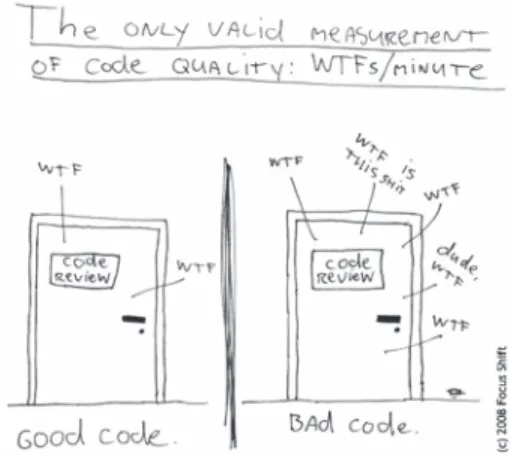
However important these expressive and rational impulses are among programmers, they don’t fully capture the affective stances of hackers, most notably their deep engagement, sometimes born of frustration, and at other times born of pleasure, and sometimes, these two converge. Soon after com-mencing fi eldwork, what I quickly learned is that hacking is characterized by a confl uence of constant occupational disappointments and personal/ collective joys. As many writers have noted, and as I routinely observed, hacking, whether in the form of programming, debugging (squashing er-rors), or running and maintaining systems (such as servers), is consistently frustrating (Rosenberg 2007; Ullman 2003). Computers/software are con-stantly malfunctioning, interoperability is frequently a nightmare to realize, users are often “clueless” about the systems they use (and therefore break them or require constant help), the rate and pace of technological change is relentless, and meeting customer expectations is nearly impossible to pull off predictably. The frustration that generally accompanies the realities of even mundane technical work is depicted as swimming with sharks in xkcd, one of the most beloved geeks’ comic strips (fi gure Intro.2).
What this comic strip captures is how hackers, as they work, sometimes swim in seas of frustration. To tinker, solve problems, and produce soft-ware, especially over one’s lifetime, will invariably be marked by varying degrees of diffi culties and missteps— a state of laboring that one theorist of craftspersonship describes as material “resistance” (Sennett 2008). In en-countering obstacles, adept craftspeople, such as hackers, must also build an abundant “tolerance for frustration” (ibid., 226), a mode of coping that at various points will break down, leading, at best, to feelings of frustration, and at worst, to anguish and even despair and burnout.
In its more mild and commonplace form, hacker pleasure could be said to approximate the Aristotelian theory of eudaemonia, defi ned succinctly by philosopher Martha Nussbaum (2004, 61) as “the unimpeded performance of the activities that constitute happiness.” In pushing their personal capaci-ties and skills though playing around with and making technologies, hack-ers experience the joy that follows from the self- directed realization of skills, goals, and talents. Indeed, overcoming resistance and solving problems, some
of them quite baffl ing, is central to the sense of accomplishment and pride that hackers routinely experience.
Hacker pleasure, however, is not always so staid and controlled; it far exceeds the pride of eudaemonia. Less frequently, but still occurring often, hackers experience a more obsessive and blissful state. Hacker descriptions of immersing themselves in technology remind me of Rainer Maria Rilke’s terse and beautiful depiction of the passion that drives his intellectual pur-suits: “All the soarings of my mind begin in my blood.” This form of plea-sure approximates what Roland Barthes (1975) has portrayed as bliss or jouissance— a pleasure so complete, engrossing, and enveloping that it has the capacity to obliterate every last shred of self- awareness. In native hack jargon, the state of bliss is the “Deep Hack Mode.” Matt Welsh, a well- known hacker and computer scientist, humorously describes the utter mag-netism of this mode, “very few phenomena can pull someone out of Deep Hack Mode, with two noted exceptions: being struck by lightning, or worse, your *computer* being struck by lightning.”10
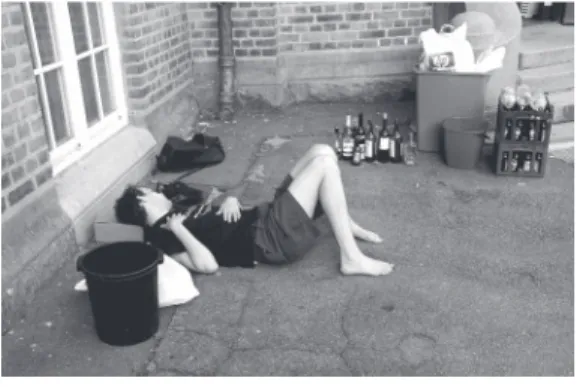
Because hackers often submit their will and being to technology— and are famous for denying their bodies sleep, at least for short periods— the joy that hackers derive from attending to and carefully sculpting tech-nologies are at times experienced as transcendent bliss. In these moments, utility is exceeded. The self can at once express its most inner being and collapse within the objects of its creation. In the aftermath of a particu-larly pleasurable moment of hacking, there is no autonomous liberal self to be found.
To be sure, these forms of pleasure and engagement were impossible for me, the ethnographer, to touch and feel. But I routinely witnessed the so-cial markers of the joy of hacking, as hackers talked shop with each other, as they joked about technical minutiae, and especially during their festive hacker celebrations. The key point is that the multifaceted pleasures of hack-ing signal that utility is not the only drivhack-ing force in hackers’ creative acts. Although hackers are fi ercely pragmatic and utilitarian— technology after all must work, and work exceptionally well— they are also fi ercely poetic and repeatedly affi rm the artistic elements of their work. One of the clearest expressions of technology/software as art is when source code is written as poetry, or alternatively when poetry is written in source code (Black 2002). For many free software hackers, the act of writing software and learning from others far exceeds the simple enactment of an engineering ethic, or a technocratic calculus for the sake of becoming a more profi cient as well as effi cient programmer or system administrator.
Rosenblum (1987, 10), is a “lavish departure from sober individualism,” but also “amounts to an exploitation of liberal ideals.” Although it is important to differentiate liberal from romantic sensibilities, they nonetheless can co-exist without much friction, as Rosenblum contends in her account on Ro-manticism. She draws on various prominent historical fi gures, such as John Stuart Mill and Henry David Thoreau, to examine the compatibilities and symbiosis between liberalism and Romanticism. Hackers, borrowing from free speech commitments and also committed to aesthetic experiences, are a social group whose sensibilities lie at the interface between a more rational liberal calculus and a more aesthetic, inward- looking one.
Hackers are not alone in embracing this aesthetic, expressive sensibility, which philosopher Charles Taylor (1992) argues persuasively is a funda-mental part of our contemporary imaginary, or what he calls the “expres-sive self.” First visibly emerging in the eighteenth century, this sentiment formed the basis for “a new fuller individualism,” and places tremendous weight on originality, sentiments, creativity, and at times, even disengage-ment. What must be noted is that expressive individualism and the moral commitments it most closely entails— self- fulfi llment, self- discovery, and self- improvement— can be secured, as many critics have shown, through consumption, self- help, human enhancement technologies, and body modifi -cation (Bellah et al. 1985; Elliott 2003; Hogle 2005), and thus can converge seamlessly with elements of possessive individualism. Today to liberate and express the “authentic,” “expressive” self is usually synonymous with a life-long engagement with consumption, fi ne tuned by a vast advertising ap-paratus that helps sustain the desire for a seemingly limitless number of consumer goods and, increasingly, human enhancement technologies such as plastic surgery.
The example set by free software (and a host of similar craftlike prac-tices), however, should make us at least skeptical of the extent to which an ethic of consumption has colonized expressive individualism. Free soft-ware hackers undoubtedly affi rm an expressive self rooted not in con-sumption but rather in production in a double sense: they produce soft-ware, and through this technical production, they also sustain informal social relations and even have built institutions. Given the different ethical implications entailed in these visions of fulfi llment, expression, and self- development (consumerist versus productive self), it behooves us to ana-lytically pry them apart.
message. A number of theorists (Galloway 2004; Söderberg 2007; Wark 2004) have previously highlighted this phenomenon. Hackers insistence on never losing access to the fruits of their labor— and indeed actively seeking to share these fruits with others— calls into being Karl Marx’s famous cri-tique of estranged labor: “The external character of labour for the worker appears in the fact that it is not his own, but someone else’s, that it does not belong to him, that in it he belongs, not to himself, but to another” (Marx and Engels 1978, 74). It evokes Marx’s vision precisely because free software developers seek to avoid the forms of estrangement that have long been nearly synonymous with capitalist production. Freedom is thus not only based on the right to speak free of barriers but also conceived as (al-though primarily through practice) “the utopian promise of unalienated la-bor, of human fl ourishing through creative and self- actualizing production,” as Barton Beebe (2010, 885) aptly describes it.
F/OSS hacker morality is therefore syncretic— a quality that is also pa-tently evident in its politics. It enunciates a liberal politics of free speech and liberty that speaks to an audience beyond hackers as well as a nonliberal politics of cultural pleasure and political detachment, which is internally and intensely focused on the practice of hacking only and entirely for its own sake, although certainly inspiring others to follow in their footsteps. When assessing the liberal ethics and affective pleasure of hacking, we should not treat pleasure as the authentic face of hacking, and the other (liberalism) as an ideological veneer simply in need of debunking (or in need of celebrat-ing). From an ethnographic vantage point, it is important to recognize many hackers are citizens of liberal democracies, and have drawn on the types of accessible liberal tropes— notably free speech— as a means to conceptualize their technical practice and secure novel political claims. And in the process, they have built institutions and sustain norms through which they inter-nalize these liberal ideals as meaningful, all the while clearly upholding a marked commitment to unalienated labor.
ON RE P R E S E N T I N G HA C K E R ET H I C S
If I was comforted by the fact that hacking could be analyzed in light of cul-tural issues like humor, liberalism, and pleasure, and that I had some meth-odological tools at my disposal to do so, as I learned more about hacking, my ease vanished as I confronted a new set of concerns. I increasingly grew wary of how I would convey to others the dynamic vitality and diversity that marks hackers and hacking, but also the points of contention among them. To further illustrate this point, allow me to share a brief story.
have chosen, but I started to tell the story of a speech by Kevin Mitnick— a more transgressive hacker (for he had engaged in illegal behavior) than most free software developers and one of the most infamous of all time— that I heard during summer 2004 at Hackers on Planet Earth (HOPE)— a confer-ence founded in 1994 to publicize his legal ordeals. Mitnick is known to have once been a master “social engineer,” or one who distills the aesthet-ics of illicit acts into the human art of the short cons. Instead of piercing through a technological barricade, social engineers target humans, duping them in their insatiable search for secret information. Because of various legendary (and at times, illegal) computer break- ins, often facilitated by his social engineering skills, Mitnick spent a good number of his adult years either running from the law or behind bars, although he never profi ted from his hacks, nor destroyed any property (Coleman and Golub 2008; Mitnick 2011; Thomas 2003).
In July 2004, free at last and allowed to use computers again, Mitnick attended HOPE in New York City for the fi rst time. He delivered his hu-morous and enticing keynote address to an overfl owing crowd of hackers, who listened, enraptured, to the man who had commanded their political attention for over a decade as part of a “Free Kevin Campaign.” He offered tale after tale about his clever pranks of hacking from childhood on: “I think I was born as a hacker because at ten I was fascinated with magic,” he explained. “I wanted a bite of the forbidden fruit.” Even as a kid, his victims were a diverse lot: his homeroom teacher, the phone company, and even the Los Angeles Rapid Transit District. After he bought the same device used by bus drivers for punching transfers, he adopted the persona of Robin Hood, spending hours riding the entire bus network, punching his own pirated transfers to give to customers. He found transfer stubs while dumpster div-ing, another time- honored hacker practice for fi nding information that was especially popular before the advent of paper shredding. Despite the way that lawyers and journalists had used Mitnick’s case to give hackers a bad name, Mitnick clearly still used the term with pride.
To be sure, hackers can be grasped by their similarities. They tend to value a set of liberal principles: freedom, privacy, and access. Hackers also tend to adore computers— the glue that binds them together— and are trained in specialized and esoteric technical arts, primarily programming, system, or Net administration, security research, and hardware hacking. Some gain unauthorized access to technologies, though the degree of illegality varies greatly (and much of hacking is legal). Foremost, hacking, in its different forms and dimensions, embodies an aesthetic where craft and craftiness tightly converge. Hackers thus tend to value playfulness, pranking, and clev-erness, and will frequently perform their wit through source code, humor, or both: humorous code.
Hackers, however, evince considerable diversity and are notoriously sectarian, constantly debating the meaning of the words hack, hacker, and hacking. Yet almost all academic and journalistic work on hackers com-monly whitewashes these differences, and defi nes all hackers as sharing a singular “hacker ethic.” Offering the fi rst defi nition in Hackers: Heroes of the Computer Revolution, journalist Steven Levy (1984, 39) discovered among a couple of generations of MIT hackers a unique as well as “daring symbiosis between man and machine,” where hackers placed the desire to tinker, learn, and create technical beauty above all other goals. The hacker ethic is shorthand for a list of tenets, and it includes a mix of aesthetic and pragmatic imperatives: a commitment to information freedom, a mistrust of authority, a heightened dedication to meritocracy, and the fi rm belief that computers can be the basis for beauty and a better world (ibid., 39– 46).
As I delved deeper into the cultural politics of hacking, though, I began to see serious limitations in making any straightforward connections between the hacker ethic of the past and the free software of the present (much less other hacker practices). Most obviously, to do so is to overlook how ethi-cal precepts take actual form and, more crucially, how they transform over time. For example, in the early 1980s, “the precepts of this revolutionary Hacker Ethic,” Levy (1984, 39; emphasis added) observes, “were not so much debated and discussed as silently agreed upon. NoManifestos were issued.” Yet (and somewhat ironically) a mere year after the publication of his book, MIT programmer Richard Stallman charted the Free Software Foundation (FSF) ([1996] 2010) and issued “The GNU Manifesto,” insist-ing “that the golden rule requires that if I like a program I must share it with other people who like it.”12 Today, hacker manifestos are commonplace. If
hackers did not discuss the intricacies of ethical questions when Levy fi rst studied them, over the span of two decades they would come to argue about ethics, and sometimes as heatedly as they argue over technology. And now many hackers recognize ethical precepts as one important engine driving their productive practices— a central theme to be explored in this book.
Additionally, and as the Mitnick example provided above illustrates so well, the story of the hacker ethic works to elide the tensions that exist among hackers as well as the different genealogies of hacking. Although hacker ethical principles may have a common core— one might even say a general ethos— ethnographic inquiry soon demonstrates that similar to any cultural sphere, we can easily identify great variance, ambiguity, and even serious points of contention.
of antisec is vehemently against any disclosure, claiming, for instance, in one manifesto that it is their “goal that, through mayhem and the destruction of all exploitive and detrimental communities, companies, and individuals, full- disclosure will be abandoned and the security industry will be forced to reform.”13 There is also an important, though currently untold, story about
gaming and hacking, not only because hackers created some of the fi rst computer games, notably Space Wars, written in 1962, but because of the formal similarities between gaming and hacking as well (Dibbell 2006).
National and regional differences make their mark as well. For instance, southern European hackers have followed a more leftist, anarchist tradi-tion than their northern European counterparts. Chinese hackers are quite nationalistic in their aims and aspirations (Henderson 2007), in contrast to those in North America, Latin America, and Europe, whose antiauthoritar-ian stance makes many— though certainly not all— wary of joining govern-ment endeavors.
Finally, while the brilliance of Levy’s account lies in his ability to demon-strate how ethical precepts fundamentally inhere in hacker technical prac-tice, it is important to recognize that hacker ethics, past and present, are not entirely of their own making. Just a quick gloss of the language many hack-ers frequently invoke to describe themselves or formulate ethical claims— freedom, free speech, privacy, the individual, and meritocracy— reveals that many of them unmistakably express liberal visions and romantic sensibili-ties: “We believe in freedom of speech, the right to explore and learn by doing,” explains one hacker editorial, “and the tremendous power of the individual.”14 Once we recognize the intimate connection between hacker
ethics and liberal commitments and the diversity of ethical positions, it is clear that hackers provide less of a unitary and distinguishable ethical posi-tion, and more of a mosaic of interconnected, but at times divergent, ethical principles.
Given this diversity, to which I can only briefl y allude here, the hacker ethic should not be treated as a singular code formulated by some homoge-neous group called hackers but instead as a composite of distinct yet con-nected moral genres. Along with a common set of moral referents, what hacker genres undoubtedly share is a certain relation to legality. Hacker actions or their artifacts are usually either in legally dubious waters or at the cusp of new legal meaning. Hence, they make visible emerging or conten-tious dilemmas.
free software.15 My preference for announcing the “self- conscious, serious
partiality” (Clifford 1986, 7) of this account comes from witnessing mo-tivations, ethical perceptions, desires, and practices far more plastic, fl ex-ible, sublime, contradictory, and especially fi ery and feverish than usually accounted for in academic theories. The world of hacking, as is the case with many cultural worlds, is one of reckless blossoming, or in the words of Rilke: “Everything is blooming most recklessly; if it were voices instead of colors, there would be an unbelievable shrieking into the heart of the night.”
OM I S S I O N S A N D CH A P T E R OV E RV I E W
Some readers may be asking why I have not addressed Silicon Valley entre-preneurship and Web 2.0, both of which might further illuminate the ethics and politics of F/OSS.16 For those interested in Web 2.0— a term that is
ban-died around to refer to nearly all contemporary digital tools and the social practices that cluster around these technologies— you might want to jump to the short epilogue, where I critique this term. It is a moniker that obscures far more than it reveals, for it includes such a wide range of disparate phe-nomena, from corporate platforms like Flickr, to free software projects, to dozens of other digital phenomena. In fact, by exploring in detail free soft-ware’s sociocultural dynamics, I hope this book will make it more diffi cult to group free software in with other digital formations such as YouTube, as the media, pundits, and some academics regularly do under the banner of Web 2.0.
The relationship between Silicon Valley and open source is substantial as well as complicated. Without a doubt, when it comes to computers, hackers, and F/OSS, this high- tech region matters, as I quickly came to learn within weeks of my arrival there. For the last thirty years, hackers have fl ocked to the Bay Area from around the world to make it one of their most cherished homelands, although it certainly is not the only region where hackers have settled and set deep roots. At the turn of this century, open source also be-came the object of Silicon Valley entrepreneurial energy, funding, and hype, even though today the fever for open source has diminished signifi cantly, redirected toward other social media platforms.
The book is thus not primarily about free software in Silicon Valley. In many respects my material tilts toward the North American and European region but, nevertheless, I have chosen to treat free software in more gen-eral than regional registers as well, so as to capture the reality of the legal transnational processes under investigation along with the experience of the thousands and thousands of developers across the world. Debian, for example, has developers from Japan, Australia, Canada, New Zealand, all over western and eastern Europe, Brazil, Venezuela, Argentina, and Mexico.17
and dynamics at play than those found in Silicon Valley, which are too often mistaken to represent the commitments of all engineers, computer scientists, and hackers.18
CodingFreedom is composed of six chapters, divided conceptually into pairs of two. The fi rst two chapters are historically informed, providing the reader with a more general view of free software. Chapter 1 (“The Life of a Free Software Hacker”) provides what is a fairly typical life history of a F/OSS hacker from early childhood to the moment of discovering the “gems” of free software: source code. Compiled from over seventy life histories, I demonstrate how hackers interact and collaborate through virtual technolo-gies, how they formulate liberal discourses through virtual interactions, how they came to learn about free software, and how they individually and col-lectively experience the pleasures of hacking. I also offer an extended discus-sion of the hacker conference, which I argue is the ritual (and pleasurable) underside of discursive publics. Chapter 2 (“A Tale of Two Legal Regimes”) presents what were initially two semi- independent legal regimes that over the last decade have become intertwined. The fi rst story pertains to free software’s maturity into a global movement, and the second turns to the glo-balization and so- called harmonization of intellectual property provisions administered through global institutional bodies like the World Trade Orga-nization. By showing how these trajectories interwove, I emphasize various unexpected and ironic outcomes as I start to elaborate a single development that will continue to receive considerable treatment later in the book: the cultivation, among hackers, of a well- developed legal consciousness.
The fi nal two chapters engage with more overtly political questions, examining two different and contrasting political elements of free soft-ware. Chapter 5 (“Code Is Speech”) addresses two different types of legal pedagogy common among free software developers. First, in the context of Debian, I look at everyday legal learning, where debating and learning about the law is an integral part of project life. I then compare this with a series of dramatic arrests, lawsuits, and political protests that unfolded between 1999– 2004 in the United States, Europe, and Russia, and on the Internet, and that allowed for a more explicit set of connections to be drawn between code and speech. These demonstrations were launched against what was, at the time, a relatively new copyright statute, the DMCA, and the arrest of two programmers. These multiyear protests worked, I argue, to stabilize a relatively nascent cultural claim— nearly nonexistent before the early 1990s— that source code should be protected speech under the First Amendment (or among non- American developers, protected under free speech laws). In contrast to the political avowal of the DMCA protests, my conclusion (“The Politics of Disavowal and the Cultural Critique of Intel-lectual Property Law”) discusses how and why hackers disavow engage-ment in broad- based politics, and instead formulate a narrow politics of software freedom. Because a commitment to the F/OSS principles is what primarily binds hackers together, and because many developers so actively disavow political associations that go beyond software freedom, I contend that the technoscientifi c project of F/OSS has been able to escape the various ideological polarizations (such as liberal versus conservative) so common in our current political climate. F/OSS has thus been taken up by a wide array of differently positioned actors and been placed in a position of signifi cant social legibility whereby it can publicly perform its critique of intellectual property law.
HISTORIES
••
While we read history we make history. — George William Curtis, TheCallofFreedom
T
he next two chapters are general in their scope, meant to introduce read-ers to the world of free software, and do so from two related although distinct vantage points, both historically informed. Chapter 1, as mentioned above, describes a typical life history compiled from over fi fty in- person interviews along with twenty email and/or Internet Relay Chat (IRC) in-terviews. It portrays everyday life and historical transformation as many experience it: in a mundane register, and without the awareness that we are making or are part of history. What it seeks to show is how hackers become hackers slowly over time and through a range of varied activities. This pro-cess, though experienced in quotidian ways, is ultimately a historical affair, for the hackers of yesteryear are not quite the same as those of today, despite crucial continuities. The fi rst chapter tracks some of the changes within free software and also provides basic sociological data about free software de-velopers: where they learned to program, where they work, and how they interact with other developers.Chapter 2 turns away from personal accounts to tell a more global story. It traces two distinct but overlapping legal trajectories and their eventual clash. During the same period in which intellectual property law assumed tremendous and global regulatory power, free software also rose to promi-nence, eventually providing one of the most robust challenges ever to intel-lectual property laws. The legal alternatives made and supported by free software did not always follow from politically motivated action, but rather from the experiences involved in the production of free software. These ex-periences were formative, leading a generation of hackers to become astute legal thinkers and producers— knowledge that was in turn eventually mar-shaled for political protest against the current intellectual property regime.
The Life of a Free Software Hacker
••
One may say that true life begins where the tiny bit begins— where what seems to us minute and infi nitely small alterations take place. True life is not lived where great external changes take place— where people move about, clash, fi ght and slay one another— it is
lived only where these tiny, tiny infi nitesimal changes occur. — Leo Tolstoy, “Why Do Men Stupefy Themselves?”
TH E BA S I C “SP E C S” O F A LI F E W O R L D
A life history, by defi nition, belongs uniquely to one person, textured by innumerable details, instances, events, idiosyncrasies, and happenings.1 As
such, the writing of a “typical” life history is an impossible, quixotic task, seeking to standardize and represent what evades such a neat distillation. Nonetheless, to the best of my ability, here I provide some fairly typical ex-periences derived primarily from seventy interviews and other sources, such as blogs, conversations, and autobiographical tales.
He could not resist. He began to drink himself silly with information on UFOs, bomb building, conspiracies, and other oddities, downloading differ-ent categories of software, shareware, sometimes warez (pirated software), and eventually free software.2 Initially he spent so much time chatting he
would “pass out on his keyboard, multiple times.” The parents, confusing locked doors and nocturnal living with preteen angst and isolation, won-dered whether they should send their son to a psychologist.
Once he met like- minded peers in high school, college, or online, the boy’s intellectual curiosity ballooned. He initiated a quest to master all the ins and outs of a technical architecture like the Linux OS, one or two computer languages, and the topographical terrain and protocols of a really cool new virtual place called the Internet. He soon discovered he could never really master all of this, and that he actually exists in an asymptotic relationship to technology. Nonetheless, he grew to adore the never- ending, never- fi nished nature of technological production, and eventually fell, almost entirely by accident, into a technical movement.
That movement, the free software movement, seemed to describe his per-sonal experiences with technology in a sophisticated yet accessible language. It said that sharing was good for the community, and that access to source code is not only handy but also the basis by which technology grows and improves. Eventually, he understood himself to be connected to a translocal community of hackers and grew increasingly peeved at their stereotyped representation in the media. As he grew older and more fi nancially indepen-dent (thanks to lucrative information technology jobs as a programmer or system administrator that gave him the fi nancial freedom, the “free time,” to code for volunteer projects, or alternatively paid him explicitly to work on free software), he consistently interacted with other geeks at work, over IRC, on a dozen (or more) mailing lists, on free software projects, and less occasionally, at exhausting and superintense hacker conferences that left him feeling simultaneously elated and depressed (because they invariably have to come to an end).