Matters Computational
Ideas, Algorithms, Source Code
CONTENTS iii
Contents
Preface xi
I
Low level algorithms
1
1 Bit wizardry 2
1.1 Trivia . . . 2
1.2 Operations on individual bits . . . 7
1.3 Operations on low bits or blocks of a word . . . 8
1.4 Extraction of ones, zeros, or blocks near transitions . . . 11
1.5 Computing the index of a single set bit . . . 13
1.6 Operations on high bits or blocks of a word . . . 14
1.7 Functions related to the base-2 logarithm . . . 17
1.8 Counting the bits and blocks of a word . . . 18
1.9 Words as bitsets . . . 23
1.10 Index of the i-th set bit . . . 25
1.11 Avoiding branches . . . 25
1.12 Bit-wise rotation of a word . . . 27
1.13 Binary necklaces‡ . . . 29
1.14 Reversing the bits of a word . . . 33
1.15 Bit-wise zip . . . 38
1.16 Gray code and parity . . . 41
1.17 Bit sequency‡ . . . 46
1.18 Powers of the Gray code ‡ . . . 48
1.19 Invertible transforms on words ‡ . . . 49
1.20 Scanning for zero bytes . . . 55
1.21 Inverse and square root modulo 2n . . . 56
1.22 Radix−2 (minus two) representation . . . 58
1.23 A sparse signed binary representation . . . 61
1.24 Generating bit combinations . . . 62
1.25 Generating bit subsets of a given word . . . 68
1.26 Binary words in lexicographic order for subsets . . . 70
1.27 Fibonacci words‡ . . . 74
1.28 Binary words and parentheses strings‡ . . . 78
1.29 Permutations via primitives‡. . . 80
1.30 CPU instructions often missed . . . 82
1.31 Some space filling curves‡ . . . 83
2 Permutations and their operations 102 2.1 Basic definitions and operations . . . 102
2.2 Representation as disjoint cycles . . . 104
2.4 In-place methods to apply permutations to data . . . 109
2.5 Random permutations . . . 111
2.6 The revbin permutation . . . 118
2.7 The radix permutation . . . 121
2.8 In-place matrix transposition . . . 122
2.9 Rotation by triple reversal . . . 123
2.10 The zip permutation . . . 125
2.11 The XOR permutation . . . 127
2.12 The Gray permutation . . . 128
2.13 The reversed Gray permutation . . . 131
3 Sorting and searching 134 3.1 Sorting algorithms . . . 134
3.2 Binary search . . . 141
3.3 Variants of sorting methods . . . 142
3.4 Searching in unsorted arrays . . . 147
3.5 Determination of equivalence classes . . . 148
4 Data structures 153 4.1 Stack (LIFO) . . . 153
4.2 Ring buffer . . . 155
4.3 Queue (FIFO) . . . 156
4.4 Deque (double-ended queue) . . . 158
4.5 Heap and priority queue . . . 160
4.6 Bit-array . . . 164
4.7 Left-right array . . . 166
II
Combinatorial generation
171
5 Conventions and considerations 172 5.1 Representations and orders . . . 1725.2 Ranking, unranking, and counting . . . 172
5.3 Characteristics of the algorithms . . . 173
5.4 Optimization techniques . . . 174
5.5 Implementations, demo-programs, and timings . . . 174
6 Combinations 176 6.1 Binomial coefficients . . . 176
6.2 Lexicographic and co-lexicographic order . . . 177
6.3 Order by prefix shifts (cool-lex) . . . 180
6.4 Minimal-change order . . . 182
6.5 The Eades-McKay strong minimal-change order . . . 183
6.6 Two-close orderings via endo/enup moves . . . 186
6.7 Recursive generation of certain orderings . . . 191
7 Compositions 194 7.1 Co-lexicographic order . . . 194
7.2 Co-lexicographic order for compositions into exactlykparts . . . 196
7.3 Compositions and combinations . . . 198
7.4 Minimal-change orders . . . 199
8 Subsets 202 8.1 Lexicographic order . . . 202
CONTENTS v
8.3 Ordering with De Bruijn sequences . . . 208
8.4 Shifts-order for subsets . . . 208
8.5 k-subsets wherek lies in a given range . . . 210
9 Mixed radix numbers 217 9.1 Counting (lexicographic) order . . . 217
9.2 Minimal-change (Gray code) order . . . 220
9.3 gslex order . . . 224
9.4 endo order . . . 226
9.5 Gray code for endo order . . . 228
9.6 Fixed sum of digits . . . 229
10 Permutations 232 10.1 Factorial representations of permutations . . . 232
10.2 Lexicographic order . . . 242
10.3 Co-lexicographic order . . . 243
10.4 An order from reversing prefixes . . . 245
10.5 Minimal-change order (Heap’s algorithm) . . . 248
10.6 Lipski’s Minimal-change orders . . . 250
10.7 Strong minimal-change order (Trotter’s algorithm) . . . 254
10.8 Star-transposition order . . . 257
10.9 Minimal-change orders from factorial numbers . . . 258
10.10 Derangement order . . . 264
10.11 Orders where the smallest element always moves right . . . 267
10.12 Single track orders . . . 271
11 Permutations with special properties 277 11.1 The number of certain permutations . . . 277
11.2 Permutations with distance restrictions . . . 282
11.3 Self-inverse permutations (involutions) . . . 284
11.4 Cyclic permutations . . . 285
12k-permutations 291 12.1 Lexicographic order . . . 292
12.2 Minimal-change order . . . 293
13 Multisets 295 13.1 Subsets of a multiset . . . 295
13.2 Permutations of a multiset . . . 296
14 Gray codes for strings with restrictions 304 14.1 List recursions . . . 304
14.2 Fibonacci words . . . 305
14.3 Generalized Fibonacci words . . . 307
14.4 Run-length limited (RLL) words . . . 310
14.5 Digitxfollowed by at leastxzeros . . . 311
14.6 Generalized Pell words . . . 313
14.7 Sparse signed binary words . . . 315
14.8 Strings with no two consecutive nonzero digits . . . 317
14.9 Strings with no two consecutive zeros . . . 318
14.10 Binary strings without substrings 1x1 or 1xy1‡ . . . 320
15 Parentheses strings 323 15.1 Co-lexicographic order . . . 323
15.3 Order by prefix shifts (cool-lex) . . . 330
15.4 Catalan numbers . . . 331
15.5 Increment-iRGS,k-ary Dyck words, andk-ary trees . . . 333
16 Integer partitions 339 16.1 Solution of a generalized problem . . . 339
16.2 Iterative algorithm . . . 341
16.3 Partitions intomparts . . . 342
16.4 The number of integer partitions . . . 344
17 Set partitions 354 17.1 Recursive generation . . . 354
17.2 The number of set partitions: Stirling set numbers and Bell numbers . . . 358
17.3 Restricted growth strings . . . 360
18 Necklaces and Lyndon words 370 18.1 Generating all necklaces . . . 371
18.2 Lex-min De Bruijn sequence from necklaces . . . 377
18.3 The number of binary necklaces . . . 379
18.4 Sums of roots of unity that are zero‡ . . . 383
19 Hadamard and conference matrices 384 19.1 Hadamard matrices via LFSR . . . 384
19.2 Hadamard matrices via conference matrices . . . 386
19.3 Conference matrices via finite fields . . . 388
20 Searching paths in directed graphs ‡ 391 20.1 Representation of digraphs . . . 392
20.2 Searching full paths . . . 393
20.3 Conditional search . . . 398
20.4 Edge sorting and lucky paths . . . 402
20.5 Gray codes for Lyndon words . . . 403
III
Fast transforms
409
21 The Fourier transform 410 21.1 The discrete Fourier transform . . . 41021.2 Radix-2 FFT algorithms . . . 411
21.3 Saving trigonometric computations . . . 416
21.4 Higher radix FFT algorithms . . . 418
21.5 Split-radix algorithm . . . 425
21.6 Symmetries of the Fourier transform . . . 428
21.7 Inverse FFT for free . . . 430
21.8 Real-valued Fourier transforms . . . 431
21.9 Multi-dimensional Fourier transforms . . . 437
21.10 The matrix Fourier algorithm (MFA) . . . 438
22 Convolution, correlation, and more FFT algorithms 440 22.1 Convolution . . . 440
22.2 Correlation . . . 444
22.3 Correlation, convolution, and circulant matrices‡ . . . 447
22.4 Weighted Fourier transforms and convolutions . . . 448
22.5 Convolution using the MFA . . . 451
CONTENTS vii
22.7 Prime length FFTs . . . 457
23 The Walsh transform and its relatives 459 23.1 Transform with Walsh-Kronecker basis . . . 459
23.2 Eigenvectors of the Walsh transform ‡ . . . 461
23.3 The Kronecker product . . . 462
23.4 Higher radix Walsh transforms . . . 465
23.5 Localized Walsh transforms . . . 468
23.6 Transform with Walsh-Paley basis . . . 473
23.7 Sequency-ordered Walsh transforms . . . 474
23.8 XOR (dyadic) convolution . . . 481
23.9 Slant transform . . . 482
23.10 Arithmetic transform . . . 483
23.11 Reed-Muller transform . . . 486
23.12 The OR-convolution and the AND-convolution . . . 489
23.13 The MAX-convolution‡. . . 491
23.14 Weighted arithmetic transform and subset convolution . . . 492
24 The Haar transform 497 24.1 The ‘standard’ Haar transform . . . 497
24.2 In-place Haar transform . . . 499
24.3 Non-normalized Haar transforms . . . 501
24.4 Transposed Haar transforms ‡ . . . 503
24.5 The reversed Haar transform‡ . . . 505
24.6 Relations between Walsh and Haar transforms . . . 507
24.7 Prefix transform and prefix convolution . . . 510
24.8 Nonstandard splitting schemes ‡ . . . 512
25 The Hartley transform 515 25.1 Definition and symmetries . . . 515
25.2 Radix-2 FHT algorithms . . . 515
25.3 Complex FFT by FHT . . . 521
25.4 Complex FFT by complex FHT and vice versa . . . 522
25.5 Real FFT by FHT and vice versa . . . 523
25.6 Higher radix FHT algorithms . . . 524
25.7 Convolution via FHT . . . 525
25.8 Localized FHT algorithms . . . 529
25.9 2-dimensional FHTs . . . 530
25.10 Automatic generation of transform code . . . 531
25.11 Eigenvectors of the Fourier and Hartley transform ‡ . . . 533
26 Number theoretic transforms (NTTs) 535 26.1 Prime moduli for NTTs . . . 535
26.2 Implementation of NTTs . . . 537
26.3 Convolution with NTTs . . . 542
27 Fast wavelet transforms 543 27.1 Wavelet filters . . . 543
27.2 Implementation . . . 544
27.3 Moment conditions . . . 546
IV
Fast arithmetic
549
28.1 Splitting schemes for multiplication . . . 550
28.2 Fast multiplication via FFT . . . 558
28.3 Radix/precision considerations with FFT multiplication . . . 560
28.4 The sum-of-digits test . . . 562
28.5 Binary exponentiation . . . 563
29 Root extraction 567 29.1 Division, square root and cube root . . . 567
29.2 Root extraction for rationals . . . 570
29.3 Divisionless iterations for the inversea-th root . . . 572
29.4 Initial approximations for iterations . . . 575
29.5 Some applications of the matrix square root . . . 576
29.6 Goldschmidt’s algorithm . . . 581
29.7 Products for the a-th root‡ . . . 583
29.8 Divisionless iterations for polynomial roots . . . 586
30 Iterations for the inversion of a function 587 30.1 Iterations and their rate of convergence . . . 587
30.2 Schr¨oder’s formula . . . 588
30.3 Householder’s formula . . . 592
30.4 Dealing with multiple roots . . . 593
30.5 More iterations . . . 594
30.6 Convergence improvement by the delta squared process . . . 598
31 The AGM, elliptic integrals, and algorithms for computingπ 599 31.1 The arithmetic-geometric mean (AGM) . . . 599
31.2 The elliptic integralsK andE . . . 600
31.3 Theta functions, eta functions, and singular values . . . 604
31.4 AGM-type algorithms for hypergeometric functions . . . 611
31.5 Computation of π . . . 615
32 Logarithm and exponential function 622 32.1 Logarithm . . . 622
32.2 Exponential function . . . 627
32.3 Logarithm and exponential function of power series . . . 630
32.4 Simultaneous computation of logarithms of small primes . . . 632
32.5 Arctangent relations forπ‡. . . 633
33 Computing the elementary functions with limited resources 641 33.1 Shift-and-add algorithms for logb(x) andbx . . . 641
33.2 CORDIC algorithms . . . 646
34 Numerical evaluation of power series 651 34.1 The binary splitting algorithm for rational series . . . 651
34.2 Rectangular schemes for evaluation of power series . . . 658
34.3 The magic sumalt algorithm for alternating series . . . 662
35 Recurrences and Chebyshev polynomials 666 35.1 Recurrences . . . 666
35.2 Chebyshev polynomials . . . 676
36 Hypergeometric series 685 36.1 Definition and basic operations . . . 685
36.2 Transformations of hypergeometric series . . . 688
CONTENTS ix
36.4 Transformations for elliptic integrals‡ . . . 700
36.5 The function xx ‡ . . . 702
37 Cyclotomic polynomials, product forms, and continued fractions 704 37.1 Cyclotomic polynomials, M¨obius inversion, Lambert series . . . 704
37.2 Conversion of power series to infinite products . . . 709
37.3 Continued fractions . . . 716
38 Synthetic Iterations ‡ 726 38.1 A variation of the iteration for the inverse . . . 726
38.2 An iteration related to the Thue constant . . . 730
38.3 An iteration related to the Golay-Rudin-Shapiro sequence . . . 731
38.4 Iteration related to the ruler function . . . 733
38.5 An iteration related to the period-doubling sequence . . . 734
38.6 An iteration from substitution rules with sign . . . 738
38.7 Iterations related to the sum of digits . . . 739
38.8 Iterations related to the binary Gray code . . . 741
38.9 A function encoding the Hilbert curve . . . 747
38.10 Sparse power series . . . 750
38.11 An iteration related to the Fibonacci numbers . . . 753
38.12 Iterations related to the Pell numbers . . . 757
V
Algorithms for finite fields
763
39 Modular arithmetic and some number theory 764 39.1 Implementation of the arithmetic operations . . . 76439.2 Modular reduction with structured primes . . . 768
39.3 The sieve of Eratosthenes . . . 770
39.4 The Chinese Remainder Theorem (CRT) . . . 772
39.5 The order of an element . . . 774
39.6 Prime modulus: the field Z/pZ=Fp= GF(p) . . . 776
39.7 Composite modulus: the ringZ/mZ . . . 776
39.8 Quadratic residues . . . 781
39.9 Computation of a square root modulo m . . . 784
39.10 The Rabin-Miller test for compositeness . . . 786
39.11 Proving primality . . . 792
39.12 Complex modulus: the field GF(p2) . . . 804
39.13 Solving the Pell equation . . . 812
39.14 Multiplication of hypercomplex numbers ‡ . . . 815
40 Binary polynomials 822 40.1 The basic arithmetical operations . . . 822
40.2 Multiplying binary polynomials of high degree . . . 827
40.3 Modular arithmetic with binary polynomials . . . 832
40.4 Irreducible polynomials . . . 837
40.5 Primitive polynomials . . . 841
40.6 The number of irreducible and primitive polynomials . . . 843
40.7 Transformations that preserve irreducibility . . . 845
40.8 Self-reciprocal polynomials . . . 846
40.9 Irreducible and primitive polynomials of special forms ‡ . . . 848
40.10 Generating irreducible polynomials from Lyndon words . . . 856
40.11 Irreducible and cyclotomic polynomials‡ . . . 857
41 Shift registers 864
41.1 Linear feedback shift registers (LFSR) . . . 864
41.2 Galois and Fibonacci setup . . . 867
41.3 Error detection by hashing: the CRC . . . 868
41.4 Generating all revbin pairs . . . 873
41.5 The number of m-sequences and De Bruijn sequences . . . 873
41.6 Auto-correlation of m-sequences . . . 875
41.7 Feedback carry shift registers (FCSR) . . . 876
41.8 Linear hybrid cellular automata (LHCA) . . . 878
41.9 Additive linear hybrid cellular automata . . . 882
42 Binary finite fields: GF(2n) 886 42.1 Arithmetic and basic properties . . . 886
42.2 Minimal polynomials . . . 892
42.3 Fast computation of the trace vector . . . 895
42.4 Solving quadratic equations . . . 896
42.5 Representation by matrices ‡ . . . 899
42.6 Representation by normal bases . . . 900
42.7 Conversion between normal and polynomial representation . . . 910
42.8 Optimal normal bases (ONB) . . . 912
42.9 Gaussian normal bases . . . 914
A The electronic version of the book 921
B Machine used for benchmarking 922
C The GP language 923
Bibliography 931
Preface
This is a book for thecomputationalist, whether a working programmer or anyone interested in methods of computation. The focus is on material that does not usually appear in textbooks on algorithms.
Where necessary the underlyingideas are explained and thealgorithms are given formally. It is assumed that the reader is able to understand the givensource code, it is considered part of the text. We use the C++ programming language for low-level algorithms. However, only a minimal set of features beyond plain C is used, most importantly classes and templates. For material where technicalities in the C++ code would obscure the underlying ideas we use either pseudocode or, with arithmetical algorithms, the GP language. Appendix C gives an introduction to GP.
Example computations are often given with an algorithm, these are usually made with the demo programs referred to. Most of the listings and figures in this book were created with these programs. A recurring topic is practical efficiency of the implementations. Various optimization techniques are described and the actual performance of many given implementations is indicated.
The accompanying software, the FXT [21] and the hfloat [22] libraries, are written for POSIX compliant platforms such as the Linux and BSD operating systems. The license is the GNU General Public License (GPL), version 3 or later, seehttp://www.gnu.org/licenses/gpl.html.
Individual chapters are self-contained where possible and references to related material are given where needed. The symbol ‘‡’ marks sections that can be skipped at first reading. These typically contain excursions or more advanced material.
Each item in the bibliography is followed by a list of page numbers where citations occur. With papers that are available for free download the respective URL is given. Note that the URL may point to a preprint which can differ from the final version of the paper.
An electronic version of this book is available online, see appendix A. Given the amount of material treated there must be errors in this book. Corrections and suggestions for improvement are appreciated, the preferred way of communication is electronic mail. A list of errata is online athttp://www.jjj.de/ fxt/#fxtbook.
Many people helped to improve this book. It is my pleasure to thank them all, particularly helpful were
and Paul Zimmermann.
Special thanks go to Edith Parzefall and Michael Somos for independently proofreading the whole text (the remaining errors are mine), and to Neil Sloane for creating the On-Line Encyclopedia of Integer Sequences [312].
jj N¨urnberg, Germany, June 2010
“Why make things difficult, when it is possible to make them cryptic and totally illogical, with just a little bit more effort?”
1
Part I
Chapter 1
Bit wizardry
We give low-level functions for binary words, such as isolation of the lowest set bit or counting all set bits. Sometimes the term ‘one’ is used for a set bit and ‘zero’ for an unset bit. Where it cannot cause confusion, the term ‘bit’ is used for a set bit (as in “counting the bits of a word”).
The C-typeunsigned long is abbreviated asulong as defined in [FXT: fxttypes.h]. It is assumed that
BITS_PER_LONG reflects the size of an unsigned long. It is defined in [FXT: bits/bitsperlong.h] and usually equals the machine word size: 32 on 32-bit architectures, and 64 on 64-bit machines. Further, the quantityBYTES_PER_LONGreflects the number of bytes in a machine word: it equalsBITS_PER_LONG
divided by eight. For some functions it is assumed thatlong andulonghave the same number of bits.
Many functions will only work on machines that use two’s complement, which is used by all of the current general purpose computers (the only machines using one’s complement appear to be some successors of the UNIVAC system, see [358, entry “UNIVAC 1100/2200 series”]).
The examples of assembler code are for the x86 and the AMD64 architecture. They should be simple enough to be understood by readers who know assembler for any CPU.
1.1
Trivia
1.1.1
Little endian versus big endian
The order in which the bytes of an integer are stored in memory can start with the least significant byte (little endian machine) or with the most significant byte (big endianmachine). The hexadecimal number
0x0D0C0B0Awill be stored in the following manner if memory addresses grow from left to right:
adr: z z+1 z+2 z+3
mem: 0D 0C 0B 0A // big endian
mem: 0A 0B 0C 0D // little endian
The difference becomes visible when you cast pointers. Let V be the 32-bit integer with the value above. Then the result of char c = *(char *)(&V); will be 0x0A (value modulo 256) on a little endian machine but0x0D (value divided by 224) on a big endian machine. Though friends of big endian sometimes refer to little endian as ‘wrong endian’, the desired result of the shown pointer cast is much more often the modulo operation.
Whenever words are serialized into bytes, as with transfer over a network or to a disk, one will need two code versions, one for big endian and one for little endian machines. The C-typeunion(with words and bytes) may also require separate treatment for big and little endian architectures.
1.1.2
Size of pointer is not size of int
1.1: Trivia 3
1.1.3
Shifts and division
With two’s complement arithmetic division and multiplication by a power of 2 is a right and left shift, respectively. This is true for unsigned types and for multiplication (left shift) with signed types. Division with signed types rounds toward zero, as one would expect, but right shift is a division (by a power of 2) that rounds to−∞:
int a = -1;
int c = a >> 1; // c == -1 int d = a / 2; // d == 0
The compiler still uses a shift instruction for the division, but with a ‘fix’ for negative values:
9:test.cc @ int foo(int a) 10:test.cc @ {
285 0003 8B442410 movl 16(%esp),%eax // move argument to %eax 11:test.cc @ int s = a >> 1;
289 0007 89C1 movl %eax,%ecx 290 0009 D1F9 sarl $1,%ecx
12:test.cc @ int d = a / 2;
293 000b 89C2 movl %eax,%edx
294 000d C1EA1F shrl $31,%edx // fix: %edx=(%edx<0?1:0) 295 0010 01D0 addl %edx,%eax // fix: add one if a<0 296 0012 D1F8 sarl $1,%eax
For unsigned types the shift would suffice. One more reason to use unsigned types whenever possible.
The assembler listing was generated from C code via the following commands:
# create assembler code:
c++ -S -fverbose-asm -g -O2 test.cc -o test.s # create asm interlaced with source lines: as -alhnd test.s > test.lst
There are two types ofright shifts: a logical and anarithmetical shift. The logical version (shrl in the above fragment) always fills the higher bits with zeros, corresponding to division of unsigned types. The arithmetical shift (sarlin the above fragment) fills in ones or zeros, according to the most significant bit of the original word.
Computing remainders modulo a power of 2 with unsigned types is equivalent to a bit-and:
ulong a = b % 32; // == b & (32-1)
All of the above is done by the compiler’s optimization wherever possible.
Division by (compile time) constants can be replaced by multiplications and shifts. The compiler does it for you. A division by the constant 10 is compiled to:
5:test.cc @ ulong foo(ulong a) 6:test.cc @ {
7:test.cc @ ulong b = a / 10;
290 0000 8B442404 movl 4(%esp),%eax
291 0004 F7250000 mull .LC33 // value == 0xcccccccd 292 000a 89D0 movl %edx,%eax
293 000c C1E803 shrl $3,%eax
Therefore it is sometimes reasonable to have separate code branches with explicit special values. Similar optimizations can be used for the modulo operation if the modulus is a compile time constant. For example, using modulus 10,000:
8:test.cc @ ulong foo(ulong a) 9:test.cc @ {
53 0000 8B4C2404 movl 4(%esp),%ecx 10:test.cc @ ulong b = a % 10000;
57 0004 89C8 movl %ecx,%eax
58 0006 F7250000 mull .LC0 // value == 0xd1b71759 59 000c 89D0 movl %edx,%eax
60 000e C1E80D shrl $13,%eax
61 0011 69C01027 imull $10000,%eax,%eax 62 0017 29C1 subl %eax,%ecx
63 0019 89C8 movl %ecx,%eax
Note that the C standard leaves the behavior of a right shift of a signed integer as ‘implementation-defined’. The described behavior (that a negative value remains negative after right shift) is the default behavior of many commonly used C compilers.
1.1.4
A pitfall (two’s complement)
c=... -c=... c= 0 -c= 0 <--= c=...1 -c=1111111111111111 c= 1 -c= -1 c=...1. -c=111111111111111. c= 2 -c= -2 c=...11 -c=11111111111111.1 c= 3 -c= -3 c=...1.. -c=11111111111111.. c= 4 -c= -4 c=...1.1 -c=1111111111111.11 c= 5 -c= -5 c=...11. -c=1111111111111.1. c= 6 -c= -6 [--snip--]
c=.1111111111111.1 -c=1...11 c= 32765 -c=-32765 c=.11111111111111. -c=1...1. c= 32766 -c=-32766 c=.111111111111111 -c=1...1 c= 32767 -c=-32767 c=1... -c=1... c=-32768 -c=-32768 <--= c=1...1 -c=.111111111111111 c=-32767 -c= 32767 c=1...1. -c=.11111111111111. c=-32766 -c= 32766 c=1...11 -c=.1111111111111.1 c=-32765 -c= 32765 c=1...1.. -c=.1111111111111.. c=-32764 -c= 32764 c=1...1.1 -c=.111111111111.11 c=-32763 -c= 32763 c=1...11. -c=.111111111111.1. c=-32762 -c= 32762 [--snip--]
c=1111111111111..1 -c=...111 c= -7 -c= 7 c=1111111111111.1. -c=...11. c= -6 -c= 6 c=1111111111111.11 -c=...1.1 c= -5 -c= 5 c=11111111111111.. -c=...1.. c= -4 -c= 4 c=11111111111111.1 -c=...11 c= -3 -c= 3 c=111111111111111. -c=...1. c= -2 -c= 2 c=1111111111111111 -c=...1 c= -1 -c= 1
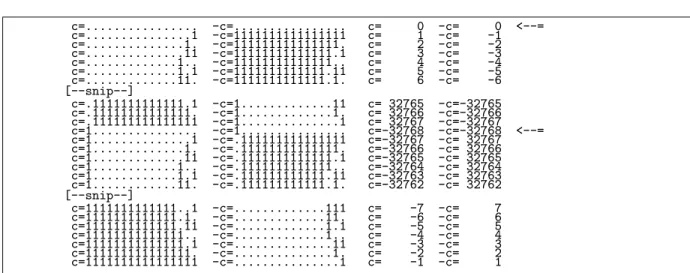
Figure 1.1-A:With two’s complement there is one nonzero value that is its own negative.
In two’s complement zero is not the only number that is equal to its negative. The value with just the highest bit set (the most negative value) also has this property. Figure 1.1-A (the output of [FXT: bits/gotcha-demo.cc]) shows the situation for words of 16 bits. This is why innocent looking code like the following can simply fail:
if ( x<0 ) x = -x;
// assume x positive here (WRONG!)
1.1.5
Another pitfall (shifts in the C-language)
A shift by more thanBITS_PER_LONG−1 is undefined by the C-standard. Therefore the following function can fail ifkis zero:
1 static inline ulong first_comb(ulong k)
2 // Return the first combination of (i.e. smallest word with) k bits,
3 // i.e. 00..001111..1 (k low bits set)
4 {
5 ulong t = ~0UL >> ( BITS_PER_LONG - k );
6 return t;
7 }
Compilers usually emit just a shift instruction which on certain CPUs doesnot give zero if the shift is equal to or greater thanBITS_PER_LONG. This is why the line
if ( k==0 ) t = 0; // shift with BITS_PER_LONG is undefined
has to be inserted just before thereturnstatement.
1.1.6
Shortcuts
Test whether at least one ofaandbequals zero with
if ( !(a && b) )
This works for both signed and unsigned integers. Check whether both are zero with
if ( (a|b)==0 )
This obviously generalizes for several variables as
if ( (a|b|c|..|z)==0 )
1.1: Trivia 5
if ( (!a) ^ (!b) )
1.1.7
Average without overflow
A routine for the computation of the average (x+y)/2 of two argumentsxandyis [FXT: bits/average.h]
1 static inline ulong average(ulong x, ulong y)
2 // Return floor( (x+y)/2 )
3 // Use: x+y == ((x&y)<<1) + (x^y)
4 // that is: sum == carries + sum_without_carries
5 {
6 return (x & y) + ((x ^ y) >> 1);
7 }
The function gives the correct value even if (x+y) does not fit into a machine word. If it is known thatx≥y, then we can use the simpler statementreturn y+(x-y)/2. The following version rounds to infinity:
1 static inline ulong ceil_average(ulong x, ulong y)
2 // Use: x+y == ((x|y)<<1) - (x^y)
3 // ceil_average(x,y) == average(x,y) + ((x^y)&1))
4 {
5 return (x | y) - ((x ^ y) >> 1);
6 }
1.1.8
Toggling between values
To toggle an integerxbetween two valuesaandb, use:
pre-calculate: t = a ^ b;
toggle: x ^= t; // a <--> b
The equivalent trick for floating-point types is
pre-calculate: t = a + b; toggle: x = t - x;
Here an overflow could occur withaandbin the allowed range if both are close to overflow.
1.1.9
Next or previous even or odd value
Compute the next or previous even or odd value via [FXT: bits/evenodd.h]:
1 static inline ulong next_even(ulong x) { return x+2-(x&1); }
2 static inline ulong prev_even(ulong x) { return x-2+(x&1); }
3
4 static inline ulong next_odd(ulong x) { return x+1+(x&1); }
5 static inline ulong prev_odd(ulong x) { return x-1-(x&1); }
The following functions return the unmodified argument if it has the required property, else the nearest such value:
1 static inline ulong next0_even(ulong x) { return x+(x&1); }
2 static inline ulong prev0_even(ulong x) { return x-(x&1); }
3
4 static inline ulong next0_odd(ulong x) { return x+1-(x&1); }
5 static inline ulong prev0_odd(ulong x) { return x-1+(x&1); }
Pedro Gimeno gives [priv. comm.] the following optimized versions:
1 static inline ulong next_even(ulong x) { return (x|1)+1; }
2 static inline ulong prev_even(ulong x) { return (x-1)&~1; }
3
4 static inline ulong next_odd(ulong x) { return (x+1)|1; }
5 static inline ulong prev_odd(ulong x) { return (x&~1)-1; }
1 static inline ulong next0_even(ulong x) { return (x+1)&~1; }
2 static inline ulong prev0_even(ulong x) { return x&~1; }
3
4 static inline ulong next0_odd(ulong x) { return x|1; }
1.1.10
Integer versus float multiplication
The floating-point multiplier gives the highest bits of the product. Integer multiplication gives the result modulo 2b whereb is the number of bits of the integer type used. As an example we square the number 111111111 using a 32-bit integer type and floating-point types with 24-bit and 53-bit mantissa (significand):
a = 111111111 // assignment
a*a == 12345678987654321 // true result
a*a == 1653732529 // result with 32-bit integer multiplication (a*a)%(2**32) == 1653732529 // ... which is modulo (2**bits_per_int)
a*a == 1.2345679481405440e+16 // result with float multiplication (24 bit mantissa) a*a == 1.2345678987654320e+16 // result with float multiplication (53 bit mantissa)
1.1.11
Double precision float to signed integer conversion
Conversion of double precision floats that have a 53-bit mantissa to signed integers via [11, p.52-53]
1 #define DOUBLE2INT(i, d) { double t = ((d) + 6755399441055744.0); i = *((int *)(&t)); }
2 double x = 123.0;
3 int i;
4 DOUBLE2INT(i, x);
can be a faster alternative to
1 double x = 123.0;
2 int i = x;
The constant used is 6755399441055744 = 252+ 251. The method is machine dependent as it relies on the binary representation of the floating-point mantissa. Here it is assumed that, the floating-point number has a 53-bit mantissa with the most significant bit (that is always one with normalized numbers) omitted, and that the address of the number points to the mantissa.
1.1.12
Optimization considerations
Never assume that some code is the ‘fastest possible’. There is always another trick that can still improve performance. Many factors can have an influence on performance, like the number of CPU registers or cost of branches. Code that performs well on one machine might perform badly on another. The old trick to swap variables without using a temporary is pretty much out of fashion today:
// a=0, b=0 a=0, b=1 a=1, b=0 a=1, b=1 a ^= b; // 0 0 1 1 1 0 0 1 b ^= a; // 0 0 1 0 1 1 0 1 a ^= b; // 0 0 1 0 0 1 1 1 // equivalent to: tmp = a; a = b; b = tmp;
However, under some conditions (like extreme register pressure) it may be the way to go. Note that if both operands are identical (memory locations) then the result is zero.
The only way to find out which version of a function is faster is to actually do benchmarking (timing). The performance does depend on the sequence of instructions surrounding the machine code, assuming that all of these low-level functions get inlined. Studying the generated CPU instructions helps to understand what happens, but can never replace benchmarking. This means that benchmarks for just the isolated routine can at best give a rough indication. Test your application using different versions of the routine in question.
Never ever delete the unoptimized version of some code fragment when introducing a streamlined one. Keep the original in the source. If something nasty happens (think of low level software failures when porting to a different platform), you will bevery grateful for the chance to temporarily resort to the slow but correct version.
1.2: Operations on individual bits 7
Proper documentation is an absolute must for optimized code. Always assume that nobody will under-stand the code without comments. You may not be able to underunder-stand uncommented code written by yourself after enough time has passed.
1.2
Operations on individual bits
1.2.1
Testing, setting, and deleting bits
The following functions should be self-explanatory. Following the spirit of the C language there is no check whether the indices used are out of bounds. That is, if any index is greater than or equal to
BITS_PER_LONG, the result is undefined [FXT: bits/bittest.h]:
1 static inline ulong test_bit(ulong a, ulong i)
2 // Return zero if bit[i] is zero,
3 // else return one-bit word with bit[i] set.
4 {
5 return (a & (1UL << i));
6 }
The following version returns either zero or one:
1 static inline bool test_bit01(ulong a, ulong i)
2 // Return whether bit[i] is set.
3 {
4 return ( 0 != test_bit(a, i) );
5 }
Functions for setting, clearing, and changing a bit are:
1 static inline ulong set_bit(ulong a, ulong i)
2 // Return a with bit[i] set.
3 {
4 return (a | (1UL << i));
5 }
1 static inline ulong clear_bit(ulong a, ulong i)
2 // Return a with bit[i] cleared.
3 {
4 return (a & ~(1UL << i));
5 }
1 static inline ulong change_bit(ulong a, ulong i)
2 // Return a with bit[i] changed.
3 {
4 return (a ^ (1UL << i));
5 }
1.2.2
Copying a bit
To copy a bit from one position to another, we generate a one if the bits at the two positions differ. Then an XOR changes the target bit if needed [FXT: bits/bitcopy.h]:
1 static inline ulong copy_bit(ulong a, ulong isrc, ulong idst)
2 // Copy bit at [isrc] to position [idst].
3 // Return the modified word.
4 {
5 ulong x = ((a>>isrc) ^ (a>>idst)) & 1; // one if bits differ
6 a ^= (x<<idst); // change if bits differ
7 return a;
8 }
The situation is more tricky if the bit positions are given as (one bit) masks:
1 static inline ulong mask_copy_bit(ulong a, ulong msrc, ulong mdst)
2 // Copy bit according at src-mask (msrc)
3 // to the bit according to the dest-mask (mdst).
4 // Both msrc and mdst must have exactly one bit set.
5 {
6 ulong x = mdst;
7 if ( msrc & a ) x = 0; // zero if source bit set
8 x ^= mdst; // ==mdst if source bit set, else zero
10 a |= x;
11 return a;
12 }
The compiler generates branch-free code as the conditional assignment is compiled to acmov(conditional move) assembler instruction. If one or both masks have several bits set, the routine will set all bits of
mdstif any of the bits in msrcis one, or else clear all bits ofmdst.
1.2.3
Swapping two bits
A function to swap two bits of a word is [FXT: bits/bitswap.h]:
1 static inline ulong bit_swap(ulong a, ulong k1, ulong k2)
2 // Return a with bits at positions [k1] and [k2] swapped.
3 // k1==k2 is allowed (a is unchanged then)
4 {
5 ulong x = ((a>>k1) ^ (a>>k2)) & 1; // one if bits differ
6 a ^= (x<<k2); // change if bits differ
7 a ^= (x<<k1); // change if bits differ
8 return a;
9 }
If it is known that the bits do have different values, the following routine should be used:
1 static inline ulong bit_swap_01(ulong a, ulong k1, ulong k2)
2 // Return a with bits at positions [k1] and [k2] swapped.
3 // Bits must have different values (!)
4 // (i.e. one is zero, the other one)
5 // k1==k2 is allowed (a is unchanged then)
6 {
7 return a ^ ( (1UL<<k1) ^ (1UL<<k2) );
8 }
1.3
Operations on low bits or blocks of a word
The underlying idea of functions operating on the lowest set bit is that addition and subtraction of 1 always changes a burst of bits at the lower end of the word. The functions are given in [FXT: bits/bitlow.h].
1.3.1
Isolating, setting, and deleting the lowest one
The lowest one (set bit) is isolated via1 static inline ulong lowest_one(ulong x)
2 // Return word where only the lowest set bit in x is set.
3 // Return 0 if no bit is set.
4 {
5 return x & -x; // use: -x == ~x + 1
6 }
The lowest zero (unset bit) is isolated using the equivalent oflowest_one( ~x ):
1 static inline ulong lowest_zero(ulong x)
2 // Return word where only the lowest unset bit in x is set.
3 // Return 0 if all bits are set.
4 {
5 x = ~x;
6 return x & -x;
7 }
Alternatively, we can use either of
1.3: Operations on low bits or blocks of a word 9
The sequence of returned values for x = 0,1, . . . is the highest power of 2 that divides x+ 1, entry A006519 in [312] (see also entry A001511):
x: == x lowest_zero(x)
0: == ... ...1
1: == ...1 ...1.
2: == ...1. ...1
3: == ...11 ...1..
4: == ...1.. ...1
5: == ...1.1 ...1.
6: == ...11. ...1
7: == ...111 ....1...
8: == ....1... ...1
9: == ....1..1 ...1.
10: == ....1.1. ...1
The lowest set bit in a word can be cleared by
1 static inline ulong clear_lowest_one(ulong x)
2 // Return word where the lowest bit set in x is cleared.
3 // Return 0 for input == 0.
4 {
5 return x & (x-1);
6 }
The lowest unset bit can be set by
1 static inline ulong set_lowest_zero(ulong x)
2 // Return word where the lowest unset bit in x is set.
3 // Return ~0 for input == ~0.
4 {
5 return x | (x+1);
6 }
1.3.2
Computing the index of the lowest one
We compute the index (position) of the lowest bit with an assembler instruction if available [FXT: bits/bitasm-amd64.h]:
1 static inline ulong asm_bsf(ulong x)
2 // Bit Scan Forward
3 {
4 asm ("bsfq %0, %0" : "=r" (x) : "0" (x));
5 return x;
6 }
Without the assembler instruction an algorithm that involves O(log2BITS PER LONG) operations can be used. The function can be implemented as follows (suggested by Nathan Bullock [priv. comm.], 64-bit version) [FXT: bits/bitlow.h]:
1 static inline ulong lowest_one_idx(ulong x)
2 // Return index of lowest bit set.
3 // Examples:
4 // ***1 --> 0
5 // **10 --> 1
6 // *100 --> 2
7 // Return 0 (also) if no bit is set.
8 {
9 ulong r = 0;
10 x &= -x; // isolate lowest bit
11 if ( x & 0xffffffff00000000UL ) r += 32;
12 if ( x & 0xffff0000ffff0000UL ) r += 16;
13 if ( x & 0xff00ff00ff00ff00UL ) r += 8;
14 if ( x & 0xf0f0f0f0f0f0f0f0UL ) r += 4;
15 if ( x & 0xccccccccccccccccUL ) r += 2;
16 if ( x & 0xaaaaaaaaaaaaaaaaUL ) r += 1;
17 return r;
18 }
The function returns zero for two inputs, one and zero. If a special value for the input zero is needed, a statement as the following should be added as the first line of the function:
if ( 1>=x ) return x-1; // 0 if 1, ~0 if 0
The following function returns the parity of the index of the lowest set bit in a binary word
1 static inline ulong lowest_one_idx_parity(ulong x)
2 {
4 return 0 != (x & 0xaaaaaaaaaaaaaaaaUL);
5 }
The sequence of values forx= 0,1,2, . . .is
0010001010100010001000101010001010100010101000100010001010100010...
This is the complement of the period-doubling sequence, entry A035263 in [312]. See section 38.5.1 on page 735 for the connection to the towers of Hanoi puzzle.
1.3.3
Isolating blocks of zeros or ones at the low end
Isolate the burst of low ones as follows [FXT: bits/bitlow.h]:1 static inline ulong low_ones(ulong x)
2 // Return word where all the (low end) ones are set.
3 // Example: 01011011 --> 00000011
4 // Return 0 if lowest bit is zero:
5 // 10110110 --> 0
6 {
7 x = ~x;
8 x &= -x;
9 --x;
10 return x;
11 }
The isolation of the low zeros is slightly cheaper:
1 static inline ulong low_zeros(ulong x)
2 // Return word where all the (low end) zeros are set.
3 // Example: 01011000 --> 00000111
4 // Return 0 if all bits are set.
5 {
6 x &= -x;
7 --x;
8 return x;
9 }
The lowest block of ones (which may have zeros to the right of it) can be isolated by
1 static inline ulong lowest_block(ulong x)
2 // Isolate lowest block of ones.
3 // e.g.:
4 // x = *****011100
5 // l = 00000000100
6 // y = *****100000
7 // x^y = 00000111100
8 // ret = 00000011100
9 {
10 ulong l = x & -x; // lowest bit
11 ulong y = x + l;
12 x ^= y;
13 return x & (x>>1);
14 }
1.3.4
Creating a transition at the lowest one
Use the following routines to set a rising or falling edge at the position of the lowest set bit [FXT: bits/bitlow-edge.h]:
1 static inline ulong lowest_one_10edge(ulong x)
2 // Return word where all bits from (including) the
3 // lowest set bit to most significant bit are set.
4 // Return 0 if no bit is set.
5 // Example: 00110100 --> 11111100
6 {
7 return ( x | -x );
8 }
1 static inline ulong lowest_one_01edge(ulong x)
2 // Return word where all bits from (including) the
3 // lowest set bit to the least significant are set.
4 // Return 0 if no bit is set.
1.4: Extraction of ones, zeros, or blocks near transitions 11
6 {
7 if ( 0==x ) return 0;
8 return x^(x-1);
9 }
1.3.5
Isolating the lowest run of matching bits
Letx=∗0W andy=∗1W, the following function computesW:1 static inline ulong low_match(ulong x, ulong y)
2 {
3 x ^= y; // bit-wise difference
4 x &= -x; // lowest bit that differs in both words
5 x -= 1; // mask that covers equal bits at low end
6 x &= y; // isolate matching bits
7 return x;
8 }
1.4
Extraction of ones, zeros, or blocks near transitions
We give functions for the creation or extraction of bit-blocks and the isolation of values near transitions. A transition is a place where adjacent bits have different values. A block is a group of adjacent bits of the same value.
1.4.1
Creating blocks of ones
The following functions are given in [FXT: bits/bitblock.h].
1 static inline ulong bit_block(ulong p, ulong n)
2 // Return word with length-n bit block starting at bit p set.
3 // Both p and n are effectively taken modulo BITS_PER_LONG.
4 {
5 ulong x = (1UL<<n) - 1;
6 return x << p;
7 }
A version with indices wrapping around is
1 static inline ulong cyclic_bit_block(ulong p, ulong n)
2 // Return word with length-n bit block starting at bit p set.
3 // The result is possibly wrapped around the word boundary.
4 // Both p and n are effectively taken modulo BITS_PER_LONG.
5 {
6 ulong x = (1UL<<n) - 1;
7 return (x<<p) | (x>>(BITS_PER_LONG-p));
8 }
1.4.2
Finding isolated ones or zeros
The following functions are given in [FXT: bits/bit-isolate.h]:
1 static inline ulong single_ones(ulong x)
2 // Return word with only the isolated ones of x set.
3 {
4 return x & ~( (x<<1) | (x>>1) );
5 }
We can assume a word is embedded in zeros or ignore the bits outside the word:
1 static inline ulong single_zeros_xi(ulong x)
2 // Return word with only the isolated zeros of x set.
3 {
4 return single_ones( ~x ); // ignore outside values
5 }
1 static inline ulong single_zeros(ulong x)
2 // Return word with only the isolated zeros of x set.
3 {
4 return ~x & ( (x<<1) & (x>>1) ); // assume outside values == 0
1 static inline ulong single_values(ulong x)
2 // Return word where only the isolated ones and zeros of x are set.
3 {
4 return (x ^ (x<<1)) & (x ^ (x>>1)); // assume outside values == 0
5 }
1 static inline ulong single_values_xi(ulong x)
2 // Return word where only the isolated ones and zeros of x are set.
3 {
4 return single_ones(x) | single_zeros_xi(x); // ignore outside values
5 }
1.4.3
Isolating single ones or zeros at the word boundary
1 static inline ulong border_ones(ulong x)
2 // Return word where only those ones of x are set that lie next to a zero.
3 {
4 return x & ~( (x<<1) & (x>>1) );
5 }
1 static inline ulong border_values(ulong x)
2 // Return word where those bits of x are set that lie on a transition.
3 {
4 return (x ^ (x<<1)) | (x ^ (x>>1));
5 }
1.4.4
Isolating transitions
1 static inline ulong high_border_ones(ulong x)
2 // Return word where only those ones of x are set
3 // that lie right to (i.e. in the next lower bin of) a zero.
4 {
5 return x & ( x ^ (x>>1) );
6 }
1 static inline ulong low_border_ones(ulong x)
2 // Return word where only those ones of x are set
3 // that lie left to (i.e. in the next higher bin of) a zero.
4 {
5 return x & ( x ^ (x<<1) );
6 }
1.4.5
Isolating ones or zeros at block boundaries
1 static inline ulong block_border_ones(ulong x)
2 // Return word where only those ones of x are set
3 // that are at the border of a block of at least 2 bits.
4 {
5 return x & ( (x<<1) ^ (x>>1) );
6 }
1 static inline ulong low_block_border_ones(ulong x)
2 // Return word where only those bits of x are set
3 // that are at left of a border of a block of at least 2 bits.
4 {
5 ulong t = x & ( (x<<1) ^ (x>>1) ); // block_border_ones()
6 return t & (x>>1);
7 }
1 static inline ulong high_block_border_ones(ulong x)
2 // Return word where only those bits of x are set
3 // that are at right of a border of a block of at least 2 bits.
4 {
5 ulong t = x & ( (x<<1) ^ (x>>1) ); // block_border_ones()
6 return t & (x<<1);
7 }
1 static inline ulong block_ones(ulong x)
2 // Return word where only those bits of x are set
3 // that are part of a block of at least 2 bits.
4 {
5 return x & ( (x<<1) | (x>>1) );
1.5: Computing the index of a single set bit 13
1.5
Computing the index of a single set bit
In the functionlowest_one_idx()given in section 1.3.2 on page 9 we first isolated the lowest one of a word xby first setting x&=-x. At this point, x contains just one set bit (orx==0). The following lines in the routine compute the index of the only bit set. This section gives some alternative techniques to compute the index of the one in a single-bit word.
1.5.1
Cohen’s trick
modulus m=11
k = 0 1 2 3 4 5 6 7
mt[k]= 0 0 1 8 2 4 9 7
Lowest bit == 0: x= ...1 = 1 x % m= 1 ==> lookup = 0 Lowest bit == 1: x= ...1. = 2 x % m= 2 ==> lookup = 1 Lowest bit == 2: x= ...1.. = 4 x % m= 4 ==> lookup = 2 Lowest bit == 3: x= ....1... = 8 x % m= 8 ==> lookup = 3 Lowest bit == 4: x= ...1.... = 16 x % m= 5 ==> lookup = 4 Lowest bit == 5: x= ..1... = 32 x % m= 10 ==> lookup = 5 Lowest bit == 6: x= .1... = 64 x % m= 9 ==> lookup = 6 Lowest bit == 7: x= 1... = 128 x % m= 7 ==> lookup = 7
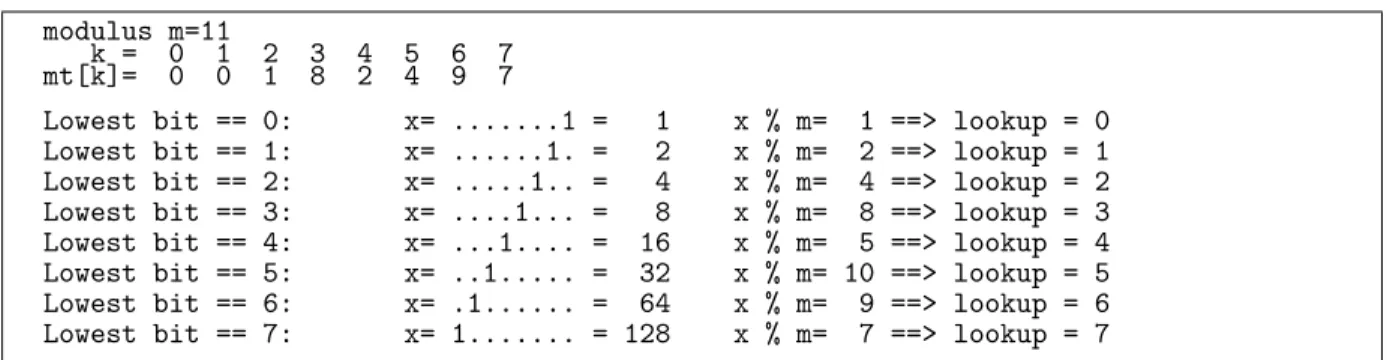
Figure 1.5-A:Determination of the position of a single bit with 8-bit words.
A nice trick is presented in [110]: forN-bit words find a numbermsuch that all powers of 2 are different modulom. That is, the (multiplicative) order of 2 modulom must be greater than or equal toN. We use a table mt[]of sizem that contains the power of 2: mt[(2**j) mod m] = jforj >0. To look up the index of a one-bit-wordxit is reduced modulomandmt[x]is returned.
We demonstrate the method forN = 8 wherem= 11 is the smallest number with the required property. The setup routine for the table is
1 const ulong m = 11; // the modulus
2 ulong mt[m+1];
3 static void mt_setup()
4 {
5 mt[0] = 0; // special value for the zero word
6 ulong t = 1;
7 for (ulong i=1; i<m; ++i)
8 {
9 mt[t] = i-1;
10 t *= 2;
11 if ( t>=m ) t -= m; // modular reduction
12 }
13 }
The entry inmt[0]will be accessed when the input is the zero word. We can use any value to be returned for input zero. Here we simply use zero to always have the same return value as withlowest_one_idx(). The index can be computed by
1 static inline ulong m_lowest_one_idx(ulong x)
2 {
3 x &= -x; // isolate lowest bit
4 x %= m; // power of 2 modulo m
5 return mt[x]; // lookup
6 }
The code is given in the program [FXT: bits/modular-lookup-demo.cc], the output with N = 8 (edited for size) is shown in figure 1.5-A. The following modulim(N) can be used forN-bit words:
N: 4 8 16 32 64 128 256 512 1024 m: 5 11 19 37 67 131 269 523 1061
db=...1.111 (De Bruijn sequence) k = 0 1 2 3 4 5 6 7 dbt[k] = 0 1 2 4 7 3 6 5
Lowest bit == 0: x = ...1 db * x = ...1.111 shifted = ... == 0 ==> lookup = 0 Lowest bit == 1: x = ...1. db * x = ..1.111. shifted = ...1 == 1 ==> lookup = 1 Lowest bit == 2: x = ...1.. db * x = .1.111.. shifted = ...1. == 2 ==> lookup = 2 Lowest bit == 3: x = ....1... db * x = 1.111... shifted = ...1.1 == 5 ==> lookup = 3 Lowest bit == 4: x = ...1.... db * x = .111.... shifted = ...11 == 3 ==> lookup = 4 Lowest bit == 5: x = ..1... db * x = 111... shifted = ...111 == 7 ==> lookup = 5 Lowest bit == 6: x = .1... db * x = 11... shifted = ...11. == 6 ==> lookup = 6 Lowest bit == 7: x = 1... db * x = 1... shifted = ...1.. == 4 ==> lookup = 7
Figure 1.5-B:Computing the position of the single set bit in 8-bit words with a De Bruijn sequence.
1.5.2
Using De Bruijn sequences
The following method (given in [228]) is even more elegant. It uses binary De Bruijn sequences of sizeN. A binary De Bruijn sequence of length 2N contains all binary words of length N, see section 41.1 on
page 864. These are the sequences for 32 and 64 bit, as binary words:
#if BITS_PER_LONG == 32 const ulong db = 0x4653ADFUL;
// == 00000100011001010011101011011111 const ulong s = 32-5;
#else
const ulong db = 0x218A392CD3D5DBFUL;
// == 0000001000011000101000111001001011001101001111010101110110111111 const ulong s = 64-6;
#endif
Letwi be the i-th sub-word from the left (high end). We create a table such that the entry with index
wi points toi:
1 ulong dbt[BITS_PER_LONG];
2 static void dbt_setup()
3 {
4 for (ulong i=0; i<BITS_PER_LONG; ++i) dbt[ (db<<i)>>s ] = i;
5 }
The computation of the index involves a multiplication and a table lookup:
1 static inline ulong db_lowest_one_idx(ulong x)
2 {
3 x &= -x; // isolate lowest bit
4 x *= db; // multiplication by a power of 2 is a shift
5 x >>= s; // use log_2(BITS_PER_LONG) highest bits
6 return dbt[x]; // lookup
7 }
The used sequences must start with at least log2(N)−1 zeros because in the linex *= db the wordx
is shifted (not rotated). The code is given in the demo [FXT: bits/debruijn-lookup-demo.cc], the output withN = 8 (edited for size, dots denote zeros) is shown in figure 1.5-B.
1.5.3
Using floating-point numbers
Floating-point numbers are normalized so that the highest bit in the mantissa is set. Therefore if we convert an integer into a float, the position of thehighestset bit can be read off the exponent. By isolating the lowest bit before that operation, the index can be found with the same trick. However, the conversion between integers and floats is usually slow. Further, the technique is highly machine dependent.
1.6
Operations on high bits or blocks of a word
1.6: Operations on high bits or blocks of a word 15
1.6.1
Isolating the highest one and finding its index
...1111....1111.111 = 0xf0f7 == word ...1... = highest_one
...1111111111111111 = highest_one_01edge 11111111111111111... = highest_one_10edge
15 = highest_one_idx ... = low_zeros ...111 = low_ones ...1 = lowest_one
...1 = lowest_one_01edge 11111111111111111111111111111111 = lowest_one_10edge
0 = lowest_one_idx ...111 = lowest_block ...1111....1111.11. = clear_lowest_one ...1... = lowest_zero ...1111....11111111 = set_lowest_zero ... = high_ones 1111111111111111... = high_zeros 1... = highest_zero 1...1111....1111.111 = set_highest_zero
1111111111111111....1111....1... = 0xffff0f08 == word 1... = highest_one
11111111111111111111111111111111 = highest_one_01edge 1... = highest_one_10edge
31 = highest_one_idx ...111 = low_zeros ... = low_ones ...1... = lowest_one
...1111 = lowest_one_01edge 11111111111111111111111111111... = lowest_one_10edge
3 = lowest_one_idx ...1... = lowest_block 1111111111111111....1111... = clear_lowest_one ...1 = lowest_zero 1111111111111111....1111....1..1 = set_lowest_zero 1111111111111111... = high_ones ... = high_zeros ...1... = highest_zero 11111111111111111...1111....1... = set_highest_zero
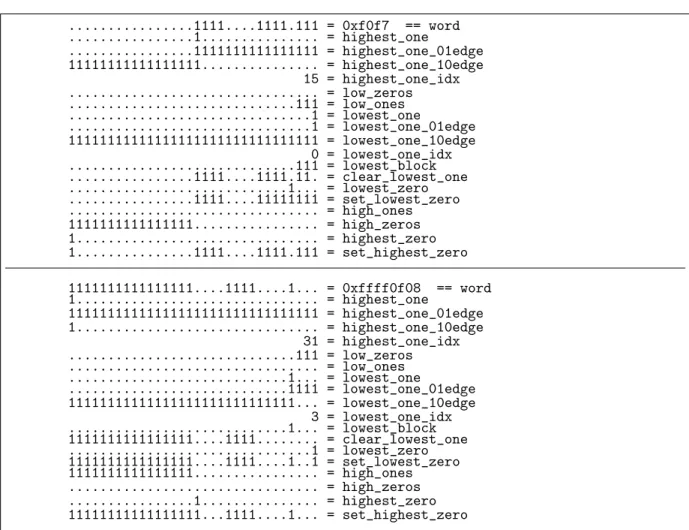
Figure 1.6-A:Operations on the highest and lowest bits (and blocks) of a binary word for two different 32-bit input words. Dots denote zeros.
Isolation of the highest set bit is easy if a bit-scan instruction is available [FXT: bits/bitasm-i386.h]:
1 static inline ulong asm_bsr(ulong x)
2 // Bit Scan Reverse
3 {
4 asm ("bsrl %0, %0" : "=r" (x) : "0" (x));
5 return x;
6 }
Without a bit-scan instruction, we use the auxiliary function [FXT: bits/bithigh-edge.h]
1 static inline ulong highest_one_01edge(ulong x)
2 // Return word where all bits from (including) the
3 // highest set bit to bit 0 are set.
4 // Return 0 if no bit is set.
5 {
6 x |= x>>1;
7 x |= x>>2;
8 x |= x>>4;
9 x |= x>>8;
10 x |= x>>16;
11 #if BITS_PER_LONG >= 64
12 x |= x>>32;
13 #endif
14 return x;
15 }
1 static inline ulong highest_one(ulong x)
2 // Return word where only the highest bit in x is set.
3 // Return 0 if no bit is set.
4 {
5 #if defined BITS_USE_ASM
6 if ( 0==x ) return 0;
7 x = asm_bsr(x);
8 return 1UL<<x;
9 #else
10 x = highest_one_01edge(x);
11 return x ^ (x>>1);
12 #endif // BITS_USE_ASM
13 }
To determine the index of the highest set bit, use
1 static inline ulong highest_one_idx(ulong x)
2 // Return index of highest bit set.
3 // Return 0 if no bit is set.
4 {
5 #if defined BITS_USE_ASM
6 return asm_bsr(x);
7 #else // BITS_USE_ASM
8
9 if ( 0==x ) return 0;
10
11 ulong r = 0;
12 #if BITS_PER_LONG >= 64
13 if ( x & 0xffffffff00000000UL ) { x >>= 32; r += 32; }
14 #endif
15 if ( x & 0xffff0000UL ) { x >>= 16; r += 16; }
16 if ( x & 0x0000ff00UL ) { x >>= 8; r += 8; }
17 if ( x & 0x000000f0UL ) { x >>= 4; r += 4; }
18 if ( x & 0x0000000cUL ) { x >>= 2; r += 2; }
19 if ( x & 0x00000002UL ) { r += 1; }
20 return r;
21 #endif // BITS_USE_ASM
22 }
The branches in the non-assembler part of the routine can be avoided by a technique given in [215, rel.96, sect.7.1.3] (version for 64-bit words):
1 static inline ulong highest_one_idx(ulong x)
2 {
3 #define MU0 0x5555555555555555UL // MU0 == ((-1UL)/3UL) == ...01010101_2
4 #define MU1 0x3333333333333333UL // MU1 == ((-1UL)/5UL) == ...00110011_2
5 #define MU2 0x0f0f0f0f0f0f0f0fUL // MU2 == ((-1UL)/17UL) == ...00001111_2
6 #define MU3 0x00ff00ff00ff00ffUL // MU3 == ((-1UL)/257UL) == (8 ones)
7 #define MU4 0x0000ffff0000ffffUL // MU4 == ((-1UL)/65537UL) == (16 ones)
8 #define MU5 0x00000000ffffffffUL // MU5 == ((-1UL)/4294967297UL) == (32 ones)
9 ulong r = ld_neq(x, x & MU0)
10 + (ld_neq(x, x & MU1) << 1)
11 + (ld_neq(x, x & MU2) << 2)
12 + (ld_neq(x, x & MU3) << 3)
13 + (ld_neq(x, x & MU4) << 4)
14 + (ld_neq(x, x & MU5) << 5);
15 return r;
16 }
The auxiliary functionld_neq()is given in [FXT: bits/bitldeq.h]:
1 static inline bool ld_neq(ulong x, ulong y)
2 // Return whether floor(log2(x))!=floor(log2(y))
3 { return ( (x^y) > (x&y) ); }
The following version for 64-bit words provided by Sebastiano Vigna [priv. comm.] is an implementation of Brodal’s algorithm [215, alg.B, sect.7.1.3]:
1 static inline ulong highest_one_idx(ulong x)
2 {
3 if ( x == 0 ) return 0;
4 ulong r = 0;
5 if ( x & 0xffffffff00000000UL ) { x >>= 32; r += 32; }
6 if ( x & 0xffff0000UL ) { x >>= 16; r += 16; }
7 x |= (x << 16);
8 x |= (x << 32);
1.7: Functions related to the base-2 logarithm 17
10 const ulong z = 0x8000800080008000UL;
11 ulong t = z & ( y | (( y | z ) - ( x ^ y )));
12 t |= (t << 15);
13 t |= (t << 30);
14 t |= (t << 60);
15 return r + ( t >> 60 );
16 }
1.6.2
Isolating the highest block of ones or zeros
Isolate the left block of zeros with the function1 static inline ulong high_zeros(ulong x)
2 // Return word where all the (high end) zeros are set.
3 // e.g.: 00011001 --> 11100000
4 // Returns 0 if highest bit is set:
5 // 11011001 --> 00000000
6 {
7 x |= x>>1;
8 x |= x>>2;
9 x |= x>>4;
10 x |= x>>8;
11 x |= x>>16;
12 #if BITS_PER_LONG >= 64
13 x |= x>>32;
14 #endif
15 return ~x;
16 }
The left block of ones can be isolated using arithmetical right shifts:
1 static inline ulong high_ones(ulong x)
2 // Return word where all the (high end) ones are set.
3 // e.g. 11001011 --> 11000000
4 // Returns 0 if highest bit is zero:
5 // 01110110 --> 00000000
6 {
7 long y = (long)x;
8 y &= y>>1;
9 y &= y>>2;
10 y &= y>>4;
11 y &= y>>8;
12 y &= y>>16;
13 #if BITS_PER_LONG >= 64
14 y &= y>>32;
15 #endif
16 return (ulong)y;
17 }
If arithmetical shifts are more expensive than unsigned shifts, use
1 static inline ulong high_ones(ulong x) { return high_zeros( ~x ); }
A demonstration of selected functions operating on the highest or lowest bit (or block) of binary words is given in [FXT: bits/bithilo-demo.cc]. Part of its output is shown in figure 1.6-A.
1.7
Functions related to the base-2 logarithm
The following functions are given in [FXT: bits/bit2pow.h]. A function that returns blog2(x)ccan be implemented using the obvious algorithm:
1 static inline ulong ld(ulong x)
2 // Return floor(log2(x)),
3 // i.e. return k so that 2^k <= x < 2^(k+1)
4 // If x==0, then 0 is returned (!)
5 {
6 ulong k = 0;
7 while ( x>>=1 ) { ++k; }
8 return k;
9 }
1 static inline ulong ld(ulong x) { return highest_one_idx(x); }
The bit-wise algorithm can be faster if the average result is known to be small.
Use the functionone_bit_q()to determine whether its argument is a power of 2:
1 static inline bool one_bit_q(ulong x)
2 // Return whether x \in {1,2,4,8,16,...}
3 {
4 ulong m = x-1;
5 return (((x^m)>>1) == m);
6 }
The following function does the same except that it returnstruealso for the zero argument:
1 static inline bool is_pow_of_2(ulong x)
2 // Return whether x == 0(!) or x == 2**k
3 { return !(x & (x-1)); }
With FFTs where the length of the transform is often restricted to power of 2 the following functions are useful:
1 static inline ulong next_pow_of_2(ulong x)
2 // Return x if x=2**k
3 // else return 2**ceil(log_2(x))
4 // Exception: returns 0 for x==0
5 {
6 if ( is_pow_of_2(x) ) return x;
7 x |= x >> 1;
8 x |= x >> 2;
9 x |= x >> 4;
10 x |= x >> 8;
11 x |= x >> 16;
12 #if BITS_PER_LONG == 64
13 x |= x >> 32;
14 #endif
15 return x + 1;
16 }
1 static inline ulong next_exp_of_2(ulong x)
2 // Return k if x=2**k else return k+1.
3 // Exception: returns 0 for x==0.
4 {
5 if ( x <= 1 ) return 0;
6 return ld(x-1) + 1;
7 }
The following version should be faster if inline assembler is used forld():
1 static inline ulong next_pow_of_2(ulong x)
2 {
3 if ( is_pow_of_2(x) ) return x;
4 ulong n = 1UL<<ld(x); // n<x
5 return n<<1;
6 }
The following routine for comparison of base-2 logarithms without actually computing them is suggested by [215, rel.58, sect.7.1.3] [FXT: bits/bitldeq.h]:
1 static inline bool ld_eq(ulong x, ulong y)
2 // Return whether floor(log2(x))==floor(log2(y))
3 { return ( (x^y) <= (x&y) ); }
1.8
Counting the bits and blocks of a word
The following functions count the ones in a binary word. They needO(log2(BITS PER LONG)) operations. We give mostly the 64-bit versions [FXT: bits/bitcount.h]:
1 static inline ulong bit_count(ulong x)
2 // Return number of bits set
3 {
4 x = (0x5555555555555555UL & x) + (0x5555555555555555UL & (x>> 1)); // 0-2 in 2 bits
5 x = (0x3333333333333333UL & x) + (0x3333333333333333UL & (x>> 2)); // 0-4 in 4 bits
6 x = (0x0f0f0f0f0f0f0f0fUL & x) + (0x0f0f0f0f0f0f0f0fUL & (x>> 4)); // 0-8 in 8 bits
1.8: Counting the bits and blocks of a word 19
8 x = (0x0000ffff0000ffffUL & x) + (0x0000ffff0000ffffUL & (x>>16)); // 0-32 in 32 bits
9 x = (0x00000000ffffffffUL & x) + (0x00000000ffffffffUL & (x>>32)); // 0-64 in 64 bits
10 return x;
11 }
The underlying idea is to do a search via bit masks. The code can be improved to either
1 x = ((x>>1) & 0x5555555555555555UL) + (x & 0x5555555555555555UL); // 0-2 in 2 bits
2 x = ((x>>2) & 0x3333333333333333UL) + (x & 0x3333333333333333UL); // 0-4 in 4 bits
3 x = ((x>>4) + x) & 0x0f0f0f0f0f0f0f0fUL; // 0-8 in 8 bits
4 x += x>> 8; // 0-16 in 8 bits
5 x += x>>16; // 0-32 in 8 bits
6 x += x>>32; // 0-64 in 8 bits
7 return x & 0xff;
or (taken from [10])
1 x -= (x>>1) & 0x5555555555555555UL; // 0-2 in 2 bits
2 x = ((x>>2) & 0x3333333333333333UL) + (x & 0x3333333333333333UL); // 0-4 in 4 bits
3 x = ((x>>4) + x) & 0x0f0f0f0f0f0f0f0fUL; // 0-8 in 8 bits
4 x *= 0x0101010101010101UL;
5 return x>>56;
Which of the latter two versions is faster mainly depends on the speed of integer multiplication.
The following code for 32-bit words (given by Johan R¨onnblom [priv. comm.]) may be advantageous if loading constants is expensive. Note some constants are in octal notation:
1 static inline uint CountBits32(uint a)
2 {
3 uint mask = 011111111111UL;
4 a = (a - ((a&~mask)>>1)) - ((a>>2)&mask);
5 a += a>>3;
6 a = (a & 070707) + ((a>>18) & 070707);
7 a *= 010101;
8 return ((a>>12) & 0x3f);
9 }
If the table holds the bit-counts of the numbers 0. . . 255, then the bits can be counted as follows:
1 ulong bit_count(ulong x)
2 {
3 unsigned char ct = 0;
4 ct += tab[ x & 0xff ]; x >>= 8;
5 ct += tab[ x & 0xff ]; x >>= 8;
6 [--snip--] /* BYTES_PER_LONG times */
7 ct += tab[ x & 0xff ];
8 return ct;
9 }
However, while table driven methods tend to excel in synthetic benchmarks, they can be very slow if they cause cache misses.
We give a method to count the bits of a word of a special form:
1 static inline ulong bit_count_01(ulong x)
2 // Return number of bits in a word
3 // for words of the special form 00...0001...11
4 {
5 ulong ct = 0;
6 ulong a;
7 #if BITS_PER_LONG == 64
8 a = (x & (1UL<<32)) >> (32-5); // test bit 32
9 x >>= a; ct += a;
10 #endif
11 a = (x & (1UL<<16)) >> (16-4); // test bit 16
12 x >>= a; ct += a;
13
14 a = (x & (1UL<<8)) >> (8-3); // test bit 8
15 x >>= a; ct += a;
16
17 a = (x & (1UL<<4)) >> (4-2); // test bit 4
18 x >>= a; ct += a;
19
20 a = (x & (1UL<<2)) >> (2-1); // test bit 2
21 x >>= a; ct += a;
22
24 x >>= a; ct += a;
25
26 ct += x & 1; // test bit 0
27
28 return ct;
29 }
All branches are avoided, thereby the code may be useful on a planet with pink air, for further details see [301].
1.8.1
Sparse counting
If the (average input) word is known to have only a few bits set, the following sparse count variant can be advantageous:
1 static inline ulong bit_count_sparse(ulong x)
2 // Return number of bits set.
3 {
4 ulong n = 0;
5 while ( x ) { ++n; x &= (x-1); }
6 return n;
7 }
The loop will execute once for each set bit. Partial unrolling of the loop should be an improvement for most cases:
1 ulong n = 0;
2 do
3 {
4 n += (x!=0); x &= (x-1);
5 n += (x!=0); x &= (x-1);
6 n += (x!=0); x &= (x-1);
7 n += (x!=0); x &= (x-1);
8 }
9 while ( x );
10 return n;
If the number of bits is close to the maximum, use the given routine with the complement:
1 static inline ulong bit_count_dense(ulong x)
2 // Return number of bits set.
3 // The loop (of bit_count_sparse()) will execute once for
4 // each unset bit (i.e. zero) of x.
5 {
6 return BITS_PER_LONG - bit_count_sparse( ~x );
7 }
If the number of ones is guaranteed to be less than 16, then the following routine (suggested by Gunther Piez [priv. comm.]) can be used:
1 static inline ulong bit_count_15(ulong x)
2 // Return number of set bits, must have at most 15 set bits.
3 {
4 x -= (x>>1) & 0x5555555555555555UL; // 0-2 in 2 bits
5 x = ((x>>2) & 0x3333333333333333UL) + (x & 0x3333333333333333UL); // 0-4 in 4 bits
6 x *= 0x1111111111111111UL;
7 return x>>60;
8 }
A routine for words with no more than 3 set bits is
1 static inline ulong bit_count_3(ulong x)
2 {
3 x -= (x>>1) & 0x5555555555555555UL; // 0-2 in 2 bits
4 x *= 0x5555555555555555UL;
5 return x>>62;
6 }
1.8.2
Counting blocks
Compute the number of bit-blocks in a binary word with the following function:
1 static inline ulong bit_block_count(ulong x)
2 // Return number of bit blocks.
3 // E.g.: