LECTURE PRESENTATIONS
For CAMPBELL BIOLOGY, NINTH EDITION
Jane B. Reece, Lisa A. Urry, Michael L. Cain, Steven A. Wasserman, Peter V. Minorsky, Robert B. Jackson
Lectures by
Animal Nutrition
• Food is taken in, taken apart, and taken up in the
process of animal nutrition
• In general, animals fall into three categories:
– Herbivores eat mainly plants and algae – Carnivores eat other animals
– Omnivores regularly consume animals as well as plants or algae
• Most animals are also opportunistic feeders
© 2011 Pearson Education, Inc.
Concept 41.1: An animal’s diet must supply
chemical energy, organic molecules, and
essential nutrients
• An animal’s diet provides:
– Chemical energy, which is converted into ATP to power cellular processes
– Organic building blocks, such as organic carbon and organic nitrogen, to synthesize a variety of organic molecules
Essential Nutrients
• There are four classes of essential nutrients:
– Essential amino acids – Essential fatty acids – Vitamins
– Minerals
• Animals require 20 amino acids and can
synthesize about half from molecules in their diet
• The remaining amino acids, the essential amino
acids, must be obtained from food in preassembled form
• Meat, eggs, and cheese provide all the essential
amino acids and are thus “complete” proteins
Essential Fatty Acids
• Animals can synthesize most of the fatty acids
they need
• The essential fatty acids must be obtained from the diet and include certain unsaturated fatty
acids (i.e., fatty acids with one or more double bonds)
• Deficiencies in fatty acids are rare
Vitamins
• Vitamins are organic molecules required in the diet in small amounts
• Thirteen vitamins are essential for humans
• Vitamins are grouped into two categories:
Minerals
• Minerals are simple inorganic nutrients, usually required in small amounts
• Ingesting large amounts of some minerals can
Assessing Nutritional Needs
• Genetic defects that disrupt food uptake provide
information about human nutrition
– For example, hemochromatosis causes iron buildup without excessive iron intake
• Insights into human nutrition have come from
epidemiology, the study of human health and disease in populations
• Neural tube defects were found to be the result of
Concept 41.2: The main stages of food
processing are ingestion, digestion,
absorption, and elimination
• Ingestion is the act of eating
Figure 41.5 Mechanical digestion Chemical digestion (enzymatic hydrolysis) Nutrient molecules enter body cells
Undigested material Elimination Absorption Digestion Ingestion
Bulk Feeders
Suspension Feeders and Filter Feeders
Fluid Feeders
Baleen
Feces Caterpillar
Substrate Feeders
Suspension Feeders
• Many aquatic animals are suspension feeders,
Substrate Feeders
• Substrate feeders are animals that live in or on their food source
Fluid Feeders
Bulk Feeders
• Bulk feeders eat relatively large pieces of food
• Digestion is the process of breaking food down into molecules small enough to absorb
• Mechanical digestion, including chewing,
increases the surface area of food
• Chemical digestion splits food into small
molecules that can pass through membranes; these are used to build larger molecules
• In chemical digestion, the process of enzymatic
• Absorption is uptake of nutrients by body cells
• Elimination is the passage of undigested material out of the digestive system
Digestive Compartments
• Most animals process food in specialized
compartments
• These compartments reduce the risk of an
• More complex animals have a digestive tube with two openings, a mouth and an anus
• This digestive tube is called a complete
digestive tract or an alimentary canal
• It can have specialized regions that carry out
digestion and absorption in a stepwise fashion
Concept 41.3: Organs specialized for
sequential stages of food processing
form the mammalian digestive system
• The mammalian digestive system consists of an
alimentary canal and accessory glands that secrete digestive juices through ducts
• Mammalian accessory glands are the salivary
• Food is pushed along by peristalsis, rhythmic contractions of muscles in the wall of the canal
• Valves called sphincters regulate the movement
of material between compartments
The Oral Cavity, Pharynx, and Esophagus
• The first stage of digestion is mechanical and
takes place in the oral cavity
• Salivary glands deliver saliva to lubricate food
• Teeth chew food into smaller particles that are
exposed to salivary amylase, initiating
breakdown of glucose polymers
• Saliva also contains mucus, a viscous mixture of
water, salts, cells, and glycoproteins
• The tongue shapes food into a bolus and provides help with swallowing
• The throat, or pharynx, is the junction that opens
to both the esophagus and the trachea
• The esophagus connects to the stomach
• The esophagus conducts food from the pharynx down to the stomach by peristalsis
• Swallowing causes the epiglottis to block entry to
the trachea, and the bolus is guided by the larynx, the upper part of the respiratory tract
• Coughing occurs when the swallowing reflex fails
and food or liquids reach the windpipe
Tongue Pharynx Glottis Larynx Bolus of food Epiglottis up Esophageal sphincter contracted Esophagus
Digestion in the Stomach
• The stomach stores food and secretes gastric juice, which converts a meal to acid chyme
Chemical Digestion in the Stomach
• Gastric juice has a low pH of about 2, which kills
bacteria and denatures proteins
• Gastric juice is made up of hydrochloric acid
(HCl) and pepsin
• Pepsin is a protease, or protein-digesting
• Parietal cells secrete hydrogen and chloride ions separately into the lumen (cavity) of the stomach
• Chief cells secrete inactive pepsinogen, which
is activated to pepsin when mixed with hydrochloric acid in the stomach
• Mucus protects the stomach lining from gastric
juice
Digestion in the Small Intestine
• The small intestine is the longest section of the alimentary canal
• It is the major organ of digestion and absorption
Fat digestion Nucleic acid digestion
Protein digestion Fat (triglycerides) DNA, RNA Nucleotides Pancreatic nucleases Pancreatic lipase
• The first portion of the small intestine is the
duodenum, where chyme from the stomach mixes with digestive juices from the pancreas, liver, gallbladder, and the small intestine itself
Pancreatic Secretions
• The pancreas produces proteases trypsin and chymotrypsin that are activated in the lumen of the duodenum
• Its solution is alkaline and neutralizes the acidic
Bile Production by the Liver
• In the small intestine, bile aids in digestion and
absorption of fats
• Bile is made in the liver and stored in the
gallbladder
• Bile also destroys nonfunctional red blood cells
Secretions of the Small Intestine
• The epithelial lining of the duodenum produces
several digestive enzymes
• Enzymatic digestion is completed as peristalsis
moves the chyme and digestive juices along the small intestine
• Most digestion occurs in the duodenum; the
Absorption in the Small Intestine
• The small intestine has a huge surface area, due
to villi and microvilli that are exposed to the intestinal lumen
• The enormous microvillar surface creates a
brush border that greatly increases the rate of nutrient absorption
• Transport across the epithelial cells can be
passive or active depending on the nutrient
Figure 41.13
Vein carrying blood to liver
Muscle layers Blood capillaries Villi Intestinal wall Epithelial cells Large circular folds Key Nutrient absorption
Absorption in the Large Intestine
• The colon of the large intestine is connected to the small intestine
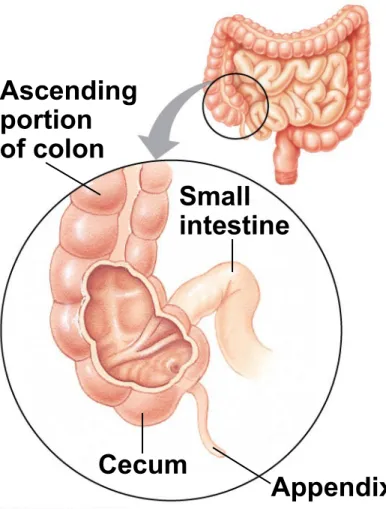
• The cecum aids in the fermentation of plant
material and connects where the small and large intestines meet
• The human cecum has an extension called the
appendix, which plays a very minor role in immunity
Figure 41.15
Ascending portion of colon
Small intestine
• A major function of the colon is to recover water that has entered the alimentary canal
• The colon houses bacteria (e.g., Escherichia
coli) that live on unabsorbed organic material;
some produce vitamins
• Feces, including undigested material and bacteria, become more solid as they move through the colon
• Feces are stored in the rectum until they can be eliminated through the anus
• Two sphincters between the rectum and anus
Concept 41.4: Evolutionary adaptations of
vertebrate digestive systems correlate with
diet
• Digestive systems of vertebrates are variations
on a common plan
• However, there are intriguing adaptations, often
related to diet
Dental Adaptations
• Dentition, an animal’s assortment of teeth, is one
example of structural variation reflecting diet
• The success of mammals is due in part to their
dentition, which is specialized for different diets
• Nonmammalian vertebrates have less
specialized teeth, though exceptions exist
Figure 41.16
Carnivore
Herbivore Omnivore
Molars Premolars
Canines Incisors
Stomach and Intestinal Adaptations
• Many carnivores have large, expandable
stomachs
• Herbivores and omnivores generally have longer
Figure 41.17
Small
intestine Stomach
Cecum
Carnivore
Colon (large intestine)
Small intestine
Mutualistic Adaptations
• Many herbivores have fermentation chambers,
where mutualistic microorganisms digest cellulose
• The most elaborate adaptations for an
herbivorous diet have evolved in the animals
Reticulum
Esophagus
Omasum Abomasum
Intestine Rumen
1 2
3 4
Concept 41.5: Feedback circuits regulate
digestion, energy storage, and appetite
• The intake of food and the use of nutrients vary
Regulation of Digestion
• Each step in the digestive system is activated as
needed
• The enteric division of the nervous system helps
to regulate the digestive process
• The endocrine system also regulates digestion
through the release and transport of hormones
Figure 41.19 Liver Gallbladder Food Stomach Duodenum of small intestine
Gastric juices
Pancreas
Bile
Chyme
1 2 3
Gastrin
CCK
Key
Stimulation Inhibition
HCO3, enzymes
Regulation of Energy Storage
• The body stores energy-rich molecules that are
not needed right away for metabolism
• In humans, energy is stored first in the liver and
muscle cells in the polymer glycogen
• Excess energy is stored in adipose tissue, the
most space-efficient storage tissue
Glucose Homeostasis
• Oxidation of glucose generates ATP to fuel
cellular processes
• The hormones insulin and glucagon regulate the
breakdown of glycogen into glucose
• The liver is the site for glucose homeostasis
– A carbohydrate-rich meal raises insulin levels, which triggers the synthesis of glycogen
Figure 41.20 Transport of glucose into body cells and storage of glucose as glycogen Breakdown of glycogen and release of glucose into blood Homeostasis:
70–110 mg glucose/ 100 mL blood
Stimulus: Blood glucose
level drops below set point.
Regulation of Appetite and Consumption
• Overnourishment causes obesity, which results
from excessive intake of food energy with the excess stored as fat
• Obesity contributes to diabetes (type 2), cancer
of the colon and breasts, heart attacks, and strokes
• Researchers have discovered several of the
Figure 41.21
Satiety center
Ghrelin
Insulin Leptin
PYY
• Hormones regulate long-term and short-term
appetite by affecting a “satiety center” in the brain
• Studies on mice revealed that the hormone leptin
plays an important role in regulating obesity
• Leptin is produced by adipose tissue and can
Obesity and Evolution
• A species of birds called petrels becomes obese
as chicks; in order to consume enough protein
from high-fat food, chicks need to consume more calories than they burn
• The problem of maintaining weight partly stems from our evolutionary past, when fat hoarding was a means of survival
• Individuals who were more likely to eat fatty food