Student Research
Case Studies in Agribusiness
California Polytechnic State University, San Luis Obispo Year
Dohi Farms
Christopher Callahan∗ Bryan Jimenez†
Greg Moxley‡
Dohi Farms
California Polytechnic State University / San Luis Obispo / Agribusiness Management/ Spring 2016
Christopher Callahan Bryan Jimenez Greg Moxley
Dohi Farms
Dohi Farms is a specialty vegetable farm headquartered in Arroyo Grande, on the
California Central Coast. Dohi Farms is owned and operated by Ben Dohi and his sons Hugh and Peter. The two brothers began slowly taking over the farm after they graduated from California Polytechnic University, San Luis Obispo. Hugh returned to the farm after he graduated with his degree in Agribusiness Management in 1983, and Peter returned to the farm after he graduated with his degree in Mechanized Agriculture in 1986.3 The family and farm are active members of
the Pismo Oceano Vegetable Exchangea headquartered in Oceano, which are both located on the California Central Coast.
Ben Dohi moved to the Central Coast to work for some of the P.O.V.E. members on their farms. In 1955 he purchased 55 acres in Arroyo Grande, California which has grown to become what is today Dohi farms.3 That parcel remains the only land owned by the family; however
Dohi Farms has expanded to grow produce on 500 acres throughout the Central Coast with a combination of land ownership, land leasing, and farm management.
The crops that Dohi Farms produces today include romaine lettuce, green leaf lettuce, broccoli, green cabbage, nappa cabbage (Chinese cabbage), bok choy, cilantro, and as of this year Brussel sprouts. The crops that have been produced over the years have changed from year-to-year based on demand in the produce market and growing conditions. Even f1or the most
experienced farmer, growing produce even in optimal soil, climate, and market conditions can be extremely difficult, and growers can run into a wide range of issues. Nonetheless, Dohi Farms has proven to be exceptional to adapting to these ever-changing conditions.
Pismo Oceano Vegetable Exchange
Dohi Farms
P.O.V.E. is noted for growing some of the highest quality produce on the California Central Coast. They are not only noted for their standard produce such as lettuce or broccoli, but also for their unique Asian specialty crops.b The cooperative consists of five, privately-owned family farms operating on approximately 2000 acres, all located on the California Central Coast.1 The primary market competitors consist of any producer, business, company, or cooperative, large or small, that produces and sells the same types of produce or different products which are supplementary to theirs.
P.O.V.E. does its best to keep a large selection of produce which allows their buyers to fulfill all of their purchasing needs at one location. Dohi farms, as well as many others farms within the cooperative sometimes produce crops even if the prices or demand are not
exceptional. One example of this is broccoli. Crops such as broccoli are complementary to other crops and allow buyers to fill all of their produce needs at one place. While broccoli may not be very profitable itself at the moment, when complimenting other goods it becomes beneficial. The ability for a buyer to fill the entire truck before it leaves P.O.V.E.’s cold storage facility helps to create a mutually beneficial relationship, where the cooperative is able to move a full trucks worth of product through the warehouse, and the buyer is able to fill an entire truck without having to make multiple stops. This encourages buyers’ continued business through the cooperative.
The success of the individual cooperative members depends greatly on the success of the cooperative. The largest benefit of the cooperative is that it provides the individual farms with an increased selling power by marketing with an established and well-recognised name. Another major member benefit is the cooperative’s shared cold storage facility. If the cooperative did not have the cold storage facility, members may have to send their crops as far as Guadalupe,
California to be stored. The farmers would also have to find their own buyers to pick up the fresh produce from the cold storage facility instead of having the sales employees at the cooperative market the produce. The cooperative gives the members power over decisions made throughout the organization so that the organization might be run in a way that is most beneficial for itself as well as its producers.
P.O.V.E. History
The hills of the California Central Coast ranging from Avila Beach to the hills of Arroyo Grande have been farmed by Japanese families since the earlier part of the 20th century. The hills
have been host to many different crops since that time, however the main crop produced early on was bush peas. In order to increase market power of their crop, farmers in the Pismo Beach area formed a marketing cooperative in 1922 called the Pismo Pea Growers Association.10 Noticing the obvious success of this move, bush pea farmers in the Arroyo Grande area followed this approach shortly after in 1925 by forming the Arroyo Grande Pea Growers Association.10 These
Dohi Farms
The approximate 40 members of the newly formed cooperative placed Bob Fukunaga in the position of manager. He was chosen because he was educated, and most importantly because he was a natural-born American citizen. Bob was born in Hawaii, and was fluent in both English and Japanese. At the time, a series of Alien Land Laws, enacted in 1913c, had forbidden all undocumented men and women in the U.S. of Asian descent to buy or lease land.10 Fukunaga’s American citizenship allowed him to assist the Japanese members of P.O.V.E. to acquire farmland through purchase or lease.
By the late 1920’s the cooperative’s pole peas had gained popularity throughout the country for their exemplary quality and taste. This popularity led to high profits which enabled the cooperative members to be minimally affected by the Great Depression. During the Great Depression the cooperative actually expanded their production to include celery, iceberg lettuce, broccoli, cauliflower, cabbage and Brussel sprouts.
Production halted in 1942 when all persons of Japanese descent were ordered to leave their homes to be placed in internment camps. The Pismo Oceano Vegetable Exchange was forced to close its doors. During this time, local citizens took action to help their Japanese neighbors during their absence by keeping watch over their properties and possessions.d Four years later, following the end of WWII, the Japanese were released from the
internment camps and allowed to return to their homes. Unfortunately, not all of the cooperative members returned to their farms. This was primarily due to a lack of capital necessary to allow them to begin farming again. Due to prejudices against the Japanese and other persons of Asian descent during that time, banks and other businesses were reluctant or unwilling to work with the Japanese farmers in extending credit. It was at this time that some of the same neighbors that had helped during their absence came forward yet again to help their friends get their farms back up and running.e
P.O.V.E. opened its doors once again. Their main crop of poled peas was no longer a viable option in the area due to disease. This made way for celery to take poled peas’s place as the cooperative’s main crop. In 1955 Ken Kitasako took over as general manager in place of Bob Fukunaga. By this2 time the second generation in the cooperative had begun taking over the operation. The second generation worked hard to continue rebuilding the cooperative as well as their family farms following WWII. As the farms began to regain their financial footing, they were able to finally replace antiquated equipment and invest in revamping their packing and cold storage facilities to meet increasing production.
Since then, Ken Kitasako has retired and was succeeded by Kazuo Ikeda, who has since been succeeded by Dan Sutton who currently holds the position. Apart from changes in
leadership, there have also been changes made to the cooperative’s facilities including improved refrigeration to increase shelf life of products, palletization, centralized buying, and the increased
2c. The Alien Lan#d Laws were declared unconstitutional in 1952
d. These included Pete Bachino, Vard Loomis, John Enos, Joe Silveira, Cyril Phelan, Ed Taylor, and Earnest Vollmer.10
Dohi Farms
production of salad products. The cooperative currently produces and distributes 22 different crops, of which nappa cabbage is now their specialty.10 Today, the cooperative is one of the world’s largest producers and shippers of nappa cabbage.
Vegetable Crop Industry in San Luis Obispo County
Within the California Central Coast, which spans approximately 250 miles from Point Mugu to Monterey Bay, lies San Luis Obispo County.f The California Central Coast is home to a wide range of vegetable crops and other agricultural commodities.g The gross value of all
agricultural crops in San Luis Obispo in 2013 amounted to $970,710,000. This value has increased 11% since 2012.16 Of this, the gross value of vegetable crops produced amounted to
$237,896,000, up 16% from 2012.16
While other areas of California struggled to remain in the green due to drought, San Luis Obispo County vegetable farmers were able to stay afloat as demand for their quality products remained high resulting in exceptional prices. In 2013, Brocolli was the highest grossing vegetable crop in San Luis Obispo County amounting to $64,135,0000.16
In 2013, 129 producers were listed in San Luis Obispo County as organic producers. This ranks San Luis Obispo County as tenth out of the 58 counties in California for the number of registered organic producers.16 The acreage in the county registered as organic in 2013 amounted to 13,128 acres, up from just 2,947 acres in 2004, but down from a high in 14,127 acres in 2012.16 The commodity with the largest amount of organic acreage in 2013 was carrots, with 1,179 acres.16 The other vegetable crops that were ranked in the top ten organic crops by acre
include mixed salad and broccoli.16 In 2013 San Luis Obispo county exported agricultural commodities to 51 different countries. These countries were scattered over 6 of the 7 continents.163
California’s Drought
3
f. San Luis Obispo County includes San Luis Obispo, Atascadero, Avila Beach, Pismo Beach, Grover Beach, Morro Bay, Paso Robles, Santa Margarita, Los Osos, Nipomo, San Miguel, San Simeon, Templeton, Squire Canyon, Cambria, and Oceano.
g. The top twenty agricultural products produced in San Luis Obispo County in 2013 were alfalfa hay, bok choy, cabbage, range land, bell peppers, celery, leaf lettuce, lemons, outdoor ornamentals, head lettuce, nappa cabbage, cauliflower, indoor decoratives, cut flowers, vegetable transplants, avocados, broccoli, cattle and calve, strawberries, and in first wine grapes. Other vegetable crops grown in the region include anise, artichokes, arugula, beans, beets, Brussel sprouts, carrots, chard, chili peppers, cilantro, collards, cucumbers, daikon, dandelion, dill, endive, escarole, fennel, garlic, green onions, herbs, kale, leeks, melons, mizuna, mushrooms, onions, parsley, potatoes, pumpkins, radishes, spinach, sweet corn, tomatoes, tomatillos, and watermelons.
Dohi Farms
California is now in its fifth year of drought, with 2014 and 2015 being among the driest years on record.6 The multiple years of drought have led to regional, as well as statewide water management actions. Dohi farms was one of the many farms throughout the state negatively impacted by the drought. The drought, among other things, has caused them to stop growing a few crops that they normally would such as celery and broccoli.
The total economic impact due to drought in the agricultural industry and its associated economies due to drought in 2015 are an estimated loss of $2.74 billion and a loss of nearly 21,000 jobs.6 The crop industry in California suffered a $900 million hit from the drought in 2015 alone.6 The low amount of surface water and rainfall led to a large quantity of groundwater replacement throughout the state. An estimated 8.7 million acft of groundwater was depleted by the drought in 2015.6 Groundwater pumping offset the shortage of surface water and rainfall by
70% in 2015.6 Still, through all of the tribulations that the past five years have brought,
California agriculture has remained resilient.
Regardless of the drought and weather conditions in California, the value of produce in the San Luis Obispo County reached record highs in 2015.6 The California Central Coast was short 5,000 acft in surface water allotments and rainfall in 2015.6 However, they helped mitigate this problem with the additional pumping of 2,000 acft of groundwater.6 The California Central
Coast's Vegetable crop industry lost 1,200 acres of irrigated land in 2015, is forecasted to lose another 1,200 acres by the end of 2016, and expected to lose an additional 1,300 acres by the end of 2017.6
Los Osos Wastewater Project
Los Osos and Baywood Park, with a mere 14,276 inhabitants according to the 2010 census, has been running into a handful of water quality issues in the past decade. Due to the rural nature of the area, homes have always been outfitted with septic systems rather than building a wastewater collection and treatment system for the area. In recent years the aging septic systems have received bad press for leaking pollutants into the area’s already diminishing water table.
These issues in the area have lead to the construction of a new water treatment facility to service the Los Osos and Baywood Park area. The water treatment facility will have a capacity of 1.2 mgdh which equates to approximately 3.68 acft per day.9 The first phase of connections to
the water treatment plant began on March 28, 2016.9
Homeowners in the area have been required to have their house connected to the sewage pipeline. Old septic tanks have either been decommissioned or repurposed as water storage to help in reducing runoff and flooding, recharging groundwater, improving water quality, and conserving greywater used around the house. Homeowners in the area have also been required to equip their homes with water conserving fixtures, and any new housing will be required to do the same.
Dohi Farms
The wastewater treatment facility lies adjacent to one of Dohi Farm’s locations. If the treated effluenti from the plant proves to be of high enough quality for agricultural use, then Hugh and Peter may be given the opportunity to purchase said reclaimed water. This opportunity hasn’t come a minute too soon given the current state of the California water tables and diminishing quantities of water being allotted to farmers. If everything goes as planned, Dohi Farms may actually be able to expand the acreage that they are currently farming to include some land that they have been unable to farm in recent years due to lack of water. This venture could possibly go into effect within the next few years after Dohi Farms has been given definite information on the price, content, distribution, and the food safety regulations involved with the use of treated effluent.
Although unknown by some, watering with treated effluent and other forms of
wastewater is very common in the U.S. as well as globally. In 2013 an estimated 2 billion acres were watered with wastewater worldwide.8 Watering with treated effluent, although done for decades without federal regulationj, poses many food safety and health concerns. States such as California and Hawaii both rely heavily on irrigating with treated effluent and thus have
developed extensive, numerical water quality criteria for its various water uses, including the irrigation of farmland. The largest concern of treated effluent use on crops at this time is the spread of pathogens. Another area of concern is the presence of high concentrations of chemical pollutants in the water. These pollutants, however, after the minimum secondary treatment of the effluent are comparable to the concentrations within conventional sources of irrigation water. Treated effluent generally meets or exceeds the irrigation water quality criteria for pathogens and chemicals that are potentially harmful to the crop itself, or harmful to the water table through ground water contamination.
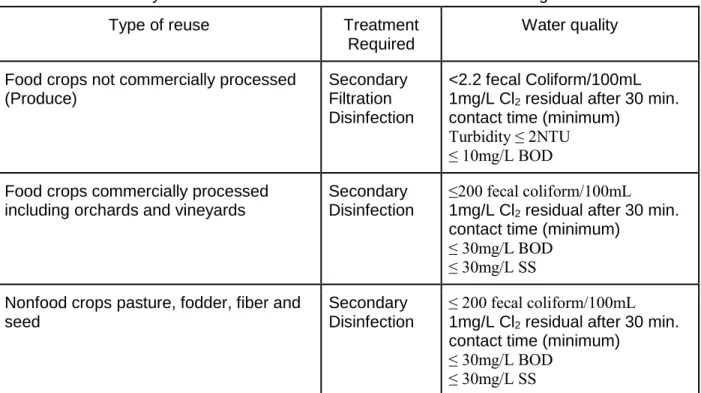
Being that Dohi Farms focuses mainly on the produce market, state laws are more stringent on the water quality levels of water that they use due to the fact that produce will often be eaten raw. Although not permitted by all states, California allows for the use of high-quality effluents to be used for produce crops. The EPA gives guidelines for what levels of
contamination are acceptable in treated effluent to be used for “crops not commercially
processed” (See Exhibit 6). California also has it’s own, more stringent regulations on levels of contamination that are acceptable, often exceeding those of the National Primary Drinking water standards.k4
The Immigration and Nationality Act and the H-2A Program
4i. Another name for reclaimed water
j. The Food safety Modernization Act, passed in 2011 has added more strict regulations to the use of sewage sludge and other forms of wastewater used to irrigate in agriculture. This act was considered to be the most sweeping reform to food safety in the 70 years prior.17
Dohi Farms
Passed in 1952l, The Immigration and Nationality Act, otherwise known as INA, formed
the H-2A program.7 The H-2A program allows temporary, qualified seasonal nonimmigrant foreign workers to come to the U.S. and fill agricultural jobs. The program provides agricultural employers sufficient reliable labor to meet their needs. Temporary labor cannot exceed 75 days and cannot be shorter than 60 days.
As is the case with many produce farmers on the California Central Coast, Dohi Farms has struggled to find adequate labor to meet their needs in recent years. This year will be the first time that Dohi Farms has utilized labor through the H-2A program. They received a dozen workers from Central and South America in May of this year, and have been happy with the results so far. They have expressed an appreciation for knowing that every day that they go to harvest, they know that they will not have a shortage of labor on hand.
Before the employer’s H-2A petition form can be approved by the U.S. Citizenship and Immigration Services they must declare first that there is no U.S. worker able, eager, and adequate enough to perform the duties of seasonal agricultural work, and that employing the H-2A worker will not have any affect on the wages and work duties of existing U.S. workers. California is currently fourth in terms of quantity of labor received through the H-2A program. Since the increase of restrictions on immigration in California, labor has become difficult to find and H-2A workers are seen by many to be the final resort. The California Central Coast is one of those areas of California that especially struggles with labor supply.
In order for an employer to apply for H-2A labor they must first file an ETA form 790m with the State Workforce Agency.14 The job listing must specify job location, job duties, identification of commodities or crops, and be submitted 60 to 75 days prior to when labor is needed. The employer must then submit a temporary labor application to the U.S. Department of Labor to obtain a temporary labor permit for H-2A. This process is reviewed and granted through the Chicago National Processing Center. After receiving a temporary labor permit, the employer will file an I-129 visa petition form with the U.S.4 Citizenship and Immigration Service and can begin recruiting H-2A workers (See Exhibit 7).4
On the other side of the spectrum, an 5individual that is trying to become a H-2A worker first applies for a H-2A visa. Although the H-2A program allows for workers from a number of countries, workers primarily come from Central and South America.4 The applicant must have
5l. The act was reformed in 1962.
m. A type of job listing.
Dohi Farms
no criminal record, not be a threat to national security, or have never been deported from the U.S. at any time. The individual may apply for the visa with the U.S. Department of State located at a U.S. Embassy or other U.S. Government office abroad. Afterward, an H-2A applicant must seek admission to the United States with the U.S. Customs and Border Protection at a U.S. point of entry. In some cases a H-2A visa may not be required, in which case, the individual can directly seek admission into the U.S. through the U.S. Customs and Border Protection.14
Hiring labor through H-2A is far different from how one would typically hire labor. An H-2A employer is required to provide housing, transportation, low-cost meals, and guarantee 75% of the work promised known as the “Three-fourths guarantee.”n14 The housing must meet
the OSHA requirements, be free of charge to the workers, and the location of housing must be within reasonable distance of the worksite. The employer is also required to pay for all utilities and expenses. Transportation must be provided daily to and from the worksite. The H-2A
workers are entitled to three meals. The “three-fourth guarantee” protects the H-2A workers from receiving pay for anything less than 75% of the worked promised to them in cases where
employer fails to offer adequate workdays.14
Rather than handling all of the rules and regulations in-house, Dohi Farms chose to hire the H-2A workers through a labor contractor. This added individual absorbs their liability and is held responsible for making sure that the rules and regulations are met. The labor contractor has an apartment complex in the area for the workers, and a large van to bring the workers to and from work. After using the H-2A workers this year, the Dohis plan on evaluating whether or not they were worth the increased cost of labor to ensure a steady labor supply.
Conclusion
Dohi Farms
Exhibit 1
Dohi Farms
Exhibit 2: San Luis County Agricultural Commodity Gross Values (2004-2013)
Source: United States of America. San Luis Obispo County Department of Agriculture. Weights & Measure. People and Places The Faces Behind Our Products. San Luis Obispo: San Luis Obispo County Department of Agriculture, 2013. Web. 20 May 2016.
Exhibit 3: San Luis Obispo County’s Vegetable Crops 2012-2013
Dohi Farms
Exhibit 4: 1920s Arroyo Grande Photograph
Source: American vegetable grower: CELEBRATING 100 YEARS. (2007). American Vegetable Grower, 55(4), 41-43. Retrieved from
Dohi Farms
Exhibit 5: Labor H-2A Statistics
Source: United States of America. UNITED STATES DEPARTMENT OF LABOR. Employment & Training Administration. H-2A Temporary Agricultural Labor Certification Program - Selected Statistics, FY 2016 YTD.
N.p.: n.p., n.d. OFFICE OF FOREIGN LABOR CERTIFICATION. Web. 20 May 2016.
Dohi Farms
Exhibit 6: Percentage of H-2A labor Used by State
Source: United States of America. UNITED STATES DEPARTMENT OF LABOR. Employment & Training Administration. H-2A Temporary Agricultural Labor Certification Program - Selected Statistics, FY 2016 YTD.
N.p.: n.p., n.d. OFFICE OF FOREIGN LABOR CERTIFICATION. Web. 20 May 2016.
Dohi Farms
Exhibit 7:
TABLE 7.13 Summary of EPA Guidelines for Reclaimed Water Reuse in Agriculture
Type of reuse Treatment
Required
Water quality
Food crops not commercially processed (Produce)
Secondary Filtration Disinfection
<2.2 fecal Coliform/100mL 1mg/L Cl2 residual after 30 min.
contact time (minimum)
Turbidity ≤ 2NTU ≤ 10mg/L BOD
Food crops commercially processed including orchards and vineyards
Secondary Disinfection
≤200 fecal coliform/100mL
1mg/L Cl2 residual after 30 min.
contact time (minimum)
≤ 30mg/L BOD ≤ 30mg/L SS
Nonfood crops pasture, fodder, fiber and seed
Secondary Disinfection
≤ 200 fecal coliform/100mL
1mg/L Cl2 residual after 30 min.
contact time (minimum)
≤ 30mg/L BOD ≤ 30mg/L SS
Source: "Regulations Governing Agricultural Use of Municipal Wastewater and Sludge." The National Academies Press. National Research Council, n.d. Web. 23 May 2016.
Dohi Farms
1. American vegetable grower: CELEBRATING 100 YEARS. (2007). American Vegetable Grower, 55(4),
41-43. Retrieved from
http://ezproxy.lib.calpoly.edu/login?url=http://search.proquest.com/docview/211365630?accountid=10362 2. "Contributions On Economic Growth." Journal of Economic Surveys 25.5 (2011): 829-32. Economic Contribution of San Luis Obispo County Agriculture. Agricultural Impact Associates LLC, 2013. Web
3. Dohi, Hugh. "Dohi Farms Interview." Personal interview. 19 May 2016.
4. Employment And Training Administration, U.s. Dol. Top States (n.d.): n. pag. UNITED STATES
DEPARTMENT OF LABOR Employment & Training Administration. OFFICE OF FOREIGN LABOR CERTIFICATION, 2016. Web. 20 May 2016.
5. "H-2A Housing." H-2A Housing. Agriculture Workforce Management Association, n.d. Web. 22 May 2016.
6. Howitt, Richard E., Duncan MacEwan, Josué Medellín-Azuara, Jay Lund, and Daniel Sumner. "Economic
Analysis of the 2015 Drought For California Agriculture." (n.d.): n. pag. Ucdavis.edu. California Department of Food and Agriculture, 17 Aug. 2015. Web. 25 May 2016.
7. "Immigration and Nationality Act of 1952 (USA)." SpringerReference (n.d.): n. pag. Questions and Answers about T He H - 2A Agricultural Guestworker Program. FARMWORKER JUSTICE. Web. 20 May 2016.
8. Mateo-Sagasta, Javier, Kate Medlicott, Manzoor Qadir, Liqa Raschid-Sally, Pay Drechsel, and Jens Liebe.
Safe Use of Wastewater in Agriculture. Geneva: WHO, 2006. Http://www.ais.unwater.org. UNW-DPC, Aug. 2013. Web. 23 May 2016.
9. Patel, S. (2007, Jul 13). Keep moving on los osos sewer or face septic system shutdown, water board says: County's progress report appreciated, enforcement official says; next report focuses on site evaluations. McClatchy - Tribune Business News Retrieved from
http://ezproxy.lib.calpoly.edu/login?url=http://search.proquest.com/docview/461672334?accountid=10362
10. "Pismo Oceano Vegetable Exchange." Pismo Oceano Vegetable Exchange. N.p., n.d. Web. 21 May 2016. 11. "Regulations Governing Agricultural Use of Municipal Wastewater and Sludge." The National
Academies Press. National Research Council, n.d. Web. 23 May 2016.
12. "Table of Regulated Drinking Water Contaminants." EPA. Environmental Protection Agency, n.d. Web. 23 May 2016.
13. United States of America. Department of Labor. Foreign Labor Certification. Employment Training
Administration. N.p., Jan. 2012. Web. June 2016.
14. United States of America. Department of Labor. Wage and Hour Division. H-2A of the Immigration
Nationality Act (INA). N.p., Feb. 2010. Web. May 2016.
15. United States of America. San Luis Obispo County Department of Agriculture. Weights & Measure.
People and Places The Faces Behind Our Products. San Luis Obispo: San Luis Obispo County Department of Agriculture, 2013. Web. 20 May 2016.
16. United States of America. UNITED STATES DEPARTMENT OF LABOR. Employment & Training
Administration. H-2A Temporary Agricultural Labor Certification Program - Selected Statistics, FY 2016 YTD.
N.p.: n.p., n.d. OFFICE OF FOREIGN LABOR CERTIFICATION. Web. 20 May 2016.