Fall 2010
Volume 23 Number 2
The O
HIO
Journal
of
T
eacher
Edu
cati
The Ohio Journal of Teacher Education
Fall 2010
Volume 23, Number 2
Published by the Ohio Association of Teacher Educators
Sarah Cecire, Ph.D.
Virginia McCormack, Ed.D.
Gayle Trollinger, Ph.D.
Savilla Banister, Ph.D.
Bowling Green State University
Michele Beery, Ph.D.
Wilmington College
Cynthia Bertelsen, Ph.D.
Bowling Green State University
Catherine Colby, O.P., Ed. D.
Ohio Dominican University
Charlotte M. Harris, Ed. D.
Wright State University
Martha Hendricks, Ed. D.
Wilmington College
Lynn Kline, Ph.D. University of Akron
Terry Miller, Ed. D.
Wilmington College
Tim Micek, D.A.
Ohio Dominican University
Carol Ramsey
Lake Erie College
Editorial Board
Virginia McCormack Technical Editor
Contents
Message from the Editors ... 4
Articles
Faculty to Faculty Collaboration and Student to Student Mentoring:
Pre-service and In-service Teachers Using Electronic Journals to
Dialogue about the Foundations of Literacy Instruction ………...5
Lisa Henderson, Ph.D.
Rochelle Berndt, M.A. Ed..
Collaborating to Share Resources and Pedagogy: Interdisciplinary
Intercollegiate Faculty Learning Circles……….. 13
Helene Arbouet Harte, Ed. D.
Lisa Bauer, Ed.D.
Karin Schumacher Dyke, Ed.D.
Sue Griebling, Ed. D.
Elizabeth Moore, Ed. D.
Growing Social Responsibility Through Service Learning and
Challenge Days ………..21
Julie Mc Intosh , Ed. D.
Sandra H. White
Kimberly Bash
The Preservice Teacher’s Web 2.0 Tool Kit………...……….25
Sarah McCorkle, M.Ed.
Book Review
The Beautiful Tree
by James Tooley ………..………..29
Terry C. Miller, Ed. D.
Ohio Association of Teacher Education Membership Invitation ... ………...32
A Message from the Editors…..
The Fall 2010 issue of The Ohio Journal of Teacher Education has an open theme. The articles cover a range of topics of interest to teacher educators such as mentoring, learning circles, shared inquiry though co-teaching and build social responsibility through service-learning projects, Web 2.0 tools for teacher candidates, and community schools among the world’s poor.
The first article byHarte and Berndt describes a collaborative project developed by an adjunct and full-time faculty member, and completed by undergraduate pre-service and graduate in-service teachers enrolled in their respective literacy courses at Baldwin-Wallace College in the fall 2009 semester. Critical colleague pairings were established between the in-service and pre-service teachers who were expected to read and react to professional literacy articles. This study includes the analysis of the dialogue, types of responses, and mentoring relationships established between the participants. The researchers also share their perspectives, as well as personal insights gained from the collaborative planning and implementation of the study .
The next article by Harte, Bauer, Dyke, Griebling, and Moore reflects on the experiences of members of a faculty-learning circle that includes faculty from several universities
collaborating to combine knowledge to improve practice. They explore benefits, challenges, and implications. The next steps in the process include focusing their efforts on participating in the academy, perfecting their own classroom pedagogy for their higher education students, and collaborating to take advantage of all of their expertise.
The third article by McIntosh, White and Bash discusses how every community faces challenges and service-learning projects can help identify and meet community needs. Service learning engages students and teacher candidates, incorporates reflective activities and analyzes results of the project. This article presents several programs implemented in Findlay, Ohio that promote youth philanthropy.
The fourth article by McCorkle examines technology services that were once limited to costly software packages. Web2.0 allows those with limited technical ability and/or funding to combine multimedia in ways that were unimaginable a decade ago. Through appropriate modeling by faculty within college and university coursework, the seed of instructional technology will be planted and ready to thrive long before teachers reach their own classrooms.
Finally, Miller shares a book review about how cooperative, community schools are educating the poor globally. It tells of the educational challenges of helping children, families, and communities create affirming learning environments that support all young people to thrive with the skills to fully participate in society. As well as, reminding us that all children deserve the
opportunity to enhance their futures through access to quality education.
We hope you enjoy this issue of the journal, and we hope you find these articles and book review to be informative and helpful in your various roles preparing teacher educators.
Sarah Cecire
Faculty to Faculty Collaboration and Student to Student Mentoring:
Pre-service and In-service Teachers Using Electronic Journals to Dialogue about the
Foundations of Literacy Instruction
Lisa Henderson, Ph.D. and Rochelle Berndt, M.A. Ed.
The term mentor originated with Homer, who, in The Odyssey tells of Odysseus, King of Ithaca. Upon leaving for battle in the Trojan War,
Odysseus placed his son Telemachus in the care of Mentor, who served as a teacher and caregiver. In contemporary lexicon, the word “mentor” has become synonymous with a trusted advisor, friend, teacher, and wise person.
Mentoring is a fundamental form of human development where one person invests time, energy, and personal know-how assisting the growth and ability of another person (Shea, 2001). A specific form of mentoring known as learning-focused mentoring is most effective for novices entering a profession. This relationship frames the learning journey from novice to expert (Lipton & Wellman, 2003). Learning-focused mentoring relationships can make a significant emotional and intellectual difference in the educational
experiences of pre-service teachers, as well as in their continuing professional practice. Based on the work of Daloz (1999), a mentor’s role within a learning-focused mentoring relationship involves a balance among three functions. These functions include offering support, creating challenge, and facilitating a professional vision. Thus, learning-focused mentoring offered by in-service teachers provides the following benefits to pre-service teachers: increased efficacy in problem- solving; engagement in collaborative dialogue regarding best practices; and retention in teacher education programs.
Introduction and Purpose
The purpose of this study is to describe a collaborative project developed by an adjunct and
full time faculty member and completed by
graduate in-service teachers and undergraduate pre -service teachers enrolled in their respective
literacy courses at a private, liberal arts institution. The research describes mentoring relationships that developed as a result of interactions between
critical colleagues engaged in electronic journal dialogues about the foundations of literacy instruction. The in-service teachers who were enrolled in a graduate literacy course, entitled “Foundations of Reading and Language Arts” served as mentors for pre-service teachers who were enrolled in an undergraduate literacy course entitled, “The Teaching of Phonics.” This paper focuses on both the faculty to faculty
collaborations involved in designing the project, as well as the purposes and factors in the mentoring of pre-service teachers.
Theoretical Framework
Social constructivism and Lev Vygotsky’s notion of learning through social interactions with more knowledgeable others are central to the success of pre-service and in-service teachers. Additionally, reflective thinking and collaborative models of teacher preparation provide the
theoretical framework that undergirds the electronic journaling project.
Social Constructivism
constructivist perspective emphasize the importance of collaboration among peers and interactions with more skillful others (Shunk, 2000). Electronic journals composed by critical colleagues provide a means for dialogue, critical thinking and questioning, which all lead to the social construction of meaning.
Further, Vygotsky (1978) defined two
developmental levels in the collaborative learning process, the level of actual development and the level of potential development. The level of actual development involves a state of learning that an individual has already reached and is considered the level at which the learner is capable of solving problems independently. Moreover, the level of potential development, or the zone of proximal development, is the level at which the learner is capable of reaching understanding with the guidance of a more capable being. At this level, pre-service teachers’ cognitive structures and processing and their levels of actual development require guidance and support from those more experienced and
knowledgeable in the field.
Reflective Thinking
The work of Dewey and Schön (1933, 1983) supports the use of electronic journal writing as a means to develop reflective thinking. Dewey’s work purports that reflective thinking is a systematic and disciplined thought process. His work further defines reflective thinking as active, persistent and sequential logic influenced by one’s prior experiences.
Additionally, Dewey argued that education is
“reconstruction or reorganization of experience.” The electronic journal project aligns with theorists’ views of reflective practice which seek to help pre-service and in-service teachers understand, question,
investigate, and take seriously their own learning and practice (Brookfield, 1995).
While Dewey’s work on reflective thinking primarily focused on aspects of prior experiences, Donald Schön introduced the dimension of time during which reflective thinking takes place. According to Schön, reflective thinking incorporates the capacity for teachers to reflect both “in action” and “on action”. Specifically, reflection-in-action occurs while a teacher is involved in a particular educational activity, while reflection-on-action takes place after an educational activity and infers that the teacher will reflect about the experience at a later time (Greiman &
Covington, 2007). The critical colleague pairings and the electronic journaling assignment used in this study
allowed practicing and future teachers an opportunity to engage in reflective thought within the context of their coursework (“in-action”). This also provided the participants a venue to make connections between theory and practice (“on-action”) and come to deeper understandings about their current beliefs, as well as adopt new perspectives and ways of thinking. Schön, argues that meaningful reflective thought may be positively influenced by the development of mentoring relationships. In this study, in-service teachers who served as critical colleagues and mentors for the pre-service teachers asked appropriate
questions and prompted analytical thinking to ensure that the reflection informed both their own
instructional decisions, as well as the learning and insights of their pre-service teacher counterparts.
Collaborative Models of Teacher Preparation
Peer- to- peer discussions, shared readings and collaborative learning have emerged as important pedagogies in teacher education programs. Teacher education programs that endorse these pedagogies emphasize at least three essential conditions for learning about the profession. These conditions include reflection, sharing, and collaboration (Ikpeze, 2007). The electronic journaling project discussed in this paper provided increased opportunities for critical colleagues to reflect on prior knowledge, share
classroom experiences, exchange ideas, and consider instructional implications for literacy teachers.
Further, the project generated time for the participants to take charge of their learning and to collaboratively reflect on theory and practice. These collaborations resulted in the emergence of mentoring relationships between the in-service and pre-service teachers.
Mentoring is a nurturing process in which an experienced teacher, usually skilled in a specific area, serves as a role model to teach, encourage, counsel, and/or befriend a novice or less skilled teacher (Barnett, 1995). Within any given relationship, mentoring can serve any or all purposes of collaboration. Fishbaugh (1997) described four purposes of collaboration. Those purposes include supportive, facilitative, informative, and prescriptive collaboration. Supportive collaboration involves individuals caring for and helping one another, recognizing each other’s work, and providing professional support to each other. Facilitative collaboration centers on helping peers to develop problem-solving skills. Similarly, informative
and offering directive assistance to colleagues. Lastly, prescriptive collaboration provides a path of action for individuals to take.
The mentoring relationship between in-service teachers and pre-service teachers plays an influential role in the pre-service teacher’s learning about the profession and induction to the field of education. During these relationships, in-service teachers’ support of pre-service teachers is influenced by at least four mentoring factors, including personal attributes, involves displaying an enthusiasm for teaching, and in a mentoring relationship between in-service and pre-in-service teachers, it also involves inspiring pre-service teachers and helping them to develop confidence and positive attitudes about the profession. Effective mentoring also requires that in-service teachers possess sufficient content expertise in order to assist pre-service teachers in the reflective processes for developing teaching practices. Thirdly, evidence supports the need for mentors to exhibit pedagogical knowledge or demonstrate practical knowledge for implementing effective teaching strategies. Finally, the literature asserts that effective mentoring occurs when in-service teachers can readily provide feedback or constructive advice to pre-service teachers. The written responses composed by the critical colleagues during the electronic journaling exercise were analyzed to reveal these factors of mentoring and the types of collaboration that existed between the in-service and pre-service teachers as they dialogued about the foundations of literacy instruction.
Methodology Participants
Two college faculty, one full-time professor and an adjunct lecturer, in a private, liberal arts teacher education program collaborated to develop a project to be conducted with in-service and pre-service teachers enrolled in graduate and undergraduate literacy courses during the fall 2009 semester. Thirteen in-service teachers and thirteen pre-in-service teachers participated in the study. The in-service teachers were graduate level students with an average of seven (7) years teaching experience in grades kindergarten through twelve. They were enrolled in the course, “Foundations of Reading and Language Arts.” The thirteen pre-service teachers were primarily
sophomore level status and were enrolled in the undergraduate course, “The Teaching of Phonics.”
The Assignment
The two faculty established critical colleague pairings between the in-service and pre-service teachers enrolled in their literacy courses. For this study, the critical colleagues were required to read and react/respond to four (4) literacy articles posted on Blackboard throughout the term. Specifically, the articles related to emergent literacy, comprehension acquisition, guided writing instruction and high-stakes reading assessment. The articles were selected from two professional journals, The Reading Teacher and the Journal of Adolescent & Adult Literacy. The students were expected to dialogue with their assigned critical colleague via electronic journal. The dialogue had to include, at minimum, two (2) exchanges within two (2) weeks of the article postings. An exchange could consist of questioning the author or the critical colleague; seeking clarification from the colleague; making text-to-self connections; and summarizing key points and ideas.
Data Collection
The faculty read and evaluated the electronic journal entries submitted by the critical colleague pairings. These assessments, conducted at the conclusion of the semester, were based on criteria outlined on a scoring rubric established for the
assignment. As indicated in Figure 1, the participants were asked to consider the following suggestions when crafting responses in the electronic journals. First, the reflections were to be supported by examples from the readings, experiences from professional practice and/or current or previous coursework. Additionally, they were asked to take advantage of the opportunity to think metacognitively and to
demonstrate critical thinking, analysis and synthesis of information.
Further data analysis of the electronic journals was completed using a constant-comparative method. In addition to assessment of the individual responses written by the participants, attention was given to the types of written interactions or transactions that occurred between the critical colleagues. Therefore, the faculty individually coded each statement or question included in each of the journals based on the theoretical framework regarding mentoring
informative collaboration, which focused on content expertise; facilitative collaboration, that incorporated pedagogical knowledge; or prescriptive collaboration, which offered feedback or constructive advice about literacy instruction.
Figure 1. Pre-service and In-service Teachers Journaling about the Foundation of Literacy Instruction.
Electronic Journal Rubric
Criteria Exemplary 5
Satisfactory 3
Unsatisfactory 1 Ideas/Content Entries
demonstrate understanding of literacy content knowledge and application of content in pro-fessional prac-tice using prior knowledge and other resources when applica-ble. Entries include critical think-ing and syn-thesis. Entries show evidence of connections between course content and the article.
Entries demonstrate understanding of literacy content knowledge and application of content in pro-fessional prac-tice using prior knowledge when applica-ble.
Entries include critical think-ing and syn-thesis.
Entries show very little evi-dence of un-derstanding literacy con-tent
knowledge, or application of content in pro-fessional prac-tice. Critical Thinking/ Reflection Entries include detailed exam-ples and refer-ences from the article.
Entries include examples and references from the arti-cle, but more detail is need-ed.
Entries do not provide rele-vant examples from the arti-cle.
Mechanics/ Conventions of Print
All of the en-tries include correct spelling and grammar.
Most of the entries include correct spelling and grammar.
Few or none of the entries include correct spelling and grammar. Completion All entries are
complete, clearly labeled and presented in order.
All entries are complete, but are not clearly labeled or pre-sented in or-der.
All entries are not present, nor clearly labeled or pre-sented in or-der.
Results
Electronic Journal Rubric Findings
Five (5) or 38% of the journals at both the in-service and pre-in-service level ranked in the exempla-ry categoexempla-ry on the scoring rubric. The entries showed clear evidence of connections between course content and the article readings. Seven (7) or 54% of the journals at both the in-service and pre-service level ranked in the satisfactory category on the scoring rubric. The entries demonstrated critical thinking and synthesis of information. Further, one (1) or 8% of the journals at both the in-service and pre-service level ranked in the unsatisfactory catego-ry on the scoring rubric. Those entries showed little evidence of application of content. The entries were primarily article summarizations. (Figure 2)
Figure 2. Assessment of Electronic Journal Entries
Coded Journal Data Findings
In-service teachers’ responses were generally categorized as facilitative collaboration. Their en-tries demonstrated practical knowledge for imple-menting effective teaching strategies. The following direct quote from Julie, a kindergarten teacher, re-flects her pedagogical knowledge:
her students. This temporary support is one of my goals this year.”
The in-service, as well as the pre-service teachers’ responses were also categorized as informative col-laboration. For example, the following direct quote from Grant, a middle childhood teacher education can-didate, reflects literacy content expertise, and the con-nections gleaned from the current coursework and the article readings:
“Text –to-text, text-to-self, and text-to-world connections were always something that was always good for not only me, but it was al-ways a large part of what teachers taught to our classes. Making these connections, I think, really takes learning to the next level. It also puts the information and text we are read-ing in a more relatable format. For me, that was important because it allowed me to con-nect on a deeper level with what any author was trying to say.”
Pre-service teachers’ journal entries consistently showed evidence of the need for supportive collabo-ration. The sophomores revealed some anxiety and uncertainty about literacy instruction. This is evi-denced in the following direct quote from Natalie, an early childhood teacher education candidate:
“I appreciate your sharing and openness with me, and I think that your ideas will help me once I get into the classroom. I think it’s great that you include a variety of genres when choosing the books for your classroom, and I think it’s very important for children to be able to go back and reread the books. I am al-so excited to hear that you make puppets al-so often to go along with the books that you read. We talked about this Readers Theatre a couple of weeks ago in class and got to try it out in groups using some stories that we were all fa-miliar with. However, I still had doubts about using the strategy in an elementary class-room.”
Pre-service teachers’ responses also required pre-scriptive collaboration. Many entries consisted of text -to-self connections and questions to their critical col-leagues about theory and practice. As a result, the in-service teachers frequently provided responses that included feedback or constructive advice. This is shown in the following direct quote from Brett, a sev-enth grade language arts teacher:
“Here’s my advice, teach the standards, not the test. Good scores will come with differentiated instruction that is derived from the state stand-ards. If you teach in a third grade classroom, I am sure you will be teaching short answer and extended responses. There is hope for change! There will be a new “OAT” (Ohio Achieve-ment Test) in the spring of 2013. It doesn’t mean things will be easier, but it will be some-thing different.”
Discussion Summary
An adjunct lecturer and a full time faculty member collaborated to conduct a study to examine the men-toring relationships that exist between in-service and pre-service teachers as they dialogue in response to professional articles about the foundations of literacy instruction. The faculty collaboration was based on the Teaching Circles initiative created by Michele Neaton at Century College in White Bear Lake, Min-nesota (2008). Teaching Circles involve faculty mem-bers, including both full time and adjunct instructors, meeting throughout an academic term to discuss areas of interest in teaching and learning. The faculty in-volved integrate what they learn as part of a collabora-tive team into their teaching. This faculty to faculty collaboration provided opportunities for the individu-als to reflect regularly upon a shared teaching experi-ence, learn and immediately implement new and ef-fective instructional and assessment techniques, and gain greater insight into their shared field of study, all within an atmosphere of mutual trust and respect. An interesting outcome of the study revealed a rela-tionship between the junior and senior faculty collabo-rators that mimics the underpinnings of social con-structivism. The level of potential development was reached by both faculty members as they gained deeper understanding about pedagogy through their social interactions and from the exchange of
information shared during the planning and implemen-tation of the study.
In-Service Teachers
the coursework phase of teacher education programs is also vital. In this study, the in-service teachers sistently provided pedagogical knowledge and con-structive feedback through facilitative and prescriptive collaboration as evidenced in their electronic journal entries. The written responses reflected thoughtful interpretation and advice to the pre-service teachers regarding the transfer of theory into actual classroom literacy practices. It was perceived from the journal entries that most of the in-service teachers experienced a sense of renewal as they were given the opportunity in this study to think and write aloud, share infor-mation, solve problems and consider novel approaches to literacy learning.
Pre-Service Teachers
The literature supports the notion that pre-service teachers may be filled with doubts about personal effectiveness, teaching competence, and whether one has the personal learning capacities to master the teaching profession (Lipton & Wellman, 2003). Men-toring, therefore, provided by an experienced, in-service teacher may offer support, create challenge, and facilitate a professional vision for the pre-service teacher. The findings in this study revealed that pre-service teachers were often managing the disequilibri-um that new questions and newly acquired knowledge about literacy instruction produced. This was evi-denced by the types of questions and quandaries not-ed in their electronic journal entries. In-service teach-ers frequently responded in a manner to inspire and to help develop the confidence of pre-service teachers through supportive collaboration. Further, through informative collaboration, provided by the experi-enced classroom teachers, pre-service teachers gained an increased understanding of literacy content
knowledge.
Recommendations
The success of the faculty to faculty collaborations and student to student mentoring has encouraged the researchers to replicate this study in subsequent se-mesters. The need for pre-service teachers mentoring during the teacher education program is essential for the formation and understanding of sound literacy pedagogy at the undergraduate level.
The researchers have identified several areas which can enhance the dialogue between the partici-pants in future studies. Instead of the random pairings of the critical colleagues that took place during this study, a more deliberate pairing can be established to take into consideration the grade level and teaching
fields of the participants. Also, in order to advocate student choice regarding the specific techniques and literacy practices available for discussion, a variety of articles will be posted which will expose in-service and pre-service teachers to additional literacy topics and provide a match with the critical colleagues’ inter-ests.
The course instructors would like to take a more active role in the electronic journaling assignment by engaging in the dialogue with a focus group of critical colleague pairings. Thereby, enabling the instructors to interact and respond throughout the semester to posted entries that can further expand the in-service and pre-service teachers’ understanding and analysis of literacy content knowledge. Additionally, the re-searchers would like to increase the face-to-face op-portunities for the in-service teachers and pre-service teachers to meet on a regular basis throughout the se-mester to participate in a “reading into the circle” ac-tivity (Calkins, 1994). This acac-tivity provides an op-portunity in which the participants can share excerpts of their electronic journal entries or article quotes in a non-threatening atmosphere, in order to showcase the important ideas gleaned from the readings and their critical colleagues’ responses, suggestions, and advice. The increased face-to-face connections can be more easily scheduled in the future, since both literacy courses taught by the instructors will be held on the same evening of the week.
Finally, the instructors will design and conduct a survey at the end of the study to gain insights and per-ceptions from the in-service and pre-service teachers’ involvement in the electronic journaling assignment. This will enable the researchers to
Discern the viewpoints of the pre-service teachers regarding the collaborations that occurred throughout the study, as well as the in-service teachers’ visions of themselves as literacy instructors.
about teaching (Hodder & Carter, 1997).
The faculty to faculty collaborations enable the researchers to discuss current literacy practices, effective pedagogy and pertinent content knowledge collegially, as they continue to build the foundations of literacy instruction. All in all, collaborative part-nerships may strengthen the faculty members’ abilities to incorporate new strategies in their teaching. The researchers can experience a perceived appreciation for teamwork, and the opportunity allows for a height-ened sense of dialogue, sharing and scholarly work. Most importantly, faculty to faculty collaborations have the potential to enhance professional relation-ships between colleagues and can rejuvenate a passion for teaching.
Lisa Henderson is a professor in the Division of Edu-cation at Baldwin- Wallace College and teaches liter-acy courses primarily at the graduate level. She earned a Bachelor of Science Degree and a Master’s Degree in Elementary Education at the University of Montevallo in Alabama. Her Ph.D. from the Univer-sity of Alabama at Birmingham is in the area of Early Childhood Education and Development with an em-phasis in Curriculum Supervision. She has nine years of teaching experience in elementary and middle grades and eighteen years of experience in higher ed-ucation. In addition to her faculty responsibilities, she serves as the Director of Initial Licensure Programs. Her major research interests include teacher educa-tion, formative assessment, and leadership
develop-ment.
Rochelle Berndt is a doctoral student in Curriculum and Instruction with a literacy concentration at Kent State University. She earned a Bachelor of Science in Education degree from Bowling Green State Universi-ty and a Master of Arts in Education degree, with a reading specialization, from Baldwin-Wallace Col-lege. Ms. Berndt is an adjunct lecturer, instructing teacher education and literacy courses for the Divi-sion of Education. She is also the Coordinator of Field/Clinical Placements in the Division of Educa-tion at Baldwin-Wallace College. Prior to her current positions, Ms. Berndt served as the Licensure Special-ist in the Division of Education at Baldwin-Wallace College and was employed as a classroom teacher for twelve years, instructing intermediate level students in language arts and mathematics. Her lines of inquiry include equity pedagogy and culturally responsive teaching in middle childhood literacy classrooms, as
well as the teaching of social justice issues through the use of adolescent literature.
References
Barnett, B. G. (1995). Developing reflection and expertise: Can mentors make the difference?
Journal of Educational Administration, 33 (5), 45-59.
Brookfield, S. (1995). Becoming a critically reflective teacher. San Francisco: Jossey-Bass.
Bybee, R. W. (1978). Science educators’ perceptions of the ideal science teacher. School Science and Mathematics, 78(1), 13-22.
Calkins, L. (1994). The art of teaching writing. Portsmouth, NH: Heinemann.
Daloz, L. (1999). Mentor: Guiding the journey of adult learners. San Francisco: Jossey-Bass. Dewey, J. (1933). How we think: A restatement of the
relation of reflective thinking to the educative pro-cess (1910), revised edition. Boston: Heath. Fishbaugh, M. (1997). Models of collaboration. New
York: Allyn & Bacon.
Greiman, B. & Covington, H. (2007). Reflective thinking and journal writing: Examining student teachers’ perceptions of preferred reflective mo-dality, journal writing outcomes, and journal struc-ture. Career and Technical Education, 32(3), 115-139.
Hancock, M. (1993). Exploring and extending per-sonal response through literature journals. The Reading Teacher, 46(6), 466-474.
Harkins, D., Bridges, C., Dohney, C., Roberts, E., & Putney, D. (2003). A multi-level approach for increasing student literacy learning: University faculty, pre-service, and in-service teachers collab-orate. Paper presented at the British Educational Research Association Annual Conference, Heriot-Watt University, Edinburgh, July 11-13.
Ikpeze, C. (2007). Small group collaboration in peer-led electronic discourse: An analysis of group dynamic and interactions involving preservice and inservice teachers. Journal of Technology and Teacher Education, 15(3), 383-407.
Kim, B. (2001). Social Constructivism. In M. Orey (Ed.), Emerging perspectives on learning, teaching, and technology. Retrieved <April 2, 2010>, from http://projects.coe.uga.edu/epltt/ Lipton, L. & Wellman, B. (2003). Mentoring matters:
A practical guide to learning-focused relation-ships. Sherman, CT: Mira Via.
Moran, S. (1990). Schools and the beginning teacher.
Phi Delta Kappan, 72(3), 210-213.
Neaton, M. (2008). Teaching circles. Center for Teaching and Learning, Century College.
Schon, D. (1983). Educating the reflective practition-er. San Francisco: Jossey-Bass.
Shea, G. (2001). Mentoring: How to develop success-ful mentor behaviors. Menlo Park, CA: Course Technology Crisp.
Shunk, D. H. (2000). Learning theories: An educa-tional perspective (3rd ed.). Upper Saddle River, NJ.: Prentice-Hall.
Vygotsky, L. (1978). Mind in Society. Cambridge, MA: Harvard University Press.
Collaborating to Share Resources and Pedagogy: Interdisciplinary Intercollegiate
Faculty Learning Circles
Helene Arbouet Harte, Ed.D. Karin Schumacher Dyke, Ed.D.
Lisa Bauer, Ed.D. Sue Griebling, Ed.D. Elizabeth Moore, Ed.D .
Collaboration is beneficial to both teachers andchildren in schools. Can this same benefit be found with higher education professionals in education departments that are teaching in-service and prac-ticing teachers? In addressing this question, we must first define collaboration.
Collaboration has multiple meanings. The intent of the collaboration often defines the
prac-tice. Michael and Balraj (2003) define collabora-tion in higher educacollabora-tion as faculty from multiple collegial institutions coming together to integrate their knowledge of curricular leadership and im-prove classroom practice. For the group described in this paper, this definition supports our efforts and accomplishments. For two years, we have come together as five professionals from multiple institutions and multiple disciplines with the inten-tion to better our teaching and thus, serve our stu-dents more effectively.
Higher education professionals who collaborate within departments produce multiple benefits. Peer collaboration for faculty members with common academic interests is shown to be an effective way for faculty to develop teaching expertise (Quinlan & Akerlind, 2000). Typically meeting in groups of 6-15, faculty-learning communities provide safe spaces to explore teaching and learning (Cox, 2004). The learning community creates a support-ive context for professional development where participants collaboratively share their unique ex-periences while engaging in active reflection (Hord, 2009). However, with all of the demon-strated benefits, the collaboration of higher educa-tion professionals is under studied and in need of further research (Quinlan & Akerlind, 2000). The
purpose of this paper is to share the experiences of participation in a faculty-learning circle with par-ticipants from different institutions and disciplines sharing resources and pedagogy in order to meet the needs of all learners. We address strengths, challenges, and lessons learned.
Participants
tenure track faculty member in interdisciplinary early childhood education, a fifth year early childhood gen-eral education faculty member seeking tenure, a first year non-tenure track special education faculty mem-ber, a full-time administrative academic director of an early childhood online education program, and an ad-junct faculty member in a gifted education pro-gram. All group members work with teachers in the classroom in various formats including supervising student teachers and practicum students, consulting, providing professional development, coaching, and parent education. In these interactions, group mem-bers encourage the concept of inclusive practice and collaboration among professionals within educational environments, thus making the idea of the partnerships within our own group essential to our personal prac-tice.
Although our disciplines and areas of expertise differ, an overlap of goals exists in the preparation of all teacher candidates which supports collaboration. Early childhood teacher educators utilize the revised National Association for the Education of Young Chil-dren (NAEYC) developmentally appropriate practices with their students, which indicate that inclusive prac-tices are the rule rather than an afterthought. Interdis-ciplinary early childhood education integrates special education throughout all of the coursework, teaching the recommended practices from the Division of Early Childhood of the Council for Exceptional Children (DEC). The National Association for Gifted Chil-dren (NAGC) has merged with the Council for Excep-tional Children (CEC) in an effort to address the di-verse needs of students identified as gifted. The CEC advises that collaboration between special educators and general educators is crucial to the success of in-clusive education (Murawski & Dieker, 2008). We follow a model that demonstrates seamless, compati-ble collaboration between regular and special educa-tion teacher educators which holds some lessons about integrating diversity and inclusivity throughout all coursework.
While CEC, DEC, and NAEYC advocate for many types of collaboration between special and general ed-ucators, our pedagogy group embodies collabora-tion. We not only model co-teaching between profes-sionals (special education and general education pro-fessors teaching classes collaboratively) for teacher education students but we also collaborate as profes-sionals to establish the best educational opportunities for our students, both special and general educators.
Our collaboration and the examination of it included meetings, reflections, and analysis of reflections.
Method
Participation involved monthly meetings, journal writing, attendance at teaching conferences, and shar-ing resources on a wiki. Findshar-ing time in five profes-sionals’ schedules was not always easy; however, there was a commitment and motivation to meet. Each gathering focused around a specific topic. For exam-ple, several meetings were devoted to discussing methods of implementing active learning in college classrooms. Meetings lasted approximately two hours and locations changed to accommodate work sched-ules and traveling distance. At each meeting one member was designated to take notes. These notes were later uploaded to the group wiki site.
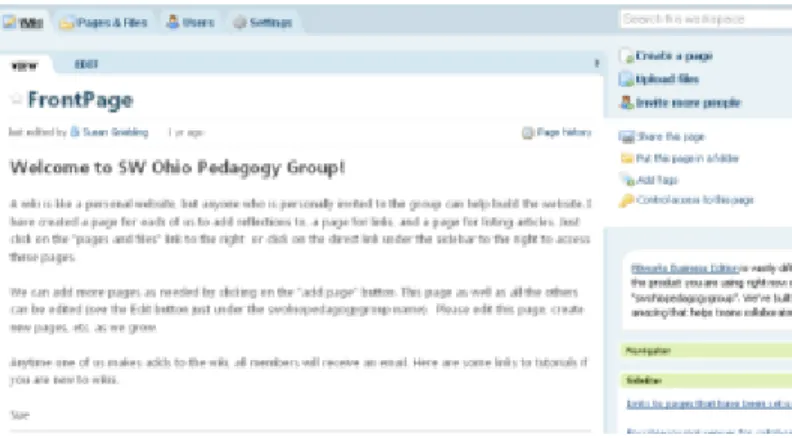
A wiki is a free, online webpage application with which WebPages can be established, housed, and maintained. This group’s wiki was implemented early on as a way to share documents, resources, notes, and reflections. The wiki (Figure 1) became invaluable for planning, organizing, collaborating, and writing. Alt-hough most members were not familiar with using a wiki for these purposes, all committed to learning how to use this tool and took responsibility for keeping the wiki organized and updated.
Figure 1. Wiki used for collaboration
Between meetings the group members were re-sponsible for further investigation of the focused top-ic, either through reading or research. For example, for several months we read and discussed the book Every Day Anti Racism (Pollock, 2008). The book was cho-sen as a response to the needs we found of our stu-dents in the classrooms in which we practiced for cre-ating culturally responsive practice in the K-12 envi-ronment.
of use in the future if teaching classes about diversity; however found that issues of culturally responsive practice applied regardless of the course topic. Discus-sions and journal reflections encouraged us to attempt to implement in an authentic manner at least one theme or idea. Using strategies with our group similar to ones utilized with students, we constantly inquired to each other, “What did you learn and what will you do with what you learned?” In addition, the group memberswho used .the book in their own classrooms included the reflections from the pedagogy group as a jumping off point for classroom discussions.
Each month a particular section of Every Day Anti Racism (Pollock, 2008) was assigned to read and this section was discussed at the next meeting. In addition to reading and researching, each member kept two re-flection journals. One journal included rere-flections on the readings. The other journal contained reflections around the process of meeting and participating in the pedagogy group – what we learned from that month’s meeting, how the group supported us, and how specif-ic discussions influenced our thinking. Each person was given an individual page on the wiki and reflec-tions were posted there. The members’ reflecreflec-tions were collected from the wiki and analyzed for content. Inductive analysis was conducted by reading through the data as a whole followed by microanalysis or line by line coding of each word and phrase (Strauss & Corbin, 1998). An examination of various possibilities of the significance of each phrase meant continuously returning to the data to make comparisons and check for accuracy. Conceptual labels were developed by examining the language and the context. We grouped related categories and determined semantic relation-ships (Hatch, 2002).
As we examined our group process we sought to explore the following research question: What are the elements of a dynamic pedagogy group?
Results
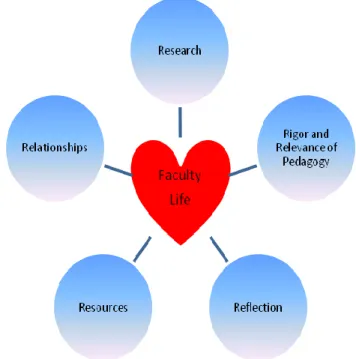
The learning circle provided support in various areas in different ways. Themes emerged that proved to be essential elements for understanding our group examination. These elements include research, rela-tionships, rigor and relevance of pedagogy, resources, and reflection. The collaborative model maintains the heart of faculty life and success as faculty members. Figure two illustrates these salient elements.
Figure 2. Collaborative Model
Research
As faculty members, there is an expectation of some productivity in the area of research. For those of us searching for employment, publication may make us look desirable. For those of us in tenure track posi-tions, some research and publication is necessary in order to keep our jobs. In addition to conducting re-search together, members of the group were willing to review individual research, answer questions, and pro-vide suggestions of possible outlets for publication.
ASHE (2009) reported that cross disciplinary col-laborations allow more publication opportunities for faculty engaging in the tenure process in higher educa-tion institueduca-tions. Also indicated are more revenue en-hancing opportunities for higher education institu-tions, such as grant opportunities, culminating from diverse collaborations.
Relationships
in higher education, the people that I teach are a little bigger, but the demands of the job are very similar [regarding intensity of time and teaching demands] and at times, I feel very overwhelmed.” The group members who were not new to teaching in higher edu-cation provided much mentoring and advice.
The group created an outlet and a safe space out-side of our own institutions. The social support and collegiality served as motivation and rejuvenation. Social support and collegiality is an important compo-nent in faculty success (Gappa, Austin, & Trice, 2005). The support provided through our relation-ships allowed us to develop as faculty.
Identity development is crucial to the growth of faculty in higher education. Collaborative groups as-sist in developing identity in that, groups allow forums in which members talk about subjects that provide clarification of new identities associated with the aca-demic demands placed upon them in higher education (Cuthbert, Spark, & Burke, 2009). Social support serves to define what appears to be vague about the academy. regarding issues such as tenure by allowing questions to be asked and answered (Greene, O’Con-nor, Good, Ledford, Peel, & Zhang, 2008).
Resources and Reflection
Shared resources became a theme of import in our group. The definition of resources implies sharing of materials; however, we found it hard to separate shar-ing physical resources from sharshar-ing our expertise. Hand in hand, sharing resources and sharing a profes-sional dialogue supported rich teaching practices and learning communities (Cox, 2004).
Utilization of a wiki allowed for sharing of re-sources such as websites, educational videos, texts, and active learning strategies. Sharing information obtained from our separate institutions and colleagues with our intercollegiate group was particularly useful. Each institution has its own culture and we were able to combine the resources from the three institutions and five departments.
Part of our supportive context and active reflection included our engagement in dialogue. Buysse, Spark-man, & Wesley (2003) defined communities of prac-tice actively participating in dialogue as a group of professionals with shared expertise focused on a par-ticular topic, (in this case higher education classroom methods) shared across disciplines. Through our di-verse expertise (special education, literacy, early childhood, gifted education, and TESOL (Teaching English as a Second Language), we learned by
engag-ing in dialogue.
Dialogue among colleagues allows the expansion of ideas. Through dialogue, professionals garner ideas that they would not have had alone (Game &
Metcalfe, 2009). Thus, students in classrooms con-ducted by teachers who are participants in collabora-tive dialogue with other professionals receive a broad-er, more developed content that assists in student growth. Debate and explication of divergent opinions of those engaged in collaboration across disciplines allows for obtaining a fuller understanding of both pedagogy and content (Bousquet, 2008). Game and Meltcalfe (2009) explained, “the good teacher knows that they are forever learning and that they need con-tinuous support from others if they are to meet the world as it really is’ (p. 49). We found that the exer-cise of clarifying our professional positions regarding our practices to the group and reflecting on how the feedback was received modified our original stances and helped us reshape and hone what we did in the classroom.
As teacher educators, we work to help our students reflect on their practice and make changes. Practicing what we preach, faculty ought to reflect on best prac-tices to continuously improve our teaching. Reflecting in journals, which we shared and posted on the wiki as well as reflecting during our meetings, provided op-portunities to improve practice. Engaging in book study, we read and discussed a book dealing with is-sues of race and diversity, considering how it might influence our teaching. Professionals who reflect on their own teaching practice engage in improving the quality of teaching in that they define what constitutes effective practice; thus, more effective ways of teach-ing students are developed and executed in the higher education classroom (Fitzmaurice, 2008; Stein, Isaacs, & Andrews, 2004; Yoon, Ho, & Hedberg, 2005). Rigor and Relevance of Pedagogy
Exemplary faculty look toward how the instruction provided for students can further the educational pro-cess toward the end goal rather than just mastery of the content matter provided in one class (Bain, 2004). The focus becomes student centered. Brown (2008) noted student centered learning occurs when “the planning, teaching, and assessment revolve around the needs and abilities of the students” (p. 30). This process of being responsive to student needs reflects best practice for faculty. Best practice is exemplified in the demonstration of reflective thinking, open com-munication, and ability to think about and perfect the teaching unit before instruction occurs (McKenna, Bugrahan, & Light, 2009).
One of the goals our group quickly adopted in its first year after members participated in a college teaching conference was to make our lessons more student centered. During this process we shared syllabi, class assignments, grading rubrics, and daily classroom structure in each of our higher education classrooms. Becoming more student centered for us meant that we moved from the lecture model toward active student engagement. In our own classrooms we became more inclusive by honoring a plurality of views and practice that allowed more student input (Bernacchio, Ross, Washburn, Whitney, & Wood, 2007). We were also afforded a unique opportunity to reflect on our practice and decide how to best impact our students educationally (Bernancchio et al., 2007).
Discussion
Throughout the first six months of meeting, we sought to establish the most productive
agenda for taking advantage of the time we had to-gether. We decided to meet for an hour at our face-to-face monthly meetings. We divided this time into slots that included social support, discussion of perti-nent book topics, examination of classroom topics and questions, and exploration of what we wanted to ac-complish for future meetings. Once we developed this schedule for meetings, a larger landscape of a commu-nity of learners emerged. As we entered into the facul-ty learning communifacul-ty, we established the following goals based upon analysis of our journal entries and meeting notes documenting discussions, needs, suc-cesses, and challenges:
1. Collaboration will tap into the expertise of each of our areas of academic discipline to strengthen our own teaching and impart more inclusive ideas to the students we work with. 2. Collaboration will assist in sharing
the experiences, processes, strategies, and les-sons learned from participation in a collabora-tive learning circle.
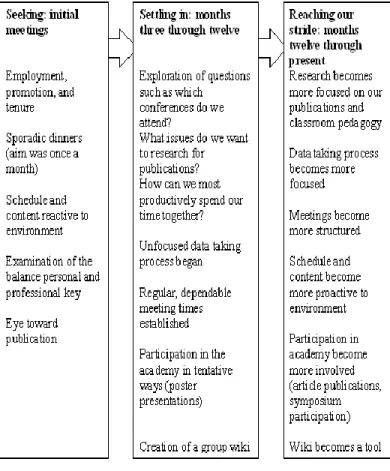
3. Collaborative groups will add to the body of import understudied in higher education, namely collaboration in higher education. We started with these linear goals. We found however, that it was an organic process in that through addressing the interests of our practice, we grew one set of ideas that ran their course, and then the founda-tions of this process germinated new essential ques-tions. We would assert that the dynamic nature of this process infused vitality into our teaching. Figure 3 demonstrates the developmental nature of our group meetings. When thought of in terms of purely structur-ing a pedagogy group, we had some successes and challenges related to the concept. The group transi-tioned over time from a vehicle of support and surviv-al to a cohesive strength based team. Over time we began to recognize and utilize our differing individual strengths to benefit us as a group.
Figure 3. Flowchart of the dynamic nature of the is-sues and questions examined by the group over time.
Successes
fundamental elements. For example, there was time at the beginning of each meeting for relationship build-ing or social support. Each meetbuild-ing was focused to address a specific topic. Exploring a book regarding pedagogy allowed for focused discussion about the rigor and relevance of pedagogy. Utilization of the wiki allowed for collaborative research and reflection as well as a consistent storage space for resources. In spite of the many benefits, the group did face some challenges.
Challenges
Time was a consistent challenge. With full time jobs and families, it was often difficult to schedule meetings. One way in which we addressed the chal-lenge of time management was to utilize the wiki and email communication. We also eventually set a fixed meeting date on the first Tuesday of every month at the same location to avoid scheduling issues. Another possible solution for the future is the use of Skype or other conferencing tools to enable the members unable to attend face to face meetings to participate.
Maintaining balance was a problematic issue for all participants. With such a strong pull from the class-room to maintain high teaching standards, and similar pull from personal lives full of family, children, and the demands that accompany living, we found our-selves in a constant struggle to balance time for both our jobs and our lives.
Implications and Future Directions
Faculty members can expand their support cir-cles by extending learning circir-cles outside of current institutions. In an effort to meet expectations and maintain balance, extending one’s support network may allow for enhanced personal and professional growth.
Resources increase when participants work across institutions. We are able to share guidance and support received from mentors, department chairs, and deans across institutions multiplying the information provid-ed. When conducting research, the ability to have part-ners searching in varying libraries enhances the likeli-hood of finding a broad range of literature Partner-ships between schools and higher education institu-tions could include an interdisciplinary
inter-institution learning circle at the high school, middle school, or elementary school level.
While no data was taken from students to measure their benefit from their instructors’ participation in the pedagogy group, certain benefits could be
in-ferred. For example, if members found that the rigor
and relevance of pedagogy was improved as a result of their work, surely their students must have derived benefits from their instructor’s interdisciplinary col-laborations. A future direction for study in this area would include devising ways to measure student satis-faction and learning in the classroom as a result of the pedagogy implemented that was devised in the in-structor’s pedagogy group.
Our next steps in the process as we embrace our future directions will be to continue to meet and grow as a group. This will enhance our ability to work together as colleagues while also enhancing the ideas and experience that are iterative in nature to the process of conducting our group. The balance of sup-port and accountability has increased our productivity and reflective teaching practices. We will focus our efforts on participating in the academy, perfecting our own classroom pedagogy for our higher education stu-dents, and collaborating to take advantage of all of our expertise. For us, the pedagogy group has been a formula that is well worth the time and effort.
Helene Arbouet Harte is an assistant professor of Ear-ly Childhood Education at Northern Kentucky Univer-sity. She holds a doctoral degree in special education and a master’s degree in early childhood education. She has worked in the early childhood field as teach-er, center director, coach and consultant for 14 years. Areas of specialization include quality early childhood programs, autism, kindergarten readiness and family involvement.
Lisa Bauer is an associate professor of education at Wilmington College. Her doctoral degree is in litera-cy/TESOL, and her master’s degree is in elementary education. She has worked as a high school, middle school, and elementary school classroom teacher, as a K-12 ESL teacher, and has been involved in various forms of teacher training in TESOL, including coordi-nating a Title III grant. Currently, she teaches cours-es in literacy and multicultural education at the grad-uate and undergradgrad-uate level. Areas of specialization include multicultural education and applied linguis-tics.
and classroom consultant in clinical settings. Dr. Dyke has also worked as a classroom teacher. Areas of specialization include autism, transition, early childhood and family involvement.
Sue Griebling is the Academic Director for the Uni-versity of Cincinnati’s Early Childhood Online Pro-gram She holds a doctoral degree in Special Educa-tion, a masters in Early Childhood Education and an bachelors in Child Development and Family Ser-vices. She taught in the early childhood classroom for ten years. She also supervised classroom teachers and coordinated the education program in a Head Start agency. Currently, she teaches courses in arts integra-tion and assessment and has developed numerous bachelor and master level courses for the online pro-gram. She facilitates a Reggio study group and has developed a studio space for the university lab school. Her research focuses on study of young children’s use of the visual arts as a language.
Elizabeth Moore is an Adjunct Professor of Gifted Ed-ucation at the University of Cincinnati. She also is Su-pervisor of Practicum students completing their Gifted Endorsement. She earned a doctoral degree in educa-tion and a master’s degree in elementary educaeduca-tion. She has worked as a classroom teacher, a Gifted In-tervention Specialist, and a consultant with school dis-tricts for over a decade. She specializes in gifted edu-cation curriculum, instructional strategies, and com-munity service.
References
ASHE (2009). Faculty and institutional structure: The conflict of interdisciplinarity . ASHE Higher Educa-tion Report, 35, 75-87.
Bernacchio, C., Ross, F., Washburn, K.R., Whitney, J., & Wood, D.R. (2007). Faculty collaboration to improve equity, access, and inclusion in higher education. Equity and Excellence in Education,40,
56-66.
Bousquet, G. (2008). A model for interdisciplinary collaboration. Modern Language Journal, 92 ,304-306.
Bain, K. (2004). What the best college teachers do. Harvard University Press: Cambridge.
Briggs, C.L. (2007). Curriculum collaboration: A key to continuous program renewal. The Journal of Higher Education, 78, 676-713.
Brown, J.K. (2008). Student centered instruction: In-volving students in their own education. Music Educators Journal, 94, 30-35. Research & Devel-opment, 29,137-149.
Buysse, V., Sparkman, K.L., & Wesley, P.W. (2003). Communities of practice: Connecting what we know with what we do. Exceptional Children, 69, 262-278.
Cox, M.D. (2004). Introduction to faculty learning communities. New Directions for Teaching and Learning, 97; 5-23
Cuthbert, D., Spark,C., & Burke, E. (2009). Disciplin-ing writDisciplin-ing: The case for multi-disciplinary writ-ing groups to support writwrit-ing for publication by higher degree by research candidates in humani-ties, arts and social sciences. . Higher Education Research & Development, 29,137-149. .
Fitzmaurice, M. (2008). Voices from within: Teaching in higher education as a moral practice. Teaching in Higher Education, 13, 341-352.
Game, A. & Metcalfe, A. (2009). Dialog and team teaching. Higher Education Research & Develop-ment, 28, 45-57.
Gappa, J., Austin. A.E., & Trice, A.G. (2005). Re-thinking academic work and workplaces. Change, 37, 32-39..Higher Education, 40, 23-52
Greene, H.C., O’Connor, K.A., Good, A.J., Ledford, C.C., Peel, B.B., & Zhang, G. (2008). Building a support system toward tenure: Challenges and needs of tenure-track faculty in colleges of educa-tion. Mentoring & Tutoring: Partnerships in Learning, 16, 429-447.
Hatch, J.A. (2002). Doing qualitative research in ed-ucation settings. Albany, NY: State University of New York Press.
Hord, S. M. (2009) Professional Learning Communi-ties. Journal of Staff Development, 30, 40-43. McKenna, A.F., Bugrahan, Y., & Light, G.J. (2009).
The role of collaborative reflection on shaping en-gineering faculty teaching approaches. Journal of Engineering Education, 98, 17-26.
Murawski, W.W., & Dieker, L. (2008). 50 ways to keep your co-teacher. Teaching Exceptional Chil-dren, 40, 40-48.
Pollock, M. (Ed.). (2008). Everyday antiracism: Get-ting real about race in school. The New Press: New York.
Quinlan, K., & Akerlind, G.S. (2000).Factors affecting departmental peer collaboration for faculty devel-opment: Two cases in context Higher Education, 40, 23-52.
Schnorr, R.F., & Davern, L. (2005). Creating exem-plary literacy classrooms through the power of teaming. Reading Teacher, 58, 494-506.
Stein, S.J., Isaacs, T., & Andrews, G. (2004). Incorpo-rating authentic learning experiences within a uni-versity course. Studies in Higher Education, 29,
239-250.
Strauss, A., & Corbin, J. (1998). Basics of qualitative research: Techniques and procedures for devel-oping grounded theory (2nd ed.) Thousand Oaks,
CA: Sage. Publication.
Volonino, V., & Zigmund, N. (2007). Promoting re-search-based practices through inclusion? Theory into Practice, 46, 291-300.
Growing Social Responsibility Through Service Learning and Challenge Days
Julie Mc Intosh, Ed. D.
Kimberly Bash
Sandra H. White
Social Responsibility
With the challenges facing our students today the Findlay, Ohio, community works together to meet these needs along with the University of Findlay. Through a robust Service Learning Pro-gram, Emerging Community Leaders Investing in Philanthropic Service (ECLIPSe) and Challenge Day our students are enmeshed in the democratic process and social responsibility. Students take charge of real world learning and build toward changing their community in terms of appreciation of diversity, serving while learning, and engender-ing philanthropy.
Service Learning
Service learning is not volunteerism or commu-nity service, it is much more. Following the work of Richard Bradley (2001), service learning is a way to reach students through active participation in a community need that is organized and built into the curriculum. When service learning pro-jects meet community needs it goes beyond raising money for a cause, it allows students to see their actions making a difference (Sloan, 2008). Service learning does not stop there, it is also involves re-flection and analysis of demonstrated results. Re-search shows that service learning can help in-crease students’ self-confidence, leadership skills and sense of empowerment and also develops civic responsibility.
Bradley (2001) has conducted research in K-12 school-based service learning projects and con-cluded that they: have a positive effect on personal development, decrease “at-risk” behavior, increase the ability to work with diverse groups, increase social responsibility, increase knowledge of
con-tent, increase motivation, increase student attend-ance, build respect, improves school climate, and has a positive impact on the perception of the com-munity regarding youth. Additionally, research shows that service learning can help increase stu-dents’ self-confidence, leadership skills and sense of empowerment and also develops civic responsi-bility. Service learning encourages students to treat each other kindly and help each other and care about their work and touches the future as youth engaged in service learning become adults they will already be individuals who will care about their community, who will be knowledgeable about their community, and who will have a stronger work ethic and who are grounded in the need for social responsibility.
Preservation, Archaeology and Serving Together
com-pound (Depot of Prisoners of War on Johnson’s Is-land, Ohio, 2008). The Friends and Descendants of Johnson’s Island are working in conjunction with Hei-delberg College, Tiffin, Ohio, to conduct archeologi-cal digs with plans to someday fully restore the site. Students from Findlay High School are raising money each year to help with the effort to pay the mortgage on the land and help with future digs. Students are involved in archeological digs at the site, restoring the site, and educating their peers and community about the need to Save Johnson’s Island. FHS and Heidel-berg students simulate an archeological dig in the ninth grade social studies classrooms. Additionally, videos, artifacts and discussions teach the ninth grad-ers the role of Johnson’s Island during the Civil War. These classroom experiences annually cause addition-al students to pick up the torch in a sustainable cycle of promoting citizenship and active participation in the democratic process.
This service learning project impact is best de-scribed by advisor, Mr. Gene Damon, "Our experience with involving high school students in historic preser-vation and archaeology is that many of our students are not the traditionally gifted and over committed stu-dents that one sees engaged in civic
involve-ment. Many of our students come from tougher, more working class backgrounds and involvement in our group helps them become more committed to school in general. Their grades and attendance tend to im-prove and their teachers and parents note the imim-prove- improve-ment." Student Nate Rackley adds, “I found that the meetings were held with a great sense of parliamen-tary procedure, questions were asked and committees for certain activities formed. As both me and my fa-ther are big into American history, and I especially in the Civil War of our country, I felt honored and a sense of duty to help preserve one of the few actual historic sites in Ohio."
Philanthropy
The State of Ohio brought together a team from the Ohio Grantmakers Forum, Ohio Community Ser-vice Council, Campus Compact and the Ohio Depart-ment of Education to fund ten partnerships in the state to develop grant-making councils run by local youth to support youth service learning projects. This impe-tus led to the development of the Findlay/Hancock County youth grantmakers forum Emerging Commu-nity Leaders Investing in Philanthropic Service (ECLIPSe). The goal of the ECLIPSe Partnership is to promote youth philanthropy and service learning
leading to greater youth civic engagement. Partners include eight K-12 school districts, University of Findlay and several non-profit organizations. Findlay City Schools working in partnership with community organizations and business has aggressively worked toward building ethics and social responsibility to pre-pare students and teacher candidates to be positive role models and community leaders.
ECLIPSe includes a youth grant making council made up of eighth grade through college level students from throughout Findlay/Hancock County who raise and grant funds for local service learning projects. ECLIPSe students embrace a philanthropic lifestyle that will impact generations to come. Those that re-quest a grant must present before the youth grant mak-ers why their project is important and the impact the project will have on the community. In Findlay/ Hancock County, ECLIPSe youth and adult partners have helped more that 263 teachers, 3,505 students and 408 adult volunteers implement service-learning projects over the past six years. Forty-eight grants totaling $43,047.08 have been awarded since 2002 in Hancock County. Projects are required to have reflec-tive activities which allow students to get an oppor-tunity to discuss, act, create or write about what they accomplished and the impact that work had on the community.
Youth grantmakers have worked hard on fundrais-ers such as a Quarter Campaign and Million Penny Campaign in K-12 schools and local businesses, Dance Marathon, Legacy Campaign and the Zach Morgan Memorial Soccer Tournament to raise the dol-lars to support grant requests. ECLIPSe youth encour-age their peers to give their time, talent and treasure for the sake of others. They work with peers and adults to address a wide range of community issues. As one ECLIPSe youth grantmakers says, “It is every-one’s responsibility to be engaged and serve”. It is important to ECLIPSe that all youth at every grade level get this opportunity. Service learning and phi-lanthropy are not just for your typical youth leaders. Dr. Martin Luther King Jr. said, “Everyone can be great, because everyone can serve.”
Some of the projects funded for Findlay City Schools through ECLIPSe include:
smARTWORKS helps youth develop art skills and neighborhood art festivals.