website: www.jdsu.com/test
Key Features • Reduce DS3 circuit testing time by using dual receivers for bidirectional monitoring, allowing for timely trouble isolation and correction
• Seamlessly transition from testing the DS3 interface to testing at the T1 tributary without swapping modules or test sets via the standard dual Transmit and receive DS1 interface
• Verify multiplexed operation by performing BER testing on one or all 28 DS1 channels within the DS3
• Accurately measure frequency and signal level to ensure optimal DS3 circuit performance
• Compact, lightweight and scalable tool ideal for the needs of the field technician today
• Support long-term testing with tabular and graphical results and the ability to save configurations and results
The HST-3000 DS3 test option enables users to perform the test operations necessary to install, maintain, and troubleshoot DS3 circuits and DS1 channels within DS3 circuits. Test operations include in-service monitoring, bit error rate testing (BERT), and loopback testing. Technicians can quickly qualify networks for accurate multiplexed operation by performing BER testing on one or all DS1 channels transmitted by a DS3 multiplexer.
Continued demand for high-bandwidth applications and services is driving the deployment of DS3 in many networks. DS3 is both a transport technology and a service offering that requires test solutions for install and maintain proper installation and maintenance. Technicians who traditionally install and maintain T1 and lower speed service are now tasked with DS3 testing responsibilities. This, coupled with today’s smaller workforces and reduced budgets for equipment and training, presents a real challenge to service providers who must ensure that the service provisioning and trouble correction is done right the first time.
Figure 1: DS3 Summary Configuration Screen
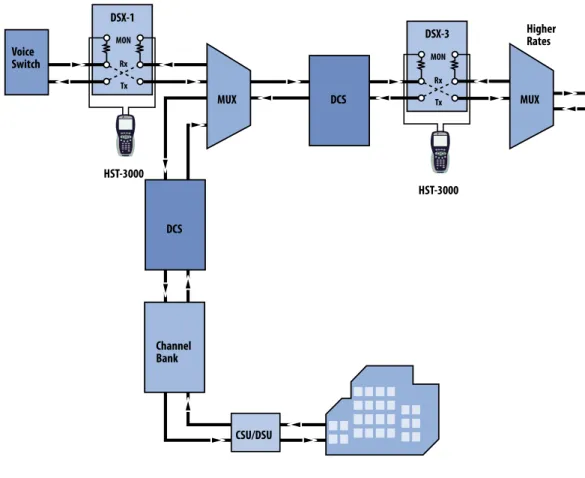
Figure 2: DS1/DS3 testing
Service installation
Testing may be performed to a loop at the far-end cross-connect panel or straight away with another test set located at the far end to sectionalize potential problems. For circuits with C-Bit framing, the HST-3000 can send DS3 far-end alarm and control (FEAC) loop commands and report FEAC alarms. For multiplexed DS3 testing, BERT patterns can be inserted on a single channel or all 28 DS1 channels within the DS3. Other standard features include error insertion to verify continuity, and alarm generation to verify proper network provisioning. Easy-to-read result menus allow technicians to view physical layer measurements, BERT results, parity errors, far-end block errors (FEBEs) and alarm conditions. The summary screen also provides a rapid assessment of overall test performance.
The testing capability of the HST DS3 helps ensure the circuit is functioning properly before handoff to the customer by providing simplified testing that includes a full range of test patterns and capabilities for both multiplexed and unchannelized DS3 circuits with M13 or C-Bit framing. Evaluation of BER test results, frequency, and signal level helps identify potential sources of problems such as faulty or loose cable crimps, improper line buildout, excessive coaxial cable length, and misallocated or faulty network equipment.
HST-3000 MON Rx Tx DSX-3 HST-3000 Channel Bank Higher Rates MON Rx Tx DSX-1 Voice Switch MUX DCS MUX DCS CSU/DSU
Figure 3: DS3 BERT Results Figure 4: DS3 Primary Event Histogram (with errors) Figure 5: DS3 Primary Events Table T1 Testing
Installing or maintaining DS3 often requires testing at the T1 tributary level. The HST-3000 DS3 Option comes standard with dual transmit and receive for DS1 interfaces. This feature lets the user switch from DS3 to DS1 physical layer testing without changing instruments or swapping modules—enabling timely and thorough testing of the T1 circuit to verify proper multiplexed operation.
Service maintenance
It is often necessary to perform in-service monitoring of a DS3 circuit during routine maintenance or troubleshooting operations. The HST-3000 DS3 Option comes standard with dual DS3 receivers for bidirectional monitoring, allowing the user quick and non-intrusive identification and sectionalization of potential problems. Results from both receivers (primary and secondary) are easily view-able on the same screen.
The HST-3000 can isolate a single DS1 from the DS3 for analysis. If it becomes necessary to conduct intrusive testing to isolate and correct a problem, the full range of out-of-service testing, described earlier, is available.
Test the Copper, Test the Service, improve the Process
As an optional capability, the HST-3000 can be configured to include a robust suite of testing features for verification and troubleshooting of copper facilities. Equipped with this option, the HST-3000 can quickly troubleshoot the local loop for line impairments that degrade or impair DS1 performance. The user can quickly identify and correct cable impairments including: shorts, grounds, opens, crosses, bridged taps, wet sections, and other highly resistive faults. These impairments are easy to locate with the advanced time domain reflectometer (TDR), precision digital volt/ ohm meter (DVOM), and the accurate resistive fault locator (RFL) of the HST-3000 to pinpoint troubles prior to circuit installation.
The HST-3000 also can transmit the full range wideband tones to confirm that noise and loss meet acceptable criteria. Copper test features are optimized for use anywhere on the local loop—at the NID, crossbox, pedestal, main distribution frame, or anywhere a technician might gain access to the local loop to locate the source of trouble.
The HST-3000 DS3 Option provides the complete range of both DS1 and DS3 physical layer circuit testing. Building on these capabilities, the HST-3000 can be equipped with options that support ISDN Primary Rate (PRI) testing as well as pulse code modulation (PCM) signaling and Transmission Impairment Measurement Set (TIMS) testing for verification of digital voice service on a T1 line. The HST-3000 can easily scale to address the full breadth and depth of testing requirements from qualification of the copper pair through voice and data service verification.
The HST-3000 offers pre-programmed tests and customized scripts that simplify testing and ensure consistent adherence to standard test procedures. These customizations help eliminate mistakes caused by improper test configurations or incorrect methodologies. With these features, the HST-3000 can reduce repeat rates and failures and improve overall process efficiency.
The architecture of the HST-3000 enables fast, easy field-swapping of a wide variety of test modules.
Flexible and Rugged Design
The HST-3000 incorporates a rugged, weather-resistant design and long battery life that are ideally suited for use in the field.
Easily configurable, technicians with differing responsibilities can use the HST-3000 to perform a wide number of tests. The HST-3000 is easily upgradeable with technologies and advanced options that support the changing needs of service installers.
Technical interfaces
DS3 (Single Tx/Dual Rx) BNC DS1 (Dual Tx/Rx) Bantam Jacks 10/100 BT Ethernet jack 8-pin modular Serial port DB-9 female via cable (DCE) USB host
USB device
DS3
Operating modes Terminate and Monitor Receiver (input) specifications
Frequency 44,736 Mbps +300 ppm Impedance Nominal 75 W at 22 MHz (unbalanced to ground) Range TERM: 0 to 12 dB cable loss at 22 MHz DSXMON: –20dB loss plus 0 to 9 dB of cable loss from high signal of 22 MHz
Jitter Tolerance
Transmitter (Output) Specifications
Frequency 44,736 Mbps +50 ppm Impedance Nominal 75 W unbalanced to ground Timing Internal clock Recovered (from network) clock Pulse (High) Nominal 1.2 Vp Pulse (DSX) Nominal 0.6 Vp Pulse (Low) Nominal 0.3 Vp with 75 W
Pulse shape Per T1.102 (1993) & ITU-T G.703 Output jitter Per T1.102 (1993) Tests BERT, Monitor Framing Auto, Unframed, M13, C-bit
Line coding B3ZS
Error/alarm types Logic, BPV, Parity, Frame, AIS, RAI Loopback codes NIU, CSU, HDSL, MSS, user defined, and repeater FEAC loop codes NIU, DS3 line, DS1 line
Frequency & Level measurements
Frequency Range: 44,736 +350 ppm Accuracy: +3ppm, +1ppm/year Resolution: 4 Hz Level Vp Range: 0.0 V to 1.99 V Accuracy: (+0.02 V/+10%) Resolution: 0.01 V DS1
Operating modes Terminate, Monitor, Drop and Insert, Loopback, (Full T1 and Fractional) Framing Unframed, D4/SF, ESF Line coding AMI, B8ZS Input impedance BRIDGE > 1000 W
TERM 100 W +5% DSX-MON 100 W +5% Receive level BRIDGE 0 to –20.0 dBdsx TERM +6 to –35.0 dBdsx DSX-MON +6 to –24.0 dBdsx Timing sources Internal clock Recovered (from network) clock Line buildout level 0, 7.5, 15.0, and 22.5 dB of cable loss at 722 kHz Error Insertion Logic, BPV, frame
Physical
Size (h x w x d) 241 x 114 x 70 mm (9.5 x 4.5 x 2.75 in) Weight (with battery) 2.7 lb (1.23 kg) Operating temperature –5.5 to 50°C (22 to 122°F) Storage temperature –40 to 65.5°C (–40 to 150°F) Battery life 10 hrs. typical usage Charging time 7 hrs. from full discharge to full charge Operating humidity 10 to 80% relative humidity Storage humidity 10 to 95% relative humidity Display 3.8-in diagonal, 1/4 VGA, Color Active Matrix with backlight (readable in direct sunlight)
General
Ruggedness Survives 91 cm (3 ft) drop to concrete on all sides Water-resistant Splashproof (may be used in heavy rain) Languages English, German, French, Spanish, Italian, Chinese, Turkish Keypad Typical 12-button keyboard
Base Unit
HST3000-NG HST-3000 Mainframe without Copper (Color) HST3000C-NG HST-3000 Copper Mainframe (Color)
Available SimS (modules)
HST3000-CUCE Copper only SIM, CE Marked HST3000-AR2A-T1 ASDL2+ T1 (ATU-R, Annex A) HST3000-AR2A ADSL1/2/2+ (ATU-R, Annex A) HST3000-AR2B ADSL1/2/2+ (ATU-R, Annex B) HST3000-AR2B-T1 ADSL2+ T1 (ATU-R, Annex B) HST3000-CAR2A ADSL1/2/2+ with Copper (ATU-R, Annex A) HST3000-CAR2A-T1 Copper, ADSL2+ T1 (ATU-R, Annex A) HST3000-CAR2B ADSL1/2/2+ with Copper (ATU-R, Annex B) HST3000-CAR2B-T1 Copper, ADSL2+ T1 (ATU-R, Annex B) HST3000-CARB Annex B Copper/ATU-R HST3000-CARCA Copper and ATU-R/C Dual Mode, AoPOTS HST3000-CARCB Copper and ATU-R/C Dual Mode, AoISDN HST3000-CARCE Copper and ATU-R (Annex A), CE Marked HST3000-WB2 Wide Band 2 (up to 30 MHz) Copper Test HST3000-VDSL-CNXT VDSL with Connexant Chipset HST-3000-VDSL-CNXT-WB2 VDSL and Copper (up to 30 MHz) with Connexant Chipset HST3000-VDSL-IK VDSL with Ikanos Chipset HST-3000-VDSL-IK-WB2 VDSL and Copper (up to 30 MHz) with Ikanos Chipset HST3000-INF-VDSL VDSL with Infineon Aware Chipset HST-3000-INF-VDSL-WB2 VDSL and Copper (up to 30 MHz) with Infineon Aware Chipset HST3000-ETH 10/100/1000 Ethernet HST3000-CT1 T1 and Copper HST3000-DC Datacom HST3000-E1 E1 HST3000-E1-DC E1/Datacom HST3000-4WLL 4-Wire Local Loop HST3000-T1 Dual TX/RX Bantam T1 Interface and T1 HST3000-T3 Dual TX/RX Bantam T1 Interface, and Dual RX/Single TX BNC DS3 Interface/and DS3 HST-BRA ETSI (Euro) ISDN BRA HST3000-BRI ISDN BRI HST3000-CSHCE G.SHDSL and Copper HST-GSH G.SHDSL HST3000-GSHCE 2-Wire G.SHDSL HST3000-CSH4 Copper, 4-Wire G.SHDSL (STU-R/C, Annex A/B) HST3000-BLK Blank
Software Options
HST3000-BLUETOOTH Bluetooth Wireless HST3000S-WEB Web Browser HST3000-REMOP Remote Operation HST3000-SCRIPT Scripted Test HST3000-DSL2 ADSL2 and ADSL2+ HST3000S-IP Advanced IP Suite—PING and Through Mode Support HST3000S-IP-Video IP Video Analysis HST3000S-VMOS Video MOS Analysis HST3000-MSTV Microsoft IPTV Video Analysis HST3000-VT100 VT100 Emulation HST3000S-VOIP VoIP Software Analysis HST3000S-H.323 H.323 VoIP Signaling HST3000S-MGCP SCCP MGCP VoIP Signaling HST3000S-MOS VoIP Mean Opinion Score HST3000S-SCCP SCCP VoIP Signaling HST3000S-SIP SIP VoIP Signaling HST3000-UNISTIM VoIP Signaling Call Controls for UNISTIM HST3000-OPTETH Optical Ethernet HST3000-IPV6 IPv6 HST3000-MPLS MPLS HST3000-MSTR Multiple Streams HST3000-TCPUDP TCP/UDP HST3000-FTP FTP HST3000-WBTONES WB TIMS HST3000-PCMTIMS TIMS (PCM) HST3000-PCMSIG Signaling (PCM) HST3000-SPE Spectral Noise HST3000-RFL RFL HST3000-TDR TDR HST3000-PRI ISDN PRI (NC Standard) HST3000-ST Basic Rate ISDN S/T (ANSI) HST3000-T1DDS DDS-T1 HST3000-TxIMP Transmission Impairments HST3000-FR Frame Relay HST3000-PS Pulse Shape
Product specifications and descriptions in this document subject to change without notice. © 2012 JDS Uniphase Corporation 30149238 504 0512 HSTDS3SIM.DS.ACC.TM.AE May 2012
Test & measurement Regional Sales NORTH AmERiCA TEL: 1 855 ASK-JDSU (275-5378) FAX: +1 301 353 9216 LATiN AmERiCA TEL: +1 954 688 5660 FAX: +1 954 345 4668 ASiA PACiFiC TEL: +852 2892 0990 FAX: +852 2892 0770 EmEA TEL: +49 7121 86 2222 FAX: +49 7121 86 1222 WEBSiTE: www.jdsu.com/test