Session Initiation
Protocol (SIP): Impact
and implications
By Arup Acharya, Nilanjan Banerjee,
Shachi Sharma, IBM Research, and
Baiju Mandalia, Gopal Soora, GTS ICS
Contents
2Who is using SIP?
4Key capabilities of SIP
5SIP infrastructure components
8Impact on IT infrastructure
9Adoption and systems integration
11Multivendor interoperability
11SIP as an enabler
12A road map for SIP
13Transitioning architectures
14Extracting the full value of SIP
15For more information
Executive summary
Session Initiation Protocol, or SIP, is the core enabling technology behind truly interoperable and productive unified communications. It represents the next step in the evolution of Internet technologies, both within the larger public Internet, as well as inside corporate intranets. The Internet and the intranets, so far, have been used primarily to deliver content as web pages containing text, images and video. This has, of course, catapulted the Internet and intranets into becoming the indispensable tool that they are for businesses today.
By adding SIP, a fundamental new capability becomes enabled on the Internet and intranet—direct person-to-person multimedia communi-cation in a single network session, whether it be a voice conversation (e.g., voice-over-IP [VoIP]), or a quick, short interaction through instant messages (IM), or simply knowing whether a person is available (presence). No longer would you need separate network sessions for each of these means of communications. With SIP, the scope of such interactions goes well beyond person-to-person and can include inter-actions within processes as well as devices. The status and presence of devices can be carried with SIP and propagated together with other communications. With communications-enabled business applications, these interactions may be initiated even by applications based on trig-gered events embedded inside the business processes.
2
Another way of looking at the impact of SIP is the transfor-mation that it brings to the IT infrastructure, including the network and communication services of an enterprise. Prior to SIP, enterprises maintained a separate network infrastructure for telephony and video in parallel to their IT data services. With SIP, the communication and IT network infrastructures become “unified” and both now run over the same corporate intranet using the Internet Protocol (IP). The starting point for this transition is usually one of two courses—the move of corporate telephony services to VoIP or the adoption of IM. To this, presence services were added within the enterprise. In the early deployments, presence services represented the telephony status of a person, namely using the phone or not within instant messaging sessions. With VoIP, instant messaging and presence now becoming an integral part of the enterprise architecture, both at the infrastructure and application layers, SIP becomes a key enabler. This is made possible because SIP shares many of the characteristics of HTTP—the technology behind the web and the basis for most IP applications today. These shared characteristics have led to the convergence of SIP and web-based services, such as a click-to-call service that is launched from a customer-facing web-portal, softphone or instant messaging application.
The next expected point of impact for SIP, in addition to transforming how we communicate and collaborate, is the transformation it can bring about in business processes. This is where presence—a key SIP capability—comes into play.
Presence now has broadened beyond just representing the real-time status of people to include processes and devices as well, where “status” now can mean much more than simple availability. It could, for example, represent complex states of a business process, location of a delivery truck or expected battery life of a smart phone. With SIP, presence functions deliver a real-time orchestration capability across people, processes and devices, and they become a powerful business tool for tomorrow.
Lastly, SIP can play a role in the emerging cloud computing model. With evolving cloud-based services, there needs to be a transformation from a distributed to a centralized architec-ture. This transformation is significantly easier with SIP and can enable interoperability between disparate multivendor systems and endpoints. Many cloud services providers—both private and public—are adopting the SIP protocol as the uni-fying foundation.
This white paper explores the key capabilities of SIP and the components that make up a SIP network, and describes both its importance and the potential transformative impact SIP can bring to the IT infrastructure and business processes.
Who is using SIP?
Although SIP might not be as familiar to readers as other protocols, SIP has been accepted by leading networking industry groups for several years. SIP is a key part of IP
Multimedia Subsystem (IMS), an architectural framework originally developed by the 3rd Generation Partnership Project (3GPP) for delivering multimedia services over mobile wireless networks, and has since been adopted by wireline providers as well. For example, PacketCable 2.0, a set of standards for the cable industry, leverages SIP and IMS to deliver advanced multimedia capabilities. In effect, SIP is widely accepted within the telecom industry as the core pro-tocol for delivering advanced multimedia services.
SIP usage can be seen in many of today’s existing and emerg-ing applications. FaceTime, a video chat application on iPhone, uses SIP to set up video sessions. Yahoo Messenger, a commonly used instant messaging and presence service from Yahoo, uses SIP for its voice services. Skype, another hugely popular service for voice-video-chat services, now supports SIP interfaces so that enterprise SIP-based PBXs can now connect to Skype.
SIP has been used widely in instant messaging systems and multimedia sessions. As a first step in 2005, in the highly diversified market of instant messaging, Microsoft®, Yahoo and AOL agreed to use SIMPLE (SIP for Instant Messaging and Presence Leveraging Extensions) as the standard for interoperability among their popular instant messaging sys-tems. Today, most instant messaging and presence systems support SIP/SIMPLE or interoperate with it through gateways.
Most leading network and communications providers like Cisco, Avaya and Microsoft provide offerings that use the SIP protocol.
End-user device manufacturers have created voice, video and data endpoints that have native SIP capability. In addition, many of the smart portable devices/tablets have the ability to run SIP-based clients. Application middleware providers and business applications have been using SIP for application-level communications for quite some time.
As mentioned previously, SIP is playing a key role in unified communications applications since it has various call control features and has the ability to support voice, video and data together in one session. Many video conferencing vendors are moving to SIP primarily because of its capability to initiate video sessions in an almost instantaneous, ad hoc manner. A SIP-based infrastructure allows the optimization of intranet and unified communications technologies.
Telecom service providers around the globe have adopted SIP standards published by the Internet Engineering Task Force (IETF). They are providing SIP trunking services as an alter-native to primary rate interface (PRI) and basic rate interface (BRI) for local and long-distance calling at rates significantly lower than traditional trunking. The adoption of SIP trunk-ing is expected to grow significantly in the next few years with time division multiplexing (TDM)-based voice trunking becoming a technology of the past.
4
With SIP trunking, organizations are able to consolidate their voice, video and data trunking to provide significant cost savings. Some SIP trunking service providers allow the aggregation of concurrent SIP session capacity at the enter-prise level with the ability to allocate bandwidth as necessary to the various enterprise sites, which can bring further opti-mization. With SIP trunking, the voice connection is carried along data network connections from the enterprise to the wide area network. The connection to the public switched telephone network (PSTN) for voice traffic may move from the enterprise boundary to well within the carrier’s backbone network.
Open source and open standards are changing the paradigm of conventional telephony and video. SIP standards have evolved to a point where enterprises will benefit from a more competitive landscape of video and voice offerings from dif-ferent vendors. The telephony and video solutions may not be provided from a service provider or a PBX vendor in the future, but rather from a range of best-of-breed building blocks. This will allow application programmers to have greater flexibility to incorporate communications into busi-ness applications.
The gatekeeper functions of H.323, the original standard established for VoIP, have been adopted by SIP solutions for wide area VoIP dial plan and routing functions. Mechanisms for session management and presence functionality with SIP have virtually eliminated the need for the H.323 functionality. This enables open standards-based SIP endpoints from dif-ferent vendors to be integrated with enterprise applications and reduces the architectural limitations imposed by different standards.
Key capabilities of SIP
SIP has three core capabilities:
1. Session setup, modification and teardown.SIP enables the cre-ation, modification and termination of sessions, or “calls.” While IP telephony may be the most well-known example of a session, SIP is independent of the media used for the call—for example, SIP supports both voice and video calls. While call setup and teardown are well-understood capa-bilities, the need for call modification may be less apparent. Nevertheless, it is a key capability, especially for mobile calls where call modification is used to update the endpoint address as the user moves to a different location. Alternately, a user may start a call from a mobile phone, but upon reaching the office, the ongoing call is “moved” to the desktop phone. Using SIP, the creation, modifica-tion and terminamodifica-tion of sessions are simplified, even in a complex transaction that may involve many users, disparate devices and multiple locations.
2. Instant messaging.Instant messaging, often known as “online chat,” is text-based communication between users over a network (such as the Internet in public domain or an enterprise intranet) in almost real-time. SIP supports two types of instant messaging models: a pager model in which a user sends instant messages to a single or small number of recipients; and a session model, often used in chat groups, where an ongoing conversation can be associ-ated with other SIP-initiassoci-ated sessions.
3. Presence.SIP provides new ways to develop presence-based applications. The SIP-based SIMPLE protocol provides well-defined rules for updating, storing and accessing pres-ence information. This standardization helps in establish-ing interoperability in presence-based IM systems such as AOL, Microsoft and Yahoo. The standardization can also ease the sharing of presence information with other appli-cations (e.g., web-based location services like Google Maps) so as to develop either new services or enhance existing services.
Secondary capabilities
Multiparty sessions.Using SIP as a signaling protocol, multi-party sessions consisting of one or more media streams can be set up. These sessions can be modified to change IP addresses or ports, invite more participants, and add or delete the media streams. This feature is particularly useful in develop-ing applications like conferencdevelop-ing (audio, video and web), collaboration, multiparty gaming and group chats.
Name mapping and redirection capability.SIP enables personal mobility by “name mapping” and redirection capabilities. Users can maintain a single externally visible identifier (address) regardless of their physical location, the network they are connected to or the device they are using. The redi-rection capability automatically redirects the sessions to the correct user location, network and device.
Internet-style addressing.SIP addresses are based on web-style uniform resource identifiers (URIs), e.g.,
sip:[email protected]. SIP addresses are not tied to any partic-ular device. As mentioned previously, a SIP URI is resolved to a specific device at the time of a session setup, which intro-duces a level of abstraction between SIP addressing and the
device used for a particular session. A key impact of SIP URIs is that the domain name systems (DNS) may need to be upgraded to recognize requests for resources that are assigned by SIP. For example, a common way of routing SIP session requests is to look up the SIP proxy name handling a given SIP sub-domain (to which the target of the session request belongs).
The SIP infrastructure and its components
In this section, we discuss various components of a SIP net-work, including logical and physical nodes.
User agents.User agents are end systems such as SIP phones, video endpoints or gateways.
Proxy server.An intermediary entity that acts as both a server and a client for the purpose of making requests on behalf of other clients. A proxy server is responsible for routing requests “closer” to the targeted user. Proxies are also useful for enforcing policies (for example, making sure a user is allowed to make a call). A proxy interprets specific parts of a request message before forwarding it.
Registrar server.A registrar server receives registration requests from endpoints or systems and records their addresses in a database. The registrar is then contacted by other endpoints to reach subscribers at their registered addresses. The registrar is a logical entity in the SIP infra-structure and is often co-located with the proxy server of the enterprise. The registrar helps to store the mapping of the logical SIP address of a user (i.e., SIP URI) to the physical address (i.e., IP address of the machine the user is currently logged into).
6 Redirect server.The redirect server directs the client to contact an alternate set of URIs. It is not “call stateful,” implying that it responds to a query, but it is not aware of individual ses-sions between user agents. The redirect server allows SIP proxy servers to direct SIP session invitations to external domains.
Location server.A location server is contacted by a SIP redirect or proxy server to obtain information about the possible loca-tion(s) of the user agent being called. It contains a list of bindings of zero or more contact addresses. The bindings can be created and removed in many ways, and one possible way is by a registrar.
Application server.The application server handles services. A full subscriber database resides there. For example, if a user changes the call forward number, it gets updated in the database on the application server. It receives a request and then it may decide to respond to it in any number of ways, depending on the configured application logic for that number or subscriber. Application servers have evolved to accepting web services interfaces from the business side and communicating with SIP to the infrastructure, which can mask infrastructure complexities for application programmers.
Session border controller (SBC).A device or application that governs the manner in which sessions are initiated, con-ducted and terminated in a SIP network. The SBC acts as an application-aware firewall hiding the network topology and
performing network address translation (NAT). It hides the internal enterprise network from the outside world by initiat-ing separate dialogs for the internal and external side and connecting them together.
Presence server.The repository of presence information, which is published in the presence server by multiple providers or users. The presence server shares presence information with other multiple users who are interested in it—all of which happens in real-time.
Electronic number mapping (ENUM).An extension to the DNS that allows SIP URIs to be mapped to legacy phone numbers and vice versa. This enables legacy phone users to reach SIP users by using phone numbers, and enables SIP users to reach legacy phone users by encoding the destination phone num-ber within SIP URIs.
In addition to the above-mentioned SIP core elements, there are media servers and gateways that connect to PSTN, UMTS/GSM and H.323.
Media server.A SIP infrastructure may use a number of media servers such as a voice mail server or audio or video servers for mixing media streams from conference participants. Although the media itself is carried through a separate proto-col (e.g., real-time protoproto-col [RTP]), SIP plays a critical role in orchestrating how the sessions are set up (to access the media).
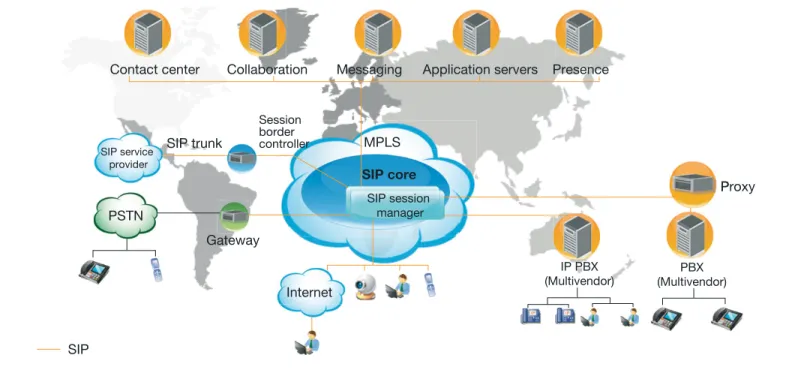
The “SIP session manager” is the term used by many leading equipment providers for their products that provide the cen-tral switching and mediation at the session level. Session manager clusters are used to create a SIP core to provide resilience and high availability.
SIP session border controllers provide a security-rich connec-tion between the enterprise and the SIP trunk.
SIP trunks are Internet Protocol (IP)-based network “pipes” for multimedia communications used as an alternative to pri-mary rate interface (PRI) and basic rate interface (BRI) voice network connections.
SIP-ready endpoints may register directly and connect to the SIP core and do not have to connect to intermediate call managers. SIP-ready IP PBXs can connect to the SIP core, while non-SIP-ready IP and TDM PBXs could connect to the SIP core using proxies.
Collaborative application systems, application servers and contact center systems that are SIP ready can communicate directly to the end devices, while systems that are not SIP ready would use proxies or gateways. This approach allows the sharing of these capabilities across the entire endpoint community.
Figure 1:Unified communications environment using a SIP-based architecture.
Contact center SIP session manager IP PBX (Multivendor) PBX (Multivendor) SIP trunk SIP Gateway Session border controller
Collaboration Messaging Application servers Presence
Proxy P SIP service provider PSTN Internet MPLS SIP core
8
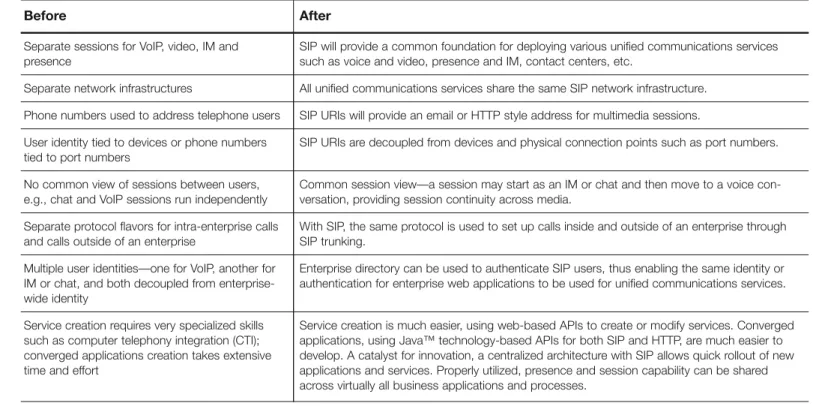
Table 1:Before and after SIP.
Impact of SIP on the IT infrastructure
Several aspects of the infrastructure can be affected by SIP. Table 1 below shows the difference before and after full SIP adoption.
Before After
Separate sessions for VoIP, video, IM and presence
Separate network infrastructures
Phone numbers used to address telephone users User identity tied to devices or phone numbers tied to port numbers
No common view of sessions between users, e.g., chat and VoIP sessions run independently Separate protocol flavors for intra-enterprise calls and calls outside of an enterprise
Multiple user identities—one for VoIP, another for IM or chat, and both decoupled from enterprise-wide identity
SIP will provide a common foundation for deploying various unified communications services such as voice and video, presence and IM, contact centers, etc.
All unified communications services share the same SIP network infrastructure. SIP URIs will provide an email or HTTP style address for multimedia sessions.
SIP URIs are decoupled from devices and physical connection points such as port numbers.
Common session view—a session may start as an IM or chat and then move to a voice con-versation, providing session continuity across media.
With SIP, the same protocol is used to set up calls inside and outside of an enterprise through SIP trunking.
Enterprise directory can be used to authenticate SIP users, thus enabling the same identity or authentication for enterprise web applications to be used for unified communications services.
Service creation requires very specialized skills Service creation is much easier, using web-based APIs to create or modify services. Converged such as computer telephony integration (CTI); applications, using Java™ technology-based APIs for both SIP and HTTP, are much easier to converged applications creation takes extensive develop. A catalyst for innovation, a centralized architecture with SIP allows quick rollout of new time and effort applications and services. Properly utilized, presence and session capability can be shared
SIP adoption and systems integration
implications
As enumerated above, SIP can have an immense impact on the IT infrastructure, including the network and communica-tion services of an enterprise. This seccommunica-tion addresses several issues and implications while embarking on a SIP infrastruc-ture project. Careful consideration of these issues is necessary for a successful project.
Network.Deployment of SIP for unified communications applications on an enterprise data network results in an additional network load, composed of voice, video, IM and presence. Therefore, adequate capacity planning is needed for the network. It is important that the network is adequately conditioned to accept the stringent quality-of-service require-ments of real-time traffic. Since SIP communication will now span a wide range of networks inside and outside the enter-prise, network management systems need to take into account the new components introduced and take a broad end-to-end perspective. Some network services, such as dynamic host configuration protocol (DHCP) or DNS, will need to be upgraded to handle SIP-related requests. For example, DNS is invoked as part of SIP session setup to discover the SIP proxy server handling a SIP URI. The DNS will now need to store resource records for SIP proxies handling domains and be able to respond to such requests. SIP implementation will also impact network traffic—for example, voice is usually
carried as user datagram protocol (UDP) packets encoded in RTP while SIP messages could be either UDP or TCP. Trunking consolidation will affect telecommunications con-tracts, and appropriate telecom expense management systems need to be put in place.
IT infrastructure services.Another area that SIP will impact is the broader IT infrastructure. As part of its normal operation, SIP interacts with multiple infrastructure services such as employee directories, security, storage and compute platforms that house the various business applications and information. Such interactions need to be properly planned for. In addi-tion, emerging converged applications will make use of both web and SIP servers within the enterprise. IT opera-tions personnel will need to be adequately trained to address this composite environment. Transitioning from a distributed to a centralized architecture with a SIP core and centralizing applications will impact data centers as well as the structure of applications in the remote locations. End-user response time and application performance may be affected. It would be advisable to measure and benchmark response time before the transformation starts and validate that application per-formance has not been impacted.
Desktop and user interface.End users will invoke SIP services either natively through a VoIP softphone on the desktop, as embedded services within applications such as click-to-call, or from SIP-ready mobile devices. It is possible to smoothly
10
migrate the end-user devices from their legacy capabilities using SIP proxy front ends to provide interoperability with a SIP core until they have native SIP capabilities. Desktop vir-tualization becomes easier with SIP. End-user provisioning, security, policy and management also become easier as the entire environment moves to SIP-based communications. Addressing and routing.With the adoption of SIP within the enterprise, users need to be assigned SIP addresses. Enterprises need to manage assignment of such URIs and how request for sessions to such URIs will be handled. Gone will be the days when a user has a separate address for each of the multiple devices being used. With a SIP URI, an individ-ual can be reached on any of the communications devices currently in use, and the sessions would be appropriately adapted to the capabilities of the device.
System management.Enterprise system management systems will need to handle a new set of services related to SIP. For example, they will need to manage various SIP servers as well as various types of SIP endpoints ranging from phones to IM and presence clients. The scope changes from solely data sys-tems and applications to a combination of voice, video and data systems that handle real-time and non-real-time com-munications to support the business.
Trunk failover.Traditional PSTN trunking provides failover from one provider to a secondary provider. SIP trunk carriers do not offer those features today. Quality of service, service
level agreements and standardized cost structures are some of the issues that need to be resolved for failover support. Trunk failover needs to be architected into the infrastructure solu-tion to match the resiliency requirements of the enterprise. SIP trunk provisioning and planning.Due to the flexibility offered by SIP trunking, it is recommended that medium and large enterprise customers provision extra bandwidth to allow for the flexible increase in voice channels. Dynamic and static allocation of enterprise-wide calling capacity to the various locations need to be planned.
Security threats.SIP trunks carry raw G.711 voice traffic between the carrier and the enterprise. The media traffic flowing on wide area network data circuits has the same secu-rity issues that data networks have. Session border controllers and the carrier’s private networks provide almost the same level of security as traditional PSTN circuits. New SIP-based technologies are much more efficient to maintain compared to traditional PSTN technologies.
Application integration and consolidation.With the deployment of a SIP-based infrastructure, it becomes easier and advanta-geous to consolidate applications into selected data center locations. Application programmers will not have to program to the specifics of the individual infrastructure components, but can focus on the application functionality.
Multivendor interoperability and
connectivity
With the growth of SIP, most major vendors are offering plug-ins to interoperate between their IP-PBX or traditional PBX equipment and systems from other manufacturers. This allows organizations to implement a more phased transition to SIP and can protect their investment while they migrate at their own pace. Interoperability of SIP-ready end-user devices is less of a challenge, so it is possible to select best-of-breed products from a variety of suppliers to match the needs of the business. At the application layer, applications using service-oriented architecture (SOA) or Web 2.0 concepts can more flexibly integrate into the new SIP session management offerings from the vendors and can provide a common appli-cation platform for the entire infrastructure layer that may have multivendor systems.
In the United States, Avaya, Cisco, ACME and Siemens are prominent vendors providing enterprise SIP technologies. SIP trunking is now available from most carriers, e.g., in the United States, major carriers such as AT&T, Verizon, Sprint, Qwest and Level 3 offer SIP trunks. Many service providers outside the United States already provide SIP trunking serv-ices or will be providing them in the near future.
SIP as an enabler for more powerful
enterprise services
If you utilize SIP correctly—namely a centralized infrastruc-ture architecinfrastruc-ture and the use of service-oriented architecinfrastruc-ture (SOA) principles for the application layer—presence and ses-sion awareness capabilities can be used enterprise-wide and can be shared across virtually all business applications and processes. Communication then becomes virtualized from within the business applications. Application programmers have the freedom to build applications using web services interfaces in a standardized manner, rather than having to address multiple proprietary interfaces of each of the net-works and end-user equipment providers and their lack of interoperability.
Presence provides a flexible method of identifying available contact center or help desk agents and scheduling them for a shift. Virtual contact centers could build tools with presence and location to match and optimize employee skills with the needs of their clients in non-traditional ways to speed prob-lem resolution. Business information can be linked with pres-ence and communications in ways not available before. Business analytics and intelligence can be incorporated into the various business processes to help reduce human latency associated with a variety of siloed communications methods, resulting in faster transactions. A SIP-based architecture becomes the common platform, enabling organizations to more easily create a common ubiquitous communications environment.
12
A road map for SIP
A SIP-based architecture provides additional value for any organization implementing unified communications. Whether an organization is starting a new project or they
have already deployed some unified communications capabili-ties, a SIP-based infrastructure can help significantly drive down costs, allow greater interoperability and provide greater flexibility for the future.
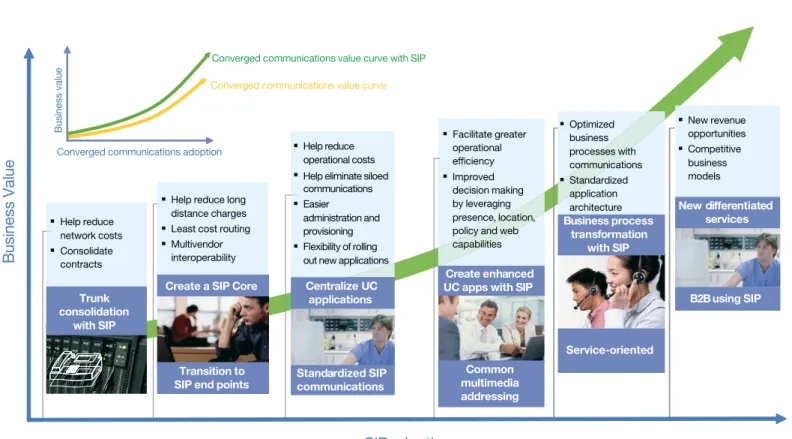
Figure 2:A SIP infrastructure can help provide additional value to your converged communications environment.
Business Value Optimized business processes with communications Standardized application architecture SIP adoption Help reduce network costs Consolidate contracts Trunk consolidation with SIP
Create a SIP Core
Transition to SIP end points
Centralize UC applications
Standardized SIP communications
Create enhanced UC apps with SIP
Common multimedia addressing New differentiated services B2B using SIP Service-oriented Business process transformation with SIP
Converged communications value curve
Converged communications value curve with SIP
Facilitate greater operational efficiency Improved decision making by leveraging presence, location, policy and web capabilities Help reduce
operational costs Help eliminate siloed communications Easier
administration and provisioning Flexibility of rolling out new applications Help reduce long
distance charges Least cost routing Multivendor interoperability New revenue opportunities Competitive business models Converged communications adoption
Enterprises can start their SIP journey with a short-term objective of optimizing their infrastructure by consolidating trunks, creating a SIP core, centralizing unified communica-tions applicacommunica-tions and transitioning to SIP endpoints. This objective would be attractive to the IT organization. This objective lays a cost-effective and flexible foundation for what can be built in the future.
Strategically, with a SIP network infrastructure, new applica-tions incorporating presence, locaapplica-tions and web-based capabilities can be built significantly easier than without SIP. Application programmers can incorporate communications capabilities into business applications and processes without having to program to the intricacies of the infrastructure complexities. In addition, multimedia, multimodal communi-cations can be built as part of new business services to pro-vide differentiation and leadership. This strategic view can drive top-line growth, differentiation, and is a key interest to line-of-business executives.
Transitioning from decentralized to centralized architectures
Data
Voice Video
Geo data centers Remote locations
SIP Trunk
Data plus SIP Data plus SIP Data plus
SIP Data plus SIP GW COL PBX IP PBX AS VM CC IP CC V
Central data centers
COL Central data centers
AS IP CC P UM IP PBX V GW SBC SM Enterprise data MPLS Enterprise voice net Enterprise
video net data MPLSEnterprise
PSTN PSTN PSTN PSTN Internet AS PBX GW VM CC VM CC IP CC IP PBX AS V GW PBX AS VM CC V GW IP PBX AS SBC Remote locations Remote locations
Geo data centers Remote locations
Conventional architecture SIP-based architecture
Internet PSTN Internet PSTN PSTN PSTN
14
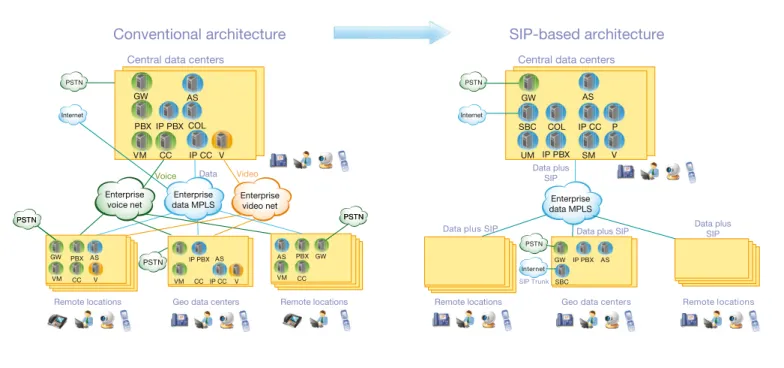
As Figure 3 shows, enterprises in the past used distributed architectures with separate voice, video and data networks connected to devices and systems siloed to these networks. Each location had its own set of communications systems, and there was no consistency in the capabilities across the various locations. This strategy was dictated by the state of technology in the past that led to these islands of communications.
Today, with a SIP-based architecture, it is possible to converge the separate voice, video and data networks into a single data network that uses SIP-based communications. The separate voice, video and data systems can be consoli-dated into a select few data centers with centralized trunking for all communications outside the enterprise. This allows optimized communications inside and outside the enterprise and provides ubiquitous capabilities across the enterprise applications. This centralized architecture lays the foundation for enabling cloud-based models.
Extracting the full value of SIP
With a SIP-based unified communications environment, it is easier to create new applications and services that integrate business information, communications and Web 2.0 capabili-ties. Businesses have new opportunities to optimize their processes as well as create new differentiated services for their customers.
A new SIP-based architecture and journey can have an impact on all aspects of the business. It has implications on the infra-structure, applications and processes layers of the organiza-tion, so it is extremely important that a structured approach be taken when embarking on any new unified communica-tions or SIP project.
The technology is evolving at a rapid pace, and the skills needed to keep up with all aspects of the changes are quite extensive. The evolving products and services require new training and certifications to effectively design, deploy and manage the solutions using either in-house IT staff or a systems integrator. At this time, no one vendor provides all the components of this broad technology, and there may be a need to work with many equipment and telecommunica-tions service providers. This leads to significant complexity and risk.
Achieving the promised benefits of this technology with reducing risk and ensuring a successful deployment requires: ● Strong IT knowledge specifically related to the SIP
protocol base networking, voice, video and unified communications
● Application integration skills
● Extensive experience in designing and deploying projects ● Detailed reference architectures and time-tested
methodologies
Often overlooked during the deployment of many projects are the implications of day-to-day operations of the new technology. After deployment, comprehensive management of all aspects of the solution to provide an end-to-end view of the service with updated processes to quickly identify and resolve problems is necessary for a smooth-running business. With these careful plans in place, an organization with a SIP foundation can reduce infrastructure costs to improve the bottom line, while adding flexibility and positioning for dif-ferentiated services to help increase top line revenue.
Conclusion
Organizations should consider building a road map to SIP adoption to start harnessing the benefits now. Consider the tactical drivers of cost savings and an optimized IT infrastruc-ture to get started. Plan for the fuinfrastruc-ture with a strategic view that allows for greater flexibility to incorporate collaborative communications, new business applications, communications-enabled business processes and the possibility of building new business models leveraging communications. SIP technology has matured and it is available now. While SIP from all ven-dors is not identical, an experienced systems integrator can help eliminate the risk of adoption and increase the speed to achieving the benefits of this exciting technology.
For more information
To learn more about IBM Converged Communications Services for Session Initiation Protocol, please contact your IBM marketing representative or visit the following website(s): ibm.com/services/networking
To understand the broad portfolio of IBM Converged Communications Services, visit: ibm.com/services/networking To gain an understanding of IBM’s capabilities in
Integrated Communications Services, visit:
ibm.com/services/integratedcommunications
Additionally, financing solutions from IBM Global Financing can enable effective cash management, protection from tech-nology obsolescence, improved total cost of ownership and return on investment. Also, our Global Asset Recovery Services help address environmental concerns with new, more energy-efficient solutions. For more information on
Please Recycle
Produced in the United States of America January 2011
All Rights Reserved
IBM, the IBM logo and ibm.com are trademarks of International Business Machines Corporation in the United States, other countries or both. If these and other IBM trademarked terms are marked on their first occurrence in this information with a trademark symbol (®or ™), these symbols indicate U.S. registered or common law trademarks owned by IBM at the time this information was published. Such trademarks may also be registered or common law trademarks in other countries. A current list of IBM trademarks is available on the web at “Copyright and trademark information” at ibm.com/legal/copytrade.shtml
Java and all Java-based trademarks and logos are trademarks or registered trademarks of Oracle and/or its affiliates.
Microsoft is a trademark of Microsoft Corporation in the United States, other countries, or both.
Other company, product or service names may be trademarks or service marks of others.