Annual Review of Pharmacology and Toxicology
Nanoparticle Toxicology
Wen Yang,
1Lin Wang,
1Evan M. Mettenbrink,
1Paul L. DeAngelis,
2and Stefan Wilhelm
1,3,41Stephenson School of Biomedical Engineering, University of Oklahoma, Norman,
Oklahoma 73019, USA; email: [email protected]
2Department of Biochemistry and Molecular Biology, University of Oklahoma Health Sciences
Center, Oklahoma City, Oklahoma 73104, USA
3Institute for Biomedical Engineering, Science, and Technology (IBEST), Norman,
Oklahoma 73019, USA
4Stephenson Cancer Center, Oklahoma City, Oklahoma 73104, USA
Annu. Rev. Pharmacol. Toxicol. 2021. 61:269–89 First published as a Review in Advance on August 25, 2020
TheAnnual Review of Pharmacology and Toxicologyis online at pharmtox.annualreviews.org
https://doi.org/10.1146/annurev-pharmtox-032320-110338
Copyright © 2021 by Annual Reviews. All rights reserved
Keywords
nanoparticles, toxicology, physicochemical properties, anti-PEG antibody, protein corona, ROS
Abstract
Nanoparticles from natural and anthropogenic sources are abundant in the environment, thus human exposure to nanoparticles is inevitable. Due to this constant exposure, it is critically important to understand the potential acute and chronic adverse effects that nanoparticles may cause to humans. In this review, we explore and highlight the current state of nanotoxicology research with a focus on mechanistic understanding of nanoparticle toxic-ity at organ, tissue, cell, and biomolecular levels. We discuss nanotoxictoxic-ity mechanisms, including generation of reactive oxygen species, nanoparticle disintegration, modulation of cell signaling pathways, protein corona for-mation, and poly(ethylene glycol)-mediated immunogenicity. We conclude with a perspective on potential approaches to advance current understanding of nanoparticle toxicity. Such improved understanding may lead to mitiga-tion strategies that could enable safe applicamitiga-tion of nanoparticles in humans. Advances in nanotoxicity research will ultimately inform efforts to estab-lish standardized regulatory frameworks with the goal of fully exploiting the potential of nanotechnology while minimizing harm to humans.
Annu. Rev. Pharmacol. Toxicol. 2021.61:269-289. Downloaded from www.annualreviews.org
1. INTRODUCTION
Nanoparticles comprise a class of materials with dimensions in the 1–100-nm range that exhibit unique physical, chemical, and biological properties, making them distinct from their corre-sponding bulk materials or small molecules (1, 2). Owing to their unique material characteristics, nanoparticles are broadly used in a range of applications and products, including industrial catalytic processes, energy conversion and storage, and image display technologies as well as cosmetics, medical devices, and therapeutics and diagnostics (3–5). In addition to such rationally designed nanoparticles, we are constantly surrounded by substantial amounts of naturally and incidentally formed particles, such as corrosion- or erosion-derived nanoparticles in water and airborne nanoparticles from traffic and industrial combustion (6, 7). The abundance of nanopar-ticles in the environment and in everyday consumer products makes human exposure inevitable. However, the potential acute and chronic health risks that nanoparticles may pose to humans are poorly investigated and understood.
In this review, we introduce the major nanoparticle classes and explore how their corre-sponding physicochemical properties affect toxicity. Our discussion of the main nanotoxicity mechanisms provides an overview of how nanoparticles interact with the body at organ, tissue, cell, and biomolecular levels. Such mechanistic understanding is enabled by diverse experimental and theoretical methods that have been developed and applied for the assessment and evaluation of nanotoxicity. We conclude our discussion with a perspective on potential strategies to mitigate nanotoxicity, with the goal of exploiting the full potential of nanotechnology for safe applications in humans. We hope that our review serves as a valuable resource that covers the current landscape of nanotoxicity research and that it will inspire new studies focused on expanding our understanding of nanoparticle toxicity. Improved understanding of nanotoxicity may ultimately inform and guide the development of regulatory frameworks to minimize potential harm to humans.
2. NANOPARTICLE CLASSIFICATION AND PHYSICOCHEMICAL PROPERTIES
Nanoparticles can be grouped into three main classes: (a) natural, (b) incidental, or (c) engineered nanoparticles (Figure 1a–c). The first class, natural nanoparticles, is ubiquitous in the environ-ment and generated via normal physical, chemical, and biological processes. Examples of such natural nanoparticles include inorganic metal-based nanoparticles, e.g., naturally formed silver (Ag) nanoparticles, and organic nanoparticles, e.g., virus nanoparticles and exosomes (Figure 1a). The second class, incidental nanoparticles, is generated unintentionally as byproducts of both industrial and nonindustrial processes such as corrosion, combustion, and cooking. Examples in-clude inorganic and organic combustion products such as metal- and carbon-based nanoparticles, respectively (Figure 1b). The third class, engineered nanoparticles, is intentionally designed and fabricated for specific industrial and/or medical applications. Examples include zinc oxide (ZnO) and titanium dioxide (TiO2) nanoparticles in sunscreen and liposomes for drug delivery appli-cations (8–10) (Figure 1c). An alternative terminology for natural and incidental nanoparticles is ultrafine particles (UFPs). These UFPs are airborne particulates of less than 100 nm in aero-dynamic diameter. While incidental and engineered nanoparticles are typically of anthropogenic origin, i.e., caused and/or prepared by human activity, natural nanoparticles are generated without human intervention (1, 6).
Beyond classification by origin, the various nanoparticle types can be further differentiated by their physicochemical properties (Figure 1d). Physicochemical properties such as nanoparticle
Annu. Rev. Pharmacol. Toxicol. 2021.61:269-289. Downloaded from www.annualreviews.org
40 nm 100 nm 100 nm 100 nm 50 nm 50 nm Natural nanoparticles Inorganic Organic
a
Incidental nanoparticlesb
d
Engineered nanoparticlesc
Physicochemical properties of nanoparticles
SIZE
1 nm 100 nm
SURFACE CHEMISTRY AND CHARGE
Surface ligands SHAPE Sphere Rod Disc Cube Polyhedron COMPOSITION Neutral Negative Zwitter-ionic Positive Liposome Micelle Au Fe3O4 Ag Figure 1
Nanoparticle classification and physicochemical properties. Nanoparticles can be broadly organized into three different classes: (a) natural, (b) incidental, or (c) engineered nanoparticles. Nanoparticles from all of these classes can be made from inorganic or organic materials. In contrast to the majority of natural and incidental nanoparticles, engineered nanoparticles typically exhibit narrow size distributions as well as defined shapes and surface properties. Panelsa–cdisplay transmission electron micrographs of different inorganic nanoparticles [(a,b,top) silver (Ag) nanoparticles, (c,top) upconversion (NaYF4/Yb,Er) nanoparticles] and organic
nanoparticles [(a,bottom) cowpea mosaic virus–like nanoparticles, (b,bottom) carbon black nanoparticles, (c,bottom) doxorubicin-loaded liposomes]. (d) Schematic of various nanoparticle physicochemical properties, including different nanoparticle compositions, sizes, surface chemistries, and shapes. Panelaadapted with permission from References 138 and 140, panelbadapted with permission from References 139 and 141, and panelcadapted with permission from References 110 and 142.
Annu. Rev. Pharmacol. Toxicol. 2021.61:269-289. Downloaded from www.annualreviews.org
Cell Cell Apoptosis Necrosis Nanoparticles Ocular Oral Inhalation Intravenous Dermal
Exposure pathways Organ/tissue interactions Cell interactions Biomolecular interactions
Chemical, physical, and biological effects
Nanoparticles
Nanoparticle
Biomolecules
Surface adsorption
Damage/lysis of intracellular organelles Damage to nucleic acids Damage to plasma membrane Damage to membrane receptors and ion channels
Inflammation
Allergic reactions and anaphylactic shock Inflammation Damage
a
b
e
Cellular toxicityf
Organ/tissue toxicityg
c
d
Damage/failure of tissues and organs: lungs, liver, brain, spleen, kidneys, and skin
ROS generation
i
ii
Disintegrationiii
Signaling pathwaysMetal ions Organic species Nanoparticle Cell MAPK Nrf-2 HIF PKC NF-κB Src Cell receptor Nanoparticle Singlet oxygen (1O 2) Superoxide radical (O2• –) Oxygen radical (O•) Peroxide ion (O22–) Hydrogen peroxide (H2O2)
Hydroxyl radical (OH•)
Nanoparticle
Reactive oxygen species (ROS)
Figure 2
Schematic representation of nanoparticle adverse effects and nanotoxicity. (a) Nanoparticle exposure pathways. Upon exposure, nanoparticles can interact with (b) organs/tissues, (c) cells, and (d) biomolecules. Major nanoparticle toxicity mechanisms include (e,i) the generation of reactive oxygen species (ROS), (e,ii) nanoparticle disintegration and release of metal ions and organic species, and (e,iii) nanoparticle-mediated activation of cell signaling pathways. Nanoparticle adverse effects and toxicity can lead to (f) cell apoptosis and necrosis and (g) tissue/organ damage, inflammation, and anaphylactic shock.
composition, size, surface chemistry, and shape are key factors that govern nanoparticle interac-tions with biological systems and biomolecules. These interacinterac-tions can affect biomolecular and cellular signaling, biological kinetics and transport, nanoparticle biodistribution, immunogenicity, and toxicity (11) (Figure 2). Compared to samples of engineered nanoparticles, natural and in-cidental nanoparticles tend to exhibit more heterogeneous physicochemical properties, with sub-stantial variations in nanoparticle composition, size, surface chemistry, and shape (Figure 1a–c). This heterogeneity complicates the assessment and understanding of nanoparticle biological interactions, adverse effects, and toxicity.
Annu. Rev. Pharmacol. Toxicol. 2021.61:269-289. Downloaded from www.annualreviews.org
3. NANOTOXICOLOGY
The study of nanoparticle adverse effects and toxicity is commonly referred to as nanotoxicol-ogy (12). Upon exposure, all three classes of nanoparticles, i.e., natural, incidental, and engineered nanoparticles, may interact with organs, tissues, cells, and biomolecules (Figure 2). Consequently, nanoparticle exposure may induce undesirable and harmful nano-bio interactions and other down-stream mechanisms that can potentially result in adverse effects and nanotoxicity.
Nanoparticle toxicity may occur as a function of exposure route, dose, concentration, time, and/or frequency. Traditionally, these fundamental toxicity factors are relevant for the assessment of small-molecule drugs and other compounds. In the evaluation of nanotoxicology, these pa-rameters are also widely used. However, beyond these traditional toxicology papa-rameters, other important factors that may affect nanoparticle toxicity need to be considered, including nanopar-ticle physicochemical properties such as material composition, size, surface chemistry, and shape (Figure 1d). Compared to small molecules, these additional physicochemical variables make nan-otoxicity assessment complex, and evaluation of nanoparticle toxicity on a case-by-case basis may be required. For example, slight variations in nanoparticle surface chemistry can result in signifi-cantly different toxicity, biodistribution, and elimination profiles, even if the nanomaterial core is the same (13–15).
To fully evaluate nanoparticle toxicity, nanoparticle structure and corresponding physicochem-ical properties need to be completely characterized and understood. In this way, observed toxic effects can be better attributed to certain nanoparticle properties for establishing specific nanoparticle structure-activity/toxicity functional relationships. As nanoparticle structural properties significantly affect toxicity, it is even more challenging to evaluate the safety of nanoparticles that exhibit large variations in physicochemical properties, as is often seen in natural and incidental nanoparticles (Figure 1a,b). Therefore, it is challenging to draw general conclusions about nanoparticle toxicity, as nanotoxicity is dependent on complex interactions between different physicochemical properties and the corresponding biological environment. Based on this complexity, it is important to establish well-defined, standardized methodologies for the systematic evaluation of nanotoxicity under relevant conditions to achieve comparable toxicological data sets. However, this level of standardization has not yet been achieved, which makes it difficult to provide general trends of nanotoxicity for acute (<14 days) and chronic (>4 months) exposure regimens (16).
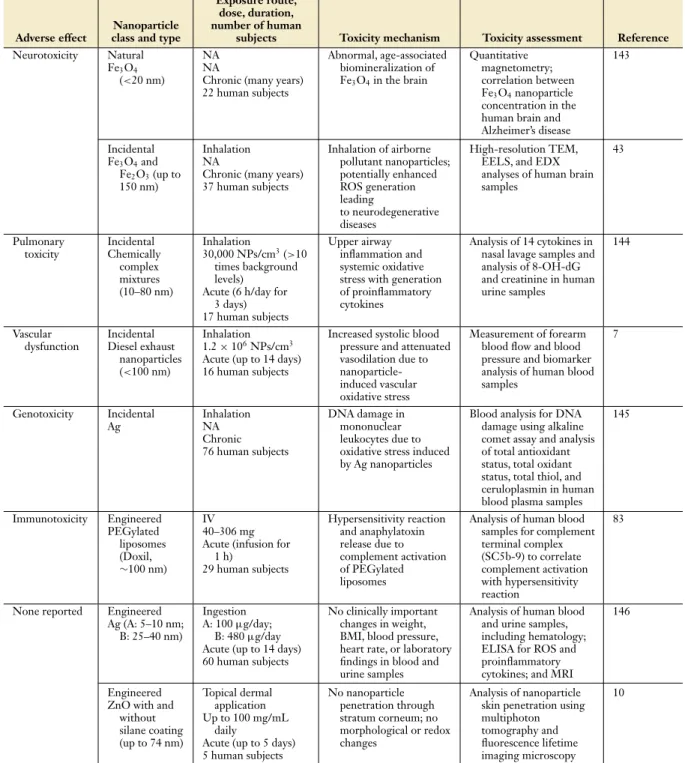
To provide examples of the broad range of potential nanoparticle adverse effects and toxicity, including neurotoxicity, pulmonary toxicity, vascular dysfunction, genotoxicity, and immunotox-icity, we have summarized studies that assessed the nanotoxicity of different nanoparticle classes and types in human subjects (Table 1).Table 1also includes studies that evaluated the toxic-ity of relevant engineered nanoparticles, such as Ag and ZnO nanoparticles, on human subjects but without any reported clinical or pathological findings, implying that the tested nanoparticles were safe and without noticeable adverse effects under the specific testing conditions. For con-text, Ag and ZnO nanoparticles are used in over-the-counter consumer products such as antiviral, antibacterial, and anti-inflammatory products and compounds as well as sunscreen (17–19). We want to emphasize that detailed reports and systematic clinical studies of nanoparticle toxicity in humans for various nanoparticle types are limited. Most published reports focus on the assessment of nanoparticle toxicity in cell culture and animal models. However, these models do not fully re-capitulate nanoparticle toxicity responses in humans and are therefore limited in their predictive power of possible hazards to humans (20).
To emphasize the importance of composition and other physicochemical properties on nanoparticle adverse effects and toxicity, we highlight a study by Mills et al. (7) that assessed adverse
Annu. Rev. Pharmacol. Toxicol. 2021.61:269-289. Downloaded from www.annualreviews.org
Table 1 Examples of nanoparticle toxicity in human subjects
Adverse effect class and typeNanoparticle
Exposure route, dose, duration, number of human
subjects Toxicity mechanism Toxicity assessment Reference
Neurotoxicity Natural Fe3O4
(<20 nm)
NA NA
Chronic (many years) 22 human subjects
Abnormal, age-associated biomineralization of Fe3O4in the brain
Quantitative magnetometry; correlation between Fe3O4nanoparticle concentration in the human brain and Alzheimer’s disease 143 Incidental Fe3O4and Fe2O3(up to 150 nm) Inhalation NA
Chronic (many years) 37 human subjects Inhalation of airborne pollutant nanoparticles; potentially enhanced ROS generation leading to neurodegenerative diseases High-resolution TEM, EELS, and EDX analyses of human brain samples 43 Pulmonary toxicity Incidental Chemically complex mixtures (10–80 nm) Inhalation 30,000 NPs/cm3(>10 times background levels)
Acute (6 h/day for 3 days) 17 human subjects
Upper airway inflammation and systemic oxidative stress with generation of proinflammatory cytokines
Analysis of 14 cytokines in nasal lavage samples and analysis of 8-OH-dG and creatinine in human urine samples
144
Vascular
dysfunction IncidentalDiesel exhaust nanoparticles (<100 nm)
Inhalation 1.2×10⁶NPs/cm3 Acute (up to 14 days) 16 human subjects
Increased systolic blood pressure and attenuated vasodilation due to nanoparticle-induced vascular oxidative stress
Measurement of forearm blood flow and blood pressure and biomarker analysis of human blood samples 7 Genotoxicity Incidental Ag InhalationNA Chronic 76 human subjects DNA damage in mononuclear leukocytes due to oxidative stress induced by Ag nanoparticles
Blood analysis for DNA damage using alkaline comet assay and analysis of total antioxidant status, total oxidant status, total thiol, and ceruloplasmin in human blood plasma samples
145 Immunotoxicity Engineered PEGylated liposomes (Doxil, ∼100 nm) IV 40–306 mg Acute (infusion for
1 h) 29 human subjects Hypersensitivity reaction and anaphylatoxin release due to complement activation of PEGylated liposomes
Analysis of human blood samples for complement terminal complex (SC5b-9) to correlate complement activation with hypersensitivity reaction 83
None reported Engineered Ag (A: 5–10 nm;
B: 25–40 nm)
Ingestion A: 100μg/day;
B: 480μg/day Acute (up to 14 days) 60 human subjects
No clinically important changes in weight, BMI, blood pressure, heart rate, or laboratory findings in blood and urine samples
Analysis of human blood and urine samples, including hematology; ELISA for ROS and proinflammatory cytokines; and MRI
146
Engineered ZnO with and
without silane coating (up to 74 nm) Topical dermal application Up to 100 mg/mL daily
Acute (up to 5 days) 5 human subjects No nanoparticle penetration through stratum corneum; no morphological or redox changes Analysis of nanoparticle skin penetration using multiphoton tomography and fluorescence lifetime imaging microscopy
10
Abbreviations: Ag, silver; BMI, body mass index; EDX, energy dispersive X-ray spectroscopy; EELS, electron energy loss spectroscopy; ELISA, enzyme-linked immunosorbent assay; IV, intravenous administration; MRI, magnetic resonance imaging; NA, not available; 8-OH-dG, 8-hydroxydeoxyguanosine; PEG, poly(ethylene glycol); ROS, reactive oxygen species; TEM, transmission electron microscopy.
Annu. Rev. Pharmacol. Toxicol. 2021.61:269-289. Downloaded from www.annualreviews.org
vascular side effects in 16 healthy human subjects exposed to combustion-derived nanoparticles from diesel exhaust over an acute exposure duration of 14 days. Impaired vascular function in study subjects was observed due to oxidative stress caused by inhalation of diesel exhaust nanoparticles. In contrast, when study subjects were exposed to filtered exhaust, i.e., exhaust without nanopar-ticles, or air containing pure carbon nanoparnanopar-ticles, vascular impairment was not observed. These findings indicate that nanoparticle composition and other physicochemical properties play key roles in nanotoxicity.
Other important nanoparticle physicochemical properties that affect nanotoxicity include size, surface chemistry, and shape (Figure 1d). For more detailed information on how nanoparticle physicochemical properties affect nano-bio interactions, adverse effects, and toxicity, we refer in-terested readers to excellent review articles by the Chan (11) and Howard groups (12).
Nanoparticle size is a physicochemical parameter that has been reported to affect cellular up-take efficiency and cytotoxicity (21). A study by Pan et al. (22) reported size-dependent cytotoxicity of gold nanoparticles with identical surface chemistry in fibroblasts, epithelial cells, macrophages, and melanoma cells in cell culture. The researchers reported that nanoparticles with a diameter of 1.4 nm exhibited the highest cytotoxicity, while nanoparticles with a diameter of 15 nm had no reported toxicity. As potential reasons for the observed differences in cytotoxicity, the researchers listed size-dependent nanoparticle cell uptake kinetics and interactions with the cell plasma mem-brane promoting cell apoptosis and necrosis.
In addition to nanoparticle size, surface chemistry is another important parameter that directly affects nanotoxicity. For example, a study by Bozich et al. (23) concluded that gold nanoparticles with an overall positive surface charge exhibited greater toxicity onDaphnia magnamodel or-ganisms compared to negatively charged gold nanoparticles of the same core size. Similarly, Lee et al. (24) reported that positively charged gold nanoparticles caused an∼50% reduction in cell viability compared to identical neutrally charged particles in cultured mouse breast cancer 4T1 cells. In comparison to neutral nanoparticles, there was a substantial reduction in cell viability of ∼50% for positively charged nanoparticles. Potential reasons for the increased toxicity of posi-tively charged nanoparticles include a higher electrostatic attraction of nanoparticles to negaposi-tively charged cell surfaces and overall increased nanoparticle cellular uptake, potentially leading to in-creases in oxidative stress and reactive oxygen species (ROS) (25, 26). As the nanoparticle surface interacts directly with biomolecules and biological systems, it is a driver of cellular uptake and intracellular transport kinetics (21). In addition, surface chemistry and surface charge are key fac-tors of nanoparticle agglomeration and aggregation, which are additional variables that need to be considered in the assessment of nanotoxicity (27, 28).
Besides size and surface chemistry, nanoparticle shape may significantly affect nanotoxicity (26). For example, a study by Zhao et al. (29) reported increased cytotoxicity of needle- and plate-shaped nanosized hydroxyapatite compared to sphere- and rod-plate-shaped nanoparticles in human lung BEAS-2B epithelial cells. A potential reason for the increased cytotoxicity may be that needle-and spike-like nanoparticle shapes potentially puncture cellular membranes, leading to compro-mised cellular integrity and cell death. The shape properties of micro- and nanoparticles can also induce physical activation of innate immunity. As reported by Wang et al. (30), TiO2 microparti-cles exhibiting nanospikes can exert mechanical stress on cells, which can lead to potassium efflux and inflammasome activation in macrophages and dendritic cells. These findings highlight the potential of nanoparticle shape as a means to tune nanoparticle immunogenicity by physical cues, which could potentially be attractive for more efficient and effective vaccination and immunother-apy approaches.
Nanoparticle physicochemical properties not only affect cellular interactions but may also de-termine biodistribution, clearance, and elimination (31–33). For example, nanoparticles with sizes
Annu. Rev. Pharmacol. Toxicol. 2021.61:269-289. Downloaded from www.annualreviews.org
smaller than 5.5 nm will be eliminated rapidly into urine via the kidneys (34). Nanoparticles larger than the renal cutoff size are often efficiently sequestered by cells in the liver and spleen, including Kupffer cells, B cells, T cells, and endothelial cells (33), and may be eliminated to varying extents via the hepatobiliary pathway (15). Understanding how nanoparticle physicochemical properties affect nano-bio interactions will provide an opportunity to control nanoparticle fate and toxic-ity inside the body. Such control may ultimately lead to more potent nanoparticle-based medi-cal treatments and diagnostics with reduced side effects and toxicity for patients. An example of this control is the application of liposomes to encapsulate the small-molecule cancer drug dox-orubicin. Compared to treatment with the free (i.e., unencapsulated) drug, US Food and Drug Administration–approved doxorubicin liposomes (i.e., Doxil) can reduce cardiotoxicity and other adverse effects to improve the quality of life for cancer patients (35).
4. NANOTOXICITY MECHANISMS
There are a number of different pathways by which nanoparticles can enter the body. These path-ways include inhalation, oral ingestion, ocular exposure, application and deposition on skin, and intravenous administration (10, 36–39) (Figure 2a). The inhalation of airborne nanoparticles is a major exposure pathway that allows nanoparticles to enter and deposit in lung tissues and the alveolar region (40) (Figure 2b). Accumulation of nanoparticles in the lung can lead to oxidative stress–mediated lung inflammation at both acute and chronic stages (41, 42). Inhalation may also lead to the accumulation of nanoparticles in the brain. Maher et al. (43) reported that airborne magnetite nanoparticles can enter the brain via the olfactory bulb. Accumulation of magnetite nanoparticles in the brain that are abundant in airborne particulate matter pollution can lead to enhanced production of ROS, which is causally linked to neurodegenerative diseases such as Alzheimer’s disease (43, 44).
After entering the body, nanoparticles may interact with the initially encountered organ or tissue. Nanoparticles may also subsequently translocate and enter the bloodstream (for example, from lungs to the capillary network to bigger vessels) to access distant organs/tissues via sys-temic transport (45, 46) (Figure 2b). Within organs, tissues, and blood, nanoparticles can interact with cells and intracellular organelles to potentially cause toxicity at cellular and subcellular lev-els (Figure 2c). It is important to point out that, upon entry into the body, nanoparticles interact with a variety of different biomolecules, including proteins, carbohydrates, lipids, and nucleic acids (Figure 2d). These interactions result in the formation of a biomolecular nanoparticle surface corona, often referred to as the protein corona. Protein corona (or biomolecular corona) forma-tion may change nanoparticle surface chemistry or stimulate the complement system substantially and ultimately affect nanotoxicity or the efficacy of nanomedicine (47–49). The damage of pro-teins to nanoparticle surfaces may also lead to protein unfolding (50, 51). This process may induce the loss of protein function and may cause immunotoxicity (52, 53). In addition, the protein con-figuration change can lead to adverse effects and toxicity via cell signaling pathway activation (51), enzyme function loss (54), nanoparticle aggregation (50), new antigenic site formation (55), and protein fibrillation (56).
At the cellular level, direct interaction between nanoparticles and cells may result in physical damage of cell membrane structures (57, 58). For example, graphene nanoparticles have been re-ported to cause physical damage, cytoskeletal dysfunction, and abnormal morphological stretching in different cell types as a result of the blade-like shape of these materials (57, 58). In addition, nanoparticles may be able to block cell membrane receptors and membrane ion channels, which may interrupt normal cellular biofunctions and homeostasis (59). Leifert et al. (59) reported that 1.4-nm gold nanoparticles were able to block voltage-gated potassium channels in vitro, which may lead to unwanted cardiac malformation in mice.
Annu. Rev. Pharmacol. Toxicol. 2021.61:269-289. Downloaded from www.annualreviews.org
A major nanotoxicity mechanism is the generation of ROS such as singlet oxygen, super-oxide anion radicals, oxygen radicals, persuper-oxide ions, hydrogen persuper-oxide, and hydroxyl radicals (Figure 2e). ROS generation can occur in different ways. One route is through one-electron ox-idative reactions with transition metals or nanoparticle surface groups (60, 61). It is important to note that a nanoparticle exhibits a relatively large surface area compared to the particle volume. An increase in surface area is typically accompanied by an increase in chemical reactivity poten-tially leading to increased ROS production. Another ROS generation mechanism is via mitochon-drial respiration and subsequent ROS release into the cytoplasm through pores in mitochonmitochon-drial membranes created by nanoparticles (60). In healthy cells, an equilibrium is maintained between intracellular antioxidants and ROS. However, intracellular nanoparticles can directly damage mi-tochondria, causing an increase in intracellular ROS and oxidative stress (62). Enhanced intracel-lular ROS levels may stimulate further ROS release from mitochondria through a process called ROS-induced ROS release. This process can substantially increase intracellular ROS levels and amplify the oxidative imbalance (63). High levels of ROS can cause oxidative stress and damage to cellular organelles, DNA, cell membranes, ion channels, and cell surface receptors, leading to adverse effects and toxicity.
Metal or metal oxide nanoparticles are used in preclinical and clinical applications such as imag-ing, photothermal therapy, and biosensors (64). However, corrosive tissue microenvironments and lysosomal degradation may disintegrate nanoparticles to release potentially harmful metal ions (Figure 2e). For many nanoparticles, including Ag, cadmium selenide (CdSe), ZnO, and ferroso-ferric oxide nanoparticles, released metal ions may generate high levels of oxidative stress and are primary sources of nanotoxicity. For example, Ag(I) ions released from Ag nanoparticles can cause DNA damage, ROS generation, and cell membrane destruction as reported from cell cul-ture studies (65). We want to emphasize that nanotoxicity results obtained in cell culcul-ture studies do not necessarily recapitulate the nanoparticle toxicity potential in animal models or human sub-jects. For example, CdSe quantum dots were found to be toxic in cell culture; however, no toxicity was observed in animal models under the specific reported testing conditions (66–69).
The generation of high levels of ROS and the release of harmful metal ions from nanoparticles have been reported to affect a variety of cell signaling pathways such as nuclear factor kappa-light-chain enhancer of activated B cells (NF-κB), mitogen-activated protein kinase (MAPK), Akt, and Src (70–73) (Figure 2e). Activation and modulation of these signaling pathways can affect cell proliferation, differentiation, and cell survival. Nyga et al. (74) reported that cobalt nanoparti-cles can stabilize hypoxia-inducible factor (HIF) protein and upregulateHIFgene expression in human macrophages. HIF pathway activation can affect cell growth, cell survival, apoptosis, and metabolic adaptation (75). Importantly, there can be interplay and synergistic effects between ROS generation, cell signaling modulation, and nanoparticle disintegration. For example, nanoparticle disintegration may lead to modulation of signaling pathways and/or induce ROS generation (76), which can activate numerous signaling pathways or cause nanoparticle disintegration; in turn, dif-ferent cell signaling pathways can subsequently induce ROS generation (77). These mechanisms may cause damage to cell membranes, intracellular organelles, and nucleic acids and eventually lead to cell apoptosis or necrosis (Figure 2f). Loss of functional cells may compromise organ function and result in organ damage or inflammatory responses (Figure 2g). Moreover, cell apop-tosis, necrosis, and pyroptosis may lead to the release of large amounts of intracellular content to potentially cause local inflammation or systemic immune responses (78–80) (Figure 2g).
In addition to the nanoparticle core material, surface components may also contribute sig-nificantly to nanoparticle adverse effects and toxicity. For example, researchers coat nanopar-ticle surfaces with polymers such as dextran or poly(ethylene glycol) (PEG) to reduce adsorp-tion of proteins and other biomolecules and to prolong nanoparticle blood circulaadsorp-tion times
Annu. Rev. Pharmacol. Toxicol. 2021.61:269-289. Downloaded from www.annualreviews.org
PEG
Spleen
Liver
Anti-PEG IgG
Anti-PEG IgM nanoparticle
Activation via classical pathway Generation of anaphylatoxins Release C
Anti-PEG IgG nanoparticle Anti-PEG IgM
Anti-PEG IgM–mediated Fc
Fcγ receptor
Anti-PEG immune response Anti-PEG antibody nanoparticle interactions
Time (h)
Blood level (% ID)
1st injection 2nd injection
a
b
Histamine TXA2 PAF Tryptase LT-2,4 IL-6 Release Histamine TXA2 PAF Tryptase LT-2,4 IL-6i
ii
Pseudoallergic infusion reaction cascade and ABC phenomenon
c
CARPAi
CIPAii
ABC phenomenoniii
Cell Cell Core Figure 3Anti-poly(ethylene glycol) (PEG) immunogenicity–induced mechanisms of nanoparticle pseudoallergic infusion reaction cascade and accelerated blood clearance (ABC) phenomenon. (a) Anti-PEG immune responses can be stimulated by intravenous administration of PEGylated nanoparticles. These nanoparticles can stimulate spleen marginal zone B cells and plasma B cells to produce anti-PEG immunoglobulin (Ig)M and IgG, respectively. (b) Anti-PEG IgM and IgG can bind efficiently to PEGylated nanoparticles. (c,i) The complement (C) activation–related pseudoallergy (CARPA) mechanism is initiated by anti-PEG IgM binding to the nanoparticle surface. In a subsequent step, the complement system is activated via the classical pathway. This activation leads to the generation of anaphylatoxins that stimulate different types of innate immune and blood cells, including macrophages, mast cells, basophils, and granulocytes, to release secondary mediators of pseudoallergy, such as histamine, TXA2, PAF, tryptase, LT-2 and 4, and IL-6. (c,ii) The complement-independent pseudoallergy (CIPA) is characterized by anti-PEG IgG binding to nanoparticles. The fragment
crystallizable (Fc) portion of the anti-PEG IgG can bind to Fcγreceptors on macrophages, mast cells, and basophils to release secondary mediators of pseudoallergy. (c,iii) The rapid blood clearance of PEGylated nanoparticles upon repeated administration is referred to as the ABC phenomenon and is mediated in part by anti-PEG IgM opsonization, leading to efficient nanoparticle phagocytosis and accumulation in cells and organs of the mononuclear phagocyte system, including the liver. The second dose of PEGylated medicine (red) has a shorter half-life than the initial dose (purple) due to the patient’s immune reaction.
(81, 82). Therefore, PEG is widely used in preclinical and clinical studies for surface modification of nanomedicines. However, PEG may induce hypersensitivity reactions and anaphylaxis mediated by anti-PEG antibodies in humans (83–85).
After an initial systemic administration of PEGylated nanoparticles, anti-PEG immunoglobu-lins (Igs; IgM initially, then IgG) may be generated by marginal zone spleen B cells (Figure 3a,b). The anti-PEG IgM then targets PEGylated nanoparticles during subsequent administrations, causing complement activation via the classical pathway (48, 86–88) (Figure 3c). Upon activation of the complement system, anaphylatoxins will be released, including platelet-activating factor, histamine, or cytokines, resulting in hypersensitivity reactions (89). Kozma et al. (90) documented the causal relationship between complement activation by anti-PEG IgM and hypersensitivity
Annu. Rev. Pharmacol. Toxicol. 2021.61:269-289. Downloaded from www.annualreviews.org
reactions in pig models. Although the study was conducted in pigs, it provides valuable insights into potential PEG-related toxicity mechanisms in humans. Other reported studies indicate that hypersensitivity to nanoparticle surface components may be induced by complement activation via the alternative pathway (47, 91). This pathway does not depend on anti-PEG antibodies and is not limited to PEGylated nanoparticles (47, 91). More in-depth studies are needed to fully elucidate the underlying mechanisms of hypersensitivity reactions. In addition to complement activation–related pseudoallergy reactions, complement-independent pseudoallergy is caused by anti-PEG IgG (Figure 3c). Mechanistically, a PEGylated nanoparticle is bound by anti-PEG IgG forming the nanoparticle-IgG complex, which subsequently can interact with the Fcγreceptors on mast cells, basophils, and neutrophils, resulting in the release of platelet-activating factor, histamine, or cytokines, to induce hypersensitivity reactions (92–94).
Hypersensitivity reactions often occur during second- and later-stage administration of PEGylated nanoparticles. However, hypersensitivity reactions have also been observed during the first dosage in human subjects. A potential rationale for this side effect is the abundance of preexisting anti-PEG antibodies in some of the patient population (93). Many humans who had never received PEGylated materials or drugs still possess preexisting anti-PEG IgM and IgG in various amounts, which is likely due to exposure to PEG-containing over-the-counter medication (e.g., daily multigram doses in some laxatives), cosmetics, and other everyday consumer products (89, 95–97). According to a study by Yang et al. (96), anti-PEG antibodies were detected in 72% of human samples collected after 1999, while 56% of historical samples from the previous 30 years (1970–1999) exhibited anti-PEG antibodies. In other words, a large number of humans exhibit de-tectable levels of anti-PEG IgG and IgM, and these numbers are expected to increase in humans in the future as a result of wider exposure to products that contain PEG.
Besides hypersensitivity reactions, complement activation can also lead to a direct attack of the lipid membrane of drug-carrying nanoparticles, such as doxorubicin liposomes, to prematurely release encapsulated chemotherapy drugs. Such premature drug release can affect the therapeu-tic effect of nanomedicines and could potentially contribute to additional nanotoxicity concerns (98). Anti-PEG immunity may also contribute to the so-called accelerated blood clearance (ABC) phenomenon (49, 99) (Figure 3c). Upon repeated administration of PEGylated nanoparticles, anti-PEG IgM opsonization may trigger efficient nanoparticle phagocytosis. As a result, nanopar-ticles may accumulate to a large extent in cells and organs of the mononuclear phagocyte system, including the liver, after their first administration, and thus not arrive at the intended target lo-cation such as a tumor. Besides the observed decrease in nanoparticle therapeutic efficacy upon ABC, acute and chronic nanotoxicity of sequestered nanoparticles are substantial concerns.
5. NANOTOXICITY ASSESSMENT
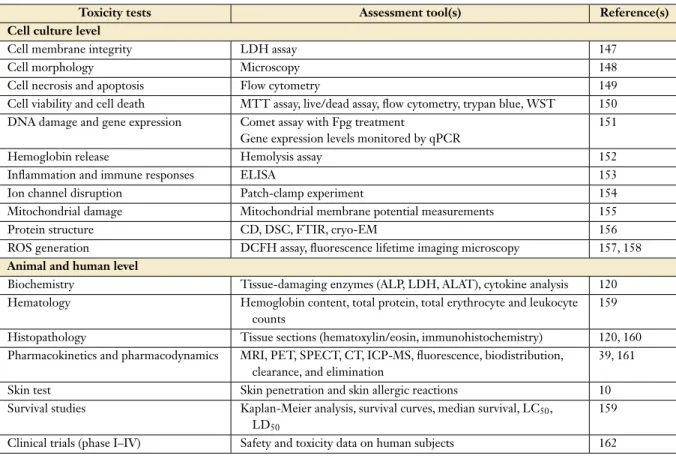
Toxicity assessments are used to evaluate the safety of nanoparticles. InTable 2, we have sum-marized examples of commonly used cell culture and animal toxicity tests used for nanotoxic-ity assessment. Cell culture studies enable nanotoxicnanotoxic-ity evaluation of various model animal and human cell lines and are beneficial due to their simplicity, scalability, low cost, and throughput. However, cell culture studies, in contrast to animal models, lack complex physiology and are lim-ited in their predictive power of nanotoxicity for other species and humans. Animal model testing can account for complex physiological environments during nanotoxicity assessment but may be limited in predicting toxic responses and adverse effects in humans. Computational nanotoxic-ity methods can assist with bridging the gaps between cell culture, animal models, and human subjects. If the underlying assumptions and models are not flawed, then these methods should substantially assist nanotoxicity modelling and prediction in the future for broad and routine
Annu. Rev. Pharmacol. Toxicol. 2021.61:269-289. Downloaded from www.annualreviews.org
Table 2 Examples of nanoparticle toxicity assessment tools
Toxicity tests Assessment tool(s) Reference(s)
Cell culture level
Cell membrane integrity LDH assay 147
Cell morphology Microscopy 148
Cell necrosis and apoptosis Flow cytometry 149
Cell viability and cell death MTT assay, live/dead assay, flow cytometry, trypan blue, WST 150 DNA damage and gene expression Comet assay with Fpg treatment
Gene expression levels monitored by qPCR
151
Hemoglobin release Hemolysis assay 152
Inflammation and immune responses ELISA 153
Ion channel disruption Patch-clamp experiment 154
Mitochondrial damage Mitochondrial membrane potential measurements 155
Protein structure CD, DSC, FTIR, cryo-EM 156
ROS generation DCFH assay, fluorescence lifetime imaging microscopy 157, 158
Animal and human level
Biochemistry Tissue-damaging enzymes (ALP, LDH, ALAT), cytokine analysis 120 Hematology Hemoglobin content, total protein, total erythrocyte and leukocyte
counts
159
Histopathology Tissue sections (hematoxylin/eosin, immunohistochemistry) 120, 160 Pharmacokinetics and pharmacodynamics MRI, PET, SPECT, CT, ICP-MS, fluorescence, biodistribution,
clearance, and elimination
39, 161
Skin test Skin penetration and skin allergic reactions 10
Survival studies Kaplan-Meier analysis, survival curves, median survival, LC50, LD50
159
Clinical trials (phase I–IV) Safety and toxicity data on human subjects 162
Abbreviations: ALAT, alanine aminotransferase; ALP, alkaline phosphatase; CD, circular dichroism; cryo-EM, cryogenic electron microscopy; CT, X-ray computed tomography; DCFH, 27-dichlorodihydrofluorescein; DSC, differential scanning calorimetry; ELISA, enzyme-linked immunosorbent assay; Fpg, formamidopyrimidine-DNA glycosylase; FTIR, Fourier transform infrared spectroscopy; ICP-MS, inductively coupled plasma mass spectrometry; LC50, lethal concentration 50%; LD50, lethal dose 50%; LDH, lactate dehydrogenase; MRI, magnetic resonance imaging; MTT, methyl tetrazolium;
PET, positron emission tomography; qPCR, quantitative polymerase chain reaction; SPECT, single-photon emission computed tomography; WST, water-soluble tetrazolium salt.
applications (100). Computational studies can reduce the need, cost, and time required for an-imal and cell nanotoxicity testing (101–103). However, due to the lack of standardized protocols for nanotoxicity testing, published studies exhibit substantial heterogeneities in terms of nanopar-ticle characterization, dose metrics, experimental methods, and data completeness, reducing the overall statistical power and accuracy of computational models for nanotoxicity predictions (104, 105).
6. STRATEGIES TO MITIGATE NANOTOXICITY
By understanding the underlying toxicity mechanisms, researchers can start to devise strategies for mitigating nanoparticle adverse effects and nanotoxicity. While few studies focus on manipulating the nanoparticle core composition, most reported approaches center around the modification of nanoparticle surface chemistry and surface properties. For example, silica coating and polymer encapsulation strategies can be used to control nanoparticle disintegration and ion release kinetics of metal and metal oxide nanoparticles to mitigate metal ion–induced toxicities and ROS
Annu. Rev. Pharmacol. Toxicol. 2021.61:269-289. Downloaded from www.annualreviews.org
production (106–110). Another popular approach is to passivate the nanoparticle surface with PEG for reducing biomolecular corona formation and for camouflaging nanoparticles. However, due to the immunogenic potential of PEG, other nanoparticle surface–coating technologies are urgently needed that provide similar camouflaging properties as PEG but without side effects for patients, including hypersensitivity, allergic reactions, and anaphylactic shock. A creative approach to address this challenge is to wrap nanoparticles in cell plasma membranes such as membranes derived from erythrocytes (111). Red blood cell membrane–coated nanoparticles exhibit minimal protein corona formation, toxicity, and immunogenicity. This camouflage strategy can be effective in mitigating the potential nanotoxicity of engineered nanoparticles to provide safer and more potent nanomedicines in the future and to use nanoparticles for safe applications in consumer products and industrial processes. However, it is difficult to apply such a strategy to natural and incidental nanoparticles as well as mitigate concerns for contaminating adventitious agents. The nanotoxicity of these natural and incidental nanoparticles may be mitigated by antioxidant therapy or by reducing human exposure to these nanoparticles via respiratory protection, including masks and other protective equipment (106, 112).
7. PERSPECTIVES AND CONCLUSION
One of the most pressing questions in conversations about nanoparticles is whether nanoparticles are toxic. The question has no direct answer due to the multiparameter nature of nanoparticle toxicity. Great caution is required to not generalize nanoparticle safety and toxicity concerns. In its current state, the evaluation of nanoparticle toxicity requires careful case-by-case assessment, because biological and pathological effects are determined by a number of variables, including nanoparticle physiochemical properties, exposure route, dose, and duration, to name a few. This opinion is in line with recent thoughtful editorials, viewpoints, and correspondences on nanopar-ticle risk assessment and nanosafety (113–118). Nanotoxicity is a highly important and timely re-search area, as human exposure to different nanoparticle classes and types will continue to increase in the future.
One of the main barriers to advancing progress in nanotoxicology is the lack of unified and standardized procedures for nanoparticle characterization, risk assessment methods, and report-ing (105, 113, 119). For example, nanoparticle dose metrics are used and reported differently in different research studies, including mass-, surface area–, and nanoparticle number–based metrics (12). Standardization of nanoparticle dose metrics in experimental design and data reporting will be critical in the facilitation of data mining and development of computational approaches, such as the NanoSolveIT project, that use multiscale physics-based and data-driven models, including toxicogenomics and biokinetics, for integrated in silico nanoparticle risk assessment (100). In ad-dition to dose metrics, standardized experimental design and data reporting will be required in all aspects of nanoparticle toxicity testing in order to train predictive computational models.
These data sets are typically obtained from conventional nanotoxicity studies that are based on in vitro cell culture and/or in vivo animal model experiments. There are ongoing debates within the research community about the potential and power of these models for predicting nanotoxicity in humans (101, 103, 104, 120). A limitation of nanoparticle risk assessment in those simplified models is that it is difficult to model chronic long-term exposure in laboratory animals that exhibit significantly shorter life spans than humans. However, data on chronic, low-dose nanoparticle exposure might provide valuable new insights on the long-term toxic effects of nanoparticles. Great attention and care should be placed on evaluating and understanding the mechanisms of nanotoxicity in biologically and physiologically relevant models. This may require new models of toxicity evaluation that exploit high-throughput screening methods (121, 122), machine learning
Annu. Rev. Pharmacol. Toxicol. 2021.61:269-289. Downloaded from www.annualreviews.org
approaches (101), and the development of new three-dimensional microfluidic-based tissue chips and organoids that are aimed at better recapitulating human physiology (123–125). Such advanced tissue models combined with advanced optical imaging and single-cell analytical methods, such as single-cell RNA sequencing and single-cell elemental quantification, could provide powerful tools to assess nanotoxicity at the individual cell level (126–131).
Since nanoparticles may trigger immunogenicity and immunotoxicity, as observed in some cases with PEGylated nanomedicines, the formulation of nonimmunogenic nanoparticles is re-quired. This goal may be achieved by coating nanoparticles with PEG alternatives such as zwit-terionic polymers, cell-derived plasma membranes, or self (i.e., identical to human) carbohydrate polymers such as hyaluronan, polysialic acid, or heparosan (132–136). Recently, Lazarovits et al. (137) reported a method to create a new class of size- and shape-tunable nanoparticles that are made entirely from (human) patient-derived proteins. These nanoparticles are biodegradable and have not been observed to activate innate or adaptive immunity following systemic administration in animal models.
Nanotoxicology research will greatly benefit from the convergence of disciplines such as ma-terials science, chemistry, engineering, biology, data science, medicine, and toxicology to answer pressing questions regarding the conditions required for the safe application and exposure of nanoparticles in humans. Ultimately, such concerted research will inform regulatory agencies and catalyze the generation of frameworks to exploit the full potential of safe nanoparticle exposure and application in humans.
DISCLOSURE STATEMENT
P.L.D. has a financial stake in Caisson Biotech, LLC, which is commercializing heparosan for drug delivery.
ACKNOWLEDGMENTS
The authors thank N. Donahue, V. Sheth, and S. Quine for fruitful discussions and assistance with illustrations. S.W. and P.L.D. acknowledge funding support from the University of Oklahoma IBEST-OUHSC Seed Grant for Interdisciplinary Research and OCAST (HR20-106).
LITERATURE CITED
1. Br. Stand. Inst. 2007.Terminology for nanomaterials. Publicly Availab. Specif., Br. Stand. Inst., London 2. Li N, Georas S, Alexis N, Fritz P, Xia T, et al. 2016. A work group report on ultrafine particles
(Ameri-can Academy of Allergy, Asthma & Immunology): why ambient ultrafine and engineered nanoparticles should receive special attention for possible adverse health outcomes in human subjects.J. Allergy Clin. Immunol.138(2):386–96
3. Santos AC, Morais F, Simões A, Pereira I, Sequeira JAD, et al. 2019. Nanotechnology for the develop-ment of new cosmetic formulations.Expert Opin. Drug Deliv.16(4):313–30
4. Hajba L, Guttman A. 2016. The use of magnetic nanoparticles in cancer theranostics: toward handheld diagnostic devices.Biotechnol. Adv.34(4):354–61
5. Liu Y, Bhattarai P, Dai Z, Chen X. 2019. Photothermal therapy and photoacoustic imaging via nanoth-eranostics in fighting cancer.Chem. Soc. Rev.48(7):2053–108
6. Hochella MF, Mogk DW, Ranville J, Allen IC, Luther GW, et al. 2019. Natural, incidental, and engi-neered nanomaterials and their impacts on the Earth system.Science363(6434):eaau8299
7. Mills NL, Miller MR, Lucking AJ, Beveridge J, Flint L, et al. 2011. Combustion-derived nanoparticulate induces the adverse vascular effects of diesel exhaust inhalation.Eur. Heart J.32(21):2660–71
Annu. Rev. Pharmacol. Toxicol. 2021.61:269-289. Downloaded from www.annualreviews.org
8. Narum SM, Le T, Le DP, Lee JC, Donahue ND, et al. 2020. Passive targeting in nanomedicine: fun-damental concepts, body interactions, and clinical potential. InNanoparticles for Biomedical Applications, ed. EJ Chung, L Leon, C Rinaldi, pp. 37–53. Amsterdam: Elsevier
9. Sindhwani S, Syed AM, Ngai J, Kingston BR, Maiorino L, et al. 2020. The entry of nanoparticles into solid tumours.Nat. Mater.19:566–75
10. Mohammed YH, Holmes A, Haridass IN, Sanchez WY, Studier H, et al. 2019. Support for the safe use of zinc oxide nanoparticle sunscreens: lack of skin penetration or cellular toxicity after repeated application in volunteers.J. Investig. Dermatol.139(2):308–15
11. Albanese A, Tang PS, Chan WCW. 2012. The effect of nanoparticle size, shape, and surface chemistry on biological systems.Annu. Rev. Biomed. Eng.14:1–16
12. Elsaesser A, Howard CV. 2012. Toxicology of nanoparticles.Adv. Drug Deliv. Rev.64(2):129–37 13. Muhr V, Wilhelm S, Hirsch T, Wolfbeis OS. 2014. Upconversion nanoparticles: from hydrophobic to
hydrophilic surfaces.Acc. Chem. Res.47(12):3481–93
14. Elci SG, Jiang Y, Yan B, Kim ST, Saha K, et al. 2016. Surface charge controls the suborgan biodistribu-tions of gold nanoparticles.ACS Nano10(5):5536–42
15. Poon W, Zhang Y-N, Ouyang B, Kingston BR, Wu JLY, et al. 2019. Elimination pathways of nanopar-ticles.ACS Nano13(5):5785–98
16. Liu J, Feng X, Wei L, Chen L, Song B, Shao L. 2016. The toxicology of ion-shedding zinc oxide nanopar-ticles.Crit. Rev. Toxicol.46(4):348–84
17. Sun D, Zhang W, Mou Z, Chen Y, Guo F, et al. 2017. Transcriptome analysis reveals silver nanoparticle-decorated quercetin antibacterial molecular mechanism.ACS Appl. Mater Interfaces9(11):10047–60 18. El-Rafie HM, Hamed MA-A. 2014. Antioxidant and anti-inflammatory activities of silver nanoparticles
biosynthesized from aqueous leaves extracts of fourTerminaliaspecies.Adv. Nat. Sci. Nanosci. Nanotechnol. 5(3):035008
19. Holmes AM, Song Z, Moghimi HR, Roberts MS. 2016. Relative penetration of zinc oxide and zinc ions into human skin after application of different zinc oxide formulations.ACS Nano10(2):1810–19 20. Rivera Gil P, Oberdörster G, Elder A, Puntes V, Parak WJ. 2010. Correlating physico-chemical with
toxicological properties of nanoparticles: the present and the future.ACS Nano4(10):5527–31 21. Donahue ND, Acar H, Wilhelm S. 2019. Concepts of nanoparticle cellular uptake, intracellular
traffick-ing, and kinetics in nanomedicine.Adv. Drug Deliv. Rev.143:68–96
22. Pan Y, Neuss S, Leifert A, Fischler M, Wen F, et al. 2007. Size-dependent cytotoxicity of gold nanopar-ticles.Small3(11):1941–49
23. Bozich JS, Lohse SE, Torelli MD, Murphy CJ, Hamers RJ, Klaper RD. 2014. Surface chemistry, charge and ligand type impact the toxicity of gold nanoparticles toDaphnia magna. Environ. Sci.: Nano1(3):260– 70
24. Lee JC, Donahue ND, Mao AS, Karim A, Komarneni M, et al. 2020. Exploring maleimide-based nanoparticle surface engineering to control cellular interactions.ACS Appl. Nano Mater.3:2421–29 25. Fröhlich E. 2012. The role of surface charge in cellular uptake and cytotoxicity of medical nanoparticles.
Int. J. Nanomed.7:5577–91
26. Sukhanova A, Bozrova S, Sokolov P, Berestovoy M, Karaulov A, Nabiev I. 2018. Dependence of nanopar-ticle toxicity on their physical and chemical properties.Nanoscale Res. Lett.13(1):44
27. Tripathy N, Hong T-K, Ha K-T, Jeong H-S, Hahn Y-B. 2014. Effect of ZnO nanoparticles aggregation on the toxicity in RAW 264.7 murine macrophage.J. Hazard. Mater.270:110–17
28. Albanese A, Chan WCW. 2011. Effect of gold nanoparticle aggregation on cell uptake and toxicity.ACS Nano5(7):5478–89
29. Zhao X, Ng S, Heng BC, Guo J, Ma L, et al. 2013. Cytotoxicity of hydroxyapatite nanoparticles is shape and cell dependent.Arch. Toxicol.87(6):1037–52
30. Wang J, Chen H-J, Hang T, Yu Y, Liu G, et al. 2018. Physical activation of innate immunity by spiky particles.Nat. Nanotechnol.13(11):1078–86
31. Dai Q, Wilhelm S, Ding D, Syed AM, Sindhwani S, et al. 2018. Quantifying the ligand-coated nanopar-ticle delivery to cancer cells in solid tumors.ACS Nano12(8):8423–35
32. Wilhelm S, Tavares AJ, Dai Q, Ohta S, Audet J, et al. 2016. Analysis of nanoparticle delivery to tumours. Nat. Rev. Mater.1(5):16014
Annu. Rev. Pharmacol. Toxicol. 2021.61:269-289. Downloaded from www.annualreviews.org
33. Tsoi KM, MacParland SA, Ma X-Z, Spetzler VN, Echeverri J, et al. 2016. Mechanism of hard-nanomaterial clearance by the liver.Nat. Mater.15(11):1212–21
34. Du B, Yu M, Zheng J. 2018. Transport and interactions of nanoparticles in the kidneys.Nat. Rev. Mater. 3(10):358–74
35. Tahover E, Patil YP, Gabizon AA. 2015. Emerging delivery systems to reduce doxorubicin cardiotoxicity and improve therapeutic index: focus on liposomes.Anticancer Drugs26(3):241–58
36. Westerhoff P, Atkinson A, Fortner J, Wong MS, Zimmerman J, et al. 2018. Low risk posed by engineered and incidental nanoparticles in drinking water.Nat. Nanotechnol.13(8):661–69
37. Zhu S, Gong L, Li Y, Xu H, Gu Z, Zhao Y. 2019. Safety assessment of nanomaterials to eyes: an impor-tant but neglected issue.Adv. Sci.6(16):1802289
38. Liou S-H, Tsou T-C, Wang S-L, Li L-A, Chiang H-C, et al. 2012. Epidemiological study of health hazards among workers handling engineered nanomaterials.J. Nanopart. Res.14(8):878
39. Ye L, Yong K-T, Liu L, Roy I, Hu R, et al. 2012. A pilot study in non-human primates shows no adverse response to intravenous injection of quantum dots.Nat. Nanotechnol.7(7):453–58
40. Qiao H, Liu W, Gu H, Wang D, Wang Y. 2015. The transport and deposition of nanoparticles in respiratory system by inhalation.J. Nanomater.2015:394507
41. Zhang H, Ji Z, Xia T, Meng H, Low-Kam C, et al. 2012. Use of metal oxide nanoparticle band gap to develop a predictive paradigm for oxidative stress and acute pulmonary inflammation.ACS Nano 6(5):4349–68
42. Adamcakova-Dodd A, Stebounova LV, Kim JS, Vorrink SU, Ault AP, et al. 2014. Toxicity assessment of zinc oxide nanoparticles using sub-acute and sub-chronic murine inhalation models.Part. Fibre Toxicol. 11:15
43. Maher BA, Ahmed IAM, Karloukovski V, MacLaren DA, Foulds PG, et al. 2016. Magnetite pollution nanoparticles in the human brain.PNAS113(39):10797–801
44. Lin Y, Hu C, Chen A, Feng X, Liang H, et al. 2020. Neurotoxicity of nanoparticles entering the brain via sensory nerve-to-brain pathways: injuries and mechanisms.Arch. Toxicol.94(5):1479–95
45. Choi HS, Ashitate Y, Lee JH, Kim SH, Matsui A, et al. 2010. Rapid translocation of nanoparticles from the lung airspaces to the body.Nat. Biotechnol.28(12):1300–3
46. Raftis JB, Miller MR. 2019. Nanoparticle translocation and multi-organ toxicity: a particularly small problem.Nano Today26:8–12
47. Moghimi SM, Simberg D. 2017. Complement activation turnover on surfaces of nanoparticles.Nano Today15:8–10
48. Szebeni J. 2014. Complement activation-related pseudoallergy: a stress reaction in blood triggered by nanomedicines and biologicals.Mol. Immunol.61(2):163–73
49. Abu Lila AS, Kiwada H, Ishida T. 2013. The accelerated blood clearance (ABC) phenomenon: clinical challenge and approaches to manage.J. Control. Release172(1):38–47
50. Dominguez-Medina S, Kisley L, Tauzin LJ, Hoggard A, Shuang B, et al. 2016. Adsorption and unfolding of a single protein triggers nanoparticle aggregation.ACS Nano10(2):2103–12
51. Deng ZJ, Liang M, Monteiro M, Toth I, Minchin RF. 2011. Nanoparticle-induced unfolding of fibrino-gen promotes Mac-1 receptor activation and inflammation.Nat. Nanotechnol.6(1):39–44
52. Saptarshi SR, Duschl A, Lopata AL. 2013. Interaction of nanoparticles with proteins: relation to bio-reactivity of the nanoparticle.J. Nanobiotechnol.11(1):26
53. Neagu M, Piperigkou Z, Karamanou K, Engin AB, Docea AO, et al. 2017. Protein bio-corona: critical issue in immune nanotoxicology.Arch. Toxicol.91(3):1031–48
54. Nel A, Xia T, Mädler L, Li N. 2006. Toxic potential of materials at the nanolevel.Science311(5761):622– 27
55. Cedervall T, Lynch I, Lindman S, Berggård T, Thulin E, et al. 2007. Understanding the nanoparticle-protein corona using methods to quantify exchange rates and affinities of nanoparticle-proteins for nanoparticles. PNAS104(7):2050–55
56. Linse S, Cabaleiro-Lago C, Xue W-F, Lynch I, Lindman S, et al. 2007. Nucleation of protein fibrillation by nanoparticles.PNAS104(21):8691–96
57. Akhavan O, Ghaderi E. 2010. Toxicity of graphene and graphene oxide nanowalls against bacteria.ACS Nano4(10):5731–36
Annu. Rev. Pharmacol. Toxicol. 2021.61:269-289. Downloaded from www.annualreviews.org
58. Chen KL, Bothun GD. 2014. Nanoparticles meet cell membranes: probing nonspecific interactions using model membranes.Environ. Sci. Technol.48(2):873–80
59. Leifert A, Pan Y, Kinkeldey A, Schiefer F, Setzler J, et al. 2013. Differential hERG ion channel activity of ultrasmall gold nanoparticles.PNAS110(20):8004–9
60. Fu PP, Xia Q, Hwang H-M, Ray PC, Yu H. 2014. Mechanisms of nanotoxicity: generation of reactive oxygen species.J. Food Drug Anal.22(1):64–75
61. Abdal Dayem A, Hossain MK, Lee SB, Kim K, Saha SK, et al. 2017. The role of reactive oxygen species (ROS) in the biological activities of metallic nanoparticles.Int. J. Mol. Sci.18(1):120
62. Xia T, Kovochich M, Brant J, Hotze M, Sempf J, et al. 2006. Comparison of the abilities of ambient and manufactured nanoparticles to induce cellular toxicity according to an oxidative stress paradigm.Nano Lett. 6(8):1794–807
63. Zorov DB, Juhaszova M, Sollott SJ. 2014. Mitochondrial reactive oxygen species (ROS) and ROS-induced ROS release.Physiol. Rev.94(3):909–50
64. Pelaz B, Alexiou C, Alvarez-Puebla RA, Alves F, Andrews AM, et al. 2017. Diverse applications of nanomedicine.ACS Nano11(3):2313–81
65. McShan D, Ray PC, Yu H. 2014. Molecular toxicity mechanism of nanosilver.J. Food Drug Anal. 22(1):116–27
66. Tsoi KM, Dai Q, Alman BA, Chan WCW. 2013. Are quantum dots toxic? Exploring the discrepancy between cell culture and animal studies.Acc. Chem. Res.46(3):662–71
67. Chen N, He Y, Su Y, Li X, Huang Q, et al. 2012. The cytotoxicity of cadmium-based quantum dots. Biomaterials33(5):1238–44
68. Derfus AM, Chan WCW, Bhatia SN. 2004. Probing the cytotoxicity of semiconductor quantum dots. Nano Lett. 4(1):11–18
69. Hauck TS, Anderson RE, Fischer HC, Newbigging S, Chan WCW. 2010. In vivo quantum-dot toxicity assessment.Small6(1):138–44
70. Nishanth RP, Jyotsna RG, Schlager JJ, Hussain SM, Reddanna P. 2011. Inflammatory responses of RAW 264.7 macrophages upon exposure to nanoparticles: role of ROS-NFκB signaling pathway. Nanotoxicology5(4):502–16
71. Son Y, Cheong Y-K, Kim N-H, Chung H-T, Kang DG, Pae H-O. 2011. Mitogen-activated pro-tein kinases and reactive oxygen species: How can ROS activate MAPK pathways?J. Signal Transduct. 2011:792639
72. Walter PL, Kampkötter A, Eckers A, Barthel A, Schmoll D, et al. 2006. Modulation of FoxO signaling in human hepatoma cells by exposure to copper or zinc ions.Arch. Biochem. Biophys.454(2):107–13 73. Frame MC. 2002. Src in cancer: deregulation and consequences for cell behaviour.Biochim. Biophys. Acta
1602(2):114–30
74. Nyga A, Hart A, Tetley TD. 2015. Importance of the HIF pathway in cobalt nanoparticle-induced cy-totoxicity and inflammation in human macrophages.Nanotoxicology9(7):905–17
75. Weidemann A, Johnson RS. 2008. Biology of HIF-1α.Cell Death Differ. 15(4):621–27
76. Angelé-Martínez C, Nguyen KVT, Ameer FS, Anker JN, Brumaghim JL. 2017. Reactive oxygen species generation by copper(II) oxide nanoparticles determined by DNA damage assays and EPR spectroscopy. Nanotoxicology11(2):278–88
77. Manke A, Wang L, Rojanasakul Y. 2013. Mechanisms of nanoparticle-induced oxidative stress and tox-icity.Biomed. Res. Int.2013:942916
78. Campisi L, Cummings RJ, Blander JM. 2014. Death-defining immune responses after apoptosis.Am. J. Transplant.14(7):1488–98
79. Frank D, Vince JE. 2019. Pyroptosis versus necroptosis: similarities, differences, and crosstalk.Cell Death Differ. 26(1):99–114
80. Wang Q, Wang Y, Ding J, Wang C, Zhou X, et al. 2020. A bioorthogonal system reveals antitumour immune function of pyroptosis.Nature579(7799):421–26
81. Bergström K, Holmberg K, Safranj A, Hoffman AS, Edgell MJ, et al. 1992. Reduction of fibrinogen adsorption on PEG-coated polystyrene surfaces.J. Biomed. Mater. Res.26(6):779–90
82. Banerjee I, Pangule RC, Kane RS. 2011. Antifouling coatings: recent developments in the design of surfaces that prevent fouling by proteins, bacteria, and marine organisms.Adv. Mater.23(6):690–718
Annu. Rev. Pharmacol. Toxicol. 2021.61:269-289. Downloaded from www.annualreviews.org
83. Chanan-Khan A, Szebeni J, Savay S, Liebes L, Rafique NM, et al. 2003. Complement activation follow-ing first exposure to pegylated liposomal doxorubicin (Doxil): possible role in hypersensitivity reactions. Ann. Oncol.14(9):1430–37
84. Ingen-Housz-Oro S, Pham-Ledard A, Brice P, Lebrun-Vignes B, Zehou O, et al. 2017. Immediate hy-persensitivity reaction to pegylated liposomal doxorubicin: management and outcome in four patients. Eur. J. Dermatol.27(3):271–74
85. Szebeni J, Simberg D, González-Fernández Á, Barenholz Y, Dobrovolskaia MA. 2018. Roadmap and strategy for overcoming infusion reactions to nanomedicines.Nat. Nanotechnol.13(12):1100–8 86. Ishida T, Wang X, Shimizu T, Nawata K, Kiwada H. 2007. PEGylated liposomes elicit an anti-PEG
IgM response in a T cell-independent manner.J. Control. Release122(3):349–55
87. Wang X, Ishida T, Kiwada H. 2007. Anti-PEG IgM elicited by injection of liposomes is involved in the enhanced blood clearance of a subsequent dose of PEGylated liposomes.J. Control. Release119(2):236–44 88. Shimizu T, Mima Y, Hashimoto Y, Ukawa M, Ando H, et al. 2015. Anti-PEG IgM and complement system are required for the association of second doses of PEGylated liposomes with splenic marginal zone B cells.Immunobiology220(10):1151–60
89. Mohamed M, Abu Lila AS, Shimizu T, Alaaeldin E, Hussein A, et al. 2019. PEGylated liposomes: im-munological responses.Sci. Technol. Adv. Mater.20(1):710–24
90. Kozma GT, Mészáros T, Vashegyi I, Fülöp T, Örfi E, et al. 2019. Pseudo-anaphylaxis to polyethylene glycol (PEG)-coated liposomes: roles of anti-PEG IgM and complement activation in a porcine model of human infusion reactions.ACS Nano13(8):9315–24
91. Chen F, Wang G, Griffin JI, Brenneman B, Banda NK, et al. 2017. Complement proteins bind to nanoparticle protein corona and undergo dynamic exchange in vivo.Nat. Nanotechnol.12(4):387–93 92. Povsic TJ, Lawrence MG, Lincoff AM, Mehran R, Rusconi CP, et al. 2016. Pre-existing anti-PEG
antibodies are associated with severe immediate allergic reactions to pegnivacogin, a PEGylated aptamer. J. Allergy Clin. Immunol.138(6):1712–15
93. Ganson NJ, Povsic TJ, Sullenger BA, Alexander JH, Zelenkofske SL, et al. 2016. Pre-existing anti-polyethylene glycol antibody linked to first-exposure allergic reactions to pegnivacogin, a PEGylated RNA aptamer.J. Allergy Clin. Immunol.137(5):1610–13.e7
94. Finkelman FD. 2007. Anaphylaxis: lessons from mouse models.J. Allergy Clin. Immunol.120(3):506–15 95. Zhang P, Sun F, Liu S, Jiang S. 2016. Anti-PEG antibodies in the clinic: current issues and beyond
PEGylation.J. Control. Release244:184–93
96. Yang Q, Jacobs TM, McCallen JD, Moore DT, Huckaby JT, et al. 2016. Analysis of pre-existing IgG and IgM antibodies against polyethylene glycol (PEG) in the general population.Anal. Chem.88(23):11804– 12
97. DeAngelis PL. 2015. Heparosan, a promising ‘naturally good’ polymeric conjugating vehicle for delivery of injectable therapeutics.Expert Opin. Drug Deliv.12(3):349–52
98. Chen E, Chen B-M, Su Y-C, Chang Y-C, Cheng T-L, et al. 2020. Premature drug release from polyethy-lene glycol (PEG)-coated liposomal doxorubicinviaformation of the membrane attack complex.ACS Nano14(7):7808–22
99. Yang Q, Lai SK. 2015. Anti-PEG immunity: emergence, characteristics, and unaddressed questions. Wiley Interdiscip. Rev. Nanomed. Nanobiotechnol.7(5):655–77
100. Afantitis A, Melagraki G, Isigonis P, Tsoumanis A, Varsou DD, et al. 2020. NanoSolveIT Project: driving nanoinformatics research to develop innovative and integrated tools for in silico nanosafety assessment. Comput. Struct. Biotechnol. J.18:583–602
101. Furxhi I, Murphy F, Mullins M, Poland CA. 2019. Machine learning prediction of nanoparticle in vitro toxicity: a comparative study of classifiers and ensemble-classifiers using the Copeland Index.Toxicol. Lett.312:157–66
102. Oh E, Liu R, Nel A, Gemill KB, Bilal M, et al. 2016. Meta-analysis of cellular toxicity for cadmium-containing quantum dots.Nat. Nanotechnol.11(5):479–86
103. Kolanjiyil AV, Kleinstreuer C, Kleinstreuer NC, Pham W, Sadikot RT. 2019. Mice-to-men comparison of inhaled drug-aerosol deposition and clearance.Respir. Physiol. Neurobiol.260:82–94
104. Ha MK, Trinh TX, Choi JS, Maulina D, Byun HG, Yoon TH. 2018. Toxicity classification of oxide nano-materials: effects of data gap filling and PChem score-based screening approaches.Sci. Rep.8(1):3141
Annu. Rev. Pharmacol. Toxicol. 2021.61:269-289. Downloaded from www.annualreviews.org
105. Leong HS, Butler KS, Brinker CJ, Azzawi M, Conlan S, et al. 2019. On the issue of transparency and reproducibility in nanomedicine.Nat. Nanotechnol.14(7):629–35
106. Eftekhari A, Dizaj SM, Chodari L, Sunar S, Hasanzadeh A, et al. 2018. The promising future of nano-antioxidant therapy against environmental pollutants induced-toxicities.Biomed. Pharmacother. 103:1018–27
107. Buchman JT, Hudson-Smith NV, Landy KM, Haynes CL. 2019. Understanding nanoparticle toxicity mechanisms to inform redesign strategies to reduce environmental impact.Acc. Chem. Res.52(6):1632–42 108. Wilhelm S, Kaiser M, Würth C, Heiland J, Carrillo-Carrion C, et al. 2015. Water dispersible upconvert-ing nanoparticles: effects of surface modification on their luminescence and colloidal stability.Nanoscale 7(4):1403–10
109. Wilhelm S. 2017. Perspectives for upconverting nanoparticles.ACS Nano11(11):10644–53
110. Wilhelm S, Hirsch T, Patterson WM, Scheucher E, Mayr T, Wolfbeis OS. 2013. Multicolor upconver-sion nanoparticles for protein conjugation.Theranostics3(4):239–48
111. Rao L, Meng Q-F, Bu L-L, Cai B, Huang Q, et al. 2017. Erythrocyte membrane-coated upconversion nanoparticles with minimal protein adsorption for enhanced tumor imaging.ACS Appl. Mater. Interfaces 9(3):2159–68
112. Dolez PI, Bodila N, Lara J, Truchon G. 2009. Personal protective equipment against nanoparticles.Int. J. Nanotechnol.7(1):99–117
113. Nat. Nanotechnol. Ed. Board. 2020. The risks of nanomaterial risk assessment.Nat. Nanotechnol. 15:163 114. Hansen SF, Lennquist A. 2020. Carbon nanotubes added to the SIN List as a nanomaterial of Very High
Concern.Nat. Nanotechnol.15(1):3–4
115. Fadeel B, Kostarelos K. 2020. Grouping all carbon nanotubes into a single substance category is scien-tifically unjustified.Nat. Nanotechnol.15(3):164
116. Heller DA, Jena PV, Pasquali M, Kostarelos K, Delogu LG, et al. 2020. Banning carbon nanotubes would be scientifically unjustified and damaging to innovation.Nat. Nanotechnol.15:164–66
117. Shatkin JA. 2020. The future in nanosafety.Nano Lett. 20(3):1479–80
118. Fadeel B. 2019. The right stuff: on the future of nanotoxicology.Front. Toxicol.1:1
119. Faria M, Björnmalm M, Thurecht KJ, Kent SJ, Parton RG, et al. 2018. Minimum information reporting in bio-nano experimental literature.Nat. Nanotechnol.13(9):777–85
120. Schrand AM, Rahman MF, Hussain SM, Schlager JJ, Smith DA, Syed AF. 2010. Metal-based nanopar-ticles and their toxicity assessment.Wiley Interdiscip. Rev. Nanomed. Nanobiotechnol.2(5):544–68 121. Nel A, Xia T, Meng H, Wang X, Lin S, et al. 2013. Nanomaterial toxicity testing in the 21st century:
use of a predictive toxicological approach and high-throughput screening.Acc. Chem. Res.46(3):607–21 122. Watson C, Ge J, Cohen J, Pyrgiotakis G, Engelward BP, Demokritou P. 2014. High-throughput screen-ing platform for engineered nanoparticle-mediated genotoxicity usscreen-ing CometChip technology.ACS Nano8(3):2118–33
123. De Simone U, Roccio M, Gribaldo L, Spinillo A, Caloni F, Coccini T. 2018. Human 3D cultures as models for evaluating magnetic nanoparticle CNS cytotoxicity after short- and repeated long-term ex-posure.Int. J. Mol. Sci.19(7):1993
124. Steger-Hartmann T, Raschke M. 2020. Translating in vitro to in vivo and animal to human.Curr. Opin. Toxicol.23–24:6–10
125. Zink D, Chuah JKC, Ying JY. 2020. Assessing toxicity with human cell-based in vitro methods.Trends Mol. Med.26(6):570–82
126. Sindhwani S, Syed AM, Wilhelm S, Glancy DR, Chen YY, et al. 2016. Three-dimensional optical map-ping of nanoparticle distribution in intact tissues.ACS Nano10(5):5468–78
127. Sindhwani S, Syed AM, Wilhelm S, Chan WCW. 2017. Exploring passive clearing for 3D optical imag-ing of nanoparticles in intact tissues.Bioconjug. Chem.28(1):253–59
128. Syed AM, Sindhwani S, Wilhelm S, Kingston BR, Lee DSW, et al. 2017. Three-dimensional imaging of transparent tissues via metal nanoparticle labeling.J. Am. Chem. Soc.139(29):9961–71
129. Syed AM, MacMillan P, Ngai J, Wilhelm S, Sindhwani S, et al. 2020. Liposome imaging in optically cleared tissues.Nano Lett. 20(2):1362–69
130. Merrifield RC, Stephan C, Lead JR. 2018. Quantification of Au nanoparticle biouptake and distribution to freshwater algae using single cell–ICP-MS.Environ. Sci. Technol.52(4):2271–77
Annu. Rev. Pharmacol. Toxicol. 2021.61:269-289. Downloaded from www.annualreviews.org