Quick Connect Analysis Ben Shelkey
To use power from the motorcycle battery, we have decided on using a guitar-amp-style connector (¼” MONO) connector with a coaxial cable. In order to keep the connector as far from the rear wheel as possible (if it should come disconnected), we are using a coiled cable.
Justifications for choice of Guitar Plug
3 = Good 2 = Okay 1 = Poor
Wire Connected to Buckle/Bayonet clip Wire in Magnetic Housing Laptop-Style Connection Guitar-Style Connection Quick to Attach (Preferable)
2 3 2 3
Will Release Automatically (Important)
1 3 3 3
Not Prone to Shaking Loose (Important)
3 3 2 2
Complexity 2 2 3 3
Aesthetics 1 3 2 3
Points 9 14 12 14
Continue to
cost analysis? no yes yes yes
Guitar Amp Connector
Part cost 6.99
Tax 0.0 (included)
Shipping 0
Magnetic Housing style
Component
Connector Plastic Magnets
Part cost 7.98 9.96 3
Tax 0.64 0.80 0.24
Shipping 6.99 5 12.98
Total (each
piece) 15.6084 15.7568 16.22
total 47.5852
Laptop-style Connector
Part cost 7.98
Tax 0.64
Shipping 6.99
Total 15.6084
Because it was one of the highest-ranking options and has a very affordable price, we chose to use the guitar-amp-style (1/4 in MONO) connector.
Connection Placement
We have determined that the best place for the mounted female connector to be on the bike is at the rear of the seat. The cable will be extending from the backpack, so that if the cable is loose, it will be significantly further from the moving parts. Since most motorcycles have the chain on the left side, the connection will be on the right side (the motorcycle depicted in these pictures does not have a chain as it is shaft-driven).
Length of Cable
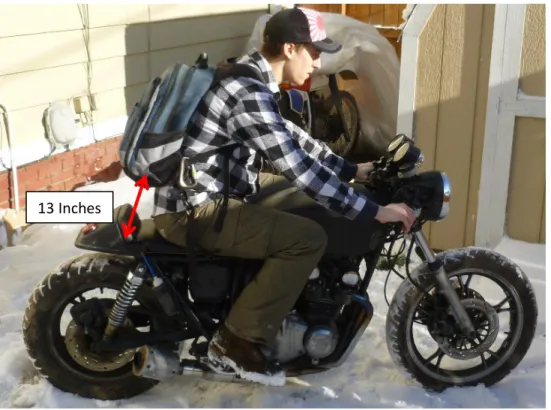
Figure 1: Seated Rider
The distance from the planned connector on the bike to where the cable emerges on the backpack is about 13 inches (will vary slightly with different bikes). The effect of a rider’s height will have little impact when they are sitting down, and since the backpack as adjustable straps, the user will be able to set it to what is most comfortable for them.
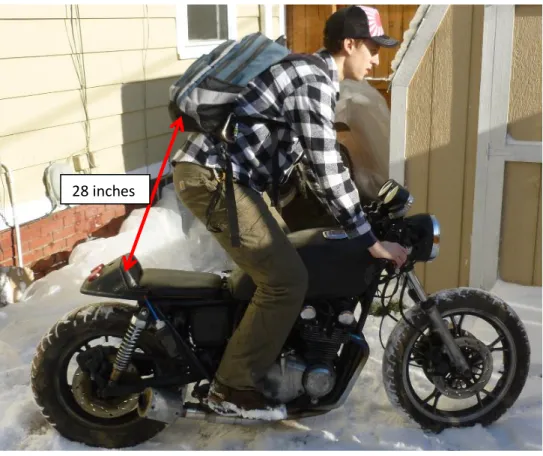
This extension cord, which we will be using, is 5 feet when coiled and 20 feet when extended. The first section of the male cable, which is straight, will make the first 7 inches of the distance. The remaining 5 inches going up to the backpack will be coiled. If you subtract the straight lengths of cable and the connectors, the coiled length is about 3.5 feet and the extended length is 18.5 feet. This means the coiled wire expands to a length of 5.2 times its coiled length. If the first seven inches is straight, the remaining five inches can safely extend to 25 inches, for a total maximum length of 32 inches, which would suit any rider, should they stand up (to look over a car or hill crest) or otherwise change riding position.
Figure 2: Rider (Ben, 6’4”) standing up as much as possible while still holding the handlebars. 28 inches
Distances to Components (with worst case reasonable scenario): Axle: 20 inches
Spoke: 15 inches Spring: 9 inches
The worst case scenario would be if the quick connect were to become tangled with the spokes
somehow. However, the distances required would demand considerable extension before this occurred. While the pictured motorcycle is shaft driven, the chances of having interference with the
chain/sprocket for other bikes is greatly mitigated by the fact that the quick connect is on the opposite side that the chain is typically mounted.
Release Characteristics
If the rider forgets to unplug from the battery or is thrown as a result of a crash , we are confident that the quick connect will disconnect because of how the female end is mounted. The geometry of the guitar connector means that it will only release when pulled axially (it won’t wiggle out or be unplugged by pulling it sideways). For this reason the female end will be bound by the wire right before the female connector, which will allow the female end to point in the direction of tension without being loose. When the cord becomes tight enough (from any angle) the female end will point in that direction, allowing the connection to come free. According to the supplier there is a roughly 4-5lb pull force required to disconnect it.
Waterproofing
One concern that was voiced by our surrogate customer was that the connection might not be
waterproof. In order to keep both ends dry while connected, a small seal will be applied and allowed to cure on the male end (it will be dry before use). This is the same sealing material intended for the zipper. While each end is not connected, the male end will be sheltered within the backpack, and the female end will be protected by a plug made with the same material as the electronics housing box. This plug will have a hole so that it can be kept on a string and/or tied near the female end.
This plug will (similarly to the male connector) have a bead of sealant to fit around the top of the connector.
It should be noted that motorcycle riders, as a nearly universal rule, avoid riding in the rain at all costs to prevent rust on the machines components, as well as the extreme discomfort of riding in the rain. Additionally, very few riders leave their motorcycle uncovered outside.
Drag
Analysis of wire tension caused by wind Fd = ½ v2 Cd A
This is the equation for velocity-based frictional drag.
= 1.2754 kg/m3
v = 53.6 m/s (120 mph)
represents the air density at 1 Atmosphere, zero degrees Celsius. v represents velocity
A represents frontal area
Cd represents the coefficient of drag for a cylinder perpendicular to airflow
Using these, the drag force is calculated to Fd = 8.51 Newtons (1.91 lbs)
Horizontal drag force on each wire end = Fd / 2 = 4.26 Newtons (.96 lbs)
To calculate tension, I treated the sum of the distributed forces as a single force acting in the center of the wire, which was converted to tension with the following equation:
T = Fd / (2 * Sin())
= Wire orientation with respect to vertical. This equation reflects the fact that a perfectly straight wire under a load would require an infinite tension, while if both wire ends were parallel to the loading force, tension would be exactly half of the total load.
For = 45 degrees, T = 6.02 Newtons (1.35 lbs)
This value for tension is very much a worst-case scenario value. It assumes a fully drawn cable is being blasted by relatively dense air at exceptional speeds, and does not account for the fact that the cable is behind the rider, which mitigates a huge portion of the drag that would otherwise be caused.