PERSISTENT EMAIL
(AKA EMAIL MODEL)
EM-PCD-001
Draft — 06/09/2004
Prepared by
PROJECT
CONTROL
DOCUMENT
UCLAPERSISTENT EMAIL
© Copyright 2002-2004, The Regents of the University of California All rights reserved.
UCLAPERSISTENT EMAIL
TABLE OF CONTENTS
1 INTRODUCTION AND PURPOSE ... 1
1.1 PURPOSE... 1
1.2 INSTITUTIONAL REQUIREMENTS FOR AND HISTORY OF THE PROJECT... 1
1.3 PROJECT STRUCTURE... 1
1.3.1 Executive Sponsors ... 1
1.3.2 Functional Sponsors ... 1
1.3.3 Project Organization and Management... 1
1.3.4 Other Stakeholders... 1
1.4 SUMMARY OF WORK TO DATE... 2
1.5 DELIVERABLES... 2
2 SCOPE ... 3
2.1 PROJECT OBJECTIVES... 3
2.2 PLANNING PROCESS... 4
2.3 PROCESSES /PEOPLE AFFECTED... 4
2.4 TECHNOLOGIES /SYSTEMS AFFECTED... 5
2.5 BUDGET... 5
2.6 FORMAL REPORTING AND REVIEWS... 5
2.7 MANAGEMENT OF CHANGES TO SCOPE,SCHEDULE AND ASSUMPTIONS... 5
2.8 EXCLUSIONS... 5
3 SCHEDULE... 6
3.1 LIFECYCLE MODEL... 6
3.2 DEPENDENCIES... 7
3.3 STAFFING... 7
3.4 SUBCONTRACTOR MANAGEMENT... 7
3.5 RISK MANAGEMENT... 7
3.6 CONTINGENCIES... 8
4 ASSUMPTIONS... 9
4.1 PLANNING... 9
4.2 THIRD PARTY COMMITMENTS... 9
4.3 EXPECTED LOADS AND/OR TRANSACTION VOLUMES... 9
4.4 TECHNOLOGIES –HARDWARE AND SOFTWARE... 9
4.5 NON-SCHEDULE RISKS... 9
4.6 NON-SCHEDULE CONTINGENCIES... 9
4.7 DEPLOYMENT... 9
4.8 FUNDING... 9
5 SIGNATURES... 10
6 REFERENCES AND ATTACHMENTS... 11
APPENDIX A... 12
UCLAPERSISTENT EMAIL LIST OF TABLES
Table 1 – Major Milestones and Deliverables ...6 Table 2 – Critical Resource Availability...7
REVISION HISTORY
PERSISTENT EMAIL (EMAIL MODEL)
1
INTRODUCTION AND PURPOSE
1.1
Purpose
This document describes the set of work products embedded in multiple independent projects that, taken together, produce the deliverables that respond to the needs articulated in the Email Model Task Force recommendations of September 27, 2003. As such, it is not a detailed Project Control Document in the usual sense, but rather an aggregation of deliverables that are more specifically described in other projects: Enterprise Directory; Bruin OnLine upgrades; and URSA ongoing enhancements.
1.2
Institutional Requirements for and History of the Project
The original project was conceptualized in response to two main institutional needs:
• That email should be sufficiently robust and ubiquitous to be used reliably for routine university business.
• That student email addresses, once assigned, should persist beyond graduation so that faculty, fellow students, and other university staff may continue to contact former students indefinitely.
An Email Model Task Force was formed to surface the functional requirements for the project. These were published in September 2003. An Implementation Workgroup was then formed, with representatives from AIS, CTS, Student Affairs, and academic units to develop an architecture which could be used to address the functional requirements. This architecture is described in this document.
1.3
Project Structure
1.3.1 Executive Sponsors
The executive sponsor for this project is the Campus IT Infrastructure (CITI) committee.
1.3.2 Functional Sponsors
The functional sponsors are represented by the members of the Email Model Task Force.
1.3.3 Other Stakeholders
Stakeholders include:
The UCLA Administration, Student Affairs, the College, professional schools and all other units wishing to conduct university business by email.
External Affairs and the Alumni Association, as well as individual faculty and students who are desirous of maintaining an ongoing relationship with UCLA graduates.
DON WORTH 1.3.4 Project Organization and Management
1.4
Summary of Work to Date
A set of functional requirements was articulated by the Email Model Task Force and is published in the September 27, 2003 recommendations.
1.5
Deliverables
The deliverables for the Persistent Email (Email Model) project are as follows:
• That all students, faculty and staff will be required to record an email address for official business in the Enterprise Directory.
• That a persistent email address will be issued to all students. Some schools already provide such an address. For those students whose school or division does not provide one, an @ucla.edu address will be assigned. All other students, faculty and staff may optionally select an @ucla.edu address in addition to their school or departmental email address. This address will forward mail to an email account of the user’s choice.
• That an additional published online directory be created where access is limited to the UCLA network and authenticated off-campus users.
• That individuals have a means of choosing whether their email address(es) are published in both the internal and external directories, or just the internal directory. Exclusions from the internal directory would be allowed by petition.
• That schools and departments that provide email accounts to their faculty, staff or students have a means of submitting them for publication in the directories.
• That individual students, faculty and staff have access to various user interfaces which allow them to enter and maintain this data: URSA, the CTS Campus Directory application, and a new web-based self-service application.
• That a process be created to validate that 100% of all students and staff have provided an email address for official business. (It may be that “all staff” is restricted to “knowledge workers”.)
UCLAPERSISTENT EMAIL
2
SCOPE
2.1
Project Objectives
A diagram which outlines the proposed architecture to be created is reproduced below:
BACK ENDS COMMON LOGON BRUIN ONLINE (CTS) @UCLA.EDU FORWARDING ENGINE (CTS) ENTERPRISE DIRECTORY (AIS)
E I O …@UCLA.EDU …@LAW.UCLA.EDU …@AIS.UCLA.EDU INTERNAL DIRECTORY EXTERNAL DIRECTORY …@UCLA.EDU WEB SERVICES SET PUBLISH (PRIVACY) FLAGS SET “OFFICIAL” EMAIL DESIGNATION ADD EMAIL ADDRESS USER INTERFACES BY PROXY CAMPUS DIRECTORY APPLICATION (CTS) URSA (AIS/RO) SET FORWARDING ADDRESS SELECT …@UCLA.EDU SELECT BRUIN ONLINE SERVICES SELECT COMMON LOGON SELF-SERVICE WEB DIRECTORY UPDATE (CTS) BATCH FEEDS LAW SCHOOL ANDERSON SEAS Etc.
EMAIL/DIRECTORY MODEL
DDW – 6/4/2004
The project objectives are as follows:
1. The current authentication mechanism for Bruin OnLine will be replaced by a generic authentication model called “Common Logon”. A Common Logon ID and password may be created for anyone, whether or not they have a UID. A person does not need to be eligible for any online service at UCLA in order to obtain a Common Logon ID. Existing Bruin OnLine users will be “grandfathered” in – their current BOL ID and password will become their new Common Logon ID and password. A web service will be created by CTS which will facilitate the selection of a Common Logon ID and password (and to change or reset the password.)
2. Bruin OnLine service provision will occur as a separate functional process from the creation of a Common Logon ID and password. After creating a Common Logon ID, users will be able to select from a list of CTS-provided services such as: email account, dial-up access, on-campus public network port access, VPN, proxy service, etc. A web service
DON WORTH
will be created by CTS which will permit certain user interfaces (eg. URSA and the new CTS self-service web application) to provision BOL services for a user.
3. CTS will create an email forwarding engine which can forward any mail directed to an @ucla.edu address (or to other domains on behalf of schools or departments who wish to outsource their persistent email forwarding) to a user-specified email account. This engine will be the book of record for @ucla.edu addresses and forwarding addresses. A web service will be created by CTS to facilitate the selection of an @ucla.edu address and the specification of the forwarding address. Once assigned, the engine will forward the @ucla.edu address to the Enterprise Directory so that it can be published. Students will have access to the forwarding service for life.
4. AIS will create the Enterprise Directory as part of the Enterprise Directory project now underway. The entry for each person will permit the recording of multiple email addresses. For each address, flags will indicate whether that address may be published in the internal and/or external directories. Also, a flag will indicate which address is to receive “official” UCLA emails (e.g. BAR bills, messages from Student Affairs or the Chancellor, etc.) The Enterprise Directory will provide web services that allow the specification of publishing flags, official email designation, and the creation of additional email addresses.
5. A process will be created to allow schools and other units to submit batch files with new students’ email addresses so that these may be loaded en masse into the Enterprise Directory. (Schools currently submit files to the Registrar’s Office and these addresses are fed into Student Records Shared Components. Feeding the files to the ED may require changes by schools.)
6. The current CTS Campus Directory application will be modified to permit departmental directory designees to add departmental addresses for staff and faculty and set their publishing flags.
7. A new self-service web application will be created to permit any faculty, staff or student to create a Common Logon and password, select Bruin OnLine services, select an @ucla.edu address, specify a forwarding address for it, and set publishing and official indicators for any of their email addresses.
8. For students who do not have an email address provided by their school, URSA will be modified to “walk them” through the process to create a Common Logon ID and password, select BOL services, select an @ucla.edu address, specify where to forward it, and set their publishing and official indicators. URSA may be used by students to update the forwarding address and flags whenever they wish to do so. Access to URSA will continue to be provided to students even after they graduate.
2.2
Planning Process
See prior description of Email Model Task Force and Implementation Workgroup activities.
2.3
Processes / People Affected
The following processes are affected:
• Registration of new students. Applicants will be given access to URSA as they are now. Once they have filed their Statement of Intent to Register and are assigned an UID, they will be asked to select a Common Logon ID and password. From that point forward, they will use their Common Logon ID to access URSA.
UCLAPERSISTENT EMAIL
• Hiring of new employees. When a new employee is hired, departments will be expected to update the CTS Directory application with their official email address. New employees should be informed of their other options (e.g. @ucla.edu forwarding, BOL services, etc.) during orientation.
Schools that provide email accounts to their students will be affected in that they must provide these addresses to the Enterprise Directory.
2.4
Technologies / Systems Affected
The following are affected: • Bruin OnLine
• URSA
• Student Records and Shared Components • CTS Directory Application
• Enterprise Directory • Campus Directory
• School email provisioning systems (for feeds of email addresses) • (Potentially) All applications using data from the CTS Directory
2.5
Budget
All development costs for the project will be absorbed by other projects/budgets, viz: • Enterprise Directory Project budget
• CTS operating budget (Common Logon, BOL, Directory Application, Self-Service Web) • AIS operating budget (URSA and SRS modifications)
2.6
Formal Reporting and Reviews
Project status will be reported through the reporting paths of the various contributing projects. Reports on overall progress will be provided to OIT and CITI periodically and when major phases are completed.
2.7
Management of Changes to Scope, Schedule and Assumptions
All changes in scope, schedule or assumptions will be submitted to OIT and CITI for approval.
2.8
Exclusions
This project does not include the provision and management of other directory elements (e.g. mailing addresses, phone numbers, etc.) These are covered by the Enterprise Directory project scope.
DON WORTH
3
SCHEDULE
3.1
Lifecycle Model
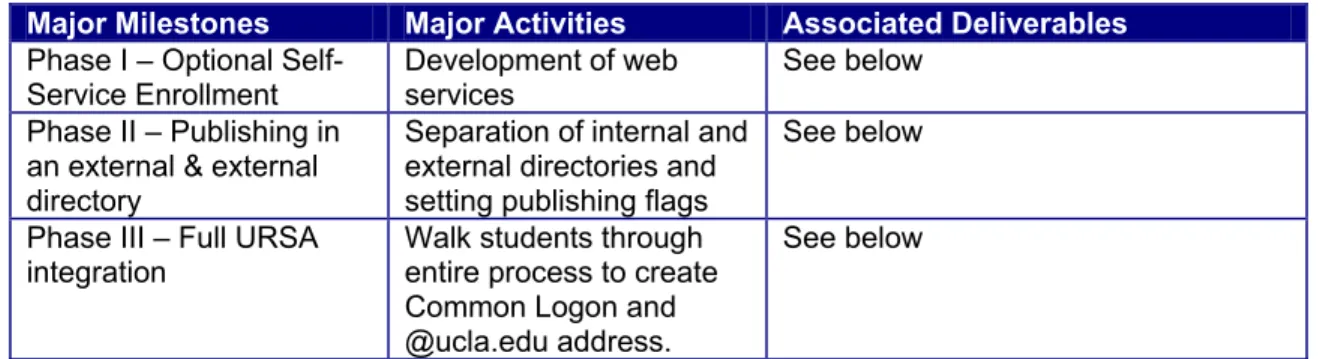
Table 1 – Major Milestones and Deliverables
Major Milestones Major Activities Associated Deliverables
Phase I – Optional
Self-Service Enrollment Development of web services See below Phase II – Publishing in
an external & external directory
Separation of internal and external directories and setting publishing flags
See below Phase III – Full URSA
integration Walk students through entire process to create Common Logon and @ucla.edu address.
See below
Phase I: To be completed Q3CY2004
1. CTS will develop web services to provide the following:
• Common LOGONID creation: convert current BOL account creation process to provide CLID support; provide an open interface for any campus service provider to include CLID
provisioning as part of their student, faculty, and staff automation processes
• Bruin OnLine service provisioning using CLID: separate CLID provisioning and BOL service authorization; make BOL a consumer of CLID services
• @ucla.edu address creation: provide an open interface for any campus service provider to include @ucla.edu address provisioning as part of their student, faculty, and staff automation processes
• Forwarding definition for @ucla.edu address: provide an open interface for any campus service provider to include @ucla.edu address configuration as part of their student, faculty, and staff automation processes
2. CTS will create a self-service web interface to the above services. This interface will serve as the reference implementation for these web services and provide campus service providers with a code base on which to build their interfaces
Phase II: To be completed Q1CY2005
1. CTS and AIS will integrate the CTS Campus Directory interface and Enterprise Directory: CTS will provide support for new ED addressing information fields in the CTS Campus Directory application. 2. CTS will separate the current Campus Directory into an internal version and an external version. 3. The ED project will release a draft enterprise directory schema implementing, among others, the data elements specified by the Persistent Email Project.
4. The ED project will roll out a pilot directory service that implements this draft schema.
5. The ED project will provide the necessary real-time and batch programming interface for CTS's Self Service web application and the CTS Directory application to populate the persistent email project specified data elements that are source from CTS systems.
UCLAPERSISTENT EMAIL
6. The ED team will work with CTS to complete and rollout the data movement mechanisms implementing the above mentioned interface.
7. The ED project will work with CTS to produce the internal campus directory.
Phase III: To be completed Q2CY2005
1. The ED project will:
• design and implement the necessary real-time and/or batch interface for professional schools to submit student email addresses and release preferences from the school mail systems. • If needed, will release a revised draft schema.
• If needed, will update the pilot directory service to implement the revised schema.
2. The URSA team will modify URSA to “walk” new students through the process of creating a CLID and password, BOL and @ucla.edu forwarding services, and to specify publishing and official flags. 3. The Student Records team will modify Shared Components so that student email addresses will be replicated from the Enterprise Directory’s “official” email address field.
3.2
Dependencies
This project depends on the Enterprise Directory project, CTS BOL & Campus Directory staff resources, as well as AIS and Student Affairs staff resources.
3.3
Staffing
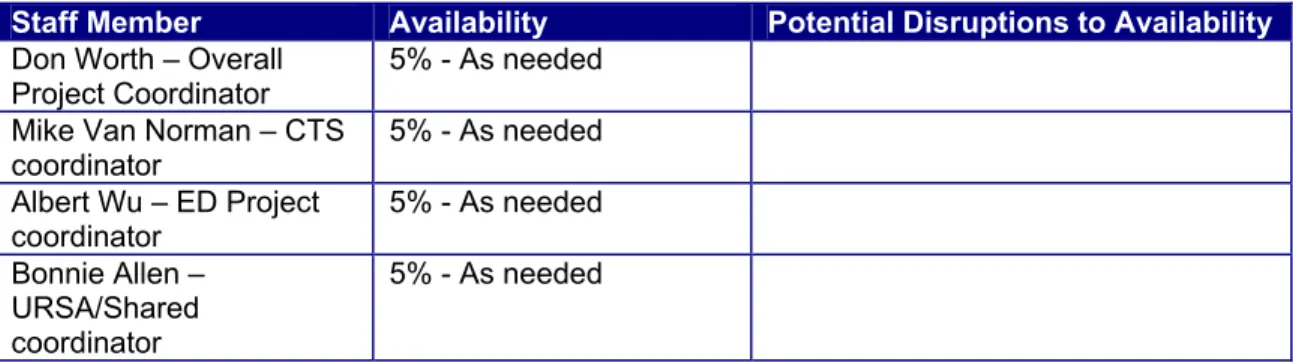
Table 2 – Critical Resource Availability
Staff Member Availability Potential Disruptions to Availability
Don Worth – Overall
Project Coordinator 5% - As needed Mike Van Norman – CTS
coordinator 5% - As needed Albert Wu – ED Project
coordinator 5% - As needed Bonnie Allen –
URSA/Shared coordinator
5% - As needed
CTS will provide all necessary staffing for their deliverables. The ED project (AIS) will provide staffing for its deliverables. Student Affairs and the AIS URSA, Shared Components, and SRS teams will provide staffing or their deliverables. It is expected that a broadly representative workgroup, coordinated by Bonnie Allen, will be assembled to design the student interfaces.
3.4
Subcontractor Management
n/a.
3.5
Risk Management
Availability of programming resources depends on the ability to schedule around other priorities for the groups in question. It is expected that the proposed lead times will provide sufficient flexibility to make completion by the phase dates possible.
DON WORTH
Delay in securing final approval for the ED project could delay implementation of deliverables required by that project.
3.6
Contingencies
Since this project’s resources are all provided by other projects and operating budgets, an extension of the due dates for the phases could be made to mitigate any temporary lack of staff availability.
Note that a parallel process to enact policy that requires all faculty, staff and students to provide an email address is currently underway in the ITPB. This must be completed before the system can be implemented.
UCLAPERSISTENT EMAIL
4
ASSUMPTIONS
4.1
Planning
Planning included the development of functional requirements with a broadly representative group of stakeholders and these were vetted with CSG and ITPB.
4.2
Third Party Commitments
It is assumed that the deliverables can be produced by the ED project, CTS operating budget, and AIS’s student applications team under the “maintenance” heading. Some support from Student Affairs personnel in modifying current processes to accommodate the change in email address will be required.
4.3
Expected Loads and/or Transaction Volumes
See ED project PCD.
4.4
Technologies – Hardware and Software
See ED project PCD.
4.5
Non-Schedule Risks
none.
4.6
Non-Schedule Contingencies
none.
4.7
Deployment
See above.
4.8
Funding
DON WORTH
5
SIGNATURES
Functional Sponsor 1 has reviewed the planning document and agrees to the timing and deliverables of the Subject Area.
______________________________________________________________ ____________
UCLAPERSISTENT EMAIL
6
REFERENCES AND ATTACHMENTS
DON WORTH