Job Satisfaction of Women Teachers
M.S University Affiliated Arts and Science Colleges
M. Murugeswari, K. Kamalakannan, Department of Commerce, V.O.Chidambaram College, Thoothukudi Introduction
Job satisfaction is the employee’s general attitude towards his job, management and the organization. A job provides both monetary benefits as well as satisfaction. According to Locke job satisfaction is cognitive, affective and evaluative reactions or attitude and states it is “a pleasurable or positive emotional state resulting from the appraisal of one's Job or Job experience.” It is generally admitted by educationist in all countries that women are better nature aptitude and interest to teach young children and to guide adolescent girls. Teaching is a highly noble profession most suited especially for women. The present study is compiled with the help of both primary and secondary data. The primary data were collected from the women teachers working in arts and science colleges affiliated to M.S University, Tirunelveli, with the help of structured scheduled questionnaire. By adopting random sampling method 400 women teachers were selected from the M.S. University affiliated colleges and the questionnaire was distributed to get the primary data from them. Secondary data were collected from various books, journals and magazines and so on. Statistical tools like percentage and chi-square test were used in analyzing and interpretation of data
Objectives of the study
1. To study the demographic profile of the women teachers 2. To find out the overall Job Satisfaction of the women teachers 3. To know the reasons for choice of teaching profession by women
teachers.
Analysis and Interpretation
Socio-Economic Conditions of Women Teachers
Out of the 400 respondents belongs to different age groups, 39 percent belongs to the age group of 21-30 years, 32 percent belongs to the age group of 31-40 years, 18 percent belongs to the age group of 41-50 years and only 11 percent belongs to the age group of above50 years. 77.5 percent of the respondents are married and remaining 22.5 percent of the respondents are unmarried. 56.5 percent of the respondents are residing in
M.S University affiliated Arts and Science Colleges
rural area and 43.5 percent of the respondents are residing in urban area. 54.75 percent of the respondents had the qualification of PG with M.phil,18.75 percent of the respondents had the qualification of PG with M.phil/B.Ed/ M.Ed,17.75 percent of the respondents had the qualification of Ph.D and remaining 8.75 percent of the respondents are have P.G. only. 66 percent of the respondents draw salary up to Rs15, 000, 19 percent of the respondents draw salary aboveRs45, 000, 11 percent of the respondents draw salary of the respondentsRs30, 001-Rs45, 000 and4 percent of the respondents draw salary in the range of Rs15, 001-Rs30, 000. 46 percent of the respondents are working in the arts group, 32 percent of the respondents are working in the science group and remaining 22 percent of the respondents are working in the areas of commerce. 50 percent of women teachers had the teaching experience of less than 5 years, 23 percent had the experience of 6-10 years, 17 percent had the experience of above15 years and 10 percent had the experience of11-15 years. 68 percent of the respondents are working in temporary nature 32 percent of the respondents are working in the permanent nature.
Reasons for Choice of Teaching Profession by Women
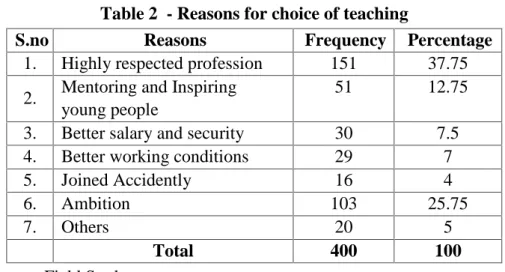
There are many reasons to join the different profession such as the profession having high respect, mentoring and inspiring young people, better salary and security, better working conditions, joined accidentally, ambitions and other reasons. It revealed that out 400 respondents, 37.75 percent of the respondents covered under the study felt that teaching is highly respected profession, 25.75percent of the respondents having ambition ,12.75 percent of the respondents look up teaching because mentoring and inspiring young people, 7 percent of the respondents joined for better working conditions, followed by 8 percent of the respondents joined to get better salary and job security; 4 percent of the respondents joined this profession accidentally 5 percent of the respondents covered under the study gave other reasons for taking up teaching. Hence it is concluded that 37.75 percent of the respondents covered under the study felt that teaching is highly respected profession.
Job Satisfaction of the Women Teachers
Job satisfaction of the teachers helps to know about the effective working of the teachers in their job. Job and work satisfaction is stated in the table.3 shows that about 70 percent of the respondents are medium level satisfaction with their job,15.8 percent of the respondents are high level satisfaction with their job and 15.3 percent of the respondents are low level satisfaction with their job.
Demographic Factors and Overall Satisfaction:
Chi-square test is used for find the level job satisfaction and demographic factors of the women teachers in the study area: It is demonstrated in table 4.
There is a significant impact of age on job satisfaction. Marital status has influenced on job satisfaction
Residential place and departments has not affected job satisfaction Highest qualification has a significant impact on job satisfaction. It
means that job satisfaction increases with increase in level of education.
Permanent academic staff was more satisfied with their job comparatively temporary academic staff.
Net monthly salary/pay has also significant impact on job satisfaction. Job satisfaction increases with the level of increase in salary.
Teaching experience has impact on job satisfaction. In other words we may say that experienced teachers are more satisfied with their jobs than less experienced staff.
Conclusion
Teachers are the sources of guidance in all the crucial steps in academic life of the students. People are interested to work in the institutions as well as in the services where they feel satisfied. It can be understood that maximum number of women teachers belong to high level satisfaction. Age, Educational Qualification, Teaching experience, net monthly salary, marital status and designation have an impact on job satisfaction. To obtain a highly satisfied teacher at M.S. University proper attention should be paid on considerable salary for Assistant Professors and selecting a suitable person to fit teaching profession.
References
1. Anand S.P. “School Teachers; Job Satisfaction Vs Extroversion and Neuroticism”. Indian Educational Review Vol-71997 Pp-68-78.
2. Ravindrakumar.A et.al; “Job Satisfaction of Women Teachers” Indian Educational Review Vol.8 Issue No.11 July 2009, Pp.42-44.
3. S.Revathi, “A Study on Job Satisfaction of Government school teachers in Tiruchendur”, M.Com project submitted to Manonmaniam Sundaranar University, March 2007.
M.S University affiliated Arts and Science Colleges
4. Stephen P.Robbins, “Organizational Behaviour” ,Tenth Edition, Eastern Economy Edition, New Delhi2003.
5. P.Vanitha, “A Study on Job satisfaction of Matriculation school teachers in Thoothukudi”, M.Phil, thesis submitted to Manonmaniam Sundaranar University, August 2011
Appendix: Table 1 - Demographic Variables
S.No Variables Particulars Frequency Percentage
1. Age 21-30 Years 156 39
31-40 Years 129 32
41-50 Years 71 18
Above 50 Years 44 11
2. Marital Status Married 310 77.5
Unmarried 90 22.5
3. Residential Place
Urban 174 43.5
Rural 226 56.5
4. Education Qualification
PG Only 35 8.75
PG with M.Phil 219 54.75
PG with B.Ed or M.Ed 75 18.75 PG with M.Phil with ph.D 71 17.75
5. Salary Up to 15000 265 66
15001-30000 17 4
30001-45000 43 11
Above 45000 75 19
6. Department Arts 184 46
Science 128 32
Commerce 88 22
7. Total Teaching Experience
Up to 5 Years 201 55
6-10 Years 91 23
11-15 Years 40 10
16-20 Years 10 2.5
Above 20 Years 58 14.5
8. Nature of Employment
Permanent 129 32
Table 2 - Reasons for choice of teaching
S.no Reasons Frequency Percentage
1. Highly respected profession 151 37.75 2. Mentoring and Inspiring
young people
51 12.75
3. Better salary and security 30 7.5
4. Better working conditions 29 7
5. Joined Accidently 16 4
6. Ambition 103 25.75
7. Others 20 5
Total 400 100
Source: Field Study
Table 3 - Overall job satisfactions of the women teachers
S.No. REASONS FREQUENCY PERCENTAGE
1. High 60 16
2. Medium 279 70
3. Low 61 15
Total 400 100
Source: Field Study
Table 4 - Demographic factors and overall satisfaction
S.No. VARIABLES STATISTICAL TOOL RESULT
1. Age X2= 48.532(P=0.000) Significant 2. Marital status X2=7.405 (P= 0.025) Significant 3. Residential place X2= 2.412 (P=0.299) Not Significant 4. Educational qualification X2=14.029 (P=0.29) Significant 5. Monthly salary X2=72.034 (P=0.000) Significant 6. Department X2=4.275 (P=0.370) Not Significant 7. Nature of employment X2=26.739 (P=0.000) Significant 8. Total teaching experience X2=63.867 (P=0.000) Significant