Financial
Stability
Report
2014:2
The Riksbank's Financial Stability Report
The Riksbank’s Financial Stability Report is published twice a year. The Report describes the Riksbank’s overall assessment of the risks and threats to the financial system and of the system’s resilience to them. The stability analysis is therefore an instrument that is directly linked to the Riksbank’s task of promoting a safe and efficient payment system. By publishing the results of its analysis, the Riksbank wishes to draw attention to, and warn of, risks and events that might pose a threat to the financial system, and to contribute to the debate on this subject.
The Executive Board of the Riksbank discussed the Report on two occasions – on 12 and 25 November 2014. The Report takes into account data available as of 21 November 2014. The Report is available on the Riksbank’s website, www.riksbank.se, where a printed version of the report can be ordered free of charge or a PDF can be downloaded.
system so that payments and the supply of capital function well. In practice, this task means that the Riksbank is responsible for promoting financial stability. The Riksbank defines financial stability as meaning that the financial system is able to maintain its basic functions – the mediation of payments, the conversion of savings into funding and risk management – and is also resilient to disruptions that threaten these functions.
The Riksbank is also the authority that has the capacity to grant emergency liquidity assistance to individual institutions if problems arise that threaten financial stability. To be able to do this in the best possible way, the Riksbank needs to be well prepared for crises by having an efficient crisis organisation with good information channels and tools for analysis, as well as well-developed cooperation with other authorities.
The Riksbank does not have the sole responsibility for promoting financial stability. It shares this responsibility with Finansinspektionen (the Swedish financial supervisory authority), the Ministry of Finance and the Swedish National Debt Office. The Ministry of Finance is responsible for the regulation of financial enterprises and Finansinspektionen is responsible for supervision. The interaction between the authorities is important both in the preventive work and in the event of crisis management. The same also applies internationally as financial enterprises increasingly operate across national borders.
The financial system plays a vital role in the economy. It is necessary to have a stable and smoothly-running financial system for the economy to function and grow. A serious crisis in the financial system is liable to entail extensive economic and social costs.
The financial system is sensitive. This sensitivity is due to the vulnerability of central parts of the system, such as banks and markets. Banks are vulnerable mainly because they fund their operations at short maturities but lend at longer maturities. This imbalance makes the banks dependent on the general public and the market having confidence in them. If the market participants’ confidence in their counterparties or for the financial instruments traded on the market declines, trading may suddenly come to a halt. The various parts of the financial system are also closely interconnected, for instance in that financial institutions borrow from and trade with one another to such a large extent. This means that problems that arise in one institution or market can rapidly spread throughout the system. Contagion effects may also arise if there is a general fall in confidence in similar activities.
The combination of the sensitivity of the financial system and the large potential costs of a financial crisis mean that the state has a particular interest in preventing threats to financial stability. Banks and other market participants do not have an incentive to give full consideration to the risks to financial stability to which they are contributing. This is because some of the costs of a financial crisis fall to others both within and outside the financial system. If a crisis occurs, the government also needs to be able to manage it at the lowest possible cost.
The Riksbank analyses the financial system’s stability on a continuous basis for the early detection of changes and vulnerabilities that could lead to a crisis. The main focus of the analysis is on the Swedish banks and on the markets and infrastructure that are important for their funding and risk management.
In some cases the Riksbank recommends specific measures to counteract risks. These recommendations may be based on the current economic situation. They may also relate to more structural circumstances and stem from current regulatory issues. The recommendations can be aimed at banks as well as at other market participants, or at legislators and other authorities.
SUMMARY 5
1. STABILITY ASSESSMENT AND RECOMMENDATIONS 7Assessment of the current situation and outlook 7 Vulnerabilities and risks in the financial system 10 Recommendations 13
2. FINANCIAL MARKETS 39Developments on the financial markets 39
Markets that are important for the banks’ funding 42
3. THE SWEDISH BANKING GROUPS’ BORROWERS 45The Swedish household sector 45 The Swedish corporate sector 49
The Swedish banking groups’ borrowers abroad 50
4. DEVELOPMENTS IN THE SWEDISH BANKING GROUPS 53Profitability and earnings 53 Lending and credit risk 54 Capital 55
BOXESAmortisation requirements – A step towards a more sustainable debt situation 23 A Swedish leverage ratio requirement 33
The financial system is deemed to work well at present. However, the Swedish banking system is large and interconnected. Moreover, the Swedish banks have a large proportion of wholesale funding and a small proportion of equity in relation to their total assets. This means that the finan-cial system is sensitive to shocks. According to current analysis, the factors that could result in shocks are the high level of risk-taking on the financial markets and the high and growing indebted-ness of Swedish households. The Riksbank assess that measures must be taken to strengthen the banks' resilience and dampen the risks inherent in household indebtedness. The Riksbank therefore recommends Finansinspektionen (the Swedish Financial Supervisory Authority) to bring forward the introduction of a leverage ratio requirement and to introduce an amortisation requirement for Swedish mortgages.
GOOD PROFITABILITY IN THE MAJOR SWEDISH BANKS Although economic activity has been relatively weak, the major Swedish banks have continued to have good profitability and have access to inexpensive funding. In addition, the debt-servicing ability of the banks' borrowers is generally good and stress on the financial markets is low. All in all, the financial system is thus deemed to be functioning well at present.
STRUCTURAL VULNERABILITIES IN THE BANKING SYSTEM ARE INCREASING SENSITIVITY TO SHOCKS
The Swedish banking system is large and interconnected. In addition, the Swedish banks have a large proportion of wholesale funding and a small proportion of equity in relation to their assets. This means that the banks are sensitive to various economic shocks. If problems arise in the banking system, this will probably also have consequen-ces for financial stability. According to current analysis, one risk that could lead to shocks is the high level of risk-taking on the global financial markets. This is largely an effect of the expansionary mone-tary policies being conducted by many central banks. These measures are important to support the economic development but, at the same time, could lead to risks accumulating on the financial markets. Another risk that could lead to shocks, both in the financial system and in the real economy, is the high level of indebtedness among Swedish households.
MEASURES MUST BE TAKEN TO DAMPEN THE RISKS LINKED TO HOUSEHOLD INDEBTEDNESS
The measures taken so far to manage the problems linked to house-hold debt have not been adequate. It is therefore necessary to adopt more measures. One suitable measure would be to introduce an amortisation requirement. Finansinspektionen presented a proposed amortisation requirement in conjunction with the November 2014 meeting of the Financial Stability Council. The Riksbank considers that this proposal is a step in the right direction, but assesses at the same time that the measure will only have small effects on household
debt. However, the most important thing at present is that measures are put in place. Consequently, to avoid delay, the Riksbank recom-mends Finansinspektionen to introduce an amortisation requirement for new mortgages by issuing a general guideline. In addition to this, other measures will also have to be adopted within several policy areas in order to reduce the risks associated with household debt. These measures will need to be introduced gradually and over a longer period of time.
THE RESILIENCE OF THE BANKS NEEDS TO BE STRENGTHENED As the Swedish banks' assets largely consist of mortgage loans, a connection exists between debt in the household sector and the state of the banks. In addition, the banks have a strong connection to the global financial markets via their wholesale funding. The structural vulnerabilities of the Swedish banking system need to be reduced to give the banks sufficient resilience to shocks. Several measures have already been taken, but the Riksbank's assessment is that further measures are needed. Increasing capital in the banks is one such measure. This is because the Swedish banks have relatively little equity in relation to their assets, which is to say that they have rela-tively low leverage ratios. Several other countries with large banking systems have already introduced a minimum requirement for the le-verage ratio. The Riksbank considers that such a requirement should also exist in Sweden and therefore recommends Finansinspektionen to introduce a leverage ratio requirement from 2016.
Recently, global growth prospects have deteriorated, which has contributed towards slightly increased uncertainty on the financial markets. This has periodically resulted in falling stock market rates, increased volatility and higher risk premiums. However, demand for high-risk assets is still high on the financial markets. Although economic activity has been relatively weak, the major Swedish banks have continued to demonstrate high profitability and have had access to inexpensive funding. In addition, the debt-servicing ability of the banks' borrowers is generally good. All in all, the financial system is thus deemed to be functioning well at present. However, there are vulnera-bilities in the structure of the banking system that make it sensitive to shocks. The Riksbank there-fore recommends Finansinspektionen to bring forward the introduction of a leverage ratio require-ment to further strengthen the resilience of the banks. Furthermore, the high and rising indebted-ness of Swedish households entails risks for both macroeconomic and financial stability. The Riksbank therefore also recommends Finansinspektionen to introduce an amortisation requirement for Swedish mortgages.
Assessment of the current situation and outlook
HIGH DEMAND FOR HIGH-RISK ASSETS DESPITE SOME AMOUNT OF UNCERTAINTY ON THE FINANCIAL MARKETSSince the last Financial Stability Report was published in June, un-certainty has increased slightly on the financial markets, among other reasons due to the deterioration of global growth prospects. This has periodically resulted in falling stock prices, increased volatility and higher risk premiums.However, seen over a longer perspective, stock prices are still high, while volatility and risk premiums are low. Among other things, this is reflected by indicators for stress on the financial markets being on the same low levels as to prior to the break-out of the financial crisis in 2007 (see chart 1:1).
One important explanation for this development is provided by the expansionary monetary policy conducted by many central banks for several years. With the aid of low policy rates and other uncon-ventional monetary policy measures, the central banks have suppor-ted economic growth. But, at the same time, the low interest rates and the low volatility to which these measures have contributed, have led investors' demand for higher-risk assets to increase (see chart 1:2). Many types of asset which are considered as higher risk and are thereby expected to give slightly higher returns have therefore increased in value over the last years. Among other things, prices for stocks have increased and yields on bonds have been pressed down to low levels (see charts 1:3 and 1:4). The signs of low stress indicated by chart 1:1 could thereby largely be seen as a consequence of this expansionary monetary policy, rather than as a consequence of risks being small on the financial markets. Additionally, the development in the real economy, for example in the euro area, has become more
Chart 1:1European stress index Ranking (1=high stress, 0=low stress)
Note. The European stress index was produced by the ECB A stress level of 1 signifies a historically high stress level while 0 signifies a historically low stress level. See Holló et al., CISS – A composite indicator of systemic stress in the financial system, Working Paper Series no. 1426, March 2012. ECB. Source: The European Central Bank (ECB)
Chart 1:2Expected volatility on the stock and bond markets
Index
Note. The chart refers to the expected volatility within 30 days that can be derived from pricing on the options market. Source: Reuters EcoWin
0.0 0.1 0.2 0.3 0.4 0.5 0.6 0.7 0.8 0.9 1.0
07 08 09 10 11 12 13 14
Money market Bond market Stock market
Foreign exchange market Financial intermediaries Stress index
0 100 200 300 400 500
0 20 40 60 80 100
07 08 09 10 11 12 13 14
OMX, volatility on the Swedish stock market VIX, volatility on the US stock market VSTOXX, volatility on the euro area stock market MOVE, volatility on US government bonds (right-hand scale)
uncertain, which is not captured in the index for financial stress either.1
ECONOMIC RECOVERY IN THE UNITED STATES AND UNITED KINGDOM
The recovery of the world economy as a whole is expected to con-tinue in the coming years. Among other things, the expansionary monetary policy has contributed to the economic development of both the United States and United Kingdom picking up. The Federal Reserve has therefore initiated the tapering of its unconventional monetary policy measures and terminated its purchases of US government and mortgage bonds in October. Market pricing also indicates that both the Federal Reserve and the Bank of England are expected to start raising their monetary policy rates in the autumn of 2015.2
ECONOMIC GROWTH IS DAMPENED IN EUROPE
Although the ECB is conducting an increasingly expansionary mone-tary policy, the economic recovery has slowed down and inflation has been lower than expected in the euro area. Growth forecasts for the years immediately ahead have been revised downwards (see chart 1:5). Lending by the banks also continues to be tight, which results in constrained corporate investment and thereby restrained economic growth. Furthermore, several euro area countries are still facing problems with high private and public debts and poor competitive-ness, which is also resulting in reduced confidence in the future eco-nomic development by both households and companies. In addition to this, the ongoing conflict in Ukraine has dampened the economic recovery.3 The risk-taking seen on the financial markets in Europe thus does not seem to have reached the real economy, where it could contribute to the economic recovery through higher consumption and increased investment.
SWEDISH ECONOMY IS BEING HAMPERED BY WEAKER INTER-NATIONAL CLIMATE BUT STIMULATED BY EXPANSIONARY MONETARY POLICY
The weaker economic development in the euro area has also contri-buted to growth in the Swedish economy being restrained, above all with exports continuing to be dampened. At the same time, the ex-pansionary monetary policy in Sweden has boosted domestic de-mand and, overall, the economy is stronger than in the euro area. In the longer term, the recovery of the Swedish economy is expected to take place at a faster rate as economic activity abroad improves.4
1 For examples of indicators for uncertainty that are not captured in the stress index for financial markets, see Armelius, Hanna, Belfrage, Carl-Johan and Stenbacka, Hanna (2014), The mystery of the weak growth in world trade following the global financial crisis, Sveriges Riksbank Economic Review: 3, 2014. Sveriges Riksbank. 2 Monetary Policy Report, October 2014. Sveriges Riksbank.
3 Monetary Policy Update, September 2014. Sveriges Riksbank. 4 Monetary Policy Report, October 2014. Sveriges Riksbank.
Chart 1:3The stock market Index, 1 January 2007 = 100
Sources: Bloomberg and the Riksbank
Chart 1:4Difference in yield between European corporate bonds and German government bonds Percentage points
Note. The chart shows the difference between the yields for ten year corporate bonds with a certain credit rating and a German government bond with a corresponding maturity.
Sources: Reuters EcoWin and the Riksbank
Chart 1:5The Riksbank's GDP forecasts for the euro area
Per cent
Source: The Riksbank 0 20 40 60 80 100 120 140 160 180
07 08 09 10 11 12 13 14
Sweden - OMXS30 United States - S&P500 Europe - STOXX600
0 1 2 3 4 5
07 08 09 10 11 12 13 14
Corporates, AA Corporates, A Corporates, BBB 0.0 0.5 1.0 1.5 2.0 2.5
14 15 16
April 2014 June 2014
August 2014 October 2014
Borrowing by Swedish companies has increased over the last six months and is also expected to continue to do so as investment in-creases. The banks' funding terms for companies have improved and increasing numbers of companies are also utilising the financial markets for their funding by issuing corporate bonds (see chapters 2 and 3). This means that, in general, corporate investments in Sweden have not been restrained by tight credit terms in the same way as in the euro area.
However, the low interest rates have also led to a more rapid rate of increase of the already-high housing prices (see chart 1:6 and chapter 3). At the same time, households are borrowing increasing amounts and the growth rate of debt has accelerated recently (see chart 1:7). This development is also expected to lead to rises in the already-high debt ratio in the years ahead (see chapter 3).
STRONG PROFITS AND LOW LOAN LOSSES IN THE MAJOR SWEDISH BANKS
Although economic activity has been relatively weak, the major Swedish banks have continued to report strong profits (see chart 1:8). One explanation for this is that growth is high in the banks' lending activities. Over the past six months, growth in the banks' lending has increased to eight per cent on an annual basis, above all because volumes of mortgages have increased. This has contributed to increased revenues for the major banks. In addition, loan losses and funding costs are low, which, combined with the generally low cost levels, means that the profitability of the major banks is high (see chapter 4).
MIXED PICTURE OF THE MAJOR BANKS' CAPITAL AND LIQUIDITY SITUATION
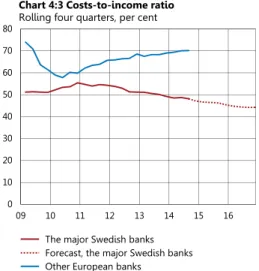
The major Swedish banks' CET 1 capital ratios have strengthened and are high in an international comparison (see chart 1:9). This is partly due to recent years' strong profits, which have made it possible for the major banks to boost their equity with retained profits. However, the main reason is that the average risk weights for the banks' assets have decreased (see chapter 4). If the decrease in risk weights is disregarded and the banks' capital instead compared to their total assets, the same improvement of the capital situation is not seen. In addition, an international comparison of one such non-risk weighted capital measure shows that the major Swedish banks have compara-tively low levels of capital (see chart 1:9).
The picture of the major banks' liquidity situation is also mixed. On an overall level, resilience to short-term liquidity risks is deemed to be strong and the banks' exceed the minimum level of 100 per cent in the short-term liquidity measure Liquidity Coverage Ratio (LCR). However, if the LCR is divided into different currencies, it can be seen that the levels are high in dollars and euros but lower, and
Chart 1:6Swedish households' debt and the real property price index
Total debt as a percentage of disposable income, and index, 2000 Q1 = 100
Note: Property price index deflated with CPIF and then calculated as index 2000 Q1 = 100.
Sources: Statistics Sweden and the Riksbank
Chart 1:7Swedish households' debt Per cent
Note. Seasonally-adjusted data. Sources: Statistics Sweden and the Riksbank
Chart 1:8Profits before loan losses and loan losses in the major Swedish banks
Rolling four quarters, SEK billion, fixed prices, September 2014
Note. The dashed lines refer to a forecast. Sources: Bank reports and the Riksbank 60 80 100 120 140 160 180 200
80 85 90 95 00 05 10
Debt ratio
Real property price index
0 2 4 6 8 10 12 14 16 18 20
02 03 04 05 06 07 08 09 10 11 12 13 14 Annual percentage change
Monthly percentage changes restated as an annual rate -20 0 20 40 60 80 100 120 140
91 93 95 97 99 01 03 05 07 09 11 13 15 Profit before loan losses
periodically very low, in Swedish kronor (see chart 1:10).5 The structural liquidity risks are also comparatively high in the major Swedish banks. They show lower levels than many other banks in Europe in both the liquidity measure Net Stable Funding Ratio (NSFR) and in the Riksbank's structural liquidity measure (see chart 1:11). The imbalances in maturities between the major banks' assets and liabilities are also large for longer maturities than those captured by the previously-mentioned liquidity measures. This means that the banks face high refinancing risks for maturities of over one year (see chapter 4).
Despite this, the overall picture is that the Swedish financial system is functioning well at present. Swedish banks, companies and households have good funding opportunities, not least as a conse-quence of the expansionary monetary policy conducted both in Sweden and internationally. Profitability is high in the major Swedish banks and their borrowers are deemed to have high debt-servicing ability. However, there are vulnerabilities and risks that may threaten both macroeconomic and financial stability.
Vulnerabilities and risks in the financial system
Even if the Swedish financial system is deemed to function well at present, there are vulnerabilities and risks that may threaten both the macroeconomic and the financial stability. The vulnerabilities, which may increase sensitivity to various economic shocks, are associated with the structure of the Swedish banking system. The largest risks, in turn, are linked to the development of the global financial markets and to the indebtedness of Swedish households.VULNERABILITIES IN THE STRUCTURE OF THE SWEDISH BANKING SYSTEM
The Swedish banking system is large in relation to the Swedish eco-nomy (see chart 1:12). Additionally, the banking system is highly concentrated on four major banks with close links to each other. Consequently, should problems arise in one major bank, it is likely that the entire banking system, and thereby the entire financial system, would be impacted. The size of the banking system also means that any problems may be very expensive to remedy.6
One factor that further increases the vulnerability of the Swed-ish banking system is the major banks' dependence on domestic and foreign wholesale funding. This makes the banks more sensitive to both shocks on the international financial markets and to a lack of confidence in the Swedish banking system. In addition, the banks are exposed to liquidity risks due to low liquidity buffers in Swedish kronor and large imbalances between the maturities of assets and
5 See also the box Liquidity coverage ratios in Swedish kronor, Financial Stability Report 2014:1, Sveriges Riksbank, and Jönsson, Björn (2014), A survey of the liquidity coverage ratio (LCR) in Swedish kronor, Economic Commentary no. 6, 2014. Sveriges Riksbank.
6 For a more detailed discussion of the vulnerabilities of the Swedish banking system, see Financial Stability Report 2014:1. Sveriges Riksbank.
Chart 1:9Swedish and European banks' CET 1 capital ratios and equity in relation to total assets June 2014, per cent
Note. CET 1 capital ratios in accordance with Basel III. The dashed lines represent mean values, the red dots show a sample of European banks.
Sources: SNL Financial and the Riksbank
Chart 1:10The major Swedish banks' Liquidity Coverage Ratios (LCR)
September 2014, per cent
Note. According to Finansinspektionen's definition in FFFS 2012:6.
Sources: Finansinspektionen and the Riksbank
Chart 1:11The Riksbank’s structural liquidity measure
December 2013, per cent
Note. The red bars illustrate a group of European banks. Sources: Liquidatum and the Riksbank
3 5 7 9 11 13 15 17 19 21 23
1 2 3 4 5 6 7 8 9
CE T 1 capit al rat io
Equity / total assets
Handelsbanken Swedbank SEB Nordea 0 50 100 150 200 250
USD EUR SEK All
currencies
0 20 40 60 80 100 120 140
SEB Nordea Handelsbanken Swedbank Average
liabilities. Funding problems may therefore arise faster than would otherwise be the case.
As mentioned above, the major banks also have relatively little equity in relation to their assets, which is to say that their level of capitalisation is relatively low in terms of the leverage ratio.
INCREASED RISK-TAKING ON THE GLOBAL FINANCIAL MARKETS MAY AFFECT FINANCIAL STABILITY IN SWEDEN
The high valuation of assets and the low volatility characterising the financial markets could be compared to the situation prevailing before the outbreak of the financial crisis in 2007. As then, there is, at present, high demand for high-risk assets among investors. The present situation is largely a deliberate effect of the expansionary monetary policies being conducted by many central banks. But at the same time, investors' high demand for high-risk assets can lead to a situation where various types of risk are being underestimated or are not being priced in full, or that the asset portfolios contain more risk than actually intended. In this way, risks may be accumulating in the financial system.7
Due to the high level of risk-taking, a chain of events entailing falling asset prices, rising risk premiums and increasing volatility may have widespread effects on the financial markets. This is because investors may choose to rapidly lower their risk-taking and therefore make large and sudden redistributions of their asset portfolios. This, in turn, may lead to the value of high-risk assets falling and volatility and risk premiums increasing. In addition, in such a situation, the liquidity of the financial markets may be negatively affected. For Sweden's part, such a development could have a negative impact on financial stability. Above all, this is because both access to and the price of the Swedish banks' wholesale funding would probably be affected negatively in a situation where stress increases considerably. Swedish companies also obtain funding from the financial markets to an increasing extent. In a stressed situation on the financial markets, these companies would probably also have decreased access to funding (see chapter 2).
There are several events that could trigger a chain of events in which the risks accumulating on the financial markets are realised. An example of such an event is a worsening of the conflict in Ukraine. Other events could include increasing unease over the situation of public finances in the euro area, for example as a result of necessary structural reforms not being adopted, or unease among market parti-cipants in conjunction with the return to less expansionary monetary policy in the United States.8 The increased uncertainty and the fluctu-ations seen on the financial markets over the autumn have been relatively moderate and are not deemed to have affected financial
7 Johansson, Tor (2013), Search for yield in a low-interest rate environment, Economic Commentary no. 4, 2013. Sveriges Riksbank.
8 See, for example, Global Financial Stability Report, October 2014. International Monetary Fund (IMF).
Chart 1:12The banks’ assets in relation to GDP December 2013, per cent
Note. In banking assets are included all of the assets of the national banking groups, that is both foreign and domestic assets. The shadowed part of the blue bar shows the four major banks’ assets abroad in relation to Sweden’s GDP. The data for Switzerland is from December 2012.
Sources: The ECB, the European Commission, the Swiss National Bank and the Riksbank
Chart 1:13Swedish households' debt ratio Total debt as a percentage of disposable income
Note. The dashed line represents the Riksbank's forecast. Sources: Statistics Sweden and the Riksbank
Chart 1:14Housing prices in Sweden Index, January 2005 = 100
Note. Seasonally-adjusted data. Sources: Valueguard and the Riksbank
0 100 200 300 400 500
Estonia Romania LithuaniaSlovakia Czech RepublicBulgaria Poland Hungary Latvia Finland Slovenia Belgium Italy Ireland Average Luxembourg Greece Portugal GermanyAustria Cyprus Denmark FranceSpain United KingdomSweden The Netherlands Switzerland 60 80 100 120 140 160 180 200
71 74 77 80 83 86 89 92 95 98 01 04 07 10 13 16
100 120 140 160 180 200 220 240
05 06 07 08 09 10 11 12 13 14 Tenant-owned apartment
stability. However, in a situation in which uncertainty is increasing, the high valuation of high-risk assets entails a risk.
HIGH HOUSEHOLD INDEBTEDNESS MAY THREATEN BOTH THE REAL ECONOMY AND FINANCIAL STABILITY
Swedish household indebtedness is high in a historical perspective and housing prices are increasing at an accelerating rate (see charts 1:13, 1:14 and 3:1 in chapter 3). The level of indebtedness in Sweden is also high in an international perspective (see chart 1:15). House-hold indebtedness has long been highlighted as a risk that could threaten both the macroeconomic development and the financial stability. This is because historical experience indicates that financial crises have often been preceded by high indebtedness and rapid growth in credits and property prices.9
The high level of indebtedness makes the real economy sensitive to shocks. If a shock occurs that affects, for example, the households' incomes, interest expenditure or the value of their housing, their con-sumption may fall. This is because in such a situation they will pro-bably choose to increase their saving and amortise their debt rather than consuming. The higher the level of household debt, the greater these effects may be. During the financial crisis that broke out in 2007, consumption in many cases decreased more in countries with high indebtedness than in countries with low indebtedness (see chart 1:16).10 The high level of indebtedness in the household sector may thus aggravate an already negative economic development.11
If a large proportion of the households reduce their consump-tion at the same time, the effects on the real economy may be so great that the profitability of the companies is weakened. This could also lead to more defaults in the corporate sector. The high level of indebtedness could thus also affect financial stability by causing higher loan losses for the banks. In negative scenarios, there may also be a risk of a decline in confidence in the Swedish banking system. This in turn may have a negative impact on the banks' access to wholesale funding, which could lead to higher interest rates for Swedish borrowers. If this occurs during a period when the borro-wers' financial situation is already strained, the economic downturn may be reinforced.
The banks could also be affected more directly in that loan losses on their lending to households may arise. This could happen if highly-indebted households end up in a position in which it is
9 International studies have shown that a substantial rise in debt can increase the probability of financial crises and of falls in housing prices, as well as exacerbating the effects if a crisis does occur. See, for example, Dealing with household debt, World Economic Outlook, April 2012, International Monetary Fund (IMF), Boria, Claudio and Drehmann, Mathias (2009), Assessing the risk of banking crises – revisited, BIS quarterly review, March 2009, Schularick, Mortis and Taylor, Alan. M. (2012), Credit booms gone bust: Monetary policy, leverage cycles and financial crises, 1870-2008, American Economic Review no. 102. American Economic Association. 10 Several studies based on household data from the financial crisis of recent years show that highly-indebted households reduced their consumption more than lowly-indebted households. See for example Dynan, Karen, (2012), Is household debt overhang holding back consumption? Brookings Papers on Economic Activity, Brookings Institution, Mian, Atif, Kamelesh, Rao and Amir Sufi, (2013), Household balance sheets, consumption, and the economic slump, Quarterly Journal of Economics 128(4), and Andersen, Asger Lau, Duus, Charlotte and Jensen, Thais Lærkholm, (2014), Household debt and consumption during the financial crisis: Evidence from Danish micro data, Working Paper. Danmarks Nationalbank.
11 Mian, Atif, och Amir, Sufi (2014), House of debt: how they (and you) caused the Great Recession, and how we can prevent it from happening again. University Of Chicago Press.
Chart 1:15Households' debt in various countries Per cent of disposable income
Note. Figures for Australia, Denmark, Canada and the euro area are from 2013. Figures for Japan and Switzerland are from 2011 and for Sweden from the second quarter 2014. Figures for other countries are from 2012. Figures for Australia, Canada, Japan, Switzerland and the United States come from either the OECD or national statistics agencies. Figures for other countries come from Eurostat. For Sweden the debt ratio during 2013 is 150 per cent if data from Eurostat is used.
Sources: Eurostat, the OECD, national statistics agencies and the Riksbank
Chart 1:16The relationship between debt ratio and consumption growth, 2007–2012
Per cent
Note. Adjusted consumption growth has been calculated as actual consumption growth minus contributions from growth in debt ratio, current account and consumption. For further information, see Flodén, Martin, (2014), Did household debt matter in the great recession?
Sources: The OECD and the Riksbank
0 50 100 150 200 250 300
LithuaniaSlovakia SloveniaPoland HungaryLatvia Check RepublicItaly EstoniaFrance GermanyAustria Belgium Euro areaFinland USA PortugalSpain JapanUK LuxembourgAustralia Canada SwedenNorway SwitzerlandIreland The NetherlandsDenmark
AUS BEL CHE DEU DNK ESP FIN FRA GBR IRL ITA JPN KOR NLD NOR SWE USA AUT CZE EST HUN CAN MEX PRT SVK SVN -10 -5 0 5 10
0 100 200 300 400
Adjus te d cons um ptio n 20 07 -2 01 2
cult for them to make their interest and amortisation payments, at the same time as the value of their homes falls to a value below that of their debt. It is true that such loan losses have previously been small and the Riksbank deems that this will also continue to be the case in future. However, at present, households are significantly more indebted than before. It cannot, therefore, be ruled out that the banks' losses on loans to households could increase in a situation in which housing prices are falling. In addition, the banks need to make provisions for loan losses as soon as they suspect that their custo-mers may face difficulty in repaying their loans.
In conclusion, the high level of household indebtedness may thus threaten both the macroeconomic development and the finan-cial stability in several ways. The low interest rates are also expected to lead to continued rises in housing prices and rising household debt.12 The risks involved in household indebtedness will thus con-tinue to increase. It will therefore become increasingly urgent to take measures to manage these risks.
Recommendations
In light of the vulnerabilities and risks identified, the Riksbank pre-sents two new recommendations. The Riksbank recommends Finans-inspektionen to introduce an amortisation requirement for new mortgages to counteract the risks linked to households' high and rising indebtedness. The Riksbank also recommends Finansinspek-tionen to bring forward the introduction of a leverage ratio require-ment. This is in order to reduce vulnerability in the financial system and strengthen the resilience of the major banks.
Apart from these new recommendations, a number of recom-mendations from previous Financial Stability Reports still stand (see table 1:1).
NEW RECOMMENDATIONS
Finansinspektionen should introduce an amortisation requirement for new mortgages.
Swedish households' indebtedness is high. Household debt in rela-tion to household income, that is the debt ratio, amounts at present to about 171 per cent. If it is assumed, as a simple example, that debt and incomes will continue to develop at the same rate as they have over the last ten years, the debt ratio will be about 230 per cent in ten years' time.13
In recent years, several measures have been taken in an effort to dampen the development of household indebtedness. For example, Finansinspektionen introduced a cap on the loan-to-value ratio in 2010. Despite this, household debt has continued to increase. House-holds' mortgages are currently increasing by an annual rate of
12 Monetary Policy Report, October 2014. Sveriges Riksbank.
13 This projection is based on the average annual growth in debt and incomes between the third quarter of 2004 and the second quarter of 2014.
roximately 6 per cent, which is higher than the increase in GDP and the households' disposable incomes. The low interest rate environ-ment also means that both the debt ratio and housing prices are expected to continue to increase in the period ahead.
The measures adopted have thus not been sufficient to manage the growing problem of the Swedish household indebtedness. The Riksbank therefore considers it necessary that more measures are taken to reduce the risk of an unsustainable development of the debt situation in the household sector. In recent years, several inter-national analysts, including the Interinter-national Monetary Fund (IMF), the Organisation for Economic Co-operation and Development (OECD) and the European Commission, have also pointed out the need for measures to deal with the problems relating to household indebtedness (see the box Amortisation requirements – A step towards a more sustainable debt situation).
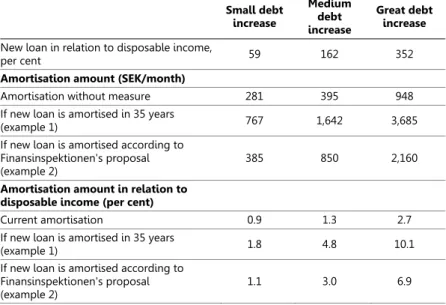
One possible measure is the introduction of an amortisation requirement for mortgages. In connection with the meeting of the Financial Stability Council in November 2014, Finansinspektionen presented a proposal that all new mortgages should be amortised down to 50 per cent of the value of the housing concerned. However, the proposal lacked certain specific details, for example there was no definition of what constitutes a new mortgage. There is therefore some uncertainty about the effects the proposal would have. Never-theless, the assessment is that even if the proposal is interpreted strictly it would have only small effects on the household debt ratio (see the box Amortisation requirements – A step towards a more sustainable debt situation). Although Finansinspektionen's proposal is a step in the right direction, the Riksbank considers it to be insuffi-cient to fully deal with the problems associated with household indebtedness.
However, the most important thing at present is that measures are put in place without any delay. The Riksbank therefore assesses that Finansinspektionen ought to introduce an amortisation require-ment by issuing a general guideline. It will then be important to frequently monitor and evaluate the effects of the measure on household indebtedness.
The risks associated with household indebtedness are also so considerable that an amortisation requirement alone will not be sufficient. This will be the case even if the stipulations of an amorti-sation requirement are stricter than the proposal presented by Finansinspektionen. Several measures that counteract the risks rela-ting to household indebtedness will thus be needed as a comple-ment to an amortisation requirecomple-ment. Such measures will concern several policy areas and will need to be introduced gradually over a long period of time. Conceivable measures include tightening the cap on loan-to-value ratios, restricting the percentage of mortgages at variable interest rates, adjusting the tax deduction for interest pay-ments, raising the minimum levels of the banks' discretionary income calculations and extending taxation of housing. In addition, measures
that increase the supply of housing and lead to a more effective hou-sing market are needed to reducing the risks associated with household indebtedness in the long term.
Finansinspektionen should introduce a leverage ratio requirement for major Swedish banks at the group level of 4 per cent from January 2016 and 5 per cent from January 2018.
One important lesson of the last financial crisis is that risk-based capital adequacy requirements are not always adequate to safeguard financial stability. One problem is that a bank's risk exposure amou-nts and the risk weights used in the calculation of this do not always fully reflect the actual risks in a satisfactory manner. The Basel Com-mittee therefore decided, in December 2010, to introduce a leverage ratio as a complement to the risk-based capital adequacy require-ments. The measure of the leverage ratio is not based on risk weights but is a ratio of a bank's capital and its assets. The Basel Committee aims to introduce an international minimum requirement for the leverage ratio in 2018 and the EU aims to introduce a requirement as a binding measure in the same year.
The Swedish banking system is large, concentrated and depen-dent on funding in foreign currency. This has motivated the major Swedish banks to currently have risk-based capital adequacy require-ments over the international minimum requirerequire-ments. At the same time, the major Swedish banks still have relatively low leverage ratios compared with many other European banks. To increase the resi-lience of the Swedish banks, it would therefore be justifiable to move forward the introduction of a Swedish leverage ratio requirement as a complement to the risk-based capital adequacy requirements. Other countries with large banking systems, such as Switzerland, the United Kingdom and the Netherlands, have similarly already introduced or will introduce leverage ratio requirements. A leverage ratio require-ment addresses the risk that the banks' risk weights do not reflect the actual risk in a satisfactory manner. Furthermore, it can reduce the risk of an unhealthy increase in lending by setting a limit for how much the banks can expand their balance sheets without their capital also increasing (see the box A Swedish leverage ratio requirement).
Just like the risk-based capital adequacy requirements, the Swedish leverage ratio requirement should be set above the mini-mum requirements indicated by the Basel III Accord. Better capitali-sed banks have better resilience to loan losses and therefore have a direct effect on promoting financial stability. But more capital in the banking system could also promote financial stability indirect by strengthening the confidence in the banking system. This would also reduce the risk of funding problems arising for the banks.
A Swedish leverage ratio requirement should be introduced gradually over a long period of time in order to give the banks time to meet the requirement. The requirement should take the form of a minimum requirement of 3 per cent supplemented by a buffer
re-quirement of 1 per cent from 2016 and 2 percent from 2018. More precisely, this means that banks that meet the minimum requirement but not the extra buffer requirement should draw up a plan to in-crease their leverage ratios, for example by limiting their dividends to shareholders and their bonus payments.The assessment is that the major Swedish banks can accumulate sufficient capital within the context of their profits. If the banks pay out half of their forecast profits in dividends, it is calculated that they will reach a leverage ratio around or above 5 per cent from 1 January 2018.
The leverage ratio should be calculated in accordance with the definition in the EU's Capital Requirements Regulation (CRR), which is being adapted to the measure used by the Basel Committee.14 This will make it possible for the banks to increase their leverage ratios in ways other than just using share capital and accumulated profits. However, experience shows that share capital and accumulated profits have a greater ability to absorb losses than other types of capital have. It is therefore important that Finansinspektionen ensu-res that the banks do not meet the requirement by using other Tier 1 capital instruments to too great an extent.
EXISTING RECOMMENDATIONS
Table 1:1 The Riksbank’s existing recommendations
Current recommendations Introduced
Household indebtedness
Finansinspektionen should ensure that sound minimum levels are introduced for the standard values that the banks use in their discretionary income calculations.
Financial Stability Report 2014:1 The banks' capital levels
The major Swedish banks should report their leverage ratios at least once a quarter.
Financial Stability Report 2013:2 Finansinspektionen should set the countercyclical capital
buffer level at 2.5 per cent with the aim of increasing the banks' resilience.
Financial Stability Report 2014:1 The major banks' liquidity risks
The major Swedish banks should continue to reduce their structural liquidity risks and approach the minimum level of 100 per cent in the Net Stable Funding Ratio (NSFR).
Financial Stability Report 2011:2
The major Swedish banks should report their Net Stable
Funding Ratios (NSFR) at least once a quarter. Financial Stability Report 2013:1 The major Swedish banks should report their Liquidity
Coverage Ratios (LCR) in Swedish kronor at least once a quarter.
Financial Stability Report 2013:2 Finansinspektionen should extend requirements for Liquidity
Coverage Ratios (LCR) to also cover Swedish kronor. The requirement should be set at 60 per cent.
Financial Stability Report 2014:1
14 On 10 October 2014, the European Commission adopted what is known as a delegated act to change the definition of the leverage ratio in the EU's Capital Requirements Regulation ahead of the start of publication of leverage ratios by banks in the EU in 2015. The definition is in line with the definition agreed on by the Basel Committee in January 2014. The delegated act will enter into force if neither the European Parliament nor the European Council raises objections within three months.
Finansinspektionen should ensure that sound minimum levels are introduced for the standard values that the banks use in their discretionary income calculations.
A large part of the Swedish banks’ lending consists of mortgage loans to Swedish households. The banks are obliged to conduct credit assessments to ensure that borrowers are able to meet their commitments. As part of this, the banks usually draw up so-called discretionary income calculations. However, at present, there are large differences in how the banks formulate these calculations, meaning that different banks assess their borrowers' economic margins in different ways. Setting minimum levels for the standard values in the discretionary income calculations will ensure that the borrowers will at least be able to cope with certain levels of lending rates, amortisation rates and living costs, regardless of which bank issues the loan.15 In addition, if the standard values are transparent, the measures could contribute towards sounder credit assessment.16
The major Swedish banks should report their leverage ratios at least once a quarter.
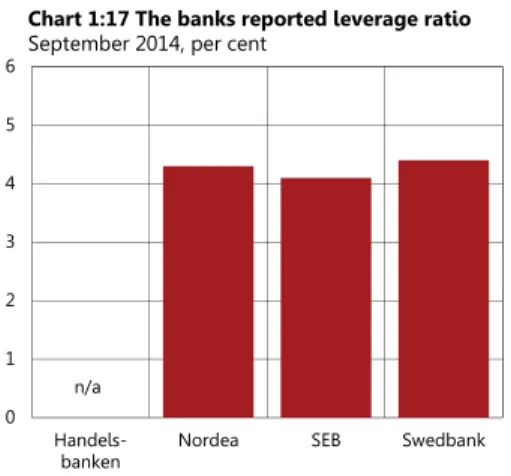
The Riksbank recommends that the major Swedish banks publicly report the leverage ratio at least once a quarter in accordance with the definition in the EU Capital Requirements Directive (CRR). By publishing this measure, the Swedish banks provide investors with information that can be compared both over time and between banks. At present, three of the four major banks report their lever-age ratios in accordance with the CRR definition (see table 1:2 and chart 1:17).17 However, from 1 January 2015, all of the major Swedish banks must publicly report their leverage ratios at least once per quarter in accordance with the CRR and Finansinspektionen's regulations.18
Table 1:2 Public reporting of leverage ratio according to the EU Capital Requirements Directive
15 An example of the introduction of minimum levels for standard values in discretionary income calculations is provided by Finland, where the Finnish financial supervisory authority recommended in 2010 that the Finnish banks use an amortisation rate of 25 years in their discretionary income calculations. 16 Financial Stability Report 2014:1. Sveriges Riksbank.
17 Financial Stability Report 2014:1. Sveriges Riksbank.
18 Finansinspektionen's regulations (FFFS 2014:12) regarding supervisory requirements and capital buffers.
Report leverage ratio according to CRR at least once a quarter
Swedbank
Reports
SEB
Does not report
Handels-banken Nordea
Chart 1:17The banks reported leverage ratio September 2014, per cent
Note. The bank's published measures are not fully comparable. This is because the European Commission recently published a delegated act that clarifies how the calculations should be carried out so that the measure is comparable between banks in the EU ahead of the turn of the year, when a publication requirement will come into force. In the third quarter, only Swedbank stated that it was applying the delegated act. Sources: Bank reports and the Riksbank
0 1 2 3 4 5 6
Handels-banken Nordea SEB Swedbank n/a
Finansinspektionen should set the countercyclical capital buffer level at 2.5 per cent with the aim of increasing the banks' resilience. The development of the housing market prices in recent years and the rapid increase in indebtedness in the Swedish household sector are considered to pose a risk that could threaten the macroeconomic development and the financial stability. To strengthen the banks' resilience to these risks, the Riksbank recommended, in the Financial Stability Report 2014:1, that a countercyclical capital buffer be inclu-ded as part of the Swedish banks' capital requirement, and that the rate of this buffer should amount to 2.5 per cent.
Since then, Finansinspektionen has set the countercyclical capi-tal buffer rate at 1 per cent as of 1 September 2015.19 This decision is based, among other things, on the buffer benchmark calculated using the Basel Committee's standard method, which is based, in turn, on the so-called credit gap (see charts 1:18 and 1:19). An up-dated calculation of the credit gap using the standard method gives a buffer benchmark of approximately 2 per cent.20 However, the Riks-bank deems that this method does not fully capture the current risks in the Swedish financial system. Other quantitative indicators and an overall assessment also suggest that considerable systemic risks have built up in recent years.21 All-in-all, this means that the Riksbank con-siders that the countercyclical capital buffer rate should be raised to 2.5 per cent. If cyclical systemic risks continue to increase, the buffer rate should be raised further.
The major Swedish banks should reduce their structural liquidity risks and approach the minimum level of 100 per cent in the Net Stable Funding Ratio (NSFR).
Over a long period of time, the Riksbank has pointed out that the structural liquidity risks in the major Swedish banks are high in com-parison with many other banks in Europe. One way of measuring this is by using the NSFR. A revised definition of this measure was presented by the Basel Committee in October 2014. The revised definition gives the Swedish banks higher NSFR levels than the original definition did. Consequently, it has become easier for the major Swedish banks to attain 100 per cent in the NSFR. In addition, the potential for reducing structural liquidity risks and improving the NSFR is strong, as the major Swedish banks are able to obtain fund-ing over long maturities at a low cost. The Riksbank thus considers that the major banks should reach an NSFR of 100 per cent as soon as possible with the definition the measure has been given in the most recent Basel Accord from October 2014.22 At present, Swedbank is the only of the four major banks to publish the NSFR. In the third
19 Finansinspektionen's regulations (FFFS 2014:33) regarding the countercyclical buffer rate. 20 A contributory factor to the increase in the buffer rate is that the figures for GDP have been revised in connection with the restructuring of the National Accounts.
21 See for example the section on vulnerabilities and risks in this chapter or the box The Countercyclical Capital Buffer, Financial Stability 2014:1. Sveriges Riksbank.
22 The Riksbank's recommendation has previously been based on the Basel Committee's definition of the NSFR from 2010, see Basel III: International framework for liquidity risk measurement, standards and monitoring, December 2010, Basel Committee. The recommendation now refers to the most recent definition, see Basel III: the Net Stable Funding Ratio, Basel Committee, October 2014. Basel Committee.
Chart 1:18The countercyclical buffer rate according to the Basel Committee's standard method with no upper limit for the buffer rate
Per cent
Note. The countercyclical buffer rate for exposures in Sweden is based on a mechanical application of the credit gap according to the BIS standard method with no upper limit for the buffer rate. The credit gap shows how much the credit-to-GDP ratio deviates from its statistical trend. The reduction of the buffer value according to the standard method is represented by a dotted line in the chart.
Source: The Riksbank
Chart 1:19The credit-to-GDP ratio and statistical trend according to the Basel Committee's standard method
Per cent
Note. Credit is defined as monetary financial institutions' lending to the private non-financial sector and the outstanding stock of commercial paper and bonds issued by the Swedish private non-financial sector. GDP is in nominal terms and is defined as the sum of GDP for the four most recent quarters. The statistical trend is calculated using a one-sided HP filter with the smoothing parameter equal to 400,000.
Source: The Riksbank 0 1 2 3 4 5 6 7 8
80 82 84 86 88 90 92 94 96 98 00 02 04 06 08 10 12
60 70 80 90 100 110 120 130 140 150 160
81 83 85 87 89 91 93 95 97 99 01 03 05 07 09 11 13 Credit-to-GDP ratio
quarter of 2014, Swedbank reported an NSFR of 102 per cent, thereby complying with the Riksbank's recommenddation. The major Swedish banks should report their Net Stable Funding Ratios (NSFR) at least once a quarter.
The Riksbank's assessment is that the major Swedish banks should report the NSFR. This is because the internationally-accepted measure makes it possible to monitor the development of structural liquidity risks over time and between banks. As mentioned above, only Swedbank publishes its NSFR at present (see table 1:3). If the major banks deem that other measures better illuminate the struc-tural liquidity risks they are taking, the Riksbank urges the banks to report these measures together with the NSFR.
Table 1:3 Public reporting of NSFR
Finansinspektionen should extend requirements for Liquidity Coverage Ratios (LCR) to also cover Swedish kronor. The require-ment should be set at a level of 60 per cent.
The major Swedish banks' LCRs in Swedish kronor are below 100 per cent. They have, at times, been extremely low and are considerably lower than their LCRs in euros and dollars. This indicates that the banks' resilience to liquidity stress in Swedish kronor is small.
The Riksbank therefore considers that Finansinspektionen should extend the current requirements for the LCR23 to also include requirements in Swedish kronor. However, the LCR requirement should initially be set at a lower level than 100 per cent. This is because the fact that the supply of government bonds in Swedish kronor is limited must be taken into account, and because the measures must not lead to a significant fall in the liquidity buffers in foreign currencies. The Riksbank considers that in the current situation it should be possible to introduce an LCR requirement in Swedish kronor at a level of 60 per cent.24 The Riksbank will continue to analyse how the liquidity risks in Swedish kronor can be reduced.
Norges Bank has carried out a similar assessment of the liquidity risks in the Norwegian banks and recommended, in its latest stability
23 Finansinspektionen's regulation FFFS 2012:6.
24 Jönsson, Björn, (2014), A survey of the liquidity coverage ratio (LCR) in Swedish kronor, Economic Commentary no. 6, 2014. Sveriges Riksbank. Financial Stability Report 2014:1. Sveriges Riksbank.
Reports NSFR at least once a
quarter
Handels-banken Nordea SEB Swedbank
Reports Does not report
report, that an LCR requirement in Norwegian kroner be introduced in Norway at the level of 60 per cent.25
The major Swedish banks should report their Liquidity Coverage Ratios (LCR) in Swedish kronor at least once a quarter.
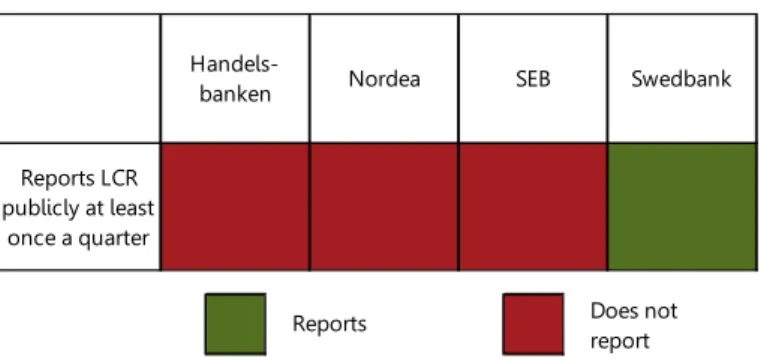
The major Swedish banks already report the LCR of all currencies together and also separately in euros and US dollars. Supplementing the present reporting by also separately reporting the LCR in Swedish kronor would provide a more complete view of the Swedish banks' liquidity risks in various currencies. At present, Swedbank is the only bank that reports its LCR in Swedish kronor (see table 1:4).
Table 1:4 Public reporting of the LCR in SEK
25 Financial stability 2014. Norges Bank.
Reports LCR publicly at least
once a quarter
Handels-banken Nordea SEB Swedbank
Reports Does not report
RECOMMENDATIONS THAT HAVE BEEN FULFILLED
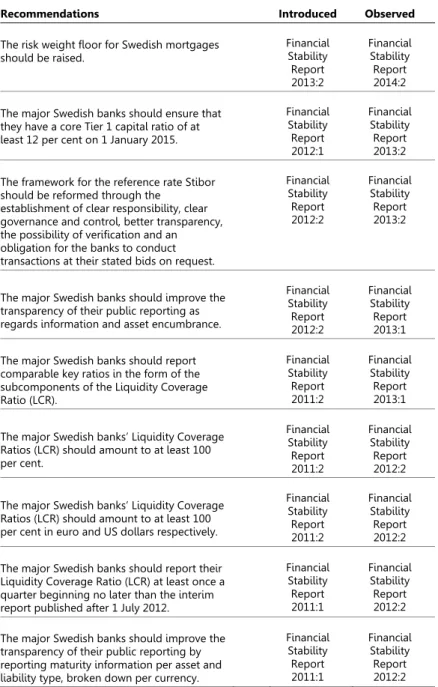
Since the autumn of 2010, the Riksbank has made recommendations in its Financial Stability Report. Many of these recommendations are fulfilled at present (see table 1:5).
Table 1:5 Recommendations that have been fulfilled
Recommendations Introduced Observed
The risk weight floor for Swedish mortgages should be raised.
Financial Stability Report 2013:2 Financial Stability Report 2014:2 The major Swedish banks should ensure that
they have a core Tier 1 capital ratio of at least 12 per cent on 1 January 2015.
Financial Stability Report 2012:1 Financial Stability Report 2013:2 The framework for the reference rate Stibor
should be reformed through the establishment of clear responsibility, clear governance and control, better transparency, the possibility of verification and an obligation for the banks to conduct transactions at their stated bids on request.
Financial Stability Report 2012:2 Financial Stability Report 2013:2
The major Swedish banks should improve the transparency of their public reporting as regards information and asset encumbrance.
Financial Stability Report 2012:2 Financial Stability Report 2013:1 The major Swedish banks should report
comparable key ratios in the form of the subcomponents of the Liquidity Coverage Ratio (LCR). Financial Stability Report 2011:2 Financial Stability Report 2013:1 The major Swedish banks’ Liquidity Coverage
Ratios (LCR) should amount to at least 100 per cent. Financial Stability Report 2011:2 Financial Stability Report 2012:2 The major Swedish banks’ Liquidity Coverage
Ratios (LCR) should amount to at least 100 per cent in euro and US dollars respectively.
Financial Stability Report 2011:2 Financial Stability Report 2012:2 The major Swedish banks should report their
Liquidity Coverage Ratio (LCR) at least once a quarter beginning no later than the interim report published after 1 July 2012.
Financial Stability Report 2011:1 Financial Stability Report 2012:2 The major Swedish banks should improve the
transparency of their public reporting by reporting maturity information per asset and liability type, broken down per currency.
Financial Stability Report 2011:1 Financial Stability Report 2012:2
situation
Swedish household indebtedness is high in both historical and international terms. The Riksbank considers that this situation may have serious consequences for the development of the real economy and for financial stability. In order to reduce the risks of such consequences, the households need to increase the amortisation of their mortgages. The Riksbank therefore recom-mends Finansinspektionen to introduce an amortisation
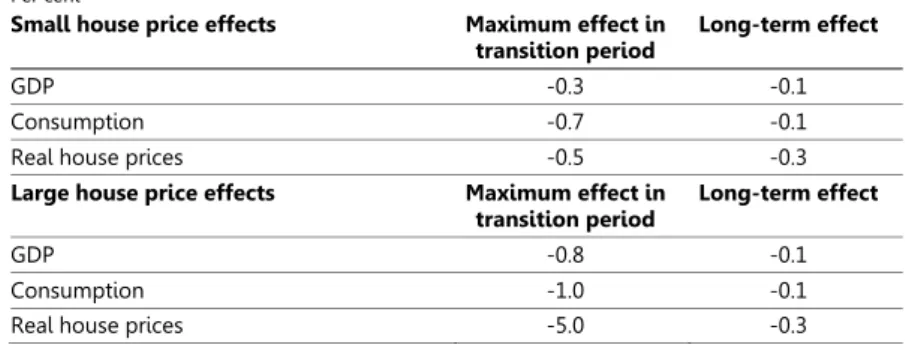
requirement for new mortgages. This box describes how Swedish households currently amortise and how amortisation requirements are expressed in other countries. The box also presents two calculations that examine how amortisation requirements can dampen household indebtedness and the potential effects on household consumption and Swedish GDP growth.
Swedish household debt has increased rapidly
The fact that a large proportion of the Swedish households are not reducing their debt has contributed to a sharp increase in the debt ratio over a long period of time. Over the last ten years, the debt ratio has increased by 41 percentage points to approximately 171 per cent. The Riksbank's forecast is that the debt ratio will continue to increase and reach 185 per cent by the end of 2017 (see chart 1:13). If it is assumed, as a simple example, that debt and incomes increase at the same rate as the average over the last ten years, the debt ratio would reach approximately 230 per cent by 2025.
Many Swedish households have interest-only loans and
long amortisation periods
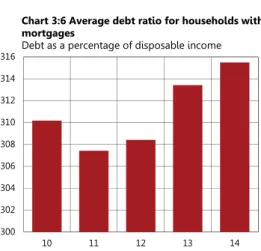
There are many indications that households' propensity to amortise has decreased in tandem with interest-only loans being offered by the banks.26 The Riksbank's credit data shows that approximately four out of ten mortgage borrowers do not amortise their mortgages today.27 Those who do amortise their mortgages often do so at a slow rate (see chapter 3). The Riksbanks’ analysis of the sample in Finansinspektionen's mortgage survey shows that a typical new mortgage borrower only amortises approximately SEK 400 of the mortgage per month, which means that it will take a very long time to pay off the loan. For approximately half of the new mortgage borrowers in the sample it will take at least 85 years to pay off the loan. The mortgage survey also shows that 42 per cent of new
26 From A to Z: the Swedish mortgage market and its role in the financial system, Riksbank Studies, April 2014. Sveriges Riksbank.
27 The Riksbank's credit data can be used to analyse how household debt has changed during the year. In this way, not only amortisation but also new loans can be taken into account. For mortgage borrowers who have reduced their debt, amortisation payments have thus been higher than the new loans that have been taken.
mortgage borrowers do not draw up an amortisation plan.28 For those households with a loan-to-value ratio of below 75 per cent, this figure is as high as 60 per cent.29
The most common reason given for households to have interest-only mortgages is that they have instead chosen to amortise more expensive loans for consumption or that they have a low loan-to-value ratio.30 The decision not to amortise by households with low loan-to-value ratios could be explained by it probably having been more advantageous to save by investing in financial assets such as equity funds and fixed-income funds. The low level of volatility on the property market since the mid-1990s has probably also led many households to assess the risk of a fall in value of their property as low. This also affects households' incentive to reduce the high loan-to-value ratios through amortisation.31
Several measures are needed to dampen household debt
In recent years, several measures have been taken to dampen house-hold indebtedness. In the autumn of 2010, Finansinspektionen intro-duced a mortgage ceiling of 85 per cent to limit how much a house-hold can borrow in relation to the value of the property. In the same year, the Swedish Bankers' Association also issued a recommendation aimed at increasing households' mortgage amortisation.32 In
addition, Finansinspektionen has taken a number of measures to raise the capital in the Swedish banks. These measures have primarily aimed to make the banks more robust and to get them to bear their losses themselves to a greater extent. However, the Riksbank’s cur-rent assessment is that the banks' lending rates have not been affected to such a degree that the households' incentives to take on debt have been reduced by these measures.33
However, the measures that have been directly targeted at household indebtedness have not been adequate either. Debt and housing prices have continued to increase rapidly and the debt ratio is also expected to continue to rise in the period ahead (see charts 1:6, 1:7 and 1:13). The Riksbank's assessment is therefore that more measures are imperative.
Several international analysts have also indicated the need for further measures to dampen the growth of housing prices and indebtedness in Sweden. They have proposed measures aimed at addressing the underlying problems on the Swedish housing market
28 The Swedish mortgage market 2014, April 2014. Finansinspektionen.
29 In October 2013, Finansinspektionen proposed that banks should provide new mortgage customers with individually-tailored amortisation plans. This was introduced by the banks in July 2014. At present, the effect this has had is unclear. However, a small survey that Finansinspektionen has conducted among some 750 new mortgage borrowers, indicate that the mortgage borrowers have started to amortize to a greater extent after this.
30 Random sampling in the mortgage survey showed that households with interest-only loans have a similar ability to repay loans as the average household included in the random sampling.
31 Jansson, Thomas, (2014), Households' amortisation decisions, Memorandum. Sveriges Riksbank. 32 In December 2010, the Swedish Bankers' Association issued a recommendation on lending for housing purposes entailing that borrowers should amortise the part of their mortgages above 75 per cent of the market value. In April 2014, this recommendation was tightened up to specify that amortisation should take place to 70 per cent of the property's market value over a 10–15 year period.
33 Monetary policy and macroprudential policy in a globalised world, Stefan Ingves, speech to Swedish Economics Association, Stockholm, May 2014. Sveriges Riksbank.
and at directly influencing household indebtedness. For example, in its annual review of the Swedish economy, the IMF proposes a combination of macroprudential policy measures targeted at the demand for loans. These are amortisation requirements, limits to the loan amounts in relation to income and a stricter cap on loan-to- value raios.34 The IMF, the European Commission and analysts at the OECD have also pointed out that the taxation system needs to be improved and that housing construction needs to be increased.35
Amortisation requirements in other countries
In many other countries, it is more common for households to amor-tise their entire mortgages. This often happens without the authori-ties having imposed requirements or recommendations on the len-ders. The common factor for most countries is that there is a clear maturity for when the loan is to be repaid, usually between 20 and 40 years.36 The proportion of interest-only loans is also low in many oter countries. For example, according to the central bank of France, only 0.33 per cent of all new loans in the country are interest-only.
There are also a number of countries that have introduced vari-ous forms of amortisation requirements to dampen hvari-ousehold indebtedness. For example, in the Netherlands, the Dutch Banking Association has issued recommendations limiting how much of a mortgage loan that may be interest-only. At the same time, the authorities have linked the right to tax relief to an obligation for households to repay their loans within 30 years. In Canada, the hous-ing market is instead regulated by the insurance terms of a govern-ment agency. Under these terms, Canadian borrowers with a loan-to-value ratio above 85 per cent must have mortgage insurance. There is also a requirement that mortgages must be paid off within 25 years.
In South Korea, the authorities have chosen to limit the per-centage of the banks' mortgage lending that can be interest-only. This resulted from a recommendation entailing that, by 2017, a maxi-mum of 60 per cent of the banks' lending may be interest-only.37 Finland does not have any statutory amortisation requirements either. Instead, the Finnish financial supervisory authority has issued a recommendation to the banks specifying that they are to assume a 25-year amortisation period for new mortgages in their credit assess-ments of new customers. Together with a stressed interest rate of 6 per cent, this is used to assess the debt-servicing ability of new mort-gage borrowers.38 Slovakia, Singapore and Hong Kong have also
34 See Sweden: 2014 Article IV Consultation Staff Report, IMF Country Report No. 14/261, July 2014. International Monetary Fund (IMF).
35 See Sweden: 2014 Article IV Consultation Staff Report, IMF Country Report No. 14/261, July 2014. International Monetary Fund (IMF). Macroeconomic imbalances Sweden, Occasional papers 186, March 2014, European Commission, and McGowan, M. Adalet, Housing, (2013), Financial and Capital Taxation Policies to Ensure Robust Growth in Sweden, OECD Economics Department Working Papers, No. 1024. OECD. 36 Lea, Michael (2010), International Comparison of Mortgage Product Offerings, September 2010, Special Report. Research Institute for Housing America.
37 South Korea's central bank, the Bank of Korea.