Capital Facilities
Planning
Guidebook
Comprehensive Planning under the
Title: Capital Facilities Planning Guidebook: Comprehensive Planning under the Growth Management Act
Publication Number: 005
Month Year Updated: October 2014
Online/Print Availability: Yes / No
Short Description: This guidebook presents strategies and techniques to draft the capital facilities element of
comprehensive land use plans. It includes guidance regarding planning for and financing infrastructure and services needed to accommodate anticipated growth.
Project Leads: Joyce Phillips, AICP
Author: Joyce Phillips, AICP
Contributing Writers/Editors: Dave Andersen, AICP Lynn Kohn, AICP Bruce Hunt Cathi Read
Mike Bailey, Finance Director, City of Redmond
Number of Pages 113
Key Words Capital Facilities Planning, Capital Facilities Element, Infrastructure
ACKNOWLEDGEMENTS
Washington Department of Commerce: Brian Bonlender, Director
Local Government and Infrastructure Division: Kendee Yamaguchi, Assistant Director
Growth Management Services Unit: Jeff Wilson, AICP
Senior Managing Director
This guidebook is dedicated to the Memory of Bruce Hunt. Bruce was a planner of exceptional ability, dedication and integrity, who served his community and the state for over 20 years. Bruce’s knowledge and experience were critical to the development of the ideas contained in the document. Bruce will be missed by his colleagues at Commerce, his community and his family.
-Bruce Hunt 1954-2014
USING THIS DOCUMENT:
This PDF document is set up to be viewed easily on the web. • Type is larger than average print document size.
• Text highlighted in BLUE is a hyperlink to outside source.
FOR PROBLEMS WITHTHIS DOCUMENTOR TO REPORTA MISSING OR BROKEN LINKPLEASE SEND AN EMAILTO [email protected]
What are Capital Facilities? ... 1
Why Plan for Capital Facilities ... 3
Capital Facilities and Fiscal Responsibility ... 4
Chapter 1: An Overview of the GMA Requirements ... 12
The Capital Facilities Element ... 13
Chapter 2: Developing and Updating your Inventory ... 21
Overview ... 21
Chapter 3: Forecast of Future Need ... 27
Developing Demand Forecasts from the Land Use Element ... 29
How to use LOS ... 30
Chapter 4: Meeting Current and Future Need ... 36
Overview: Using Land Use and Capital Facilities Analysis Together ... 36
Managing Capital Facilities Costs with your Land Use Element ... 37
Three Drivers of Capital Facilities Need ... 38
Developing project lists from needs ... 39
Alternatives to new facilities ... 40
Project Selection and Prioritization ... 41
The perils of ignoring system preservation ... 42
Asset Management ... 43
Checking in with other Comprehensive Plan Elements ... 43
Chapter 5: Financing Plan ... 44
Overview: Why a Financing Plan? ... 44
Six-Year Capital Improvement Plan ... 46
Financing Plan Questions to Consider in Capital Facilities Element ... 47
Identifying Revenue Sources ... 50
Using currently untapped revenue sources ... 51
Economic Forecasting ... 52
Implementation Plan ... 53
Types of Revenue ... 54
Rate Setting ... 56
Financing Policies Regarding Capital Facilities ... 57
CFP Team... 58
Scenario Planning and Fiscal Implication Models ... 59
Additional Resources ... 59
Chapter 6: Smaller Jurisdictions ... 61
Overview ... 61
What must be included? ... 61
A forecast of future needs ... 64
Provide at least a six-year plan that will finance such capital facilities. ... 67
A requirement to reassess the land use element if probable funding falls short. ... 69
Using a Decision Matrix to help prioritize funding commitments ... 70
Resources for developing capital facility plans ... 73
Good Examples ... 74
Chapter 7: County Considerations ... 75
Working with Other Service Providers ... 75
Urban service providers in unincorporated UGAs ... 76
Extension of urban services ... 76
Urban Growth Area Expansions ... 79
Additional Growth Management Hearings Board cases ... 79
Summaries from GMHB Digests ... 79
Additional Considerations ... 81
Chapter 8: Consistency and Coordination... 82
Internal Consistency... 83
External Consistency & Coordination ... 84
Intergovernmental Coordination ... 86
Examples of Intergovernmental Coordination ... 86
When a local project is not on a state project list ... 87
Projects identified for funding by others ... 87
Identified Needs without Identified Funding ... 88
Chapter 9: Implementation ... 89
Using the Comprehensive Plan for Project Decisions ... 90
On-Site Sewage Systems in Urban Growth Areas ... 95
Capital Facilities and Development Review ... 96
Providing Sufficient Capacity ... 96
Concurrency ... 96 Development Phasing ... 97 Development Standards ... 97 Project Integration ... 98 Developer Improvements ... 98 Additional Resources: ... 100
Chapter 10: Review, Update and Evaluate the Capital Facilities Element ...101
Overview: The Role of the Update ... 101
Basic Steps in the Periodic Review... 102
Chapter 11: Conclusions ...104
Think Like a Business ... 104
Be a Good Fiscal Steward ... 104
next chapterINTRODUCTION
Helping Communities Shape their Future
The Growth Management Act (GMA) provides statutory authority for local governments to plan in Washington State (see RCW 36.70A). The process of identifying current capital facility needs, future needs to serve the growth
anticipated in the comprehensive plan, and how to fund them, is an important aspect of planning under the GMA.
The capital facilities plan (CFP) includes a six-year capital improvement plan (CIP) which should align with the jurisdiction’s budget, and a longer-range (20-year) CFP of capital projects, with estimated costs and proposed methods of financing. The CFP provides for the full implementation of the land use plan by showing how public facilities and services will be provided for in the community, at the population and intensities of development envisioned in the plan, and at adopted levels of service. This chapter of the guidebook provides an overview of the topic and explains:
• What are capital facilities?
• Why planning for capital facilities and public services is important
• Integrating capital facilities plans with land use, transportation and utilities
• Including public participation
• Dealing with existing services and infrastructure
• Planning for services and infrastructure to serve new growth
• Adopting plans prepared by others
• Fiscal considerations of capital facilities planning
What are Capital Facilities?
Most people have a general idea about what capital facilities are. But the GMA does not specifically define them. The GMA defines public facilities as including “streets, roads, highways, sidewalks, street and road lighting systems, traffic signals, domestic
law enforcement, public health, education, recreation, environmental protection, and other governmental services.” The GMA also defines rural governmental services (rural services) and urban governmental services (urban services):
"Rural governmental services" or "rural services" include those public services and public facilities historically and typically delivered at an intensity usually found in rural areas, and may include domestic water systems, fire and police protection services, transportation and public transit services, and other public utilities associated with rural development and normally not associated with urban areas. Rural services do not include storm or sanitary sewers,
except as otherwise authorized by RCW 36.70A.110(4).
"Urban governmental services" or "urban services" include those public services and public facilities at an intensity historically and typically provided in cities, specifically including storm and sanitary sewer systems, domestic water systems, street cleaning services, fire and police protection services, public transit services, and other public utilities associated with urban areas and normally not associated with rural areas.
While these definitions certainly prove useful, they do not define capital facilities specifically. Over the years, the Growth Management Hearings Board (GMHB) has provided additional guidance.
For purposes of conducting the inventory required by RCW 36.70A.070(3)(a), “public facilities” as defined in RCW 36.70A.030(13) are synonymous with “capital facilities owned by public entities.” West Seattle Defense Fund v. City of Seattle, CPSGMHB Case 94-3-0016, FDO April 4, 1995, as cited in EWGMHB Case 06-1-0009c, FDO March 12, 2007. The board further defined capital facilities as what is required to fulfill the GMA
obligation:
The Board holds that a Capital Facilities Element (CFE) must include all facilities that meet the definition of public facilities set forth in RCW 36.70A.030(12). All facilities included in the CFE must have a minimum standard [level of service] (LOS) clearly labeled as such (i.e., not “guidelines” or “criteria”), must include an inventory and needs assessment and include or reference the location and capacity of needed, expanded, or new facilities. (RCW 36.70A.070(3)(a), (b) and (c). In addition, a CFE must explicitly state which of the listed public facilities are determined to be “necessary for development” and each of the facilities so designated must have either a “concurrency mechanism” or an “adequacy mechanism” to trigger appropriate reassessment if service falls below the baseline minimum standard. Transportation standards are
next chapterthe only facilities required to have a concurrency mechanism, although a local government may choose to adopt a concurrency mechanism for other facilities.” Jody L. McVittie v. Snohomish County, CPSGMHB Case No. 01-3-0002, FDO, July 25, 2001, as cited in EWGMHB Case 06-1-0009c, FDO March 12, 2007.
And in Wilma et al v. Stevens County, EWGMHB Case 06-1-0009c, FDO March 12, 2007, the Eastern Board included
streets, roads, highways, sidewalks, street and road lighting systems, traffic signals, domestic water systems, storm and sanitary sewer systems, parks and recreational facilities, and schools…fire protections and suppression, law enforcement, public health, education, recreation, environmental protection and other governmental services. (WAC 365-195-200(12) and (13).
The Washington Administrative Code (WAC) was updated in 2010, after the cases above were determined. WAC 365-196-415 provides guidance as to which capital facilities should be included in the inventory. At a minimum, they should include water systems, sanitary sewer systems, storm water facilities, reclaimed water facilities, schools, parks and recreational facilities, police and fire protection facilities.
Why Plan for Capital Facilities
Capital Facilities Elements are required by state statute for jurisdictions fully planning under the GMA. The specific requirements for the Capital Facility Element are set forth in the GMA. (RCW 36.70A.070)
Even without a specific mandate, planning ahead for capital investments is good management. Capital facilities plans can help your jurisdiction use its limited funding wisely and most efficiently to maximize funding opportunities. By planning ahead to determine what the needs are, jurisdictions can prioritize projects, coordinate related projects, and be ready to apply for loan and grant opportunities. When the
comprehensive plans, development regulations, and budgeting policy and decisions
Each jurisdiction should define capital facilities and identify which capital facilities and public services are included. Additionally, each jurisdiction should clearly identify which capital facilities and public services are necessary to support development.
Preparing the plan is an investment in the future. A complete and thorough CFP is easier to maintain once you’ve invested the time in creating it. Per statute, the CFP must include these five key components:
• An inventory of existing capital facilities owned by public entities, showing
the locations and capacities of the capital facilities;
• A forecast of the future needs for such capital facilities;
• The proposed locations and capacities of expanded or new capital
facilities;
• At least a six-year plan that will finance such capital facilities within
projected funding capacities and clearly identifies sources of public money for such purposes; and
• A requirement to reassess the land use element if probable funding falls
short of meeting existing needs and to ensure that the land use element,
capital facilities plan element, and financing plan within the capital
facilities plan element are coordinated and consistent. Park and recreation facilities shall be included in the capital facilities plan element.
Capital Facilities and Fiscal Responsibility
Adequacy of urban services is defined as adequacy to meet adopted LOS standards. Providing adequate public facilities is part of the affirmative duty local governments
have. For example, each expansion of an Urban Growth Area (UGA) incurs additional costs. Investment in services to these new UGA areas comes at the expense of
investments needed to preserve and maintain existing infrastructure. When Counties and Cities consider adding any new land area to a UGA, changes to the county
comprehensive plan must be accompanied by an update to the transportation and capital facilities elements to show how the County, Cities, and other service providers will provide the needed facilities. The update must include: the current inventory of
“One of the best ways to make a future land use plan come true is to use investments in public facilities to reinforce the plan. The community should invest in new roads, sewer and water lines and other facilities where it wants growth to occur. It should refuse to make investments in areas where it does not want growth to occur.” (Association of Washington Cities (AWC), 2011)
next chapterurban services, what urban services will be needed to support the expansion of the
UGA, what the costs for urban services are projected to be, and a statement of funding sources to underwrite the costs of providing urban services to the entire UGA and any amended areas, consistent with RCW 36.70A.070(3). The County and Cities’ Comprehensive Plans would need to be updated to support changes in land use, housing, transportation, and utilities that would result from expanding the
current UGA.
The fiscal analysis must show the generalized costs to meet adopted levels of service, as well as the detail necessary for roads, water, wastewater or storm water service. Without such analysis, there is no record to show how the local government will be able to meet its obligation to provide adequate public facilities consistent with RCW 36.70A.070(3) and RCW 36.70A.110(3).
Capital Facilities and Economic Development
Key factors of economic recovery – good jobs, significant private investment, effective infrastructure and adequate public funding – have an interdependent relationship. Planning for them in an integrated fashion is a powerful strategy for local vitality. Infrastructure planning leads to strategic infrastructure investments that help the community achieve its intended future.
Capital Facilities, Neighborhood Character and Livability
Neighborhood character and livability can certainly be influenced by capital facilities
planning. These are often of great importance in UGAs. For example, including
street trees in public rights of way can boost neighborhood character, provide separation between motorized and pedestrian travel ways, and reduce urban heat island impacts. Providing for street and pedestrian connectivity, street lighting, crosswalks at key areas such as to schools and parks, providing safe pedestrian and bicycling routes to schools, adding new sidewalks or filling in sidewalk gaps,
identifying needed neighborhood school and park sites, and coordinating transit stop distances and amenities with transit provider(s) can all influence character and
livability of a community or neighborhood. The amenities affect quality of life as well as capital facilities planning.
Integration of Land Use and Capital Facilities, Connection to the Utilities Element You may hear the phrase “truth in planning” used when discussing capital facilities. This is because the CFE of the plan is meant to be the reality check in regard to how much it will cost and how it will be paid for in order to implement the vision of the comprehensive plan. The CFE must integrate the land use element with the
transportation, utilities, and other plan elements. It is the local jurisdiction’s plan for the provision of public facilities and services needed to serve the community over the life of the planning period. To be a successful, integral part of the plan it must be based on projected needs to serve the anticipated growth at the levels of service adopted by the community.
the GMA in the manner that best meets their needs. In this guidebook we will strive
to include examples from jurisdictions of varying sizes, geography, and circumstance. For example, the City of Ellensburg operates its own natural gas and electric utility,
therefore it has a combined Capital Facilities and Utilities Element. Ellensburg is one of only three municipalities in the state that provides natural gas service and one of only four that have an electric utility.
It is essential to integrate the CFP with all elements so that budgeting decisions are made consistent with the CFP and the comprehensive plan as required by RCW 36.70A.120. This includes components of other elements, such as the utilities
element and facilities and services provided by others (e.g. school districts). Projects and maintenance needs identified in other elements (e.g. utilities, parks and open space) or more detailed functional plans (e.g. water system plans, sewer plans) should all be included in the CFP.
Public Participation
It is important to involve the public in the review and update of the capital facilities plan. Each community may want to include a definition of capital facilities in its plan, provide an overview of the requirements under the GMA for the CFE, and detail the differences between the 6 year capital improvement plan (CIP) and the longer term planning involved as well (funding years 7-20 of the plan). Typically, the six-year capital improvement plan is project specific, while funding of the remaining years seven to twenty of the plan is more area defined.
Educating the public on the role and importance of the CFE will result in a better comprehensive plan overall. Graphics that show the revenue sources and amounts,
as well as expenditures, can help inform citizens about the financial specifics of their
community. It may serve to influence growth and infrastructure patterns of the
community. For example, financial information could be used to compare the cost of
providing facilities and services to different densities and intensities of development. Using a decision matrix can make a big difference and help the public see the
rationale for decisions that have been made or are being considered.
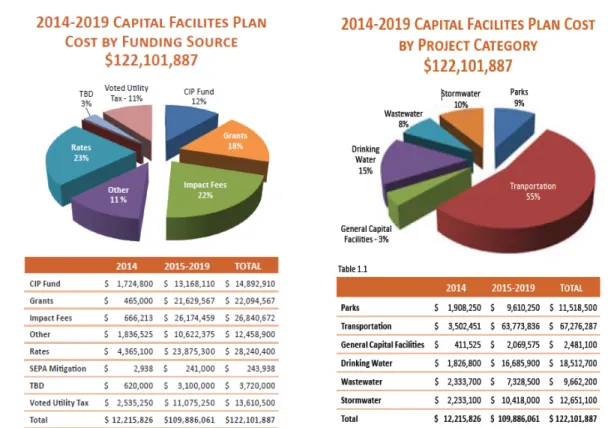
Jurisdictions can use visual aids to help make funding requirements and decisions more understandable to the public. In the example below, a city shows how
property taxes were allocated. Local governments may wish to visually depict how taxes, fees, and other resources are obtained and expended to help the public have a
better sense of the obligations and any shortfalls. The City of Olympia uses two graphics in its CFP introduction, designed to help people understand where the money comes from and how it is used.
next chapterGraphic 1: Visual aids used in the City of Olympia’s Preliminary 2014-2019 Capital Facilities Plan. Existing Services & Infrastructure
Local governments fully planning under the GMA must include an inventory of
existing capital facilities owned by public entities (including those owned by special
purpose districts), showing the location and capacities of them.
Some jurisdictions may choose to separate the inventory by category. For example,
in its 2012 CFP update1, Kitsap County inventoried its capital facilities by type (i.e., Public Buildings, Law Enforcement, Fire Protection, Parks and Recreation, Sanitary Sewer, Schools, etc.).
The City of Shoreline2is an example of a local government that provides some
facilities and services, and contracts with special purpose districts for others. They group facilities and services into those owned or managed by the city and those that are non-city managed facilities and services.
The inventory should include the extent to which facilities have capacity available for
future growth. This will also help identify future need if there are gaps between available capacity and the capacity that will be needed to implement the growth anticipated in the comprehensive plan. It is also important to plan for the financial
obligations of long term operation and maintenance of existing infrastructure.
1 See http://www.kitsapgov.com/dcd/community_plan/comp_plan/cfp/final%20cfp/CFP%20Final.pdf 2 See http://www.cityofshoreline.com/home/showdocument?id=12672
assumptions and growth targets in the land use plan, what are the anticipated
changes in capital facilities and public services that will be needed? Which existing
facilities and services will need to be replaced or enhanced? What new facilities or services will be needed? At the end of the planning period, based on the
assumptions and growth targets, all capital facilities and public services should be provided at the adopted levels of service (LOS). For many jurisdictions this will require working closely with special purpose districts to ensure the facilities and
services they provide can be expanded or enhanced as needed to implement the
comprehensive plan. If the special purpose district cannot meet the new demand, the local government must work to determine how those needs will be met and how they will be financed.
Options to consider may include upsizing infrastructure to serve infill growth versus
expansion of development into currently un-served areas. Even with new growth paying for the infrastructure to serve an undeveloped area, in the long term the operation and maintenance costs of the infrastructure may cost more than upsizing
the existing infrastructure to serve infill. Local governments must carefully consider the costs, both initially and over the life of the investment, to make sound financial decisions.
The CFE should include the proposed location and capacities of expanded or new
capital facilities. Local governments need to have a good idea about the land needed for future investments (e.g., water reservoirs, sewer lift stations, stormwater
facilities, parks). Some uses are dependent upon certain geographic features, such as a higher or lower elevation than the surrounding area or in an area that serves as a critical junction between pressure zones. Knowing these needs and making
appropriate investments and land use decisions years in advance is often necessary to ensure the facility or service can be provided. Making appropriate decisions in advance may provide a greater degree of property selection options or avoid costly and lengthy purchase or condemnation actions in later years.
Local governments must identify which capital facilities and public services are necessary to support new development. There are likely to be others that will be provided but are not necessary to support new growth. At least those that are necessary to support development need to have an adopted LOS standard, as well as a concurrency or adequacy mechanism. The concurrency or adequacy mechanism is what will be used to ensure the facilities and services necessary for new development are adequate to serve that development. If these facilities or services cannot be provided at the adopted level of service, the local government must reassess its land use element. This reassessment might result in amendments to the land use
element, reducing the adopted level of service standards, or securing additional funding. Other options include – but are not limited to:
next chapter• reducing demand through demand management strategies,
• reallocating or redirecting planned growth within the jurisdiction or among jurisdictions within the urban growth area to make better use of
existing capital facilities,
• phasing growth or adopting other measures to adjust the timing of development until the full range of capital facilities needed for new development are available, or
• revising county-wide population forecasts within the allowable range or revising the county-wide employment forecast.
A jurisdiction cannot determine what it will need in the future for public facilities and services without knowing what levels of service it is to meet.
Adopting other Plans by Reference
All capital and public facilities needed for future growth must be included in the comprehensive plan. These needed facilities may be identified in other
comprehensive plan elements, in the jurisdiction’s functional plans, or in the plans of other entities that provide services or facilities.
Functional Plans
Often a city or county has a water system plan, sanitary sewer plan, or transportation plan that contains more detail than is needed in the comprehensive plan. However, the detail is necessary to show adequate provisions can be made to provide facilities and plan for long term expenses. Such functional plans are often adopted by
reference. Jurisdictions should use care to ensure plans adopted by reference are – and remain – consistent with the comprehensive plan over time. Some functional plans must be updated more frequently than comprehensive plans, so plans should be reviewed regularly for consistency.
Special Purpose Districts or Other Service Providers
Jurisdictions should not rely solely on the assurances of availability from other service providers, whether they are public or private entities. Many jurisdictions have special purpose districts that provide at least some of the capital facilities or public services within their boundaries. When adopting system plans or master plans of special purpose districts, the local government should provide a summary of the information in the capital facilities plan, synthesize the information from each of the various
providers, and verify/demonstrate that the actions included in the plans, when taken
together, will provide adequate public facilities within the planning horizon. The local government should conclude that the capital facilities element shows that the area will be provided with adequate public facilities. In completing this, it is important to look at any assumptions used in the special purpose district’s plan. For example, are
their planning timeframes and anticipated population growth and demand consistent with what the city or county is planning for? If there are any gaps, how will they be addressed? Ultimately, it is the local government’s responsibility to show that adequate capital facilities and public facilities will be provided.
projected funding capacities and that clearly identifies sources of public money. However, in reality, each jurisdiction must consider funding issues over the entire life of the plan. While the funding capacities and identification of public funding sources may not be as clear as those required for the six-year plan, a general idea of how capital facilities needed to serve the community - at adopted levels of service and for the anticipated degree of growth - is warranted. This longer term thinking will help communities take steps necessary to fund needed infrastructure. Sometimes the planning or steps needed to secure infrastructure must begin or take place years before development can occur. Knowing what is needed and identifying estimated costs will allow the city or county to appropriately set fees, address rate setting, allow for partnering with special purpose districts, and provide time to research funding options for various projects. It may allow additional time to work with property owners and other stakeholders on the formation of special taxing districts
or provide opportunities to collect impact or mitigation fees to pay for a portion of the project.
The GMA requires coordination and consistency within the comprehensive plan. The Capital Facilities Element must be consistent with the land use, transportation, utilities, and other elements of the comprehensive plan. This includes the financing plan to implement the plan.
Potential for annexation should be factored into financial planning. Areas to be
annexed may require significant investment for maintenance of roads, infrastructure, or both. Cities and towns should assess the condition of all existing or needed
facilities, the timing and need of any upgrades or major maintenance investments, and make provisions to fund them.
There is a direct connection between the expansion of UGAs and capital facilities planning. Whenever a UGA expansion is being considered, the jurisdiction must
analyze the area and the ability to serve it with urban services and how that provision of services will be financed. Please see Commerce’s, “Urban Growth Area
Guidebook: Reviewing, Updating, and Implementing Your Urban Growth Area.”
A Tour of the Guidebook
This guidebook is intended to help local government planners complete the review and update of a capital facilities plan prepared under the Washington State GMA. The guidebook will cover requirements under the GMA and provide general
information about conducting and updating the inventory, forecasting future needs, meeting current and future needs, developing a meaningful and realistic financing plan, provide tips for smaller jurisdictions, and identify additional considerations for county governments. The guide will also provide information to help implement the CFP by addressing consistency and coordination issues, implementation through decision-making, and reviewing and updating the Capital Facilities Element. The
next chapterguidebook will include examples from local governments, resources, and summaries
CHAPTER 1:
An Overview of GMA Requirements
The Growth Management Act (GMA) provides statutory requirements for local governments in planning for Capital Facilities. In addition, the rules3 in Washington Administrative Code (WAC) 365-196-415 provide guidance to meet the requirements. Additional direction has been provided by the Growth Management Hearings Boards. This chapter provides an overview of the requirements. Later Chapters provide more
detail and helpful information, including applicable WACs, examples, and resources.
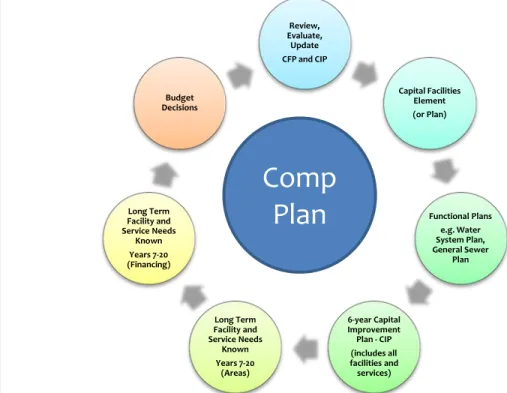
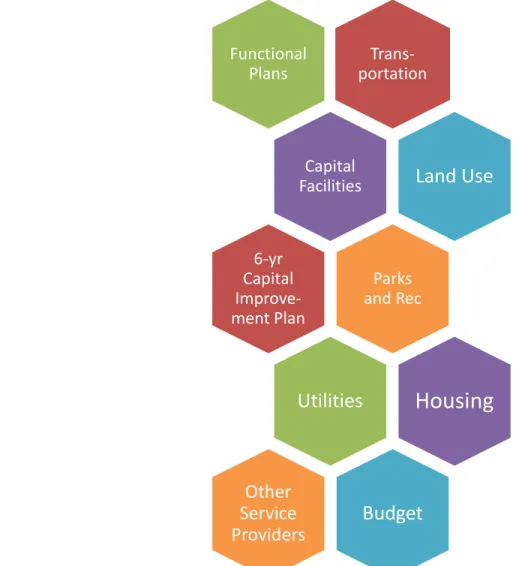
Graphic 2: Representation of the major components of capital facilities and public services planning. 3 See WAC 365-196-415 Review, Evaluate, Update CFP and CIP Capital Facilities Element (or Plan) Functional Plans e.g. Water System Plan, General Sewer Plan 6-year Capital Improvement Plan - CIP (includes all facilities and services) Long Term Facility and Service Needs Known Years 7-20 (Areas) Long Term Facility and Service Needs Known Years 7-20 (Financing) Budget Decisions
Comp
Plan
next chapter
previous chapter
The Capital Facilities Element
RCW 36.70A.070(3) requires a capital facilities plan element consisting of:
a) An inventory of existing capital facilities owned by public entities, showing the
locations and capacities of the capital facilities;
b) A forecast of the future needs for such capital facilities;
c) the proposed locations and capacities of expanded or new capital facilities;
d) At least a six-year plan that will finance such capital facilities within projected funding capacities and clearly identifies sources of public money for such purposes; and
e) A requirement to reassess the Land Use Element if probable funding falls
short of meeting existing needs and to ensure that the land use element,
capital facilities plan element, and financing plan within the capital facilities plan element are coordinated and consistent. Park and recreation facilities shall be included in the capital facilities plan element.
Inventory of existing facilities
Knowing which capital assets are owned by the jurisdiction, what condition they are in and when you need to start thinking about replacing or repairing them is a prudent business practice. It’s also a requirement of the GMA. RCW 36.70A.070(3)(a)
requires: “…An inventory of existing capital facilities owned by public entities,
showing the locations and capacities of the capital facilities…”.
The information in the inventory should be updated at least every eight years as part of the periodic update, however, it may be more helpful to update when a new capital facility is added or an old one is replaced.
It is likely that not all publicly owned capital facilities will be owned by one
jurisdiction. The inventory will most likely include working with adjacent jurisdictions and special purpose districts. It is important to provide adequate time to gather information needed from other providers. Also, the information will probably be provided in different formats. Some may provide electronic data layers while others
may give you an excel spreadsheet or list of facilities and their attributes. Each
jurisdiction will need to compile the data and put it into a format that works for them to meet their needs.
There are several examples available for creating your inventory. Growth Management Services has a webpage devoted to the capital facility plan:
www.commerce.wa.gov/cfp which includes a template for an inventory. The Grays Harbor Council of Governments developed a simplified spreadsheet for their
customers (see example in Chapter 6).
Forecast of future need: RCW 36.70A.070(3)(b)
In addition to knowing what you already own, the capital facility plan should include any capital assets that are needed to serve existing development and accommodate future growth.
An important aspect of capital facilities planning is a forecast of a fully implemented plan and a determination what will be needed to serve that growth. To determine what is needed, the levels of service (LOS) standards for services and facilities to serve growth must be identified. This should be consistent with the planning horizon and the densities and distribution of growth in the Land Use Element.
In determining the future need, the jurisdiction may include reasonable assumptions about the effect of any identified system management or demand management approaches that will be used to preserve capacity or avoid the need for new facilities.
For example, governments that implement a new water reduction program may be
able to delay or avoid improvements to add domestic water supply. Likewise, new or
expanded reclaimed water systems that could be used to provide irrigation to school grounds, parks, golf courses or other large areas may result in significant reductions in domestic water supply needs that can be factored in to the forecast.
This forecast should include all capital facilities that are planned to be provided within the planning period, including the general locations and anticipated capacity needed. Local governments should divide the needed improvements into two categories – those needed to fix existing deficiencies and those needed to serve new growth.
WAC 365-196-320 covers provision of urban services. For urban growth areas, it is important to note that at a minimum, adequate public facilities in urban areas should include sanitary sewer systems and public water service from a Group A public water system because these services are usually necessary to support urban densities. The services provided must be adequate to allow development at urban densities and serve development at densities consistent with the land use element.
The WAC states that the obligation to provide urban areas with adequate public facilities is not limited to new urban areas. Counties and cities must include in their capital facilities element a plan to provide adequate public facilities to all urban areas,
including those existing areas that are developed but do not currently have a full
range of urban governmental services or services necessary to support urban densities.
next chapter
previous chapter
Cities and towns, and counties planning for unincorporated Urban Growth Areas (UGAs), should develop capital facilities plan that will show how the full range of urban governmental services will be provided for the UGA within the planning horizon of the comprehensive plan, including how the improvements will be financed.
Proposed locations and capacity of future facilities: RCW 36.70A.070(c)
Some facilities, such as water storage tanks or sewer lift stations, are dependent on geography for future location. Knowing in advance where these types of facilities will be needed can help the city or county acquire land. Determining future capacity needed for the various facilities provides the city or county with a clear idea of what will be needed and provides more time to meet those needs. For more information, please see Chapter 4 of this guidebook.
At least a six year financial plan–and why you probably need more: RCW 36.70A.070(d)
The Growth Management Act (GMA) requires that the Capital Facilities Element
include at least a six year capital facilities plan for financing capital facilities needed within that time frame.
Most jurisdictions are familiar with developing a six year transportation improvement
plan (TIP) which is required in order to obtain federal funding through the Washington State Department of Transportation (WSDOT) for transit, roadway,
bridge, etc. improvements. The six-year capital improvement plan (CIP) for capital facilities is similar to the TIP. These are the projects that rise to the top in terms of priority and funding availability. The jurisdiction should identify funding sources, both public and private, that can reasonably be anticipated. This may require
including revenue estimates that will be provided by others, such as special purpose districts.
Resources:
Municipal Research Services Center on Capital Facilities Planning
The Association of Washington Cities (AWC) developed a helpful video: “GMA and budget decisions”. http://www.youtube.com/watch?v=1lT9koLi_8o
Reassessment of the Land Use Element if probable funding falls short of meeting existing needs: RCW 36.70A.070 (e)
This requirement ensures that the land use element, capital facilities plan element, and financing plan within the capital facilities plan element are coordinated and consistent. Park and recreation facilities shall also be included in the capital facilities plan element.
WAC 365-916-415(2)(d) makes recommendations on how to interpret the RCW:
(i) Counties and cities must reassess the Land Use Element and other elements of the comprehensive plan if the probable funding falls short of meeting the need for facilities that are determined by a county or city to be necessary for development. Counties and cities should identify a mechanism to periodically evaluate the adequacy of public facilities based on adopted LOS or other objective standards. The evaluation should determine if a
combination of existing and funded facilities are adequate to maintain or exceed adopted level of service standards.
(ii) This evaluation must occur, at a minimum, as part of the periodic review and update required in RCW 36.70A.130(1), during the review of urban growth areas required by RCW 36.70A.130(3) and as major changes are made to the Capital Facilities Element.
“To achieve planning goal 12, a capital facilities element should address, over the life of the plan, how the needed public facilities and services will be provided and financed throughout the jurisdiction. This does not need to be as explicit or detailed as the financing plan specifically required by the RCW 36.70A.070(3)(d), but an effective CFP should describe a strategy (or at least an approach) for financing the facilities needed and how it will be able to support the land use plan at the adopted levels of service.”
next chapter
previous chapter
(iii) If public facilities are inadequate, local governments must address this inadequacy. If the reassessment identifies a lack of adequate public facilities, counties and cities may use a variety of strategies including, but not limited to,
the following:
(A) Reducing demand through demand management strategies; (B) Reducing LOS standards;
(C) Increasing revenue;
(D) Reducing the cost of the needed facilities;
(E) Reallocating or redirecting planned population and employment growth within the jurisdiction or among jurisdictions within the urban
growth area to make better use of existing facilities;
(F) Phasing growth or adopting other measures to adjust the timing of development, if public facilities or services are lacking in the short term for a portion of the planning period;
(G) Revising county-wide population forecasts within the allowable range, or revising the county-wide employment forecast.
Existing comprehensive plans should have a policy or policies in place to reassess the
plan if probable funding falls short of meeting the need for facilities. This
reassessment should at a minimum, occur as part of the periodic review and update. It is recommended that local governments identify when and how often this
reassessment will occur. If public facilities, or the funding for them, are deemed to be inadequate, the local government must address the inadequacies. There are a
number of strategies the local government can use, such as:
• Reduce demand through demand management strategies;
• Reduce level of service standards;
• Increase revenue;
• Reduce the cost of the needed facilities;
• Reallocate or redirect planned population and employment growth to areas within the urban growth area that do have available capacity;
• Phase growth or adopt other measures to adjust the timing of
development, if public facilities or services are lacking in the short term for a portion of the planning period;
• Revise county-wide population forecasts (e.g. select the medium or low range rather than the high or medium range) or revise countywide employment forecasts.
In the McVittie case (9316c, FDO at 26-27), the Growth Management Hearings Board (GMHB) found that local governments can use various regulatory techniques to avoid situations when funding shortfalls occur in order to reassess and re-evaluate its plan; that it does not automatically require revision of the Land Use Element.
Relationship between the Capital Facilities Element and the Land Use Element: RCW
36.70a.070 (e) …and to ensure that the land use element, capital facilities plan
element, and financing plan within the capital facilities plan element are coordinated and consistent. Park and recreation facilities shall be included in the capital facilities plan element.
The land uses and assumed densities/intensities identified in the Land Use Element
and Future Land Use Map determine the location and timing of the need for new or
expanded facilities. Facilities needed for growth, whether new or expanded, the
needs for maintenance and rehabilitation of the existing systems, and the need to address any existing deficiencies, constitutes the demand.
The provision of these facilities can often include facilities and services provided by others (e.g. Fire, Library, or School Districts). Counties and cities have a responsibility to prepare a Capital Facilities Element that meets the requirements of the GMA. However, they don’t always have control over the full range of services and facilities provided. To meet their responsibility, cities and counties should not merely rely on the assurances of availability by other providers. When the plans of other providers
are adopted by reference, the city or county should:
• Summarize the information in the city or county’s comprehensive plan;
• Synthesize the information from the various providers to show that the actions, when taken together, will provide adequate public facilities;
• Conclude that the Capital Facilities Element shows how the area will be provided with adequate public facilities.
next chapter
previous chapter
In Cederdale Property Owners v Mt. Vernon (02-2-0010), the GMHB stated there are parameters to the City’s obligation to see that infrastructure is provided within the urban growth area (UGA). By creating the UGA boundaries that it did, the City, in partnership with the County, committed to public facilities necessary to support the planned development within the UGA.
Implementation in Conformance with Comprehensive Plan
The Capital Facilities Element is meant to demonstrate that the jurisdiction has a realistic plan to provide the needed facilities to serve development at the LOS standards adopted, in order the implement the vision of the comprehensive plan. It should serve as a guide in future financial planning and decision making.
Important factors to consider:
• Counties and cities should identify in the Capital Facilities Element, which types of facilities it considers to be necessary for development.
• Counties and cities should identify facilities as necessary for development if the need for new facilities is reasonably related to the impacts of new development.
• Capital facilities must be identified as necessary for development if a county or city imposes an impact fee as a funding strategy for those facilities.
• In urban areas, all facilities necessary to achieve urban densities must be identified as necessary for development.
Local governments can establish concurrency mechanisms for facilities necessary for development. However, they do not have to establish concurrency for facilities other than transportation. Some facilities may be necessary for development but not subject to concurrency. These types of decisions should be identified and included in the Capital Facilities Element. For capital facilities that are necessary for
development, but not subject to concurrency, the city or county should set a minimum level of service standard, or provide some other basis for assessing the
“One of the best ways to make a future land use plan come true is to use investments in public facilities to reinforce the plan. The community should invest in new roads, sewer and water lines and other facilities where it wants growth to occur. It should refuse to make investments in areas where it does not want growth to occur.”
Eric Damian Kelly and Barbara Becker, “Planning: An Introduction to the Comprehensive Plan” (2000)
need for new facilities or capacity. It should be the standard the jurisdiction strives to meet as growth occurs. Policies to measure or evaluate the level of service should be adopted. Such review should occur at least every eight years as part of the periodic review and update of urban growth areas, comprehensive plans, and development regulations under RCW 36.70A.130.
Capital Facilities and Periodic Review
Every eight years counties and cities are required to review and update, if necessary, the comprehensive plan and the development regulations that implement it. This includes review of the urban growth area and critical areas ordinances. The purpose of the periodic update is to ensure the plans and regulations are consistent with the GMA and any amendments that have occurred to the Act since the previous update. It is also the time to review the Capital Facilities Element to determine if the county or city is “on track” to meet its provision and financial obligation of providing capital facilities and services.
Administrative Rules
In addition to WAC 365-196-415, at least the following WACs should also be consulted:
• WAC 365-196-305 – County-wide Planning Policies
• WAC 365-196-320 – Providing Urban Services
• WAC 365-196-330 – Phasing Development within the UGA
• WAC 365-196-340 – Lands Useful for Public Purposes
• WAC 365-196-840 – Concurrency
next chapter
previous chapter
CHAPTER 2:
Developing and Updating your Inventory
Overview
Developing and updating your inventory is a critical first step in completing the
Capital Facilities Element. This chapter includes some examples of tools for tracking
inventory data, how to use the information, addressing facilities owned by the city or county preparing the plan as well as those owned by others, and levels of detail needed in the plan.
The Washington Administrative Code (WAC 365-196-415) further recommends the
following to comply with the law:
(i) Counties and cities should create an inventory of existing capital facilities showing locations and capacities, including the extent to which existing facilities have capacity available for future growth.
(ii) Capital facilities involved should include, at a minimum, water systems, sanitary sewer systems, storm water facilities, reclaimed water facilities, schools, parks and recreational facilities, police and fire protection facilities.
(iii) Capital facilities that are needed to support other comprehensive plan elements, such as transportation, the parks and recreation or the utilities elements, may be addressed in the capital facility element or in the specific element.
(iv) Counties and cities should periodically review and update the inventory. At a minimum this review must occur as part of the eight-year4 periodic update required by RCW 36.70A.130(1). Counties and cities may also maintain this inventory annually in response to changes in the annual capital budget. Why we conduct an inventory and what we use the information for?
Millions of dollars could potentially be saved or invested elsewhere, by having an
updated inventory of capital assets, condition analysis, and a replacement/repair plan. The inventory will also assist a jurisdiction in determining future expansion
needs, based on current conditions, capacity and locations. For example, water
system data may include location, diameter of pipe, what the pipe is made of, pipe
condition, age of pipe, etc. This data is used in several key ways:
• Allows the jurisdiction to know which facilities are owned by the jurisdiction, where they are located, and their capacities
• Identifies when replacement/repair may be needed and potential costs
• Identifies what funding sources could be used for repair/replacement
• Allows each jurisdiction to calculate the capacity needed for full build out of the comprehensive plan to determine what, if any, shortfalls there are in capacity to meet that need (e.g. maintenance and replacement needs, new capacity needs)
• Allows the local government to determine where improvements can be made so the facilities and services needed to support development can be planned for (e.g. location, capacity, funding)
• Provides upfront indication about whether public facilities may be historic (i.e. 50 years of age and older) and/or located in archaeologically sensitive
lands, thereby facilitating steps to manage and plan accordingly What analysis is done and what conclusions can be drawn?
When comparing what exists now versus what is needed to serve the projected
growth, each local government can develop the list of needed improvements. These
improvements include normal maintenance and repair of the existing facilities,
replacement of aging infrastructure at the end of its useful life, or identifies facilities of cultural and historic note that merit being sustained for the future, and adding needed capacity. It provides the jurisdiction with a full picture of what the needs are and allows them to estimate the costs of providing the needed facilities and services.
4 Updated to reference changes in GMA update schedule in RCW 36.70A.130, which was amended in
2012 after the WAC was last updated. GMA updates are now required at least once every eight years, rather than seven.
next chapter
previous chapter
Counties and cities can then assess how to meet those needs or review options for raising the capital needed to provide them. For instance, it may show that a major new facility will be needed near the end of the planning horizon. The city or county may need to revisit its utility rate setting formula to ensure the rates are set at a level that is adequate to cover the anticipated costs of that new facility. The earlier the jurisdiction is aware of the needs, the more time it has to facilitate funding of the projects.
Alternatively, the data may show that provision of facilities and services to a certain area is more costly than another, or that significant infrastructure improvements are needed in a certain area. There may be opportunities to consolidate projects to gain economy of scale cost savings (e.g. replacing or upsizing water and sewer lines in a portion of an urban growth area, resurfacing the streets and adding stormwater and pedestrian improvements) and then using zoning and implementation techniques to encourage development or infill in that area.
Facilities owned by the jurisdiction
Gathering this data should be easiest for the facilities your jurisdiction owns. Ideally, local governments would want the information and data format to be the same for all types of facilities. This can be a set of uniform mapping layers in a Geographic Information System, or contained in electronic spreadsheets. The data gathering process may include data from different departments (e.g. public works for water, sewer, stormwater, etc.; parks and recreation for parks and community facility structures; and any other departments that own or operate buildings, land, or infrastructure). Some jurisdictions include necessary equipment, usually more
expensive items such as pump trucks and fire trucks, if they operate their own fire protection services.
Facilities owned by others-what level of detail to expect
There are numerous special purpose districts to consider. There may be overlapping service boundaries, boundaries that do not match up with urban growth boundaries, no designated service areas, or multiple districts providing similar services. Consider
consulting the following districts: water, sewer, stormwater, fire, school, parks,
irrigation, library, flood control zone districts, flood control districts, and diking and drainage districts, and any other known districts within your boundaries. Cities will also want to consult with any special purpose districts that provide services (or that could) in the unincorporated portions of their urban growth areas.
Not all special purpose districts will provide the level of detail the city or county may want or need. It may be difficult to obtain the information and it is likely to be provided in different formats.
Tips to get information from other service providers:
• Start early – give them plenty of time. In some cases they may need to gather the information because they don’t actually have it.
• Let them know the type of information you want and why.
• If they don’t have the information, there may be opportunities to help them gather the data or get it into a format that is most useful to you.
• Offer any assistance you can give. Even sharing the types of data you have can help them organize their data in a way that will be more helpful to you.
• Check to make sure they are using the same population projections and planning horizons.
Additionally, the county or city may want to consider utilizing established relationships between your public works department or other staff and private service providers (e.g. Coordinated Water System Plans). There are many local service provider organizations (i.e. PUDs, Water Purveyors, Fire Districts, etc.) that you can contact and go to their meetings. Opportunities to meet and discuss the needed capital facilities of all facility and service providers is likely time well spent. How to find information about historic status
Capital facilities may be historic properties and/or may be located in or near areas
that have potential for containing archaeological resources. Facilities such as schools, fire stations, and city halls that are over 50 years may be considered historically or architecturally important. Also, treatment plants, utility lines, and recreation areas may be the site of archaeological resources or maybe even burial sites. A good place to start your research is to contact the Washington State Department of Archaeology and Historic Preservation (DAHP). First, check DAHP’s WISAARD searchable on-line database (https://fortress.wa.gov/dahp/wisaard/) to see if any buildings and structures in your community have already been inventoried. Since archaeological and cultural resource location information is protected to prevent any disturbance, contact DAHP’s Archaeology staff to discuss appropriate
next steps for your capital facility planning process. Early identification and planning
helps to preserve and protect these fragile resources plus avoids damage or loss and costly delays. Please note that though infrastructure may exist, that fact does not
eliminate the need to identify and evaluate the presence of archaeological resources,
as the resources may extend beyond the previous project area and could affect a
future capital project.
Also, many jurisdictions in Washington, including cities, counties, and tribes support local or tribal historic preservation programs. Many of these programs maintain their own databases or files with records on archaeological and historic properties. Visit
next chapter
previous chapter
DAHP’s website at www.dahp.wa.gov for contact information of local and tribal preservation programs.
What information should be included?
Generally, the inventory data will be used to determine capacity and condition of the
existing facilities. Once completed, the county or city should have the data necessary
to determine both. Again, this will include information such as diameter of pipe, type
of pipe (e.g. PVC, concrete), age, condition, etc. This will inform the jurisdiction of maintenance needs (e.g. an older, leaking concrete pipe that is small in diameter may
need to be replaced with a larger PVC pipe to provide better water pressure,
conserve water from leaks, and meet current fire flow requirements) and allow for an
evaluation of capacity (e.g. is the existing system adequately sized to allow infill development and if so, to what extent? Will a new pump station or treatment facility
be needed at some point during the planning horizon and if so, when?). Where to find this information
Water system plans, general sewer plans, stormwater plans and other system plans can be very helpful in providing information on current facilities – including location, condition and capacity, as well as replacement/repair needs.
A city or county may also benefit from looking at existing insurance coverage for the
various facilities. Insurance information should provide the date the system was installed and age of system as well as make, model, etc. In some cases, a city or county may find that some essential facilities are not covered by insurance or that insurance payments are still being made on facilities no longer in use or owned by the local government.
Historical information can be obtained from previous public works directors or system operators, mayors, councilmembers or clerks. Gathering and documenting this information will prevent being left in the dark when the city official or employee who has the most knowledge but didn’t write it down, is no longer available.
Analysis, what is evaluated?
Using the inventory data, each county and city can determine the demand it will need
to satisfy. “Demand” is made up of:
• Fixing any existing deficiencies
• Meeting operational and maintenance needs
• Supplying facilities and services at adopted Level of Service (LOS) standards for new development
It is important to identify any existing deficiencies. This may include bringing all areas
of the community up to LOS standards for public capital facilities and services. Until the inventory is updated, a city or county may not realize certain areas do not meet adopted LOS standards. Any that do not meet adopted LOS standards should be analyzed to see what is needed to bring them up to current standards, or to lower the LOS, if it’s set too high to meet the current financial situation.
Identifying maintenance needs is also important. Any deferred maintenance, or
general maintenance needed to extend the life of existing capital facilities should be included. This keeps maintenance projects on the list of projects and ensures costly maintenance projects are planned and budgeted for.
And ultimately, each county and city must identify what new capacity is needed to meet the new demand anticipated in the land use element of the plan. This includes accommodating new population growth as well as employment growth and other economic development.
Finally, every system has a life cycle and knowing where a system is in its life cycle can help a jurisdiction set aside funding for replacement of facilities such as a waste water treatment plant, roadway, water supply system, and other vital facilities. Once this is obtained, the county or city can use its LOS standards to determine what
is needed for each type of facility. Compiling the demands from existing deficiencies,
maintenance, and anticipated for new growth provides a robust picture of the needed facilities and services.
Examples
• The City of Tacoma includes a detailed inventory in its capital facilities plan. The “Inventory of Public Facilities” is separated into the following
categories: Community Development; Municipal Facilities and Services;
Parks, Recreation & Cultural Facilities; Transportation Facilities; and, Utilities and Services.
• Kitsap County includes an overview, inventory of existing facilities, Level
of Service capacity analysis, and list of capital projects and funding for each type of capital facility they address.
next chapter
previous chapter
CHAPTER 3:
Forecast of Future Needs
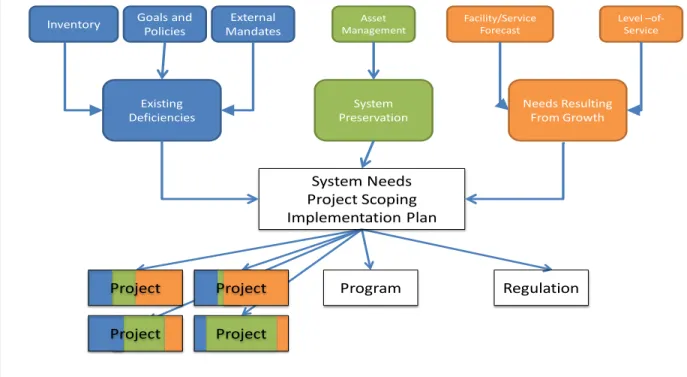
Forecasting future need sounds easy enough in concept. But what steps need to be included? This chapter considers the major components of estimating what the future need will be in order to be consistent with the Land Use Element and other chapters of the comprehensive plan.
Level –of-Service Facility/Service
Forecast
Inventory Goals and Policies MandatesExternal
Existing Deficiencies
Asset Management
System
Preservation Needs Resulting From Growth
System Needs Project Scoping Implementation Plan Project Project Project Project Program Regulation
With the full picture from the inventory, along with identification of needs through the planning horizon and an estimate of those costs, jurisdictions can then use information flowing from visioning, through planning to implementation, budgeting, and project development to evaluate success in providing capital facilities and
services over time. On an on-going basis the information can be used back through review and evaluation into visioning and the planning process.
WAC 365-916-415 (2)(b) recommends the following:
i. Counties and cities should forecast needs for capital facilities during the planning period, based on the levels of service or planning assumptions selected and consistent with the growth, densities and distribution of growth anticipated in the Land Use Element. The forecast should include reasonable assumptions about the effect of any identified system management or demand management
approaches to preserve capacity or avoid the need for new facilities. ii. The Capital Facilities Element should identify all capital facilities that
are planned to be provided within the planning period, including general location and capacity.
A. Counties and cities should identify those improvements that are
necessary to address existing deficiencies or to preserve the ability to maintain existing capacity.
B. Counties and cities should identify those improvements that are necessary for development.
C. Counties and cities may identify any other improvements desired to raise levels of services above locally adopted minimum
standards, to enhance the quality of life in the community or meet other community needs not related to growth such as administrative offices, courts or jail facilities. Counties and cities are not required to set level of service standards for facilities that are not necessary for development. Because these facilities are not necessary for development, the failure to fund these facilities as planned would not require a reassessment of the land use element if funding falls short as required by RCW
next chapter
previous chapter
Developing Demand Forecasts from the Land Use Element
A local government cannot determine what it will need in the future for public
facilities and services without knowing what levels of service (LOS) it has to meet.5 If
the existing plan includes adopted LOS standards, these standards should then be
applied to additional population and employment growth anticipated. If the existing
plan does not include adopted LOS standards, consult other sources, such as in functional plans. Ideally, the Capital Facilities Element defines capital facilities and services, identifies which ones are necessary to support development, and clearly states the adopted LOS or other planning assumptions for those necessary to support development.
Kitsap County’s Final Capital Facilities Plan Update6, dated August 2012, is a good
example of a county documenting its current inventory, its level of service capacity analysis, and its capital projects and funding. In the plan the county provides the analysis for public buildings, fire protection, law enforcement, parks and recreation, sanitary sewer, schools, solid waste, stormwater, transportation, and water. The plan forecasts revenues by source and identifies the assumptions used in the plan. To help set LOS standards and forecast need, consult resources from other agencies.
For example, the Washington State Department of Health has guidance related to Safe Drinking Water. These resources help identify any requirements of related potential funding sources. A careful review allows local governments to address applicable requirements in the planning work, potentially streamlining funding and construction work later.
Agencies with guidance or funding resources:
Department of Health – Drinking Water
Department of Ecology – Water, Water Quality, Wastewater Treatment,
Stormwater
Recreation and Conservation Office - Recreation and Conservation Office Public Works Board – Financial Assistance Options
Public Works Board – Technical Assistance Services
Community Economic Revitalization Board – CERB Core Programs Department of Commerce - Community Development Block Grant Developing and Using Levels of Service
Using an adopted LOS standard or other planning assumptions is the key to determining what improvements will be needed and ensuring that the level of
facilities and services the public expects will be provided and funded.
5 See Wilma et al v Stevens County, Case No. 06-1-0009c, FDO, page 23.
6 See http://www.kitsapgov.com/dcd/community_plan/comp_plan/cfp/final%20cfp/CFP%20Final.pdf