The Journal of Sri Krishna Research & Educational Consortium
ASIA PACIFIC JOURNAL OF RESEARCH
IN BUSINESS MANAGEMENT
Internationally Indexed & Listed Referred e -Journal
INVESTMENT TREND NOW & THEN:
A SURVEY BASED STUDY OF MORADABAD (U.P.)
SMITA SRIVASTAVA*; GUNJAN SAXENA**
*Lecturer, College of Management & Computer Application, Teerthanker Mahaveer University, Moradabad.
**Lecturer, College of Management & Computer Application, Teerthanker Mahaveer University, Moradabad.
ABSTRACT
Investment is the best way to multiply money. Getting into the investment without having the complete knowledge of all the available options and understanding own financial goal is like going for treasure hunt without any map and clues. However the financial needs & goals keep changing throughout the different phases of one’s life time. The paper attempts to know the awareness level of the investment alternatives available amongst the investors & compares the investment trend now from 20 years back. The area of the study is Moradabad, a city in Uttar Pradesh and the sample size is 150. The data used in the study comprises of both Primary & Secondary data. It is found in the survey that the investment decisions vary as per investor’s age, experience, profession, financial circumstances, family structure and other more factors. Most of the investors are risk averse & thus ignore risky investments like derivatives, equities & prefer safe heaven like bank deposits, post office deposits, gold, etc. There is very little enhancement in the awareness level for newer financial instruments amongst investors over the years.
KEYWORDS: Investment Alternatives, Investment Trends, Awareness Level.
______________________________________________________________________________
INTRODUCTION
goes hand in hand. The probability of getting higher return increases only when we take higher risk. Apart from this primary objective of maximum return with minimum risk, there are some subsidiary objectives of investment like liquidity, safety, hedge against investment, need of regular income & tax saving. Getting into the investment without having the complete knowledge of all the available options and understanding own financial goal is like going for a treasure hunt without any map and clues. However the financial needs & goals keep changing throughout the different phases of his life time. Thus the re-evaluation of asset allocation mix is the desired mantra to get the higher value of the invested money. This job can be enhanced by taking the help from professional advice and scientific risk profiler.
RISK & RETURN
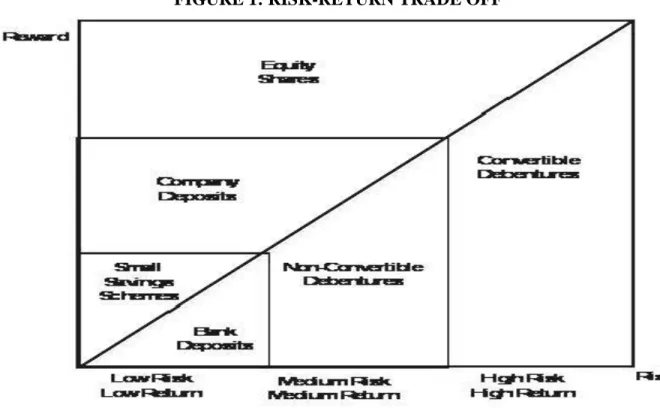
Return is actually the total income the investor receives during his holding period where as Risk is the deviation of actual return from expected return. Risk is related to the probability of actual return becoming less than the expected return. Sometimes risk is considered as interchangeable with uncertainty but in the true sense, both are different. The possible sets of outcomes & the probabilities of their occurrences are not known in uncertainty but it is known in the case of risk. The age, personality, personal experiences and current financial circumstances can make a person conservative or risk taker while taking investment decisions. If one plans to invest in securities, he needs to sacrifice his current consumption of the surplus in expectation of future return. The sacrifice which he makes today is certain but the return he will reap in the future is uncertain. Every investment opportunity carries some risks. Higher the risk, more the return is. This can be illustrated by below mentioned risk-return trade-off.
FIGURE 1: RISK-RETURN TRADE OFF
For better return, the investors must have thorough knowledge of different investment alternatives available in the market & how to built portfolio (combination of securities) that could meet their goals & objectives.
Portfolio must satisfy the need of the individual for which it has been made, keeping time horizon in mind. The purpose of investment may be buying a house, car, retirement plan etc. The portfolio must be constructed carefully & reviewed at a certain interval of time to check if there is any deviation in expected return. Corrective actions must be made thereafter. But when the objectives are very clear & portfolio is carefully selected, one must need to be consistent & stick to the plan especially in case of long term financial instruments. Investor‟s financial goal also changes over the years, so corrective actions need to be taken carefully while shuffling the securities.
INVESTMENT ALTERNATIVES
An educated investor generally keeps his investment portfolio diversified into different asset classes to minimize the investment risk. By doing so, he reduces the risk of losing money in case his preferred asset has underperformed. A well diversified portfolio selects those assets which are not correlated and thus the negative performance of some securities could be neutralized by the positive performance of other securities. Let‟s discuss the basic investment options available to an individual to grow his money & satisfy his financial requirements:-
SAFE INVESTMENT INSTRUMENTS: Government Bonds, Saving Account, Fixed Deposits / Certificate of Deposit, Bonds and Debentures, Public Provident Fund, Post Office Plans viz. NSC, KVP, MIS etc.
INVESTMENT INSTRUMENTS WITH MODERATE RISK: Gold, Real Estate, Company Deposits, Non-convertible debentures, Mutual Funds, Unit Linked Insurance Plans
INVESTMENT INSTRUMENTS WITH HIGH RISK: Company Shares & Derivatives, Convertible Debentures, Forex Trading
A) NEW PENSION SCHEME (NPS): Pension Plan is a basically a risk hedging tool for those risks which arise because of long survival or living too long at older age when income generation of an individual stops. NPS is the low cost investment plan which has been newly introduced by Government of India. There are two types of funds available:-
a) Tier 1:- No partial or full withdrawal is possible upto the age of 60 years.
b) Tier 2:- Partial or full withdrawal is possible any time during the term.
B) SAVING ACCOUNT: Keeping the money into saving account ensures liquidity & safety but neither gives good return (very low interest of 4%-5% p.a.), nor hedges against inflation. Interest amount earned on saving account is also taxable. Money available in saving account is safest till the bank goes bankrupt. Though in the case of bankruptcy, amount remains safe in every saving account of the scheduled commercial bank in India.
C) FIXED DEPOSIT / CERTIFICATE OF DEPOSIT: This is a safe & liquid investment tool but liquidity is lesser than the saving account. In the case of saving account, the investor remains in instant access of his money but here money may not be released instantly and takes 2-5 days. In case of premature encashment of money, the penalty would be charged by the bank and the offered interest rate may not be the same as the realized rate. Though, even the reduced rate remains higher than the saving account rate. Interest rate increases as the time period (starting from 15 days to several years) of deposit increases. Interest earned may be taxable or non-taxable, depending upon the period of the deposit.
Considering safety, the amount deposited is safe till the concerned bank goes bankrupt. Some banks provide safety of certain amount in FDs/ CDs in the case of bankruptcy but not by all the banks.
D) SHARES: Section 2(46) of the Company‟s Act 1956 defines a share as a part in the share
capital of the company. It is the unit of ownership of the investors in the company‟s capital. There are two major types of shares namely equity shares & preference shares. Shares provide pretty good return when money is invested for long term. Shares are quite volatile too. With the change in economic condition, flow of FIIs, inflation rate & other factors which have a bearing on the stock market, the price varies widely minute to minutes. Thus is a riskier option to go with. Although the capital gains tax may be levied on the investor depending upon his holding period & country‟s tax structure.
E) DERIVATIVES: Derivative is a financial instrument which derives its value from the value of an underlying asset viz. shares, foreign exchanges, commodities, stock index, etc. It indicates that it has no value of itself; its price varies with the variation in the prices of the underlying asset. Derivative is an innovative financial product used to hedge risk. It involves less or no money transaction at the time of signing the deal. While opting for it one must have enough technical skills to avoid heavy losses.
F) GOVERNMENT BONDS: These are considered as the safest investment as they are directly issued by Government bodies. Although the return is very less with some lock-in-period but still return is better than the saving account. Return may be taxable or non-taxable.
appropriate for small investors because real estate investment needs big buck to invest in. Buying and selling of real estate is a time consuming job as well. Thus liquidity oriented & small investors keep this tool out from their investment portfolio.
H) GOLD: It is a traditional, oldest and highly liquid investment asset but still glitters in the investment basket. During last few years of global depression and economic slowdown, when all the asset classes failed to perform, even real estate underperformed, gold has remained upbeat not only in Indian market but also in the global economy. Increased money supply may induce hyper inflation in the economy and cause currency devaluation. Gold value has inverse relationship with US dollar. Thus, keeping the past performance in mind, Gold can be considered as the strongest hedging asset against the dollar and inflation. In a well diversified portfolio, the assets should not be correlated to one another; Gold has a very low correlation with other asset classes like equity, debt or others and thus a safe heaven for investors. Hence, considering demand-supply balance and ignoring interim volatility in gold, this would prove its lusture when put in a diversified portfolio.
I) PUBLIC PROVIDENT FUND (PPF): It is a long term debt instrument with the sovereign guarantee of Government of India of assured tax free return of 8% (current rate) per annum. The return earned is usually higher than the return being provided by the Banks on FDs. The minimum investment amount is Rs 500 and maximum amount is Rs. 70,000 per annum. The investment made in the PPF account is eligible for tax deduction u/s 80C and the interest earned on it is also tax free. The PPF account can be opened in Post Office, SBI branches and in some other nationalized banks. But this instrument is not at all useful for those investors whose motive is liquidity & time horizon is short. In case of PPF, full withdrawal is possible only after the completion of 15 years. Even the partial withdrawal is possible only after the end of 5 year. Hence, for a high tax payer, looking for guaranteed return and ready to sacrifice the liquidity aspect, PPF can shine in his portfolio basket.
J) POST OFFICE SAVINGS SCHEMES (POSS): The Postal Department offers its financial services through Post Office Savings Bank on behalf of Ministry of Finance, Government of India and is the oldest in the country. Department of Posts offers this service through more than 1,54,000 post offices across the country. There are several investment plans being offered by department of post like NSC (National Savings Certificate), KVP (Kisan Vikas Patra), MIS (Monthly Income Scheme) Recurring Deposit Schemes, Time Deposit Schemes, Public Provident Fund Schemes, Monthly Income Schemes and various others. All these plans are backed with government guarantee for fixed return which is normally higher than the Bank FDs rate. It also needs low investment amount. Investment amount limit (minimum & maximum), interest rate, tenure and tax benefit varies with different plans. So, investors can select the plan as per their specific requirement. The retired person who has regular income need, monthly income plan can be a good investment option for his portfolio.
It is such an option in which even an uneducated investor, with very less corpus, can invest and get smarter return of equity market, debt market, money market, commodities, equity index, etc. The collective corpus of investors gets managed by professional Fund Manager who has through knowledge of financial market and better knows from where to divest & where to invest in. MFs are highly liquid. Open-ended MFs can be bought & sold any time from the Asset Management Company itself whereas all the close-ended MFs are stock enlisted. The money invested in MF Plan can become eligible for tax deduction u/s 80C, if one has invested in the ELSS (Equity Linked Saving Schemes) plan with the lock-in-period of 3 years.
L) LIFE INSURANCE PLANS: Most of the investors consider Life insurance policies as a sole investment option whereas it is the risk hedging tool which arises because of premature death. The traditional as well as ULIP plans carry lots of charges viz. mortality charge, fund management charge, fund administration charge, fund allocation charge, fund switching charge etc. Thus it becomes very costly & reduces the net return. Buying Pure Term Plan (cheapest insurance plan), which covers the death risk without any survival benefit, can be a wise decision to satisfy one‟s insurance need. Almost all the insurance schemes have the lock-in period of 3 years & if the plan is surrendered before maturity, the heavy penalty is levied by the insurance companies. Depending upon one‟s financial responsibilities & age, one needs to be rightly insured. Tax benefits are also available u/s 80C, 80D & 10(10D). This asset must be carefully selected for the portfolio and only up to the amount which satisfies the insurance cover risk.
RESEARCH METHODOLOGY
The study undertaken with the prime objective of judging the change in the personal investment portfolio trend now i.e. in the year 2011 in comparison to the trend twenty years back. The research paper is analytical in nature as it analyses changes in the awareness level for the investment alternatives available amongst the people over a period of time. The sample area of the study is Moradabad, a city in Uttar Pradesh. The sample size selected for the study was of 150 investors considering the convenience sampling. The data used in the study comprises of both Primary & Secondary data. The primary data was collected with the help of a structured questionnaire while various books, websites, newspapers & magazines were used to collect the secondary data. It was analyzed using charts & percentage method. The time period used to carry out this study is three months i.e. from May 2011 to July 2011.
OBJECTIVE OF THE STUDY
The objectives of the study are as follows:
1. To know the recent investment pattern of the investors at Moradabad.
2. To find out the awareness level of the investment alternatives available amongst the investors.
ANALYSIS & INTERPRETATION
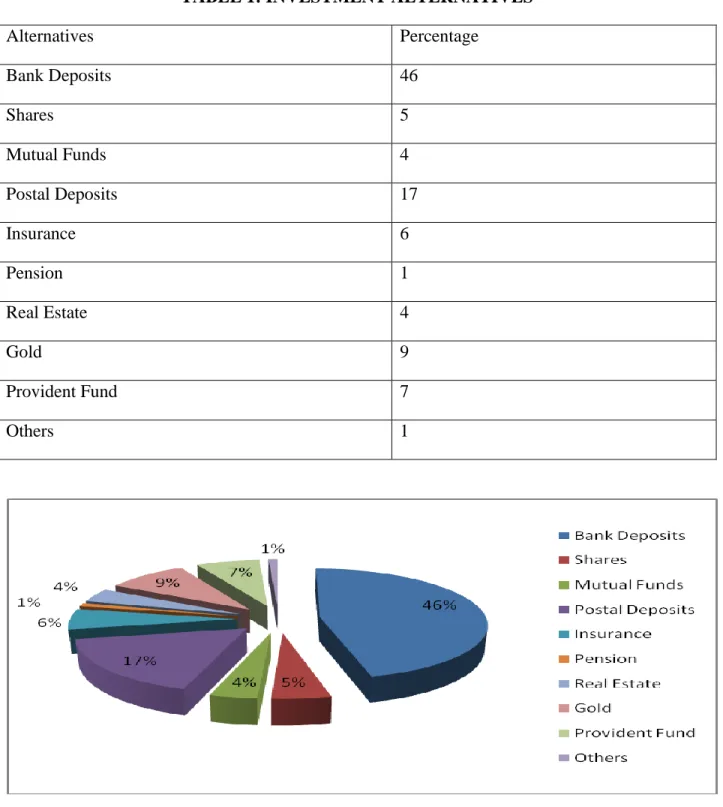
Q2. Where do you invest most of your investment?
TABLE 1: INVESTMENT ALTERNATIVES
Alternatives Percentage
Bank Deposits 46
Shares 5
Mutual Funds 4
Postal Deposits 17
Insurance 6
Pension 1
Real Estate 4
Gold 9
Provident Fund 7
Others 1
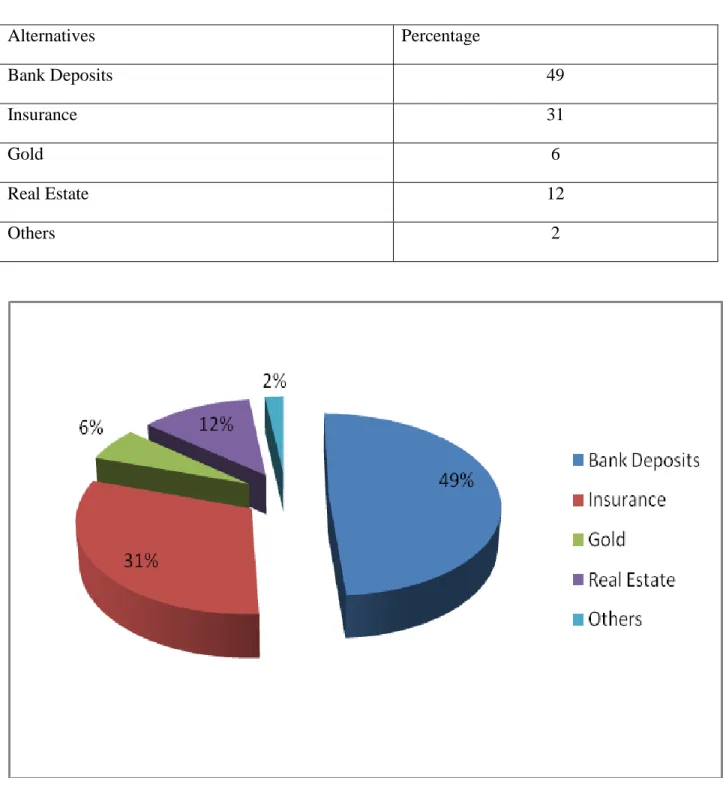
Q3. What was the major investment option in the portfolio 20 years back either made by you or any of your family members?
TABLE 2: INVESTMENT OPTION PREFERENCE 20 YEARS BACK
Majority respondents went for Bank Deposits as the major investment tool while next major group of 31% respondents answered Insurance.
Alternatives Percentage
Bank Deposits 49
Insurance 31
Gold 6
Real Estate 12
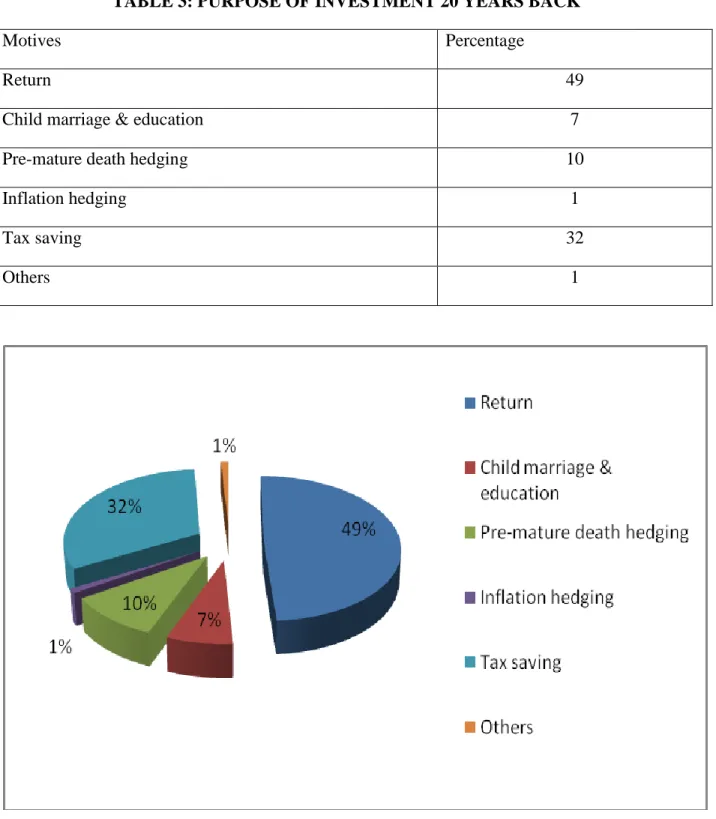
Q4. What was the purpose of your investment 20 years back either made by you or any of your family members?
TABLE 3: PURPOSE OF INVESTMENT 20 YEARS BACK
Motives Percentage
Return 49
Child marriage & education 7
Pre-mature death hedging 10
Inflation hedging 1
Tax saving 32
Others 1
Q5. Do you feel that the motive of investment has been changed over the years? If yes, in which context:
TABLE 4: CHANGED MOTIVE OF INVESTMENT
Motives Percentage
Safety/ security 13
Return 35
Liquidity 24
Tax saving 21
Child education & marriage 7
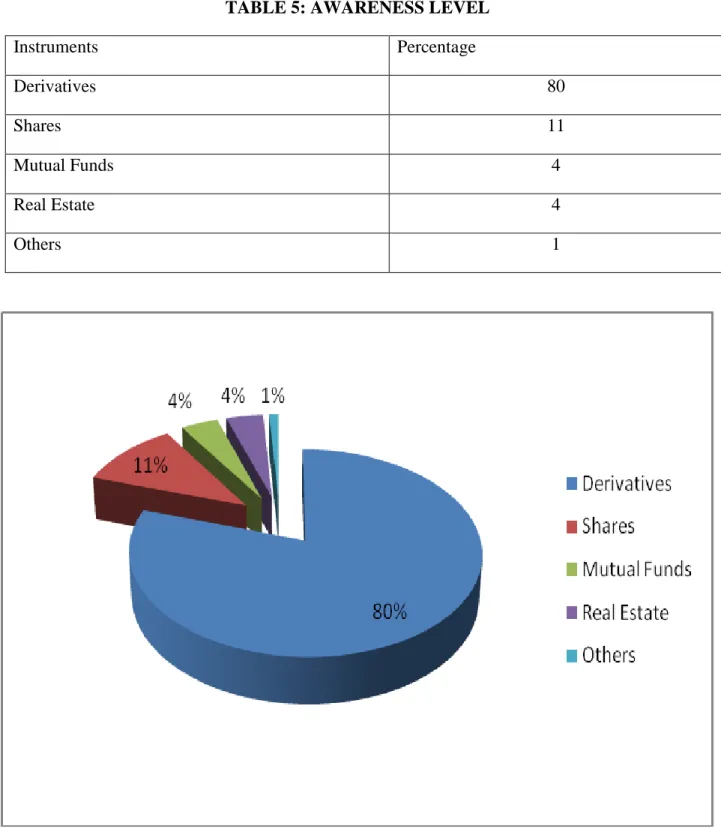
Q6. The technical know how you are not aware of & so cannot invest in that instrument?
TABLE 5: AWARENESS LEVEL
Instruments Percentage
Derivatives 80
Shares 11
Mutual Funds 4
Real Estate 4
Others 1
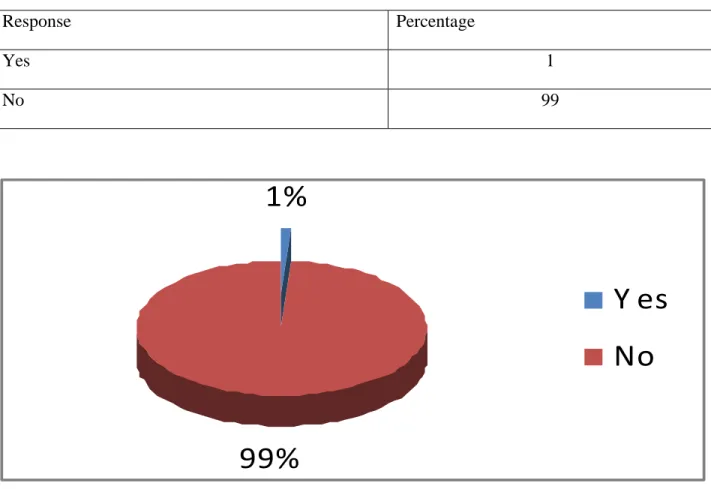
Q6.1. Was the awareness level same 20 years back?
TABLE 6: AWARENESS LEVEL 20 YEARS BACK
Response Percentage
Yes 1
No 99
1%
99%
Y es
No
Almost all the respondents agreed that the awareness level was different 20 years back. The technical knowledge of investment was less as responded by 99% of the respondents.
Q7. When the market is volatile, which you think is the best investment option?
TABLE 7: PREFERENCE DURING VOLATILITY
Alternative Percentage
Gold 33
Bank Deposits 54
Mutual Funds 11
Derivatives 1
54% of the respondents selected bank deposits as the best investment option in case of market volatility while 33% prefers gold.
Q8. Was the market volatility, a criterion of investment 20 years back?
TABLE 8: CRITERION OF INVESTMENT
Response Percentage
Yes 11
No 89
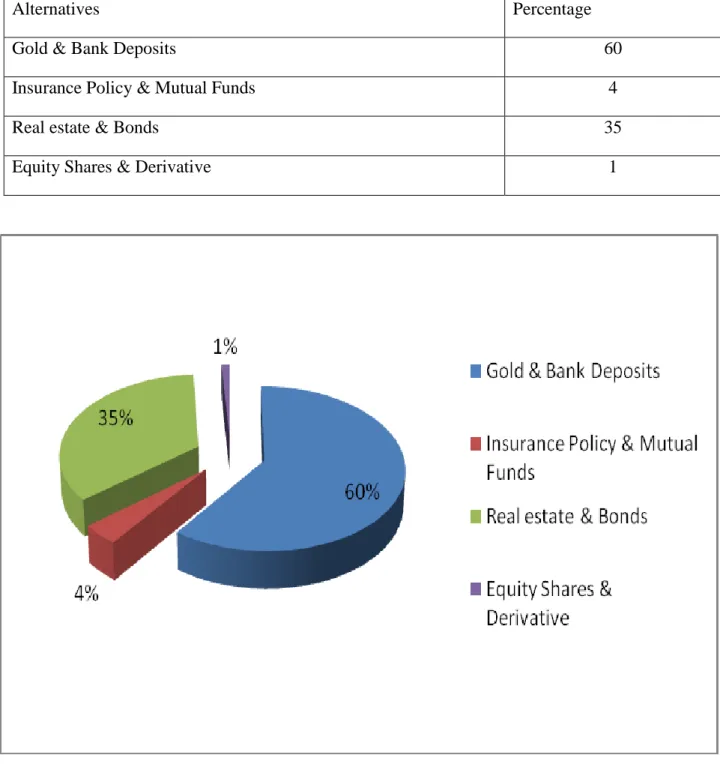
Q9. In your opinion, which one is the best combination from safety view point in today‟s scenario?
TABLE 9: COMBINATION FROM SAFETY VIEW POINT
Alternatives Percentage
Gold & Bank Deposits 60
Insurance Policy & Mutual Funds 4
Real estate & Bonds 35
Equity Shares & Derivative 1
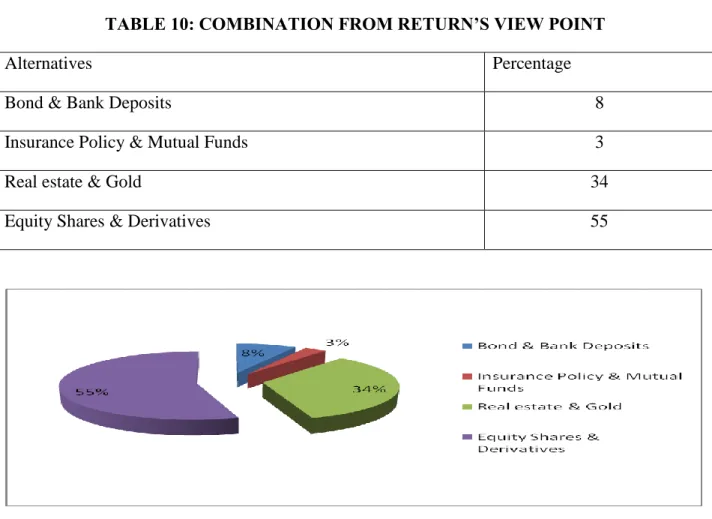
Q10. In your opinion, which one is the best combination from return’s view point?
TABLE 10: COMBINATION FROM RETURN’S VIEW POINT
Alternatives Percentage
Bond & Bank Deposits 8
Insurance Policy & Mutual Funds 3
Real estate & Gold 34
Equity Shares & Derivatives 55
The above response interprets that Equity & Derivatives is the most lucrative investment option as it is selected by the major respondents of 55%. Real Estate & Gold is the second most desirable investment option from return view point.
Q11. In your opinion, which one is the best combination from liquidity view point?
TABLE 11: COMBINATION FROM LIQUIDITY VIEW POINT
Alternatives Percentage
Saving A/c & Bank Deposits 80
Gold & Mutual Funds 9
Real estate & Insurance Policy 2
Majority the respondents, 80%, accepted that Saving A/c & Bank Deposits is the most liquid investment option.
Q12. What is the basis of your investment portfolio selection?
TABLE 12: BASIS FOR PORTFOLIO SELECTION
Basis Percentages
Friend & family advice 70
Professional advice from registered investment advisor 6
Self assessment 20
In the said survey at Moradabad, Friend & family advice is still the most reliable criterion of investment portfolio selection, as answered by 70% of the respondents. 20% creates the portfolio on the self assessment basis using their technical skill & experience.
Q12.1. Was the criteria same 20 years back for portfolio selection?
TABLE 13: CRITERIA FOR PORTFOLIO SELECTION 20 YEARS BACK
Response Percentage
Yes 86
No 14
86%
14%
Y es
No
FINDINGS
The data collected from the survey done at Moradabad city, indicates the following:
1. Most of the investors prefer bank deposits & postal deposits in comparison to any other investment alternatives available where bank deposits & insurance policies were the major investment alternatives 20 years back.
2. It is found that „return‟ has remained the predominant investment motive for the last 20 years. Though the motive has been shifted a bit towards the liquidity & safety factor.
3. The data reveals that Moradabad based investors still do not trade in derivatives. They are not technically sound in derivative & shares trading. Very surprisingly the collected data reveals that the awareness level is still almost the same as it was 20 years back.
4. Most of the Moradabad based investors are risk averse & thus ignores risky investments. They prefer bank deposits & gold to be in their investment nest during volatile market. As people have less technical knowledge today & 20 years back their preference had never been riskier instruments, like equity shares & derivatives. Thus, market volatility factor did not affect them in selecting their personal investment portfolio.
5. People accept gold, bank deposit, real estate & bonds as the safest investment option while equity shares, derivatives, gold & real estate as the best option for maximizing return. Therefore, it is concluded that gold & real estate are being preferred by return & safety seekers both.
6. When liquidity was discussed, majority of the respondents went for saving accounts & bank deposits as money deposited here is readily and easily available to the investors.
7. The criterion for portfolio selection has not been changed over the years. Majority of the people are still dependent on friend & family advice for their personal investment portfolio creation.
CONCLUDING REMARKS
The present study compares and analyses the present and past attitude of investors towards investment alternative selection at Moradabad city. It is found in the survey that the investment decisions vary as per investor‟s age, experience, profession, financial circumstances & family structure. People who are not technically savvy, hesitate investing in technical tools like derivatives, equities & prefer traditional tools like bank deposits, post office deposits, gold, etc. There is very little enhancement in the awareness level for newer financial products amongst investors of smaller cities like Moradabad.
investment. Professionally educated investors take their investment decision more rationally by analyzing professional advice from registered investment advisor. They park their fund in less but fixed & steady return based instrument when market is volatile and keep their money safe. In the up swinging market, they take advantage by investing in more risk more return based instruments like equities, derivatives, mutual funds, etc. However the number of these investors is very less. To achieve the true investment goal, the masses should be professionally educated to optimize the desired outcome. People with 45 years & above age group normally select fixed return based instruments & invest either on self assessment basis or rely heavily on friend & family advice. Lower age group people are less attracted towards fixed return and thus go for equity shares & Mutual Funds. Tax saving motive of investment dominates at higher age group for salaried people. Most obvious reason seems to be the higher income slab at older age & thus more income tax liability for them.
LIMITATIONS OF STUDY
The study is limited to a city of Western Uttar Pradesh only. The area of survey could be extended to other cities, states and to the country as well.
SUGGESTIONS
The primary data collected through the survey revealed that majority of the investors hesitate in newer & technical financial instruments. The reason behind is their own ignorance and lack of professional help available to make them understand these products. Thus the financial institutions located in this area should come forward and help educating the investors by their team of well groomed and trained professionals. The marketing strategy of them should also focus on “selling after educating” rather mere “selling”.
The investors should also take initiative to learn and get expertise by taking the professional advice and keep themselves updated about the different rules framed by the concerned regulatory authorities. They should know how and when the investment portfolio should be reviewed and reframed. The right decision can result in higher value of invested amount where wrong decision can end up in losing the wholesome of it.
SCOPE FOR FURTHER RESEARCH
The focus area of survey is only the investors where as the marketing strategies of local financial institutions could also be covered to know the gap of less awareness about the technical know how of newer financial products.
REFERENCES
1. Pandian, P., Security Analysis and Portfolio Management, Vikas Publication, pp. 1-14
2. <http://www.moneymanagementideas.com/investment-options.html>
4. <http://www.investopedia.com>
5. <http://www.rediff.com/money/2008/jun/24bspec.htm>
6. <http://www.vakilno1.com/bareacts/companiesact/s2.htm>
APPENDIX
Questionnaire: Investment Trend now & then: A Survey Based Study of Moradabad (U.P.)
Q1. Personal Details:
Name: _____________________________
Age group: below 35 years 35-45 years 45-55 years above 55 years
Profession: Salaried Businessmen Professional Retired Others
Gender: Male Female
Family Structure Nuclear Family Joint Family
Education Graduation PG Professional Education Others
Q2. Where do you invest most of your investment? (Rank them)
Bank Deposits Shares Mutual Funds Postal Deposits
Insurance Pension Real Estate Gold
Provident Fund Others
Q3. What was the major investment option in the portfolio 20 years back either made by you or any of your family members: (Rank them)
Bank Deposit Insurance Gold Real Estate Others
Q4. What was the purpose of your investment 20 years back either made by you or any of your family members?
Return Child marriage & education Pre-mature death hedging
Q5. Do you feel that the motive of investment has been changed over the years? If yes, in which context:
Safety/ security Return Liquidity Tax saving Child education & marriage
Q6. The technical know how you are not aware of & so can not invest in that instrument?
Derivatives Shares Mutual Funds Real Estate Others
Q6.1 Was the awareness level same 20 years back? Yes No
Q7. When the market is volatile, which you think is the best investment option?
Gold Bank Deposits Mutual Funds Derivatives Others
Q8. Was the market volatility, a criterion of investment 20 years back? Yes No
Q9. In your opinion, which one is the best combination from safety view point?
Gold & Bank Deposits Insurance Policy & Mutual Funds
Real estate & Bonds Equity Shares & Derivative
Q10. In your opinion, which one is the best combination from return view point?
Bonds & Bank Deposits Insurance Policy & Mutual Funds
Real estate & Gold Equity Shares & Derivatives
Q11. In your opinion, which one is the best combination liquidity from view point?
Saving Account & Bank Deposits Gold & Mutual Funds
Q12. What is the basis of your investment portfolio selection?
Friend & family advice Self assessment
Professional advice from registered investment advisor Others