Critical temperature for the two-dimensional attractive Hubbard model
Thereza Paiva,1Raimundo R. dos Santos,1R. T. Scalettar,2and P. J. H. Denteneer3 1
Instituto de Fı´sica, Universidade Federal do Rio de Janeiro, Caixa Postal 68.528, 21945-970 Rio de Janeiro, Rio de Janeiro, Brazil 2Department of Physics, University of California, Davis, California 95616-8677, USA
3Instituut-Lorentz, Leiden University, P.O. Box 9506, 2300 RA Leiden, The Netherlands
共Received 26 August 2003; revised manuscript received 19 February 2004; published 3 May 2004兲 The critical temperature for the attractive Hubbard model on a square lattice is determined from the analysis of two independent quantities, the helicity modulussand the pairing correlation function Ps. These quantities
have been calculated through quantum Monte Carlo simulations for lattices up to 18⫻18, and for several densities, in the intermediate-coupling regime. Imposing the universal-jump condition for an accurately calcu-lateds, together with thorough finite-size scaling analyses共in the spirit of the phenomenological renormal-ization group兲of Ps, suggests that Tcis considerably higher than hitherto assumed.
DOI: 10.1103/PhysRevB.69.184501 PACS number共s兲: 74.20.⫺z, 71.10.Pm, 74.25.Dw, 74.78.⫺w
The attractive Hubbard model1,2 has been successfully used to elucidate a number of important and fundamental issues in both conventional and high-temperature 共cuprate兲 superconductivity. The nature of the crossover between BCS superconductivity共at weak coupling, or small on-site attrac-tion兲and Bose-Einstein condensation of tightly bound pairs
共strong coupling兲 has been shown to be smooth.3,4The ap-pearance of preformed pairs within a certain range of param-eters in the normal phase, especially below a characteristic temperature, has been related to pseudogap behavior of high-temperature superconductors.5,6 Further, this model allows one to introduce disorder on the fermionic degrees of freedom7,8 and investigate the behavior near the quantum critical point of the two-dimensional insulator-superconductor transition; this provides an alternative to the dirty-boson picture9 to discuss the universal conductivity.10 The attractive Hubbard model with a periodic modulation of
U has been used to interpret superconductivity in layered
structures.11
A basic concern has run through many of these calcula-tions, in particular, those based on quantum Monte Carlo
共QMC兲simulations. In two dimensions, there is a consensus that the early QMC phase diagram12,13—in the space of criti-cal temperature Tc, electronic density
具
n典
, and magnitude of the on-site attraction兩U兩—is qualitatively correct. However, some serious quantitative discrepancies have emerged over the years, pointing towards higher critical temperatures; see, e.g., the Bogoliubov-Hartree-Fock 共BHF兲 approach of Ref. 14. Our purpose here is to examine the dependence of Tc with具
n典
, for fixed U, by resorting to a much wider共namely, larger system sizes and several electronic densities兲 set of QMC data, together with alternative procedures to locate the critical temperature. Establishing an accurate value for this most fundamental property of the model is important, espe-cially as the physics of variants of the attractive Hubbard Hamiltonian is explored, and comparisons are made to the original system.The model is defined by the Hamiltonian
H⫽⫺t
兺
具i,j典, 共
ci†cj⫹H.c.兲⫺
兺
i 共
ni↑⫹ni↓兲⫺兩U兩
⫻
兺
i
冉
ni↑⫺1
2
冊冉
ni↓⫺ 12
冊
, 共1兲where ci (ci
†) destroys共creates兲an electron with spin on site i of a square lattice,
具
i,j典
denotes nearest-neighbor sites,ni⬅ci†ci, 兩U兩is the strength of the attractive interaction, and is the chemical potential. From now on, all energies are expressed in units of the hopping amplitude t and we also set kB⫽1.
At half filling 共which corresponds to the particle-hole symmetric point, ⫽0), the degeneracy of charge-density wave 共CDW兲and singlet superconducting 共SS兲 correlations leads to a three-component order parameter;15 the transition temperature is therefore suppressed to zero. Away from half filling, CDW correlations are suppressed and a finite-temperature Kosterlitz-Thouless 共KT兲 transition16 into a SS phase takes place;13,17 this phase has only algebraically de-caying correlations for 0⬍T⭐Tc. Further, close to half fill-ing an exact mappfill-ing onto the two-dimensional Heisenberg antiferromagnetic model in a magnetic field leads to12,13Tc
⯝⫺2J/ln兩1⫺
具
n典
兩, so that Tcrises sharply from zero as one dopes away from具
n典
⫽1.We start by employing the analysis of Ref. 13 to new data for the SS pairing correlation function,
Ps⫽
具
⌬†⌬⫹⌬⌬†典
共2兲with
⌬†⫽ 1
冑
N兺
ici†↑ci†↓. 共3兲
For 0⬍T⭐Tc, one expects
⌫共r兲⬅
具
ci†↑ci†↓cj↓cj↑⫹H.c.典
⬃r⫺(T), 共4兲where r⬅兩i⫺j兩, and (T) increases monotonically between (0)⫽0 and(Tc)⫽1/4.16,18
The finite-size scaling behavior of Ps is therefore ob-tained upon integration of⌫(r) over a two-dimensional sys-tem of linear dimension L. One then has13
Ps⫽L2⫺(Tc)f共L/兲, LⰇ1,T→Tc⫹ 共5兲
with
⬃exp
冋
A共T⫺Tc兲1/2
册
; 共6兲
in the thermodynamic limit, one recovers Ps⬃7/4. For com-pleteness, one should mention that since→0 as T→0, the system displays long-range order in the ground state, so that a ‘‘spin-wave scaling’’ is expected to hold,19
Ps
L2⫽兩⌬0兩
2⫹C
L, 共7兲
where ⌬0 is the superconducting gap function at zero tem-perature, and C is a兩U兩-dependent constant.
Similarly to Ref. 13, here we use the determinant QMC algorithm20 to calculate Ps. Typically our data have been obtained after 500 warming-up steps followed by 50 000 sweeps through the lattice. The discretized imaginary-time interval20 was set to ⌬⫽0.125, which is small enough for the results not to depend on this choice in any significant way.
In Fig. 1 we show raw data for Psas a function of (1/T), for fixed density,
具
n典
⫽0.5 and U⫽⫺4, and for different lattice sizes. The crossover between temperature- and size-limited regimes is described by finite-size scaling 共FSS兲 theory21and appears as a leveling off of Psbelow a certain temperature for each system size. Before a more quantitative scaling analysis, we can already see a suggestion that Tc is around 1/6 from the raw Psdata. In general, at temperatures for which correlations are short ranged, a structure factor likePsis independent of lattice size. As T is decreased, the point at which the structure factor begins growing with lattice size signals the temperature at which the correlation length is becoming large共comparable to the lattice size L), thus pro-viding a crude estimate of Tc. The subsequent plateau at low temperatures occurs when ⰇL. This crossover is
contem-plated by the FSS form, Eq. 共5兲, which can be invoked to determine Tc by plotting L⫺7/4P
s as a function of of w
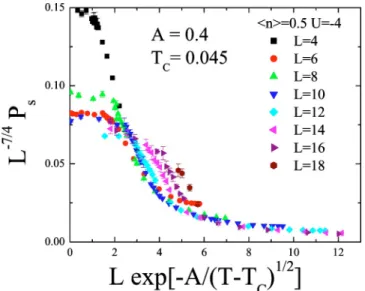
⬅L exp关⫺A/(T⫺Tc)1/2兴, at a given U, for different system sizes, with Tcand A being adjusted to give the best possible data collapse, as done in Ref. 13. Figure 2 shows the result-ing scalresult-ing plot, in which the values A⫽0.4 and Tc⫽0.045 were determined in Ref. 13. With our substantially increased amount of data points it becomes clear that the data collapse onto a single curve with the parameters A and Tcof Ref. 13 becomes rather unsatisfactory. We furthermore note that Eq.
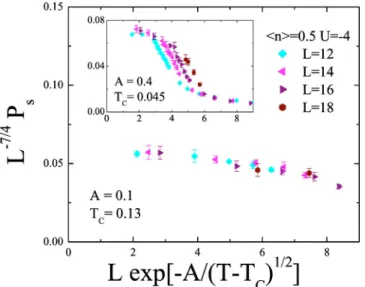
共6兲 is expected to hold only for tⱗ10⫺2 关t⬅(T⫺Tc)/Tc兴, see, e.g., Ref. 22. For the value of Tcused in Fig. 2, only few data obtained for L⫽4,6,8,10 in Ref. 13 satisfy this criterion. We therefore obtain new values of A and Tc from our expanded data set. We disregard the data from the smallest system sizes, L⫽4 共which, additionally, has a special topol-ogy, being equivalent to a 2⫻2⫻2⫻2 four-dimensional lat-tice兲, L⫽6, L⫽8, and also L⫽10; as we will see below, the SS pairing correlation function presents large finite size ef-fects for these lattice sizes. Furthermore, we only include data points for temperatures T for which Eq.共6兲is expected to hold 共see above兲. Figure 3 clearly shows that, for the larger latices, our newly determined parameters A⫽0.1 and critical temperature Tc⫽0.13 render a much better data col-lapse than the old parameters.
The present analysis shows that the estimates of Tc ob-tained in Ref. 13 can be quantitatively quite unreliable. In our opinion, this is due to the fact that the finite-size behav-ior of Ps, Eqs.共5兲and共6兲, follows from an analysis which is valid only for large enough lattice sizes, since it involves the binding-unbinding of rather large structures 共vortices兲in the KT transition.16Moreover, the parameters A and Tcthat have to be found via data fitting both reside in an exponent, re-sulting in large uncertainties for the individual fitted param-eters. Although the lattice sizes used in the present study may not be large enough to determine Tcwith high accuracy, our result is bound to be an improvement and in any case indi-cates that the actual Tcmay be much larger共by even a factor of 3兲than believed so far.
FIG. 1. 共Color online兲 Ps as a function of ⬅1/T for 具n典
⫽0.5 and different lattice sizes L.
FIG. 2. 共Color online兲 Rescaled Ps as a function of w ⬅Lexp关⫺A/(T⫺Tc)1/2兴 for 具n典⫽0.5 and different lattice sizes L.
The values for A and Tc are the ones determined in Ref. 13.
This tendency towards higher critical temperatures ap-pears as well in a completely independent analysis, based on the behavior of the helicity modulus 共HM兲. The latter is a measure of the response of the system in the ordered phase to a ‘‘twist’’ of the order parameter,23 and can be expressed in terms of the current-current correlation functions as follows.24
s⫽
Ds
4e2⫽
1 4关⌳
L⫺⌳T兴, 共8兲
where Ds is the superfluid weight, and
⌳L⬅ lim qx→0
⌳xx共qx,qy⫽0,n⫽0兲 共9兲
and
⌳T⬅ lim qy→0
⌳xx共qx⫽0,qy,n⫽0兲 共10兲
are, respectively, the limiting longitudinal and transverse re-sponses, with
⌳xx共qជ,n兲⫽
兺
ᐉ
ជ
冕
0
deiqជ•ᐉជein⌳
xx共ᐉជ,兲, 共11兲 wheren⫽2nT,
⌳xx共ᐉជ,兲⫽
具
jx共ᐉជ,兲jx共0,0兲典
, 共12兲 wherejx共ᐉជ,兲⫽eH
冋
it兺
共cᐉជ⫹xˆ,
†
cᐉជ,⫺cᐉជ, †
cᐉជ⫹xˆ,兲
册
e⫺H共13兲 is the x component of the current density operator; see Ref. 24 for details.
At the KT transition, the following universal-jump rela-tion involving the helicity modulus holds:25
Tc⫽
2s
⫺, 共14兲
wheres⫺is the value of the helicity modulus just below the critical temperature. Thus we can obtain Tc by plotting s(T), and looking for the intercept with 2T/. This proce-dure has been used before, with s calculated within a BHF approximation;14,26 since transverse current-current correla-tions were neglected,sis likely to have been overestimated, and the ensuing Tc’s may have been too high. Here we cal-culate both ⌳L and ⌳T by QMC simulations to obtain s through Eq.共8兲; a typical example ofs(T), for
具
n典
⫽0.5, is shown in Fig. 4. We see that finite-size effects are not too drastic, since all curves cross the straight line within a small range of temperatures; that is, from Fig. 4 we can estimateTc⫽0.14⫾0.02.
In order to check the robustness of this method, we can extract Tc from Ps through a ‘‘phenomenological renormal-ization group’’共PRG兲 共Refs. 27 and 28兲 analysis, provided some subtleties peculiar to the KT transition are kept in mind. Since→⬁ for all T⬍Tc, Eq.共5兲implies that curves for L⫺7/4Ps(L,), when plotted as functions of , and for different L, should all merge for⬎c. Figure 5 shows that this characteristic feature only sets in for the largest system sizes, namely, L⭓12, from which we can infer c⫽7.5
⫾0.25; these error bars are somewhat arbitrary, and result from visual inspection. It should be stressed that this esti-mate for c agrees remarkably well with the one obtained from the helicity modulus, indicating the robustness of both procedures to extract Tc. Interestingly, we should notice that the curves for L⫽6 and 8 cross each other共as in an ordinary second-order transition兲at⯝7, which is very close to c estimated from the larger systems. Therefore, within the con-text of PRG, for the smallest sizes a KT transition appears as an ordinary transition, only crossing over to the merging fea-ture for the largest sizes.
FIG. 3. 共Color online兲Same as Fig. 2, but with A and Tc
deter-mined from the present data. Inset shows same system sizes, with A and Tcfrom Ref. 13.
FIG. 4. 共Color online兲Helicity modulus as a function of tem-perature for具n典⫽0.5 and different lattice sizes L. The straight line corresponds to 2T/.
The critical temperature has been estimated for other elec-tronic densities,
具
n典
⫽0.1 共HM and PRG兲, 0.3 共PRG兲, 0.7共PRG兲, and 0.875共HM and PRG兲; all PRG plots display the crossing and merging tendency observed for
具
n典
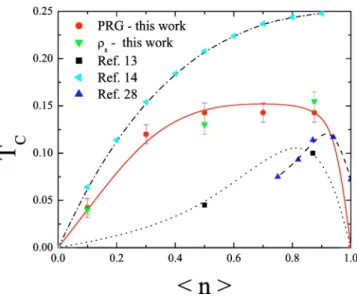
⫽0.5. The resulting phase diagram is shown in Fig. 6; for comparison, we also plot the early QMC results,13the parquet data from Luo and Bickers,29 and the estimates from the BHF approximation.14 While close to half filling all results 共but BHF兲are in fair agreement, for larger dopings agreement is only found between the results from PRG and those from the helicity modulus. The inescapable conclusion is that the criti-cal temperature for the superconducting transition in the at-tractive Hubbard model is actually higher than previously assumed.In summary, we have established very reliable estimates for the critical temperature of the square-lattice attractive
Hubbard model. This is done by finding quantitative agree-ment between entirely different procedures to extract Tc from two independent correlation functions 共both computed by determinant QMC兲. As a result, the critical temperature is found to be substantially higher than the currently accepted values, also obtained using QMC, but with a different data analysis; as expected, they are also substantially lower than estimates obtained within a Hartree-Fock/mean-field ap-proximation.
The authors are grateful to S. de Queiroz and A. Moreo for discussions. T.P. and R.R.dS. acknowledge partial finan-cial support by Brazilian Agencies FAPERJ, CNPq, Instituto do Mileˆnio para Nanocieˆncias/MCT, and Rede Nacional de Nanocieˆncias/CNPq; R.T.S. acknowledges support by NSF-DMR-0312261. This research was further supported by a joint CNPq-690006/02-0/NSF-INT-0203837 grant.
1
R. Micnas, J. Ranninger, and S. Robaszkiewicz, Rev. Mod. Phys.
62, 113共1990兲.
2J.A. Wilson, J. Phys.: Condens. Matter 13, R945共2001兲. 3A.J. Leggett, in Modern Trends in the Theory of Condensed
Mat-ter, edited by A. Pekalski and J. Przystawa 共Springer, Berlin, 1980兲.
4M. Randeria, in Proceedings of the International School of Phys-ics ‘‘Enrico Fermi,’’ edited by G. Iadonisi, J.R. Schrieffer, and M. Chiofalo共IOS Press, Amsterdam, 1998兲.
5M. Randeria, N. Trivedi, A. Moreo, and R.T. Scalettar, Phys. Rev. Lett. 69, 2001共1992兲.
6R.R. dos Santos, Phys. Rev. B 50, 635共1994兲.
7G. Litak, K.I. Wysokiski, R. Micnas, and S. Robaszkiewicz, Physica C 199, 191共1992兲.
8R.T. Scalettar, N. Trivedi, and C. Huscroft, Phys. Rev. B 59, 4364
共1999兲.
9M.P.A. Fisher, G. Grinstein, and S.M. Girvin, Phys. Rev. Lett. 64,
587共1990兲.
10S.-Y. Hsu, J.A. Chervenak, and J.M. Valles, Jr., Phys. Rev. Lett.
75, 132共1995兲.
11T. Paiva, M. El Massalami, and R.R. dos Santos, J. Phys.: Con-dens. Matter 15, 7917共2003兲.
12R.T. Scalettar, E.Y. Loh, Jr., J.E. Gubernatis, A. Moreo, S.R. White, D.J. Scalapino, R.L. Sugar, and E. Dagotto, Phys. Rev. Lett. 62, 1407共1989兲.
13A. Moreo and D.J. Scalapino, Phys. Rev. Lett. 66, 946共1991兲. 14P.J.H. Denteneer, G. An, and J.M.J. van Leeuwen, Europhys. Lett.
16, 5共1991兲; Phys. Rev. B 47, 6256共1993兲. 15H. Shiba, Prog. Theor. Phys. 48, 2171共1972兲.
16J.M. Kosterlitz and D.J. Thouless, J. Phys. C 6, 1181共1973兲. 17
F.F. Assaad, W. Hanke, and D.J. Scalapino, Phys. Rev. B 49, 4327
共1994兲.
18B. Berche, A. Farinas Sanchez, and R. Paredes, Europhys. Lett.
60, 539共2002兲. FIG. 5. 共Color online兲Logarithm-linear plot for the rescaled Ps
as a function of , for具n典⫽0.5 and for different lattice sizes L, symbols are the same as in Fig. 2. The inset shows a blowup of the region centered about⫽7. No parameters are adjusted.
FIG. 6.共Color online兲Critical temperature as a function of band filling, obtained by different methods. All lines through data points are guides to the eye.
19D.A. Huse, Phys. Rev. B 37, 2380共1988兲.
20R. Blankenbecler, R.L. Sugar, and D.J. Scalapino, Phys. Rev. D
24, 2278 共1981兲; S.R. White, D.J. Scalapino, R.L. Sugar, E.Y. Loh, Jr., J.E. Gubernatis, and R.T. Scalettar, Phys. Rev. B 40, 506共1989兲; R.R. dos Santos, Braz. J. Phys. 33, 36共2003兲. 21J.L. Cardy, Current Physics—Sources and Comments 共
North-Holland, Amsterdam, 1988兲, Vol. 2.
22R. Gupta and C.F. Baillie, Phys. Rev. B 45, 2883共1992兲. 23M.E. Fisher, M.N. Barber, and D. Jasnow, Phys. Rev. A 8, 1111
共1973兲.
24D.J. Scalapino, S.R. White, and S.C. Zhang, Phys. Rev. Lett. 68, 2830共1992兲; Phys. Rev. B 47, 7995共1993兲.
25
D.R. Nelson and J.M. Kosterlitz, Phys. Rev. Lett. 39, 1201
共1977兲.
26P.J.H. Denteneer, Phys. Rev. B 49, 6364共1994兲. 27M.P. Nightingale, J. Appl. Phys. 53, 7927共1982兲.
28R.R. dos Santos and L. Sneddon, Phys. Rev. B 23, 3541共1981兲. 29J. Luo and N.E. Bickers, Phys. Rev. B 48, 15 983共1993兲.