Open Access
Research
Attitudes and doping: a structural equation analysis of the
relationship between athletes' attitudes, sport orientation and
doping behaviour
Andrea Petróczi
Address: Kingston University, School of Life Sciences, Penrhyn Road, Kingston upon Thames, Surrey, UK, KT1 2EE
Email: Andrea Petróczi - [email protected]
Abstract
Background: For effective deterrence methods, individual, systemic and situational factors that make an athlete or athlete group more susceptible to doping than others should be fully investigated. Traditional behavioural models assume that the behaviour in question is the ultimate end. However, growing evidence suggests that in doping situations, the doping behaviour is not the end but a means to an end, which is gaining competitive advantage. Therefore, models of doping should include and anti-doping policies should consider attitudes or orientations toward the specific target end, in addition to the attitude toward the 'tool' itself.
Objectives: The aim of this study was to empirically test doping related dispositions and attitudes of competitive athletes with the view of informing anti-doping policy developments and deterrence methods. To this end, the paper focused on the individual element of the drug availability – athlete's personality – situation triangle.
Methods: Data were collected by questionnaires containing a battery of psychological tests among competitive US male college athletes (n = 199). Outcome measures included sport orientation (win and goal orientation and competitiveness), doping attitude, beliefs and self-reported past or current use of doping. A structural equation model was developed based on the strength of relationships between these outcome measures.
Results: Whilst the doping model showed satisfactory fit, the results suggested that athletes' win and goal orientation and competitiveness do not play a statistically significant role in doping behaviour, but win orientation has an effect on doping attitude. The SEM analysis provided empirical evidence that sport orientation and doping behaviour is not directly related.
Conclusion: The considerable proportion of doping behaviour unexplained by the model suggests that other factors play an influential role in athletes' decisions regarding prohibited methods. Future research, followed by policy development, should incorporate these factors to capture the complexity of the doping phenomenon and to identify points for effective anti-doping interventions. Sport governing bodies and anti-doping organisations need to recognise that using performance enhancements may be more of a rational, outcome optimizing behaviour than deviance and consider offering acceptable alternative performance-enhancing methods to doping.
Published: 9 November 2007
Substance Abuse Treatment, Prevention, and Policy 2007, 2:34 doi:10.1186/1747-597X-2-34
Received: 13 August 2007 Accepted: 9 November 2007
This article is available from: http://www.substanceabusepolicy.com/content/2/1/34
© 2007 Petróczi; licensee BioMed Central Ltd.
Background
The fight against doping is a challenging task. Owing to the complexity of the doping phenomenon, simultaneous consideration of physiological, medical, pharmacologi-cal, psychologipharmacologi-cal, ethical and systemic factors [1] is required in order to be successful in this endeavour. The need for effective deterrence policy is underscored by the fact that the problem of performance enhancements has spread beyond the elite athlete population. It is well doc-umented that groups other than competitive athletes are at risk of using doping agents, especially steroids [2-5]. Furthermore, medical enhancement of non-sport per-formance (i.e. quality of life, appearance) appears to be widely acceptable among non-athlete population [6-8].
For this this paper, the term 'doping' is used as the employment of prohibited means to enhance perform-ance, with the intention to gain competitive advantage over the opponent. This definition incorporates the key elements of the previously used definitions, such as artifi-cial stimulation [9] and intention to gain advantage [10], and it is also congruent with the current official definition [11]. Doping may be done by taking prohibited (banned) performance enhancing drugs (PEDs) or using banned methods. Using agents to mask the presence of PEDs, physical manipulation and tampering with the test sam-ples, non-therapeutic gene manipulation resulting in enhanced sport performance and non-cooperation of an athlete are also considered doping. The list of prohibited substances is published by the World Anti-Doping Agency (WADA) and updated yearly [11]. The WADA operates a Therapeutic Use Exemption scheme to allow athletes to take prohibited substances if they have an illness or med-ical condition that requires medication otherwise on the Prohibited List. Using supplements that are not on the Prohibited List does not constitute doping even if they have a performance enhancing effect (e.g. caffeine, creat-ine, protein).
Recreational drugs (also called social drugs) are psychoac-tive drugs used for recreational purposes rather than for work, medical or spiritual purpose, although some recre-ational drugs (e.g. marijuana, hasish, heroin, ampheta-mine, ephedrine) are on the List of Prohibited Substances if they the concentration in urine exceeds a specified level and/or were taken during competition.
The doping phenomenon
Despite the fact that doping is not a new phenomenon in sport, enhancing performance through artificial means has only been banned since the 1960s. Doping as a poten-tial danger to the modern Olympic movement was recog-nized in the '50s and officially acknowledged ten years later by the creation of a list of banned substances. After an agonizing period over athletes' amateur status,
per-formance enhancing drugs have taken over as the major basis for tension and concern within the Olympic move-ment since 1972 [12]. Researchers seem to agree that dop-ing is unwelcome in sport. However, opinions are divided between doping being a serious deviance one must fight against and doping as undesirable but unavoidable conse-quence of the institutionalized sport. Notably, the reason behind banning doping initially was the growing concern about athletes' health [13]. Doping only became estab-lished as unethical after that point.
Doping incidents infesting high prestige sport events such as the 1998 Tour de France, which was dubbed as the 'Tour of Shame' [14] or the 2004 Athens Olympic Games with a sudden double number of positive cases [15]; and the reaction to them (i.e. establishing national anti-dop-ing agencies) indicate that these events may only be the tip of the iceberg. Whilst the adverse analytical findings (positive results) in tests conducted by the World Anti Doping Agency (WADA) remain low around 2% [16], other occassions have revealed an elevated level of sub-stance use. For example, the presence of some kind of drug or supplement was evidenced in 45% of the athletes who participated and were tested in the Tour de France 2000 [17]. However, the problem seems to be rooted more deeply. The litereature supports the assumption that the consideration of and actual use of doping starts well before the athlete reaches his/her best career years as the prevalence of doping, particularly the use of anabolic ster-oids, is well documented among adolescents [18-21] and even among pre-adolescent athletes where a steady increase in doping use was observed over the period of four years from age 11 to 15 [22].
The seriousness of the problem is reflected by the recent increase in organised effort to combat doping in sport. The first step toward a globalised effort was the creation of the Anti-Doping Code of the World Anti-Doping Agency (WADA) in 1999 as an organisational level response to the Festina Scandal at the Tour de France [14], parallel to the European Union's (EU) pledged support in the fight against doping. The first report (known as the HARDOP report) was commissioned in 1998 and published in 1999, followed by targeted research projects under the
EU's Competitive and Sustainable Growth run under 5th
Doping prevention
Historically, the anti-doping movement has been based on detection and prevention, with the initial emphasis on detection. Organisational structures and standard operat-ing procedures have been in place to ensure compliance with the anti-doping regulations [25]. Detection relies on testing, which has been increasingly problematic in high performance sport. Haugen [26] argued persuasively that making testing effective as a deterrence method, either the volume of tests conducted or the sanctions imposed have to be increased significantly, potentially to the level that is practically not feasible. The new technologies in both the development of undetectable methods and the detection of the new methods have led to rapidly escalating costs [27], bearing in mind that tests are currently not even available for all banned substances and methods. If the trend continues, costs of effective testing will soon became a prohibiting factor.
Athletes, as they progess in their sports career, are gradu-ally drawn into the vicious circle of the constant desire to enhance performance. In this process, some athletes may become more susceptible to doping than others, depend-ing on the combination of their personality and the situa-tion. Therefore, both the individual and systemic factors contributing to doping behaviour should be fully investi-gated in order to underpin effective, targeted anti-doping intervention.
In support of the argument against detection from a psy-chological perspective, Strelan and Boeckmann [28] pro-vided empirical evidence for the failure of detection based deterrence showing that in a hypothetical situation, ath-letes first consider their moral beliefs, followed by the fear of negative health consequences and legal sanctions asso-ciated with the use performance-enhancing drugs. The effect of the threat of legal sanctions practically dimin-ished when moral beliefs and health concerns were added to the behavioural model, directing policy makers to alter-native deterrence methods. Additionally, many speculate that with gene doping on the horizon of competitve sport, detection based regulation will soon be seriously under-mined [29-33].
The WADA and national sport governing bodies have added preventive measures to their detection programs. Examples for anti-doping prevention include: WADA's
Athlete Outreach Program (launched in 2001) targeting top
performing athletes at major sporting events, the
Anti-Doping Development Program (started in 2004), which aims to help countries and organizations to set up quality
dop-ing control, and the Educational Programme, which is a
major tool of the WADA in an attempt to create a doping free culture by providing education to all stakeholders about the dangers of doping and its consequences.
Congruently, the 100% me programme of UK Sport aims
to promote positive attitudes and values of those who suc-cessfully competed drug-free and to provide accurate and
relevant information on anti-doping. The 100% me is an
educational program with three distinct but related strands. Outreach programme provides a framework for delivering accurate information and giving advice on anti-doping issues to athletes, athlete support personnel, and parents across the UK via sports events, workshops, train-ing sessions and conferences. The accreditation pro-gramme allows interested individuals to gain knowledge
in anti-doping and became a '100% me' tutor. The 100%
me is also a 'brand' promoting the image of the 'clean ath-letes' based on values of personal responsibility, choices, fairness and honesty. This image is linked to the Ambassa-dor programme where successful drug-free athletes
com-mitted to anti-doping use the 100% me platform to
promote drug-free sport among their fellow athlete The
Education Model Guidelines (EMG) are in place to help National Governing Bodies (NGBs) develop their own
programmes using the 100% me framework.
The UK model is one of the existing anti-doping national programmes. In the US, the U.S. Anti-Doping Agency (USADA) is responsible for similar testing and education programmes, and in place to eliminate conflict of interest of NGBs testing and sanctioning their own athletes. The Australian Sports Anti Doping Authority (ASADA) has
also launched a comprehensive the ASADA Education
Serv-ice Charter in 2007. The Charter places an emphasis on developing athletes' and support personnels' understand-ing of the physical and psychological risks of dopunderstand-ing to ensure that athletes and support personnel are aware of their rights and responsibilities.
Whether it is a realistic goal or not, effective deterrence is hindered as long as doping behaviour is poorly under-stood. Before any serious consideration is given to deter-rence methods, factors that make an athlete or athlete group more inclined to doping than others must be fully investigated. The WADA has only just started to channel funds to social science doping research to develop better understanding and consequently, more effective deter-rence programs. Aiming to add to the body of knowledge on one possible cause of doping behaviour (i.e. individ-ual dispositions and attitudes) is congruent with the cur-rent priorities of the WADA Social Science Research Programme [35].
Explaining the doping behaviour
Both the eminent literature and the official global sport organisational stance suggest that athletes' attitudes are responsible for the deviant behaviour of doping [36-38]. Being overly competitive or exceedingly win-orientated is often used as a lay explanation for doping. Although gen-der, cultural and competitive level differences among ath-letes have been scrutinized since the late '80s [39,40] the relationship between these factors and doping behaviour has not been empirically tested, except in one project. In the study by Lucidi et al. [41] the classic Theory of Planned Behaviour (TPB) model [42] provided a theoretical frame-work for a study among Italian adolescents, where atti-tude was found to be the strongest predictor for behavioural intention. The TPB model held across differ-ent levels of sport involvemdiffer-ent and gender.
Recently, alternative theoretical models of doping have been developed [43,44] attempting to explain the com-plex nature of doping. The models are based on existing general models from either health science or criminology but their application to the doping situation has not been empirically validated. The first among the few, Donovan
and colleagues [43] used the Health Belief Model to
develop a theoretical drug control model. Although it was not explicitly stated, the model also incorporates some kind of economic rationality when it considers the bal-ance between deterrence and incentives and availability and affordability of performance enhancing substances. According to the model, athletes' doping behaviour is the ultimate function of this cost/benefit ratio, personality and morality, legitimacy of sanctioning organisation, social context (reference group) and attitude toward dop-ing.
The Drugs in Sport Deterrence Model by Strelan and Boeck-mann [44] also considered costs and benefits but used these concepts in a broader sense. Their model is based on
Deterrence Theory used in criminology [45] and costs and benefits include material and social consequences, as well as individual effects, such as health concerns, guilt or even
satisfaction from sport achievement. Situational factors (i.e. prevalence perception, professional status, type of drug, experience with testing, etc.) were also thought to have an effect on the final decision regarding doping use.
The common element of all three models [41,43,44] is that subjective norms play a seemingly important role in doping behaviour. As it is evidenced in a recent, WADA Social Science research funded extensive literature review [46], published research into doping attitude is domi-nantly descriptive and with a few exceptions, it falls short on theoretical underpinning or on establishing causal relationships between attitudes and behaviour. The major achievement of the existing doping models is that they draw attention to the complexity of the doping problem. Many of them touched upon attitudes and many other perhaps important factors contribution to doping but their claims have not been supported with empirical evi-dence.
Therefore, the intention of this study was to to fill this gap and to explore the relationship between doping behav-iour and sport achievement orientation by expanding the traditional one-step attitude – behaviour models (e.g. The-ory of Reasoned Action, TheThe-ory of Planned Behaviour) and col-lecting and analyzing data regarding athletes' sport achievement orientation, doping orientation and behav-iour. The traditional one-step behavioural models [42,47] assume that the behaviour in question is the ultimate end and considers antecedents, such as beliefs, attitudes, sub-jective norms and perceived behavioural control regard-ing the particular behaviour. Research into athletes' motivation and reasons for doping use reveal an impor-tant factor that has been prominent in game theory mod-els [26] but overlooked in the existing doping behaviour models [43,44]: that doping behaviour is not the ultimate end but rather a means to an end [10,48,49]. It can be argued whether the ultimate end is winning or achieving a specific sport related goal (i.e. breaking a record); and it may vary from athlete to athlete. Nevertheless, if doping is a tool to achieve an end-goal, then models of doping should include attitudes or orientations toward the spe-cific target end, in addition to attitudes toward the 'tool' itself.
Aims
In consideration of the structural model of doping, the existing literature, more specifically the Theory of Reasoned Action (TRA) [47], the Theory of Planned Behaviour (TPB)
[42], previous structural equation models of attitude and behaviour [51-53] and previous doping models
[40,42,43,54,55] were consulted. The Theory of Reasoned
Action [47] established a linear sequence of cognition (beliefs), affects (attitude), conation (behavioural inten-tion) and behaviour. Later, the model has been criticized for the underlying and unrealistic assumption of absolute behavioural control, hence perceived behavioural control was added and the model expanded into the TPB [42]. Models have been empirically tested and refined by show-ing interaction between the predictors [53] and by ques-tioning the generality of the model [52]. An earlier model of Bentler & Speckart [51] suggests an important notion, namely multiple factors influencing the behaviour. The notion of multiple factors is, of course, not new. In 1977, Ajzen and Fishbein [56] already mentioned multiple-act criterion, where attitudes toward a target (i.e. doping in general) is linked with observed heterogeneous behav-iours (i.e. supporting the anti-doping movement but using doping at the same time). Influencing factors can be learned experiences (past behaviour), perceived control, personality, cost/benefit ratio and most importantly: goals. Bentler and Speckart [51] focused on past behav-iour (in general) whereas new doping models consider personality, availability, free choice of actions [43] and situational factors as well as perceived control over behav-iour and free choice [44]. Curiously, a situation where multiple attitudes are influencing a single behaviour has not been considered in doping attitude-behaviour mode-ling. If doping behaviour is considered as a means to an end, attitude toward the end point should be taken into account. Support for this assumption can be found in the literature for at least 2 decades.
English [48] suggests that doping may be used to achieve one or more of many goals, including reaching unattaina-ble goals, breaking off the plateau, or even to signal group membership; or mark transition from being recreational to professional athlete. Contrary to Lüschen's argument [10] that the crucial element of doping is the intent to gain unfair advantage at the expense of other competitors, ath-letes do not necessarily see using doping as unfair or advantageous. Doping may be employed as a useful tool to improve performance to the level that is, or perceived to be necessary to have a reasonable chance for winning [49]. When athletes assume that their competitors follow the same logic, the motivation for doping use is often reduced to the desire to level the playing field and ensure equal chances. These rational decisions regarding doping behaviour could easily be against the general attitude toward doping, which is suppressed by other, stronger
driving forces such as the desire to win, goal orientation or competitiveness.
Therefore the aim of this paper is to test a model that embrace the two constucts presumed to be related to win-ning. The present investigation makes an attempt to pro-vide empirical evidence regarding the interconnection of sport orientation, doping attitude, and behaviour. It is not the intention to test an existing doping model or to apply a general attitude-behaviour model to doping situation, but to draw attention to the complexity of the influencing factors in doping behaviour by addressing the missing segment and focusing on a popular lay explanation of ath-letes' doping behaviour by treating doping behaviour as a means to an end (winning), hence considering elements of the sport achievement orientation as integral parts of the doping behaviour model. To this end, athletes' sport ori-entation and attitude toward doping were quantified, measured by scales, and statistically analysed. Sport orien-tation and doping orienorien-tation are thought to be hypothet-ical constructs, which cannot be observed or measured directly. Thus, using statistical techniques that are able to represent dependency between hypothetical constructs (latent variables) was preferred. From the array of availa-ble statistical techniques, structural equation modeling (SEM) was selected with the main advantage being its applicability to multivariate data where measurements are not expected to be error-free.
Methods
In order to investigate the relationship between individual attitudes and behaviour, empirical data were collected via paper and pencil questionnaire from 199 US male college athletes. Athletes' sport orientation and attitude toward
doping were quantified and measured using the
model. Consequently, the model was also tested at the single indicator measurement scale level. The metric for each factor was set by fixing the factor loading for the first item to 1.0.
The proposed models were tested using the maximum likelihood (ML) method in AMOS 5.0. Although the ML method assumes normally distributed data measured on continuous scales, much social science and behavioural research uses ML because of its robustness. As alternative methods are less robust and require very large samples [58], ML methods appeared to be the most suitable for the present study. As a reassurance, the overall model fit sta-tistic was checked against its boostrap equivalent and
indicated by the Bollen-Stine p value [59]. The model's
overall fit was examined using chi-square statistics along with the root mean squared error of approximation (RMSEA) and its 90% confidence interval, as well as the
standardized root mean square residual (SRMR)
follow-ing Boomsma [60]. As recommended by Hoyle and Panter [61], the Tucker-Lewis index (TLI), which is rela-tively independent of sample size and Bentler's
compara-tive fit index (CFI) was also used and reported. All
statistical analyses in this study, including SEM, were per-formed using raw data.
Concerning sample size, there is no clear rule regarding how many subjects are required, yet recommendations [62,63] are fairly consistent about the following: 1) sam-ple sizes under 100 require at least two indicators for every latent variable, 2) sample sizes between 150 and 200 are more desirable, and 3) researchers should try to have at least 5 subjects for every estimable parameter. Thus, a
sample size around 150 was planned with two or three indicators for each construct, allowing up to 30 parame-ters.
Participants
Because attitude is not thought to be constant across dif-ferent populations, the sample was drawn from approxi-mately the same population. One hundred and ninety nine male athletes from the US participated in the study. Data from a single-gender sample were collected in order to reduce the within sample variability. Literature prece-dence suggests that there is a difference in attitude and use of drugs between males and females, males being more likely to endorse using performance enhancing substances [46].
Athletes were approached via their coaches. Participation was voluntary and athletes were assured of complete ano-nymity. Athletes were informed about the purpose of the study and were made aware that their answers will be used in an aggregated form for research. The survey packets were distributed and collected in individually sealed enve-lopes by either the athletic directors or coaches in a prac-tice setting. The researchers did not have direct contact with the athletes as the collected surveys were returned to the researchers by mail.
Participants were predominantly from the National Colle-giate Athletic Association (NCAA) upper divisions (nDivI = 78, nDivII = 116, nDivIII = 5) and 8 collegiate sports: base-ball, basketbase-ball, footbase-ball, golf, ice hockey, soccer,
swim-ming and track and field. The mean age was 20.20 (SD =
2.15) and the mean number of years in the sport career was 8.77 (SD = 4.68). Information relating to the weekly training hours was not collected. Being a student athlete under the NCAA Bylaw, the allowable training hours are limited to 20 hrs per week during academic season, although anecdotally in some sports (i.e. American foot-ball) the 20-hour limit is regularly exceeded. As the sam-ple was recruited from predominantly the upper divisions, it can be assumed that athletes in the sample trained at least 20 hours per week.
The proportion of missing values remained under 10% and appeared to be due to randomly missed items in scales. Cases with missing values were deleted from the data set, resulting in 174 complete cases being used for model fitting. Questions regarding past and present dop-ing behaviour were more problematic with a high propor-tion (49–50%) of denied answers. Assuming a medium
effect size (Cohen's d = 0.3 – 0.5), the minimum
recom-mended sample size for most statistical analysis at a 0.05 significance level, and power of 0.7 ranges between 59 and 139 [64-66]. For the purpose of this study, an effect size smaller than 0.3 was considered trivial, thus it was not The scale-level model of doping
Figure 1
the researchers' intention to find differences with ES approximately 0.5. Therefore, the final number of
partici-pants (N = 174) was sufficient (minimum 5 participants
per variable, as recommended by Bentler and Chou, cited in Schumacker & Lomax [67]) for calculating internal con-sistencies, correlation coefficients, comparison, and struc-tural analysis.
Measures
The survey packet contained the Performance Enhancement
Attitude Scale (PEAS, [54], the Sport Orientation Question-naire [50], Doping Use Belief (DUB) statements, ques-tions regarding past experience and current use of doping, brief definitions of terminology (i.e. performance enhanc-ing drugs and methods), a cover letter explainenhanc-ing the pur-pose of the study, and a specially marked envelope for the completed surveys to ensure complete anonymity. To ensure that none of the instruments were seriously con-founded by socially desirable responding, the Social Desir-ability Scale [68] was also administered.
The PEAS is a measure of general doping attitudes. Dop-ing attitude is defined as an individual's predisposition toward the use of banned performance enhancing sub-stances and methods. The PEAS consists of 17 attitude statements measured on a six point Likert-type scale rang-ing from strongly disagree (1) to strongly agree (6). No neutral middle point was offered and all 17 items were scored in the same direction (see Appendix). There was evidence from previous use that the scale is unidimen-sional and reliable, with Cronbach alpha values above .70 [54,55]. The internal consistency of the scale for the
present sample (Cronbach α = .83) was above the
custom-ary cutoff value.
Doping Use Belief measures (DUB) were operationally defined as expressions of presumed opinion regarding doping use, namely whether doping should be allowed for top and all level athletes (2 separate questions). Partic-ipants were asked to select one of the three responses: 'yes, without restrictions', 'yes, with restrictions' and 'abso-lutely not' (Appendix). Internal consistency of the belief
measure for this sample was .94. The Doping behaviour
latent variable was defined by two self-reported measures of doping behaviour: current use of and past experience with performance enhancing substances.
The Sport Orientation Questionnaire (SOQ) is a multidi-mensional, sport specific measure of individual differ-ences in sport achievement orientation. The questionnaire contains 25 items that uniquely relate to one of three independent factors: (a) competitiveness, (b) winning, and (c) goals. Competitiveness is defined as "the desire to enter and strive for success in sport competition" p.200 [50]. The desire to win in a sport situation is a sport
spe-cific measure and not related to general individual achievement orientation. Goal orientation reflects an ori-entation to personal standards, regardless of the situation. Of the total 25 items, the competitiveness subscale con-sists of 13 items, whereas the winning orientation and goal orientation subscales contain 6 items each. Respond-ents are asked to indicate how they usually feel about sport and competition on a five-point Likert scale that ranges from strongly agree to strongly disagree. The inter-nal consistency coefficients for the three subscales are reported as follows: competitiveness subscale 0.94, win orientation subscale 0.86, and goal orientation subscale 0.80 [50]. In the present study, the observed internal
con-sistencies of the SOQ were excellent: Competitiveness (α
= .98), Win orientation (α = .93) and Goal orientation (α = .96). Reliability of the Social Desirability (SD) scale was less than desirable (KR-21 = .64), although KR-21 values are known to produce conservative estimates. Due to the nature of responses (Y/N where there is no correct or incorrect answer), using the more general but more
con-servative reliability measure KR-21 is the appropriate
approach. Weak but statistically significant correlation
was only found between SD and PEAS (r = -.220, p <
.001).
Results
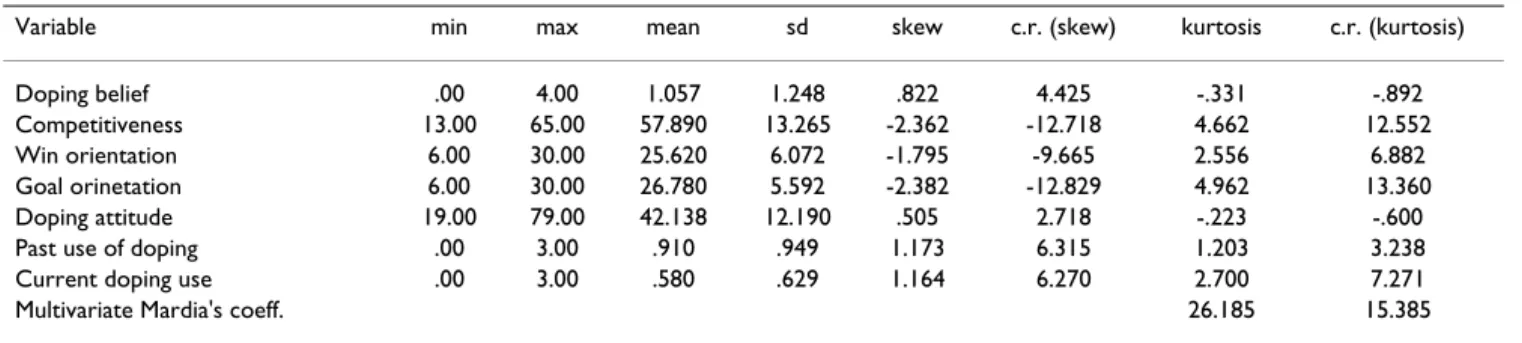
Cases were subject to both univariate and multivariate screening. Measures of goal orientation, win orientation and competitiveness were negatively skewed whilst self reported doping behaviour measures were positively skewed. PEAS and SD scores were normally distributed (Table 1).
Due to the multivariate non-normality of the data, the overall model fit was also tested using the Bollen-Stine corrected p-value, which indicates the probability of the perfect fit of the proposed model to the population; thus it is interpreted the same way as the p-value belongs to the
chi-square statistic. As recommended by Byrne [62] and Kline [69], 500 bootstrapped samples were used to gener-ate parameter estimgener-ates, standard errors of parameter esti-mates, and significance tests for individual parameters.
Descriptive statistics
additional 9 (4.5%) claimed to have used substances clas-sified as doping for medical reasons. The same figures for current use of performance enhancing substances were lower: 5 (2.5%) and 1 (0.5%), respectively.
Item level analysis
Due to the difference in measurement scales, the first analysis was done at the item level. The model was
recur-sive with df = 977. Standardized regression weights are
displayed in Table 2.
Items defining sport orientation subscales had very high regression weight often close to 1.00. The correlations between sport orientation measures were very strong and positive; correlation coefficients for win orientation, goal orientation and competitiveness were above .93 for all pairs. Modification Indices suggested specifying relation-ships among items within and between the scales, which suggest multicollinearity and having standardized regres-sion weights above 1.00 and rs > .85 indicate the same. Very high correlations among the items; and individual items and their factor are especially present in the Sport Orientation Questionnaire.
Overall, the item level model showed poor fit. Whilst some goodness of fit indices (e.g. χ2 = 2091.9, df = 977, p
= .880, χ2/df = 2.141 using the ML chi-square test as
sug-gested by Marsh, Hau and Wen [70] met the conventional cut off criteria for goodness of fit indices (TLI = .855; CFI
= .863) fell short of the more stringent criteria proposed
by Hu and Bentler [71]. SRMR = .0797; RMSEA(90CI) =
.081(.076, .086) were higher than the conventional stand-ards of .08 and .06, respectively. Bootstrapped Bollen-Stine p value = .010 led to the same conclusion.
Measurement level model
Summated scales may not have the multicollinearity problem caused by individual items being very similar. Thus, the same model of doping was tested with summed scale values. Moreover, using sum scores instead of indi-vidual item values helped to overcome the problem of cat-egorical variables. Summed scores from psychological
tests with items measured on at least a 5-point scale are generally treated as continuous variables [62].
The measurement level hypothesized model of doping is depicted in Figure 1. The hypothesized model of doping was recursive. Correlation coefficients among the meas-ured variables are shown in Table 3. Goodness of fit statis-tics were statistically non-significant at the .01 level but the model should be rejected at the .05 level (χ2 = 16.74, df = 7, p = .02, χ2/df = 2.39). However, the relative chi
square was under the recommended 3:1 range ([69]) indi-cating acceptable fit. Other fit indices (TLI = .966; CFI =
.989; SRMR = .096; RMSEA(90CI) = .090(.039, .146))
also demonstrated a good model fit, even if the more stringent criteria of Hu and Bentler [71] are applied. Hoel-ter's critical N values suggest that the model would have been accepted at the .05 significance level with 146 cases and the upper limit of N for the .01 significance level is 191. No Modification Index was above the customary cut-off value of 4.00. Because the data violated the normality assumption, bootstrapped chi-square values were also cal-culated and of the 500 random samples, the model in 488 bootstrap samples fit better and only 12 fit worse or failed.
The Bollen-Stine p = .026 provided further reassurance
about the model fit.
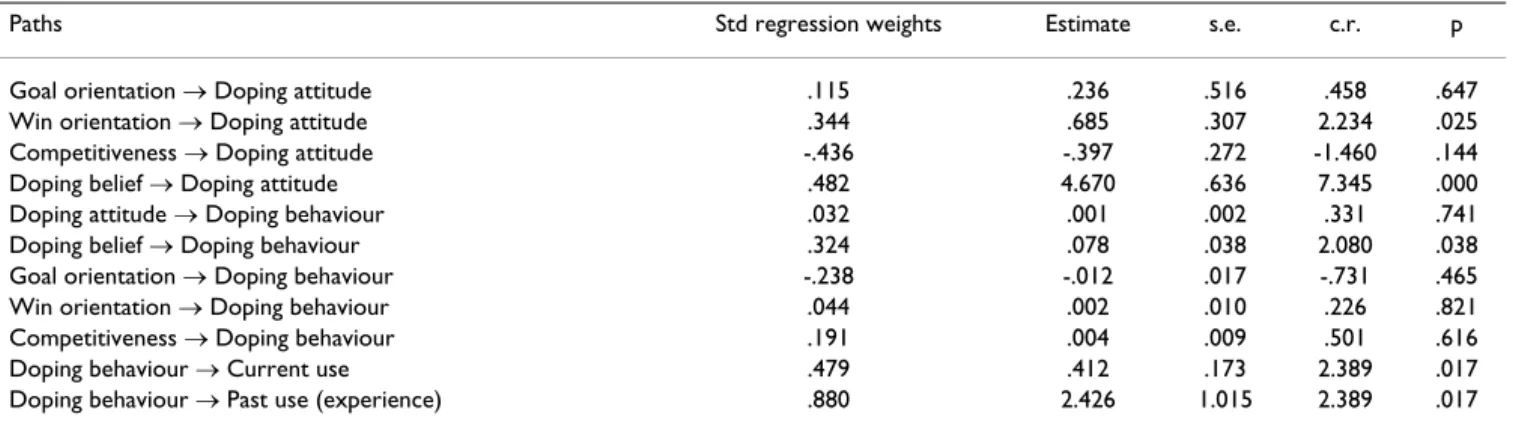
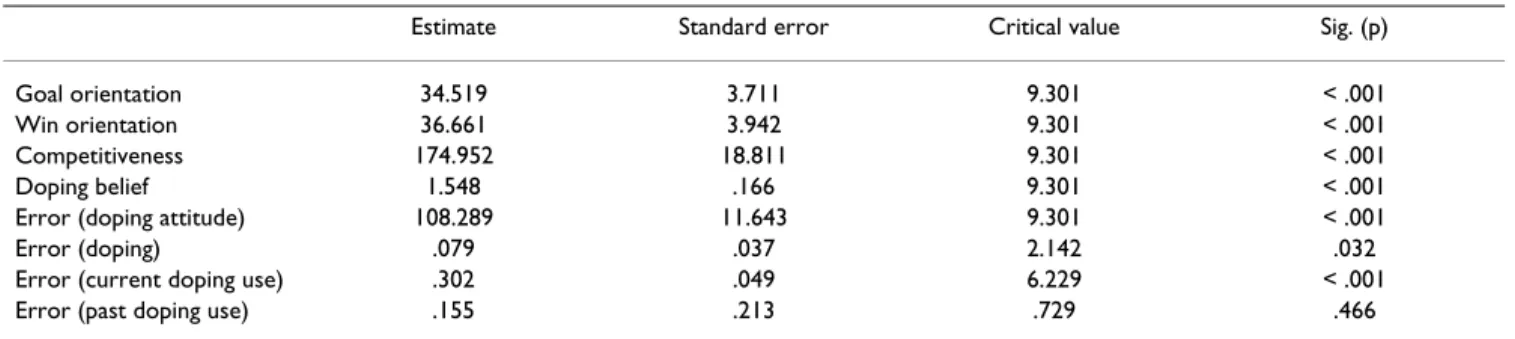
Among the regression weights (Figure 1 and Table 4), the only significant relationship was between doping belief and attitude. Self reported doping behaviour had a signif-icant relationship with doping belief, but not with atti-tude or sport orientation. Of the sport orientation measures, win orientation showed significant relationship with doping attitude. Correlation among the sport orien-tation measures (Table 5) were very high, all three being above .80 and naturally, significant. Variances, corre-sponding critical ratios and significance levels are dis-played in Table 6.
Owing to the lack of previous empirical research, with the exception of sport orientation and self-reported use of doping, there was no other study for comparison. Further-more, the data used for this model may warrant some
cau-Table 1: Measurement level descriptive statistics and univariate and multivariate normality (N = 174)
Variable min max mean sd skew c.r. (skew) kurtosis c.r. (kurtosis)
Doping belief .00 4.00 1.057 1.248 .822 4.425 -.331 -.892
Competitiveness 13.00 65.00 57.890 13.265 -2.362 -12.718 4.662 12.552
Win orientation 6.00 30.00 25.620 6.072 -1.795 -9.665 2.556 6.882
Goal orinetation 6.00 30.00 26.780 5.592 -2.382 -12.829 4.962 13.360
Doping attitude 19.00 79.00 42.138 12.190 .505 2.718 -.223 -.600
Past use of doping .00 3.00 .910 .949 1.173 6.315 1.203 3.238
Current doping use .00 3.00 .580 .629 1.164 6.270 2.700 7.271
Multivariate Mardia's coeff. 26.185 15.385
tion. In general, covariance structure analysis, like other parametric statistical procedures, assumes that variables are being measured on a continuous (numerical) scale. As was discussed earlier, psychological scales that have at least 5 points are generally treated as continuous varia-bles. The doping behaviour, however, was measured on a weaker scale with only 3 interval points (use, use for med-ical reasons, and no use).
The risk related to treating discrete variables as continuous variables for structural equation modeling has been reviewed and thoroughly discussed by Byrne [62]. The consequences of such violations lead to lower Pearson correlation coefficients when the two variables are not continuous, thus the models' regression weights might be conservative estimates. The situation is even worse, when there are less than five categories and/or the data are highly skewed. In relation to skewness, the worst scenario is when variable distributions are skewed in opposite directions. Although the present data were skewed, the variables 'belonging together' were skewed in the same direction. Athletes generally scored very high on sport ori-entation measures and below the mean/median on the doping related measures. On the other hand, normally distributed categorical variables have very little effect on the chi-square likelihood ratio of the model fit. Thus, as it is recommended, instead of relying on the goodness of fit test (chi-square), several fit indices were used to evaluate the hypothesized models. Finally, serious underestima-tion of factor loadings and factor correlaunderestima-tions can occur when the number of categories is less than three. With
cat-Table 3: Correlation (r) matrix of sport orientation and doping orientationa, N = 174
1 2 3 4 5
1. Doping attitude (PEAS) 1.000
2. Doping Beliefb .399 1.000
3. SOQ-Competitivenessc (-.128) (-.050) 1.000
4. SOQ-Win orientation (-.029) (-.052) .904 1.000
5. SOQ-Goal orientation (-.135) (-.082) .965 .861 1.000
a non-significant correlation (α = .05) coefficients are in parentheses
b Kendall's tau
c SOQ: Sport Orientation Questionnaire
Table 2: Item level parameter estimates and significance (at .05 level denoted by *)
Std Regr. Weights estimate Std Regr. Weights estimate
Doping Attitude ← Competitiveness -2.528 LegalAll ← Doping Belief 0.911*
Doping Attitude ← Goal orientation 1.603 D.Experience ← Doping Behaviour 0.883*
Doping Attitude ← Win orientation 0.935 Current use ← Doping Behaviour 0.478*
Doping Attitude ← Doping Belief 0.592* SO24 ← Goal orientation 0.877*
Doping Behaviour ← Competitiveness 2.045 SO20 ← Goal orientation 0.939*
Doping Behaviour ← Win orientation -0.364 SO16 ← Goal orientation 0.898*
Doping Behaviour ← Goal orientation -1.700 SO12 ← Goal orientation 0.886*
Doping Behaviour ← Doping Attitude - 0.076 SO8 ← Goal orientation 0.868*
Doping Behaviour ← Doping Belief - 0.312* SO4 ← Goal orientation 0.914*
PEAS1 ← Doping Attitude 0.677* SO2 ← Win orientation 0.917*
PEAS3 ← Doping Attitude 0.630* SO6 ← Win orientation 0.804*
PEAS4 ← Doping Attitude 0.526* SO10 ← Win orientation 0.903*
PEAS5 ← Doping Attitude 0.509* SO14 ← Win orientation 0.570*
PEAS6 ← Doping Attitude 0.291* SO18 ← Win orientation 0.866*
PEAS8 ← Doping Attitude 0.436* SO22 ← Win orientation 0.884*
PEAS10 ← Doping Attitude 0.549* SO25 ← Competitiveness 0.933*
PEAS11 ← Doping Attitude 0.471* SO23 ← Competitiveness 0.903*
PEAS15 ← Doping Attitude 0.330* SO21 ← Competitiveness 0.932*
PEAS17 ← Doping Attitude 0.402* SO19 ← Competitiveness 0.803*
PEAS19 ← Doping Attitude 0.478* SO17 ← Competitiveness 0.915*
PEAS21 ← Doping Attitude 0.373* SO15 ← Competitiveness 0.903*
PEAS22 ← Doping Attitude 0.663* SO13 ← Competitiveness 0.828*
PEAS23 ← Doping Attitude 0.297* SO11 ← Competitiveness 0.886*
PEAS25 ← Doping Attitude 0.532* SO9 ← Competitiveness 0.929*
PEAS28 ← Doping Attitude 0.212* SO7 ← Competitiveness 0.952*
PEAS29 ← Doping Attitude 0.539* SO5 ← Competitiveness 0.964*
LegalTop ← Doping Belief 0.976* SO3 ← Competitiveness 0.929*
SO1 ← Competitiveness 0.909*
PEASi = Performance Enhancement Attitude Scale items; SOi = Sport Orientation Questionnaire items; LegalTop = legalising doping for athletes at
egory points between three and five, a modest underesti-mation should be expected. However, recent studies showed that serious problems are associated with dichot-omous scales and methods relying on continuous data can be used with scales of four or more categories with no or little worry (p. 72 [62]). Keeping in mind that underes-timation can occur when a variable is measured on a scale with less than four points; it is possible that the path between doping behaviour and its indicators would be stronger when measured differently. However, the regres-sion weights associated with each were already statistically significant.
Discussion
One of the most important features of the present study was the finding that sport orientation is not strongly related to doping behaviour, or to doping attitude. The only exception was win orientation, which showed a sig-nificant relationship with doping attitude. Thus the importance of winning may have influenced what athletes think about doping, but it does not necessarily manifest in their behaviour. From the path coefficients, it was clear that athletes' desire to win, to achieve their personal goals or their competitive nature is not necessarily related to their decision regarding use of prohibited performance enhancements. None of the measures, except expressed belief, had a significant path to behaviour. Apparently, athletes using prohibited means of performance enhance-ments do not have to be overly competitive or win-orien-tated. They do not have to endorse such pharmaceutical
agents, or agree with the use of such substances in order to actually use them. These findings seem to be congruent with conclusions that emerged from previous qualitative studies [46] stating that doping is often viewed as a neces-sary means to an end. Many athletes claimed that they would prefer not to use drugs and would not do it if they were certain that the competition was drug-free. The para-noia about other competitors using performance enhancement is a reappearing theme in these papers. In addition, Anshel [72] noted that athletes often feel an external pressure to win, most often in the form of warn-ing about exceptionally good opponents. Hence, uswarn-ing doping agents may be more of a rational, outcome opti-mizing behaviour than deviance. If this is the case, sport governing bodies may do well if in addition to placing a ban on certain performace enhancing substances and methods, they provide athletes with acceptable alterna-tives.
The small negative (but not significant) relationship between goal orientation and doping behaviour was a log-ical connection because among the three sport orientation measures, goal orientation reflects an orientation to per-sonal standards, regardless of the situation. The other two measures, desire to win and competitiveness reflect a ten-dency to enter and strive for success in a sport situation. Using banned performance enhancements in most ath-letes' view was expected to be against their standards as sportsmen. However, at the same time doping is often viewed as a means to an end; a 'tool' that is bad but
nec-Table 5: Variances, covariances and correlations of winning, goal orientation and competitiveness measures
Correlation estimate Covariance Estimate Standard error Critival value Sig. (p)
Win orientation ↔ Competitiveness .904 72.370 8.207 8.819 < .001
Goal orientation ↔ Win orientation .861 30.639 3.569 8.584 < .001
Goal orientation ↔ Competitiveness .965 74.997 8.211 9.134 < .001
Table 4: Measurement level standard regression rates, parameter estimates, standard errors (s.e.), critical values (c.r.) and significance (p)
Paths Std regression weights Estimate s.e. c.r. p
Goal orientation → Doping attitude .115 .236 .516 .458 .647
Win orientation → Doping attitude .344 .685 .307 2.234 .025
Competitiveness → Doping attitude -.436 -.397 .272 -1.460 .144
Doping belief → Doping attitude .482 4.670 .636 7.345 .000
Doping attitude → Doping behaviour .032 .001 .002 .331 .741
Doping belief → Doping behaviour .324 .078 .038 2.080 .038
Goal orientation → Doping behaviour -.238 -.012 .017 -.731 .465
Win orientation → Doping behaviour .044 .002 .010 .226 .821
Competitiveness → Doping behaviour .191 .004 .009 .501 .616
Doping behaviour → Current use .479 .412 .173 2.389 .017
essary to ensure success in competition. Therefore, a posi-tive relationship was expected. Of the two measures studied, competitiveness had a small but insignificant, positive path to doping behaviour, whilst winning practi-cally showed no relationship at all. On the other hand, the only statistically significant relationship with sport tation measures and other factors was between win orien-tation and doping attitude. Sport orienorien-tation and attitude appear to be similar constructs and distinctly different from behaviour. Athletes may think that doping is needed or not needed for winning but when it comes to actual
behaviour, it might be influenced by other factors more than attitude or orientation.
This is not to say that personality, attitude, values should be discarded in order to make room for other factors. As probably no two individuals would react identically to the same combination of environmental factors, it is fair to assume that contextual contingencies are mediated through the combination of individual factors. Adherence to norms is a particularly difficult question. Decisions regarding doping use are influenced by at least two possi-bly competing norms: 1) the general social norms, such as fair play, condemnation of cheating and 2) the special norms held by the athletes' immediate subcultures as sug-gested by English [48] particularly to competitive sport. When respondents completed the survey, they might feel compelled to consider the general social norms and offer a picture of a fair playing athlete. Athletes might answer in a particular way so they were seen as highly motivated, goal oriented individuals who understandably placed great importance on winning and achieving in a competi-tive situation (as the highly skewed sport orientation measures suggest) but despised unaccepted means of per-formance enhancement (again, mean score was rather low on doping attitude). The low correlation between the sport orientation and doping attitude measures and the Social Desirability scale gave some reassurance that the data were not contaminated badly by response bias but its effect warrants further investigation.
The non-significant path between doping attitude and behaviour was surprising. Instead of the practically zero
regression weight, a small positive but significant relation-ship was expected. Although the Theory of Reasoned Action
[73] and Theory of Planned Behaviour [42] suggest that
beliefs form attitude before their effect on behaviour, results from this research showed a fairly strong and sig-nificant direct path from beliefs to behaviour. Mediating beliefs through attitude would only slightly increase the regression weight between doping attitude and behaviour but remained non-significant (β=.14, p = .446). One pos-sible explanation for the strong path between belief and behaviour is justification. Those athletes who use doping or wish to use such performance enhancements would prefer to do so without social stigmatization. Such a view is in keeping with previous research where athletes expressed their view of doping as a necessary means to a desired end and whilst they acknowledge rule breaking behaviour, they do not consider themselves cheaters or more cheating than any other athlete [74].
Follow-up research efforts should be directed toward find-ing additional components that may contribute to the doping model, such as drug attitude, morality, anxiety over performance, health concerns, and deterrent factors. Data collected via self-reports always pose limitations to the study owing to the undesirable but unavoidable effect of response bias (typically resulting in the under-reporting of socially undesirable behaviour). Modelling behav-ioural intentions in hypothetical situations instead of self-reported actual behaviour may help to reduce the effects of strategic responding. The appropriateness of testing via hypothetical situations is discussed in Strelan and Boeck-mann's perceptual deterrence model paper [28]. Alterna-tively, experimenting with implicit measures, as oppose to explicit self-declaration, may also provide a useful approach to doping behaviour reseach.
The relationship between doping belief and behaviour was significant, suggesting that investigating and quanti-fying belief might be a more fruitful approach in the future. Individual attitudes or actions, however, cannot be understood without taking the environmental context into consideration. The environmental effect is used in a broader sense, as it should include the culture (i.e.
coun-Table 6: Variances of winning, goal orientation and competitiveness measures and measurement errors
Estimate Standard error Critical value Sig. (p)
Goal orientation 34.519 3.711 9.301 < .001
Win orientation 36.661 3.942 9.301 < .001
Competitiveness 174.952 18.811 9.301 < .001
Doping belief 1.548 .166 9.301 < .001
Error (doping attitude) 108.289 11.643 9.301 < .001
Error (doping) .079 .037 2.142 .032
Error (current doping use) .302 .049 6.229 < .001
try) and subculture (i.e. sport), societal norms (i.e. values which society holds about sport and in general) but also the influence of other people (i.e. peers, coaches, family), alternative choices, and consequences of acting or not act-ing in a certain way.
Whilst the relationship between behavioural intention and behaviour is well established, moderating factors are less commonly used. Godin, Gagnë and Sheeran [75] pro-vided empirical evidence from meta-analysis of eight pub-lished health-related behavioural intention research for the importance of including moderating variables, such as perceived behavioural control (a combination of per-ceived difficulty and perper-ceived control) and perper-ceived power. Including these elements will further enhance the doping model.
Doping in varied cultures is perhaps viewed differently by the individual, his/her immediate social circle and broader society. The view of doping can even differ from
one subgroup to another within the boundaries of sport.
Therefore, testing for measurement invariance across groups (model's applicability to other groups, such as females, athletes from other nations or from different lev-els of sport involvement) should also be an important avenue to pursue in future research.
Conclusion
The SEM analyses provided empirical evidence that sport orientation and doping behaviour is not directly related. The understanding we can gain from research aiming at individual characteristics is limited if the context was ignored. Sport governing bodies and anti-doping organi-sations need to recognise that using performance enhancements (both acceptable and prohibited methods) may be more of a rational, outcome optimizing behaviour than deviance.
There is an important lesson to be learned from main-stream management. Similar lines of research have been conducted in leadership when the first model in search of 'good leaders' exclusively focused on the leader and his or her personality and only decades later reached the point when complexity of the phenomena and contextual con-tingencies were acknowledged and taken into account. At this point, the factors that make the difference between using and not using banned performance enhancements are not well understood. Focusing solely on athletes' per-sonalities and treating doping as a deviant behaviour of the few is misleading. No doubt, attitude is an important construct in social psychology and plays a significant role in the doping issue as well. However, one must be careful not to place too much emphasis on attitudes to the exclu-sion of other, perhaps equally important factors. Athletes' sport orientation appeared to be unrelated to doping
behaviour. Doping specific attitudes, but more so beliefs, are an integral part of doping behaviour, but it cannot be said whether they are reasons or consequences of other, related attitudes, dispositions and experiences. Attitudes and actions are intimately intertwined and such unison is subject to constantly competing forces to maintain the inner equilibrium (as a natural human desire for stability)
and to change in accordance with new experiences,
infor-mation and situation. Instead of focusing solely on atti-tudes, a better understanding of doping should be developed. Perhaps then, alternative actions can be iden-tified, explored, and offered for athletes who wish to con-stantly improve their performance up to or above the level of competitors.
The results of this research have both theoretical and prac-tical implications. At the theoreprac-tical level, the findings of this paper are a step toward a comprehensive doping model. This paper highlights the need for the inclusion of other influencing factors and makes suggestions for future model testing. At the practical level, understanding the driving forces behind doping and how athletes wish to deal with these factors must be at the centre of informed deterrence policies. Athletes are, by nature, highly moti-vated and achievement oriented individuals and have grown to appreciate methods for performance enhance-ment (training, nutrition, physiotherapy, equipenhance-ment, etc.). The distinction between acceptable and prohibited methods must be made clear and convincing. To be effec-tive, authorities must be able to i) justify the doping ban in general, ii) use evidence-based selection of substances and methods included into the prohibited list, iii) use the same criteria for all substances and methods, and iv) com-municate such decisions to all stakeholders.
Competing interests
The author(s) declare that they have no competing inter-ests.
Appendix
Performance Enhancement Attitude Scale (PEAS)[53]
1 = Strongly disagree, 2 = Disagree, 3 = Slightly disagree, 4 = Slightly agree, 5 = Agree, 6 = Strongly agree
1. Doping is necessary to be competitive.
2. Doping is not cheating since everyone does it.
3. Athletes often lose time due to injuries and drugs can help to make up the lost time.
4. Only the quality of performance should matter, not the way athletes achieve it.
5. Athletes in my sport are pressured to take performance-enhancing drugs.
6. Athletes, who take recreational drugs, use them because they help them in sport situations.
7. Athletes should not feel guilty about breaking the rules and taking performance-enhancing drugs.
8. The risks related to doping are exaggerated.
9. Athletes have no alternative career choices, but sport.
10. Recreational drugs give the motivation to train and compete at the highest level.
11. Doping is an unavoidable part of the competitive sport.
12. Recreational drugs help to overcome boredom during training.
13. There is no difference between drugs, fibreglass poles, and speedy swimsuits that are all used to enhance per-formance.
14. Media should talk less about doping.
15. The media blows the doping issue out of proportion.
16. Health problems related to rigorous training and inju-ries are just as bad as from doping.
17. Legalising performance enhancements would be ben-eficial for sports.
Doping Use Belief (DUB)
Do you believe that performance-enhancing drugs/meth-ods should be allowed for top level athletes?
Yes, without restrictions (2), Yes, but with restrictions (1), Absolutely not (0)
Do you believe that performance-enhancing drugs/meth-ods should be allowed for all athletes?
Yes, without restrictions (2), Yes, but with restrictions (1), Absolutely not (0)
Have you ever had personal experience with banned per-formance-enhancing drugs and/or methods?
Yes (3), Yes, but only for treating a medical condition (2), No (0), I do not wish to answer (1)
Do you currently use banned performance-enhancing drugs?
Yes (3), Yes, but only for treating a medical condition (2), No (0), I do not wish to answer (1)
References
1. Verroken M: Drug use and abuse in sport. Clin Endocrin Metabol
2000, 14:1-23.
2. Baron DA, Martin DM, Magd SA: Doping in sports and its spread to at-risk populations: an international review. World Psychiatry
2007, 6:54-9.
3. Irving LM, Wall M, Neumark-Sztainer D, Story M: Steroid use among adolescents: findings from Project EAT. J Adolesc Health 2002, 30:243-52.
4. Kindlundh AM, Isacson DGL, Berglund L, Nyberg F: Factors associ-ated with adolescent use of doping agents: anabolic-andro-genic steroids. Addiction 1999, 94:543-54.
5. McDuff D, Baron D: Substance use in athletics: a sports psychi-atry perspective. Clin Sports Med 2005, 24:885-97.
6. Møldrup C, Traulsen JM, Almarsdóttir AB: Medically-enhanced normality: an alternative perspective on the use of medi-cines for non-medical purposes. Int J Pharm Pract 2003, 11:243-9. 7. Nilsson S, Baigi A, Marklund B, Bengt F: The prevalence of the use of androgenic anabolic steroids by adolescents in a county of Sweden. Eur J Pub Health 2001, 11:195-7.
8. Rose N: Beyond medicalisation. Lancet 2007, 369:700-2. 9. Breivik G: The doping dilemma. Sportwissenschaft 1987, 17:83-94. 10. Lüschen G: Doping in Sport: The social structure of deviant
subculture. Sports Sci Rev 1993, 2:92-106.
11. World Anti-Doping Agency: The 2007 Prohibited List of sub-stances. [http://www.wada-ama.org/rtecontent/document/ 2007_List_En.pdf].
12. Bryson L: Sport, drugs and the development of modern capi-talism. Sport Traditions 1990, 6:135-53.
13. Todd J, Todd T: Significant event is the history of drug testing and the Olympic Movement: 1960 – 1999. In Doping in elite sport
Edited by: Wilson W, Derse E. Champaign, IL: Human Kinetics; 2001:65-128.
14. Dauncey H, Hare G: The Tour de France: a pre-moderncontest in a post-modern context. Int J History Sport 2003, 20:1-29. 15. Tsivou M, Kioukia-Fougia N, Lyris E, Aggelis Y, Fragkaki A, Kiousi X,
16. WADA: Adverse analytical findings reported by accredited laboratories
2006 [http://www.wada-ama.org/rtecontent/document/ LABSTATS_2006.pdf].
17. Bahrke MS, Yesalis CE: The future of performance enhancing substances in sport. Physician Sportmed 2002, 30:.
18. Calfee R, Fadale P: Popular Ergogenic Drugs and Supplements in Young Athletes. Pediatrics 2006, 117:e577-e589.
19. Gomez JE: Performance-enhancing substances in adolescent athletes. Tex Med 2002, 98:41-6.
20. Koch JJ: Performance-enhancing Substances and Their Use Among Adolescent Athletes. Pediatrics Rev 2002, 23:310-317. 21. Yesalis CE, Bahrke MS: Doping among adolescent athletes. Clin
Endocrin Metabol 2000, 14:25-35.
22. Laure P, Binsinger C: Doping prevalence among preadolescent athletes: a 4-year follow-up. Br J Sports Med 2007, 41:660-663. 23. European Union: Fifth Framework Programme, GROWTH.
[http://ec.europa.eu/research/growth/gcc/projects/antidop ing.html#08].
24. UNESCO: International Convention Against Doping in Sport. 2007 [http://unesdoc.unesco.org/images/0014/001425/ 142594m.pdf#page=2].
25. Houlihan B: Managing compliance in international anti-doping policy: the world anti-doping code. Eur Sport Manag Quart 2002, 2:188-208.
26. Haugen KK: The performance-enhancing drug game. J Sports Econ 2004, 5:67-86.
27. Trout GJ, Kazlauskas R: Sports drug testing – an analyst's per-spective. Chem Soc Rev 2004, 33:1-13.
28. Strelan P, Boeckmann RJ: Why drug testing in elite sport does not work: perceptual deterrence theory and the role of per-sonal moral beliefs. J Appl Soc Psychol 2006, 36:2909-34. 29. Lippi G, Guidi GC: Gene manipulation and improvement of
athletic performances: new strategies in blood doping. Br J Sports Med 2004, 38(5):641.
30. McCrory P: Super athletes or gene cheats? Br J Sports Med 2003, 37:192-4.
31. Miah A: Gene-Doping: Sport, Values & Bioethics. In The Ethics of Human Genetics: Challenges of the (Post) Genomic Era Edited by: Glasa J. Strasburg, Council of Europe; 2003:171-180.
32. Miah A: Genetically Modified Athletes. BiomedicalEthics, Gene Doping and Sport London: Routledge; 2004.
33. Unal M, Unal DO: Gene Doping in Sports. Sports Med 2004, 34:357-62.
34. Wanjek B, Rosendahl J, Strauss B, Gabriel HH: Doping, drugs and drug abuse amond adolescents in the State of Thuringia (Germany): prevalence, knowledge and attitudes. Int J Sports Med 2007, 28:346-53.
35. WADA Social Science Research Call for Proposal 2008 [http:// www.wada-ama.org/rtecontent/document/
Call_for_Proposals_2008_En.pdf].
36. Alaranta A, Alaranta H, Holmila J, Palmu P, Pietilä K, Helenius I: Self-reported attitudes of elite athletes toward doping: differ-ences between type of sport. Int J Sports Med 2006, 27:842-6. 37. Crown J, Heatherington L: The cost of winning? The role of
gen-der in moral reasoning and judgements about competitive athletic encounters. J Sport Exerc Psychol 1989, 11:281-9. 38. Hoberman J: How Drug testing fails: The politics of doping
control. In Doping in elite sport Edited by: Wilson W, Derse E. Cham-paign, IL: Human Kinetics; 2001:241-274.
39. Gill DL, Dzewaltowski DA: Competitive orientations among intercollegiate athletes: Is winning the only thing? Sport Psy-chol 1988, 2:212-21.
40. Gill DL, Kelley BC, Martin JJ, Caruso CM: A comparison of com-petition orientation measures. J Sport Exerc Psychol 1991, 8:266-80.
41. Lucidi F, Grano C, Leone L, Lombardo C, Pesce C: Determinants of the intention to use doping substances: an empirical con-tribution in a sample of Italian adolescents. Int J Sport Psychol
2004, 35:133-48.
42. Ajzen I, Madden TJ: Prediction of goal directed behaviour: Atti-tudes, intentions and perceived behavioural control. J Exp Soc Psychol 1986, 22:453-74.
43. Donovan RJ, Egger G, Kapernick V, Mendoza J: A conceptual framework for achieving performance enhancing drug com-pliance in sport. Sports Med 2002, 32:269-84.
44. Strelan P, Boeckmann RJ: A new model for understanding per-formance-enhancing drug use by elite athletes. J Appl Sports Psychol 2003, 15:176-83.
45. Paternoster R: The deterrent effect of the perceived certainty and secerity of punishment: A review of the evidence and issues. Justice Quarterly 1987, 4:173-217.
46. Backhouse S, McKenna J, Robinson S, Atkin A: International Liter-ature Review: Attitudes, Behaviours, Knowledge and Educa-tion – Drugs in Sport: Past, Present and Future. 1987 [http:// www.wada-ama.org/rtecontent/document/
Backhouse_et_al_Full_Report.pdf].
47. Fishbein M, Ajzen I: Belief, attitude, intention and behaviour Reading, MA: Addison-Wesley; 1975.
48. English G: A theoretical explanation of why athletes choose to use steroids, and the role of the coach in influencing behav-iour. Nat Strength Cond Assoc J 1987, 9:53-56.
49. Tangen JO: "Competitors influence each others drug use!" A heuristic use of discriminant analysis to predict drug abuse among Norvegian athletes. Corpus, Psyche et Societas 1999, 6:1-20.
50. Gill DL, Deeter TE: Development of the Sport Orientation Questionnaire. Res Quart Exerc Sport 1988, 59:191-202.
51. Bentler PM, Speckart G: Models of attitude-behaviour relations. Psychol Rev 1979, 86:452-64.
52. Bentler PM, Speckart G: Attitudes "cause" behaviours: A struc-tural equation analysis. Journal of Personality and Psychology 1981, 40:226-38.
53. Vallerand RJ, Deshaies P, Cuerrier JP, Pelletier LG, Mongeau C: Ajzen and Fishbein's theory of reasoned action as applied to moral behaviour: A confirmatory analysis. J Pers Soc Psychol
1992, 62:98-109.
54. Petróczi A: Exploring the doping dilemma in elite sport: Can athletes' atti-tudes be responsible for doping? Published Doctor of Philosophy disser-tation, University of Northern Colorado, USA; 2002.
55. Petróczi A: Attitude-behaviour relationship regarding the use of performance enhancing drugs and/or methods. Med Sci Sports Exerc 2003, 35:S326.
56. Ajzen I, Fishbein M: Attitude-Behaviour relations: A theoretical analysis and review of empirical research. Psychol Bull 1977, 84:888-918.
57. Bandalos DL, Finney SJ: Item parceling issues in structural equa-tion modeling. In Marcoulides GA & Schumacker RE (Eds.). In New developments and techniques in structural equation Mahawah, NJ: Lawrence Erlbaum Associates, Inc; 2001.
58. McDonald RP, Ho MR: Principles and practice in reporting structural equation analyses. Psychol Methods 2002, 7:64-82. 59. Bollen KA, Stine RA: Bootstrapping goodness-of-fit measures in
structural equation modeling. In Testing structural equation models
Edited by: Bollen KA, JS Long JS. Newbury Park: Sage.
60. Boomsma A: Reporting analyses of covariance structures. Structural Equation Modeling 2000, 7:461-83.
61. Hoyle RH, Panter AT: Writing about structural equation mod-els. In Structural equation modeling: Comments, issues, and applications
Edited by: Hoyle RH. Thousand Oaks, CA: Sage; 1995:56-77. 62. Byrne BM: Structural Equation Modeling with AMOS Mahwah, NJ:
Law-rence Erlbaum; 2001.
63. Kline RB: Latent variable path analysis in clinical research: A beginner's tour guide. J Clin Psychol 1991, 47:471-84.
64. Cohen J: A power primer. Psychol Bull 1992, 112:155-9. 65. Gall MD, Borg WR, Gall JP: Educational Research 6th edition. White
Plains: NY: Longman; 1996.
66. Olejnik SF: Planning educational research: Determining the necessary sample size. J Experiment Educ 1984, 53:40-8. 67. Schumacker RE, Lomax RG: A beginner's guide to structural equation
modeling Mahwah, NJ: Lawrence Erlbaum; 1996.
68. Crowne DP, Marlowe D: A new scale of social desirability inde-pendent of psychopathology. J Consult Psychol 1960, 24:349-54. 69. Kline RB: Principles and practice of structural equation modeling New
York, NY: Guilford; 1998.
70. Marsh HW, Hau KT, Wen Z: In search of golden rules: Com-ment on hypothesis testing approaches to setting cutoff val-ues for fit indexes and dangers of overgeneralizing Hu and Bentler's (1999) findings. Struct Equat Model 2004, 11:320-41. 71. Hu L, Bentler PM: Cutoff criteria for fit indexes in covariance
Publish with BioMed Central and every scientist can read your work free of charge "BioMed Central will be the most significant development for disseminating the results of biomedical researc h in our lifetime."
Sir Paul Nurse, Cancer Research UK
Your research papers will be:
available free of charge to the entire biomedical community
peer reviewed and published immediately upon acceptance
cited in PubMed and archived on PubMed Central
yours — you keep the copyright
Submit your manuscript here:
http://www.biomedcentral.com/info/publishing_adv.asp
BioMedcentral 72. Anshel MH: A survey of elite athletes on the perceived causes
of using banned drugs in sport. J Sport Behav 1991, 14:283-307. 73. Ajzen I, Fishbein M: Understanding attitudes and predicting social
behav-iour Englewood Cliffs, NJ: Prentice-Hall; 1980.
74. Tangen JO, Bergsgard NA, Barland B, Breivik G: "To dope or not to dope". A study on the decision to use drugs in Norvegian sports. Corpus, Psyche et Societas 1997, 4:41-65.