International Journal Advances in Social Science and Humanities
Available online at: www.ijassh.com
RESEARCH ARTICLE
Family’s Health Matters and Role of Women
Polakshi Bhattacharyya Baruah*
University of Science and Technology Meghalaya, India.
Abstract
The MDGs adopted by the United Nations in the year 2000 targeted 2015 as the year to achieve the millennium development goals which include eight goals framed to address the world's major development challenges with health and its related areas as the prime focus. Out of the eight goals to be achieved by 2015 three goals are directly related to health, the other goals are related to factors which have a significant influence on health. The main areas of focus are poverty, health, education, gender equality and sustainable development. Various poverty eradication programmes in the form of employment generation schemes has been implemented that emphasizes on participation of women, with a believed that their participation would lead to their empowerment. Evidence shows that resources in the hands of women boost household spending in areas that benefit family and children health. Women empowerment has been an important area of focus, various scheme has been launched with a prime focus on empowering the woman, as it has been acknowledged that women do have a very important role in the process of development. This paper intends to examine the role women in health related matters of the family. The study is mainly based on primary data collected in the Morigoan district of Assam.
Keywords: Empowerment, Participation, Health-care.
Introduction
Human health is a pivotal factor for a strong human resource; various measures have been undertaken by the policy makers to improve the health care system of the country. But unfortunately very few success have been achieved in this direction, one major reason for this is the lack of accessibility of proper health care facilities by the women. In India the women especially the women from the rural areas are deprived of proper education, occupation, freedom of movement which are actually term as important
Various policies on women’s empowerment exist at the national, state, and local (Panchayat) levels in many sectors, including health, education, economic opportunities, gender-based violence, and political participation. However, there are significant gaps between policy advancements and actual practice at the community level. One key factor for the gap in implementation of laws and policies1 to address discrimination, economic disadvantages, and violence against women at the community level is the largely patriarchal structure that governs the community and households in much of India. As such, women and girls have restricted mobility, access to education, access to health facilities, and lower decision-making power, and experience higher rates of violence. Political participation is also hindered at the Panchayat (local governing bodies) level and at the state and national levels, despite existing reservations for women.
Gender equity and women’s empowerment has been advocated as prerequisites of social reform by different researchers and reform activists, mostly in the field of health reforms.
The study of Qureshi and Shaikh [1] highlight the factors that contribute to gender inequality which ultimately create barriers to women empowerment and their health status. The study reveals that lack of formal education, poor nutrition for girls; early marriage is the main factors responsible for their ill health. The women are always considered subordinate to men therefore they have a minimal say in matters related marriage, pregnany and family size which have a negative impact on their health. The study stressed on empowering the women through more and more access to formal education.
The study of Vos et al. [2] spells out that the participation;
empowerment and right based approach to health have much in common. Right –base approaches to health have evolved from empowerment concept and empowerment concept in turn, were built
attention to issues of social class, that is the requirement of involving the poor and the other marginalizes groups in decision-makings in the policies that affect their communities. Empowerment approach highlights the role that power plays within communities. Human rights approach introduces the essential concept of accountability of the state. The study concludes that the three interrelated concepts of participation, empowerment and right based approach be combined together in a proportion so that it will achieve the desired end objective of sustainable rural development.
S. Chakravarty [3] highlighted the role of SHGs in the empowerment of women with a special emphasis on health status. The study stated that the SHGs have positively impact the empowerment level of the women especially with regard to deciding about the health care matters. The women who are associated with the SHGs are comparatively more aware about the improved health care measures, their children are likely to survive more, receive better care when they need. Healthy women actively participate in society and markets and take collective action to advance their own interest, which is of vital important for a nation to develop.
A study by Reecha Upadhyay [4] stated that the education levels and caste and class divisions prevailing in our society is one of the important factor that hinders the empowerment of women. Women from lower castes (the scheduled castes, other backward castes, and tribal communities) are particularly vulnerable to maternal mortality and infant mortality. They are often unable to access
health and educational
services, lack decision-making power, and face higher levels of violence.
affected by and large by the prevailing social structure. The women in rural area particularly, faced lot of discrimination compared to men in the area of education, occupation and freedom of mobility which directly or indirectly affect their accessibility to proper health care. The study stressed on the women health because a healthy woman means a healthy family and a healthy community and thereby a healthy nation.
Objective and Methodology of the Study
Since health is an important factor that determines the quality of human resource, which is the core factor of economic development, so it can be, stated that health of the people is an important parameter of economic development. Various factors like availability of health care facilities, climate of the area, educational facilities etc, and influence the health of the people of an area. Apart from these factors the women participation in health care matters of the family is also equally important as it is the women who mainly take care of children and old sick person at home. It has been increasingly realised now a days that women empowerment and participation in all important decision making process is indispensable for
development. This study simply attempts to examine the role of women in health care matters of the family and to see whether caste and community to which the women belongs do have some influence in their decision making process.
The data was collected from the Chariabahi village of Kapili development block of Morigaon district. The village was selected among other villages of the panchayat as it has a population comprised of ST, SC, OBC, General and Minority (Muslim community). And a sample of 130 women was purposively selected to interact with a schedule, which belongs to different caste and community, but out of 130 sample 2 sample (who were from minority community refuse to interact). So the final sample size consisted of 128 women.
Distribution of Respondents According to their Caste and Age
The pie Figure 1, below shows that majority of the respondents are ST (29.6 %) followed by OBC (28.1 %) and SC (23.4%) the proportion of General and minority is (10.9%) and (7.8%) respectively.
Figure 1: Caste of the respondents Figure 2: Age of the respondents
29.6 28.1 23.4 10.9 7.8 ST OBC SC GENERAL MINORITY 15 51 39 19 4 0 10 20 30 40 50 60
The bar Figure 2 of age distribution shows that most of the respondents (51 respondents) are from the age group of 26-35, followed by the age group of 36-45 with 39 respondents. There is 15 and 19 respondents from the age group of 15-25 and 46-55 respectively. The number of respondent is only 4 from the age group of 56 above. All the respondents are married.
Distribution of the Respondents According to their Occupation
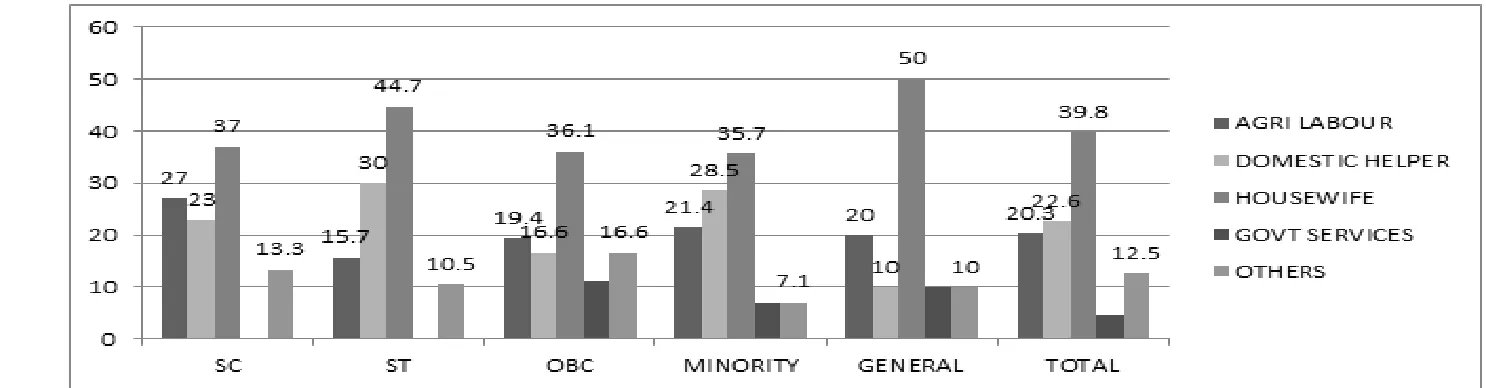
From the table 1 and diagram 3 given below it can be revealed that majority of the respondents are housewife and unemployed (39.8 per cent) followed by domestic helper (22.6 per cent) and agricultural labour (20.3 per cent). Above 12.5 per cent are engaged in other occupations like mid-day meal cook, sale girls, tailoring etc. Only 4.6 percent are engaged as government employees who are mostly teacher in government school. A caste wise classification reveals that the majority of women from the general caste are unemployed. Looking at the women from other caste the same picture is reveals as majority of them belongs to unemployment category. Women are mostly employed as domestic helper and agricultural laboure where
the per day wage is at the most Rs 60 per day and the nature of the job is very seasonal which gives an impression that they are economically not much empowered. The income of the women from their occupation is very negligible expect for those engage in government sector and other occupations. The income of the women engaged as agricultural labour and domestic helper are very low and it is only a temporary source of income. But in rural areas majority of the women are agricultural labourer and domestic helper, with a very low level of income and hence less empowered to influence the decision making process at home.
Education is being considered as one of the important parameter of women empowerment, but here the educational level of the respondent is very poor. The educational qualification of the respondents reveals that the 22.6 per cent are illiterate and among the literate majority of them are below primary level of education (27.3 %). A caste wise analysis reveals that among the ST women majority of them (39.4) are illiterate followed by women from minority community (28.5 %).
Table 1: Distribution of the respondents according to their occupation
Categories Agri
Labour Domestic Unemployed Housewife/ Govt services Others Total
Figure 3: Distribution of the respondents according to education qualification
It can be seen from the table 2 and diagram 4 that the percentage of
women from all most all the caste and community declines with the increase in level of education. Only the women from general and OBC are comparatively more educated (HSLC passed) to women from other communities.
Table 2: Distribution of the respondents according to education qualification
Categories Illiterate Literate but
less then primary level
Less than class viii Less than madhyamic Less than
HSLC Less than Graduate Graduate Above Total
OBC 2 (5.5) 5 (13.8) 10 (27.7) 7 (19.4) 6 (16.6) 5 (13.8) 1 (2.7) 36
SC 7 (23.3) 7 (23.3) 6 (20.0) 5 (16.6) 3 (10.0) 2 (6.6) - 30
ST 15 (39.4) 14 (36.8) 2 (5.2) 4 (10.5) 2 (5.2) 1(2.6) - 38
GEN 1 (10.0) 3 (30.0) 3 (30.0) - 1(10.0) 1 (10.0) 1 (10.0) 10
MINORITY 4 (28.5) 6 (42.8) 1 (7.1) 1 (7.1) 1 (7.1) 1 (7.1) - 14
Figure 4: Distribution of the respondent according to education qualifications
Distribution of Respondents According to who Decides about the Treatment
An attempt has been made to evaluate role of women in deciding about the treatment for health care (table1.3, diagram 5). It has
been found that in majority of the cases it is the husband who solely decides about the treatment (33.4 %). About 31.2 per cent of the respondents stated that the elder member of the family has the power to decide regarding health care treatment.
Table 3: Distribution of respondents according to who decides about the treatment
Categories Husband Wife Both Elder member Total
OBC 11 (30.5) 2 (5.5) 15 (41.6) 8 (22.2) 36
SC 12 (40.0) 3 (8.3) 7 (19.4) 8 (26.6) 30
ST 12 (31.5) 1 (2.6) 10 (26.3) 15 (39.4) 38
GEN 4 (40.0) 1 (10.0) 4(40.0) 1(10.0) 10
MINORITY 5 (35.7) 0 (00) 1 (7.1) 8 (57.1) 14
TOTAL 44 (34.3) 7 (5.4) 37 (30.0) 40 (31.2) 128
The percentage of women who agreed that both wife and husband jointly decide about treatment are 30.0% per cent and a very negligible number of respondent (5.4 %) stated that the wife alone decide about the health care matters. A caste wise analysis reveals
Figure 5: Distribution of respondent according to who decides about the treatment
Distribution of Respondents According to their Preference for types of Treatment
An attempt has also been made to highlight the respondents preference to the various type of health care namely, government hospital, Traditional methods and household medicine. It has been observed from table 1.4 and diagram 6, that of the total respondent majority of them about 32.8 % prefer household medicine, initially they go for household medicine and if the case is a serious one they prefer government hospital. A caste wise analysis reveals that a majority of the respondent from the Schedule Caste prefer
traditional methods and household medicine (23.6 %) and (31.5%) respectively. The percentage of ST going to government hospital for health care is very negligible only 5.2%. Among the minority community it has been observed that majority of them prefer traditional methods of treatment (35.7%) and the percentage of respondent opting government hospital as the sole health care centre is nil among the minority community. Among the various community it has been observed that the general, OBC and the SC, prefer government hospital and household medicine more than other methods of treatments.
Table 4: Distribution of respondents according to their preference for types of treatment
Categories Government
hospital Traditional Methods Household medicine Government hospital & Household medicine Traditional methods of Household medicine &
treatment
Total
OBC 8 (22.2) 4 (11.1) 10 (27.7) 14 (38.8) 0 (00) 36
General 1 (10.0) 3 (30.0) 1 (10.0) 5 (50.0) 0 (00) 10
SC 7 (23.3) 1 (3.33) 5 (16.6) 11(36.6) 6 (20.0) 30
ST 2 (5.2) 9 (23.6) 12 (31.5) 8 (21.05) 7 (18.4) 38
Minority 0(00) 5(35.7) 2 (14.2) 4 (28.5) 3 (21.4) 14
Figure 6: Distribution of respondents according to their preference for various types of treatment
The study also attempt to examine whether there is any connectivity between the educational level of the women, occupational level and their participation in deciding about the treatment, with the type of the treatment opted for health care in the family. It has been observed that the respondent from ST and minority community mostly prefer the traditional methods of treatment. Where majority of the women are illiterate and even if literate that too up to primary level only, majority of them are unemployed and they have no role in deciding about the treatment for health care of the family, which is mostly done by the elder member of the family and the husband alone in case of ST (39.4%) and (31.5%) respectively and for the minority it is (35.7 %) and (57.1%) respectively. In case of the other categories namely general, OBC and SC, the percentage of respondents preferring traditional methods of treatment is comparatively low. Again it has also been observed that women respondent from this group are comparatively
more educated even though majority of them are unemployed and among these communities decision regarding the health care is mostly taken jointly by husband and wife. Thus it has been observed in the study area that cultural values are embedded deeply in the family traditions, of some communities especially the minority community making female member access to health care limited and most of the time dependent on the family’s decision
Conclusion
without any recognition and appreciation in the decision making power in the family, which is a major hindrance to the progress of the society as it is well realised by many research that the women have an important role in the path of the society’s progress. Hence educating the women is a factor to be addressed with top priority. Education is the pillar of women empowerment, and an empowered women do have the power to influence the decision making process
in the family especially in the field of child health care and education which is the future of the society. Regular awareness programme regarding health care (like proper hygiene, cleanliness and sanitation) should be conducted with more and more involvement of women. Proper awareness of the women about cleanliness can prevent many diseases.
Reference
1. Qureshi and Shaikh (2007) Women empowerment and health:
The role of institutions of power in Pakistan, Eastern Mediterranean Health Journal, 13(6):1459-1464.
2. Vos PD, Ceukelaire WD, Malaise G, Stuyft PV, Pereze D (2009)
Health through People’s Empowerment: A Right-Base Approach to Participation, Health and Human Right, 11(1):23-35.
3. Chakravarty S (2012) Health care and women’s empowerment;
Role of Self Help Group, Health, Culture and Soceity, 2(1):115-128.
4. Upadhyay R (2013) Womens Empowerment in India, Asia
Foundation, downloaded from
asiafoundation.org/in-asia/authors/reecha upadhyay.
5. Panchani M (2014) Role of primary health care in the