ISSN: 2347-7474 International Journal Advances in Social Science and Humanities
Available Online at: www.ijassh.com
RESEARCH ARTICLE
Transparency and Accountability in MGNREGA with Special
Reference to Kashmir Division of District Anantnag
Mushtaq Ahmad Ganaie
Department of Regional Planning and Economic Growth, Barkatullah University Bhopal (M.P.), India.
*Corresponding Author Email: [email protected]
Abstract
The National Rural Employment Guarantee Scheme is one of the most important employment providing schemes in India backed by legislation. For any programme to succeed it is imperative that it should be implemented effectively at all levels. Mere introduction of any programme never means the end of the problem or the achievement of the set objectives. A poorly organized programme is bound to prove to be a failure despite its massive investment because it gives rise to a number of deficiencies & inefficiencies like slow and poor decisions, lack of co-ordination among the different levels and line departments, poor specification of duties etc. The present paper makes an effort to know about the transparency and accountability features from the sample respondents and also to know how much MGNREGA workers are aware about the provision.
Keywords: Transparency, Accountability, Co-ordination.
Introduction
Anantnag District lies in the Southern sector of the Kashmir Valley. The district is known for its majestic and high mountains, many perennial springs and streams flowing with melodious sounds and enchanting beauty, famous heath resort which make her climate pleasant and rejuvenating. Besides, fertile soil, suitable agro-climatic conditions, crop diversity, production of fresh and dry fruits, trout fish rearing add to its greatness and fame. As the district is surrounded by the Peer Panchal Range which stretches in its South and South-East, it has a temperature climate in summer than other districts of the valley.
In winter, however, snowfall is heavier and temperature is relatively low. Being bordered on two sides by mountains, the monsoon does occasionally reach the district.The National Rural Employment Guarantee Scheme is one of the most important employment providing schemes in India backed by legislation. The legislation guarantees 100 days employment to any rural household that desires to do any manual work stipulated in the Act, during a financial year. The scheme has three important dimensions -one dimension is the creation of assets in rural areas; second
dimension is the social protection of the vulnerable sections of the society; and the third dimension is the guaranteed provision for employment, the mother of all social securities. For any programme to succeed it is imperative that it should be implemented effectively at all levels. Mere introduction of any programme never means the end of the problem or the achievement of the set objectives.
A poorly organized programme is bound to prove to be a failure despite its massive investment because it gives rise to a number of deficiencies and inefficiencies like slow and poor decisions, lack of co-ordination among the different levels and line departments, poor specification of duties etc.
implementation rather than its mere introduction.
Some Review Of Literature Related To The Present Study
Dre’ze[1] noticed lingering delays in wage payment and hurdles for delays. The delay in work capacity, flow of funds, irresponsible record keeping etc., were observed. In addition to these, unexpected switching to bank payments led to ‘jam’ in banking system and unwillingness of government functionaries also contributed to the delays.
He commented that the answer shown by the centre to the crisis of delay payment was ‘Business Correspondent (BC)’ model which has little to do with delays. He also suggested the substitution of piece-wage rate with daily wage in drought exaggerated areas and revoking of the Section 25 of MGNREGA to ensure transparency.
Siwach Raj Kumar and Kumar Sunil [2], conducted a study focusing on social audit in Haryana. They reported that unemployment was the main reason for the existence of abject poverty in rural areas. The study further highlighted that the NREGA had the
potential not only to strengthen social security in India but also strengthened community mobilizations to ensure better responsiveness of local government to community needs and priorities.
Need and Objectives of the Study
A structurally sound programme & scheme on the other hand can produce better results even with a modest investment. The failure of any development strategy/programme largely depends on its implementation rather than its mere introduction. Consequently, the present study has been carried out to know about the Transparency and Accountability in the scheme and also to know about the role of Panchayat Raj Institutions in the MGNREGA scheme.
Methodology
The present study is based on primary data collected by researcher by applying simple random sampling. From each village of the two blocks, 60 beneficiaries holding active job cards in year 2015-16 were selected.
Results and Discussion
Transparency and Accountability Custody of Job Cards
Table 1: Distribution of respondents according to custody of Job Card Cu s t o d y
o f j o b ca r d
A n a n t n a g
D a ch i n i p o r a Bl o ck K h o v er i p o r a Bl o ck Ch in e g u n d L e h e din g an Katso o Bo n
-N u m bal
Ak o o r a F o h ar T o tal
Ye s 5 3 3 3 1 4 19 5. 3%
N o 55 57 57 57 59 56 341 94. 7%
T o tal 60 60 60 60 60 60 360 100%
So u r c e : P r im ar y data
The respondents were asked at the worksite about possession of their job cards. But results found were very dismal only 5 respondent workers accepted that they
possessed job cards. About 95% out of the total 360 workers inquired said that their job cards were not with them.
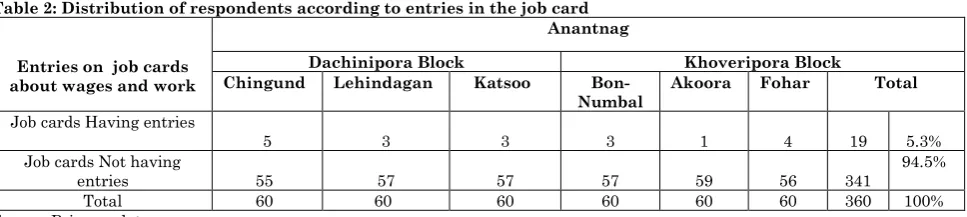
Entries in the Job Cards Table 2: Distribution of respondents according to entries in the job card
Entries on job cards about wages and work
Anantnag
Dachinipora Block Khoveripora Block Chingund Lehindagan Katsoo
Bon-Numbal
Akoora Fohar Total
Job cards Having entries
5 3 3 3 1 4 19 5.3%
Job cards Not having
entries 55 57 57 57 59 56 341
94.5%
Total 60 60 60 60 60 60 360 100%
Source: Primary data
At the time of survey it is found that only 5 job cards have been entered with information about wages and number of days work done
by workers. About 95% of job cards are found without entry of such information.
Table 3: Distribution of respondents who demand employment
R es p o n d en t s E m p l o y m en t
A n a n t n a g
D a ch i n i p o r a Bl o ck K h o v er i p o r a Bl o ck Ch i n g u n
d
Leh ed i n g a n
K a t s o o
Bo n -N u m ba
l
A k o o r a
Fo h a r
To t a l
Ha v e d em a n d ed em p l o y m en t
0 5 1 0 12 8 26 7. 2%
Ha v e p r o v i d ed E m p l o y m en
t
60 55 59 60 48 52 33
4
92. 5 %
To t a l 60 60 60 60 60 60 36
0 100%
So u r c e : P r im ar y data
The Table 3 portrays that out of total sample of 360 respondents only 26 respondents who have demanded jobs and 334 respondents have not demanded jobs under scheme MGNREGA work but on questioning about it
respondent workers revealed that they were contacted by contractor directly and he offered them jobs under scheme.
Payment of wages
Table 4: Distribution of respondents according to payment of wages
Wages on time
Anantnag
Dachinipora Block Khoveripora Block
Chingund Lehedingan Katsoo Bon-Numbal Akoora Fohar Total
Yes 0 0 0 0 0 0 0
No 38 53 15 47 19 24 196
Sometime 22 7 45 13 41 36 164
Total 60 60 60 60 60 60 360
Source: Primary data
The Table 4 portrays that out of total sample of 360, 164 respondents (45.4%) reported that sometime wages were paid within a period of 15 days and majority of respondents reported that there is delay in payment of wages. Important reasons for the delay in payment
of wages as told by the respondents in group discussions were delay in making available the MGNREGS funds, lack of staff, delay in measurement, and delay on the part of the bank etc.
Awareness about worksite facilities Table 5: Distribution of Respondents according to worksite facilities
Awareness about worksite facilities
Anantnag
Dachinipora Block Khoveripora Block Chingund Lehindagan Katsoo
Bon-Numbal
Akoora Fohar Total
Yes 6 4 5 6 3 6 30 8.3%
No 54 56 55 54 57 54 330 91.7%
Total 60 60 60 60 60 60 360 100%
Source: Primary data
Table 5 shows that out of total sample of 360 respondents only 30 respondents (8.3%) have awareness about the worksite facilities and majority of 330 respondents (91.7%) have not awareness about worksite facilities. When observation was made at the time of survey there found no such facility at worksite.
When beneficiaries were interviewed they stated that they did not aware of such provisions in the scheme. Majority of work done under contractors and he never provided such facilities.
Participation of Respondent workers in Gram Sabh
Ta bl e 6 : D i s t r i bu t i o n o f R es p o n d en t s a cc o r d i n g t o t h ei r p a r t i ci p a t i o n i n G r a m S a bh a P a r t i ci p a t i o n
i n G r a m S a bh a Dac h in i po r a B lo c k A n a n t n a g Kh o v e r ipo r a Blo c k Ch in g u n d L e h e din g an Katso o Bo n
-N u m bal
Ak o o r a F o h ar T o tal
Yes 2 4 3 2 2 4 17 4. 7%
N o 58 56 57 58 58 56 343 95. 3%
To t a l 60 60 60 60 60 60 360 100%
Out of total 360 respondent workers only 17 workers accepted that they had participated in Gram Sabha meetings as shown in table 6.6.Alarge chunk of respondent workers (343) told that they have no knowledge about
meetings of Gram Sabha regarding MGNREGA work.
Awareness about Provisions of MGNREGA Among Workers
Table 7: Distribution of Respondents in selected villages with respect to awareness of MGNREGA
S o u r c e o f I n f o r m a t i o n
A n a n t n a g
D a ch i n i p o r a Bl o ck K h o v er i p o r a Bl o ck Ch i n g u n d Leh ed i n g a n K a t s o o Bo n
-N u m ba l A k o o r a Fo h a r To t a l Gr am
pan c h a y at
6 6 10 7 9 10 48 13. 3%
Me dia 0 0 0 0 0 0 0 0%
P o ste r 0 0 0 0 0 0 0 0%
Gr am Ro zg ar Sah ay ak
0 41 38 13 43 29 164 45. 4%
T h ir d
pe r so n 54 13 12 40 8 21 148 41%
T o tal 60 60 60 60 60 60 360 100%
So u r c e : P r im ar y data
The Table 7 portrays that out of total sample of 360 respondents 48 respondents gets information about MGNREGA from Gram Panchayat,164 respondents aware through Gram Rozgar Sahayak and 148 respondents aware through third person (contractor etc). All in all it can concluded that at grassroots level implementation of MGNREGS in study area is severely beset by malpractices; corruption; inefficiency; lack of knowledge; least participation.
Conclusion
Strengths
As the scheme provides guarantee for 100 days of employment to the willing household in the vicinity of village.
A considerable reduction in distress migration through MGNREGA in study area is a major achievement of the scheme.
Weaknesses
Use of machineries by contractors is great loophole in schemes which weakens the very purpose of labour employment. Also involvement of contractor is serious concern to address.
It is also found contractors and panchs call their own relatives and acquaints in social audit.
Political interference and pressure of higher authorities create disruption in functioning of Gram Panchayats. Works assigned by Panchayats are largely political motivated.
Opportunities
Availability of worksite facilities is important factor that can raise the profitability of the scheme in future.
Literacy among the members of panchayat
and Sarpanchs also one more step of
success.
Threats
MGNREGA has become important part of the life of rural poor and a considerable share of their livelihood depends upon MGNREGA earnings.
It is found that contractors take contracts from Sarpanchs and ward members for MGNREGA works and with help of machinery they completed work ruin the concept of labour work.
References
1. Dre’ze J (2009) “Employment guarantee or
slave labour” ?, The Hindu Opinion page, September, 19.
2. Raj Kumar, Kumar Sunil (2009)
"Implementing NREGS in Haryana: A Study of Social Audit", Kuruksetra, 57:41-44.
3. Bhat Basharat, Mariyappan P (2014) “Impact of
MGNREGA on Unskilled Labourers”, An International Journal of Ideas, 28:37-40.
4. Farooqi Saleem,Imran Saleem (2015)
“Mahatma Gandhi National Rural Employment Guarantee Act (MGNREGA) and Empowerment of women from BPL families in rural areas: A case study of district Aligarh (India)”, IOSR Journal of Humanities And Social Science, 20:07-16.
5. Five-Year Plans, Planning Commission,
6. Govt. of Jammu and Kashmir (2011) “State Profile,” Ph D Chamber of Commerce and Industry.
7. Govt. of Jammu and Kashmir (2011) “District
census Handbook Anantnag”, Directorate of Census operations Jammu and Kashmir.
8. Narang AS (1996) Indian Government And
Politics, Gitanjali Publishing House.
9. Singh SP, Nauriyal DK (2009) “System and
Process Review and Impact Assessment of NREGS in the state of Uttarakhand”, Indian Institute of Technology, Roorkee.
10. United Nations Department of Economic and