Research Article
July
2017
Computer Science and Software Engineering
ISSN: 2277-128X (Volume-7, Issue-7)
Effectiveness of Ant Colony Optimization for Weighted
Page Rank Algorithm in Web Access
T. Mylsami
Department of Computer Science and Information Technology, Dr. G.R. Damodaran College of Science,
Coimbatore, Tamil Nadu, India
Dr. B. L. Shivakumar
Department of Computer Applications, Sri Ramakrishna Engineering College, Coimbatore,
Tamil Nadu, India
DOI: 10.23956/ijarcsse/V7I7/0223
Abstract: In general the web is growing very rapidly and data generation is also vast and high. Search Engines play an eminent role in retrieving data from web. The user searching for a topic in a web and it retrieves more than hundreds of searchresults as websites. Among the all websites it is difficult for the user to access all the web pages to find relevant information. Weighted Page rank algorithms play a dominant role to make navigation easier to the user. The popularity of a web page depends on the number of its in links and out links and each webpage gets a proportional page rank value. This algorithm considers only link structure not thecontent of the page, so it returns lesssignificant pages to the user query. To overcome the above issues the study focuses on Ant Colony optimization. This study proposes application of ant colony algorithm for modified weighted page rank algorithm. The ACO concept will discovery of redundant components, use clustering based on the structure similarity or web behavior for user and similar WebPages matching. User and webpage similarity matching using Ant colony Optimization based clustering will leads to better access of the webpage in less time and required webpage.
Keywords: ACO, NLP, TSP, QAP
I. ABOUT WEB MINING
In general internet is the place where data generation in huge amount and any user interact with other user through internet.Internet is the reliable source for any person to access data at any time. The term data mining refers to extract unknown data from the existing data. The term web mining refers to extract data from website through available methods and techniques.
Web mining is the process of using data mining techniques and algorithms to extract information directly from the Web by extracting it from Web documents and services, Web content, hyperlinks and server logs. The goal of Web mining is to look for patterns in Web data by collecting and analyzing information in order to gain near into trends, the industry and users in common.
Web mining is a branch of data mining techniques to extract knowledgefrom webpage, it conisist of web documents, hyperlinks between documents, and usageof web logs. Web mining is the application of data mining techniques to extract knowledge from web data, web content, web structure, and web usage data.
Specifically Data mining intent on the World Wide Web as the primary data source, including all of its components from Web content, server logs to everything in between. The contents of data mined from the Web may be a collection of information that Web pages are meant to include any type of data, and these may consist of text, structured data such as lists and tables and also images, video and audio file contents.
Types of Web mining
Web content mining — The process of mining useful information from thecontents of Web pages and Web documents, which are mostly text, images and audio/video files. Techniques used in this disciplinefrom natural language processing (NLP) and information retrieval process.
Web structure mining — The process of analyzing the nodes and connection structure of a website through the use of graph theory. It concentrates on two key points on the structure of a website, how it linked to another website and as well how the each page is connected.
Web usage mining —Theprocess of extracting patterns and information from server logs to gain near on user activity. It provides how many click done by the user on the website and the various activities done on the website by user.
II. WEIGHTED PAGE RANK ALGORITHM
Page Rank is an algorithm used by Google Search to rank websites in their search engine results. Page Rank is a way of measuring the importance of website pages.Page Rank is a link analysis algorithm used by Google to help determine the relative importance of a website. Every website is given a Google Page Rank score between 0 and 10 on an exponential scale.
ISSN(E): 2277-128X, ISSN(P): 2277-6451, DOI: 10.23956/ijarcsse/V7I7/0223, pp. 375-379
Among the various page rank algorithms, the weighted page rank algorithm plays a different role in web access.Weighted PageRank algorithm assigns larger rank values to more important(popular) pages. Every outlink page gets a value relative to its reputation (its number of inlinksand outlinks). The popularity from the number of inlinks and outlinks is recorded as
Win (v,u) and W out ( v,u ), respectively.
Wenpu Xing and Ali Ghorbaniproposed an extension to standard Page Rank called Weighted PageRank (WPR). This algorithm assigns larger rank values to more important pages instead of dividing the rank value of a page evenly among its outgoing linked pages. Each outlink page gets a value proportional to its popularity or importance and this popularity ismeasured by its number of incoming and outgoing links.
The recognition is assigned in terms of weight values to the incoming and outgoing links, which are calculated using Win(v,u) and Wout(v,u) respectively.
Win (v, u) is the weight of link (v, u) calculated based on the number of incoming links of page u and the number of incoming links of all reference (outgoing linked) pages of p.
Win (V,U) = Lu / ∑ Lp
Lu, Lp represent the number of inlinks of page u and p respectively.
Wout (V,U) = Ou / ∑ Op
Weighted PageRank (WPR) algorithm is upgrading of PageRank algorithm. This algorithm assigns a larger rank values to the more key pages rather than dividing the rank value of a page equally among its outgoing linked pages. Each outgoing link gets a value proportionalto its webpage. The importance is assigned in terms of weight values to the incoming and outgoing links and are denoted as Win(u,v) and Wout(u,v) respectively.
Win(u,v)is the weight of link (u, v) calculated based on the number of incoming links of page v and thenumber of incoming links of all orientations pages of page u.Where Iv and Ip are the number of incoming links of page v and page p respectively. R (u) denotes the allusion page list of page u.
Win (u,v)= Iv / ∑p R(u) IP
Where Iv and Ip are the number of incoming links of page v and page p respectively. R (u) denotes the reference page list of page u.
III. ANT COLONY OPTIMIZATION
ACO is a class of algorithms,called as Ant System, was initially proposed by Colorni ,Dorigo and Maniezzo.Ant algorithms act as a multi-agent approach to difficult combinatorial optimization problems like the traveling salesman problem (TSP) and the quadratic assignment problem (QAP).
The idea behind the Ant system, loosely inspired by the behavior ofreal ants, is that of a parallel search over several constructive computational threads based on local problem data and on a dynamic memory structure containing information on the quality of previously obtained result. Ant Colony Optimization (ACO) is designedfor higher level procedure providing a sufficient solution to optimization problems. The first algorithm which can be confidential within this framework was presented in 1991.
Ant algorithm inspired from the concept of real ant colonies. Ants are social insects, usually it live in colonies and those ants survival of the colony as colony or whole, not of individual ant of the colony. The key success of the ant colony optimization is that, ant can find the shortest paths between food sources and their nest.
The key advantage of Ant colony optimization is that ants do some strategy and again allows the dynamic rerouting through shortest path, if one node breaks in uncertain situation. This method used in telephone network, internet, it comesunder Travel salesman problem. The following is the basic structure of ant colony system.
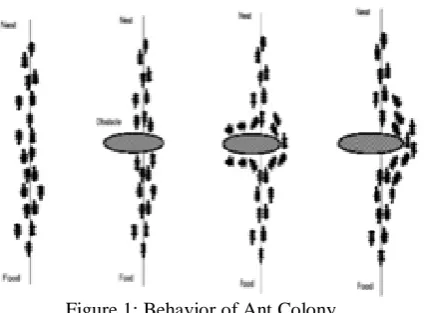
Figure 1: Behavior of Ant Colony
The following is the standard Ant colony Algorithm, Let um and Lm be the number of ants that have used the
ISSN(E): 2277-128X, ISSN(P): 2277-6451, DOI: 10.23956/ijarcsse/V7I7/0223, pp. 375-379
P u(m) = (um + k) h
/ (um + k) h + (lm + k ) h
Figure 2: Logical diagram for ant flow system.
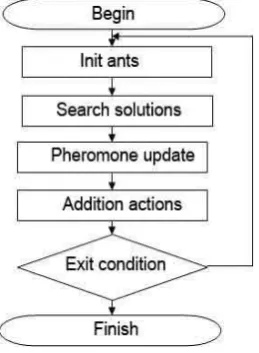
Figure 3 : Flowchart for Ant search
From the figure 3, ant starts searching from the source to designation. Initially the starting point called as entry state and it proceed to next step and check for goal state. If it reaches goal state, then it starts repeating the task to complete the process. One the path has been found tentatively, ant uses the pheromone for repetition process and also to come back from goal to initial state. The same concept used in webpage search for web mining concept to reach the goal state.
Basic path finding by Ant System
The following figure highlights the shortest path find done by ant through available paths n the whole system. Ant searches the path from nest to the food with shortest path as its objective to reach the food.
ISSN(E): 2277-128X, ISSN(P): 2277-6451, DOI: 10.23956/ijarcsse/V7I7/0223, pp. 375-379
The Ant start searching from the nest to the food, in some situation it reach the foodwithout any obstacles, in the figures highlights the obstacles based system. It start search from nest when it reach the obstacles, basically it takes alternate path to reach food. It uses both the path to overcome the obstacles, and it calculates the shortest path with help of pheromones. The above figure concludes that obstacle is not the factor to stop searching; ant uses the all possible ways to reach the goal state with shortest path.
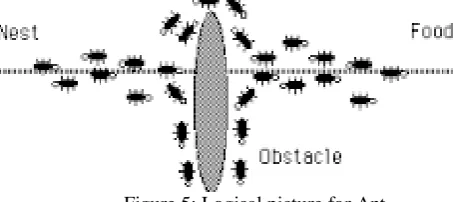
Figure 5: Logical picture for Ant
From above logical diagram is that ant searching for food, at the time obstacle may occur in any possible ways. In such a situation, ant looks for all possible ways to reach the destination. Ants calculate all the possible ways and finalize the shortest path to reach the goal state, with the help of access media called as pheromone. The pheromone is the base media for path to find the shortest path in time.
The figure 6 shows the basic activities covered by ant in the search the destination in shortest path. The figures divides in to four section of A, B, C, D. The section A represents that the ant start from nest to food in normal flow with the help of finding shortest path. Second the section B, ant start searching from nest to food with some obstacles, and ant faces difficult in finding the path.
The section C represents, the ant start searching from nest to food with obstacles, ant check for all possible ways to overcome the obstacle to reach the food in time. In this section ant finds the all possible path with some strategy. In final section D, ant has planned the possible ways or route to reach goal state. It uses the shortest path method to reach the goal / food state in time. To achieve the shortest path, antuses the pheromone as media. The same methods to be used for web access to achieve the exact webpage.
Figure 6: Ant done by Ant Colony System
ISSN(E): 2277-128X, ISSN(P): 2277-6451, DOI: 10.23956/ijarcsse/V7I7/0223, pp. 375-379
From the ant colony optimization concept, ant frames the trial marking before the actual search start from nest to food. First part of the above figures states that, ant uses the method of finding food through possible ways and while searching the path, it applies the pheromone in the way ant traveled. Ant again and again repeats the process for achieving the goal state. Second part of the picture says that, the ant uses the method of finding another possible ways to reach it. Finally the section three says that, comparing the all paths and finds the shortest path t reach the goal state in time.
Types of Ant interaction
The Ant colony system uses the following interactions system as follows 1. Direct interactions
Food or liquid exchange
Visual contact
Chemical contact i.e through pheromones 2. Indirect interactions (Stigmergy)
Individual behavior modifies the environment, which in turns modifies the behavior of other individuals.
IV. CONCLUSION
Thus the above concept of Ant colony optimization has been applied in various fields of web access. The key functions of Ant colony optimization is that to find the similar web pages accessed by the user and that are grouped. Through this method the less time is required for web search process. Finally the efficiency of web access successfully done through Ant colony Optimization method and to fulfill the user need in all possible ways.
REFERENCES
[1] Xiaoyong Liu, Hui Fu, An Effective Clustering Algorithm with Ant Colony, Journal of Computers, Vol.5, No.4, April 2010.
[2] O.A.Mohamed Jafar and R.Sivakumar, Ant-based Clustering Algorithms : A Brief Survey, International Journal of Computer Theory and Engineering, Vol.2, No.5, October 2010, 1793-8201.
[3] Marco Dorigo and Ganni Di Caro, Luca M. Gambardell, ― Ant Algorithms for Discrete Optimization‖, Artificial Life, MIT Press,1999.
[4] Mohammad hadi Afshar, H.ketabchi, E.Rasa, ―Elitist continuous Ant Colony Optimization Algorithm: Application to Reservoir Operation Problems‖, International Journal of Civil Engineering Vol.4, No.4, Dec 2006.
[5] Sorin C.Negulesu, Constantin Oprean, Claudin V. Kifor, Ilie Carabulea, ― Elitist Ant System for Route Allocation Problem‖, WSEAS International Conference on Applied Informatics and Communications, Greece, Aug 20-22, 2008.
[6] Thomas Stutzle, Hogler H.Hoos, ―MAX – MIN Ant System‖, Furture Generation Computer Systems, Vol.16, 2000, pp. 889-914.
[7] Shi Chen, Chao Gao, Xianghua Li, Yitong Lu, Zili Zhang, ―A Rank based Ant System Algorithm for Solving 0/1 Knapsack Problem‖ Journal of Computational Information System, Vol.11: 20, 2015, pp. 7423-7430. [8] Bernd Bullnheimer, Richard F.Hartl, Christine Straub, ― A New Rank Based Version of the Ant System- A
Computational Study‖, adaptive Information Systems and Modelling in Economics and Management Science. [9] Oscar Cordon, Inaki Fernandez de Viana and Francisco Herrera, ― Analysis of the Best – Worst Ant System and
its Variants on the QAP‖, Springer – Verlag Berlin Heidelberg 2002, pp 228-234.