Research Article
a
August
2017
Computer Science and Software Engineering
ISSN: 2277-128X (Volume-7, Issue-8)
Intra-flow Contention Scheme for Improving QoS in WLAN
Simranjeet Kaur*, Maninder SinghDepartment of Computer Science, Punjabi university Patiala, Punjab, India
DOI: 10.23956/ijarcsse/V7I8/0119
Abstract—.With the increasing popularity of wireless local area network(WLAN),the demand for multimedia services encompassing VoIP, multimedia streaming and interactive gaming is increasing rapidly. The real-time services require stringent Quality of Service (QoS) guarantees for effective communication. While a lot of research has dealt with providing QoS support for real-time services in traditional wired networks, the shared and broadcast nature of the wireless medium necessitates the design of new solutions for wireless networks. In wireless networks, unlike wired networks, the communication from one node will consume the bandwidth of the neighboring nodes and hence the shared bandwidth can be easily over-utilized. Therefore, to provide an acceptable level of QoS for the real-time services, it is necessary to control the utilization of the shared bandwidth. In this paper , we propose an efficient admission control scheme named Intra-flow contention scheme with CAC-OLSR routing protocol for WLAN networks which aims at preserving the QoS for all the admitted flows by employing a low overhead threshold mechanism. We describe several alternatives for the design of IAC and compare the performance of these alternatives using simulation results.
Keywords— QoS, WLAN, IAC, CAC-OLSR, IEEE802.11e.
I. INTRODUCTION
With the diminishing costs of electronic hardware, IEEE 802.11 based wireless local area networks(WLANs) have been massively deployed in public and residential places such as classrooms, airports and apartments, and more and more devices and peripherals are integrated with WLAN access capability. On the other hand, with the increasing popularity of multimedia applications, quality of service (QoS) support in communication networks has become more and more important. QoS can be interpreted as the ability for a network to provide some consistent services for multimedia delivery. The internet engineering task force(IETF) has defined two different frameworks, integrated services (IntServ) and differentiated services (DiffServ)[1], for Internet traffic with QoS. Compared with wired networks, to provide QoS in wireless networks is even more challenging since wireless networks have limited bandwidth, and radio channels are error-prone environment affected by multi-path shadowing, interference, weather and so on. For WLANs, IEEE 802.11 is designed for best effort services. The 802.11 standard specifies two medium access control (MAC) mechanisms: the mandatory Distributed Coordination Function (DCF) and the optional Point Coordination Function (PCF) .The lack of a built-in mechanism for supporting real-time services makes it very difficult to provide QoS guarantees for multimedia applications. To enhance the QoS support in 802.11, the IEEE 802.11 working group is currently working on a new standard, known as the IEEE 802.11e , which introduces the so-called hybrid coordination function (HCF). HCF includes two medium access mechanisms:
contention-based channel access, controlled channel access (includes polling). Contention-based channel access is referred as enhanced distributed channel access (EDCA), and controlled channel access is referred as HCF controlled channel access (HCCA).Although the 802.11e standard has defined the QoS-enabled MAC mechanisms, how to apply these mechanisms in different QoS issues is not specified. Among various QoS issues, admission control is an important component for the provision of guaranteed QoS parameters. The purpose of admission control is to limit the amount of traffic admitted into a particular service class so that the QoS of the existing flows will not be degraded while at the same time the medium resources can be maximally utilized. In this article, we provide a survey of recent advances in admission control algorithms/protocols in IEEE 802.11e WLANs. Our survey covers the research work of admission control for both EDCA and HCCA. Our purpose is to study how those new QoS schemes and parameters provided in EDCA and HCCA can be well utilized to fulfill the requirements of admission control so that QoS for multimedia applications can be provided in WLANs.
A. IEEE 802.11E QOS MECHANISMS
Due to the limitations of DCF and PCF, the 802.11e defines a single coordination function, HCF, which combines the functions from both DCF and PCF for QoS data transmission. In 802.11e, a superframe still consists of the two phases of operations, i.e., CP and CFP. EDCA is only used in the CP while HCCA can be used in both phases. The major benefits offered by the 802.11e standard are:
1. Reducing the latency through prioritizing different types of traffic packets;
2. Enabling access points (APs) to allocate resources based on data rate and latency requirements from each individual station;
ISSN(E): 2277-128X, ISSN(P): 2277-6451, DOI: 10.23956/ijarcsse/V7I8/0119, pp. 106-111 B. HCF Contention-Based Channel Access
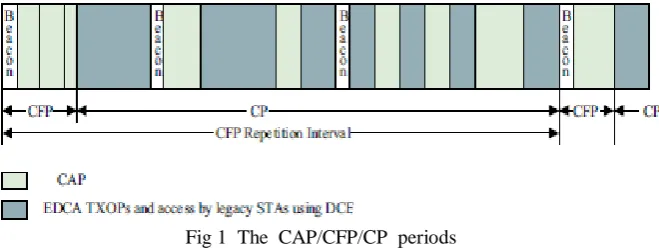
In EDCA, the QoS support is realized through introducing multiple access categories in each QoS station (QSTA). EDCA defines four ACs, and different ACs have different priorities, servicing different types of traffic. Table I shows the mapping between the user priorities (UPs)[2] specified in IEEE 802.1D and the ACs in 802.11e. As shown in Fig 1, each AC is an enhanced variant of DCF that contends for transmission opportunity (TXOP) using AC specified channel access parameters from the EDCA parameter set, which specifies Minimal CW value for a given Access category (CWmin[AC]): CWmin can be different for different ACs. Assigning smaller values of CWmin to high priority classes can ensure that high priority classes obtain more TXOPs than low priority ones.Maximal CW value for a given
AC (CWmax[AC]): Similar to CWmin, CWmax is also on a per AC basis.
Table I 802.1d Priority - Ac Mapping
1) Contention Window(CW):The CW value is dependent on the access category. There are two variations of the contention window CWmin and CWmax which means contention window minimum and contention window maximum respectively. Assign conte ntion window smaller values to the high priority classes which means that higher priority classes contain more transmission opportunity(TXOP) than low priority classes.
2) Arbitration Inter-Frame Space (AIFS):Every back-off entity has different Inter frame space , which is known as arbitrary inter frame space (AIFS[AC]).
3) TXOP limit: TXOP’s are used in a EDCA parameters is known as EDCA –TXOP’s. The greater the value of
TXOP limit[AC] , the maximum the capacity of channel sharing by backoff entity.
C. HCF Controlled Channel Access
Although EDCA improves the legacy DCF, it is not sufficient to provide effective traffic protection and QoS guarantees, especially under high traffic loads. Here comes the need for the polling-based medium access mechanism, HCCA. Similar to the legacy PCF, HCCA provides polled access to the wireless medium. In particular, HCCA uses a QoSaware hybrid coordinator (HC), which is typically located at the QoS access point (QAP)[3] in infrastructure WLANs. HC uses PIFS to gain control of the channel and then allocates TXOPs to QSTAs, which are referred as HCCA TXOPs or polled TXOPs. Unlike PCF, HCCA can poll the QSTAs during contention periods (CPs), and HCCA takes into account QSTAs’ specific flow requirements in packet scheduling. Fig 1 illustrates the different periods under HCCA.
Fig 1 The CAP/CFP/CP periods
Note that the CAP (controlled access phase) is defined as the time period when HC maintains the control of the medium. It can be seen that CAPs consist of not only CFPs but also parts of CPs. After grabbing the channel, the HC polls QSTAs in turn according to its polling list. In order to be included in the polling list of the HC, a QSTA must send a QoS reservation request using the special QoS management frame, and each individual flow needs one particular reservation request. Fig. 3 depicts a common frame format for carrying traffic specification (TSPEC) parameters. The major TSPEC parameters include
1) Mean data rate (½): the average bit rate for packet transmission, in bits per second (bps);
2) Delay bound (D):the maximum delay allowed to transport a packet across the wireless interface (including queuing delay), in milliseconds;
802.1D Priority
802.1D
interpretations
Access Category
Service type
0 Best Effort AC[0] Best Effort
1 Best Ground AC[0] Best Effort
2 Best Ground AC[1] Best Effort
3 Excellent Ground AC[1] Video probe
4 Controlled load AC[2] Video
5 Video<100ms AC[2] Video
6 Video and voice AC[3] Voice/video
ISSN(E): 2277-128X, ISSN(P): 2277-6451, DOI: 10.23956/ijarcsse/V7I8/0119, pp. 106-111 3) Maximum service interval (SImax): the maximum time allowed between neighbor TXOPs allocated to the same station, in microseconds;
4) Nominal MSDU size (L): the nominal size of a packet, in octets;
5) Minimum PHY rate (R): the minimum physical bit rate assumed by the scheduler for calculating transmission time, in bps. For the definitions of other parameters, details can be found in the 802.11e draft [4].Note that, although the QAP decision is based on the characteristics of individual flows, the HCCA TXOPs are actually assigned on a per QSTA basis instead of per flow, and each QSTA is then responsible for allocating the TXOPs to its individual flows.
D. CAC-OLSR
The CAC-OLSR method, it stands for Call Admission Control-Optimized Link State Routing , uses the mechanism for flow admission by check the current channel time occupation and the estimated bandwidth occupation that is needed by a new admitted flow. The CAC-OLSR aims to ensure that the traffic flows between the stations with quality of service requirements, especially voice and video , are only entered in the wireless local area network if it has available resources in order to provide sufficient flow requirements. And the Quality of service of the previously entered traffic flows cannot be decreased. This mechanism can be evaluated by the NS-2 proposal. Furthermore, it uses the IEEE 802.11e access categories, check inter and intra-flow interference and deals with quality of service requirements. To measure the estimation of channel gain, carrier detection is used for a given period of time(that time in which we want to access the channel). This can be done in IEEE 802.11 by sensing a function called PHYCS – PHY carrier sense, which tells that the channel is busy or idle. In other sentences , channel must be assumed idle during transmission or reception of traffic without quality of service(best effort and background) considering. This mechanism was adopted to control non-admission of Quality of service flows because of channel can access with traffic without providing proper quality of service. It is considered here, as adopted in , that the lower channel access priority and the use of TCP will automatically degrade best effort and background traffic category throughput in the presence of quality of service traffic. The rest of the paper is organized as follows: Section II covers the related work of our problem. Section III and IV reveal existing and proposed schemes. Section V shows the simulation results of proposed and existing schemes. We conclude our work in Section VI.
II. RELATED WORK
In this section, we discuss several existing admission control algorithms in the area of wired, ad hoc , wireless mesh networks and Traditional approaches like IntServ/RSVP and DiffServ[11] for QoS provisioning on the internet do not work well for wireless networks due to the inherent distinctions between the wired and wireless networks.
INSIGNIA[7] and SWAN[8] are both protocols that provide QoS guarantees by controlling the traffic in ad hoc network. INSIGNIA relies on in-band signaling by piggybacking the control information on data. This in-band signaling allows INSIGNIA to quickly re-establish flow state when topology changes occur. SWAN, an alternative to INSIGNIA, is characterized by its improved scalability. Here, the per-flow information is not stored in the intermediate nodes and therefore the protocol avoids complex signaling which makes the system more simple and scalable. However, the downside of both these schemes is that neither takes into account the fact that the communication from one node may consume the resources of the neighboring nodes in addition to its local resources. TAC[9] and AAC-AODV[10] implement flow admission control based on intra-flow interference. However, both these schemes do not give enough attention to inter-flow interference and thus, fail to estimate the neighbor available bandwidth.
Sanjeev Kumar[11] gave a proposed scheme on soft computing. It took the survey of different CAC schemes that are used for mobile multimedia networks use the soft computing as the base technique like fuzzy logic, artificial neural network and genetic algorithms. Soft computing can give the optimized results.
V.S.S. Vyshnavi [12] explained the adaptive bandwidth management for HWN’swith considering the requirements of CAC algorithm by using a bandwidth level degradation algorithm and a CAC algorithm. This algorithm differentiates the incoming traffic that is used by each class and give priority to the handoff calls over the new calls which want to access the channel to guarantee quality of service requirements of accepted calls ,it decrease the call blocking probability and a handoff call dropping probability and maintain the efficient network consumption. Samrin Shareef [13]in this paper we examined the preference to wireless local area network(WLAN) is calculated ,that is based on the traffic load in the WLAN and the location where the cellular users are located and from the analysis of past study that divides the cellular area into zones that is based on the quantity of the resources that are used to support connections to a mobile user. With the help of this model ,we can calculate new call blocking and handoff failure probability and new call and call handoff attempt failure probabilities. Chakeres and Belding-Royer[14] use the reactive protocol to provide association, In this we find the optimal path when we want to enter a new flow. but they did not give any information how this method can be implemented to the OLSR protocol. And this research also not consider the intra-flow interference.
III. INTERFERENCE CONTENTION ALGORITHM
ISSN(E): 2277-128X, ISSN(P): 2277-6451, DOI: 10.23956/ijarcsse/V7I8/0119, pp. 106-111
requires all the receiving nodes to buffer these broadcasts and as a result when a new flow request arrives at each node, it locally determines whether the incoming flow can be accepted by comparing the new flow requirement with the buffered bandwidth information. In this sequel, initially we discuss how to determine the local and neighbor available bandwidth of a given node. Then, we focus on the design of the proposed algorithm, IAC and several challenges associated with the design of IAC.
In the existing schemes ,we studied the admission of the new flow and check the performance of all the nodes on the channel. The previous techniques did not provide the proper bandwidth for the nodes and in this way the required performance is not achieved.
IV. PROPOSED WORK
Before glancing the proposed work, several assumptions based on related search is made which can add the features to the existing approach by enabling the mobility with energy efficient routing scheme.
In proposed approach, to eliminate the overhearing problem of existing scheme mentioned in above section,we design a new approach which is based on following assumptions:
A. Intra-flow Contention Measurements
Determining the accurate intra-flow contention count depends on the interference range of a node. Assuming that the nodes within the two hops distance can cause interference, the interference count on any node along the data forwarding path mainly depends on the node’s distance from the source and the destination nodes. For a new flow’s admission request, Intra-flow Contention scheme determines the actual intra-flow contention counts on source, intermediate (data relaying nodes), and destination nodes. Fig 2 depicts the guidelines for determining the intra-flow contention count on the source and the destination nodes, and Fig 2 depicts the guidelines for determining the intra-flow contention count on intermediate nodes between a source-destination pair. The scenarios presented in Fig 2 demonstrate that in order to determine the intra-flow contention count, a node must know its one hop and two hop neighbors. As in Intra-flow contention scheme each node maintains lists of its one hop and two hop neighbors, Intra-flow Contention scheme determine the intra-flow contention count without any additional overhead.
Fig 2 Contention Factor on Source and Destination Node
V. SIMULATION RESULTS
The proposed approach simulates through NS2 version 2.2.8.
Fig 3 Simulation Parameters
To compare the existing and proposed schemes, the following metrics are evaluated: 1. Throughput: It is the amount of data packets transmitted through medium per unit time. 2. Delay: It is the amount of time taken by the nodes to transmit the data packets.
ISSN(E): 2277-128X, ISSN(P): 2277-6451, DOI: 10.23956/ijarcsse/V7I8/0119, pp. 106-111
Fig 3 shows the throughput achieved in both existing and proposed approaches where proposed approach shows more throughput. In the case of aggregate throughput for QoS traffic, CAC-OLSR presented the best result.
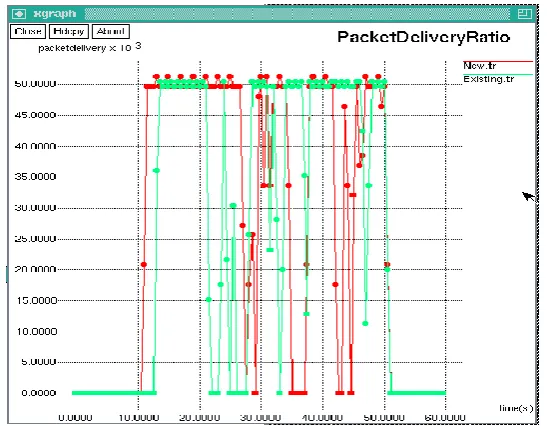
Fig 4 shows packet delivery ratio in both existing and proposed approaches where PDR in proposed scheme is seen at a maximum limit in each phase of time.
Fig 5 shows the delay in both existing and proposed approaches where delay in proposed scheme is always seen less than existing technique .Delay in proposed technique is seen up to maximum 50 whereas in existing its maximum
ISSN(E): 2277-128X, ISSN(P): 2277-6451, DOI: 10.23956/ijarcsse/V7I8/0119, pp. 106-111
VI. CONCLUSION AND FUTURE WORK
In this paper, we present an Intra-flow contention scheme for use in WLAN. The core concept of this scheme is to use a low overhead dual-threshold based approach to share the bandwidth information with the neighbors in the interfering range. As a result, this scheme guarantees that the shared wireless bandwidth is not over-utilized and the quality of all existing flows are preserved. Moreover, Intra-flow contention scheme takes into account the intra-flow interference effect to estimate the bandwidth consumption of the flow in a multi-hop path. We have also proposed an intraflow measurement scenario which helps to count the neighbor nodes of the source . Simulation results illustrate that Intra-flow contention scheme effectively limits the over-utilization of channel resources which in turn results in high throughput, low delay and low packet loss rate for all admitted flows. In this work, we assume error free wireless channel and plan to extend this work to perform admission control in the presence of channel errors.
ACKNOWGEMENT
I owe my special thanks to Maninder Singh, Assitant Professor,Department of Computer Science, Punjabi University,Patiala,who helped and guided me for this work .His encouraging remarks from time to time greatly helped me in improving my skills.
REFERENCES
[1] R. Braden, D. Clark, and S. Shenker, “Integrated services in the Internet architecture: An overview,” RFC 1633, June 1994.
[2] S. Blake, D. Black, M. Carlson, E. Davies, Z. Wang, and W.Weiss, “An architecture for differentiated service,” RFC 2475, Dec. 1998.
[3] Wireless LAN Medium Access Control (MAC) and Physical Layer (PHY) Specifications, IEEE Std. 802.11, 1999.
[4] Wireless Medium Access Control (MAC) and Physical Layer (PHY) Specifications: Medium Access Control
(MAC) Quality of Service (QoS) Enhancements, IEEE P802.11e/D6.0, Nov. 2003.
[5] X. Yang, “IEEE 802.11e: QoS provisioning at the MAC layer,” IEEE Wireless Commun. Mag., vol. 11, no. 3, pp. 72–79, 2004.
[6] S. Mangold, S. Choi, G. Hiertz, O. Klein, and B. Walke, “Analysis of IEEE 802.11e for QoS support in wireless LANs,” IEEE WirelessCommun. Mag., vol. 10, no. 6, pp. 40–50, 2003.
[7] S. Lee, G. Ahn, X. Zhang and A. T. Campbell, “INSIGNIA: An IPBased Quality of Service Framework for Mobile Ad Hoc Networks,” in Journal of Parallel and Distributed Computing, vol. 60, pp. 374-406, 2000. [8] G. Ahn, A-T. Campbell, A. Veres and L. Sun, “SWAN: service differentiation in stateless wireless ad hoc
networks,” in Proceedingsof Infocom, vol. 2, pp. 457- 466, 2002.
[9] C. Rodrigo Cerveira and L.H. M. K. Costa, “A Time-based Admission Control Mechanism for IEEE 802.11 Ad Hoc Networks,” in SpringerBoston, vol. 211, 2006.
[10] R. de Renesse, M. Ghassemian and V. Friderikos “Adaptive Admission Control for Ad Hoc and Sensor Networks Providing Quality of Service,” Technical Report, Center for Telecommunications Research, King’s
College London, UK, May. 2005.
[11] Sanjeev Kumar,Krishan Kumar, Anand Kumar Pandey” A Comparative Study of Call Admission Control in Mobile Multimedia Networks using Soft Computing,” ’International Journal of Computer Applications, ISSN: 0975–8887, vol: 107, No: 16, pp: 5-11(2014)
[12] E.V.S.S.Vyshnavi,T.Sunitha”A Call admission Control Algorithm to Enhance the Network Management in Heterogeneous Wireless Networks,” International Research Journal of Engineering and Technology, p-ISSN: 2395-0072, vol: 3, pp: 1506-1503(20.16)
[13] Samrin Shareef, P.Prasanna Murali Krishna” Call Admission Control Scheme to Determine the Preference for WLAN” International Journal of Scientific & Engineering Research, ISSN 2229-5518, vol: 4, pp: 1728-1733(2013)