ISSN-L: 2501 - 1235 Available on-line at: www.oapub.org/edu
doi: 10.5281/zenodo.2631923 Volume 5 │ Issue 7 │ 2019
CONSEQUENCES OF WEIGHTED VEST AND WEIGHTED SLED
RUNNING ON ELASTIC POWER OF SCHOOL SPRINTERS
S. Ganesan1,
M. Muthuraj2,
R. Srinivas3 1PhD Scholar, Department of Physical Education,
Annamalai University, Tamil Nadu, India 2Assistant Professor Dr., Department of Physical Education, Annamalai University, Tamil Nadu, India 3Principal, Dr., College of Physical Education,
Bangalore University, Karnataka, India
Abstract:
The purpose of the study was to cause of weighted vest and weighted sled running on elastic power of school sprinters. To achieve the purpose of this study, forty five male sprinters from the Public school. The age, height and weight of the subjects ranged from 17 to 19 years, 155 to 165 centimetres and 50 to 55 kilograms in that order. They were divided into three groups; each group consisted of fifteen subjects. Group-I underwent weighted vest sprint training, group-II underwent weight sled training and group-III acted as control who does not participate in any training programme. The data collected from the three groups prior to and post experimentation were statistically analyzed by analysis of covariance (ANCOVA). When the obtained ‘F’ ratio value in the analysis of covariance test was significant, the Scheffe’s test was applied as post hoc test to determine the paired mean differences, if any. In all the cases, statistical significance was fixed at .05 levels. Conclusion: The experimental group sprinters had significant improvement on elastic power when comparing to the control group sprinters.
Keywords: weighted vest, weighted sled, elastic power
1. Introduction
static and dynamic exercises with weighted vest are increase on core body muscles temperature and stimulated to get good warm-up and increase a dynamic range of motion on joints of an athletes. An athlete’s ability to accelerate is dependent upon various factors, including technique (kinematics) and the force production capability (kinetics) of the body, in particular the lower limb musculature. Examples of kinematic factors that are considered important to sprint acceleration performance include step frequency and step length (Hunter, Marshall, and McNair, 2004).
Doing exercise with weighted vest that require more effort by body to overcome gravity of force and possibly more effective. While doing exercise with weighted vest by an athlete’s increase the cardiovascular demands of body systems, even if he runs at slower speed or light activities. The increase of intensity in cardiovascular could be low or high it dependence on the weight of vest. Sprint running has been described as consisting of an acceleration phase, a maximum speed phase, and a deceleration phase (Delecluse, 1997).
Weighted sleds are bounty adaptable read on for some proof but they really stand out as training tools for runners, sprinters, or any athlete looking to improve their explosive legs power. Sled pulling and pushing develops some concrete strength in the muscles of glutes, calves, hamstrings, quads, and core. Not only get gains in strength with sled work, but also improve anaerobic and aerobic conditioning its intense, and more calorie will burn is so good for the athletes.
2. Methodology
3. Results
Table 1: Analysis of Covariance on Elastic Power of Weighted Vest, Sled Running and Control Groups
Weighted Vest Group Weighted Sled Group Control
Group SoV
Sum of Squares df Mean squares ‘F’ ratio Pre-test Mean SD
6.53 6.46 6.47 B 0.041 2 0.020
0.26
0.26 0.29 0.28 W 3.32 42 0.079
Post-test Mean SD
8.04 8.79 6.54 B 39.12 2 19.56
85.30*
0.44 0.63 0.29 W 9.63 42 0.22
Adjusted
Post-test Mean 8.03 8.79 6.55
B 39.07 2 19.54
84.46*
W 9.48 41 0.23
Notes: The required table value for significance at 0.05 level of confidence with degrees of freedom 1 & 42 and 1 & 41 are 3.22 and 3.23 respectively; *Significant at .05 level of confidence
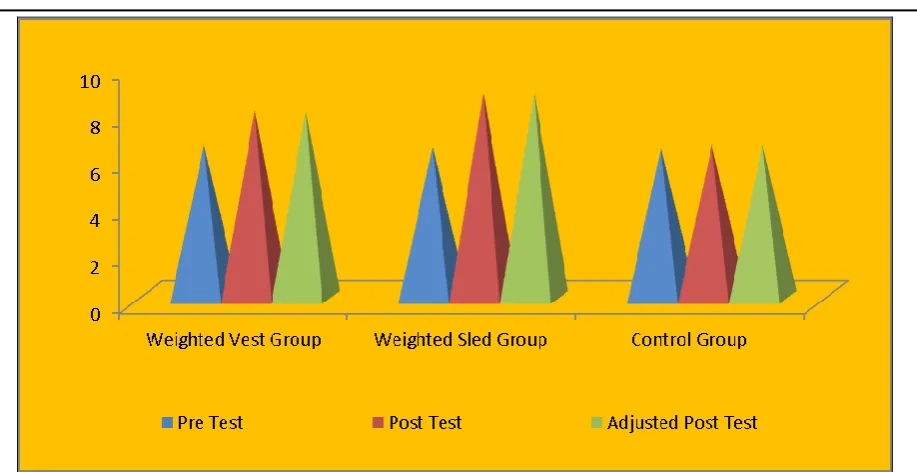
The adjusted post-test means on elastic power of weighted vest, weighted sled running and control groups are 8.03, 8.79 and 6.55 respectively. The obtained ‘F’ ratio value of 84.46 for adjusted post-test means on elastic power of weighted vest, weighted sled and control groups were higher than the required table value of 3.23 for the degrees of freedom 2 and 41 at 0.05 level of confidence. It is observed from this finding that significant differences exist among the adjusted post-test means of experimental and control groups on elastic power. Due to the weighted vest, weighted sled training the elastic power of the subject’s is significantly improved. Since, the adjusted post-test ‘F’ ratio value is found to be significant the Scheffe’s test is applied as post hoc test to determine the paired mean differences, and it is presented in table-II.
Table 2: Scheffe’s Test for the Difference
between the Adjusted Post Test Paired Means of Elastic Power Adjusted Post Test Means
DM CI Weighted Vest Weighted Sled Control Group
8.03 8.79 0.76* 0.29
8.03 6.55 1.48* 0.29
8.79 6.55 2.24* 0.29
*significant
Figure 1: Pyramid Diagram on Elastic Power of Weighted Vest Weighted Sled Training and Control Groups
4. Discussion and Findings
The result of this study stated that there is a significant difference between the weighted vest, weighted sled running group and control group on elastic power. The weighted vest and weighted sled running groups had improved elastic power. The following
studies are supporting our finding of the study. Bellar, et al., (2011) reported around a
5lbs increase in 1RM bench strength after only 3wks of training with a combination of
elastic bands and free weights. Anderson, et al., (2008) reported changes in power
production with athletes who utilized a combination of elastic and free-weight tension. Wallace, et al., (12) demonstrated that power was acutely increased in the back squat exercise with the addition of elastic tension. Sled towing resulted in significantly greater knee angles (i.e. less extension, greater flexion) at foot strike compared with baseline and vest sprinting at all stages of the 30-m sprint. Therefore, during sled towing there was greater knee flexion at foot strike and no change in extension at toe-off. This suggests that during sled towing propulsive forces may act through a greater range, and possibly comprise a greater proportion of the stance phase.
5. Conclusion
References
Anderson, C. E., Sforza, G. A., Sigg, J. A., (2008). The effects of combining elastic and free weight resistance on strength and power in athletes. Journal of Strength and Conditioning Research. 22(2), 567-574.
Bellar, D., Muller, M., Ryan, E.J., Bliss, M.V., Kim, C-H, Ida, K. Barkley, J. E., Glickman, E. L., (2011). The Effects of Combined Elastic and Free Weight Tension vs Free Weight Tension on 1 RM Strength in the Bench Press. Journal of Strength and Conditioning Research. 25(2), 459-463.
Delecluse, C., (1997). Influence of strength training on sprint running performance. Sports Medicine. 24, 147–156
Hunter, J. P., Marshall, R. N., and McNair, P. J., (2004). Interaction of step length and step rate during sprint running. Medicine and Science in Sports and Exercise, 36, 261–271.
Creative Commons licensing terms