Research Article
a
January
2018
Computer Science and Software Engineering
ISSN: 2277-128X (Volume-8, Issue-1)
Dynamic Clustering and Cluster Head Selection for Energy
Optimization under Wireless Sensor Network
Ravinder Singh, Rajdavinder Singh Boparai CGC Group of Colleges, Gharuan, Mohali, Punjab, India [email protected], [email protected]
Abstract- Wireless sensor network is a field of networking that has been used for sensing information from environment. In WSN the sensor nodes are attached to a battery for sensing information. Each node utilizes three types of energy during its lifetime over the network. These energies are sensing energy, transmission or receiving energy and idle energy. During the sensing information the nodes consumes energy and transmission energy is used to transmit a data over a distance. Idle energy is that when node is not working but remains in on state. Due to deployment of WSN in unreachable area energy is main constraint for network to be cost effective.
The major issue is network lifetime that must be increase so that network performs for long duration of time and provide cost effective for an n organization. To overcome this issue various methods had been proposed, chaining, pegasis, clustering and chain head selection are one of these methods.
Index Terms- Base Station, Clusters, Cluster heads, LEACH, Sensor Node, WSN
I. INTRODUCTION
In WSN the sensor nodes are attached to a battery for sensing information. In wireless sensor network the large numbers of sensors are organized in an area to accumulate information from the surroundings area. These sensor nodes consist of
limited hardware resources and restricted battery backup. WSN is a collection of hundreds or thousands of sensor nodes
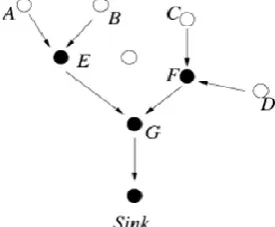
that sense the changes occurred in the environment captured the changes in the form of data using the cameras and the scalar sensors aggregate the data and transmit to the sink the Base Station (BS). The cameras capture data in the form of images or videos and scalar sensors capture scalar data in the form of temperature, pressure etc. In recent time, WSN become most popular because of its low cost, small size, adoption to harsh environment and so on.A WSN may bedesigned with different objectives. It may be designed to gather the data from the environment and process it in order to have abetter understanding of the behaviour of the monitored entity. Itmay also be designed to monitor an environment for theoccurrence of a set of possible events, so that the proper actionmay be taken whenever necessary.A sensor node is a tiny node which is used to sense an event inits transmission range and transmit the sensed data to sink orbase station. When a large number of nodes are deployed inthe field, a group of nodes are combined to form clusters. Eachcluster has a cluster head and manages the data handlingactivities for that cluster. Since data generated in a sensornetwork is too much for an end-user to process, methods forcombining data into a small set of meaningful information isrequired, thus avoiding redundancy. A simple way of doingthat is aggregating from different nodes. In Figure 1, nodes Aand B pass their sensed information to node E. Hence node Eaggregates the data collected by both A and B, thus avoidingredundancy. Node G does a second level of aggregating fromE and F. Thus, during data gathering, it is inefficient to sendthe data from each sensor node to the sink directly. Hence, thenetwork is divided into various clusters and cluster heads arechosen in each cluster. This is done by LEACH (Low –Energy Adaptive Clustering Hierarchy) algorithm. Tomaximize the energy utilization of all sensor nodes clusteringtechniques is used. Clustering helps in increasing overallnetwork lifetime.
ISSN(E): 2277-128X, ISSN(P): 2277-6451, pp. 84-94 Components of WSN
Sensor Node: The core component of WSN. Sensor nodes based on multiple roles in a network, such as simple sensing; data storage; routing; and data processing.
Clusters: Clusters are the organizational unit for WSNs. The dense nature of these networks requires the need for them to be broken down into clusters to simplify tasks such a communication.
Cluster heads: Cluster heads are the organization leader of a cluster. They often are required to organize activities in the cluster. These tasks include to some limit to data-aggregation as well as for organizing the communication schedule of a cluster.
Base Station: The base station is at the upper level of the hierarchical WSN. It provides the communication link between the sensor network and the end-user.
End User: The data in a sensor network can be used for a wide-range of applications. Therefore, a particular application may make use of the network data over the internet, using a PDA, or even a desktop computer [4].
II. RELATED WORK
A literature survey has been done on different approaches that provide solution on different problems in WSN that are energy consumption, network lifetime, network stability period and routing management.
Qiuling Tang et al [1] “Cross-layer energy efficiency analysis and optimization in WSN”Energy conversation is a critical problem in wireless sensor networks (WSNs) so that the energy consumption must be minimized whilesatisfying application requirements. The energy efficiency can be supported across all layers of the protocol stack. In this paper, we propose and analyze a cross-layer energy efficiency model, which takes routing layer, MAC layer, data link layer, hardware circuitry, and battery discharge nonlinearity into account. For successfully delivering all data generated by source nodes to the sink node with minimal network energy consumption, we consider two orthogonal modulation schemes of M-ary pulse position modulation (PPM) and frequency shift keying (FSK), and distribute an appropriate time slot to every link so that the optimal routing can be obtained. Based on the model, we formulate the optimization problem of minimizing network energy consumption and solve it by existed approaches. The numerical results show that, if PPM scheme is adopted, the cross-layer energy efficiency model with optimal routing has up to 99% lower network energy consumption than that with a uniform single-hop routing in general WSN, and the optimal model also exists 93% energy saving if FSK is used. Multi-hop routing is more energy efficiency than single-hop routing in general WSN, while single-hop routing is more preferable in dense WSN.
Sharawi, M. et al [2] “WSN's energy-aware coverage preserving optimization model based on multi-objective bat algorithm” This research expands the scope of wireless sensor network (WSN) optimization from single objective to multi objective optimization. It introduces a WSN's energy-aware and coverage preserve hierarchal clustering and routing model based on multi-objective bat swarm optimization algorithm. Twoobjectives are taken into consideration; coverage and nodes residual energies. The proposed model optimizes theWSN by selecting the best fitting set of nodes as cluster heads. It works to maximize the WSN's coverage and to minimize the nodes' consumed energy. This minimizes the number of active cluster heads while preserving a higher percentage of the covered nodes in WSN. It extends the longevity of the WSN's lifetime and achieves good functioning reliability. The proposed optimization model overcomes the WSN's coverage and lifetime challenges. The proposed model outperforms the LEACH routing and clustering protocol.
Darif, A. Et al [3] “Energy consumption optimization in real time applications for WSN using IR-UWB technology”Energy consumption optimization in Wireless sensor networks (WSN) applications is a major issue and constraint to which researchers are continuously faced to, due to the direct dependence of the network's life time to it. Real time applications using WSN have some requirements to be accomplished; in this paper we targeted the factors influencing real time's performance such as latency time and packets delivery ratio which were studied with different scenario. We present the status of WSN based on Zigbee and IR-UWB technologies, and the specificities of each one. A simulation of a sink based architecture network with various nodes' number has been performed to prove the good impact when using IR-UWB technology to decrease the energy consumption and reduce the latency time. We used MiXiM platform under OMNet++ simulator to analyze and compare the performance of the IEEE 802.15.4 and IEEE 802.15.4a standards with the considered factors.
ISSN(E): 2277-128X, ISSN(P): 2277-6451, pp. 84-94 transmission power is calculated based on the good put and delay constraints. Analytical results were validated through simulations.
Abusaimeh, et al [5] “Energy-aware optimization of the number of clusters and cluster-heads in WSN” Improving the network lifetime and saving energy are the performance measurement in designing any Wireless Sensor Network. Clustering the wireless sensor nodes and choosing leader nodes to aggregate the sending data are considered a main way of saving energy and increasing the network lifetime. Many researchers have worked on designing clustering protocols for the Wireless Sensor Network. However, few of the clustering algorithms have studied the numbers of clusters required in each network and the optimal cluster-heads in each cluster. Little of these clustering algorithms consider the energy level of the wireless sensor nodes to determine how many clusters are required in the network and which node should act as the optimal cluster-head of the cluster. In this paper, we have proposed a new technique to determine the number of clusters and choose the best node to be the cluster-heads in the Wireless Sensor Network based on the energy level of the wireless sensor nodes. We have compared this technique with the built-in cluster-tree technique in establishing the network and linking the nodes to each other in the latest sensor standard “ZigBee”. Based on the simulation results, the proposed clustering technique has increased the lifetime of the wireless sensor network by 50% in average comparing with the original lifetime of the cluster-tree network.
III. PROBLEM FORMULATION
Wireless sensor network is a field of networking that has been used for sensing information from environment. In WSN the sensor nodes are attached to a battery for sensing information. Each node utilizes three types of energy during its lifetime over the network. These energies are sensing energy, transmission or receiving energy and idle energy. During the sensing information the nodes consumes energy and transmission energy is used to transmit a data over a distance. Idle energy is that when node is not working but remains in on state. Due to deployment of WSN in unreachable area energy is main constraint for network to be cost effective.
The major issue is network lifetime that must be increase so that network performs for long duration of time and provide cost effective for an n organization. To overcome this issue various methods had been proposed, chaining, pegasis, clustering and chain head selection are one of these methods.
IV. METHODOLOGY
Wireless sensor network is used for sensing information from the sensing environment that can be used for sensing information from the environment and transmit this information to base station for decision-making process in the purposed work WSN network has been deployed that utilizes energy for energy sensing, transmission, receiving information from the sensed environment.
In this work nodes have been divided into different clusters so that energy consumption can be reduced. In the purposed work cluster has been divided on the basis of homogeneous and heterogeneity of the nodes. On the basis of cluster division different nodes have been selected as cluster head. Cluster head selection has been done on the basis of residual energy available to a single node. The node having maximum residual energy has been elected as cluster head. After cluster head selection sub-cluster head selection has been done on the basis of 2nd level residual energy node in the cluster. The nodes available in the cluster transmit sensed information to the cluster head or sub cluster head on the basis of distance. The distance has been computed from cluster head and sub cluster head to all nodes. Data has been transmitted by cluster member to SCH and CH on the basis of minimum distance.
In the purposed work data congestion control approach has been implemented that utilized token bucket approach for congestion avoidance. In the process of token bucket approach congestion has been avoided in the network. In the token bucket approach a clock rate has been generated for a single message that has to be transmitted. On the basis of token has been assigned to message and token has been compared with if bucket if full then message has been discarded by the system and remove of the token has been done. Discarding of the message does not accruing congestion over the network.
In the purposed work congestion avoidance has been done to enhance the performance of the network. In the purposed work various parameters have been analyzed for performance evolution of purposed work.
This figure represents flow of the purposed work that must be carried out for achievement of desired objectives. In this flow various steps have been explained that must be followed by the user for development of congestion control wireless sensor network.
ISSN(E): 2277-128X, ISSN(P): 2277-6451, pp. 84-94 Flow of work:
After deployment of the nodes cluster formation has been done using leach protocol that divides nodes into different clusters on the basis of nodes properties. Nodes have been divided into different clusters that include different cluster members with in clusters. These members are sensor nodes that have been used for sensing information and transmitting of this information to base station. Cluster head selection has been done on the basis of different nodes residual energy that has been used for selection of cluster head and sub cluster head with in a cluster. The concept of sub clustering is used for congestion avoidance because data division has been done so that network overhead on a single node does not affect performance of the network. The node having maximum energy is elected as cluster head and node with energy less than maximum node has been elected as sub cluster head. After every rerun selection of the cluster head and sub cluster head has been done on the basis of residual energy.
After selection of cluster head and sub cluster head sensing information has been started for transmission over the network so that data can be transmit from source node to base station. The nodes start communicating with cluster head and sub cluster head for transmits of data so that data can be easily transmitted over the network without extra consumption of energy. In the process of transmission CSNM congestion avoidance approach has been implemented that work using token bucket approach. This approach is useful foe congestion avoidance over the network. Token bucket approach is an optimized congestion control approach that avoids congestion by using busty information over the network. In the process of token bucket approach different clock duration has been assigned to a single data message transmitted over the network.
Initialization of WSN
This is the first phase of WSN for sensing information from the environment. In this phase various parameters have been initialized for deployment of sensor nodes. In this phase area of sensing, nodes location, link layer type, queue type, queue length and routing protocol has been defined. On the basis of these parameters network has been deployed over the network for sensing information from environment area.
Cluster Formation
In this phase clustering in WSN has been done to divide whole network into different clusters. In the process of clustering nodes has been divided into clusters on the basis of nodes properties. The total number of nodes available in the network has been divided into 5 different clusters that will transmit sensed information to base station.
Selection of cluster head and Sub cluster head
ISSN(E): 2277-128X, ISSN(P): 2277-6451, pp. 84-94 cluster has been selected as a sub cluster head. Nodes residual energy after a round has been computed by defined formula.
Energy Calculation of Node
In WSN node have energy to sense information and transmit information from source to destination. The nodes available in network consume sensing, data aggregation, transmission and receiving energy.
E = Energy given to a node, Er = Energy Dissipated in receiving data, Et = Energy Dissipated in Transmission, Eda = Energy dissipated during data collection, Eres= Remaining Energy.
Eres= E-(Er+ (Et+ Eda)*distance) (1)
After selection of cluster head and sub cluster head sensor nodes available in the network transmit data to cluster head or sub cluster head on the basis of distance. Nodes that are at minimum distance from sub cluster head than that of cluster head will transmit information to sub cluster head or vice versa.
Distance between two different node having position (x1, y1) and (x2, y2) has been computed using distance formula that works as follow
Distance= (𝑥2 − 𝑥1)2+ (𝑦2 − 𝑦1)2 (2)
On the basis of these energy and distance computation formulas energy of a single node and distance of a node from all the nodes have been computed and cluster head has been selected in the network so that reliable communication can be achieved.
Congestion Avoidance Approach
After selection of CH and SCH, CSMA approach has been used for avoidance of congestion occurred in the network. In this approach a token bucket approach has been used for congestion control in the network.
Data Transmission using Routing Protocol
Sensing nodes available in the network transmit sensing information to cluster head or sub cluster head using routing protocol routes. In the purposed work dynamic route selection approach has been used for transmission of information from single node to cluster head or sub cluster head. Sensor nodes can communicate directly with cluster head or utilized intermediate nodes for transmission of information. After receiving information from nodes sub cluster head communicate with cluster head and cluster head will transmit data directly to base station or to other cluster head that are nearby to base station.
Parameters Evaluation
In the last phase various performance evaluation parameters have been analyzed. These parameters are computed for performance evaluation of purposed approach. These parameters are packet loss, throughput, packet delivery ratio network lifetime and end to end delay.
Packet Loss: Packet loss occurs when one or more packets of data travelling across a computer network fail to reach their destination. Packet loss is typically caused by network congestion. Packet loss is measured as a percentage of packets lost with respect to packets sent.
𝑃𝑙= 𝑇𝑝−𝑇𝑑
𝑇𝑝 (3)
Packet Delay: The sum of store-and-forward delay that a packet experiences in each router gives the transfer or queuing delay of that packet across the network. Packet transfer delay is influenced by the level of network congestion and the number of routers along the way of transmission.
D = (Tr - Ts) (4)
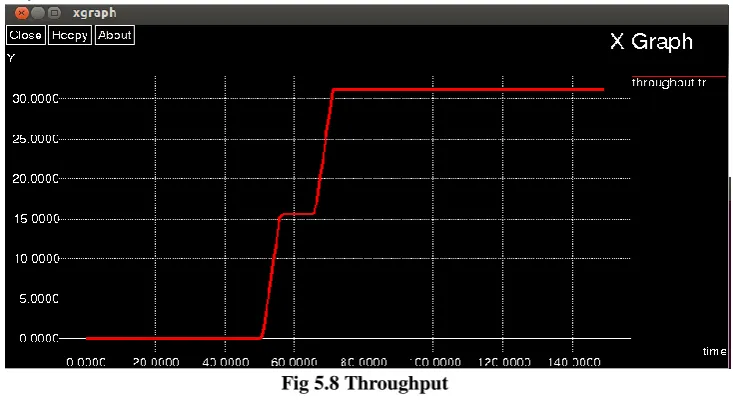
Throughput: It is the number of packets/bytes received by source per unit time. It is an important metric for analyzing network protocols.
𝑇ℎ =𝑇𝑑∗𝑆
𝑇𝑖𝑚𝑒 (5)
Packet Delivery Ratio (PDR): It is the ratio of actual packet delivered to total packets sent. The following table shows the values of the various parameters used during simulation of these protocols.
𝑃𝑙=𝑇𝑑
𝑇𝑝 (6)
ISSN(E): 2277-128X, ISSN(P): 2277-6451, pp. 84-94 V. RESULT AND DISCUSSION
In the result section simulation has been done for sensing the information from the sensing environment. In this chapter simulation of WSN has been reported. In the process of simulation different parameters have been analyzed for performance evaluation of purposed work. In the purposed work simulation parameters have been initialized for WSN. These parameters are described below.
Table 5.1 Simulation parameters Setup
Parameter Description Area 1500 * 1500 Number of nodes 55
Antenna Omni
Queue Type Drop Tail Queue Length 250 Routing Protocol LEACH
MAC Type 8.02/11 Receiving Energy 0.5 J Transmission Energy 0.9 J
Initial Energy 100 Jules Energy Model ENERGY Model
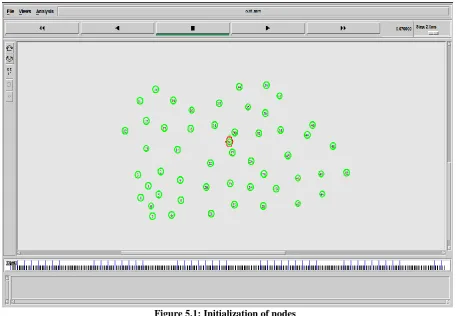
Table 5.1 defines various simulation parameters that are necessary for simulation of the purposed work. In the process on WSN these parameters are utilized for initialization of the simulation setup. In the WSN 55 nodes have been deployed in the network that have been used for sensing information and transmitting information to 50th node that is act as a base station from the purposed work.
Figure 5.1: Initialization of nodes
ISSN(E): 2277-128X, ISSN(P): 2277-6451, pp. 84-94
Scenario 5.2: Initialization of cluster head & base station
This figure represents cluster division done in the network based on leach protocol. Leach protocol divided nodes into different clusters so that cluster head and sub cluster has been selected from the nodes. Different colors available in the scenario represent different clusters formed by the leach protocol.
Scenario 5.3: Transmission of data
ISSN(E): 2277-128X, ISSN(P): 2277-6451, pp. 84-94
Scenario 5.4: Routing for route selection
This figure represents data transmission over WSN by route discovery mechanism. Route has been discovered on the basis of different routing approaches. And on the basis of shortest route data has been transmitted over the network. The nodes transmit information to CH or SCH and these cluster head and sub cluster head transmit this information to base station.
Scenario 5.5: Transmission b/w cluster heads & base station
ISSN(E): 2277-128X, ISSN(P): 2277-6451, pp. 84-94
Fig 5.6 Packet Delivery Ratio
In this X-axis represent the Time and Y-axis represent the Bytes send over the network. This figure is use to represent the Packet Delivery Ratio. Packet Delivery Ratio is defined as the number of packet deliver with respect to time.
Fig 5.7 Life time
This figure is use to represent the Lifetime of a node. Lifetime is defined as the total time in which node can survive without any disturbance.
Fig 5.8 Throughput
ISSN(E): 2277-128X, ISSN(P): 2277-6451, pp. 84-94 VI. CONCLUSION
WSN is the emerging field of communication for transmission of sensing information from the sensing environment using different sensor nodes. Sensor nodes transmit information to the base station so that value able information can be used for decision making process. Due to transmission of the messages over a single node by all the nodes data congestion may be occurred that causes to data loss. In the process of WSN sensor nodes available in the network consumes amount of energy for sensing information from the environment that has been transmitted to base station. Energy consumption is the main issue that disperses WSN usage.
In the latest researches various approaches had been proposed for energy conservation in wireless sensor network so that network can be utilized for maximum lifetime. In this process chain based routing, cluster based routing and rendezvous point based routing had been initialized. In the purposed work wireless sensor network has been used for minimize energy consumption and avoid congestion over the network so that data loss to be minimum. To avoid congestion in WSN dynamic cluttering based approach has been utilized that computes cluster head dynamically on the basis of energy available at a particular node. In the purposed work cluster head selection and sub cluster head selection has been done so that data can be divided and avoid the congestion occurred in the network.
On the basis of dynamic clustering the major advantages is that network each node has the chance to be a cluster head and whole energy of all the nodes consumed in predict manner. Sub cluster that has been elected in the single cluster educes packet loss due to utilization of two nodes for data collection in a single cluster. This reduces overhead Burdon on the single cluster so that data can be delivery with a proper data delivery rate.
Purposed approach provides much better results than previous approaches. We can easily predicts from the results that purposed approach provides much better results than previous approaches that had been purposed.
VII. FUTURE SCOPE
In the future reference proposed approach can be used in real world application so that network lifetime can be increased and minimum cost will incur for data sensing. Major amount of energy has been consumed for data transmission from cluster head to base station, this problem can be removed in future on the basis of mobility based base station so that network lifetime can be improved.
REFERENCES
[1] Qiuling Tang; ChangyinSun; Huan Wen; Ye Liang “Cross-layer energy efficiency analysis and optimization in
WSN”IEEE conference on Networking, Sensing and Control (ICNSC), 2010, pp. 138 – 142
[2] Sharawi, M.;Emary, E.; Saroit, I.A.; El-Mahdy, H. “WSN's energy-aware coverage preserving optimization
model based on multi-objective bat algorithm” IEEE conference on Evolutionary Computation (CEC), 2015, pp. 472 – 479
[3] Darif, A.; Aboutajdine, D.; Saadane, R. “Energy consumption optimization in real time applications for WSN using IR-UWB technology” IEEE conference on Renewable and Sustainable Energy Conference (IRSEC), 2013, pp. 379 – 384
[4] Ganhão, F. Pereira, M.; Bernardo, L.; Dinis, R. “Energy per Useful Packet Optimization on a TDMA WSN Channel” IEEE conference on Computer Communications and Networks (ICCCN), 2010, pp. 1 – 6
[5] Abusaimeh, H.;Shuang-Hua Yang, “Energy-aware optimization of the number of clusters and cluster-heads in
WSN”, IEEE conference on Innovations in Information Technology (IIT), 2012, pp. 178 – 183
[6] Bojan, S.;Nikola, Z. “Genetic algorithm as energy optimization method in WSN” IEEE conference on
Telecommunications Forum (TELFOR), 2013, pp. 97 – 100.
[7] Jackulin, T.; Ramya, M.; Subashini, C. “Energy optimization for WSN architecture and self-test Embedded processor” IEEE conference on Emerging Trends in Electrical Engineering and Energy Management (ICETEEEM), 2012, pp. 253 – 256
[8] Tanevski, M.; Boegli, A.; Farine, P. “Power supply energy optimization for ultra-low-power wireless sensor nodes” IEEE conference on Sensors Applications Symposium (SAS), 2013, pp.176 – 181
[9] Elshaikh, M. ; Bin MohdWarip, M.N. ; Lynn, O.B. ; Ahmad, R.B. “Energy consumption optimization with Ichi
Taguchi method for Wireless Sensor Networks” IEEE conference on Electronic Design (ICED),2014,pp 493 – 498.
[10] Elhabyan, R.S.; Yagoub, M.C.E. “Particle swarm optimization protocol for clustering in wireless sensor networks: A realistic approach” IEEE conference on Information Reuse and Integration (IRI), 2014, pp. 345 – 350.
[11] Das, A.; Das, S. “Power conservation in Wireless Sensor Networks: A graph-theoretic approach” IEEE
ISSN(E): 2277-128X, ISSN(P): 2277-6451, pp. 84-94
[12] Namakwa, R.J.; Biradar, R.C. “QoS analysis of WSN based cluster tree data fusion for integrated public utility
management” IEEE conference on Advance Computing Conference (IACC), 2015, pp. 579 – 584
[13] Chuanjin Zhang;YanGu “Cluster analysis based and threshold based selection localization algorithm for WSN”
IEEE conference on Electronics Information and Emergency Communication (ICEIEC), 2015, pp. 186 – 189.
[14] Indhumathi, T.C. ; Sivakumar, P. “Comparison and performance analysis of clustering protocol using
sleep&wakeup technique in WSN” IEEE conference on Advanced Communication Control and Computing Technologies (ICACCCT),2014,pp. 667 – 672.
[15] Alnuaimi, M.; Shuaib, K ; Nuaimi, K.A. ; Abdel-Hafez, M. “Performance analysis of clustering protocols in WSN” IEEE conference on 2013,pp. 1 – 6.
[16] Xuhui Chen, “Research on hierarchical mobile wireless sensor network architecture with mobile sensor nodes”,
ISSN 978-1-4244-6498-2, Vol.56, no.14, pp.: 2863 – 2867, IEEE, China, 2010.
[17] Xiao Zhenghong, Chen Zhigang, “A secure routing protocol with intrusion detection for clustering wireless sensor network”, ISSN 978-0-7695-4115-0, Vol.8, no.12, pp.:1253 – 1258, China, IEEE, 2010.