Research Article
a
March
2018
Computer Science and Software Engineering
ISSN: 2277-128X (Volume-8, Issue-3)
A New Technique for File Sharing Mechanism Ad hoc
Networks
N. Lavanya*
MTech, Sir CV Raman Institute of Technology and
Sciences, Tadipatri,Andhra Pradesh, India
M. Balakrishna
Asst. Professor, Sir CV Raman Institute of Technology
and Sciences, Tadipatri,Andhra Pradesh, India
Abstract: Network coding is a data transmission technique which allows intermediate nodes in a network to re-code data in transit. In contrast to traditional network communication where a node repeats incoming data to its outgoing channel without modifying the payload, a node implementing network coding not only repeats but also alters data. Network coding has been demonstrated to increase network throughput compared to the traditional forwarding transmission. It has potentially broad applications in many areas, including traditional computer networks, wireless ad-hoc networks, and peer to peer systems. This paper process a new technique for file sharing in P2P.
Keywords: URL, TCP, TTL
I. INTRODUCTION
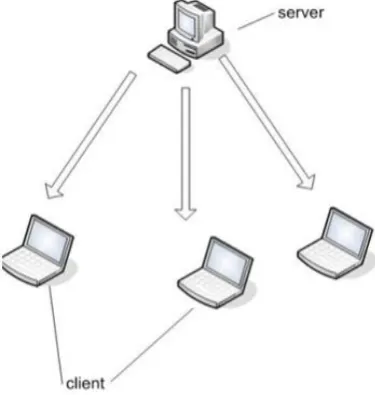
The Internet can be looked upon as a medium to disseminate information. Distribution of large size multimedia content has become commonplace today. The original stereotype of content distribution was the server-client architecture, wherein a dedicated server furnished the required content to all requesting clients. However such a system faces a bottleneck from the constraints of available upload bandwidth and resources at the server and is thus incapable of scaling up to serve a large number of clients. This problem of sharing content with a large number of clients was solved through two main techniques. One was through the use of large-scale commercial content distribution services depicted in figure 1, which mirror customers’ content to be published on various servers and employ sophisticated algorithms to locate the mirroring server from which content is transferred to the requesting client.
Figure 1: Traditional Client Server System
The second method, peer to peer content distribution, entails the formation of a network topology in which there is no defined server-client architecture and each node (or peer) in the topology has the capability of acting as the source, transferring agent or requester of content.
ISSN(E): 2277-128X, ISSN(P): 2277-6451, pp. 1-7
Figure2: Peer-to-Peer Architecture
The fundamental premise of P2P networks depicted in figure 2 is the concept of sharing of content and resources amongst all participants of the network. Hence, as the number of peers increases, the resources available to the system increase too and thus such a system is fundamentally scalable. Though some variations exist, P2P networks are characterized by the absence of a central server and the peers are capable of joining or leaving the network at any time without any centralized control.
The P2P systems have the following properties:
Authenticity and privacy: It must be ascertained that unauthorized peers are not able to make changes to the content shared or substitute forged content in place of the correct content to be shared. The system must have mechanisms in place to ensure that only authorized peers are entitled to access available content. Several systems impose restrictions on the type of content being shared.
System stability: The topology of a P2P system changes continuously as peers join and leave. The system should remain stable and continue to provide services at all times. Though the topology of the system is subject to change, the peers which are a part of the system at any given time should remain unperturbed by the dynamics and their functioning should continue as normal.
Performance: This is defined in terms of the duration between the request and the final receipt of the desired content. Similarly, the time to complete other requests like searching, uploading, browsing for content on the system are also taken into account.
Scalability: The system’s performance is not expected to degrade even in the wake of an increase in the number
of peers or the volume of the content shared. The increased number of peers in the network should imply an increase in the number of resources available to the system.
Fairness: The performance of the system as experienced by a peer should be contingent with the utility of the
peer to the system. Neither should a peer get any undeserved advantage (e.g. disproportionately large share of the bandwidth) nor should a peer be unfairly penalized (due to scarcity of resources or hogging of the bandwidth by another peer).
II. RELATED WORK
There are wide variety of file sharing systems are implemented under P2P architecture the most basic and famous is the BitTorrent.
2.1 BitTorrent:
ISSN(E): 2277-128X, ISSN(P): 2277-6451, pp. 1-7 These chunks are assembled in their correct order by the requesting peer. The requested file thus reaches the peer who had initiated the request for the same. The main elements of BitTorrent are:
• Torrents: For every file that is to be shared using BitTorrent, a corresponding torrent file is required to be made. Also referred to as torrent files, torrents are very small sized files which contain hashed information about the file’s content, and name, length of the file to be shared, number of blocks of data and the size of each block in which the file’s contents are to broken and shared. These files also contain the URL of the tracker (see below).
• Tracker: Every BitTorrent network has a unique machine called the tracker. It is the centralized entity which keeps a record of the peers sharing a particular content and is responsible for coordinating the download of a desired file from several peers which are sharing that content. There are several web-based tracker software available, e.g. Torrent Bits [5] which can be run at the tracker. The tracker software allows peers to register with the tracker, login into their account, browse for shared content, download content and upload torrent files. Some tracker software provide additional functionalities like RSS feeds, discussion forums, personal message boards.
• BitTorrent Client: This is software which runs at each peer in the P2P system and it helps share and download content from other peers. Bitspirit, U-torrent are some popular BitTorrent client software.
• Uploading content: When a peer wishes to share content with other peers, it creates a torrent file [3] containing the URL of the unique tracker in the system. It then uploads this torrent file on the tracker and shares this file for the P2P network using its BitTorrent client software. This sharing is called seeding of content. Once a file is seeded, it becomes available to other peers for download.
• Downloading content: When a peer wishes to download content from the P2P network, it searches for it on the tracker. If the search is successful, the peer downloads the torrent file for the same.
This torrent file is then opened with theBitTorrent client software. Since the torrent file contains the URL of the tracker, the BitTorrent client software contacts the tracker using this URL. The tracker has a list of peers who are sharing the requested content. Since the requested content is broken into blocks of fixed size for sharing, different peers send different blocks of data to the requesting peer. The tracker coordinates and decides the blocks to be obtained from different peers. These blocks when assembled by the BitTorrent client complete the file download.
2.2 Network Coding:
None of the peers are completely aware of which peers have which pieces of the file, or even that there is a bottleneck. If two different peers on one side of the slow link send the same block to two different peers on the other side of the link, that link has carried redundant information. Even if only one copy of a particular block is sent across the slow link, peers on the other side will be able to quickly swap that block among them; it would be a more efficient use of resources to send only distinct blocks across the slow link.
Network coding [GR05] allows peers to participate in peer-to-peer file distribution without concern for which blocks of the file other peers have. As with BitTorrent, the file is divided into blocks. However, instead of transmitting a block of the file, a seed transmits a coded block that contains an amalgamation of some information from each block of the file. Peers aid in file distribution by sending coded blocks that contain an amalgamation of all of the information they have received so far. If there are n blocks in the original file, peers need to receive n of these amalgamated blocks before being able to decode the original file. This is done using linear algebra. Each block transmitted is a linear combination of all of the information that the peer has, and recovering the original file amounts to solving a linear algebra problem. With each coded block, a list of coefficients used to generate it is transmitted. Because random coefficients are used in the computation of each of these linear combinations, there is a low probability that any of the coded blocks transmitted will be identical. Therefore, there is very little risk that the same data is ever transmitted more than once over any particular network link.
2.3 Congestion Control:
Communication among peers is basically implemented with more than one concurrent TCP associations in file-sharing scenario as well as in most recent streaming systems. As a result, the ratio of TCP connections for applications such as VoIP and HTTP over the complete number of TCP connections are minor, so the part of the bandwidth these latter applications will become weaker. In other words, the reasonable bandwidth distribution mechanism of TCP fails in guarantying a fair sharing between applications.
ISSN(E): 2277-128X, ISSN(P): 2277-6451, pp. 1-7 III. PROPOSED TECHNIQUE
Our approach to solve the congestion problem at a particular node is to employ a congestion control strategy based on deleting and transferring the message, as the congested node calculate the storage value of each packet according to the forwarding possibility and Time to Leave (TTL) value of packet, then deletes the packet with the smallest amount of storage value and transfers the packet with the lesser forwarding possibility to neighboring nodes. The nearest nodes calculate the receiving value of the packet according to the forwarding possibility and free buffer capacity of this packet. The congested node transfers the packet to the adjacent node with the highest receiving value. The packet will be deleted when there is no adjecent node to receive it.
3.1 Network Model:
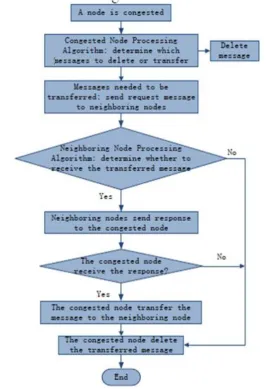
When congestion occurs, the congested node determines a set of messages for deletion and another set of messages for migration.
Meanwhile, the neighboring nodes determine whether to receive the transferred message and give a response to
the congested node.
If the neighboring nodes refuse to receive the transferred message, it will be deleted
3.2 Congested Node Analyzing and Processing Algorithm:
Step 1: The congested node measures the storage value of each packet and deletes the packet with the smallest amount of storage value.
Step 2: The congested node transfers the packet with the smallest amount of forwarding probability to its adjacent nodes. Step 3: The congested node broadcasts transfer request message to its neighboring nodes and gets their receiving values of the message. If there is no response from any neighboring node, go to Step5
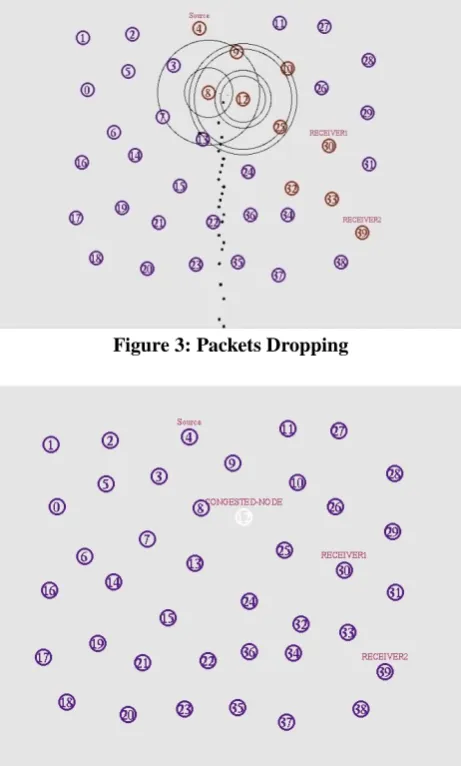
The figure 3 depicts the packets continuously dropping between the node 8 and node 12 leading that the 12 is incapable of handling the incoming traffic and the figure 4 depicts that the node 12 is detected as congested node.
Figure 3: Packets Dropping
ISSN(E): 2277-128X, ISSN(P): 2277-6451, pp. 1-7 Step 4: The congested node selects the adjacent node with the maximum receiving value according to the responses and transfers the chosen message to this neighboring node.
Step 5: The congested node deletes this packet.
3.3 Neighbor Node Analysis Algorithm:
The neighboring node judges whether its own buffer space can meet the requirements and calculates the storage
value of the transferred message.
Figure 5: Flow of the Node Analysis Process
If the storage value of the transferred message is smaller than the minimum storage value in the neighboring node, the process is over.
Otherwise, the neighboring node will calculate the receiving value of the transferred message and return this value to the congested node.
IV. EXPERIMENTAL EVALUATION
The proposed congestion control technique is tested under various general metrics including:
Packet Drops
Error Rate
Delay Ratio and
Throughput
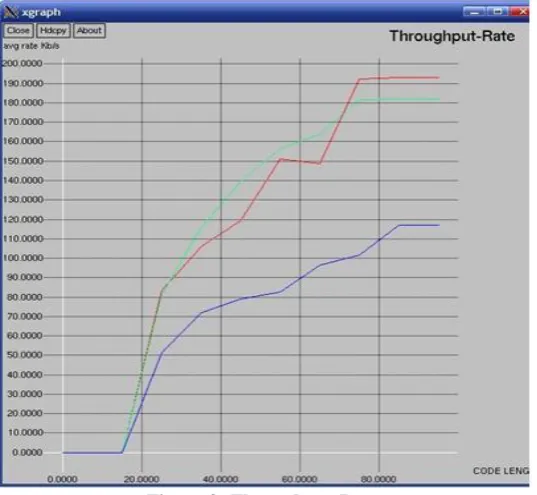
The results of the proposed scheme (red) are compared with the traditional BitTorrent (green) System and the Network coding (blue) scheme and are represented.
ISSN(E): 2277-128X, ISSN(P): 2277-6451, pp. 1-7
Figure 6: Packet Drops
The next metric to measure is the Error Rate and is depicted in the figure 7 where the rate of error is low for the proposed scheme.
Figure 7: Error Rate
The final and most crucial metric is the throughput. This defines the efficiency of the complete network the higher the throughput then the performance will be greater.
ISSN(E): 2277-128X, ISSN(P): 2277-6451, pp. 1-7 V. CONCLUSION
Consider a generic model of a P2P file-sharing service in which all nodes participate in both downloading and uploading of content, and no centralized entity is required. Files are divided into blocks of arbitrary size and peers barter for blocks, exchanging blocks they have with other nodes to obtain missing blocks. As soon as a peer acquires at least one block, she can begin sharing that block with others. However, this system may encounter the last block problem where some blocks become rare and downloads finish slower since many nodes wait to download those rare blocks. Nodes with many blocks are also not likely find nodes who have new blocks to offer, further delaying download completion (we call this the unfair barter problem). Network coding can be a good solution for these problems.
REFERENCES
[1] Min Yang and Yuanyuan Yang, “Applying Network Coding to Peer-to-Peer File Sharing”, IEEE
Transactions On Computers, Vol. 63, No. 8, August 2014, pp. 1938-1950.
[2] BitTorrent. http://www.bittorrent.com/
[3] Boneh, D., Freeman, D., Katz, J., and Waters, B. Signing a linear subspace: Signature schemes for network coding. In Public Key Cryptography (2009), pp. 68–87.
[4] Chiu, D. M., Yeung, R. W., Huang, J., and Fan, B. Can network coding help in P2P networks? In WiOpt (2006),
pp. 1–5.
[5] Gkantsidis, C., Miller, J., and Rodriguez, P. Comprehensive view of a live network coding P2P system. In Internet Measurement Conference (2006), pp. 177–188.
[6] Min Yang and Yuanyuan Yang. "Peer-to-peer File Sharing Based on Network Coding". In ICDCS '08 Proceedings of the 2008.The 28th International Conference on Distributed Computing Systems, 2008.
[7] Radu Stoica, Rodica Stoian, and Lucian Andrei Perisoara. "Random Network Coding for Wireless ad-hoc Networks". Technical report, Wireless Communications and Networking Conference, 2010.
[8] Ralf Koetter, David R. Karger, Michelle Effros, Jun Shi Tracey Ho, Muriel Medard and Ben Leong. "A Random
Linear Network Coding Approach to Multicast". Technical report, IEEE Trans. Information Theory, Oct 2006. [9] Claudio E. Palazzi Armir Bujari and Daniel Bonaldo. "performance evaluation of a file sharing dtn protocol
with realistic mobility". In Wireless Days (WD), 2011 IFIP, 2011.