India
India
Abstract— A wireless ad hoc network is a decentralized kind of wireless network. It is a kind of temporary Computer-to-Computer connection. It is a spontaneous network which includes mobile hoc network (MANET), vehicular ad-hoc network (VANET) and Flying ad-ad-hoc network (FANET). Mobile Ad Hoc Network (MANET) is a temporary network that can be dynamically formed to exchange information by wireless nodes or routers which may be mobile. A VANET is a sub form of MANET. It is an technology that uses vehicles as nodes in a network to make a mobile network. FANET is an ad-hoc network of flying nodes. They can fly independently or can be operated distantly. In this research paper Fuzzy based control approaches in wireless network detects & avoids congestion by developing the ad-hoc fuzzy rules as well as membership functions.In this concept, two parameters have been used as: a) Channel load b) The size of queue within intermediate nodes. These parameters constitute the input to Fuzzy logic controller. The output of Fuzzy logic control (sending rate) derives from the conjunction with Fuzzy Rules Base. The parameter used input channel load, queue length which are produce the sending rate output in fuzzy logic. This fuzzy value has been used to compare the MANET, FANET and VANET in terms of the parameters Throughput, packet loss ratio, end to end delay. The simulation results reveal that usage of Qual Net 6.1 simulator has reduced packet-loss in MANET with comparing of VANET and FANET.
Keywords— MANET, VANET, FANET, Fuzzy logic, load, Data Rate, Qual net, Membership function.
I. INTRODUCTION
ISSN(E): 2277-128X, ISSN(P): 2277-6451, pp. 132-138
Fig. 1 Block diagram of MANET, VANET and FANET
II. FUZZY LOGIC CONTROLLER
A fuzzy system consists of three step 1) fuzzification 2) interference 3)defuzzication.Fuzzy logic controller may be viewed as alternative, non-conventional way of designing feedback controllers. Fuzzy logic controllers, like expert system can be used to model human decision making behaviours. In fuzzy logic controller input and output relations can be expressed as a set of linguistics rule (If-then rules), to model a particular system. Many of the fuzzy control application have an input data which has a crisp value, so a fuzzification is necessary to convert a input crisp data into a suitable set of linguistic value that is needed in the inference engine. Singleton fuzzifier is the general fuzzification method which is used to map the crisp input to a singleton fuzzy set. In the rule base of fuzzy logic controller, a set of fuzzy control rules, which characterize the dynamic behaviour of the system.
Fig.2 Block diagram of fuzzy control system
III. MEMBERSHIP FUNCTIONS FOR FUZZY VARIABLES
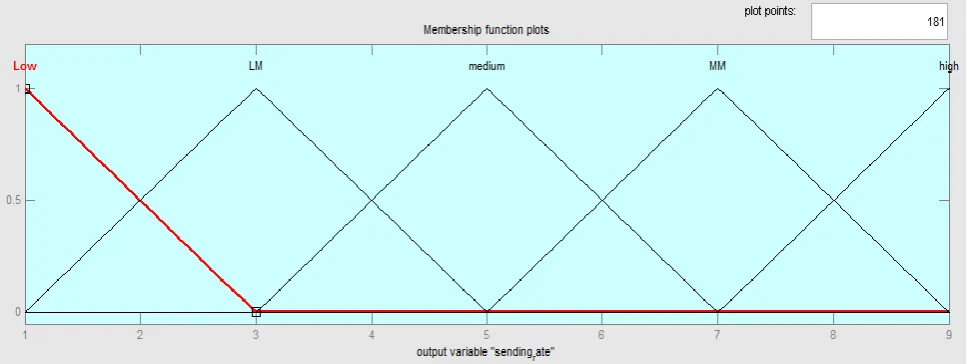
The MFs that are used for the fuzzy input is channel load, queue length and output is sending rate are illustrated in fig. 1
Fig. 4 Membership function used for input variable
Fig. 5 Membership function used for output variable
Table 1 Fuzzy based rule are used
S. No. Channel load Queue length Sending rate
1. Small Small High
2. Small Big More than medium
3. Medium Small Medium
4. Medium Big Medium
5. Big Small Less than medium
6. Big Big Low
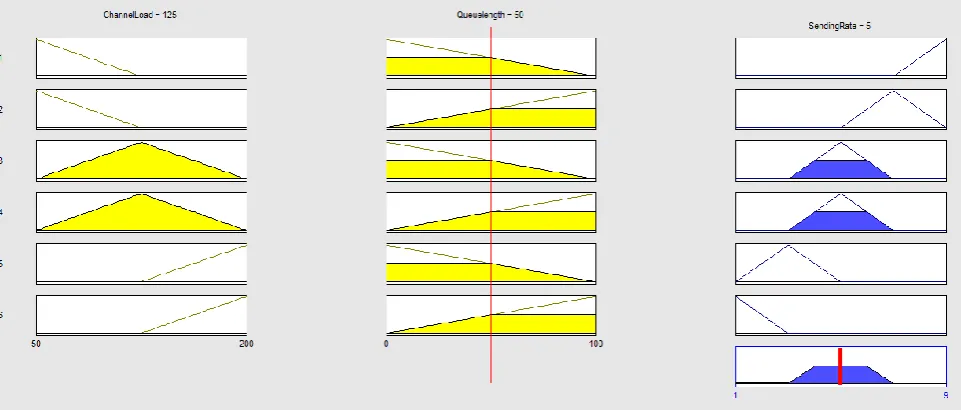
According to [3], The rule viewer, which is an inbuilt MATLAB fuzzy logic tool for computing the output based on the set of given inputs, and surface viewer, which is also an inbuilt MATLAB fuzzy logic tool for graphical representation of relationship between membership functions [3], are shown below in Fig. 4 and Fig. 5, respectively and also shown the numerical value of sending rate, Queue length and channel load.
ISSN(E): 2277-128X, ISSN(P): 2277-6451, pp. 132-138
Fig. 6 Rule view for Channel load, Queue length and Sending rate
Fig. 7 Surface view showing channel load, queue length and sending rate
IV. SIMULATION PARAMETERS
Qual net 6.1 is quicker, most adaptable system demonstrating platform.[5] In this exploration paper, QualNet 6.1 system test system is utilized for performing simulation . Qualnet is a commercial simulator which is very effect solution to study the performance of a communication network through simulation process and can also be used to design network which provides optimum performance by varying various simulation parameter. This simulator is typically favoured for wireless network because of faster simulation and more noteworthy adaptability. Thus, it can easily analyse the behaviour of any real communication network by virtual simulation on the software [5]. In this research paper, MANET, VANET, FANET is utilized for simulation in Qual net 6.1 simulator to assess whether the alteration utilized in the fuzzy parameter, in system, FANET better when contrasted with the Fuzzy value estimation of parameter in Qual net 6.1. In this paper execution by changing maximum speed 10, 20,30,40,50 mbps and all parameter depicting in taking after Table 2.
Table 2 Simulation parameters Qual net 6.1
Antenna Omni Directional Node placement model Random
Mobility Pattern Random Waypoint
MAC 802.11
and packet loss is done on the premise of recreation result in Qual net 6.1.
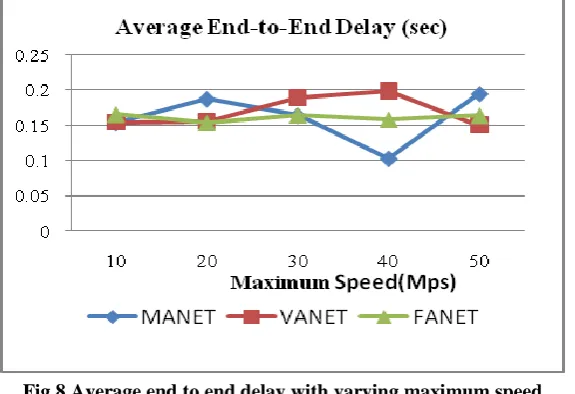
Average End-to-End Delay: The average time interval between the generation of packet in a source node and successfully delivery of the packet at the destinations node. The queuing time can be caused by network congestion or unavailability of valid routes.[4]
Fig.8 Average end to end delay with varying maximum speed
The above figure shows that average end-to-end delay is less in Fuzzy value of MANET as compared to VANET and FANET. Hence, MANET better in case of average end-to-end delay.
Packet loss Ratio: Packet loss influences the apparent nature of the application. A few reasons for packet loss or debasement would be bit mistakes in an incorrect remote system or inadequate buffers because of system congestion when the channel ends up plainly over-loaded [7]. A portion of the Packet is lost because of network congestion or due to noise. Packet loss proportion ought to be least, in order to keep the effective conveyance of high QoS.[6]
Fig. 9 Packet loss ratio with varying maximum speed
ISSN(E): 2277-128X, ISSN(P): 2277-6451, pp. 132-138
Throughput- Throughput is measure of number of Packet effectively conveyed in a network. It is measured in term of packets/second. The estimation of throughput ought to be high.[6]
Fig. 10 Throughput with varying maximum speed
The above figure shows that overall performance of Fuzzy value of VANET is better than MANET and FANET in terms of Throughput simulation parameter.
VI. CONCLUSION
In this paper, the performance of MANET, VANET and FANET have been compared in team of throughput, packet loss ratio, end to end delay using fuzzy logic controller from result, it has been observed that performance of FANET is almost better than that MANET and VANET.
REFERENCES
[1] Bodhy Krishna. S " Study of Ad hoc Networks with Reference to MANET, VANET, FANET"International Journals of Advanced Research in Computer Science and Software Engineering ISSN: 2277-128X (Volume-7, Issue-7) July 2017.
[2] ,Bekmezci, OK Sahingoz, Ş Temel,"Flying ad-hoc networks (FANETs): A survey." Ad Hoc Networks 11. No 3 1254-1270. (2013).
[3] MATLAB® & Simulink® Release 2013a, commercialsoftware package, http://in.mathworks.com/products/matlab/
[4] Makoto Ikeda, “Congestion Control for Multi -flow Traffic in Wireless Mobile Ad-hoc Networks” IEEE Sixth International Conference on Complex, Intelligent and Software Intensive Systems , pp. 290 - 297, 2012.
[5] Qual net simulator software, http:// web. scalable network.com/content/qualnet.
[6] SamikshaNikam, B.T. Jadhay " Fuzzy Apporch for Throughput section in Mobile Ad-hoc Network" International Journal of Innovative Research in Computer and Communcation Eng. (An ISO 3297:2007cerified Orgainzation) ISSN(Online): 2320-9801 ISSN (Print): 2320-9798 Vol. 3, Issue 4, April 2015.
[7] S. Mercy Shalinie, G. Preetha, S. Dina Nidhya, B.S. Kiruthika Devi, “ Fuzzy Adaptive Tuning of Router Buffers for Congestion Control” International Journal of Advancements in Technology ,Vol 1, Pages 85-94, June 2010 [8] K Kumari, S Maakar, B sah, “A Brief Survey of Mobility Model for FANET”, National Conference on
Innovative Trends in Computer Science Engineering held at BRCMCET 4th ,April 2015.
[9] Muneer Bani Yassein and “Nour Alhuda” Damer" Flying Ad-Hoc Networks: Routing Protocols, Mobility Models, Issues" (IJACSA)International Journal of Advanced Computer Science and Applications, Vol. 7, No. 6, 2016.
[10] I_lker Bekmezci, Ozgur Koray Sahingoz , S_amil Temel " Flying Ad-Hoc Networks (FANETs): A survey"Ad Hoc Networks xxx (2013).
[11] E. W. Frew and T. X. Brown, “Networking Issues forSmall Unmanned Aircraft Systems,” Journal of Intelligent andRobotic Systems, vol. 54, no. 1-3, p. 21, 2008. [Online].Available: http://dx.doi.org/10.1007/s10846-008-9253-2
[17] Armir Bujari,Carlos T Calafate, Juan-Carlos Cano, Flying ad-hoc network application scenarios and mobility models " International Journal of Distributed Sensor Networks 2017, Vol. 13(10)
[18] E. Yanmaz, C. Costanzo, C. Bettstetter, and W. Elmenreich, “A discrete stochastic process for coverage analysis of autonomous uav networks,” Proceedings of IEEE Globecom-WiUAV, IEEE, 2010.