Dorstenia luamensis (Moraceae), a new species
from eastern Democratic Republic of Congo
Miguel E. Leal1
1 Wildlife Conservation Society, Kiwafu Road 802, Kansanga, Kampala, Uganda Corresponding author:Miguel E. Leal ([email protected])
Academic editor:Hugo De Boer | Received 28 March 2014 | Accepted 7 October 2014 | Published 24 October 2014
Citation: Leal ME (2014) Dorstenia luamensis (Moraceae), a new species from eastern Democratic Republic of Congo. PhytoKeys 42: 49–55. doi: 10.3897/phytokeys.42.7604
Abstract
A new species of Dorstenia L. (Moraceae), D. luamensis M.E.Leal, is described from the Luama Wildlife Reserve, west of Lake Tanganyika and north of the town of Kalemie in the eastern part of the Democratic Republic of Congo (DRC). This species is endemic to the region and differs from any of the other species by its fernlike lithophytic habit and lack of latex. A description and illustration of this species is presented here. Dorstenia luamensis M.E.Leal inhabits moist and shady vertical rock faces close to small waterfalls in the forest; the species is distributed in small populations within the type locality, and merits the conservation status of endangered (EN).
Keywords
Dorstenia, Albertine Rift, endemic, lithophytic
Introduction
In 2012, a specimen of Dorstenia L. was collected from the Luama Wildlife Reserve
in eastern DRC (M.E. Leal 2551) hanging from vertical cliffs and rock faces close to a waterfall on the shear zone of two plateaus. These plants have a typical Dorstenia L. in-florescence but their hanging habit and lack of latex is unusual. The only other hanging
Dorstenia species (hemi-epiphyte) is D. astyanactis Aké Assi first described from Ivory Coast (Ake Assi 1967) and later also collected in Cameroon (Pollard et al. 2003). Its inflorescence only has one appendix whereas the specimens from Luama have between
http://phytokeys.pensoft.net
Copyright Miguel E. Leal. This is an open access article distributed under the terms of the Creative Commons Attribution License (CC BY 4.0), which permits unrestricted use, distribution, and reproduction in any medium, provided the original author and source are credited.
8 to12 appendices. The only other species in Africa mentioned in the revision of Berg
and Hijmans (1999) growing on rocks is D. zanzibarica Oliver, but this species has
dentate leaves and its receptacle is triangular to subquadrangular.
The specimens collected in the Luama Wildlife Reserve keyed out to the section of Kosaria using Berg and Hijman (1999) key to the sections of Dorstenia based on the two rows of appendages, short ones in the inner and longer ones in the outer row.
Ignoring its hanging herbaceous habit, the specimens keyed out closest to D.
benguel-lensis Welw. in the key to “Succulent and semi-succulent species of the Old World”
(Bergman and Hijman 1999). They also mention in the species description that D.
benguellensis Welw. grows “often among rocks” close to water courses and that its morphology is highly variable.
Therefore in this study, I compared the specimens collected from the Luama Wild-life Reserve with D. benguellensis Welw. to determine: 1) whether differences are
insig-nificant and the existing description of D. benguellensis Welw. should be broadened to
incorporate these specimens, or 2) whether differences are significant and these speci-mens should be described as a separate species. I argue that differences beyond habit are significant and that they merit their own status as a new species from the Luama
Wildlife Reserve, D. luamensis M.E.Leal.
Methods
The collected specimens from the Luama Wildlife Reserve were compared to D.
benguel-lensis Welw. following terminology and description format of Berg and Hijman (1999). Similarly, characteristics used in the Berg and Hijman (1999) key were applied to validate whether these specimens from the Luama Wildlife Reserve were significantly different from similar species within section Kosaria. The website Global Plants (www.plants.jstor.
org) was also consulted to identify and measure specimens of Dorstenia collected and
entered into the database after the publication of Berg and Hijman (1999).
Results
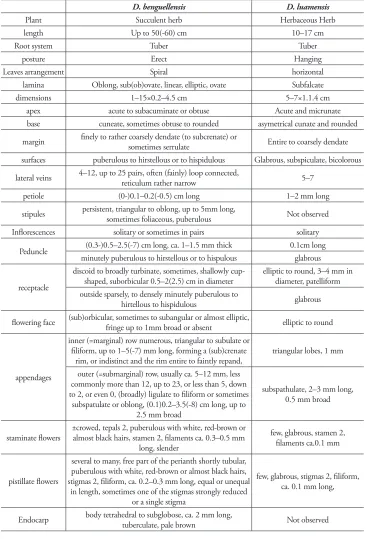
Table 1 shows the description of D. benguellensis Welw. and the specimens collected in
the Luama Wildlife Reserve. Besides the hanging habit and lack of latex, the specimens
collected differ most distinctively from D. benguellensis Welw. on leaf arrangement,
spiral versus horizontal; leaf shape subfalcate with an asymmetric base versus oblong, sub(ob)ovate, linear, elliptic, ovate and a symmetrical base; and peduncle length 0.1
cm versus (0.3)0.5–2.5(7) cm. The only specimen of D. benguellensis Welw. entered
Table 1. Comparison D. benguellensis and D. luamensis.
D. benguellensis D. luamensis
Plant Succulent herb Herbaceous Herb
length Up to 50(-60) cm 10–17 cm
Root system Tuber Tuber
posture Erect Hanging
Leaves arrangement Spiral horizontal lamina Oblong, sub(ob)ovate, linear, elliptic, ovate Subfalcate dimensions 1–15×0.2–4.5 cm 5–7×1.1.4 cm
apex acute to subacuminate or obtuse Acute and micrunate base cuneate, sometimes obtuse to rounded asymetrical cunate and rounded
margin finely to rather coarsely dendate (to subcrenate) or sometimes serrulate Entire to coarsely dendate
surfaces puberulous to hirstellous or to hispidulous Glabrous, subspiculate, bicolorous
lateral veins 4–12, up to 25 pairs, often (fainly) loop connected, reticulum rather narrow 5–7
petiole (0-)0.1–0.2(-0.5) cm long 1–2 mm long
stipules persistent, triangular to oblong, up to 5mm long, sometimes foliaceous, puberulous Not observed
Inflorescences solitary or sometimes in pairs solitary
Peduncle (0.3-)0.5–2.5(-7) cm long, ca. 1–1.5 mm thick 0.1cm long minutely puberulous to hirstellous or to hispulous glabrous
receptacle
discoid to broadly turbinate, sometimes, shallowly
cup-shaped, suborbicular 0.5–2(2.5) cm in diameter elliptic to round, 3–4 mm in diameter, patelliform outside sparsely, to densely minutely puberulous to
hirtellous to hispidulous glabrous
flowering face (sub)orbicular, sometimes to subangular or almost elliptic, fringe up to 1mm broad or absent elliptic to round
appendages
inner (=marginal) row numerous, triangular to subulate or filiform, up to 1–5(-7) mm long, forming a (sub)crenate
rim, or indistinct and the rim entire to faintly repand, triangular lobes, 1 mm outer (=submarginal) row, usually ca. 5–12 mm, less
commonly more than 12, up to 23, or less than 5, down to 2, or even 0, (broadly) ligulate to filiform or sometimes
subspatulate or oblong, (0.1)0.2–3.5(-8) cm long, up to 2.5 mm broad
subspathulate, 2–3 mm long, 0.5 mm broad
staminate flowers ±crowed, tepals 2, puberulous with white, red-brown or almost black hairs, stamen 2, filaments ca. 0.3–0.5 mm long, slender
few, glabrous, stamen 2, filaments ca.0.1 mm
pistillate flowers
several to many, free part of the perianth shortly tubular, puberulous with white, red-brown or almost black hairs, stigmas 2, filiform, ca. 0.2–0.3 mm long, equal or unequal
in length, sometimes one of the stigmas strongly reduced or a single stigma
few, glabrous, stigmas 2, filiform, ca. 0.1 mm long,
Discussion
D. benguellensis Welw. and the specimens collected from the Luama Wildlife Reserve are most conspicuously different in vegetative morphology, both in size and shapes. Key differences mentioned in the key to “succulent and semi-succulent species of the Old world” (Berg and Hijman 1999) distinguishes sister species mainly based on veg-etative morphology, e.g. absent, short or long internodes; habit hanging, erect or as-cending; root tuberous or rhizome at the base and or at internods; petiole short or long; number of lateral veins; length of the plant; and some ambiguous characteristics for some species such as absence or presence of stipules.
D. benguellensis has been characterized as highly variable, which might raise the question whether the specimens from the Luama Wildlife Reserve are an adaptation
to growing on vertical rock faces. Are there two types of D. benguellensis Welw.?
The most common one is erect and grows in between rocks and the hanging one is rare and only grows on vertical rock faces. If this were the case, than I would have expected to find the erect type at the same location of the hanging type. This was however, not the case.
Conclusion
Based on the differences in vegetative morphology, the specimens from the Luama Wildlife Reserve can easily be keyed out from the sister species in the same section of
Kosaria (see the key provided under “distinct from other species”. These plants from the Luama Wildlife Reserve resemble ferns hanging from rocks. This has not been observed elsewhere for the genus. Therefore, I conclude that the specimens from the
Luama Wildlife Reserve merit their own separate status as new species, Dorstenia
lua-mensis M.E.Leal, sp. nov.
Taxonomic treatment
Dorstenia luamensis M. E. Leal, sp. nov. urn:lsid:ipni.org:names:77142870-1 Figs 1A, B, 2
Diagnosis. Haec species notabilis ab omnibus Dorstenia speciebus differt ob filicinu lithophitu habitu novu familae
Type. THE DEMOCRATIC REPUBLIC OF CONGO, Katanga Province, Tumbwe Sector, Luama Wildlife Reserve, M.E. Leal 2551 (holo LWI, iso BR), S5°14,526', E 28°52,215', 1176m, 31 October 2012.
exu-date. Stipules absent or deciduous without scars. Leaves distichous; blade narrowly subfalcate 5–7 × 1–1.4 cm, membranaceous, apex micrunate, base cunate, adaxi-al side glabrous and subspiculate, abaxiadaxi-al side white and glabrous; margins entire;
Figure 2. A population of Dorstenia luamensis M.E.Leal on a vertical rock face (photo: M.E. Leal 2012). Figure 1.Dorstenia luamensis M.E. Leal A habit B receptacle.
B
petiole 1–2 mm long; venation brochidodromous; 5–7 pairs of secondary veins; tertiary veins scalariform. Receptacle elliptic to round, 3–4 mm in diameter, patel-liform; margin greenish with triangular lobes (1 mm) and subspathulate appendages, 2–3 mm long; peduncle 1 mm long, glabrous. Staminate and pistilate flowers (7 to 8) tightly packed in receptacle: perianth short lobed, whit apex minutely 2–3 lobed, glabrous; stigma 0.1 mm long. Drupes and seeds are unknown.
Distinction from other species. This new species can be distinguished from any other Dorstenia species by its fernlike habit, hanging from vertical rock faces and the absence of latex.
The new species is added to the existing key of Berg and Hijman (1999) the “key to succulent and semi-succulent species of the Old World”
1 Stems succulent and thick, internodes short; leaves subrosulate ...
...section Acauloma
1’ Stems (semi-)succulent, or herbaceous, internodes long; leaves spaced,
some-times crowded at stem apices ...section Kosaria, 2
2 Plants stem hanging
3 Plant lithophyte, multiple appendages ...D. luamensis
3’ Plant epiphyte, one appendage ...D. astyanactis
2’ Plants stem erect to ascending
4 Plants annual, without a rhizome or a tuber ...D. annua
4’ Plants perennial, with rhizome or a tuber
5 Petiole relatively short, (0-)0.1–0.2(-0.5) cm long ...D. benguellensis
5’ Petiole relatively long (0.2-)0.5–2.5(-3) cm long... ...other species of section Kosaria
Phenology. The specimens were collected in late October.
Ecology. D. luamensis M.E.Leal inhabits moist and shady vertical rock faces close to small waterfalls in forest within a riverine forest-open woodland-savanna mosaic.
Distribution and conservation status. The species is distributed in small popula-tions within the type locality, and according to these demographic characteristics it merits the conservation status of endangered (EN).
Etymology. The epithet luamensis refers the Luama Wildlife Reserve which is drained by the Luama River.
Acknowledgements
References
Ake Assi L (1967) Un nouveau Dorstenia (Moracees) de Cote D’Ivoire. Adansonia 7(3): 387–390. Berg CC, Hijman MEE (1999) The genus Dorstenia (Moraceae) Ilicifolia 2: 1–211.
IUCN Standards and Petitions Subcommittee (2011) Guidelines for using the IUCN Red List Categories and Criteria. Version 9.0. Prepared by the Standards and Petitions Subcommittee. Linnaeus C (1753) Species plantarum. Impensis Laurentii Salvii, Holmiae.