13
EFFECTS OF AUDITORY PROCESSING THERAPY ON ATTENTION SPAN OF
PERSONS WITH DOWN SYNDROME
GIGINA ONYEKA CHRISTIAN, [email protected]
THERAPEUTIC DAY CARE CENTRE AND BOARDING SCHOOL ABAKPA NIKE , ENUGU.
&
EJIKE HYACINTH MGBENKEMDI (Ph.D) [email protected]
DEPARTMENT OF PSYCHOLOGY, FACULTY OF SOCIAL SCIENCES
ENUGU STATE UNIVERSITY OF SCIENCE AND TECHNOLOGY
&
PROF OBY OMEJE [email protected]
DEPARTMENT OF PSYCHOLOGY, FACULTY OF SOCIAL SCIENCES
ENUGU STATE UNIVERSITY OF SCIENCE AND TECHNOLOGY
Abstract
This study aimed to find out if an attention training program developed by the researcher (The Gigina Method, 2012) will improve the attention span of children with Down syndrome. The study has a total of 18 participants randomly assigned to control and experimental conditions. The pre and post-test control group design was used, the t-test for dependent and independent group was applied for test of significance, the outcome showed that the Gigina Method had a significant effect on the attention span of persons with Down syndrome with an observed t=7.697 at p <.001 level (2-tailed). The implication of the study were discussed, including its limitation and suggestions for further studies were made, the conclusion of the study is that with attention training a child with short attention span can have his/her attention increased. The results were discussed in relation to relevant literature.
Keywords: Auditory Processing Therapy, Attention Span, and Down syndrome.
Introduction
Man by nature always seeks for comfort; this notion has always been the drive behind every effort of man, creating internal balance where there is disequilibrium I all spheres of his endeavors’ including; economic, political, religious, and even educational. These imbalances have been the major propeller of all scientific endeavors’ to solve problems, more so, when these problems are found within man himself, as they obviously affect his ability to actualize his goals of existence.
One of the major problems that actually hinder actualization is mental status specifically known as mental retardation. Mental retardation is defined in the Diagnostic and Statistical Manual of Mental Disorder (2000) as:
A. Significant sub average intellectual functioning, an IQ of a proximately 70 or below on an individually administered IQ test.
14 the following areas. Communication, self care, home living, social/interpersonal skills. Use of community resources, self direction, functional academic skills, work, leisure, health and safety. C. The onset is before 18 years.
Dykens, and Hodapp (2001), said that mental retardation is characterized both by a significantly below average score on a test of mental ability or intelligence and by daily life, such as communication, self care and getting along in social situations and school activities. So mental retardation is when a person’s Intelligent Quotient is below average and the adaptive skill is not in conformity with the expected behaviors’ of the society.
Mental retardation has been classified into levels,
A modern classification that has been widely accepted was that by DSM-IV-TR, (2000) which classified MR based on degree of severity reflecting levels of intellectual impairment. Thus the levels are as follows:
Mild mental Retardation: IQ level 50-55 to approximately 70 Moderate mental Retardation: IQ level 35-40 to 50-55 Severe mental Retardation: IQ level 20-25 to 35-40 Profound mental Retardation: IQ level below 20 or 25
Mental retardation severity unspecified: when there is strong presumption of mental retardation but the person’s intelligence is attestable by standard tests.
The various levels have been associated with different characteristics.
Mild Mental Retardation: (IQ level 50-55 to approximately 70): this level of retardation presents with the following developmental characteristics;
The individual can develop social and communication skills, minimal retardation in sensory-motor areas often not distinguished from normal until later age. The individual can learn academic skills up to approximately sixth-grade level by late teens, and can be guided toward social conformity. He or she can usually achieve social and vocational skills adequate to minimal self-support, but may need guidance and assistance when under unusual social or economic stress.
Moderate mental retardation (IQ level 35-40 to 50)
This class of individuals can talk or learn to communicate; have poor social awareness; fair motor development; profit from training in self-help and can be managed with moderate supervision. They can profit from training in social and occupational skills; unlikely to progress beyond second grade level in academic subjects, may learn to travel alone in familiar places.
May achieve self maintenance in unskilled or semi skilled work under sheltered conditions, need supervision and guidance when under mild social or economic stress. This feat may be attained by adults (> 21 yrs).
Severe mental retardation (IQ level 20-25 and 35-40)
Pre-school age 0-5 yrs; maturation and development- poor motor development; speech is minimal, generally unable to profit from training in self help; little or no communication skills. At school age (6-20 yrs); training and education can talk or learn to communicate; can be trained in elemental health habits, profit from systematic habit training; unable to profit from vocational training. As adults (> 21 yrs); they achieve social and vocational adequacy, may contribute partially to self maintenance under complete supervision; can develop self protection skills to a minimal useful level in controlled environment.
Profound mental retardation (IQ below 20 or 25)
At preschool age (0-5 yrs); in terms maturation and development-there is gross retardation; the child has minimal capacity for functioning in sensory-motor areas. Thus he/she needs nursing care; constant aid and supervision. At school age (6-20 yrs): the person requires training and education –some motor development is present, the individual may respond to minimal or limited training in self help. As an adult (>21 yrs), there is social and vocational adequacy, some motor and speech development occurs, the individual may achieve very limited self care, but need nursing care (Adapted from American Association on Mental Deficiency, 2010).
ETIOLOGY OF MENTAL RETARDATION
15 retardation are not only complex but controversial, embracing genetic, environmental and socio-cultural dimensions. These causes are briefly explained below:
I. Genetic causes;
Abnormalities in autosomal chromosomes are frequently associated with mental retardation, such abnormality includes the fragile X syndrome, Down syndrome, Prader-Willi syndrome, cats cry syndrome. Whereas aberration in sex chromosome can result in characteristic physical syndromes that do not include mental retardation (e.g. , turners syndrome with xxy, xxxy, and xxyy variation). Other biological causes includes infections like meningitis, measles, head trauma, acquired childhood disorders (Macmillian,Siperstein &Gresham,1996).
II. Environmental causes;
Mental retardation can result from significant deprivation and nurturance. Children who have endured these conditions are subject to lasting damage to their physical and emotional development. Prenatal environment compromised by poor medical care and poor maternal nutrition can be a contributory factor in the development of mild mental retardation. Teenage pregnancies are risk factors and they are associated obstetrical complications, prematurity and low birth weights. Poor post natal medical care, malnutrition, exposure to such toxic substance as lead, and physical trauma are risk factors for mild mental retardation (Opitz, 2008).
III. Socio cultural causes;
An incapacitating mental disorder in parent may interfere with appropriate child care and stimulation and cause developmental risk ( Macmillian,Siperstein &Gresham,1996 ).
Of all the types of mental retardation, Down syndrome is the focus of the present study. This is based on the fact that persons with Down syndrome present with a lot of attention deficit (American Association on Mental Deficiency, 2010 ).
Down syndrome.
The description of Down syndrome, first made by the English physician Langdon Down in 1866, was based on the physical characteristics associated with subnormal mental functioning. Since then, Down syndrome has been the most investigated and most discussed syndrome in mental retardation. Children with this syndrome were originally called Mongoloid because of their physical characteristics of slanted eyes, epicanthi folds and flat nose. Despite a plethora of theories and hypotheses advanced in the last 100 years the cause of Down syndrome is still unknown (Opitz, 2008).
The problem of cause is complicated even further by the recent recognition of three types of chromosomal aberration in Down syndrome namely:
Patients with trisomy 21 (Three chromosome 21 instead of the usual two) represent the overwhelming majority: they have 47 chromosomes, with an extra chromosome 21. The mothers’ karyotypes are normal. A no disjunction during meiosis, occurring for unknown reasons, is held to be responsible for the disorder.
Secondly, non disjunction occurring after fertilization in any cell division results in mosaicism, a condition in which both normal and trisomic cells are found in various tissues.
Lastly, translocation in which a fusion occurs of two chromosomes, usually 21 and 15, resulting in a total of 46 chromosomes, despite the presence of an extra chromosome 21. The disorder, unlike trisomy 21, is usually inherited and the translocated chromosome may be found in unaffected parents and siblings. The asymptomatic carriers have only 45 chromosomes.
Down syndrome has been associated with different characteristic symptoms; the symptoms vary from person to person and can range from mild to severe. However, children with Down syndrome have a widely recognized appearance. The head may be smaller than normal and abnormally shaped. For example, the head may be round with a flat area on the back. The inner corner of the eye may be rounded instead of pointed. Other physical signs include:
Decreased muscle tone of the neck Excess skin at the nape of the neck Flattened nose
Separated joints between the bones of the skull Single crease on the palm of the hand
Small ears
Upward slanting eyes
16 White spots on the coloured part of the eyes.
Physical development is often slower than normal; most children with Down syndrome never reach their average adult height.
Children may also have delayed mental and social development and are associated with the following problems:
Impulsive behavior Poor judgment Short attention span Slow learning
As children with Down syndrome grow and become aware of their limitations they may also feel frustration and anger. Many different medical conditions are seen in people with Down syndrome including:
Birth defects or ventricular septal defects Dementia
Eye problem such as cataract (most children with Down syndrome need glasses)
Early and massive vomiting, which may be sign of gastro intestinal blockage, such as oesophageal atresia and duodenal atresia.
Hearing problem, probably caused by regular ear infections. Hip problem and risk of dislocation.
Long term (chronic) constipation problem.
Sleep apnea (because the mouth, throat and airways are narrowed in children with Down syndrome).
Teeth appear later than normal and in a location that may cause problem with chewing. Under active thyroid (hypothyroidism)( Hodapp,Evans &Gray,2008).
INCIDENCE OF DOWN SYNDROME IN NIGERIA
The earliest reported study on the incidence of Down syndrome by Adeyokunmi (1982) shows an incidence of 1 in 865 live births. Prior to this time, it was believed that Down syndrome is rare or none existent among Africans (Osakwe, 2010). This is collaborated by the reports of other clinical practice over several years in Nigeria (Oloyode,Fatuga,Iyaniwura & Jagun, 2006). While there may be other reports from Nigeria the case reports by Mba (1995) was the first to draw attention to the occurrence of the condition among Nigerian children (Mba,1995). After the report, it was now agreed that the condition is not as rare among Nigerians and Africans as was once believed, in spite of this however, there was still difficulty in achieving accurate data collection in Nigeria and other developing countries. This difficulty was attributed to many factors.
First, a large number of deliveries take place in non orthodox centers such as churches and traditional birth homes, most of which do not keep records. The government registered private maternity centers also have difficulty keeping accurate statistic (Oloyode, Iyaniwura &Jagun, 2006).
Secondly, within the community, cases of congenital malformations such as Down syndrome are not reported for record purpose because of the traditional belief that still associates them with witch craft and witches. Consequently, an accurate population based data are difficult to generate and most of the data reported are hospital based. In spite of this however, health planning is still based on this data with the assumption that they represent the actual situation.
Since the study by Adeyokunmi (1982), there has been no published report about the incidence in Nigeria till date. Though there is no record of incidence of Down syndrome, the few known cases require assistance to survive. They have special needs. They require assistance to cope with disability that may be medical, mental or psychological. The Diagnostic and Statistical Manual of Mental Disorders (2000), and the International Classification of Diseases (ICD-10) refer to people with Down syndrome, autism etc as requiring special needs.
Special needs, also known as special education needs (SEN) is used to classify children needing more educational services than those children without special needs.
According to Zindi (2009), in theory many African countries show interest in the education of pupils with Special Education Needs (SEN). He identified four factors militating against converting theory into practice. The factors include-:
17 2. Effectiveness of legislation and policy: many African countries develop splendid policy to stimulate the teaching of pupils with SEN in order to tempt donors to donate funds but fail to implement them.
3. Traditional and cultural attitudes: in many African countries getting a child with disability is considered to be a curse.
4. Expertise: for the time being, many African countries rely on the expertise of expatriates. In Nigeria the educational system has been criticized for so many reasons among which Mba (1995), identified as its failure to take into account individuals with SEN.
The school system now face increasing pressure to raise standards, develop social and personal skills, broaden curricula, pay greater attention to equal educational opportunities and prepare young people for rapidly changing world, the trend today all over the world is shifting towards addressing the educational plights of students with one form of disability or the other so as to better their life. The rationale behind this is contingent upon the fact that people with disability too have invaluable role to play in national development and to be able to do this attentively and meaningfully, their educational needs must be given proper attention (Osakwe, 2010).
Similarly, Corbett, Schickman and Ferrer,2007), reported that persons with Down syndrome have short attention span, also Betrand (1999) reported that the auditory/attention problem is common in young children with Down syndrome.
Of the entire handicap afore-mentioned to characterize persons with Down syndrome, the auditory processing/attention problem caught the interest of the researcher, hence the Auditory Processing Therapy (APT). The Auditory Processing Therapy is also called the listening program (TLP), developed by Alfred Tomatis in 1991. He was an ear and throat physician, he formulated the theory “The voice does not produce what the ear does not hear”, Meaning that vocal problems were hearing problems (Alfred, 1991). Alfred, maintained also that problems like dyslexia, depression; schizophrenia and even autism result from failure in communication, which has to do with listening and the ear.
The listening programs uses the advantage of the “plastic factor”, a term scientist use to describe the brains amazing ability to constantly change its structure and function in responses to experiences coming from the outside, listening to compact discs in the listening program literally exercises and tones tiny muscles in the ear and helps build stronger multisensory pathways in the brain. Weiss (1979) had earlier maintained that auditory processing is a skill essential for academic progress and cognitive development of children with special needs.
EFFICACY OF THE AUDITORY PROCESSING THERAPY (APT)
Auditory processing therapy using the Alfred Tomatis method (1991) has been proven to be effective in some parts of the world like Europe and America. In Arizona USA, Andrew, Thompson &Trumps (2005), carried out a study on the effectiveness of the Alfred Tomatis method in listening, in which children were divided into Tomatis listening therapy group and a placebo control group. The Tomatis group showed more improvement than the placebo control group.
In another study at the Hospital Foch de Sursnes in France, in which a group of 345 pregnant women were not expose to special maternal care, another group of 223 women exposed to good maternal care plus the Tomatis method yielded the following result in favour of the Tomatis group, decreased labour, babies of the mothers had a superior birth weight, better listening.
In Nigeria there is no literature reporting the efficacy of APT, hence this study aim to find out whether a similar listening program developed by the researcher called The GIGINA Method (TGM) or The GIGINA Listening Program (TGLP), will improve the attention span of children with Down syndrome. It was hypothesized as follows:
1. There will be no significant difference between the pretest and posttest mean scores of the experimental group on the effect of TGM on the attention span of persons with Down syndrome. 2. There will be no significant difference between the pretest and posttest mean scores of the control group on the effect of TGM on the attention span of persons with Down syndrome.
3. There will be no significant difference between the posttest scores of the control and experimental groups on the effect of TGM on the attention span of persons with Down syndrome.
18 The researcher needs 18 participants, their age range is a minimum of 8 years and maximum of 20 years and a mean years of 14 years with a standard deviation of 3.5, 17 of the participants are from the South-East region and speaks Igbo and English languages except one (1) who is from the South-South region and speaks English and his native language Calabar. 3 of the participants are in special Nursery classes, another 3 are in an inclusive nursery class, the other 3 are in special primary one and 1 other participant is in an inclusive class (primary 1A 1A) with a special teacher attached to him and the other 1 is in a special primary 1A 1C. Seven other participants are at the Sheltered Workshop section of the centre. The participants were selected through a purposive sampling technique.
INSTRUMENT
The researcher has developed a scale for measuring attention- Attention Span Scale (ASS). The ASS has two subscales with first scale measuring child’s attention during regular classroom lesson; attention is measured in minutes and seconds. The other subscale is also measuring the child’s attention span using the Gigina listening program (GLP) An instrument developed by the researcher using locally available and affordable equipment which will typically cost N1,500.00 and used for attention training. The component of the GLP includes:
-Head phone -Cassette player -Batteries
-Cassette (with dubbed items) Head phones
Good quality headphone, a Sony product with model name and number- Access- value 505 and with good frequency response.
Cassette player
The cassette player is a good quality Auto stop mini cassette Recorder with the following features:
Brand Name SMART; Model No: JL-6603
Batteries
Super quality Battery Brand- Tiger Head Art. No. 304 1.5V Type- R6 Um-3AA size
Cassette
High efficiency cassette Brand –maxon UD-3 Type-C60
19 The Cassette is filled with scholastic materials like rhymes and songs in Igbo and English languages, counting of numbers and letters including days of the week. Musical instruments used which include: Drum and Gong (ogene), each of the 13 items lasts for specific time as describe below:
1. Akwukwo na to uto 2:14 minutes
2. Monday, Tuesday, Wednesday………….1:42 minutes 3. ‘A’ is for Apple, ‘B’ Ball………...1:38 minutes 4. Reciting letters A-Z with and without instrument 1:10 minutes 5. Baba Black Sheep………2:00 minutes
6. Pawpaw is a kind of fruit……….2:05 minutes 7. Motor car motor car………1:07 minutes
8. Every day the clock is saying Tic, Tac, Tic, Tac………1:32 minutes 9. Its play time, its play time…………2:16 minutes
10. One, two, buckle my shoe………….1:16 minutes
11. One, two, three, four, five, catching fishes all alive……….1:19 minutes 12. Counting numbers 1-50 with instrumental……….2:19 minutes
13. I love you, you love me………..1:24 minutes
(The rationale for selecting these rhymes is that they are common among nursery and primary schools in (Igbo land) the south eastern region of Nigeria. The GLP lasts 20 minutes per session).
STATEMENT OF VALIDITY
The validity of the ASS was established using the content and construct validation procedures. The instrument was given to pedagogies, teachers at nursery and primary school levels, music producers. The experts were giving the instrument to critically assess the relevance of the items in tapping the information for which they were designed and necessary corrections were affected.
STATEMENT OF RELIABILITY
A test-retest method was employed using the Pearson product moment reliability test. Analysis was done using the Statistical Package for the Social Sciences (SPSS). A statistics software version 16.0 the researcher used 10 samples of children with Down syndrome, the test was administered and re administered after 3 weeks, the SPSS output using Pearson product moment statistics was a coefficient of r = 0.95 which is positive and near perfect (Rose, 2012,Loe & Feldman,2007).
SCORING
The direction for scoring is apt, the ASS is composed of two items, the first item measures the child attention by naturalistically observing the child during a regular class lesson and record of attention is done with a stop watch and thus recorded in hours, minutes and seconds. In the second item the GLP is given to the child to listen to the contents and with a stop watch attention span is recorded in hours, minutes and seconds, for each individual, score are entered into the scale for further analysis. A base line attention span obtained was 1.5 minutes.
PROCEDURES
After obtaining ethical approval from the management of Therapeutic Day Care Centre and Boarding Schools, Abakpa Nike, in Enugu East Local Government Area of Enugu State, Nigeria. The researcher took an inventory of the total population of children who met the DSM-IV TR (2000) Criteria for Down syndrome in the school and discovered a total of 46 individuals with Down syndrome, the Draw- A- Person (DAP) test which was standardized in Nigeria by Ebigbo, Okwaraji &Ekwo (2001), was used as a screening instrument to obtain the participants’ Intelligence Quotient (IQ), the purpose of the screening is to control extraneous variable, eventually 18 pupils got IQ scores that fell within the range of 35-55, which the DSM-IV-TR (2000), classified as moderately retarded individuals.
20 post treatment test was administered and scores of pre and post tests was compared. Furthermore post test scores of the treatment and control groups were compared.
DESIGN
The pre and post-test control group design was adopted for this study. STATISTICS
The researcher used the t-test statistic for dependent samples to analyze the pre and post test scores, since all the participant in the two conditions share the same characteristics and sample size is small and equal in the pre and post test conditions, the t-test for independent samples was also applied for analysis of scores between the experimental and control groups.
RESULTS
The results obtained by adopting the t-test for dependent and independent samples to test for the efficacy of the Gigina Listening Program on the attention span of persons with Down syndrome are presented below:
SPSS OUTPUT (SUMMARY TABLE) OF DEPENDENT t-test (PAIRED SAMPLE) STATISTICS FOR PRE-TEST- POSTTEST EXPERIMENTAL CONDITION.
TABLE 1
PAIRED SAMPLE DESCRIPTIVES
Mean N STD Deviation Std error mean Pair 1 pretest
posttest
4.0544 14.0400
9 9
3.39397 3.86802
1.13132 1.29934
Table 1. Shows the descriptive for the experimental groups’ pre and post tests, the pre test mean score is 4.0544 (SD= 3.39397, N=9), which is lower than the post-test mean of 14.0400 (SD= 3.86802, N=9).
TABLE 2
PAIRED SAMPLE TEST mean Std
deviation
Std error mean
95% confidence interval of the difference
Lower Upper t df
Sig (2 tailed Pair 1
pretest-posttest
-9.985 3.4815 1.16052 -12.66172 -7.30940 -8.604 8 <.001
The above tables are statistical analysis performed using SPSS V, 16.0. Table two shows the output of a dependent t-test (paired sample) statistics for the experimental group, the pre and posttest mean is -9.985, a standard deviation of 3.4814 and a “t” observed value of -8.604 (a negative “t” value indicates that the mean score of the second group i.e., the posttest group is higher than the mean score of the first group i.e. the pretest group) at a significant level of p<.001 and the degree of freedom is 8.
This means that there is a statistically significant difference between the pre and posttest means, with the posttest mean significantly higher than the pretest mean in the experimental group. SPSS OUTPUT (SUMMARY TABLE) OF DEPENDENT T-TEST (PAIRED SAMPLE) STATISTICS FOR PRETEST-POSTTEST CONTROL CONDITION
TABLE 3 PAIRED SAMPLE DESCRIPTIVES
Mean N Std deviation Std error mean Pair 1 pretest
posttest
3.4000 3.5211
9 9
1.30766 1.35961
.43589 .45320
21 TABLE 4 PAIRED SAMPLE
Mean Std Std 95% confidence Dev- error interval of the iation mean difference Lower Upper
T Df Sig (2 tailed)
Pair 1 pretest-posttest -12111 .96722 .32441 .86458 .62236 -.376 8 .717
The pretest-posttest mean as shown in table 4 is -12111 an indication that the mean of the post test group is higher, this table also shows a “t” observed value of -.376 and an insignificant (probability) value of .717, this outcome is obviously not significant since it is above .05 significance level.
This means that there is no statistically significant difference between the pre and posttest mean scores of the control group.
SPSS OUTPUT OF INDEPENDENT (UNPAIRED SAMPLE) T-TEST FOR EXPERIMENTAL AND CONTROL GROUP
TABLE 5 DESCRIPTIVES (GROUP STATISTICS)
Conditions N Mean Std deviation Std error mean Attention span-experimental
control
9 9
14.04000 3.5211
3.86802 1.5211
1.28934 .45320
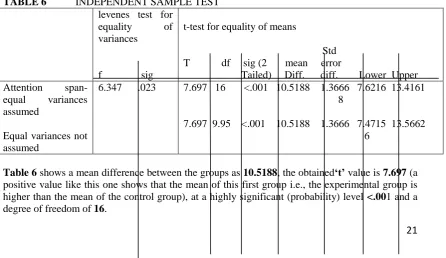
Table 5 above show the descriptive obtained for the experimental and control conditions, the mean score for the experimental group is 14.0400 which is very much higher than the control group’s mean which is 3.5211.
TABLE 6 INDEPENDENT SAMPLE TEST levenes test for
equality of variances
f sig
t-test for equality of means
Std T df sig (2 mean error
Tailed) Diff. diff. Lower Upper Attention
span-equal variances assumed
Equal variances not assumed
6.347 .023
7.697 16 <.001 10.5188 1.3666 7.6216 13.4161 8
7.697 9.95 <.001 10.5188 1.3666 7.4715 13.5662 6
22 This means that there is a statistically significant difference between the experimental and control conditions.
Discussion
Three hypotheses were postulated and tested in this study. The results obtained did not support the first and third hypotheses; it however supported the second hypotheses.
The first hypothesis which states that there will be no significant difference between the pretest and posttest mean scores of the experimental group on the effect of TGM on the attention span of persons with down syndrome was rejected, Mack,(2007), Horn & Blankson,(2005), and Davis,(2005). This may be because the findings revealed that there is a statistically significant difference between them, with the posttest mean significantly higher than the pretest mean in the experimental group ( Corbett,Shickman &Ferrer,2007; James,2001; & Brody,1997).
The second hypothesis which states that there will be no significant difference between the pretest and posttest mean scores of the control group accepted,( Tomatis,1991). This could be because the findings revealed that there is no statistically significant difference between the pre and posttest mean scores of the control group (McDade,Evans & Gray,1999).
The third hypothesis which states that there will be no significant difference between the control and experimental groups on the effect of TGM on the attention span of the persons with Down syndrome was rejected because the findings revealed that there is a statistically significant difference between the experimental and control conditions (Carroll,1993; Wagner,1997; Stephen,1996; Schalock, Stark,Snell,Coutler, ,Luckasson,Reiss, &Spitalnik ,1994,Vygotsky,1993 & Ziglar & Balla,1982).
Implications of the study
The findings of the study show that the Gigina method (also known as the Gigina Listening Program) has a significant effect on the attention span of persons with Down syndrome. This has also added a brand new variant to other existing attention training programs and thus an addition to knowledge.
The findings is a positive reaction to the many criticisms against the Nigerian Educational System among which Mba (1995), Identified as its failure to take it into account individuals with special needs, according to Zindi (1997), many African countries show interest in the education of pupils with special needs only in theory,
The outcome of this study is in line with current trend all over the world which is shifting towards addressing the educational plights of students with one form of disability or the other so as to better their lives (Osakwe, 2010). Short attention span as one of the symptoms presented by person with Down syndrome (Valsiner,&Vanderveer, 2008) has led to their academic under achievement; the outcome of this study has thrown a light on how to fill this gap.
SUGGESTIONS
1) Future researches in this area should try to bring the number of conditions to at least 3 i. e., including another variant of auditory processing therapy in order to compare which is more efficacious in the improvement of attention span.
2) Future researches should also test for the efficacy of the Gigina Listening Program on other children with special needs such as children with Autism, Attention Deficit/Hyperactivity Disorder etc.
3) Future researches should try and see the possibility of digitalizing this program to give it a State-Of–The-Art validity status.
CONCLUSION
The focus of this research was on the effect of the Gigina Listening Program (2012) on the attention span of persons with Down syndrome. Three hypotheses were postulated and tested for significance, these were as follows;
HO;
23 2) There will be no significant difference between the pretest and posttest scores of the control group on the effect of TGM on the attention span of persons with Down syndrome.
3) There will be no significant difference between the control and experimental groups on the effect of TGM on the attention span of persons with Down syndrome. Data were collected using one set of instrument; The Attention Span Scale (Gigina, 2012). The instrument was used to measure the attention span of 18 children with Down syndrome. The t-test statistics for dependent and independent samples were applied for data analysis. For hypothesis one, the findings revealed that there is a statistically significant difference between the pre and posttest mean, with the posttest mean significantly higher than the pretest mean in the experimental group. This finding suggests that the Gigina Listening Program is really effective in improving attention span of children with Down syndrome (Rose,2012).
For hypothesis two, result indicates that there is no statistically significant difference between the pre and posttest scores of the control group (George & Mather ,2006) .
For hypothesis three, the findings revealed that there is a statistically significant difference between the experimental and control conditions. This finding suggests that the experimental group which received the Gigina training as treatment had an improved attention span compared to the control group (Wagner,1997).
From the outcome of this study, it is safe to say that with attention training a child with short attention span can have his or her attention increased which is the basis for learning educational achievement and task completion etc.
REFERENCES
Adeyokunmi, A. A, (1982). The Incidence of Down Syndrome In Nigeria. Journal of Medical Genetics. Vol. 19 pp. 227-279.
Alfred Tomatis, (1991). The Conscious Ear. My Life of Transformation Through Listening. Paris station hill press.
American Association of mental Deficiency, (2010), family Resourses and stress associated with having a mentally retarded child. American Journal of Mental Retardation,93(2) 184-192.
American Psychiatric Association (2000). Diagnostic and Statistical Manual of mental Disorder. 4th ed. Text rev, Washington DC.
Andrew, Thompson & Trumps, (2005). Tomatis in School Wilson Academy Phoenix, Arizona, Research on Tomatis Method pp. 5
Betrand , Delgutte (1999). Auditory Neural Processing of Speech. Blackwell Publishing ISBN –631-21478-x
Brody, N. (1997). Intelligence, Schooling and Society. American Psychologist, 52, 1040-1050.
Carrol, J.B. (1993). Human Cognitive Abilities. A Survey of Factor Analytic Studies. New York: Cambridge
Corbett, B., Shickman, K., Ferrer, E. (2007), The Effects of Tomatis Sound Therapy on Language, Cognition and Behaviour in Children with Autism. Journal of Autism
and Developmental Disabilities. 38 (3), 562-566.
Davis, D. (2005). A Review of Various Abilities Improved Abilities Improved After The Basic Tomatis Method Program For Autistic, Milliam’s Syndrome & ADHD Clients, Presented At The 2005 Educational Audiology Association Summer Conference.
24 Ebigbo, Okwaraji & Ekwo (2001). A study of Norm Reference Indicators of The Draw A
Person Test. Journal of Research in Special Education. Vol. 4, no 2b
George and Mather, (2006). Foundation of Perception. Psychology Press. ISBN 0-86377-834-8.
Gigina ,O.C (2012), The Gigina listening program: for attention training program. M.Sc Thesis submitted to the Department of Psychology. Enugu State University of Science and Technology (ESUT).
Hodapp, R. M, Evans, D & Gray, F. L. (2008). What We Know About Intellectual Development In Children With Down Syndrome. In J.A. Rondal, J. Perera, and Nadale L, (Eds). Down syndrome: A Review of Current Knowledge (pp. 124-132). London : Whurr Publishers.
Horn, J. L, & Blankson, N. (2005). Founation For Better Understanding Cognitive Abilities. In D.P. Flanagan and P. Harrison (Ed.s), Contemporal Intellectual Assessment (2nd ed., pp. 41-68). New York: Guifford press.
James, B, (2001). How We Hear Music. The Boydel press ISBN 0-85115-813-7
Loe, M & Feldman H. M, (2007). Measuring Outcome in Attention Deficit Hyperactive Disorder. Journal of Pediatric Psychology. VOLUME 32 ISSUE 6 PP. 627-650 Macmillan D. L, Siperstein G. N & Gresham F. M. (1996). A Challenge to the Variety of
Mild Mental Retardation as a Diagnostic Category. Exceptional Children 62 (4): 356-371.
Mack,M, (2007). Result of Tomatis Training on Autism Listen and Learn Centre, Free Background Check For People in Canada.
Mba, P. O, (1995). Fundamentals of Special Education and Vocational Rehabilitation: Ibadan Condat publications.
Mcdade, R. M. Evans, D., & Gray, F.L, (1999). What we know about intellectual development in children with Down syndrome. In J. A. Rondal, J. Perera, and Nadale L, (eds). Down syndrome. A review of current knowledge (pp. 124-132). London: Whurr
Oloyode O. A. O., Fatuga M. B, Iyaniwura C. A, Jagun E. O, (2006). Profile Congenital Malformation in Sagamu, Nigeria. The Nigeria Medical Practitioners, Vol. 49, pp. 65-67.
Opitz, J. M. (2008). Historiography of the Casual Analysis of Mental Retardation. Speech to the 29th Annual Gatlinburg Conference on Research and Theory of Mental
Retardation. Gatlinburg T. N
Osakwe, R. N. (2010), Education for People with Special Needs in Nigeria Challenges And Way Forward in M. I. Attimo, J. B. Bbalola, O. A Moron ola and A. I Akandu Eds. Education for Sustainable Development. Faculty of Education University of Ibadan 33-43.
Rose, H.W (2012), Somethings wrong with my child! Springfield, I: Charles C Thomas. Schalock R, Stark J, Snell M, Coutler D, Polloway E, Luckasson R, Reiss S, Spitalnik D.
(1994). The Changing Conception Of Mental Retardation.
Stephen, J (1996). The Measurement of Man. The Scientific Racism. pp 24-25
Stromme, P. and Hagberg, G. (2000). Etiology in Severe and Mild Mental Retardation. Population Based Study of Norwagian Children. Developmental Medicine And Child Neurology: 42, 76-86
Valsiner, J. and Vanderveer, R. (2008). The Encoding of Distance. The Concept of the Zone of Proximal Development and its Interpretation. In R. Cocking and R. Renninger (Eds). The Development and Meaning of Psychological Distance. Lawrence Erlbaum, NJ: Hillsdale.
Vygotsky, L. S. (1993). The Collected Works of L. S. Vygotsky. Vol. 2. The Fundamentals of Defectology ( Abnormal Psychology and Learning Disabilities). Translated and with introduction by Jane, E. Knox and Carol B, Stevens.
25 Weiss, J. R., and Ziger, E. (1979). Cognitive Development in Retarded and Non Retarded Persons, Piagetian Test of the Similar Sequence Hypothesis: Psychological Bulletin, 8, 6, 831-851.
Ziglar E, Balla (eds). (1982). Mental Retardation the Developmental Difference Controversy. Hillsdale, NJ: Lawrence Erlbaum Associates.09309916410