Available online throug
ISSN 2229 – 5046
International Journal of Mathematical Archive- 8(8), August – 2017 1
VISCOUS DISSIPATION AND PARTIAL SLIP EFFECTS
ON MHD BOUNDARY LAYER FLOW OF NANOFLUIDAND HEAT TRANSFER
OVER A NONLINEAR STRETCHING SHEET WITH NON-UNIFORM HEAT SOURCE
Y. DHARMENDAR REDDY
1*, V. SRINIVASA RAO
2, L. ANAND BABU
31,2,3
Departtment of Mathematics,
Anurag Group of Institutions, Venkatapur,
Ghatkesar, Medchal, 500088, Telangana, India.
(Received On: 10-06-17; Revised & Accepted On: 31-07-17)
ABSTRACT
T
his paper deals with the steady two-dimensional laminar flow of a viscous nanofluid of magnetohydrodynamic(MHD) flow and heat transfer of the boundary layer flow over a nonlinear stretching sheet. The flow is caused by a nonlinear stretching sheet with effect of velocity slip and variable temperature in the presence of viscous dissipation and non-uniform heat source parameter. The resulting governing equations are converted into a system of nonlinear ordinary differential equations by applying a suitable similarity transformation and then solved numerically using Keller-Box technique. The effect of different flow parameters on velocity, temperature and concentration profiles are presented in both graphical and tabular forms. Numerical values of local skin-friction coefficient, local Nusselt number and Sherwood number are tabulated. It is found that the velocity decreases and the temperature & concentration are increases with increase of velocity slip parameter.
Keywords: Non-uniform heat source, Viscous Dissipation, Nanofluid, MHD, Nonlinear Stretching sheet, Velocity slip.
INTRODUCTION
The boundary layer flow and heat transfer over a stretching sheet have important aspects not only from a theoretical point of view but also concerning their practical applications in the paper production, polymer industry, crystal growing, food processing etc. The boundary layer flow problem over a stretching sheet was first studied by Crane [1], he analyzed an exact solution for the developing problem. Afterwards, the boundary layer flows by linear and nonlinear stretching surfaces have attracted a great deal of attention of the researchers. R. Cortell [2] investigated on fluid flow and radiative nonlinear heat transfer over a stretching sheet. The effect of variable fluid properties on the hydro-magnetic flow and heat transfer over a non-linearly stretching sheet was investigated by K.V. Prasad et al. [3].
Magnetohydrodynamic (MHD) flow and heat transfer due to the effect of magnetic fields on the boundary layer flow, it acts as electrically conducting fluids. In addition, this type of flow detects many applications in engineering problems such as MHD generators, plasma studies, nuclear reactors and geothermal energy extractions. M. Subhas Abel and Mahantesh M. Nandeppanavar [4] discussed heat transfer in MHD viscoelastic boundary layer flow over a stretching sheet with non-uniform heat source/sink. MHD flow and heat transfer over a stretching surface with variable thermal conductivity and partial slip was analyzed by Mahantesh et al. [5]. Asterios Pantokratoras [6] studied numerically the MHD boundary layer flow over a heated stretching sheet with variable viscosity.
In recent years, some studies have been given to the interest of nano fluids of convective transport. Conventional heat transfer fluids, including oil, water and ethylene glycol mixture are inadequate heat transfer fluids, since the thermal conductivity of these fluids plays an important role on the heat transfer coefficient between the heat transfer medium and the heat transfer surface. Therefore, several methods have been taken to improve the thermal conductivity of these fluids by suspending nano/micro or larger-sized particle materials in liquids. An advanced technique to improve heat transfer is by using nanoparticles in the base fluid. Nanotechnology has been widely used in industry, since materials with size of nanometers have unique physical and chemical properties. Nano-scale particle added fluids are called as nanofluid and these nanoparticles range in diameter between 1 - 100 nm. Nanofluid term was coined by Choi firstly [7].
Corresponding Author: Y. Dharmendar Reddy
1*1
Departtment of Mathematics, Anurag Group of Institutions,
© 2017, IJMA. All Rights Reserved 2
Khan and Pop [8] derived Boundary-layer flow of a nanofluid past a stretching sheet. MHD boundary layer flow and heat transfer of nanofluids over a nonlinear stretching sheet using R.K method by Mabood et al. [9]. Malvandi et al.
[10] analyzed boundary layer flow and heat transfer of nanofluid induced by anon-linearly stretching sheet using homotopy analysis method. Sheikholeslami et al. [11] discussed MHD nanofluid flow and heat transfer considering viscous dissipation using numerical technique. Hydromagnetic nanofluid flow due to a stretching or shrinking sheet with viscous dissipation and chemical reaction effects was analyzed numerically byet al. [12]. Dulal Pal and Gopinath Mandal [13] investigated the mixed convection-radiation on stagnation-point flow of nanofluids over a stretching/shrinking sheet in a porous medium with heat generation and viscous dissipation. Rizwan Ul Haq et al.
[14] discussed the effect of thermal radiation and slip effects on MHD stagnation point flow of nanofluid over a stretching sheet.
Rana and Bhargava [15] examined mixed convection flow of nanofluids with heat source or sink along a vertical plate using numerical technique. Nandy and Mahapatra [16] analyzed the stagnation point flow of nanofluids over a stretching sheet or shrinking sheet with effects of slips and heat generation/absorption. A. Alsaediet. et al. [17] discussed the effects of heat generation/absorption on stagnation point flow of nanofluid over a surface with convective boundary conditions. Noghrehabadi et al. [18] studied effect of partial slip boundary condition on the flow and heat transfer of nanofluids past stretching sheet with constant wall temperature. Magnetohydrodynamic (MHD) mixed convection slip flow and heat transfer over a vertical porous plate problem was discussed by Swati Mukhopadhyay and Iswar Chandra Mandal [19]. Mustafa et al. [20] investigates motion of nanofluid in a channel with wall properties. Bhattacharyya et al. [21] explained Slip effects on boundary layer stagnation-point flow and heat transfer towards a shrinking sheet. Naramgari Sandeep et al. [22] discussed the flow and heat transfer in MHD dusty nanofluid past a stretching/shrinking surface with non-uniform heat source/sink. Dulal Pal and Gopinath Mandal [23] investigated the effect of thermal radiation and MHD on boundary layer flow of micropolar nanofluid past a stretching sheet with non-uniform heat source/sink. Tasawar Hayat et al. [24] studied the effect of inclined magnetic field and heat source/sink aspects in flow of nanofluid with nonlinear thermal radiation.
The objective of the present paper is to study the MHD nanofluid flow and heat transfer over a nonlinear stretching sheet with partial slip effects. Therefore to extend the work of Mahantesh et al. [25] by considering viscous dissipation in to account. Using the similarity transformations, the set of governing P.D.E. and the boundary conditions are reduced to a system of non-linear ordinary differential equations which are solved numerically using Keller-Box method and the effects of the governing parameters on the flow field are discussed.
FORMULATION OF THE PROBLEM
© 2017, IJMA. All Rights Reserved 3
0
=
∂
∂
+
∂
∂
y
v
x
u
(1)( )
u
x
B
y
u
y
u
v
x
u
u
fρ
σ
ν
22−
2∂
∂
=
∂
∂
+
∂
∂
(2)( )
q
c
y
T
D
y
C
y
D
y
u
c
y
y
v
x
u
f p T B p′′′
−
∂
Τ
∂
+
∂
∂
∂
Τ
∂
+
∂
∂
+
∂
Τ
∂
=
∂
Τ
∂
+
∂
Τ
∂
∞ρ
τ
ν
α
1
2 2 2 2 (3)
∂
∂
+
∂
∂
=
∂
∂
+
∂
∂
∞ 2 2 2 2y
T
T
D
y
C
D
y
C
v
x
C
u
TB (4)
The boundary sheet is stretched nonlinearly with a velocity proportional to x coordinate (i.e., the distance from a slit); hence theappropriate boundary conditions for the problem are
1
,
0,
,
w w
u
u
u
A
v
T
Ax C
C
y
λ
∂
=
+
=
=
=
∂
aty
=
0
(5)∞
∞
→
→
=
T
T
C
C
u
0
,
,
asy
→
∞
(6)where x and y denote the cartesian coordinates along and normal to the sheet, respectively, u and v are the velocity components of the fluid in the x and y directions, respectively,
ρ
is the fluid density,ρ
µ
υ
=
is the kinematicviscosity,
µ
is the viscosity, T is the temperature, C is the concentration, k is the thermal conductivity, andc
p is the specific heat at constant pressure.Where 𝑢𝑤= 𝑏𝑥𝑛,
A
1 is the velocity slip parameter,(
)
fk
c
α
ρ
=
is the thermal diffusivity,f p
c
c
)
(
)
(
ρ
ρ
τ
=
is the ratiobetween the effective heat capacity of the nanoparticle material and the heat capacity of the ordinary fluid. We assume that the variable magnetic field
B
(
x
)
=
Β
0x
n−1/2, where 𝐵0 is constant.q
′′′
is the non-uniform heat source, which is modeled as:( )
(
)
(
)
(
)
−
+
+
−
−
=
′′′
A
T
T
∞y
b
n
x
−B
T
T
∞x
x
ku
q
n ww 2 *
1 *
2
1
exp
υ
υ
(7)where
A
*andB
* are parameters of the space and temperature dependent internal heat generation/absorption. The case*
A
> 0 andB
*> 0 corresponds to internal heat generation whileA
*< 0 andB
*< 0 corresponds to the internal heat absorption.The dimensionless variable can be taken as
( )
(
)
( )
( )
(
)
( )
( )
∞ ∞ ∞ ∞ − −−
−
=
−
−
=
+
=
+
−
+
+
−
=
=
C
C
C
C
T
T
T
T
x
n
b
y
f
n
n
f
x
n
b
v
f
bx
u
w w n n nη
φ
η
θ
υ
η
η
η
η
υ
η
η η,
,
2
1
,
1
1
2
1
,
2 1 2 1 (8)Substituting Eq. (8) into Esq. (1) - (4), we obtain the ordinary differential equations as follows:
0
1
2
′
2+
′′
−
′
=
+
−
′′′
f
f
f
M
f
n
n
f
(9)0
1
2
1
2
1
2
Pr
2 2 *
*′
=
+
+
+
+
′
+
−
′
+
′
′
+
′′
+
′
+
′′
A
f
n
B
n
f
n
Nt
Nb
f
Ec
f
θ
θ
φ
θ
λ
θ
θ
θ
(10)0
=
′′
+
′
+
′′
φ
θ
φ
Nb
Nt
© 2017, IJMA. All Rights Reserved 4
The transformed boundary conditions
( )
( )
( ) ( )
( )
( )
( )
( )
0,
1
,
1,
1
0
0,
0,
0
.
f
f
f
at
f
as
η
η
β
η θ η
ϕ η
η
η
θ η
ϕ η
η
′
′′
=
= +
=
=
=
′
→
→
→
→ ∞
(12)where the prime denotes differentiation with respect to𝜂.
(
)
(
)
( )
(
)
( )
( )
(
)
( )
(
)
2 2 0 1 2 12
, Pr
,
,
,
1
1
,
, A
2
B w
p w
f p w f
n
T w
p
B f
c
D
C
C
B
u
M
Ec
Nb
b n
c
T
T
c
c
D T
T
b
n
Le
Nt
x
D
c
T
ρ
σ
υ
ρ
α
ρ
υ
ρ
υ
υ
β
ρ
υ
∞ ∞ − ∞ ∞−
=
=
=
=
+
−
−
+
=
=
=
(13)The special interests and importance of the present problem of nano fluid, in this study, the local skin-friction, Nusselt number and Sherwood number are defined as
(
∞)
(
∞)
=−
=
Τ
−
Τ
=
∂
∂
=
C
C
D
xq
Sh
k
xq
Nu
y
u
u
C
w B m x w w x y w ffx
,
,
0 2
ρ
µ
(14) Where
k
is the thermal conductivity of the nanofluid andq
w,
q
mare the heat and mass fluxes at the surface, given by0 0
,
= =
∂
∂
−
=
∂
Τ
∂
−
=
y B m y wy
C
D
q
y
q
(15) Substituting Eq. (6) into Eqs. (14)-(15), we obtain)
0
(
'
2
1
Re
),
0
(
'
2
1
Re
),
0
(
"
2
1
Re
1x/2Cf
x=
n
+
f
x−1/2Nu
x=
−
n
+
θ
1x/2Sh
x=
−
n
+
φ
(16) Where
Re
x=
u
wx
/
ν
is the local Reynolds number.METHOD OF SOLUTION
The system of nonlinear ordinary differential equations in Eqs.(9)–(11) with the boundary conditions (12) are solved numerically by means of a finite-difference scheme known as the Keller-box method,the following steps are involved to achieve the Numerical solution.
• Reduce the non-linear higher order ordinary differential equations into a system of first order ordinary differential equations.
• Write the finite differences for the first order equations.
• Linearize the algebraic equations by Newton’s method, and write them in matrix–vector form. Solving the linear system by the block tri-diagonal elimination technique.
• In order to solve the above differential equations numerically, we adopt Matlab software which is very efficient in using the well known Keller box method.
For getting accuracy of this method to choose appropriate initial guesses.
( ) ( )
1
(
)
( )
( )
1
,
,
1
f
η
e
ηθ η
e
ηϕ η
e
ηβ
− − −=
−
=
=
+
The step size
δ
=
0
.
006
is used to obtain numerical solution with four decimal place accuracy as criterion of convergence.RESULT AND DISCUSSION
© 2017, IJMA. All Rights Reserved 5
Effects of
β
, Ec, Nb, Nt, Le and M when Pr = 1.0, n = 0.5, A* = B*=0.1, 𝜆= 2.0 on skin-friction, local Nusselt and loacal Sherwood numbers are presented in Table 2. It is to found that skin friction coefficient increases for different values of magnetic parameter M, but skin friction coefficient slowly decreases with increasing inβ
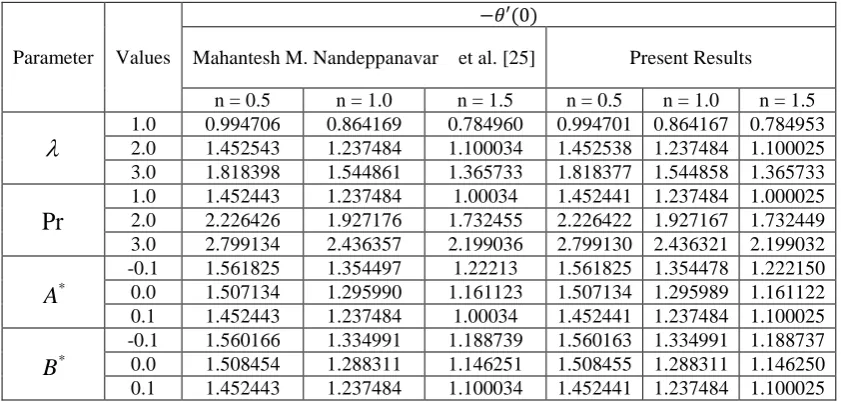
.Table-1: Comparison values of Local Nusselt number
−
θ
′
(
0
)
for several values of the flow parameters.Parameter Values
−𝜃′(0)
Mahantesh M. Nandeppanavar et al. [25] Present Results n = 0.5 n = 1.0 n = 1.5 n = 0.5 n = 1.0 n = 1.5
λ
1.0 2.0 0.994706 1.452543 0.8641691.237484 0.7849601.100034 0.994701 0.864167 0.784953 1.452538 1.237484 1.100025 3.0 1.818398 1.544861 1.365733 1.818377 1.544858 1.365733Pr
1.0 1.452443 1.237484 1.00034 1.452441 1.237484 1.000025 2.0 2.226426 1.927176 1.732455 2.226422 1.927167 1.732449 3.0 2.799134 2.436357 2.199036 2.799130 2.436321 2.199032
*
A
-0.1 1.561825 1.354497 1.22213 1.561825 1.354478 1.222150 0.0 1.507134 1.295990 1.161123 1.507134 1.295989 1.161122 0.1 1.452443 1.237484 1.00034 1.452441 1.237484 1.100025
*
B
-0.1 1.560166 1.334991 1.188739 1.560163 1.334991 1.188737 0.0 1.508454 1.288311 1.146251 1.508455 1.288311 1.146250 0.1 1.452443 1.237484 1.100034 1.452441 1.237484 1.100025
Table-2: Calculation of −𝑓′′(0), −𝜃′(0) and−𝜙′(0) for various flow parameters when Pr = 1.0, n = 0.5, A* = B*=0.1, 𝜆= 2.0
M Ec Nb Nt Le
β
−𝑓"(0) −𝜃′(0) −𝜙′(0) 0.00.5 0.1
0.1 2.0
0.1
0.7717 1.1806 0.0414
0.1 0.8224 1.1552 0.0428
0.2 0.8705 1.1306 0.0449
0.1 0.0
0.8224
1.2764 -0.0602
0.1 1.2521 -0.0396
0.3 1.2037 -0.0016
0.5
0.1 1.1552 0.0428
0.3 1.0889 0.6130
0.5 1.0266 0.7263
0.1
0.1 1.1552 0.0428
0.3 1.1203 -1.5260
0.5 1.0877 -2.9918
0.1
2.0 1.1552 0.0428 3.0 1.1463 0.3490 5.0 1.1350 0.8152 2.0
0.1 0.8224 1.1552 0.0428 0.5 0.5280 1.0106 0.0162 0.7 0.4423 0.9490 0.0151
© 2017, IJMA. All Rights Reserved 6
Figure-2: Effect of Magnetic field M on velocity profile
Figure-3: Effect of Magnetic field M on temperature profile
Figure-4: Effect of Magnetic field M on concentration profile
© 2017, IJMA. All Rights Reserved 7
Figs.5, 6 and 7 demonstrates the effect of velocity slip parameter (
β
) on velocity, temperature and concentration profiles. From the figure 5 it is observed that the velocity profile decreases with increasing values ofβ
. As the velocity slip parameter increases, the slip velocity increases and the fluid velocity decreases. The reason for this phenomena is when the slip condition occurs, the velocity of the stretching sheet is not same as the velocity of the flow near the sheet. The effect of velocity slip parameter on the temperature profile and the concentration profile are presented in Figs. 6 and 7. In the presence of a magnetic field and a thermal jump, it is observed that the temperature and concentration profiles increases as the value of the velocity slip parameterβ
increases.Figure-5: Effect of velocity slip parameter
β
on velocity profileFigure-6: Effect of velocity slip parameter
β
on temperature profile© 2017, IJMA. All Rights Reserved 8
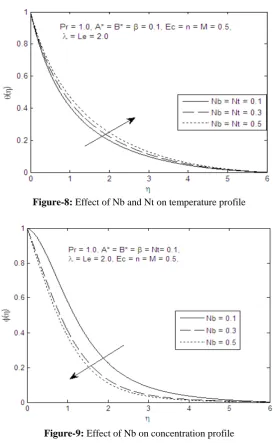
Figure 8 depicts the influence thermophoresis parameter (Nt) and Brownian motion parameter (Nb) on temperature profile. As the thermophoretic and Brownian motion parameters increases, the movement of nanoparticles from the hot surface to cold surface and ambient fluid is occurred, as result the temperature increases in the boundary layer, this results in the growth of thermal boundary layer thickness.
Figure-8: Effect of Nb and Nt on temperature profile
Figure-9: Effect of Nb on concentration profile
© 2017, IJMA. All Rights Reserved 9
Figure 9 illustrates the effect of Brownian motion parameter (Nb) on concentration profile. The nanoparticle concentration profile decreases with the increase in the Brownian motion parameter Nb. Brownian motion attends to warm the boundary layer and simultaneously infuriates particle deposition away from the fluid regime or onto the surface, thereby describing for the reduced concentration magnitudes. For large particles and clearly Brownian motion does maintain a significant enhancing influence on concentration profiles. The converse is the case, for minor particles and Brownian motion is strong and the parameter Nb will have high values. Figure 10 shows the effect of thermophoresis parameter (Nt) on concentration profile. We observed that the concentration profile is increased with increasing values of thermophoresis parameter Nt. This is due to the fact that the thermophoretic force is produced by the temperature gradient and it creates a very high speed flow away from the stretching sheet. Hence the concentration profile ϕ(η) increases at the surface.
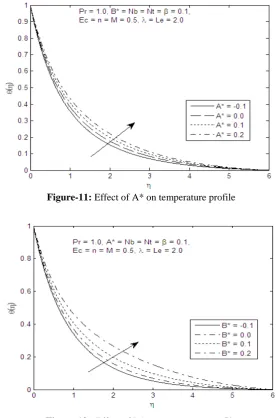
Figure-11: Effect of A* on temperature profile
Figure-12: Effect of B* on temperature profile
© 2017, IJMA. All Rights Reserved 10
Figure-13: Effect of Eckert number Ec on temperature profile
Fig.13. illustrates the effects of the viscous dissipation parameter (Eckert number) Ec on the temperature. It can be seen that the temperature increases with increasing values of Ec and that the thermal boundary layer thickness also increases. This is due to the fact that heat energy is stored in the liquid due to the frictional heating. The effect of increasing Ec, is to enhance the temperature at any point.
Figure-14: Effect of Lewis number Le on concentration profile
Fig. 14.depicts the influence of the Lewis number on the concentration profile. It is noticed that the nanoparticle volume fraction experiences a strong reduction for larger Le values. The dimensionless Lewis number is defined as the ratio of thermal and mass diffusivity. By increasing the value of Le, the thermal boundary layer thickness is increased whereas the concentration boundary layer thickness is reduced.
© 2017, IJMA. All Rights Reserved 11
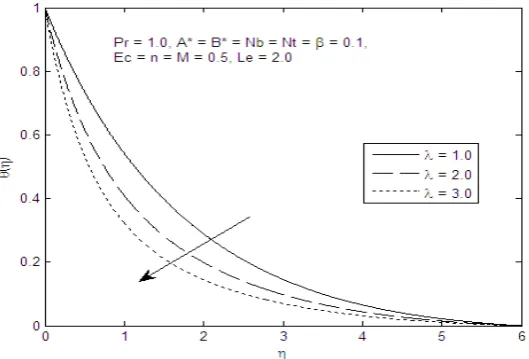
Fig. 15 shows that the effect of the parameter
λ
on temperature distribution. It can be observed that the direction of heat transfer depends on the magnitude of the parameterλ
. From fig. 15 it can be seen that, the increasing values ofλ
is to decrease the magnitude of temperature in the boundary layer, and hence there is heat transfer from sheet to liquid.Figure-16: Effect of non-linear stretching sheet parameter (n) on velocity profile
Figure-17: Effect of non-linear stretching sheetparameter (n) on temperature profile
The effect of non-linear stretching sheetparameter (n) is discussed in Fig. 16 & Fig. 17. It is evident that as the nonlinear stretching parameter n increases, velocity profiles are decreases whereas temperature distribution is accelerate.
© 2017, IJMA. All Rights Reserved 12
Figure-18: variation of
−
f
′′
( )
0
for different values of Magnetic field M and non-linear stretching sheet parameter n.Figure-19: variation of
−
θ
′
( )
0
for different values of Magnetic field M and non-linear stretching sheet parameter n.Figure-20: variation of
−
θ
′
( )
0
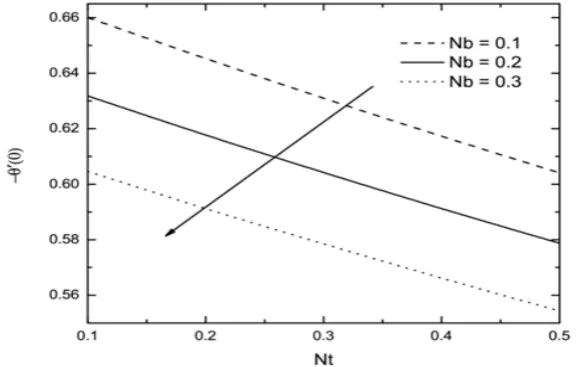
with thermophores is parameter Nt for different values of Brownian motion parameter Nb.© 2017, IJMA. All Rights Reserved 13
CONCLUSIONS
The problem of MHD boundary layer flow of nanofluids and heat transfer over a nonlinear stretching sheet with viscous dissipation, non-uniform heat source and velocity slip condition has been investigated numerically. Similarity solutions are presented which effects magnetic field, nonlinearly stretching sheet, Brownian motion parameter, thermophoresis parameter, viscous dissipation, velocity slip parameter and Lewis number. The governing partial differential equations were transformed to non-linear ODEs with the help of similarity transformations. The solution of the problem was obtained numerically using Keller box method.
The following conclusions have been drawn from the present study:
1. Velocity distribution decreases with increasing the values of Magnetic field M, whereas temperature and concentration profiles are increases.
2. The effect of increasing values of velocity slip parameter (
β
) is to decrease the velocity distribution, but increase the temperature and concentration distributions in flow region.3. An increase in Brownian motion parameter and thermophoresis parameter inceases the temperature distribution.
4. Concentration profilesare decreased with increasing of Brownian motion parameter, whereas it increases when the thermophoresis parameter increases.
5. The internal heat generation/absorption parameters space dependent (
A
*) and temperature dependent (B
*) increases then temperature profiles are also increases.6. It is noted that with increasing values of Eckert number (Ec) the surface temperature increases. 7. Concentration profiles are reduced with the larger values of Lewis number.
8. The rate of heat transfer increases with the increasing values of non-linear stretching parameter, magnetic parameter. Whereas it decreases with increasing values of Brownian motion parameter and thermophoresis parameter.
9. Skin-friction coefficient increases with increasing values of non-linear stretching parameter and magnetic parameter.
REFERENCES
1. L. J. Crane, Flow past a stretching plate, Journal of Applied Mathematic and Physics (ZAMP), Vol. 21,
2. R. Cortell, Fluid flow and radiative nonlinear heat transfer over a stretching sheet, Journal of King Saud University – Science (2014) 26, 161–167.
3. K.V. Prasad, K. Vajravelu , P.S. Datti, The effects of variable fluid properties on the hydro-magnetic flow and heat transfer over a non-linearly stretching sheet International Journal of Thermal Sciences 49 (2010) 603–610.
4. M. Subhas Abel and Mahantesh M. Nandeppanavar , Heat transfer in MHD viscoelastic boundary layer flow over a stretching sheet with non-uniform heat source/sink, Commun Nonlinear Sci Numer Simulat 14 (2009) 2120–2131.
5. Mahantesh M. Nandeppanavar, K. Vajravelu, M. Subhas Abel, M.N. Siddalingappa, MHD flow and heat transfer over a stretching surface with variable thermal conductivity and partial slip, Meccanica (2013) 48:1451–1464.
6. Asterios Pantokratoras, Study of MHD boundary layer flow over a heated stretching sheet with variable viscosity: A numerical reinvestigation,
7. Choi, S. U. S., (1995). "En hancing thermal conductivity of fluids with nanoparticles, ASME Int. Mech. Eng. Congress. San Francisco, USA, ASME, FED, 231/MD., 66: 99-105.
8. W.A. Khan, I. Pop, Boundary-layer flow of a nanofluid past a stretching sheet, International Journal of Heat and Mass Transfer 53 (2010) 2477–2483.
9. F.Mabood ,W.A.Khan , A.I.M.Ismail ,MHD boundarylayer flow and heat transfer of nanofluids over a nonlinear stretching sheet: Anumericalstudy, Journal of Magnetism and Magnetic Materials 374(2015) 569–576.
10. A. Malvandi1,F. Hedayati2 and M. R. H. Nobari, An Analytical Study on Boundary Layer Flow and Heat Transfer of Nanofluid Induced by a Non-Linearly Stretching Sheet Journal of Applied Fluid Mechanics, Vol. 7, No. 2, pp. 375-384, 2014.
11. Mohsen Sheikholeslami, Shirley Abelman, Davood Domiri Ganji, Numerical simulation of MHD nanofluid flow and heat transfer considering viscous dissipation, International Journal of Heat and Mass Transfer 79 (2014) 212–222.
12.
© 2017, IJMA. All Rights Reserved 14
13. Dulal Paland Gopinath Mandal, Mixed convection-radiation on stagnation-point flow of nanofluids over a stretching/shrinking sheet in a porous medium with heat generation and viscous dissipation,
14. Rizwan Ul Haq, Sohail Nadeem, Zafar Hayat Khan and Noreen Sher Akbar, Thermal radiation and slip
effects on MHD stagnation point flow of nanofluid over a stretching sheet, Physica E 65 (2015) 17–23 15. Rana P., Bhargava R., (2011). "Numerical study of heat transfer enhancement in mixed convection flow
along a vertical plate with heat source/sink utilizing nanofluids", Commun. Nonlinear Sci. Numer.Simul., 16: 4318-4334.
16.
point flow nanofluid past a stretching/shrinking surface with convective boundary conditions", Int. J. Heat Mass Transf., 64, 1091-1100.
17. A. Alsaedi, M. Awais and T. Hayat, Effects of heat generation/absorption on stagnation point flow of nanofluid over a surface with convective boundary conditions, Commun Nonlinear Sci Numer Simulat 17 (2012) 4210–4223.
18.
condition on the flow and heat transfer of nanofluids past stretching sheet prescribed constant wall temperature, International Journal of Thermal Sciences 54 (2012) 253-261.
19. Swati Mukhopadhyay and Iswar Chandra Mandal, Magnetohydrodynamic (MHD) mixed convection slip flow and heat transfer over a vertical porous plate,
20. M. Mustafa,S. Hina ,T. Hayat ,A. Alsaedi, Slip Effects on the PeristalticMotion of Nanofluid in a Channel With Wall Properties, Journal of Heat Transfer, Vol. 135(4), 041701(2013).
21.
point flow and heat transfer towards a shrinking sheet,
22. Naramgari Sandeep, Chalavadi Sulochana and Banglore Rushi Kumar, Flow and Heat Transfer in MHD Dusty Nanofluid Past a Stretching/Shrinking Surface with Non-Uniform Heat Source/Sink, Walailak J Sci & Tech 2017; 14(2): 117‐140.
23. Dulal Pal and Gopinath Mandal, Thermal radiation and MHD effects on boundary layer flow of micropolar nanofluid past a stretching sheet with non-uniform heat source/sink,
24. Tasawar Hayat, Sajid Qayyum, Ahmed Alsaedi and Anum Shafiq, Inclined magnetic field and heat source/sink aspects in flow of nanofluidwith nonlinear thermal radiation, International Journal of Heat and Mass Transfer 103 (2016) 99–107.
25. Mahantesh M. Nandeppanavar, K. Vajravelu, M. Subhas Abel and Chiu-On Ng, Heat transfer over a nonlinearly stretching sheet with non-uniform heat source and variable wall temperature, International Journal of Heat and Mass Transfer 54 (2011) 4960–4965.
Source of support: Nil, Conflict of interest: None Declared.