EASY-IMPLEMENTING ANTIMICROBIAL POLYPROPYLENE
MATERIALS MODIFIED BY SILVER(I) AND COPPER(II) IONS
Olga Gornukhina,
[a,b]Tatiana Tikhomirova,
[a]Anna Filippova,
[b]Artur
Vashurin
[b]*Keywords: Polypropylene; Antimicrobial activity; Chemical activation; Functionalization.
Common polypropylene exhibiting no antimicrobial activity was effectively transformed into novel functional material. A surface of polypropylene materials was preliminarily activated via two chemical methods which are the treatment of the sample with water solution of sodium hydroxide in presence of iron(II) sulfate under boiling temperature and treatment with water solution of hydrogen peroxide in presence of iron(II) sulfate (to activate decomposition of the peroxide). Silver(I) and copper(II) ions were immobilized onto the surface of activated polypropylene, giving a set of four hybrid materials. Resulting functional polymers are of continuous and comprehensive antimicrobial activity. An impact of preliminary chemical activation of the polypropylene surface on the antimicrobial activity of the hybrids was shown. The highest efficiency in terms of antimicrobial properties is manifested by nonwoven polypropylene material activated by 20% water solution of chemically pure sodium hydroxide in the presence of iron(II) sulfate under boiling temperature for 2 hours followed by immobilization of silver ions.
* Corresponding Authors E-Mail: [email protected]
[a] Ivanovo State University of Chemistry and Technology, 153000, Russia, Ivanovo, Sheremetevsky ave. 7 [b] Research Institute of macroheterocycles, Ivanovo State
University of Chemistry and Technology, 153000, Russia, Ivanovo, Sheremetevsky ave. 7
INTRODUCTION
Polymers are of wide application in almost every sphere of humanity. Polypropylene is one of the most widely used and available commercial commodity polymers produced in tons. In order to impart it more functions, one need to functionalize a surface by some active compounds because polypropylene itself has limited application range due to brittleness and hydrophobic nature. There are three common ways to realize the functionalization, namely: plasma treatment that is expensive, but environmental-friendly;1,2,3
microwave treatment being controversial;4,5,6and relatively
dirty but cheap chemical activation.7,8 Resulting surface
acquires activated groups being able to form bonds with different compounds that make polypropylene to be a potential carrier. This approach is used, for example, for catalysis of oil sweetening.9,10 However, one of the most
significant polymers application area is medicine.
Use of biomedical polymer materials modified by curative and antimicrobial compounds becomes increasingly common in recent years.11,12 Practical medicine concluded
advisability of using hybrid medicinal drugs being principally (polymer carrier)+(a biologically active substance (BAS)) combination.13 Chemical modification of
polymer surface by BAS requires the initial materials to be biologically inert, mechanically durable and able to link BAS after preliminary activation. Polypropylene (PP) meets all of these requirements. Materials based on it are widely used in medical practice, which for example, are suture materials for microsurgery, surging clothes, dressing and covering means made of non-woven fabric produced using spunbond technology ("Spunbond"), etc.
There are two common and easily available metals exhibiting antimicrobial activity, namely copper and silver.14,15,16,17 In order to approach obtaining antimicrobial
activity being easy and at the same time effective these very two elements were chosen for the work.
We previously obtained PP films functionalized by indomethacin,18 PP films and nonwoven materials
containing immobilized gentamycin.19 All compounds
exhibited antimicrobial activity. Although microorganisms become resistible towards antibiotics, there is no adaptation to antiviral, antifungal and antiseptic action of silver and copper ions. Therefore, the work provides data on PP material’s modification by copper and silver ions to impart them antimicrobial properties. The goal was to develop a cheap, easy-implementing and efficient approach for obtaining antimicrobial materials, which could be performed right on the place of probable application, for example, hospital.
RESULTS AND DISCUSSION
PP is one of the most inert polymers that is to say it contains no active functional groups neither on the surface no in the volume. Therefore, it is impossible to anchor antimicrobial substances on the surface of the initial PP. That is why chemical activation of PP surface being part of the entire modification process is of great importance.
Successful activation of polypropylene surface is proved by spectrophotometric studying resulted in samples. Spectrophotometric studies of chemically activated polymer surface by ATR IR technique indicate the formation of absorption bands in the range of 3650–3100 cm-1
correspondings to valent vibrations of H-bonded OH-groups upon alkaline etching at elevated temperature (method 1). This is supported by absorption bands in the range of 1680– 1600 cm-1 related to stretching vibrations of OH-groups.
characterizing asymmetrical vibrations of carbonyl groups of modified polymer surface layer as well as absorption band in the range of 1580–1560 cm-1 which are attributed to
carboxylate-ions.20,21
Similar spectral change is observed upon chemical activation of PP by the solution of hydrogen peroxide in the presence of iron(II) salt (method 2). IR-spectra show formation of primary alcohol groups upon activation according to method 2 that is confirmed by absorption bands in the range of 3000–2800 cm-1 (stretching vibrations of
H-bonded OH-groups) complemented by absorption bands in the range of 1350–1240 cm-1 (deformation vibrations of
OH-groups). There is also an increase of absorption band in the range of 1180–1160 cm-1 intensity corresponding to
vibrations of C-(O)H groups. In addition, signal accumulation is observed in the range of 1750–1730 cm-1,
which corresponds to asymmetric valence vibrations of the carbonyl group and is confirmed by the amplification of the absorption band signal in the range of 1380–1360 cm-1
(deformation vibrations of the carbonyl group).20,21,22 ATR
IR spectra of PP film before treatment and after are shown in Figure S2. Spunbond exhibits similar spectral behavior.
Summarizing the aforesaid, suchlike chemical activation of polymers leads to the formation of the modified surface having a large number of reactive groups. Herewith, the amorphous phase is predominantly etched and globular structures of the crystal phase are redistributed.23 Such
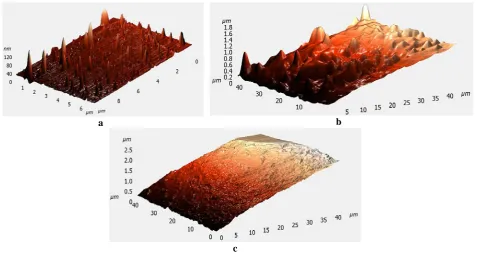
changes of the activated PP surface were observed by AFM. Since the PP films have low surface stiffness, the AFM intermittent contact mode was applied, which allows to significantly reduce the lateral forces between the probe and the sample. Figure 1 provides 3D micrographs of the PP film’s surface obtained by AFM method.
Figure 1 demonstrates the chemical activation being able to change the surface morphology. The surface of
unactivated PP films is characterized by the presence of large peaks and depressions, some of the concentration areas are of 10-45 µm high and 0.8-2.0 µm diameter (Figure 1, a). Surface morphology is smoothed resulting from chemical activation that is shown in Figure 1, b, where the height of some concentration areas is 0.3-3.0 µm and diameter is 0.1-0.5 µm. The samples activated according to method 2 exhibit resembling characteristics, the height of the concentration areas is 0.2-1.7 µm and diameter is 0.05-0.18 µm (Figure 1, c). AFM data are supported by SEM images given in Figure S1.
Table 1. Physicomechanical characteristics of the initial and activated polypropylene film.
t, min The workload at break (Nm-1)
Elongation at break, %* Untreated
0 9.8 ± 0.4 35 ± 1.7
Activated by 30 % aq. Н2О2
90 9.4 ± 0.5 32.5 ± 1.5
120 9.5 ± 0.4 32.2 ± 1.7
Activated by 20 % aq. NaOH
90 7.2±0.9 28.3±1.7
120 7.1±1.0 28±1.7
*Relative to initial sample length equal to 60 mm working speed at
break is 100 mm s-1 (constant for all samples); error in measuring
the working load and elongation at break is not greater than 5 %.
Obtained data suggest a less essential change of the surface in case of chemical activation according to method 2 compared to that one according to method 1. This fact indicates less harsh modification of supramolecular polymer surface, that is in agreement with results of a study of the strength characteristics of activated PP samples given in Table 1 showing treated materials to lose mechanical durability insignificantly.
a b
c
This indirectly suggests smooth morphology’s modification without inner structure changes. Chemically activated samples were treated by water solutions of silver(I) and copper(II) nitrates in order to obtain PP materials (film, “Spunbond”) being antimicrobial. Since the chemically activated surface of PP materials has active oxygen-containing functional groups and immobilized substances are dissociating, the way of anchoring metal ions onto the surface of polymer-carrier proceeds through the formation of chelate bonds in case of Cu, while Ag is bonded through weak coordination interaction. Proposed mechanism for the process is presented in Figure 2.
Figure 2. The proposed binding mechanism for Ag and Cu with polypropylene.
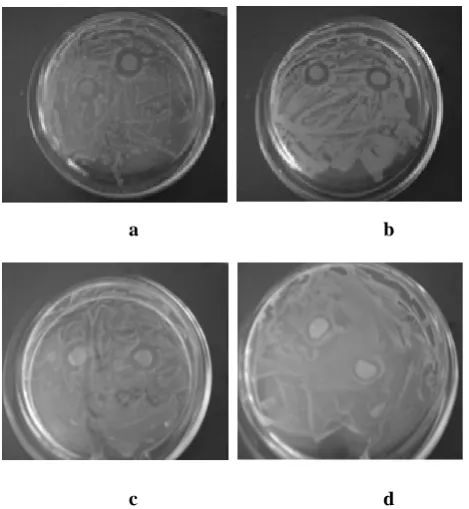
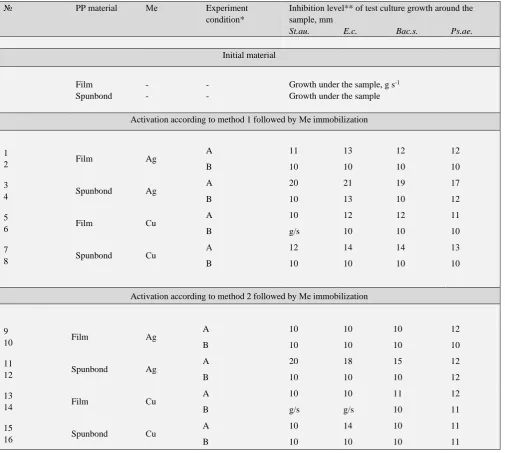
Obtained modified PP materials were tested toward antimicrobial activity. Experimental data are presented in Figure 3, Table 2. Conditions A and B used upon antimicrobial experiment were applied in order to find out the antimicrobial effect of weakly-bonded metal ions.
a b
c d
Figure 3. Images of modified "Spunbond" material (activation according to M1 with silver) toward Staphylococcus aureus(a),
Bacillus subtilis(b), Escherichia coli(c) and Pseudomonas aeruginosa (d).
Table 2 shows unmodified materials to have no antimicrobial properties. The samples containing silver ions are more active than copper-containing ones as a rule that is
explained by the difference in action mechanisms of silver and copper ions toward microbial cells.
Nonwoven PP material (Spunbond) is known to have more developed specific surface compared to PP film and thus greater possibility to bind metal ions.23 This fact is
indirectly supported by more pronounced antimicrobial effect observed in the case of Spunbond compared to the film. Storing for 7 days of samples in the medium of infected agar decreases antimicrobial activity but not more than two times. Films activated according to method 2 and modified by copper ions are of exception – they have completely lost their activity on the fifth day. Loss of activity is more pronounced in the case of Spunbond usage. At the same time, some of the films modified by silver ions have not changed antimicrobial activity even after 7-days soaking.
Based on obtained results one can propose the duration of antimicrobial activity of obtained polymer materials is related to the mechanism of metal ions binding by chemically activated PP carrier, the amount of immobilized substance exhibiting antimicrobial properties and the sterilization method of such materials.
EXPERIMENTAL
Following materials,being samples of 25×60 mm size, were used in present work: biaxially oriented commercial film of isotactic polypropylene (PP film) TU RB 00204079.164-97 (RF, Moscow, JSC "Moscow Oil Refinery") (molecular mass 400-700 thousand, thickness 20
μm);non-woven polypropylene material “Spunbond”
(Spunbond) grade N-55/2100 (Republic of Belarus, Mogilev, Mogilev Kkhimvolokno OJSC) with specific density of 40 g/m2, molecular weight 400-700 thousand, thickness 40 μm).
Method 1 (M1). PP material sample of 20×65 mm is treated by wt.20% water solution of sodium hydroxide in the presence of iron(II) sulfate under boiling temperature for 2 hours.
Method 2 (M2). The similar sample is treated by wt.37% water solution of hydrogen peroxide in the presence of iron(II) sulfate (to activate decomposition of the peroxide) under the temperature of 60ºС for 2 hours.
After activation, the samples were thoroughly washed by distilled water (till pH ≅ 5.5 for method 1; negative reaction toward hydrogen peroxide according to iodine-starch paper for method 2). The change in the chemical composition of the surface layer of polypropylene was studied by multiply attenuated total reflection infrared spectroscopy (ATR IR). The measurements were carried out on an "Avatar 360" FT-IR ESP spectrophotometer in the wave-number range of 400–4000 cm-1. The ATR prism of the crystalline zinc
selenide was used. The angle of incidence of the beam at the media interface was 45°, the number of reflections was 12. The spectra were recorded with an accumulation of the signal based on the results of 32 scans. The surface structure of modified films was investigated by AFM method (in a semi-contact mode using cantilevers NSG 11) on an atomic force microscope Solver P-47 Pro.
C H2 CH2 H3C
C H2 H2C
O
HC CH3 Ag
C H2 CH2 H2C
C H2 H2C
O
HC CH3 O
Table 2. Antimicrobial properties of polypropylene materials modified by metal ions (Me).
№ PP material Ме Experiment
condition*
Inhibition level** of test culture growth around the sample, mm
St.au. E.c. Bac.s. Ps.ae.
Initial material
Film - - Growth under the sample, g s-1
Spunbond - - Growth under the sample
Activation according to method 1 followed by Ме immobilization
1
2 Film Ag
A 11 13 12 12
B 10 10 10 10
3
4 Spunbond Ag
A 20 21 19 17
B 10 13 10 12
5
6 Film Сu
A 10 12 12 11
B g/s 10 10 10
7
8 Spunbond Сu
А 12 14 14 13
B 10 10 10 10
Activation according to method 2 followed by Ме immobilization
9
10 Film Ag
A 10 10 10 12
B 10 10 10 10
11
12 Spunbond Ag
A 20 18 15 12
B 10 10 10 12
13
14 Film Сu
A 10 10 11 12
B g/s g/s 10 11
15
16 Spunbond Сu
A 10 14 10 11
B 10 10 10 11
Mechanical tests were carried out on the breaker PM-30-1 according to the known method.24 The speed of the
extension of the clamps of the testing machine is 100 mm min-1, the studies were carried out for a set of 10 samples.
Activated PP materials were treated by water solutions of silver or copper nitrates to impart antimicrobial activity. Immobilization of Ag+ and Cu2+ ions was performed by
means of 2% water solutions of corresponding salts under the temperature of 17 ± 2 ºС for 12 hours. Antimicrobial activity tests of the samples were performed right after immobilization of the ions and washing by distilled water. Improved “agar plate" method on base of meat-peptone agar (MPA) was applied in order to study the antibacterial activity of modified PP materials. The following test cultures being primary causative agents of wound infection were used: Escherichia coli (АТСС 25922), Staphylococcus aureus (АТСС 6538), Pseudomonas aeruginosa (ATCC 27853) and Bacillus subtilis (ATCC 6633). The microbial load was 107 cells ml-1. Each Petri dish of 15 cm diameter
was loaded with 20 ml of contaminated with a
microorganism environment. Then, test samples of the material having ~10mm diameter were placed onto not hardened MPA under the temperature of +45ºС in the way that the sample was in contact with the substratum.
The dished were maintained under room temperature for 1-2 hours to eliminate time variation upon the sample's loading. After this, the dishes were incubated under the temperature of (36 ± 1) ºС for 24-48 hours. Uneven inhibition zones were observed around test samples of the material after incubation. Diameters of inhibition zones were measured in narrowest place.25
Conclusion
binding copper and silver ions. Absence of dramatical loss of physicochemical characteristics (within 5%) suppose studied methods to be applied for obtaining antimicrobial polypropylene materials of biomedical purposes.
The highest efficiency in terms of antimicrobial properties is manifested by Spunbond material activated by 20% water solution of sodium hydroxide in the presence of iron(II) sulfate under boiling temperature for 2 hours followed by immobilization of silver ions.
Hereby, obtained PP materials provide one of the possible ways of biologically active polymers creation that is of great importance and could be recommended for medicine, veterinary or agriculture purposes (disposable medical clothing, suture, plugging, dressing and covering materials, etc.). The synergy of inert carrier and the active substance is quite a simple formula giving outstanding results. Novel materials combine properties of starting ones in order to perform tasks they were made for.
ACKNOWLEDGMENTS
The modification of polymeric materials was supported by the Grants at the President of the Russian Federation (Program for State Support of Young Russian Scientists, Project [No. МК-204.2019.3]). The study of surface structure was supported by state task of the Ministry of Education and Science of the Russian Federation [project № 4.1929.2017/4.6] and study of antimicrobial activity was supported by state task of the Ministry of Education and Science of the Russian Federation [project № 4.7305.2017/8.9].
REFERENCES
1Cui, N.-Y., Brown, N. M. D., Modification of the surface
properties of polypropylene (PP) film using an air dielectric barrier plasma, Appl. Surf. Sci, 2002, 188, 31. DOI: 10.1016/S0169-4332(01)01035-2.
2Thakur, V. H., Vennerberg, D., Kessler, M. R., Green aqueous
surface modification of polypropylene for novel polymer nanocomposites, Appl. Mater. Interfaces, 2014, 6, 9349. DOI: 10.1021/am501726d.
3Yu, H.-Y., Xie, Y.-J., Hu, M.-X., Wang, J.-L., Wang, S.-Y., Xu,
Z.-K., Surface modification of polypropylene microporous membrane to improve its antifouling property in MBR: CO2
plasma treatment, J. Membr. Sci. 2005, 254, 219. DOI: 10.1016/j.memsci.2005.01.010.
4Mirabedini, S. M., Rahimi, H., Hamedifar, Sh., Mohseni, S. M.,
Microwave irradiation of polypropylene surface: a study on wettability and adhesion, Int. J. Adhes. Adhes, 2004, 24, 163. DOI: 10.1016/j.ijadhadh.2003.09.004.
5Yuen, F. K., Hameed, B. H., Recent developments in the
preparation and regeneration of activated carbons by microwaves, Adv. Colloid Interface Sci.,2009, 149, 19. DOI: 10.1016/j.cis.2008.12.005.
6Vashurin, A. S., Badaukaite, R. A., Futerman, N. A., Pukhovskaya,
N. G., Shaposhnikov, G. P., Golubchikov, O. A., Catalytic properties of polymer matrix-immobilized cobalt complexes with sulfonated phthalocyanines, Petrol. Chem, 2013, 53,
197. DOI: 10.1134/S0965544113030122.
7Dogue, I. L. J., Mermilliod, N., Boiron, G., Staveris, S.,
Improvement of polypropylene film adhesion in multilayers by various chemical surface modifications, Int. J. Adhes. Adhes, 1995, 15, 205. DOI: 10.1016/0143-7496(96)83700-6.
8 Ramkumar, M. C., Pandiyaraj, K. N., Kumar, A. A.,
Padmanabhan, P. V. A., Kumar, S. U., Gopinath, P., Bendavid, A., Cools, P., De Geyter, N., Morent, R., Deshmukh, R. R., Evaluation of mechanism of cold atmospheric pressure plasma assisted polymerization of acrylic acid on low density polyethylene (LDPE) film surfaces: Influence of various gaseous plasma pretreatment,
Appl. Surf. Sci., 2018, 439, 991. DOI: 10.1016/j.apsusc.2018.01.096.
9Vashurin, A., Kuzmin, I., Titov V., Pukhovskaya S., Razumov M.,
Golubchikov O., Koifman I. O., Surface modification of polypropylene by water soluble CoII phthalocyanine for preparation of catalytically active materials,
Macroheterocycles, 2015, 8, 351. DOI: 10.6060/mhc150248v.
10Joseph, J., Jain, S., Sain, B., Covalently anchored polymer
immobilized Co (II) phthalocyanine as efficient catalyst for oxidation of mercaptans using molecular oxygen as oxidant,
Ind. Eng. Chem. Res., 2010, 49, 6674. DOI: 10.1021/ie100351s.
11Hinderer, S., Layland, S. L., Schenke-Layland, K., ECM and
ECM-like materials-biomaterials for applications in regenerative medicine and cancer therapy, Adv. Drug Deliv. Rev., 2016, 97, 260. DOI: 10.1016/j.addr.2015.11.019.
12Abraham, G. A., Alencar De Queiroz, A. A., San Roman, J.,
Hydrophilic hybrid IPNs of segmented polyurethanes and copolymers of vinylpyrrolidone for applications in medicine,
Biomaterials, 2001, 22, 1971. DOI: 10.1016/S0142-9612(00)00381-1.
13Vashurin, A. S., Pukhovskaya, S. G., Garasko, E. V., Voronina,
A. A., Golubchikov, O. A., Formation and bacteriostatic properties of AgII and CuII Complexes of meso
-tetrakis(N-methyl-4-pyridyl)porphyrin tetratosylate, Macroheterocycles,
2014, 7, 272. DOI: 10.6060/mhc140491v.
14Hernández, S., Papp, J. K., Bhattacharyya, D., Iron-based redox
polymerization of acrylic acid for direct synthesis of hydrogel/membranes and metal nanoparticles for water treatment, Ind. Eng. Chem. Res., 2014, 53, 1130. DOI: 10.1021/ie403353g.
15Durán, N., Durán, M., Bispo de Jesus, M., Seabra, A. B., Fávaro,
W. J., Nakazato, G., Silver nanoparticles: a new view on mechanistic aspects on antimicrobial activity, Nanomedicine,
2016, 12, 789. DOI: 10.1016/j.nano.2015.11.016.
15Borkow, G., Gabbay, J., Copper, an ancient remedy returning to
fight microbial, fungal and viral infections, Curr. Chem. Biol.,
2009, 3, 272. DOI: 10.2174/187231309789054887.
16Chen, C. Y., Chiang, C. L., Preparation of cotton fibers with
antibacterial silver nanoparticles, Mater. Lett., 2008, 62,
3607. DOI: 10.1016/j.matlet.2008.04.008.
17Vershinina, I. A., Gornukhina, O. V., Golubchikov, O. A.,
Surface immobilization of indometacin for preparing polypropylene materials exhibiting biological activity, Russ. J. Appl. Chem., 2009, 82, 139. DOI: 10.1134/S1070427209010261.
18Gornukhina, O. V., Vershinina, I. A., Golubchikov, O. A.,
Surface modification of polypropilene by gentamicin, Russ. J. Appl. Chem., 2009, 82, 680. DOI: 10.1134/S1070427209040259.
19Morent, R., DeGeyter, N., Leys, C., Gengembre, L., Payen, E,
Comparison between XPS‐and FTIR‐analysis of plasma ‐treated polypropylene film surfaces, Surf. Interface. Anal,
2008, 40, 597. DOI: 10.1002/sia.2619.
20Mayo, D. W., Miller, F. A., Hannah, R. W., Course notes on the
21Marsich, L., Ferluga, A., Cozzarini, L., Caniato, M., Sbaizero, O.,
Schmid, C., The effect of artificial weathering on PP coextruded tape and laminate, Composites Part A, 2017, 95,
370. DOI: 10.1016/j.compositesa.2017.01.016.
22Povstugar, V. I., Kodolov, V. I., Mikhailova, S. S., The structure
and surface properties of polymeric materials, Chimiya, Moscow, 1988, p. 192
23Polymer films. Tensile test method, RF GOST №14236-86,
January 1, 1989
24Antonov, B. I., Borisov, V. V., Volkov, P. M., Laboratory studies
in veterinary medicine. Bacterial infection, Antonov B. I., Ed., Agropromizdat, Moscow, 1986, p. 352