ECO-FRIENDLY SYNTHESIS AND SPECTRAL
CORRE-LATIONS IN SOME
1-PHENYL-3-(5-BROMOTHIOPHEN-2-YL)-5-(SUBSTITUTED PHENYL)-2-PYRAZOLINES
G. Thirunarayanan
[a]*, P. Mayavel
[a], K. Thirumurthy
[a], S. Dinesh Kumar
[a],
R. Sasikala
[a], P. Nisha
[b]and A. Nithyaranjani
[b]Keywords: 1-phenyl-3(5-bromothiophen-2-yl)-5-(substituted phenyl)-2-pyrazolines; Green synthesis; IR and NMR spectra; Hammett correlations
A series containing eight 1-phenyl-3(5-bromothiophen-2-yl)-5-(substituted phenyl)-2-pyrazoline derivatives have been synthesized by microwave assisted, solid acidic green catalyst SiO2-H3PO4 catalyzed cyclization of 5-bromo-2-thienyl chalcones and phenyl hydrazine
hydrochloride under solvent free conditions. The yields of the pyrazolines were more than 85%. The purities of these pyrazolines were checked by their physical constant, micro analysis, Infrared, Nuclear magnetic resonance and Mass spectroscopic data published earlier in literature. From the spectral frequencies, infrared (cm-1) of C=N, C-S, C-Br, 1H and 13C NMR chemical shifts (δ, ppm) of pyrazoline ring
proton, carbon and C=N carbons were assigned and correlated with Hammett substituent constants, F and R parameters. From the results of statistical analysis the effects of substituent on the spectral frequencies have been discussed.
* Corresponding Author Tel.; +914144238282,
E-Mail: [email protected]
[a] Department of Chemistry, Annamalai University, Annamalainagar-608 002, India.
[b] Department of Chemistry, Dhanalakshmi Srinivasan College of Arts and Science for Women, Perambalur-621 212, India.
INTRODUCTION
The 1H pyrazolines are well-known important di-nitrogen
containing five membered heterocyclic stereo-bioorganic molecules. Hydrazine hydrate or phenylhydrazine hydrate or phenylhydrazine hydrochloride were used for synthesis of pyrazoles derivatives by cyclization of enones. The pyrazoline ring protons were bonded with carbon atoms spatially different environment. The ,-unsaturated ketones can play the role of versatile precursors in the synthesis of the corresponding pyrazolines.1-6 Numerous
solvent assisted and solvent-free methods have been reported for the preparation of pyrazoline derivatives.
Cyclization of chalcones with phenyl hydrazine
hydrochloride using ultrasonic sound assisted synthesis of pyrazolines was reported by, Li et al.,.7 The K
2CO3
-mediated microwave irradiation has been shown to be an efficient method for the synthesis of pyrazolines.8 The
regioselective formation of pyrazolines have been synthesized by the reaction of substituted hydrazine with ,
-unsaturated ketones.9,10 Many solvent free catalysts and
methods such as solution phase MWI,11 K
2CO3/Basic
alumina,12 Surfactant THAC,13 KF/Al
2O3,14 HSBM,15
fly-ash:H2SO4,16 Thermal solvent-free17 heating were available
for synthesis of pyrazoline derivatives. These pyrazolines used widely in the current decades due to various biological and pharmacological activities such as analgesic,18
anti-inflammatory,19, 20 anti-microbial,21 anti-amoebic,22, 23
anti-tubercular,24,25 hypoglycemic,26 anti-coagulant,27
anti-depressant,28-30 pesticides,31 fungicides,32 anti-bacterial 33
and anti-con-vulsant activities.34 Recent report shows some
new pyrazoline substituted thiazolone based compounds exhibit anti-cancer activity.35 Apart from biological
activities, pyrazolines are also extensively used as synthons in organic synthesis,36-38 optical brightening agent for
textiles, paper, fabrics, and as a hole-conveying medium in photoconductive materials.39-43
Spectroscopic data is useful for predicting the ground state equilibrium of organic compounds.44-47 The ultraviolet
spectroscopic data of absorption maxima (λmax, nm) is also applied for prediction of effects of substituent.48 In
pyrazoline molecules (1H pyrazoles), the infrared spectra is
used for predicting the effects of substituents on the vibrations of C=N, C-H, N-H. From NMR spectroscopy, the spatial arrangements of the protons Ha, Hb and Hc or Ha, Hb, Hc and Hd of the types shown in Fig. 1 were predictable by their frequencies with multiplicities viz., doublet or triplet or doublet of doublets. Based on the geometry, the chemical shift of the protons of respective pyrazoles has been predicted and the effects of substituents will be studied. The effects of substituents on the pyrazoline ring protons were studied first by Sakthinathan et. al.44 In
their study, they synthesized some 2-naphthyl based pyrazolines and characterized by infrared and NMR spectroscopic data.
Figure 1. General structure of pyrazoles
From infrared spectra, the C=N stretches(cm-1) have been
assigned and these vibrations were correlated with Hammett substituent constants. In this correlations they observed satisfactory r values. From 1H NMR chemical
N N
Ar Ar'
Ha Hb
Hd
Hc
N N
Ar Ar'
Ha Hb
R
shifts of these pyrazolines the Ha, Hb and Hc values were
assigned and studied the effects of substituents by correlation with these frequencies and Hammett substituent constants, F and R values. Similarly the 13C chemical shifts
(δ, ppm) of these pyrazolines also correlated. In this present study the authors have taken efforts to synthesis some 1-aryl-3(5-substituted aryl-2-yl)-5-(substituted phenyl)-2-pyrazolines from various chalcones and phenyl hydrazine hydrochloride in presence of SiO2-H3PO4. The purities of
these pyrazolines were checked by their physical constants and spectral data published earlier in literature. The infrared and nuclear magnetic resonance spectral group frequencies of 5-bromo-2-thienyl based pyrazolines have been assigned and correlated with Hammett substituent constants, F and R parameters.
EXPERIMENTAL
Materials and methods
All chemicals used were procured from Sigma-Aldrich and E-Merck companies. Melting points of all pyrazoliones have been determined in open glass capillaries on Mettler FP51 melting point apparatus and are uncorrected. Infrared spectra (KBr, 4000-400 cm-1) have been recorded on
BRUKER (Thermo Nicolet) Fourier transform
spectrophotometer. The NMR spectra of all pyrazolines have been recorded on Bruker AV400 spectrometer operating at 400 MHz for recording 1H and 100 MHz for 13C
spectra in CDCl3 solvent using TMS as internal standard.
Mass spectra have been recorded on SHIMADZU spectrometer using chemical ionization technique.
Preparation of solid SiO2-H3PO4 catalyst
In a 50mL Borosil beaker, 2g of silica (10-20μ) 2mL of ortho phosphoric acid were taken and mixed thoroughly with glass rod. This mixture was heated on a hot air oven at 85°C for 1h, cooled to room temperature, stored in a borosil bottle and tightly capped. This was characterized by infrared spectra and SEM analysis.49
Infrared spectral data of SiO2-H3PO4 were ν(cm-1):
3437(P-OH); 2932, 2849 (P-O-H); 1747, (O=P-OH); 1091(P=O), 800(P-O).
Synthesis of pyrazoline derivatives
An appropriate equi-molar quantities of chalcones (2 mmol), phenyl hydrazine hydrochloride (2 mmol) and SiO2
-H3PO4 (0.5 g) have been taken in borosil tube and tightly
capped. The mixture has been subjected to microwave irradiation for 6-8 minutes in a microwave oven at 550 watts, 2540 MHz frequency (Scheme 1) (Samsung Grill, GW73BD Microwave oven, 230V A/c, 50Hz, 2450Hz, 100-750W (IEC-705), and then cooled to room temperature. After separating the organic layer with dichloromethane the solid product has been obtained on evaporation. The solid, on recrystallization from benzene-hexane mixture afforded glittering product. The insoluble catalyst has been recycled by washing with ethyl acetate (8 mL) followed by drying in an oven at 100°C for 1h and reused for further reactions.
Scheme 1. Synthesis of pyrazolines
RESULTS AND DISCUSSION
In our organic chemistry research laboratory, we attempts to synthesize pyrazoline derivatives by cyclization of electron withdrawing as well as electron donating group substituted chalcones and phenylhydrazine hydrochloride in the presence of acidic catalyst SiO2-H3PO4 in microwave
irradiation. Hence the authors have synthesized the pyrazoline derivatives by the cyclization of 2 mmole of chalcone, 2 mmole of phenylhydrazine hydrochloride in microwave irradiation with 0.5g of SiO2-H3PO4 catalyst at
550W, 6-8 minutes (Samsung Grill, GW73BD Microwave oven, 230V A/c, 50Hz, 2450Hz, 100-750W (IEC-705),
(Scheme 1). During the course of this reaction SiO2-H3PO4
catalyzes cyclization between aryl enones and
phenylhydrazine hydrochloride to elimination of water followed by proton transfer gave the pyrazoline derivatives. The yields of the pyrazolines in this reaction are more than 85%. The proposed general mechanism of this reaction is given in Scheme 2. Further we have investigated this cyclization reaction with equimolar quantities of the styryl-5-bromo-2-thienyl ketones (entry 21) and phenylhydrazine hydrochloride.
Figure 2. Effect of catalyst loading
In this reaction the obtained yield was 91%. The effect of catalyst on this reaction was studied by varying the catalyst quantity from 0.1 to 1g. As the catalyst quantity is increased from 0.1 to 1g, the percentage of yield of product is increased from 75 to 91%. Further increase the catalyst amount, there is no significant increasing of the percentage of product.
N N
Ar Ar'
Ha Hb Ph
Hc
Ar O
Ar'
PhNHNH2.HCl
SiO2-H3PO4
MW, 550W
(1-36)
%
o f
p r o d u c t
Scheme 2. Proposed mechanism for synthesis of pyrazolines by cyclization of chalcones and phenylhydrazine hydrochloride in presence of SiO2:H3PO4 under microwave irradiation
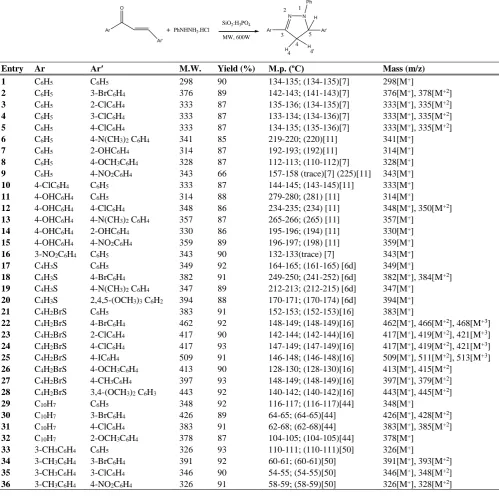
This catalytic effect is shown in (Fig. 2). The optimum quantity of catalyst loading was found to be 0.4g. We have carried out this reaction with various aryl chalcones and phenyl hydrazine hydrochloride. There is no significant effect of substituents on the cyclization reaction. The results, analytical and mass spectral data are summarized in Table 1. The reusability of this catalyst was studied the cyclization of
5-bromo-2-thienyl chalcone and phenyl hydrazine
hydrochloride ( entry 21) and is presented in Table 2.
From the Table 2, first two runs gave 91% product. The third, fourth and fifth runs of reactions gave the yields 90.5%, 90.5% and 90% of pyrazolines. There was no appreciable loss in its effect of catalytic activity were observed up to fifth run. The effect of solvents on the yield also studied with methanol, ethanol, dichloromethane and tetrahydrofuran from each component of the catalyst (entry 21). Similarly the effect of microwave irradiation was studied on the each component of the catalysts. The effect of solvents on the yields of pyrazolines were presented in Table 3. From the table highest yield of the pyrazolines obtained from the condensation of chalcone and phenylhydrazine hydrochloride with catalyst SiO2:H3PO4 in
microwave irradiation.
IR SPECTRAL STUDY
The synthesis of pyrazoline derivative is shown in Scheme 1. In the present study, the authors have chosen a series of pyrazoline derivatives namely 1-phenyl-3(5-bromothiophen-2-yl)-5-(substituted phenyl)-2-pyrazolines (entries 21-27) for studying the effects of substituent on the spectral group frequencies.
The infrared νC=N stretching frequencies (cm-1) of these
pyrazolines have been recorded and are presented in Table 4. These data are correlated with Hammett substituent constants44-49 and Swain-Lupton’s51 parameters. In this
correlation the structure parameter Hammett equation employed is as shown in equation (1).
ν = ρσ + νo (1)
where νo is the frequency for the parent member of the series.
The observed νC=N stretching frequencies (cm-1) are
correlated with various Hammett substituent constants and F
and R parameters through single and multi-regression analyses including Swain-Lupton’s51 parameters. The results
of statistical analysis of single parameter correlation are shown in Table 5.
The correlation of νC=N (cm-1) frequencies of pyrazolines
with R parameter was satisfactorily (r=0.907). The remaining Hammett substituent constants and F parameter were found to be poor in correlation. A satisfactory correlation was obtained for νC-S(cm-1) frequencies of
pyrazolines with Hammett substituents and F parameter. The R parameter was fail in correlation. All correlations produce positive ρ values. This implies that there is a normal substituent effect operates in all systems. The correlation of νC-Br (cm-1) frequencies of pyrazolines with Hammett
substituent constants, F and R parameters were gave poor correlation. This failure in correlation was due to the absence of inductive and polar effects of the substituent and is associated with the conjugated structure shown in Fig.3.
Ar C
H O
C
H Ar'
PhNHNH2.HCl SiO2:H3PO4
Ar C
H O
C
H Ar'
H
SiO2:H2PO4
Ar C
H O
C
H Ar'
H
Ar C
H CH Ar'
OH HN
NH Ph
SiO2:H3PO4 HCl
Ar C
H CH Ar'
OH HN
NH Ph
SiO2:H2PO4
SiO2:H3PO4
Ar C
H CH Ar'
OH2 HN
NH Ph
N N
Ar
Ph
Ar'
SiO2:H2PO4 H2O
N N
Ar
Ph
Ar'
H
SiO2:H2PO4
SiO2:H3PO4
(1- 41)
Enttry 21: Ar=
S Br
Ar C
H CH Ar'
OH2 HN
NH Ph
N N
Ar
Ph
Ar'
H
Ar'= Ph MW, 550W
Table 1. Analytical and mass spectral data of pyrazolines synthesized by solvent-free cyclization of chalcones and phenylhydrazine hydrochloride reaction of the type
Entry Ar Ar′ M.W. Yield (%) M.p. (ºC) Mass (m/z)
1 C6H5 C6H5 298 90 134-135; (134-135)[7] 298[M+]
2 C6H5 3-BrC6H4 376 89 142-143; (141-143)[7] 376[M+], 378[M+2] 3 C6H5 2-ClC6H4 333 87 135-136; (134-135)[7] 333[M+], 335[M+2] 4 C6H5 3-ClC6H4 333 87 133-134; (134-136)[7] 333[M+], 335[M+2] 5 C6H5 4-ClC6H4 333 87 134-135; (135-136)[7] 333[M+], 335[M+2] 6 C6H5 4-N(CH3)2 C6H4 341 85 219-220; (220)[11] 341[M+]
7 C6H5 2-OHC6H4 314 87 192-193; (192)[11] 314[M+] 8 C6H5 4-OCH3C6H4 328 87 112-113; (110-112)[7] 328[M+] 9 C6H5 4-NO2C6H4 343 66 157-158 (trace)[7] (225)[11] 343[M+] 10 4-ClC6H4 C6H5 333 87 144-145; (143-145)[11] 333[M+] 11 4-OHC6H4 C6H5 314 88 279-280; (281) [11] 314[M+]
12 4-OHC6H4 4-ClC6H4 348 86 234-235; (234) [11] 348[M+], 350[M+2] 13 4-OHC6H4 4-N(CH3)2 C6H4 357 87 265-266; (265) [11] 357[M+]
14 4-OHC6H4 2-OHC6H4 330 86 195-196; (194) [11] 330[M+] 15 4-OHC6H4 4-NO2C6H4 359 89 196-197; (198) [11] 359[M+] 16 3-NO2C6H4 C6H5 343 90 132-133(trace) [7] 343[M+] 17 C4H3S C6H5 349 92 164-165; (161-165) [6d] 349[M+]
18 C4H3S 4-BrC6H4 382 91 249-250; (241-252) [6d] 382[M+], 384[M+2] 19 C4H3S 4-N(CH3)2 C6H4 347 89 212-213; (212-215) [6d] 347[M+]
20 C4H3S 2,4,5-(OCH3)3 C6H2 394 88 170-171; (170-174) [6d] 394[M+] 21 C4H2BrS C6H5 383 91 152-153; (152-153)[16] 383[M+]
22 C4H2BrS 4-BrC6H4 462 92 148-149; (148-149)[16] 462[M+], 466[M+2], 468[M+3] 23 C4H2BrS 2-ClC6H4 417 90 142-144; (142-144)[16] 417[M+], 419[M+2], 421[M+3] 24 C4H2BrS 4-ClC6H4 417 93 147-149; (147-149)[16] 417[M+], 419[M+2], 421[M+3] 25 C4H2BrS 4-IC6H4 509 91 146-148; (146-148)[16] 509[M+], 511[M+2], 513[M+3] 26 C4H2BrS 4-OCH3C6H4 413 90 128-130; (128-130)[16] 413[M+], 415[M+2]
27 C4H2BrS 4-CH3C6H4 397 93 148-149; (148-149)[16] 397[M+], 379[M+2] 28 C4H2BrS 3,4-(OCH3)2 C6H3 443 92 140-142; (140-142)[16] 443[M+], 445[M+2] 29 C10H7 C6H5 348 92 116-117; (116-117)[44] 348[M+]
30 C10H7 3-BrC6H4 426 89 64-65; (64-65)[44] 426[M+], 428[M+2] 31 C10H7 4-ClC6H4 383 91 62-68; (62-68)[44] 383[M+], 385[M+2] 32 C10H7 2-OCH3C6H4 378 87 104-105; (104-105)[44] 378[M+]
33 3-CH3C6H4 C6H5 326 93 110-111; (110-111)[50] 326[M+]
34 3-CH3C6H4 3-BrC6H4 391 92 60-61; (60-61)[50] 391[M+], 393[M+2] 35 3-CH3C6H4 3-ClC6H4 346 90 54-55; (54-55)[50] 346[M+], 348[M+2] 36 3-CH3C6H4 4-NO2C6H4 326 91 58-59; (58-59)[50] 326[M+], 328[M+2]
Table 2. Reusability of catalyst on cyclization of styryl 5-bromo-2-thienyl ketone (2 mmol) and phenylhydrazine hydrochloride (2 mmol) under microwave irradiation (entry 21).
Run 1 2 3 4 5
Yield, % 91 91 90.5 90.5 90
Table 3. The effect of solvents in conventional heating and without solvent in microwave irradiation on yield of pyrazoline (entry 21)
Solvents Microwave irradiation
MeOH EtOH DCM THF
SiO2 PA SiO2:PA SiO2 PA SiO2:PA SiO2 PA SiO2:PA SiO2 PA SiO2:PA SiO2 PA SiO2:PA
73 77 78 74 75 80 73 80 80 75 81 81 82 80 91
MeOH=Methanol; EtOH=Ethanol; DCM= Dichloromethane; THF=Tetrahydrofuran; PA=Phosphoric acid
N N
Ar Ar'
H H
Ph
H 1 2
3
4 5 4
4 Ar
O
Ar
PhNHNH2.HCl
SiO2:H3PO4
Table 4. The infrared (cm-1) of C=N, C-S, C-Br, 1H and 13C NMR chemical shifts (δ, ppm) of pyrazoline ring proton, carbons of
1-phenyl-3(5-bromothiophen-2-yl)-5-(substituted phenyl)-2-pyrazolines(entries 21-28)
Entry Substituent C=N C-S C-Br δ H4 δ H4′ δ H5 δ C3 δ C4 C5 δ C=N 21 H 1593 679 562 3.06 3.77 5.25 155.60 43.66 64.68 154.56
22 4-Br 1596 685 562 3.07 3.82 5.26 155.56 43.53 64.10 155.56
23 2-Cl 1595 690 566 3.01 3.93 5.66 157.50 42.08 61.50 157.50
24 4-Cl 1594 688 531 3.10 3.80 5.28 155.82 43.70 64.75 155.82
25 4-I 1595 680 531 3.04 3.78 5.21 156.11 43.52 64.21 156.11
26 4-OCH3 1596 670 553 3.07 3.77 5.24 155.81 43.75 64.29 159.13 27 4-CH3 1594 680 546 3.07 3.77 5.24 156.10 43.72 64.47 156.10
The single parameter correlations of νC=N, C-S and C-Br (cm-1) frequencies with Hammett substituent constants of
resonance and inductive effects fail. So, the authors think that it is worthwhile to seek the multi regression analysis and which produce a satisfactory correlation with Resonance, Field and Swain-Lupton’s51 constants. The corresponding
equations are given in (2-7).
νCN(cm-1) = 1593.76(±0.553) + 3.805σI(±1.627) +
2.584σR(±1.611) (2)
(R=0.978, P> 95%, n=7)
νCN(cm-1) = 1593.06(±0.512) + 2.388F (±1.429) –
4.173R (±1.714) (3)
(R=0.998, P > 95%, n=7)
νCS(cm-1) = 677.98(±1.947) + 7.680σI (±1.535) +
24.399 σR (±5.668) (4)
(R=0.931, P> 90%, n=7)
νCS(cm-1) = 682.05(±3.402) + 24.577F (±9.496) +
31.947R (±11.386) (5) (R=0.985, P > 95%, n=7)
νCBr(cm-1) = 552.39(±11.595) - 6.515σI (±3.407) +
5.965 σR (±3.337) (6)
(R=0.915, P> 90%, n=7)
νCBr(cm-1) = 554.19(±13.979) + 13.627F (±3.972) +
0.576R (±0.041) (7) (R=0.918, P > 95%, n=7)
1H NMR SPECTRAL STUDY
The 1H NMR spectra of seven pyrazoline derivatives
under investigation have been recorded in deuterio-chloroform solution employing tetramethylsilane (TMS) as internal standard. The signals of the pyrazoline ring protons have been assigned. They have been calculated as AB or AA' systems respectively. The chemical shifts (δ, ppm) of H4 are at higher fields than those of H4′ and H5 in this series
of pyrazolines. This is due to the deshielding of H4′ and H5
which are in different chemical as well as magnetic environment.. These H4 protons gave an AB pattern and the
H4′ proton doublet of doublet in most cases was well
separated from the signals H5 and the aromatic protons. The
assigned chemical shifts (δ, ppm) of the pyrazoline ring H4,
H and H protons are presented in Table 4.
In nuclear magnetic resonance spectra, the 1H or the 13C
chemical shifts (δ, ppm) depend on the electronic environment of the nuclei concerned. These chemical shifts have been correlated with reactivity parameters. Thus the Hammett equation may be used in the form as shown in (8).
log δ= og δ0 + ρσ (8)
where δ0 is the chemical shift of the corresponding parent
compound.
The assigned Ha4, H4′ and H5 proton chemical shifts (ppm)
of pyrazoline ring have been correlated with various Hammett sigma constants.44-49 The results of statistical
analysis are presented in Table 5.
The H4 proton chemical shifts (ppm) with Hammett σ+
and R parameters gave satisfactory correlation. The remaining substituent constants and F parameters were fail in correlation. The failure in correlation is associated with the conjugative structure shown in Fig. 3.
Figure 3. Resonance-conjugative structure
The results of statistical analysis of H4′ proton chemical
shifts (δ, ppm) with Hammett substituents are shown in Table 5. The H4′ proton chemical shifts(δ, ppm) with
Hammett substituent constants and F parameters gave satisfactory correlation excluding 2-Cl and 3-OCH3
substituents. The R parameter was fail in correlation. This is due to the absence of resonance effect of substituents on the H4′ proton chemical shifts and it is associated with the
conjugative structure shown in Fig. 3.
The results of statistical analysis of H5 proton chemical
shifts (ppm) with Hammett substituents are presented in Table 5. The H5 proton chemical shifts with Hammett σ, σ+,
σI constants and F parameters gave satisfactory excluding
2-Cl substituent. All correlations produce positive ρ values. This means that the normal substituent effect operates in all systems. This failure in correlation is associated with conjugative structure shown in Fig. 3.
N N
Ph
S Br
O CH3
Table 5. Results of statistical analysis of (cm-1) of C=N, C-S, C-Br bands, 1H and 13C NMR chemical shifts (δ, ppm) of
pyrazoline ring protons, carbons of 1-Ph-3(5-bromothiophen-2-yl)-5-(aryl)-2-pyrazolines, Hammett σ, σ+, σ
I, σR constants
and F and R parameters(entries 21-28).
r = correlation coefficient; ρ = slope; I = intercept; s = standard deviation; n = number of substituents
Functionality Constants r I ρ s n Correlated derivatives
C=N σ 0.806 1594.71 0.032 1.21 7 H, 4-CH3, 2-Cl, 4–Cl, 4-Br, 4-I, 4-OCH3
σ+ 0.805 1594.71 0.153 1.21 7 H, 4-CH
3, 2-Cl, 4–Cl, 4-Br, 4-I, 4-OCH3
σI 0.806 1593.84 3.000 0.97 7 H, 4-CH3, 2-Cl, 4–Cl, 4-Br, 4-I, 4-OCH3
σR 0.802 1594.80 1.432 1.16 7 H, 4-CH3, 2-Cl, 4–Cl, 4-Br, 4-I, 4-OCH3 F 0.866 1593.65 3.703 0.91 7 H, 4-CH3, 2-Cl, 4–Cl, 4-Br, 4-I, 4-OCH3 R 0.907 1593.49 5.255 0.75 6 H, 4-CH3, 2-Cl, 4–Cl, 4-I, 4-OCH3 C-S σ 0.908 680.24 27.109 3.95 7 H, 4-CH3, 2-Cl, 4–Cl, 4-Br, 4-I, 4-OCH3
σ+ 0.981 681.82 13.765 3.47 7 H, 4-CH
3, 2-Cl, 4–Cl, 4-Br, 4-I, 4-OCH3
σI 0.905 677.30 15.206 3.32 5 2-Cl, 4–Cl, 4-Br, 4-I, 4-OCH3
σR 0.989 680.07 26.720 3.01 5 2-Cl, 4–Cl, 4-Br, 4-I, 4-OCH3
F 0.904 697.57 14.510 3.06 7 H, 4-CH3, 2-Cl, 4–Cl, 4-Br, 4-I, 4-OCH3 R 0.705 686.53 20.815 6.28 7 H, 4-CH3, 2-Cl, 4–Cl, 4-Br, 4-I, 4-OCH3 C-Br σ 0.701 550.52 -7.121 15.98 7 H, 4-CH3, 2-Cl, 4–Cl, 4-Br, 4-I, 4-OCH3
σ+ 0.701 550.13 5623 15.84 7 H, 4-CH
3, 2-Cl, 4–Cl, 4-Br, 4-I, 4-OCH3
σI 0.782 552.56 -8.355 15.93 7 H, 4-CH3, 2-Cl, 4–Cl, 4-Br, 4-I, 4-OCH3
σR 0.821 550.63 7.931 15.94 7 H, 4-CH3, 2-Cl, 4–Cl, 4-Br, 4-I, 4-OCH3 F 0.789 554.10 -13.810 15.78 7 H, 4-CH3, 2-Cl, 4–Cl, 4-Br, 4-I, 4-OCH3 R 0.707 551.70 6.752 16.02 7 H, 4-CH3, 2-Cl, 4–Cl, 4-Br, 4-I, 4-OCH3
δH4 σ 0.802 3.061 -0.026 0.03 7 H, 4-CH3, 2-Cl, 4–Cl, 4-Br, 4-I, 4-OCH3
σ+ 0.903 3.068 -0.025 0.02 5 H, 4-CH
3, 2-Cl, 4–Cl, 4-I
σI 0.781 3.065 -0.020 0.03 7 H, 4-CH3, 2-Cl, 4–Cl, 4-Br, 4-I, 4-OCH3
σR 0.812 3.062 0.033 0.02 7 H, 4-CH3, 2-Cl, 4–Cl, 4-Br, 4-I, 4-OCH3 F 0.715 3.066 -0.021 0.03 7 H, 4-CH3, 2-Cl, 4–Cl, 4-Br, 4-I, 4-OCH3 R 0.902 3.058 -0.005 0.02 5 4-CH3, 2-Cl, 4–Cl, 4-Br, 4-I
δH4′ σ 0.905 3.797 0.147 0.05 6 H, 4-CH3, 4–Cl, 4-Br, 4-I, 4-OCH3
σ+ 0.906 3.805 0.087 0.04 6 H, 4-CH
3, 2-Cl, 4–Cl, 4-I, 4-OCH3
σI 0.906 3.763 0.147 0.05 6 H, 4-CH3, 4–Cl, 4-Br, 4-I, 4-OCH3
σR 0.904 3.797 0.178 0.05 6 H, 4-CH3, 2-Cl, 4–Cl, 4-Br, 4-I F 0.901 3.763 0.145 0.05 6 H, 4-CH3, 2-Cl, 4–Cl, 4-Br, 4-I
R 0.803 3.808 0.171 0.06 7 H, 4-CH3, 2-Cl, 4–Cl, 4-Br, 4-I, 4-OCH3
δH5 σ 0.903 5.297 1.257 0.16 6 H, 4-CH3, 4–Cl, 4-Br, 4-I, 4-OCH3
σ+ 0.904 5.308 1.025 0.15 6 H, 4-CH
3, 2-Cl, 4–Cl, 4-I, 4-OCH3
σI 0.903 5.228 1.266 0.15 6 H, 4-CH3, 4–Cl, 4-Br, 4-I, 4-OCH3
σR 0.801 5.289 1.271 0.15 7 H, 4-CH3, 2-Cl, 4–Cl, 4-Br, 4-I, 4-OCH3 F 0.903 5.236 0.246 0.16 6 H, 4-CH3, 4–Cl, 4-Br, 4-I, 4-OCH3 R 0.803 5.312 0.036 0.17 7 H, 4-CH3, 2-Cl, 4–Cl, 4-Br, 4-I, 4-OCH3
δCN σ 0.822 156.03 0.722 0.712 7 H, 4-CH3, 2-Cl, 4–Cl, 4-Br, 4-I, 4-OCH3
σ+ 0.823 156.07 0.511 0.681 7 H, 4-CH
3, 2-Cl, 4–Cl, 4-Br, 4-I, 4-OCH3
σI 0.729 155.82 0.861 0.697 7 H, 4-CH3, 2-Cl, 4–Cl, 4-Br, 4-I, 4-OCH3
σR 0.703 156.00 1.166 0.674 7 H, 4-CH3, 2-Cl, 4–Cl, 4-Br, 4-I, 4-OCH3 F 0.825 155.82 0.858 0.704 7 H, 4-CH3, 2-Cl, 4–Cl, 4-Br, 4-I, 4-OCH3 R 0.805 156.02 0.245 0.728 7 H, 4-CH3, 2-Cl, 4–Cl, 4-Br, 4-I, 4-OCH3
δC4 σ 0.841 43.48 -1.181 0.59 7 H, 4-CH3, 2-Cl, 4–Cl, 4-Br, 4-I, 4-OCH3
σ+ 0.751 43.42 -0.783 0.54 7 H, 4-CH
3, 2-Cl, 4–Cl, 4-Br, 4-I, 4-OCH3
σI 0.742 43.75 -1.129 0.59 7 H, 4-CH3, 2-Cl, 4–Cl, 4-Br, 4-I, 4-OCH3
σR 0.900 43.49 1.761 0.58 6 H, 4-CH3, 2-Cl, 4–Cl, 4-Br, 4-I F 0.903 43.73 1.095 0.61 6 H, 4-CH3, 4–Cl, 4-Br, 4-I, 4-OCH3 R 0.900 43.35 0.145 0.65 6 H, 4-CH3, 4–Cl, 4-Br, 4-I, 4-OCH3
δC5 σ 0.735 64.09 1.671 1.17 7 H, 4-CH3, 2-Cl, 4–Cl, 4-Br, 4-I, 4-OCH3
σ+ 0.704 64.00 1.121 1.09 7 H, 4-CH
3, 2-Cl, 4–Cl, 4-Br, 4-I, 4-OCH3
σI 0.904 64.61 2.137 1.11 6 H, 4-CH3, 4–Cl, 4-Br, 4-I, 4-OCH3
In view of the inability of the Hammett σ constants to produce individually satisfactory correlation, the authors think that it is worthwhile to seek multiple correlations involving either σI and σR constants or Swain-Lupton’s51
F and R parameters. The correlation equations for H4 – H5
protons are given in (9-14).
δH4(ppm)= 3.065 (±0.021) - 0.119 (±0.006)σI +
0.290 (±0.005)σR (9)
(R=0.927, P> 90%, n=7)
δH4(ppm) = 3.063(±0.260) - 0.247 (±0.007)F +
0.158 (±0.002)R (10)
(R=0.917, P > 90%, n=7)
δH4′(ppm) = 3.765(±0.341) - 0.119(±0.007)σI +
0.929 (±0.004)σR (11)
(R=0.966, P> 95%, n=7)
δH4′(ppm) = 3.777(±0.046) + 0.173 (±0.001)F +
0.960 (±0.015)R (12)
(R=0.955, P > 95%, n=7)
δH5(ppm) = 5.234(±0.111) + 0.202(±0.0326)σI –
0.207 (±0.002)σR (13)
(R=0.947, P> 90%, n=7)
δH5(ppm) = 5.297(±0.143) + 0.292 (±0.004)F +
0.162 (±0.002) R (14)
(R=0.934, P > 90%, n=7)
13C NMR SPECTRA
Spectroscopic chemists and organic chemistry
researchers44-49 have made extensive study of 13C NMR
spectra for a large number of different ketones, styrenes and keto-epoxides. They have studied linear correlation of the chemical shifts (δ, ppm) of Cα, Cand CO carbons with Hammett constants in alkenes, alkynes, acid chlorides and styrenes. In the present study, the chemical shifts (δ, ppm) of pyrazoline ring C3 (C=N), C4, and C5
carbon, have been assigned and are presented in Table 4. Attempts have been made to correlate the above said carbon chemical shifts (δ, ppm) with Hammett substituent constants, field and resonance parameters, with the help of single and multi-regression analyses to study the reactivity through the effect of substituents.
The chemical shifts (δ, ppm) observed for the δC3(C=N), C4, and C5 have been correlated with Hammett
substituent constants and the results of statistical analysis are presented in Table 5. The δC=N chemical shifts (δ, ppm) gave poor correlation with Hammett substituent constants and F and R parameters. Here the polar, inductive and resonance effects were incapable for predicting their effects on the C=N carbon chemical shifts(δ, ppm). The chemical shifts (δ, ppm) observed for the δC4 carbon have been correlated satisfactorily with
Hammett σR constant, F and R parameters. Here the polar
and inductive effects were incapable for predicting their effects on the C4 carbon chemical shifts (δ, ppm). The
chemical shifts (δ, ppm) observed for the δC5 carbon
have been correlated satisfactorily with Hammett σI
constant, F and R parameters. Here the polar and resonance effects were incapable for predicting their
effects on the C5 carbon chemical shifts (δ, ppm). This is
due to the reason stated earlier and it is associated with the resonance - conjugative structure shown in Fig. 3.
In view of inability of some of the σ constants to produce individually satisfactory correlation, the authors think that it is worthwhile to seek multiple correlation involving all σI, σR, F and R parameters. The correlation
equations are given in (15 and 20).
δCN(ppm) = 155.848(±0.480)+0.560(±1.411)σI –
0.991 (±0.137)σR (15)
(R=0.943, P> 90%, n=7)
δCN(ppm) =155.852(± 0.623)+9.235 (±0.173)F +
0.198 (±0.002)R (16)
(R=0.926, P> 90%, n=7)
δC4(ppm) = 43.724(±0.480) – 0.845 (±0.111) F +
0.920 (±0.010)R (17)
(R=0.953, P> 95%, n=7)
δC4(ppm) =43.281(± 1.024) +0.525(±1.424)σI –
0.981 (±0.125)σR (18)
(R=0.916, P> 90%, n=7)
CONCLUSION
A series of some aryl pyrazolines including 1-phenyl-3-(5-bromothiophen-2-yl)-5-(substituted phenyl)-2-pyrazoline derivatives have been synthesized by microwave assisted, solid acidic green catalyst SiO2
-H3PO4 catalyzed cyclization of 5-bromo-2-thienyl
chalcones and phenyl hydrazine hydrochloride under solvent free conditions. The yields of the pyrazolines were more than 85%. The spectral frequencies, infrared
(cm-1) of C=N, C-S, C-Br, 1H and 13C NMR chemical
shifts (δ, ppm) of pyrazoline ring proton, carbon and C=N carbons were assigned and correlated with Hammett substituent constants, F and R parameters. From the results of statistical analysis the effects of substituents on the spectral frequencies have been discussed.
REFERENCES
1Elguero, J., Bulton, In., Mckillop (editors). Comprehensive Heterocyclic Chemistry, Pergamon Press., 1984, 5, 293.
2Dambal, D. B., Pattanashetti, P. P., Tikare, R. K., Badami,
B. V., Puranik, G. S., Indian J. Chem.1984, 23B, 186.
3Sachchar, S. P., Singh, A. K., J. Indian Chem. Soc.1985, 62,
142.
4Kulkarni, S. E., Mane, R. A., Ingle, D. B., Indian J. Chem. 1986, 25B, 452.
5Cremlyn, R. J., Swinbourne, F. J., Mookerjee, E., Indian J. Chem. 1986, 25B, 562.
6(a) Sid, A., Lamara, K., Mokhtari, M., Ziani, N., Mosset, P., Eur. J. Chem. 2011, 2, 311; (b) Patel, M., Desai, K. R.,
Arkivoc.2004, 1, 123; (c) Gothwal, P., Srivastava, Y. K.,
Der Chem. Sincica. 2012, 3, 318; (d) Patil, V. S., Wadher, S. J., Karande, N. A., Yeole, P. G., Int. J. Univ. Pharm. Life Sci. 2011, 1, 16; (e) Kumar, B., Pathak,V., Rani, S., Kant, R., Tewari, I. C., Int. J. Microbiol. Res.2009, 1, 20.
8Kidwai, M., Kukreja, S., Thakur, R., Lett. Org. Chem. 2006, 3,
135.
9Katritzky, A. R., Wang, M. Y., Zhang, S. M., Vonkov, A. V.
V., Steel, P. J., J. Org. Chem. 2001, 66, 6787.
10Kuz’menok, N. M., Koval’chuk, T. K., Zvonok, A. M., Synth. Lett. 2005, 3, 485.
11Malhotra, P., Pattan, S., Nikale, A. P., Int. J. Pharm. Pharm. Sci. 2010, 2(2), 21.
12Kidwai, M., Mothsra, P., Indian J. Chem. 2006, 45B, 2330. 13Dadiboyena, S., Hamme, A. T., 4th Int. Symp. Recent Adv.
Environ. Health Res.,, September 16-19, 2007, PA 76, College of Science, Enginnering and Technology, Jackson State University, Jackson, MS 39217, USA.
14Bougrin, K., Loupy, A., Soufiaaoui, M., J. Photochem. Photobiol C: Photochem. Rev. 2005, 6, 139.
15Zhu, X., Li, Z., Jin, C., Xu, L., Wu, Q., Su, W., Green Chem. 2009, 11, 163.
16Sasikala, R., Thirumurthy, K., Mayavel, P., Thirunarayanan,
G., Org. Med. Chem. Lett. 2012. doi:10.1186/2191-2858-2-20
17Siddiqui, Z. N., Musthafa, T. N. M., Ahmad, A., Khan, A.
U., Bioorg. Med. Chem. Lett.2011, 21, 2860.
18Sahu, S. K., Banerjee, M., Samantray, A., Behera, C., Azam,
M. A., Trop. J. Pharm.Res.2008, 7(2),961.
19Karabasanagouda, T., Adhikari, A. V., Girisha, M., Ind. J. Chem. 2009, 48B, 430.
20Farghaly, M., Chaaban, L., Khali, M. A., Behkit, A. A., Arch. Pharm (Weinheim).1990, 311.
21Ramalingam, K., Thyvekikakath, G. X., Berlin, K. D.,
Chesnut, R. W., Brown, R. A., Durham, N. N., Ealick, A. E., Vender, H. D., J. Med. Chem. 1997, 20, 847.
22Abid, M., Azam, A., Bioorg. Med. Chem. 2005, 15, 2213. 23Abid, M., Azam, A., Bioorg. Med. Chem. Lett. 2006, 16,
2812.
24Shahar Yar, M., Ahmad Siddiqui, A., Ali, M. A., J. Serb, Chem. Soc. 2007, 72(1), 5.
25Hatri, H. Z., Vunii, S. A., J. Ind. Chem. Soc. 1981, 58, 168. 26Das, N., Verma, A., Shrivastava, P. K., Shrivastava, S. K.,
Ind. J. Chem. 2008, 47B, 1555.
27Jia, Z., Wu, Y., Huang, W., Zhang, P., Song, Y., Scarborough,
R. M., Zhu, B. Y., Bioorg. Med. Chem. Lett. 2004, 14,
1229.
28Can, O. D., Ozkay, U. D., Kaplanclkll, Z. A., Ozturk, Y., Arch. Pharm. Res. 2009, 32, 1293.
29Palaska, E., Erold, D., Demirdamar, R., Eur. J. Med. Chem. 1996, 31, 43.
30Prasad, Y. R., Rao, A. L., Prasoona, K., Murali, K.,
Ravikumar, P., Bioorg. Med. Chem. Lett. 2005, 15, 5030.
31Berghot, M. A., Moawad, E. B., Eur. J. Pharm. Sci. 2003, 20, 173.
32Nauduri, D., Reddy, G. B., Chem. Pharm. Bull. 1998, 46,
1254.
33Korgaokar, S. S., Patil, P. H., Shah, M. T., Prekh, H. H., Indian J. Pharm. Sci. 1996, 58,222.
34Guniz, K. S., Rollas, S., Erdeniz, H., Kiraz, M., Cevdet, E. A.,
Vidin, A., Eur. J. Med. Chem.2000, 35, 761.
35Havrylyuk, D., Zimenkovsky, B., Vasylenko, O., Zaprutko,
L., Gzella, A., Lesyk, R., Eur. J. Med. Chem. 2009, 44, 1396.
36Klimova, E. I., Marcos, M., Klimova, T. B., Cecilio, A. T.,
Ruben, A. T., Lena, R. R., J. Organomet. Chem. 1999,
585, 106.
37Padmavathi, V., Sumathi, R. P., Chandrasekhar, B. N.,
Bhaskar Reddy, D., J. Chem. Res. 1999, 610.
38Bhaskar Redy, D., Chandrasekhar, B. N., Padmavathi, V.,
Sumathi, R. P., Synthesis, 1998, 491.
39Soni, N., Pande, K., Kalsi, R., Gupta, T. K., Parmar, S. S.,
Barthwal, J. P., Res. Commun. Chem. Pathol. Pharm.
1987, 56, 129.
40Frigolo, M., Barros, H. M., Marquardt, A. R., Tanhauser, M., Pharmcol. Biochem. Behav. 1998, 60, 431.
41Erhan, P., Mutlu, A., Tayfun, U., Dilek, E., J. Med. Chem. 2001, 36, 539.
42Shader, R. I., Greenblatt, D. J., J. Clin. Psychopharm. 1999, 19, 105.
43Urichuk, L. J., Allison, K., Holt, A., Greenshaw, A. J.,
Baker, G. B., J. Affec. Disord, 2000, 58, 135.
44Sakthinathan, S. P., Vanangamudi, G., Thirunarayanan, G., Spectrochim. Acta. 2012, 95A, 693.
45Thirunarayanan, G., Gopalakrishnan, M., Vanangamudi, G., Spectrochim. Acta. 2007, 67A, 1106.
46Thirunarayanan, G., Vanangamudi, G., Subramanian, M., Org. Chem: An IndianJ. 2013, 9, 1.
47Vanangamudi, G., Ranganathan, K., Thirunarayanan, G., World J. Chem. 2012, 7, 22.
48Sakthinathan, S. P., Suresh, R., Mala, V., Sathiyamoorthi, K.,
Kamalakkannan, D., Ranganathan, K., Arulkumaran, R., Vijayakumar, S., Sundararajan, R., Vanangamudi, G., Thirunarayanan, G., Int. Lett. Chem. Phys. Astron. 2013,
6, 77.
49Janaki, P., Sekar, K. G., Thirunarayanan, G., Org. Chem: An Indian J. 2013, 9, 68.
50Nithyaranjani, A., Nisha, P., Thirunarayanan, G., Natl. Conf. Exploring Excellence in Chemistry (NCEEC-12), December 21, 2012, P21, Dhanalakshmi Srinivasan College of Arts and Science for Women, Perambalur-621 212, Tamilnadu, India.
51Swain, C. G., Lupton, Jr. E. C., J.Am. Chem. Soc.1968, 90,
4328.