ISSN: 2347-7474
International Journal Advances in Social Science and Humanities
Available online at: www.ijassh.com
RESEARCH ARTICLE
Intellectual Capital and Municipal Competitiveness in the Region Toluca,
Mexico
María del Rocío Gómez Díaz*
Research professor of the Accounting and Management Faculty of the Autonomous, University of the Estate of Mexico.
*Corresponding Author :E-mail: [email protected]
Abstract
Intellectual capital on the current times is a powerful tool to increase competiveness and add value to the public and private organizations. However, its application and impact on a municipal level has not been researched enough.This article presents the results of a poll performed with the objective to identify items of intellectual capital related to the municipal competiveness; taken from the conceptual review of the involved variables and the results of a empirical research done on the municipalities that are part of Toluca region, in the State of Mexico. The main results obtained were descriptive and correlational information that helped to identify inherent factors to the intellectual capital linked to municipal competiveness; highlighting the relationship between GDP (Gross Domestic Product) and the education level workersin all the positions. It was identified the need to provide training, manuals, and procedures to the human capital that allow staff to offer fast and high quality services to the users. At the same time, this should increase productive and commercial activities of the region.
Keywords:Competitiveness, Intellectual capital, Municipality, Region.
Introduction
Nowadays, one of the issues that has been consideredas an important factor for the growth and development of organizations is Intellectual Capital. This concept has been discussed in recent times in academic as well as in businesses contexts. However, it has been little studied at the municipal level.
Today, municipalities present great problems and inequalities in economic and social levels. The administration of municipalities is irregular and thus high levels of inefficiency in the distribution of resources and services to the population.This situation is latent when changes in the world economy confirm that intangible actives contribute to increase development and competitiveness levels. This is the reason why the government different levels (municipality, state and federal) should be interested in measuring, controlling and developing it [1].
Among the intangibles that generate value and wealth for a country, a region and a nation, it is the intellectual capital because it is associated with the generation of wealth and welfare, not from higher income but from political and economic powers [2]. Henceforth there is a need to
identify its implications at the municipal level. Nevertheless, it is more frequent that management in the public municipal sector adopts very slowthe new theories that will raise its competitiveness unlike what happens in the private sector. In any case, modern public sector management has the responsibility to give high quality services to citizens, which justifies a reflection on the possible contributions to increase competitiveness through intellectual capital.
The present investigation was realized by the aim to identify inherent elements to the intellectual capital (human, structural and relational) that are constituted as promoters of the municipal competitiveness, based on experts' theoretical frameworks of the topic and results of an empirical study in twelve municipalities that integrate the Region Toluca in the State of Mexico.
Theoretical Frame
about competitiveness a new determinant is detected: intellectual capital; so increasing the assets based on knowledge acquires a substantial importance to compete in the new generation of innovation, research and development.
Nowadays organizations compete in local markets with companies worldwide and their sales are no longer depending on the decisions of producers of goods and services but instead on the final consumers’ demand; which besides demandinggoods and services at low prices, they feel inclined to use products with better performance, durability, design, art and quality [3]. Having efficient services in local government will contribute to face this level of competition.
Therefore the competitiveness of an organization can be considered from the level of development achieved within the factors of: productivity, knowledge management, intellectual capital, technological development, market prices, customer needs’ satisfaction, policies and incentives, sectoral and organizational levels of cooperation, the economic environment, fiscal regulations, safety and confidence among the society.
Employees with higher education, training and practical experience’s integration as mentioned by Xiaowei, Koput and Powell [4] has led to the formation of human resourcestrained in the research and development areas forming great scientistsin the dynamic organizations enhancing the intellectual capitalof the same, which can convert the municipality into a competitive social economic entity.
Intellectual Capital
In the last two decades, intellectual capitalhas been regarded for the experts as a substantive element in the success of companies and nations. In a retrospective analysisit could be observed that in the late nineties the concept took force. The definitions include important elements of thematter presented.
Bradley [5] believes that the importance of intellectual capitalis the ability to transform human factor’s knowledge in an intangible value able to increase wealth incountries and companies. Edvinsson and Malone [6] define itas: "the possession of knowledge, applied experience, organizational technology, customer relationships and professional skills that give a company a competitive advantage in the marketplace. Bueno [7] consider it as “the measure of value created for determining the effectiveness of
organizational learning and evaluate the efficiency of knowledge management” .Sullivan [8] affirms that is "the sum of ideas, inventions, technologies, general knowledge, software, designs, data processing techniques, processes, creativity and publications of an organization." More specifically he states: "IC can be simply understood as knowledge that can be turned into profits."To Ross, Ross & Dragonetti [9] consider that knowledge is only apart of the intellectual capital thatin association with good relationshipsto the environment agents they will be able to create value. To Bontis [10] human capital of a nation can be defined as the sum of knowledge, education and skills of citizens.
We can finally close this compendium of definitions with the intellectual capital of a territory that gives Sanchez [11]: "Is the set of assets that are available and despite of not having a physical or financial nature generates or may generates sustainable development either alone or in conjunction with another territory".
Important elements are perceived in the previous compilation: transformation and use of knowledge, experience, preparation, technology, relationships, organizational learning, creativity, inter alia.
To reinforce the competitiveness in municipalities is relevant to highlight three points raised by IC experts: the first is the level of relationships to be maintained inside and outside the organization the second concerns to the competitive advantagesthe third aspect is directed to the social and economic development of countries and territories. It is important to improve services for users considering that they are equivalent to customers in the municipalities.
Derived from the previous analysis intellectual capital can be defined as the set of skills, knowledge and experience of the members of an organization that enable the generation of competitive advantages in different areas through knowledge management [13].
Components of Intellectual Capital
There are differences in the way the authors conceptualize to the intellectual capital, the same happens with the elements that constitute it, some criteria are presented:
employees of a company, each of which has abilities, skills, and knowledge. To optimize their strengths the employees (single unit of human capital) must be physically located where the skill, ability or knowledge are needed. Within each employee tacit knowledge resides (un-coded) that theorganization requires [8].
Intellectual assets are created when human capital confirms in a written mode any knowledge or learning. Once written knowledge is coded and defined. At this point the company can transfer the intellectual assets, not the individual, where it is needed. Possible examples of intellectual assets are: plans, procedures, tables, graphics and software projects, to name just a few. When any of them has legal protectionis called intellectual property: patents, copyright, trademarks and trade secrets are included.
Saint-Onge [14] prefers the term Knowledge Capital referring to intellectual capital. He defines Knowledge Capital as the sum of: human capital, client capital and structural capital. Ordoñez de Pablos visualizes a convergence in theattributes of organizational knowledge. He defines three components: human capital, stock of individual knowledge of an organization, represented by its employees; relational capital, includes the present knowledge in the relationships established with the environment. It is accumulated knowledge as a product of their interrelationships and structural capital,it is the knowledge which is owned by the company. It includes organizational routines, strategies, process manuals and databases, inter alia [15].
Ross, Ross & Dragonetti [9] provide a subdivision of human capital and consider its value arises from three components: competence, attitude and intellectual agility.
Based on the reviewed literature it is appreciated that the components of the intellectual capital might be used in the municipalities to increase their competitiveness.
Competitiveness
Competitivenessis understood as the ability of an organization to compete in the field in which it operates with a higher performance compared to similar organizations. It comes from ancient organizations that aspired to achieve the best results and optimize their (human, technical, material and financial) resources.
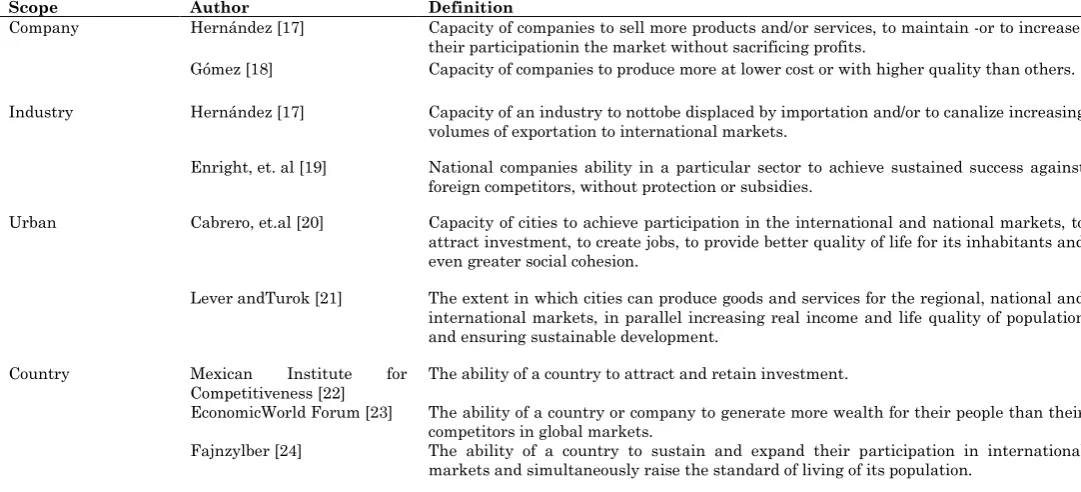
Michael Porter identifies four major areas called "determinants of competitiveness" and represents them in a diamond model of four edges: factor management, as the provision of specialized factors that are transferable to connected sectors and supportareas; demand conditions, depending on the composition of intern demand; conditions related to connected sectors and support areasin terms of effective access to key inputs, unities to coordinate or to share activities in the production chain and conformation of clusters of activities; and level of strategy, structure and rivalry of the organization regarding n how to create, organize and manage the companies and the nature of domestic rivalry [16]. To complement the concept of competitiveness, it can be approached from different fields: business, industry, urban and country. Table 1 shows some definitions about the areas already mentioned.
Table 1: Definition of competitiveness in various fields
Scope Author Definition
Company Hernández [17] Capacity of companies to sell more products and/or services, to maintain -or to increase- their participationin the market without sacrificing profits.
Gómez [18] Capacity of companies to produce more at lower cost or with higher quality than others.
Industry Hernández [17] Capacity of an industry to nottobe displaced by importation and/or to canalize increasing volumes of exportation to international markets.
Enright, et. al [19] National companies ability in a particular sector to achieve sustained success against foreign competitors, without protection or subsidies.
Urban Cabrero, et.al [20] Capacity of cities to achieve participation in the international and national markets, to attract investment, to create jobs, to provide better quality of life for its inhabitants and even greater social cohesion.
Lever andTurok [21] The extent in which cities can produce goods and services for the regional, national and international markets, in parallel increasing real income and life quality of population and ensuring sustainable development.
Country Mexican Institute for
Competitiveness [22] The ability of a country to attract and retain investment.
EconomicWorld Forum [23] The ability of a country or company to generate more wealth for their people than their competitors in global markets.
Commission of Industrial Competitiveness [25]
A nation or a company is competitive if, under free market conditions, it is able to maintain or increase their participation in national and international markets, while maintaining or improving the income of its citizens or its human capital.
A predominant factor in the above definitions is the ability of organizations to grow and participate in national and international markets; in the case of the company and industry they seek higher profitability, while in urban areas and the countrytheir purpose is to raise the quality of life of each and every one of the inhabitants, providing efficient services and encouraging national and international investment; in all areas analyzed they not only seek personal gain but collectively which will allow them internal and external development that contribute to local, national and international growth.
Sources of Competitiveness
In the economic environment some impulse factors had been analyzed. Marlene Peñalozain her article "New Economic Competitiveness Paradigm?” the sources of competitiveness are divided into three groups:
Traditional: division of labor; quality; managerial and financial capacity; organizational culture; productivity and technology.
Linked to the national environment: macroeconomic conditions; market conditions; organizational structures at enterpriselevel and public sector; and legal framework.
Modern: Knowledge; information; other assets (intellectual capital); and the environmentpreservation [26].
The ranking above shows that factors are involved in competitiveness internally (processes and structures) and externally (macroeconomics, market, business networks, public organization and society) to the organization, as well as intangible assets in which intellectual capital have an important place, making it necessary to establish strategies for each one.
Municipal Competitiveness
Competitiveness is a very controversial notion that different debates have been developed. One of them relates to the so-called "competitive cities"1 which arises from the same definition
usually referred to those cities that manage to
1
In Mexico the municipalities located in zones of high economic and social concentration receive the category of cities or metropolises existing others with minor levels of economic development and minor number of population (semi-urban or rural municipalities). In this investigation respecting the postulates of the authors allusion is done to urban or municipal competitiveness of an indistinct way since both are pertinent to refer to the municipalities.
participate in the international and national market, attracts investment, creates jobs, provides better quality of life to those who live in and even in a greater social cohesion [20].Urban competitiveness refers to the degree in which cities can produce goods and services for the regional, national and international markets, increasingreal income and quality of life of the population and ensuring sustainable development [21].
The concept of competitiveness refers to the ability of a municipality to penetrate in the local and international market, and its relationship between the local economic growth and the increasing of the quality of life of its residents [27].
According to the postulates of Porter, municipalities are spaces that can offer competitive advantages optimizing the factors that can generate them: static and dynamic. Static come primarily from the location and geographical concentration; the availability of infrastructure (land, buildings, transport and communication systems) and acceptable environmental standards. The dynamics arise when municipalities can offer an environment with qualified human resources (universities, research and cultural centers); work force; technological and business innovation capacity; inter management cooperation; local government’s promoters of economic development; institutional and legal environment; and belonging to networks of cooperation between municipalities and governments [28].
Municipalities compete for investments that can create jobs, contribute to local economic growth, with high income elasticity of demand and investments that promote production without threatening environmental conditions. This clarifies that cities compete in some areas and in companies in another areas [29].
For Porter [28] competitiveness is a process of generation and dissemination of skills which depends not only on microeconomic factors but also of the capabilities offered by the territory to facilitate macroeconomic activities.The idea is to generate a physical, technological, social, environmental and institutional environment to attract and develop economic activities that generate wealth and employment According to this, municipalities can promote or create these conditions.
The competitiveness of a municipality can be affected by the region in which it is inserted, understanding for “region” a group of contiguous municipalities that form an unitary space and attend to a specific intention of development; it acts upon to the combination of geographical and socioeconomic characteristics, productive vocation and the public intentions to solve their problems or to value its potential. The basic criteria is to take advantage of the resources and opportunities that a territory offers resolute to reach the intentions of development established in the planning system; it allows to decentralize functions of the public administration and to attend coordinately to the demands of services of the population.
It is difficult to identify which policies, programs or actions create differences in favor of municipalities to make them competitive. It is clear that these policies, programs and actions that involve a high degree of coordination among stakeholders and it is up to local authorities play the role to coordinate the different interests. The competitiveness of advanced countries is not increasingly based on the intensive use of material resources but in the knowledge factor, intangible nature, and which focuses on urban environments [20].In this context the use of information technology and communication plays a major role in the competitiveness of cities and municipalities for the transmission of knowledge to more people.
Competitiveness becomes a determinant factor for urban and regional economic development, which can lead to the cities, through actions and policies implemented by local authorities,to compete directly with each other, with autonomy of the national governments to which they belong. In the case of Latin American economies, including Mexico, one of the most significant competitive elements that offer their major metropolitan areas is the abundant availability of labor, whose wages are often lower than those of developed
economies or even other developing economies [32].To create better conditions, to train more the workforce, increasing productivity and offering better urban environmental and institutional conditions mainly in terms of basic infrastructure and communications, quality of specialized services, technological innovation, sustainable environment, transparent institutions, quality regulations, combating insecurity and promoting social cohesion, are prior to municipalities to provide best general conditions for the production economic development and social life [20].
In general the competitiveness of a municipality lies in the ability to increase production and service activities that generate greater presence in state, national and international markets, protecting the environment, increasing the level of education, income and health of its people and improve their quality of life.
Intellectual Capital and Municipal
Competitiveness
The intellectual capital is formed by a skill set, knowledge and experiences that may generate competitive advantage. The importance in the competitive is based in three levels : enterprise; municipal and inclusive national.
Last decades have been an important progress in the determination of why the intellectual capital may generate competitive advantage.The richness and up growth in the economic comes determined by the intangibles actives. Materials and financial actives are being commodities or resources with a low differentiation level, which often do not offer high levels of profitability.From here, that the intellectual capital every time penetrates more to the public sector, particularly to the municipal ambience. In 1997 Bradley [5] focuses it so much on the development of the companies as of the nations; later, Edvinsson and Stenfelt [34] visualize it like driving factor of the development of the territories and the interest that for the same ones has the intellectual capital is given by the fact that this type of resource constitutes one of the most important factors for the economic and social development [11].
Bueno, Salmador and Merino [35] affirm that in the territorial plane, beyond the industrial and technical expositions, the engine of the socioeconomic development has been linked to the human being and its relations like system of creation and information transfer and basic knowledge in the accumulative process that leads to the innovation, well-being and quality of life. The valuation of the elements appears in the tangible and physical plane to be focused in the identification, analysis, handling and management of the intangible resources, characterized by its contribution to the innovative and competitive capacity.
In Mexico the municipality is capable of politics becoming stronger and economically, as well as of being a driver and a generator of its development. The municipalities in a competitions frame have the opportunity to design its own plans, to execute them and to evaluate them, to propose targets and development goals, to validate its programs and projects; all this with base in the knowledge of its problems, of its political, social and economic environment. It emphasizes the need to activate and to promote the different types of capital that manage at local level: native, financier, physicist (infrastructure), institutional, cultural, social, human, technological, and political, as well as to develop strategies for the management of relations and actors' joint, participation, civil education, opening towards the globalization, instruments of stimulus and mobilization and, territorial arranging [36].
According to appropriate strategies and actions, the intellectual capital can transform the engine that impels the municipal development and, by
means of a cooperative effort, the regional development, therefore is important consider not only population value under perspective of potential labor, but like holders of knowledge and ancestral knowledge. Basuand Waymire [2] coincides that the modern economies evolved from the primitive economies by humanknowledge generated, kept as well as its diffusion.
Method
A municipality is a management division minor of an state, governed by a town hall, which comprises a built-up area and a surrounding territory and a region it integrates for a group of contiguous municipalities that form a geographical space.
The objective of this research is to identify the components inherent elements of intellectual capital (human, structural and relational) that constitute potential factors in promoting competitiveness in municipalities. The research question was: what elements of intellectual capital helps to promote local competitiveness? Obtaining information was based on theoretical framework and empirical research in the Toluca region in the year 2010.The hypothesis is that the municipality in the region Toluca presents elements of intellectual capital that affect municipal competitiveness
Toluca´s region is comprised of twelve municipalities, among which is the city of Toluca, Mexico State Capital and the remaining eleven are located in the surrounding area being the most distant town of Texcalyacac located 34 kms. Table 2 shows socio demographic features.
Table 2: Social demographics data of Toluca´s region
Municipality
Number of habitants 2010 [37]
GDPannualpercapita 2010[38]
Human development index2010[38]
Rate of literacy 2010[38]
Almoloya de Juárez 147 653 11,875 0.8168 90.25
Almoloya del Río 10 886 13,374 0.8505 94.66
Calimaya 47 033 11,937 0.8466 94.21
Chapultepec 9 676 12,490 0.8740 97.46
Metepec 214 162 22,873 0.8924 97.58
Mexicaltzingo 11 712 13,279 0.8660 95.89
Rayón 12 748 13,314 0.8630 94.67
San Antonio la Isla 22 152 11,218 0.8650 96.48
Tenango del Valle 77 965 11,678 0.8107 91.38
Texcalyacac 5 111 12,874 0.8483 96.10
Toluca 819 561 17,451 0.8620 95.49
Data collection was conducted through official information and by applying a survey of mayors, public employers of several administrative and operational areas of the municipalities and municipal services user population in order to evaluate aspects related with intellectual capital and the quality of municipal services.
The sample is 11 municipal presidents, 369 public employers (employees of the municipal administration) and 353 service users (citizens)
The dimensions were measured as elements of varying intellectual capital were: human capital (education and experience of staff), structural capital (procedures and use of information and
communication technologies) and relational capital (relations with other municipalities for mutual development projects) and competitiveness variable in their internal external dimensions (GDP per capita) and (service quality).
Results and Discussion
The results are presented on the basis of descriptive information obtained by the survey, and the main correlations between indicators of competitiveness and intellectual capital.
Tables 3 to 5 presentdescriptive information obtained in interviews with mayors respect to the three elements of intellectual capital.
Table 3: Municipal presidents profile
Number % Characteristics
11 100 Are men
4 36.4 Have technical level or high school
6 54.5 Have college studies
1 9.1 Have master studies
4 36.4 Don’t have curses of leadership
5 45.5 Don’t have curses of information systems
2 18.2 Age between 26 and 35 years old
7 63.6 Age between 36 and 45 years old
Table 3 shows the fact of the 11mayors that answered the survey, 4 of them have technical high school studies; just one have master
program, 4 of them don’t have leadership curses and 5 of them don’t have information systems training.
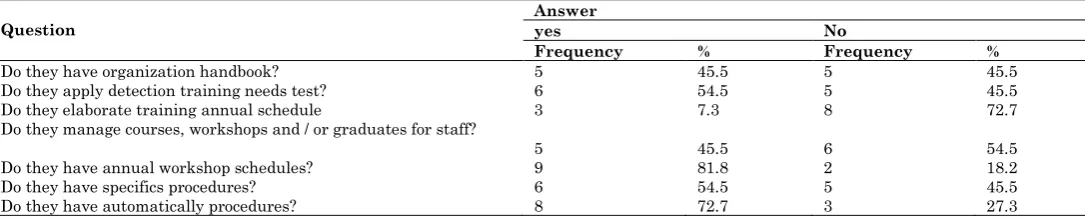
Table 4: Human capital management
Question Answer yes No
Frequency % Frequency %
Do they have organization handbook? 5 45.5 5 45.5
Do they apply detection training needs test? 6 54.5 5 45.5
Do they elaborate training annual schedule 3 7.3 8 72.7
Do they manage courses, workshops and / or graduates for staff?
5 45.5 6 54.5
Do they have annual workshop schedules? 9 81.8 2 18.2
Do they have specifics procedures? 6 54.5 5 45.5
Do they have automatically procedures? 8 72.7 3 27.3
The table 4 shows the need to strengthen
activities to training the human capital, and the structural with handbooks, procedures, schedules and automation.
Table 5: Linked with others municipality within and outside the region Region municipality Linked municipality
Linked reason Number % Within outside
1 9 2 0 Sharing of equipment and support in natural disasters
1 9 3 0
2 18 4 0
1 9 3 0
4 37 0 0
1 9 6 0 Territorial boundaries, and help with equipment and public services in cases
of natural disasters
1 9 0 2 Foreign trade and partnership with other national producers and regions
Table 5 shows 10 of the 11 municipality (91%) don’t maintain region link within and outside with others municipality to boost productive and commerce projects; 54 %( 6 municipality) are
Mexico (Jalisco) and one more in Spain. Is
important says that the last one has the highest GDP per capita.
Table 6: Public servers profile
Amount % Characteristics
170 46.1 Less than 2 years of experience
143 38.75 No handbooks, manuals or tools to facilitate the work
131 35.5 They think that administration does not help to create an environment for learning
133 34.1 Have a bachelor's degree
120 32.5 Think there is no initiative to introduce new techniques or procedures
81 22 Do not have training course
This Table shows the low interest municipal authorities have to encourage learning and provide training manuals and tools that make job easier for public workers. It has to be noticed that 22% of 369 workers surveyed say that they do not
receive training courses, only 34% have a bachelor degree and 46.1% have less than 2 in the job imply that the large amount of human capital do not have experience on previous administrations
Table 7: User perception
Amount % Perception
160 45.3 Current administration has not improve its customer service
153 43.34 Does not provide written guides or handbooks
133 37.67 Staff does not have the required knowledge or skills for the ob 115 32.6 Staff does not provide required information to do some process
High levels of dissatisfaction are notice among users, on the other hand, more than a third of the surveyed users agree that the staff is not trained to perform the required job, this situation
matches with the low levels of education and lack of recourses for training, which is related to the poor quality of the services provided
Table 8: Appreciation index of quality of provided services by the municipality*
Appreciation Frequency % Added percentage
Very bad 20 5.7 5.7
Deficient 58 16.4 22.1
Regular 125 35.4 57.5
Good 135 38.2 95.8
Excellent 15 4.2 100.0
Total 353 100.0
It has to be noticed that 22% of the surveyed users think the quality of services provided are very bador deficient, while 35.4% thinks the service is regularIn the search to determine the influence of the intellectual capital with the external competiveness, a correlation analysis
was done with the information gathered on the interviews performed to the mayors, using Spearman rho coefficient (Table 9) and Pearson's R on the surveys done to public workers and users (Tables 10 and 11, respectively)
Table 9: Relation between GDP per capita and intellectual capital indicators
Indicators Spearman's Rho
Municipal president education level .220
Public management training courses taken by the municipal president -.122
Leadership training courses taken by the municipal president .056
IT training courses taken by the municipal president .141
New hiring staff percentage on current administration -.278
Percentage of staff that has level of education and training required for the job .782**
Percentage of staff that has the experience required for the job .156
** Correlations are accurate to leve .01 bilateral
According to above results, there is one indicator that gathers more attention: level of education of the staff, only indicator that correlates significantly with intellectual capital. Some authors that discuss this topic are: Edvinsson and
Malone [6], Roos et.al [9], Bontis [10] and Ordoñez de Pablos [15].
Table 10: Correlation between quality of services and intellectual capital indicators
Indicators
Correlation index
How often are training curses provided to staff .684(*)
Availability of training manuals .597(*)
Give information to user .680(*)
Improve quality of service to users .643(*)
Good handing of public resources .675(*)
Swift and fast public process .710(**)
** Correlation is accurate to level .01 bilateral *Correlation is accurate to level 0.05 bilateral
manuals so that they provide to the users the information necessary for the accomplishment of their steps; a better attention to the public, in the good use of resources but mainly in that the steps
are rapid and simple. All this reconciles that the education and training influences also the external competitiveness.
Table11: Relation between quality of the services and indicators of the intellectual capital
Indicator Correlation index
Betterattention to users .913(**)
Improved services .888(**)
Better resources handing .856(**)
Simple and fast services .846(**)
Quality surveys .679(*)
Handling of training manuals .537 (*)
** Correlation is accurate to level .01 bilateral * Correlation is accurate to level 0.05 bilateral
The fact that the user receives the information that it needs it is of high priority for him and has relation with which it perceives a better attention; better service; good use of resources; that the services provided seem to him to be simple and rapid and with high quality.
Limitations
and
Future
Lines
of
Research
This study limits itself exclusively to the municipalities that integrate the Region Toluca in the State of Mexico, to the being a study of transverse type, it corresponded to the second year of three of management of the municipal administration for what his results are cannot be generalized. Nevertheless they offer founding to other regions for the accomplishment of similar studies.
The results obtained in the study show that it is important and indispensable to focus new lines of investigation that are orientated to study the administration of the municipalities linked to the management of the intellectual capital East study opens the doors for new investigations in the area, it is suitable that it is continued studying because the administrative and technological advances continue advancing at the time that the theory of the intellectual capital gets stronger and receives more support
Conclusion
In the dynamics of the current society, the availability of economic funds from the government orfrom the private sector, are not sufficient to stimulate the growth and development of the municipalities, therefore it is necessary to incorporate new theories that contribute to facing this task.
The main result obtained in this research concludes that the components of the intellectual capital are constituted in potential factors to strengthen the competitiveness to municipal level. The human capital includes the municipal presidentand public workers of alllevels in the region. It has a preponderant role in the competitiveness, particularly for the trainingand education degree. It makes necessary to possess processes andpersonnelselection rules that guarantee to cover the profile needed by the posts, as well as institute pertinent programs of training to the changes and requirements of the environment.
credits and loans with preferential rates; governmental supports of diverse species (endowment of equipment, technical advising, economic resources, optimization of knowledge) derived from the interaction between inhabitants of different localities.
The structural capital has a fundamental role to orchestrate and to put at the disposal of the workers of the town hall procedures, databases and endowment of manuals to give the opportunity to the inhabitants to receive
attention, information and accomplishment of services with standard high level of quality.
In the middle of the second decade of the third millennium, the challenge of stimulating the competitiveness in municipalities in Mexico and many other countries is latent. It is indispensable to estimate the value of the wealth that the new theories like the intellectual capital can contribute and orchestrate them with the support of joint actions between authorities, workers and inhabitants.
References
1. López Ruiz VR, Nevado Peña Dy, Baños Torres J
(2008) Indicador sintético de capital intelectual humano y estructural. Un factor de competitividad, Revista Eure, Santiago de Chile. 34(101): 45-70.
2. Basu S y, Waymire Gregory (2008) Business
Research. 38(3):171-190.
3. Calva J, Ahumada I (2007) Educación, Ciencia,
Tecnología y Competitividad.UNAM. México10.
4. Xiaowei RL , Koput KW ,Powell W (2009)
“Intellectual capital or signal? The effects of scientists on alliance formation in knowledge-intensive industries”. Research Policy. 38(8):1313-1325
5. Bradley K (1997) “Intellectual Capital and the New
Wealth of Nations”. Business StrategyReview. 8(1):53-62.
6. Edvinsson L, y Malone MS (1999) El capital
intelectual, cómo identificar y calcular el valor inexplorado de los recursos intangibles de su empresa. Grupo Editorial Norma. Barcelona, España.
7. Bueno, Campos E (1999) Gestión del conocimiento,
aprendizaje y capitalintelectual. Madrid: Club Intelect. pp.2-3
8. Sullivan PH (2001) Rentabilizar el capital
intelectual, Paidós, España 2001.
9. Roos J, Roos G, Edvinson L, Dragonetti NC (2001)
Capital Intelectual: El valor intangible de la empresa.Paidós Empresa. Barcelona, España.
10.Bontis (2002) “Intellectual capital development in
the Arab Region” National intellectual capital index:, Ontario, Institute for Intellectual Capital Research.
11.Sánchez Medina AJ (2004) Desarrollo sostenible y
capital intelectual de un territorio, en Contribuciones a la Economía.Universidad de las Palmas de Gran Canaria.pp1-17
12.Escorsa Pere y Maspons Ramón (2001) De la
Vigilancia Tecnológica a la Inteligencia
Competitiva. Pearson Educación. Madrid, España.
13.Gómez Díaz MR (2009) Tesis Doctoral: Análisis de
la influencia de la Gestión del Conocimiento sobre
la competitividad municipal en la Región Toluca del estado de México. Facultad deContaduría y Administración de la Universidad Autónoma de Estado de México. (Mimeo)
14.Saint Onge H (1991) Tacit knowledge: the key to the
strategic alignment of intellectual capital, en Knowledge and Strategy, editadopor Michael H. Zack Butterworth-Heinemann. British Library.
15.Ordóñez de Pablos P (2004) “El capital estructural
organizativo como fuente de competitividad empresarial: un estudio de indicadores”Economía industrial. Nº 357: 131-140.
16.Porter M (1991) La ventaja competitiva de las
naciones. Editorial Vergara. Buenos Aires, Argentina.
17.Hernández Laos E (2000) La competitividad
Industrial en México Universidad Autónoma Metripolitana Unidad Ixtapalapa, Colección CSH. México.
18.Gómez E (1994) La Competitividad. .Revista
Talento. Número 1, Caracas, Venezuela.
19.Enright Ml, Francés A , y Scott E (1994) El reto de
la competitividad. Venezuela, IESA.
20.Cabrero E, Ziccardi A, y Orihuela I (2003)
“Ciudades competitivas – ciudades cooperativas: conceptos claves y construcción de un índice para ciudades mexicanas”. Comisión Federal de Mejora Regulatoria (COFEMER) México pp.1-7
21.Lever W, Turok I (1999) Competitive Cities:
Introduction to the Review, Urban Studies, 36 (5).
22.Instituto Mexicano para la competitividad IMCO
(2015)
http://www.imco.org.mx/libroweb/03_capítulo1.pdf(a ccesed 20th September 2015).
23.Economic World Forum (2009).www.weforum.org/
(Accesed 14th July2015).
24.Fajnzylber F (1998) “Competitividad Internacional:
evolución y lecciones”. Revista de la CEPAL. No. 36. Santiago de Chile. PP. 12-26.
25.Comission of Industrial Competitiveness.
President’s Commission on Industrial
Competitiveness Report, Washington D.C. p.230
26.Peñaloza M (2005) “Competitividad ¿Nuevo
Paradigma Económico?” Forum Empresarial, Universidad de Puerto Rico, San Juan Puerto Rico. 10 (1): 42-67.
27.Millán H (1996) La Competitividad de la Industria
Manufacturera del Estado de México, Zinacantepec,
El Colegio Mexiquense (Seminarios de
Investigación).
28.Porter Michael (1995) The competitive advantege of
the inner city, Harvard Business Review. 73(3): .55-71
29.Sobrino J (2002) Competitividad y ventajas
competitivas: revisión teórica y ejercicio de aplicación a 30 ciudades de México. Estudios demográficos y urbanos. 17(2):311-361.
30.Scott A (1998) Regions and the world economy.
Oxford: Oxford University Press.
31.Nevado D, y López VR (2002) El capital intelectual:
valoración y medición. Prentice Hall. España.
32.Fritzsche F, y Vio M (2000) Especialización y
diversificación industrial en la región metropolitana de Buenos Aires, Revista Eure, Santiago de Chile 26(79):.25-45.
33.Lev Baruch (2003) “Intangibles: “Medición, Gestión
E Información”. Deusto. Barcelona.
34.Edvinsson L y, Stenfelt C (1999) “Intellectual
capital of nations – for future wealth creation”, Journal of Human Resource Costing and Accounting. 4(1): 21-33.
35.Bueno E, Salmador MP, Merino C (2008) “Génesis,
concepto y desarrollo del capital intelectual en la economía del conocimiento: Una reflexión sobre el Modelo Intellectus y sus aplicaciones”. Estudios de Economía Aplicada, 43-64 Vol. 26-2. Asociación de Economía aplicada, España.
36.López B (2005) El Desarrollo Municipal. Su
sustento social, jurídico y técnico
http://www.uv.mx/iiesca/revista2005-1/municipal.pdf. (accesed el 13 de marzo de 2015) pp41-49
37.INEGI Instituto Nacional de Estadística y
Geografía. Censo de Población y Vivienda 2010. México.
http://www.inegi.org.mx/est/contenidos/Proyectos/cc pv/
38.PNUD Programa de las Naciones Unidas para el
Desarrollo. (dólares PPC, precios).