International Journal Advances in Social Science and Humanities
Available online at: www.ijassh.com
RESEARCH ARTICLE
Cakchiquel Traditional Midwives: Harmonizing Biomedicine and
Beliefs in Chimaltenango, Guatemala
Melissa M. Baker*
Amsterdam Institute for Social Science Research (AISSR) Universiteit van Amsterdam.
*Corresponding Author: Email:[email protected]
Abstract
Objective: To explore how Cakchiquel midwives were involved in the Mayan cultural-political shift perpetuating traditional beliefs and practices while adapting to the new expectations of midwifery and care of parturient women. Design: A qualitative study based on in-depth interviews.Setting: Three municipalities, Tecpán, Patzicia and Patzún, located in the departemento of Chimaltenango in the highlands of Guatemala.Participants: Cakchiquel midwives from Tecpán, Patzicia and Patzún (n = 11).Measurement of findings: The study analysis involved a coding framework to identify all key themes and categories. The analytical and interpretive process involved understanding midwives‟ practices and beliefs within each transcript/interview.Key conclusions and implications for practice: The main themes that emerged from the interviews with the Cakchiquel midwives from Tecpán, Patzicia and Patzún were the noted differences between past and present obstetrical practices and beliefs, such as the different „callings‟ that midwives experience to practice midwifery, the persistent socio-economic disadvantages confronted by indigenous midwives, the legalization of midwifery as a profession, and the inception and support of a referral system. The respondents have been active in a social movement of post-materialism and newly created identities generating an intercultural healthcare alternative for indigenous women which integrates elements of western medicine into traditional practices.
Keywords: Midwives, Cakchiquel, Tradition, Obstetrical Training, Social movement.
Introduction
Historical, political-economic and
socio-cultural reasons explain the Maya
indigenous midwives resistance to the full integration of biomedical practices into their traditional obstetrical care. For centuries, Guatemala experienced political economic regimes that situated indigenous peoples at the bottom of a hierarchically organized society. The early Spanish colonial order that was introduced to Guatemala in the sixteenth century set distinct social boundaries that situated indigenous peoples at the bottom of the hierarchy. Well into the nineteenth century even the Ladinos, or,
Spanish-speaking indigenous peoples,
remained marginalized in colonial political, social and economic processes [1]. It was at this time that regimes of extraction and accumulation of wealth of the Spanish and
Historically, resistance to public health efforts dates back to the sixteenth century, when the Spanish set out to conquer Guatemala [4]. With the arrival of the Spanish, foreign epidemics killed nearly 50% of indigenous Guatemalans. Diseases such as smallpox, measles, yellow fever, and influenza were introduced to a non-immune population [4,5]. Because of the devastating effects, Guatemalans related disease to foreigners colonizing the Americas [5]. Additionally, the indigenous population has associated many public health efforts to a process of control that reinforces the lines of power and authority [6]. Evidence suggests that the more recent introduction of a new model of modern obstetrics practices to Guatemala by the Guatemalan Ministry of Public Health and Social Assistance (MSPA) has reinforced indigenous peoples‟ suspicions of public health efforts [7-9]. With this new model, midwives were forced into a hierarchy
where biomedical health personnel,
knowledge and practices were perceived
superior to tradition, and therefore
supersede midwives‟ practices [10]. The
combination of western educational
techniques, language and practices do not always meet the needs of midwives, some of whom are illiterate, speak minimal Spanish (the language of biomedicine), and often have difficulties accessing training. Some studies have found that these social and economic barriers to accessing training and the authoritarian framework of the new obstetrical model has made midwives hesitant to incorporate biomedical obstetrics into their practices [11, 12]. Furthermore, evidence suggests that parturient indigenous women and their families are suspicious of these public health efforts and prefer to receive health care from indigenous midwives over biomedical personnel, even when biomedical personnel attend rural communities or health areas, or when midwives refer their patients to seek out biomedical care [13,14]. We explore these themes in our interviews.
Despite centuries of political, economic and socio-cultural suppression, in recent years there has been an indigenous cultural resurgence in Guatemala. In the late 1980s and early 1990s Guatemala‟s indigenous
peoples started various social, cultural and political movements to resist the persistent inequality that had intensifying during the civil [15]. Many factions of indigenous population started what theorist; Alberto Melucci [16] defined as progressive social movements in mass society which operate outside of the larger political system and focusing attention on the re-appropriation of indigenous identity [16]. Guided by this new social movement theoretical framework, this study objective is to understand how indigenous midwives, without necessarily being active in Guatemala‟s indigenous movement, were involved in the Mayan
cultural-political shift, perpetuating
traditional beliefs and obstetrical practices while adapting to the new expectations of midwifery and care of parturient women. This study aimed to generate insights of how
the Cakchiquel midwives from the
municipalities of Tecpán, Patzicia and
Patzún in the departemento of
Chimaltenango have been active in a social movement of post-materialism and newly created identities as they have generated an intercultural healthcare alternative for indigenous women which integrate elements
of western medicine into traditional
practices.
Methods
This study was carried out from May 2007 to
January 2008. The municipalities of Tecpán,
Patzicia and Patzún in the departemento of Chimaltenango were purposively chosen as the study location, as the research aims to focus on the Cakchiquel Maya peoples, whom are most concentrated in this area. These municipalities are within an approximately one hour drive from el Centro de Salud in Tecpán, where obstetrical training programs are regularly offered to indigenous midwives.
The municipalities of Tecpán, Patzicia and
Patzún are located in the Guatemalan Highlands. In these municipalities many
women wear traditional hand-woven
from May to October (rainy season). Given the majority of the population subsist on agriculture many families experience economic hardship throughout the year when the climate is poor. Additionally, poor weather in the highlands also increases risk of landslides, which can obstruct roads, and destroy homes and other infrastructure.
This research builds on over 18 months of field research with the non-governmental organization (NGO), Mujeres en Acciòn (MeA), from the departemento of Chimaltenango. Two Cakchiquel women from MeA were trained and worked as research assistants. MeA‟s network of contacts provided linkages into communities located in the municipalities of Tecpán,
Patzicia and Patzún. Initial trips to the
municipalities involved engaging in dialogue with community elders and women to identify local midwives. A recruitment script was used to explain the goal, objectives and process of this study. Informed written consent was obtained from all midwives. At the study onset only five midwives were located; however, in the months that followed five more Cakchiquel midwives were interviewed (n = 11).
The interviews were carried out at a time and location of the midwife‟s choosing, and language of choice (either Cakchiquel or Spanish). The research assistant(s) used an interview discussion guide which had three major categories of questions and prompts. (1) demographics; (2) daily routines, interpersonal relationships and activities of the midwives. The goal of these data was to generate a rich profile of the Cakchiquel
and means of obtaining obstetrical information (including training), contact with biomedical personnel or facilities (e.g. hospitals, clinics), and others. (3) The midwifes‟ beliefs and practices across the spectrum of maternal and newborn health.
The research assistant(s) engaged in regular debriefings with the research leader. MP3 recordings of interviews were transferred to the research leader. The research team reviewed the interview recordings to clarify any problems, challenges and gaps in thematic areas that were being investigated.
A professional translator was hired to transcribe all interviews to Spanish. Once the transcripts underwent a secondary review by the research team, the MP3 files were destroyed and a coding frame for the interview data was identified. This study was approved by the University of Windsor Research Ethics Board.
Results
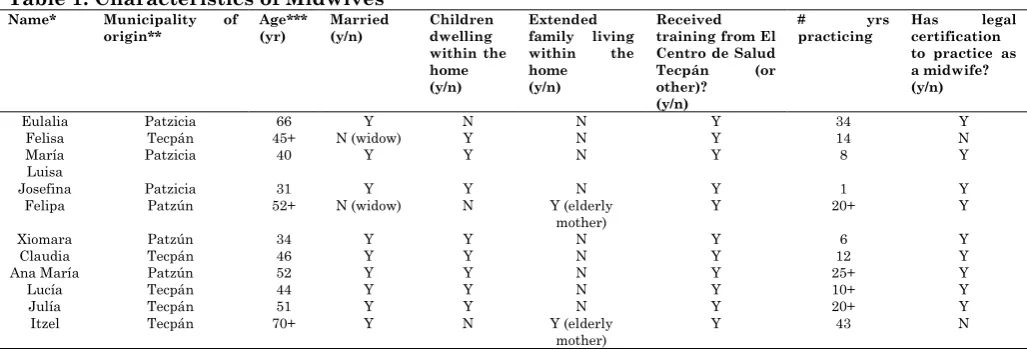
In this section we present the common themes found during the interviews with the Cakchiquel midwives. There were no significant differences between the themes that emerged in the respondent‟s interviews. All midwives are Cakchiquel women and are from the municipalities Tecpán, Patzicia and
Patzún. An overview of the characteristics of
the midwives is provided in Table 1. Pseudonyms were used for each midwife for sake of anonymity.
Table 1: Characteristics of Midwives
Name* Municipality of origin**
Age*** (yr)
Married (y/n)
Children dwelling within the home (y/n)
Extended family living within the home (y/n)
Received training from El Centro de Salud Tecpán (or other)?
(y/n)
# yrs
practicing
Has legal certification to practice as a midwife? (y/n)
Eulalia Patzicia 66 Y N N Y 34 Y
Felisa Tecpán 45+ N (widow) Y N Y 14 N
María
Luisa Patzicia 40 Y Y N Y 8 Y
Josefina Patzicia 31 Y Y N Y 1 Y
Felipa Patzún 52+ N (widow) N Y (elderly mother)
Y 20+ Y
Xiomara Patzún 34 Y Y N Y 6 Y
Claudia Tecpán 46 Y Y N Y 12 Y
Ana María Patzún 52 Y Y N Y 25+ Y
Lucía Tecpán 44 Y Y N Y 10+ Y
Julía Tecpán 51 Y Y N Y 20+ Y
Itzel Tecpán 70+ Y N Y (elderly
mother)
Y 43 N
*Pseudonyms were used to protect the anonymity of the midwives.
It is impossible to exhaustively discuss all the ways and circumstances that have influenced all midwives midwifery practices and beliefs. Instead, we discuss below a summary of the common themes that emerged from the narratives of the
midwives, which cover five specific
dimensions:
The „Calling‟ – Becoming a midwife
Preservation of tradition
Introduction of Biomedicine
Socio-economic disadvantage
An authoritarian framework
The ‘Calling’ – Becoming a Midwife
This study found that some women believe they are destined to become midwives as they experience spiritual revelations in daily activities. Some midwives explained how they experienced religious and cosmic visions that guided them to practice as midwives. Like all the interviewed midwives, Señora Felisa, is a firm believer in the spiritual connection between midwives and the supernatural world. She explained that she had experienced a very unique, spiritual calling to become a midwife when she was 31 years old. Maria (The Virgin Mary) and Jesus appeared in dreams advising her to provide prenatal, delivery, and postpartum obstetrical care to women.
“God gave me the gift of being a midwife, but I have also attended many capacity classes at El Centro de Salud in Tecpán.”
Five of the midwives explained that they had experienced medical problems which they believed were related to their calling to become midwives. For instance, Señora Maria Luisa fell ill following the birth of her second child, in turn guiding her towards midwifery:
“I was ill a lot and was in bed a long time. After fifteen days or so I had a dream that people were looking over me, contemplating my illness. My mother-in-law said that perhaps these dreams meant that I was a midwife. She told me that this was a gift and that this was indicated when I was born.” At that time, Señora Maria Luisa‟s mother-
in-law, Señora Eulalia, an experienced midwife and healthcare professional offered to train her through an apprenticeship and mentorship. Like Señora Maria Luisa, four respondents completed apprenticeships with older, experienced midwives while also attending obstetrical training programs at El Centro de Salud in Tecpán.
Unlike the traditional beliefs that originate
from the Mayan manuscript, Popul Vuh,
which declare that cosmic visions are the basis for the calling into the profession as a midwife, all respondents expressed that that
obstetrical training programs have
influenced a new form of recruitment to the role of being a midwife [17-18]. Women do not need to experience a divine calling, rather they may be genuinely interested in working in the field of maternal and newborn health-as was the case with three respondents. Nonetheless, despite their „calling‟ to the profession, all midwives explained that they are motivated to participate in the obstetrical training programs because these courses enable them to strengthen they knowledge and practices and this allows indigenous women the opportunity to continue accessing parturient care from Cakchiquel midwives who they respect, trust, can relate to. All the midwives expressed that indigenous women prefer the health care of an indigenous midwife as opposed to medical personnel in a clinic or hospital. This confirms evidence from other studies that suggest that when biomedical personnel attend rural communities or health areas, or when midwives refer their patients to seek out biomedical care, indigenous women often prefer indigenous midwives for healthcare because they are familiar with, and can relate to them [13-14].
“I tell my patients that even if there are mountains of doctors it is really up to God to guide the destiny of the mother and her baby. So, if their baby dies it is not up to the doctor, it is up to God.”
All respondents echoed similar sentiments.
Preservation of Tradition
Despite formal obstetrical training programs and the introduction of modern obstetrical knowledge and practices, some traditional indigenous rituals and practices have gone unchanged. All respondents continue to practice external massage, administer manzanilla tea, and use sweat baths which they believe facilitate an easier and uncomplicated birth. The midwives use external massage of the lower abdominal area to determine the position of the fetus, establish the baby‟s due date, and generate heat within the mother to make both the baby and mother more comfortable. The midwives examine physical attributes of the mother and the baby during and following the delivery.
“You have to watch the position the mother is in during the birth, the position the baby is in the womb, and the position that the baby takes when he/she is delivered. This predicts the baby‟s and the mother‟s future, and their future health,” stated Señora Felisa.
Physical attributes such as birthmarks, and read the marks on the placenta and the umbilical cord can have meaning, stated Señora Maria,
“…if there is a lot of distance between markings on the umbilical cord this means the woman will give birth again, the times when they will take place, the number of children the woman will have, and the sex of each child… Since ancient times midwives did this and today midwives still do it because these are old customs of our people.”
For medical reasons, midwives also examine the amount of amniotic fluid and its texture and color, as this can indicate potential
delivery or postpartum complications.
During postpartum visitations the midwife
performs rituals that are believed to ensure a healthy recovery. It is common for the midwife to massage and bind the postpartum mother with an abdominal sash. For
centuries, indigenous midwives have
believed that by wrapping a tightly woven sash around a woman‟s lower abdomen in the post partum period this will realign bones and helps with reducing the size of the uterus, slowing postpartum bleeding and
associated pain [10]. The midwives also
understand that the binding is essential for postpartum indigenous women to carry on with their domestic or working duties, as it enhances the physical strength needed for women to lift heavy loads, carry water and children. Given the possibility of possible risks associated with any traditional
practices, all midwives take extra
precautions during a delivery to meet the needs of both mother and baby.
Introduction of Biomedicine
From the interviews conducted with the
Cakchiquel midwives in Tecpán, Patzicia and
Patzún, it is clear that despite retaining some traditions and beliefs there have been significant changes in their practices. For instance, internal manipulation of the fetus, vertical delivery position, and cauterization of the umbilical cord have all declined in use or have been replaced with more modern biomedical skills and techniques that are taught through formal obstetrical training programs.
Prior to receiving formal obstetrical training the respondents believed that active labor started as soon as the woman‟s water broke. The midwives admitted that obstetrical training taught them of the dangers of a woman starting to push, to deliver her baby when the cervix is not dilated. Today, the respondents understand the importance of waiting to deliver:
“…if contractions are occurring between five and ten minutes you have to remind the patient not to struggle because they have to wait for the proper hour,” stated Señora Josefina
interpret a woman‟s physical health indicators, such the breaking of the water, the position of the baby in utero, the state of the mother‟s health, and the pulse of both woman and baby. Señora Felipa explained that these physical health indicators help the midwife to facilitate an easier delivery experience as they are more knowledgeable and can cater to the mother and baby‟s needs, and deal with complications prior to their occurrence, including making a referral to a hospital if needed.
As midwives expertise has expanded so has their dependency on medical products. Today, all midwives interviewed use clocks to record contractions, weight scales, mucus aspirators, scissors, soap, alcohol, umbilical cord clamps and ties for the umbilical cord or gauze. Some midwives reported that health centres such as El Centro de Salud in Tecpán occasionally dispense materials free of charge to the midwives who participate in the centres‟ obstetrical training programs. The majority of the respondents who have legal certification to practice as a midwife in Guatemala have received some of equipment for free from El Centro de Salud in Tecpán. Gaining regular access to medical supplies is
difficult for midwives without legal
certification to practice.
There has also been an increased focus on sterilization of materials used by the midwife, including a focus on hand hygiene. This is an especially important point, as all
midwives expressed that historically,
indigenous midwives would manipulated the baby in utero if they believed the baby was transverse or breech; leading to infections with both the mother and baby. Typically, midwives did not have sterile hands and nails when they internally examined the mother and baby. Today, capacity courses instruct midwives to refer their patients to hospitals when complications arise, including transverse or breech pregnancies occur.
Señora Corina reported that prior to receiving training she did not know proper nutrition to advise parturient women. Today she provides dietary advice recommending that her patients remain hydrated, drink orange juice (as it is high in vitamin C
content), and consume frijoles (beans), and tortillas (which are high in fat content). Three of the midwives interviewed indicated that they also utilize injectable supplements to ensure their patient has energy, harmony of all elements, and is relaxed prior to the birth. Señora Eulalia explained:
“I give injections but the people that come to have injections bring their own medicines, before there was no one here to give this option. Some women do not need these injections because they take prenatal tablets, and eat well, I tell them to drink a lot of
water, to eat a lot of fruit and atole” (a
traditional drink prepared for upset stomachs, pains and indigestion).
Regardless of utilizing a combination of biomedical and traditional skills and techniques, instruments and medicines, the respondents continue to meet the spiritual, physical, and emotional needs of their communities while modernizing at the same time.
Socio-economic Disadvantage
In terms of their socio-economic situation, the conditions of the midwives vary considerably. There were few – if any – of the midwives who are considered affluent in Guatemala. In most cases, the midwives come from low-income families whose family members work subsistence jobs – mainly farming. Some midwives are the sole income earners for their family of dependents (children or unemployed elderly spouses or elderly parents) whiles others such as Señora María Luisa and Señora Claudia have spouses who work in Canada as seasonal farm workers. These double income families live in houses that differed from the other respondents, with all cement walls and flooring, metal roofs and private courtyards. These women also owned cars, while the other midwives did not. The homes of other midwives are constructed of earth floors, a combination of earthen walls and cement and tin roofs.
Most of the midwives in this study have
experienced challenges in accessing
Cakchiquel with varying levels of Spanish literacy, which has in some cases hindered them from participating in some obstetrical training programs, and impeded two of the midwives from obtaining legal certification to practice as a midwife in Guatemala. In addition, many of the midwives experience transportation difficulties which hinders their involvement in all training, and also in accessing their patients. The majority of the midwives does not own vehicles and attend to women who reside in remote communities. Señora Felisa explained that she often worries that she may not be able to attend to her patients in urgent or emergency situations. Additionally, Señora Xiomara admitted that she does not feel safe as a
woman traveling alone on public
transportation (bus) and worries that she is susceptible to robbery (as she is a known midwife and carries valuable medical supplies).
Eulalia and Señora Felipa explained that some family‟s economic hardships have them striving to minimize all household expenses, including those related to maternal health:
“…some villages are very ungrateful and want midwives to give them a favor. They speak a lot of one midwife charging a few cents more than another…There are husbands who love their wives and they feed her well. If there is money they feed her and she is able to eat whatever she wants. But there are cases where the woman may want an orange or a banana but there is no money, so where can they get this food? When there is a lot of poverty the lady remains very weak, because there is not a lot of food or because the family already has a lot of children and cannot give more money to the woman to eat more.” (Señora Eulalia)
This is a problem for many indigenous families, as they do not have formal or fixed employment. The majority of rural families work on their own agricultural plots, or as seasonal workers on other farms or plantations, jobs that do not always guarantee a fixed income. Despite these socio-economic hardships, the midwives voiced that they feel obligated and will care
for a parturient woman even if they cannot afford the midwives‟ services.
An Authoritarian Framework
In most interviews the respondents expressed that obstetrical training programs indirectly instills a hierarchical relationship among health practitioners, biomedical personnel, midwives, and patients. They argued that this hierarchy is intentional and that the modern medicalized knowledge and practices taught through obstetrical training
programs creates an authoritarian
framework where midwives must undergo formal training and obtain a license to
legally practice in Guatemala. This
ultimately assigns and determines their roles within the medical field as it establishes that any midwife without a license cannot practice. The control and designation of roles [of biomedical personnel and midwives] is demonstrated as training programs concentrate on identifying risk factors and complications that require
referrals to a clinic or hospital.
Acknowledging their limitations, the
midwives expressed an understanding that they may not have the training or skills
necessary to handle some obstetric
complications. From the interviews it can be
concluded that these midwives are
supportive of this training and acknowledge their limitations; and the respondents have set out to establish an effective referral and counter-referral system between traditional midwives and hospital personnel. Making these referrals demonstrates how the
Cakchiquel midwives from Tecpán, Patzicia
and Patzún are confident in hospital services and the biomedical obstetrical care that is available. All the midwives who were interviewed reported that by having the option of these biomedical services women have greater opportunities and more possibilities as to where they elect to have their baby and the kind of care they would like to receive.
Discussion
segregated past, with the help of the government and international organizations, the Cakchiquel midwives have established a cultural agenda that emphasizes the importance of recognizing Guatemala‟s cultural distinctiveness and its varying elements. Evidence suggests that this social movement served not only to revitalize the indigenous culture and traditions, it has also unified indigenous Guatemalans as they come together to reassess the countries
inequities and pursued acceptance,
integration and opportunities in society at large [15,19].
Confirming other studies, we found that childbirth is a physiological experience as well as a culturally mediated event in Guatemala [9, 20]. This strong association creates a dynamic relationship of inseparable components of the individual and the collective, a holistic conception of medicine and health. Due to this diversity in context and concept of health from Mayan medicine, conquest-era Spanish medicine, and current western concepts, the Cakchiquel midwives have played an integral role in interweaving cultures and producing a commingled medical system to address the socio-cultural and medical dimensions of their communities – generating an alternative that complicates
the notion of traditional medicine [21].
Despite the numerous changes brought to the midwives practices, the respondents do not see themselves as being manipulated by this healthcare model. Rather, it was striking that all the midwives interviewed were all relatively aware of, and comfortable with the biomedical healthcare model, and willing to work with it and incorporate it into their own practices. They continue to operate within a Cakchiquel cultural context; however, they are fairly modern and secularized in their approach to practicing midwifery. The midwives interviewed are excellent examples of an intellectual movement within Maya culture that has accepted modernization whilst perpetuating Cakchiquel in rituals, traditions, and values.
Although some may argue that biomedical obstetrics and training programs, the lack of formal healthcare facilities in indigenous
communities, and increased poverty and poor socio-economic circumstances are forcing the
indigenous population to integrate
themselves into Western „norms‟ and abandon Maya cultures, communities, and traditional practices, this is not necessarily
the case. The indigenous midwives
interviewed in Tecpán, Patzicia and Patzún
have integrated their practices with modern biomedical techniques whilst avoiding complete assimilation into one homogeneous biomedical obstetric model. The midwives interviewed explained that they prefer to operate on a commingled set of biomedical and traditional principles that maintain and preserve their culture and traditions whilst offering the best medical alternatives that they are capable of.
The experiences of the Cakchiquel midwives captured in this study demonstrate how they are extraordinary women who not only meet the physical and medical needs of their
communities‟ members but also
simultaneously preserve and perpetuate Mayan traditions, culture, and beliefs through spiritual and mentoring support. This interrelation of dynamic socio-cultural dimensions and health and medical circumstances demonstrate why these
women have been characterized as
extraordinary for centuries: they are individuals of considerable standing in a community. As medical historian, Steven Palmer explained, indigenous midwives are “artisans of a special kind… integrally involved within the community” [22].
Conclusions
In their post-materialist new social
movement, the Cakchiquel midwives from
the municipalities of Tecpán, Patzicia and
Patzún demonstrate how they have focused on the indigenous value of autonomy while being pressured by biomedical obstetrics.
The Cakchiquel midwives from Tecpán,
These midwives have generated a new healthcare model that rejuvenates and
advances indigenous medicine, whilst
demonstrating its intercultural relevance and encompassing and accommodating the needs of Guatemala‟s indigenous peoples. This commingled system enables each midwife to accommodate the unique and diverse characteristics of each community‟s socio-economic situations, therefore enabling an environment where both the biomedical healthcare system and traditional medicine can harmonize and coexist.
These conclusions are made with caution, as there are notable limitations to this study. Questions of representation may arise due to the data coming from such a small number of midwives interviewed. From May 2007- January 2008 the research team aimed to capture as many interviews as possible; however, due to remote locations and poor road conditions during the rain season it was difficult to access more midwives for several months. Additionally, not all midwives wanted to participate in this study. Two midwives were approached and did not want to take part in the study. In an informal conversation with these older women (of approximately 50+ years of age) the research assistant asked their reason for not
participating and both expressed fear of persecution from not being licensed to legally practice in Guatemala. They are unable to obtain licensed because they are illiterate and do not feel comfortable participating in formal obstetrical training programs.
While these interviews do not allow us to make strong claims about wider processes of change in Mayan midwifery based on primary sources alone, the detailed picture of the practices that have emerged can be compared to other anthropological studies that have been conducted over the past few decades with Mayan midwives from other areas. This study raises some interesting questions for further research. When there is a choice of health providers, how often do indigenous women seek out the biomedical personnel or a midwife? Do indigenous women view traditional midwives as first-rate health care providers? How many indigenous biomedical personnel exist?
Conflicts of Interest
The author has no actual or potential conflicts of interest to disclose, including financial, personal or other relationships with other people or organizations that could inappropriately influence, or be perceived to influence this study.
References
1. Grandin G (2000) The Blood of Guatemala: A history of Race and Nation. Duke University Press.
2. Smith CA (1984) Local History in a Global Context: Social and Economic Transitions in Western Guatemala. Comparative Studies in Society and History 26(2):193-228.
3. North LL, Simmons AB, (2000) Journey of Fear, Refugee return and national transformation in Guatemala. Montreal: McGill-Queen‟s University Press.
4. Cook NB (1998) Born to Die: Disease and New World Conquest: 1492-1650. Cambridge, UK: Cambridge University Press.
5. Lovell WG (1994) Conquest and population: Maya demography in historical perspective. Latin American Research Review 29(2):133-140.
6. Jordan B (1989) Cosmopolitical obstetrics: Some insights from the training of traditional midwives. Social Science & Medicine 28(9):925-944.
7. Hurtado E, Saenz de Tejada, E (2001) Relations between Government Health Workers and Traditional Midwives in Guatemala in Huber, B.R., Sandstrom, R.A. (Eds), Mesoamerican Healers. USA: University of Texas Press.
8. Foster JF, Anderson A, Houston J., Doe-Simkins M (2004) A report of a midwifery model for training traditional midwives in Guatemala. Midwifery,20(3):217-225.
10. Cosminsky S (2001) Maya Midwives of Southern Mexico and Guatemala. In: Huber, B.R., Sandstrom, A.R. (Eds), Mesoamerican Healers. USA: University of Texas Press. 11. Pebley AR, Goldman N, Rodriguez G (1996)
Prenatal and Delivery Care and Childhood Immunization in Guatemala: Do Family and Community Matter? Demography 33(2): 231-247.
12. Garcia K, Morrison B, Savrin C (2012) Teaching Guatemala midwives about postpartum hemorrhage. MCN. American Journal of Maternal Child Nursing 37(1):42-47.
13. Goldman N (2003) Evaluation of midwifery care: Results from a survey in rural Guatemala. Social Science & Medecine 56(4):685-700.
14. Schooley J, Mundt C, Fullerton J (2009) Factors influencing health care-seeking behaviours among Mayan women in Guatemala. Midwifery25(4): 411-421.
15. Warren KB (1998) Indigenous movements and their critics: Pan-Maya activism in Guatemala. Princeton, NJ: Princeton University Press.
16. Melucci A (1980) The new social movements: A theoretical approach. Social Science Information19(2): 199-226.
17. Tedlock D (1996) Popol Vuh : The Definitive Edition of the Mayan Book of the Dawn of Life and the Glories of Gods and Kings. Touchstone; Rev sub edition.
18. Maupin JN (2008) Remaking the Guatemalan midwife: Health care reform and midwifery training programs in Highland Guatemala. Medical Anthropology: Cross-Cultural Studies in Health and Illness, 27(4):353-382.
19. Foster J, Houston J, Anderson A et al. (2014) Weaving traditional and professional midwifery: The story of midwife, birth center, and the empowerment of midwives in Guatemala. In White, R.C. (Ed.), Global Case studies in maternal and child health. USA: Jones & Bartlett Learning.
20. Jordan B (1974) Mothers and Midwives: Contemporary Maya Indian Childbirth Practices in Yucatan, Mexico. Presented at the Annual Meeting of the American Anthropological Association, Mexico City. 21. Sierra A, Garcia H (1999) Wind in the Blood:
Mayan Healing and Chinese Medicine. Berkeley, CA: North Atlantic Books.