7th Educators’ Symposium @ MODELS 2011:
Software Modeling in Education
(EduSymp2011)
Model Correctness Patterns as an Educational Instrument
Azzam Maraee , Mira Balaban, Arnon Strum , Adiel Ashrov
10 pages
Guest Editors: Marion Brandsteidl, Andreas Winter
Managing Editors: Tiziana Margaria, Julia Padberg, Gabriele Taentzer
Model Correctness Patterns as an Educational Instrument
Azzam Maraee1, Mira Balaban1, Arnon Strum2, Adiel Ashrov1
1mari, mira, [email protected]
Computer Science Department
Ben-Gurion University of the Negev, Beer-Sheva 84105, ISRAEL
Department of Information Systems Engineering
Ben-Gurion University of the Negev, Beer-Sheva, 84105, ISRAEL
Abstract: UML class diagrams play a central role in modeling activities. Given the difficulty in producing high quality models, modelers must be equipped with an awareness of model design problems and the ability to identify and correct such models. In this paper we observe the role of class diagram correctness patterns as an educational instrument for improving class diagram modeling. We describe a catalog of correctness and quality design (anti)-patterns for class diagrams. The patterns characterize problems, analyze their causes and provide repairing advice. Pattern specification requires an enhancement of the class diagram meta-model. The pattern classification has a major role in clarifying design problems. Finally, we describe an actual experiment of using the catalog for teaching modeling.
Keywords: Design patterns, correctness and quality patterns, educational instru-ments, model and Meta-Model levels, abstraction, visual language, pattern catalog.
1
Introduction
Models are the backbone of the emerging Model Driven Engineering (MDE) approach, whose major theme is development of software via repeated model transformations. The quality of models used in such a process affects not only the final result, but also the development process itself. In order to achieve high quality, it is important to have educated modelers, who are sensi-tive to model quality. Indeed, similarly to software construction, model quality can be improved by applying automatic transformations (refactoring), but this approach still cannot replace the need for good modelers.
Design patterns encapsulate expert advice for solving typical problems that might occur in multiple contexts. They fulfill an educational role: Awareness of design patterns yields better solutions. The design patterns trend in software construction gained increasing popularity since the appearance of the design patterns book of the “GoF” [GHJV95]. On the model-level, there is research on formulation of software patterns [LP09,BBC08b], formulation of model-level gen-eral and domain specific design anti-patterns [EBL11], proposals for design pattern specification languages [FKGS04,Kim07,BBC08a], and research on the impact of design patterns [TB11]. [EBL10] is a rich catalog of model-level patterns that identify modeling problems.
improving class diagram modeling. Given the widespread usage of UML class diagrams and the difficulty in producing high quality models, modelers must have deep understanding of model design problems, their identification and repair. Patterns of correctness and quality problems in modeling characterize typical situations in which correctness or quality problems arise, analyze the causes, and suggest possible solutions. Their educational role is to increase the awareness of designers to inter-relationships between modeling elements that create incorrect or low quality models.
To the best of our knowledge, this is the first catalog that provides an in-depth analysis of causes of correctness and quality problems, together with repair advices. The catalog is intended to play an educational role in teaching object modeling. In view of this goal, we discuss the pat-tern specification language, the problem-oriented organization of the catalog, and its instruction. Finally, we describe an actual experiment in using the catalog in teaching modeling.
Section 2 presents a variety of causes for incorrect class diagram modeling. Section3 dis-cusses the nature of the pattern specification language and presents an enhancement to UML class diagrams. Section4 shortly introduces our patterns catalog, and Section 5 describes an experiment that observes the role of the correctness patterns in teaching class diagram modeling. Section6concludes the paper.
2
Correctness patterns
The two main correctness problems in UML class diagrams areconsistency[BCG05] andfinite satisfiability[MMB08]. Consistency deals with necessarily empty classes, and finite satisfiabil-ity deals with necessarily empty or infinite classes. Both problems are caused by problematic interaction of constraints.
Figure1presents four incorrect class diagrams, in which the kind of incorrectness problem, or the kind of problematic constraint interaction vary. Figure1dpresents an inconsistency problem, caused by the interaction of the disjoint generalization-set constraint, and the multiple inheri-tance of classC3: The disjoint constraint forces classC3 to be empty in every legal instance. Figures 1a, 1b, 1c present three cases of the finite satisfiability problem, caused by different kinds of constraint interaction. In Figure 1a each instance ofC has a single successor and at least two predecessors. Therefore, if the number ofC-s in a legal instance isc, and the number of predecessor-successor links isd, then d must satisfy d =c·1 and also d≥c·2, implying the inequalityc≥c·2, that can be satisfied only by an empty or an infinite extension of class C. The problematic constraint interaction in this case involves the multiplicity constraints on the predecessor−successorassociation. In Figure1bthe problematic constraint interaction involves the multiplicity constraints in the cycle of associationsw,q,r, and in Figure 1c the problem is with the class hierarchy betweenC1 andC, and the multiplicity constraints on the parent−child association.
Figure1shows that correctness problems are varied and can occur for many reasons. We argue that in real class diagrams it is not easy to understand the various interactions among constraints, and their impact on correctness or quality. Awareness to patterns that single out problematic constraint interactions, analyze the problems they create, and suggest possible repairs, improves the overall design quality.
interac-C -succ 1 -pred 2
(a)
C1 C2 C3
w
1 2
r
1 1
q
1 1
(b) (c)
C
C3 C2 C1
{disjoint}
(d)
Figure 1: Finite satisfiability problems
tions, characterize the involved problems, and suggest solutions. Each pattern describes a design problem that is identified by characteristic structures within a class diagram [BMS10].
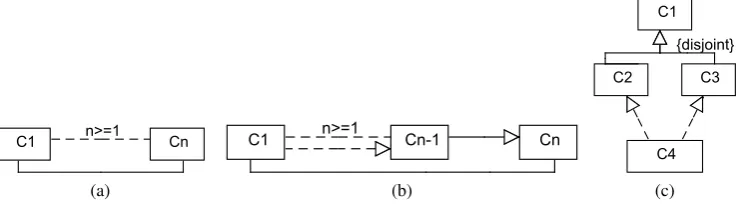
The class diagrams in Figures 1a, 1b are instances of the Pure Multiplicity Cycle (PMC) pattern, which characterizes finite satisfiability problems due to interaction of multiplicity con-straints on a cycle of associations. Figure2ainformally sketches the identification template of this pattern. The dashed line indicates a sequence of successive binary associations (the binary associations path). The pattern includes an additional verification constraint, and analysis of possible repairs, like relaxing the multiplicity constraint “2” to “1..2”.
The class diagram in Figure 1c is an instance of the Multiplicity Hierarchy Cycle (MHC) pattern, which characterizes finite satisfiability problems due to interaction of multiplicity con-straints on a cycle of associations and class hierarchy concon-straints. Figure2binformally sketches the identification template of this pattern. The two dashed lines indicate an interleaved path of associations and class hierarchy constraints. This pattern also includes an additional verifica-tion constraint, and analysis of possible repairs, like switching the direcverifica-tion of a class hierarchy constraint in the cycle.
The class diagram in Figure 1d is an instance of the diamond pattern, which characterizes consistency problems due to interaction between multiple class hierarchy (multiple inheritance) and disjoint constraints. Figure2cinformally sketches the identification template of this pattern. A possible repair is to remove the disjoint constraint.
(a) (b) (c)
Figure 2: Informal sketches of identification templates of correctness patterns
Correctness patterns as an educational instrument
exam-ples enhance syntactic quality, while negative examexam-ples enhance semantics equality, and neither has much effect on pragmatic quality. While there is an educational value in presenting concrete examples, patterns provide an abstraction level that classifies the concrete cases along typical characterizations. [TB11] show the influence of design patterns on improving the inception of models (although their patterns are presented by concrete syntactic examples).
Correctness pattern abstraction characterizes correctness problems in terms of conceptual structures such ascycle of associationsandclass hierarchy cycle, rather than in terms of concrete examples. Furthermore, patterns provide an accurate specification ofproblem domains, and so-lution advices. They can be viewed asanti-patternsthat point to negative designs and suggest repairs. The benefit is twofold: First, they provide a systematic approach for identifying pattern instances; second, they sharpen the distinction between different kinds of problematic constraint interaction.
3
Model-Pattern Specification Language
Pattern specifications include desired and undesired structures of elements from the pattern con-text. Writing a specification demands a language. Pattern writing approaches can be categorized by two factors: 1) textual notation vs. visual notation (or both); 2) expression at the model-level vs. expression at the Meta-Model-level. The main mode of usage for patterns is as expert advice for educational purposes. Formally specified patterns are also used as automatic transformations (refactorings). It seems that the appropriate mode for pattern expression depends on the intended usage.
Visual vs. textual specification: Visual notations are uniquely human-oriented representa-tions, that facilitate human communication, comprehension and problem solving [Moo09]. In contrast, textual representation might provide a better support for rigorous reasoning but is infe-rior with respect to user comprehension [Kim07]. Indeed, pattern specifications usually employ some kind of visual representations, usually in an informal manner, using concrete examples. Good visual representations enjoy thecognitive effectivenessproperty, i.e., the ability to directly clarify translations between cognitive and visual concepts [FDCB10]. This property sets a crite-rion for visual language evaluation [Moo09].
Model-level vs. Meta-model-level specification: In the model-level approach for pattern specification, patterns are specified using typical examples, that are enhanced with textual spec-ification [GHJV95, LP09]. This is the more popular approach, especially in software design patterns. Model-level specification proved helpful for communicating design experience to de-velopers. Yet, since structures are expressed via examples and text, it can create ambiguities that make it difficult to verify conformance to patterns [KE07]. For example, Figure1adoes not capture the intentioned problem domain, i.e., “finite satisfiability problem due to a cycle of asso-ciations with multiplicity constraints” in a way that enables identifying it with the class diagram in Figure1b(which belongs to the same problem domain). This approach does not lend itself to automation of reasoning about patterns.
meta-model-level specification can support pattern automation as refactorings. However, it is inappropriate for educational purposes, since defining and comprehending the meta-model-level textual patterns demand expert knowledge.
Conclusion: We argue that for educational purposes, patterns should have visually, hence model-levelspecification, but use a notation that captures the meta-model-level abstractions. For that purpose, the model-level visual language should be enhance with new notation that en-ables visualization of the meta level abstractions. Below, we describe few extended notation to the UML class diagrams, that enables visual, model-level specification of the correctness patterns in our catalog. A similar approach is used in [BBC08a].
Class diagram enhancement for pattern specification: The necessary abstraction involves constructs for specification of unbounded relationship structures like association paths, hierarchy paths, interleaved association and hierarchy paths, aggregation paths, etc. We extend the UML class diagram meta-model with new classes that capture these abstractions, and provide their concrete syntax as new visual notations in class diagrams.
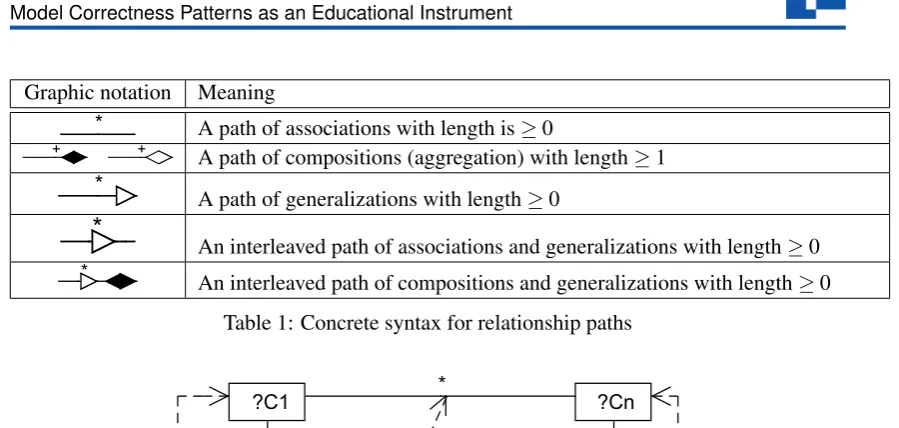
Figure3bpresents the Meta-Model extension for thegeneralization pathabstraction. The en-hancement includes a new meta-classGeneralizationPath, and a derived meta-association nex-tassoc. Existing meta-model elements appear within dashed rectangles. The new visual notation for relationship paths uses*for denoting paths of lengths≥0, and +for paths whose lengths >0. These symbols are added as labels, on top of the standard relationship symbol. For ex-ample, a class hierarchy (generalization) path is represented by a generalization line, labeled by *. Figure3apresents the identifying structure for theMultiplicity-Hierarchy-Cyclepattern, that uses the new generalization-path construct. The concrete syntax enhancement is demonstrated in Table1. Figure4intuitively sketches a possible instantiation of the identification structure of thePure-Multiplicity-cyclepattern.
(a) Identification structure for the Multiplic-ity Hierarchy Cycle
(b) The Meta-Model enhancement for generalization paths
Figure 3
Graphic notation Meaning
A path of associations with length is≥0
A path of compositions (aggregation) with length≥1
A path of generalizations with length≥0
An interleaved path of associations and generalizations with length≥0
An interleaved path of compositions and generalizations with length≥0
Table 1: Concrete syntax for relationship paths
Figure 4: Instantiation of the Pure-Multiplicity-Cycle pattern
relationship lines is associated with the traditional meaning of these operators as denoting≥0 and>0 repetitions, respectively.
4
The Correctness-Pattern Catalog
The catalog includes patterns for solving problems ofcorrectnessor ofqualityof class diagrams. The correctness problems refer to the two formal correctness problems of consistency and finite satisfiability. Quality problems refer to formally correct design problems that do not meet criteria of desirable design. The quality problems are further classified intoincomplete design, redun-dancy problems, andcomprehension problems. Within the categories, patterns are classified by the kind of the constraint interaction that causes the problem. This problem based classification is contrasted with the approach of [EBL10], which is syntax-semantics-pragmatics based.
Based on the above classification the catalog currently includes a total of 45 patterns: 15 patterns for finite satisfiability problems, 11 patterns forconsistency problemsand 17 patterns forqualityproblems. The catalog is still under development, and new patterns are being added.
advice (refactoring); 8. Related patterns; 9. Pattern justification – a correctness proof for the pattern identification, verification, and advice.
Example1 (Pure-Multiplicity-Cycle Pattern)
1. Pattern name:Pure Multiplicity Cycle (PMC).
2. Problem: A cycle of associations with multiplicity constraints might introduce a finite satisfiability problem.
3. Concrete Example: See Figure5a.
4. Pattern Identification Structure: See Figure5b.
(a) (b)
Figure 5
5. Involved meta-model elements: The meta-classesAssociationandClass.
6. Pattern verification: The pattern identification structure characterizes a necessary but not sufficient condition for existence of a finite satisfiability problem caused by the multiplicity constraints in an association cycle. The verification condition below provides the sufficient condition. Its specification requires an elaboration of the identification structure, as in Figure6.
The cycle causes a finite satisfiability problem if one of the following conditions holds:
• ∏n
i=1
m0i <
n ∏ i=1
ni.
• ∏n
i=1
mi < n ∏ i=1
n0i.
Figure 6: Pattern verification
7. Repair advice: Consider relaxation of the multiplicity constraints: decrease a minimal multiplicity value or increase a maximal multiplicity value.
8. Related patterns: TheMultiplicity Hierarchy Cycle (MHC)pattern.
9. Pattern justification: Proof is omitted.
t o p r e l a t i o n A s s o c i a t i o n C y c l e {
c h e c k o n l y domain s o u r c e a s s o c : A s s o c i a t i o n{ a l l c o n n e c t e d a s s o i c a t i o n s−>
i n c l u d e s ( a s s o c ) { } };
e n f o r c e domain t a r g e t c : C a t e g o r y {name = ’ A n t i−P a t t e r n s ’ , p a t t e r n = p : P a t t e r n {name = ’ A s s o c C y c l e ’ , r o o t B i n d i n g = r b 1 : R o l e B i n d i n g {r o l e = ’ A s s o c i a t i o n ’ , e l e m e n t = a s s o c} } };}
Listing 1: A QVT based rule for detecting associations that participate in association cycles
5
Putting the catalog into practice
In order to examine the extent to which patterns help in identifying erroneous models, we con-ducted a series of experiments that check various factors that affect the usage of the correctness patterns. Table2presents the experiment settings: The subjects’ background (Software Engi-neering and Information Systems EngiEngi-neering students) and numbers, the education type (by simple example or by formal and abstract demonstration of the patterns), the domain type (real or synthetic domains), and the size of the domain and the number of errors.
Exp Subjects Education Type Domain Type Additional Factors Checking Mode
1 SE (49) Examples Real Different domain Class Assignment 2 ISE (49) Examples Synthetic Different size Class Assignment
3 SE (42) SE (42) Synthetic Class Assignment
4 SE (61) Patterns Synthetic Exam
Table 2: Experiment settings
In the first experiment we divided the subjects into two groups. In the first session (before introducing the patterns) each group got a different domain model (via a class diagram) of an academic and a genome domain. In the second session (after introducing the patterns by exam-ples by the paper authors), each group had the other domain model. In each session the subjects were asked to identify places in which correctness problems occur. The results of the experiment show that the differences among the subjects’ achievements before and after introducing the patterns are not statistically significant (see Table3). Examining the differences across the two domains does not show any statistical significance as well. Our conjecture is that the students focused on the domain semantics rather on the model semantics.
These results have led us to perform another experiment that was based on synthetic domains. Here again, we divided the subjects into two groups, yet the two groups had domain models with different sizes (with 6 and 2 problems, respectively). We had the same setting as in the first experiment, in which the subjects had to identify existing problems before and after introducing the patterns. The results show that in the case of a large domain model with several correctness problems, there is a significant improvement in identifying the problems after introducing the patterns (see Table3).
Exp Before After
1 42% (Academia); 49% (Genome); 39%(Genome); 48%(Academia) 2 28% (6 patterns) ; 52% (2 patterns) 51% (6 patterns); 50% (2 patterns
3 42% 70%
4 Precision = 85.57%, Recall = 66.39%
Table 3: Experiment results
were high (70 % identification of the existing problems) compared to previous experiments (see Table3).
In the forth examination, we checked the extent to which the patterns help in identifying only existing problems. For that purpose we calculated the recall measure which is the ability of the subjects to identify all relevant problems and the precision recall which is the ability of the subjects to identify only the relevant problems. The results (as appear in Table3) show that the patterns indeed provide support for identifying only relevant problems. Yet, their support for identifying all relevant problems is limited.
Summarizing the results we found out that the correctness patterns indeed provide guidelines for identifying erroneous models and that their effectiveness increases in cases where the domain models are complex (and thus have more problems) and when their introduction is presented in a more formal and abstract form (instead of by examples).
Pattern instruction: Teaching catalogs of patterns or refactorings is hard [Pil10,Kop11]. This is a well known problem, that results from the monotonic repetitive character of catalogs. Not surprisingly, we have found through our experiments that we have been most successful when we taught only one or two patterns out of each category. The problem oriented organization of the catalog encourages a focused usage, such as when a new kind of constraint is introduced.
6
Conclusion
This paper presented a catalog of correctness and quality patterns for class diagram design, and discussed its role as an educational instrument. We argued that for educational purposes pat-terns should be visually formulated, using model-level concepts, and provided an appropriate enhancement to UML class diagram.
The correctness catalog is still under development. About 30 additional patterns are planned. In the future, we plan to include the catalog as a routine class material in our object modeling courses.
Bibliography
[BBC08a] D. Ballisa, A. Baruzzo, M. Comini. A Minimalist Visual Notation for Design Patterns and Antipatterns. InFifth International Conference on Information Technology: New Generations. Pp. 51–56. 2008.
[BCG05] D. Berardi, D. Calvanese, D. Giacomo. Reasoning on UML class diagrams.Artificial Intelligence168:70–118, 2005.
[BGU10] BGU Modeling Group. UML Class Diagram Patterns. 2010.
http://www.cs.bgu.ac.il/∼cd-patterns/
[BMS10] M. Balaban, A. Maraee, A. Sturm. Management of Correctness Problems in UML Class Diagrams – Towards a Pattern-Based Approach.International Journal of Infor-mation System Modeling and Design1(1):24–47, 2010.
[BSV09] N. Bolloju, C. Schneider, D. Vogel. Asymmetrical Effects of Using Positive and Neg-ative Examples on Object Modeling. In18th International Conference on Information Systems Development. 2009.
[EBL10] M. Elaasar, L. Briand, Y. Labiche. Metamodeling Anti-Patterns. 2010.
https://sites.google.com/site/metamodelingantipatterns
[EBL11] M. Elaasar, L. Briand, Y. Labiche. Domain-Specific Model Verification with QVT. In ECMFA 2011. 2011.
[FDCB10] K. Figl, M. Derntl, M. Caeiro Rodriguez, L. Botturi. Cognitive effectiveness of visual instructional design languages.Journal of Visual Languages & Computing, 2010.
[FKGS04] R. France, D. Kim, S. Ghosh, E. Song. A UML-Based Pattern Specification Tech-nique.IEEE Transactions on Software Engineering30(3):193–206, 2004.
[GHJV95] E. Gamma, R. Helm, R. Johnson, J. Vlissides.Design patterns: elements of reusable object-oriented software. Volume 206. Addison-wesley Reading, MA, 1995.
[KE07] D. Kim, C. El Khawand. An approach to precisely specifying the problem domain of design patterns.Journal of Visual Languages & Computing18(6):560–591, 2007.
[Kim07] D. Kim. The Role-Based Metamodeling Language for Specifying Design Patterns. In Taibi (ed.),Design Pattern Formalization Techniques. Pp. 183–205. IGI Global, 2007.
[Kop11] C. Koppe. A Pattern Language for Teaching Design Patterns. InEuropean conference on pattern languages of programs, EuroPLoP 2011. 2011.
[LP09] M. Llano, R. Pooley. UML Specification and Correction of Object-Oriented Anti-patterns. InICSEA ’09. Pp. 39 –44. 2009.
[MMB08] A. Maraee, V. Makarenkov, B. Balaban. Efficient Recognition and Detection of Finite Satisfiability Problems in UML Class Diagrams: Handling Constrained Generaliza-tion Sets, Qualifiers and AssociaGeneraliza-tion Class Constraints. InMCCM08. 2008.
[Moo09] D. Moody. The ”physics” of notations: towards a scientific basis for constructing visual notations in software engineering.IEEE Transactions on Software Engineering 35(6):756 – 779, 2009.
[Pil10] N. Pillay. Teaching Design Patterns. InSouthern African Computer Lecturers Associ-ation Conference, SACLA 2011. 2010.