Using Corpora for Error Correction in EFL
Learners’ Writing
Qinqin Luo
School of Foreign Languages, Southwest Petroleum University, Chengdu 610500, China
Ying Liao
School of Foreign Languages, Southwest Petroleum University, Chengdu 610500,China
Abstract—This study reports on a small-scale study exploring the effects of using corpora in the process of
revising essays in English as a foreign language (EFL). 30 undergraduate students from two College English Classes in China participate in the experiment. The BFSU CQP web is used for assisting experimental group to correct the lexico-grammatical errors in writing. The findings reveal that corpora as reference resources are more helpful than the online dictionary in helping learners make accurate corrections and reduce errors in free production. The following questionnaires indicate that participants generally show positive attitudes toward corpus use in writing. However, there are also some challenges to overcome while using corpora such as too much time spent in analyzing data, too many examples in the concordance lines and so on. These findings suggest the need for more well-planned corpus-based activities to help learners benefit as much as possible from corpora-assisted learning.
Index Terms—corpora, error correction, EFL learners, writing
I. INTRODUCTION
A lack of grammatical or lexical accuracy in writing is a major problem for English as a foreign language (EFL) learners. In China, the lexico-grammatical errors are commonly seen in EFL learners’ writing, which to some extent prevents learners from producing high-quality essays. Just as Yoon (2008, p.45) states, the mastery of lexical and grammatical accuracy can lead to “an increased confidence in themselves as L2 writers as well as a possible increase in the quality of their writing”. However, providing the correct forms directly to learners may not always be the only, or actually the most effective, way of correction for it may prevent the learners from testing alternative hypotheses. And it may also lead to learners’ laziness, which is not beneficial to the development of their linguistic competence. Thus the most effective way for both learners and teachers may be “making learners try to discover the right forms”. (Corder, 1981 p.11).
Data-driven learning (DDL), proposed by Johns (1991), is considered as an effective way to help learners solve this problem since it advocates inductive, discovery-oriented learning. In this process, students act as researchers to analyze corpus examples and engage in autonomous and exploratory learning. Over the past decade, corps consultation in the classroom has been regarded by some L2 writing researchers as one of the most promising areas that can inform L2 writing pedagogy and broaden language teaching and learning (Bloch, 2007; Conrad, 2008; Granath, 2009; Yoon, 2011). Numerous studies (Coxhead & Byrd, 2007; Flowerdew, 2010; Tribble, 2009) have shown that corpus examples are effective in helping learners with lexico-grammatical patterns to enhance L2 learner writing performance. However the empirical studies about actual corpus use in learners’ writing in China are rarely seen due to the following reasons: firstly, corpus tools are not easy enough for learners to use (Kosem, 2008) and texts sampled in corpora are so difficult that learners can hardly comprehend, especially for lower-level learners. Secondly, a considerable number of teachers don’t have a pedagogical background in using corpora. What is more, many EFL learners in China are accustomed to being told directly what to do by a teacher and not willing to assume the responsibility for their learning (Boulton, 2009b).To tackle this problem, the corpus for learners to use should be carefully selected and sufficient training is also necessary to help learners benefit as much as possible from using corpora in writing. The present study attempts to apply corpus use in EFL learners’ error correction in writing by providing them with easy-handled corpora and sufficient training on corpus consultation.
II. LITERATURE REVIEW
difficult for EFL learners to identify errors themselves, so “most approaches to self-correction do not leave learners totally to their own devices, but require teachers to provide some support” (Todd, 2001, p.94) This support usually means detecting and pointing out the errors such as underlining the errors or informing them of the nature of the errors. Then learners are supposed to correct the errors on their own. Some learners do the correction work just by intuition which usually results in the wrong correction, while some others try to seek support from resources such as dictionaries, reference books. In recent years there has been some research on learners’ use of corpora as reference tools to solve linguistic problems in writing since DDL was advocated in language teaching and learning.
Among these studies, some researchers mainly focus on students’ lexical errors. For instance, in Todd’s (2001) study, 25 postgraduate students at a Thai university self-corrected lexical errors coded by their teacher by consulting a web-based corpus. The findings revealed that these learners were able to induce valid patterns from self-selected concordances and to use these patterns in self-correcting errors. But another research done by Gaskell & Cobb (2004) concentrates on grammatical errors. This study investigated the role of using concordance feedback in correcting L2 learners’ sentence-level writing errors. In their research, 20 Chinese EFL participants in an English writing course handed in ten essays in a fifteen-week semester and revised essays by referring to corpus examples. The results showed that “adapting concordances for lower level learners’ grammar development is less straightforward than for lexical development” (Gaskell & Cobb, 2004, p.317). However, the results were also positive, because learners got a higher accuracy rate of error correction when the online concordance links for errors with instructions were provided to them.
There are also some studies concerning various types of errors which include lexical errors, grammatical errors, and capitalization errors. For example, Chambers and O’Sullivan (2004) conducted a research project involving native English speaking learners of French, aiming to investigate the effects of corpus use in correcting various errors and learners’ evaluation of the process of corpus consultation. In this study, a small semi-specialized corpus was used as reference sources by 8 graduate students to correct errors marked by their teacher after a 3-week training in concordancing. The findings were positive since 64 changes (75%) were made correctly among all the changes (85) that they made. And after that, O’Sullivan and Chambers (2006) conducted another similar research on 14 undergraduate French major students. In this research, 122 changes (about 73%) were correct among the 166 changes they made through corpus consultation. In the two studies, corpus consultation was confirmed to be useful in reducing native language interference even though learners can correct all kinds of errors. What’s more, it proved that corpus use was more useful than dictionaries and grammar books while correcting errors relevant to prepositions and idiomatic expressions. When it came to the evaluation of corpus consultation, the undergraduates were slightly less positive than the post-graduate students. This is consistent with Granath’s (2009) opinion that the advanced learners benefited more from corpus use.
In spite of the above-mentioned positive effects of corpus consultation, Tono, Y. et. al (2014) showed that not all types of errors were appropriate for correction by consulting corpora. In their research, they concentrated on three error types while learners used corpus in the process of revising compositions in English as a foreign language. The findings revealed that “there was a significant difference in the accuracy rate among the three error types when the students consulted the corpus: omission and addition errors were easily identified and corrected, whereas misformation errors were low in correction accuracy”(Tono, Y. et.al, 2014, p.147). In addition, Chang & Sun’s (2009) experiment indicated that students behaved much better in the collocation use (verb + preposition) in the proofreading tasks with the support of scaffolding prompts, which proved the necessities of teachers’ guidance and instruction especially for lower-level
students. These studies indicate that the type of tasks and proper training may influence the effects of corpus consultation thus teachers should take the factors into consideration while giving students corpus-based assignments.
corpus use is more effective than the traditional sources in improving L2 writing. The present study is an empirical one selecting BFSU CQP web, which can provide user-friendly interfaces and easily accessible and readable corpora, as the reference resource for learners. And it attempts to investigate whether the use of corpora is more helpful in helping lower-level EFL learners correct lexical-grammatical errors and reducing the number of errors in free writing. Meanwhile, learners’ perceptions about corpus use are investigated in the form of questionnaires.
III. METHOD
A. Research Questions
The present study was designed to investigate the effects and student’s evaluation of corpora-assisted error correction in EFL learners’ writing. The following research questions are addressed:
1) Will error correction with the help of concordances reduce errors in free production? Which one is more useful in helping learners reduce errors in free production, consulting corpora or consulting the online dictionary to correct errors?
2) Is corpora-assisted error correction more useful in making the right corrections compared with dictionary-assisted error correction?
3) What are EFL learners’ attitudes toward the corpora-assisted error correction? B. Participants
The study was conducted in a lower intermediate level compulsory College English course. 30 students (20 males, 10 females) participated in the study. 15 of them from one class are in the experimental group, and 15 from another class are in the control group. The participants in the study were all native speakers of Mandarin Chinese who have been learning English as a foreign language (EFL) for 7 years. They have taken part in College English Test Band 4 (CET 4 for short) in July, 2014, and all of their scores range from 400 to 424(The total is 710). And their writing score in the previous final exam ranges from 7 to 10(The total score is 15). They are carefully selected to ensure there are no significant differences in language proficiency and learning motivation. An independent t-test was performed to examine their average score in the experimental group and the control group and the results showed that the two groups were equivalent in both their language proficiency and writing competence. They have to take CET 4 at the end of the term, thus both the two groups have strong motivation to improve their language proficiency especially wring competence.
C. Instruments
1. BFSU CQP web
CQP web is a web-based fourth generation corpus analysis tool, “intended to address the conflicting requirements for usability and power in corpus analysis software” (Hardie, 2012, p.380). It is easy to handle enabling technically less competent learners to exploit corpora just like browsing web pages. The functions provided by CQP web are including: collocations, concordancing, frequency lists, keywords and so on (Xu & Wu, 2014)
Fig.1: The screenshot of Brown corpus indexed in BFSU CQPweb
Compared with other online corpus, BFSU CQP web has its own advantages: Firstly, EFL learners can have easy access to multiple corpus examples. Just as Frankenberg-Garcia (2012) stated, multiple concordances are more useful than dictionary definitions in helping participants to correct the use of words that they knew but frequently misused. And the research also proved that multiple corpus examples seem to help more consistently than single corpus examples in autonomous error correction. Thus multiple corpus examples presented by BFSU CQP web can help EFL learners better in correcting errors than a single online corpus. Secondly, the parallel corpora can function as a dictionary when learners are confused about some new words in the concordance lines or unable to express what they want to convey in target language.
2. Online dictionary
Traditionally learners correct the lexico-grammatical errors by referring to dictionaries. In dictionaries, learners can get not only definitions, collocations, synonyms, antonyms and usages, but also the grammatical information of target words. Chan (2012) investigated the use of grammatical information in a monolingual dictionary by advanced Cantonese ESL learners, which prove that it was useful in helping learners determine the correct use of a word. However, the dictionary that learners use in the research is paper dictionary. According to our investigation, most learners prefer an online dictionary to a paper dictionary for quick reference in this technology-based era. Thus we choose the online dictionary (http://dict.cn/) for the control group to correct errors in their articles. This dictionary not only provides functions of the monolingual dictionaries but also has the advantages of bilingual dictionaries.
D. Procedure
The following procedure was adopted.
Step 1 Training: from hands-off DDL to hands-on DDL
One teacher-friendly way to encourage students to focus more on error correction, is to train them in methods to query online corpora. Considering all the participants had no prior experience in consulting corpus, we divided the training into two stages. In the first stage, hands-off DDL was adopted. That’s to say, students needn’t get direct access to corpora at the beginning, but it was the teacher who consulted the corpora and prepared printed materials based on concordance for them. As for the task in the training stage, we firstly required all the participants to complete the same error-correction task. Just as Bernardini (2004) recommended about training, we can start with convergent tasks that lead learners to the same outcome. When learners are more skilled in doing the task, the more divergent, or independent tasks can be assigned to them. Thus the training materials in this stage were like this:
Hands-off DDL tasks: Correct the following wrong sentences with the help of corpus examples below. All the following examples are from Corpora in BFSU CQP web. (accessed 1/9/2014, http://124.193.83.252/cqp/)
1) Despite he is lazy, he is good at all his subjects.
a. President Musharraf seems to to be hanging on despite the fact that the vast majority of Pakistanis don’t want him. b. Amazingly, despite the fact that many of Kerry’s congressional colleagues had faced similar….
Hands-on DDL tasks:Correct the following wrong sentences with the help of BFSU CQP web 1). He introduced an approach to learn English in the meeting.
2). I would appreciate if I could give an early reply. 3). I am glad to tell you I will be graduate from our school.
Step 2 Writing Practice
1) Essay tasks
All the participants were required to finish the writing assignments given by the teacher in the given time and submitted them on time. They were supposed to compose 6 essays in this term. The assignments were mainly argumentative essays.
2) Teachers’ guided feedback
The teacher underlined all the lexical-grammatical errors in essays and highlighted those that should be corrected with the help of corpus examples or the online dictionary. Participants were also advised not to limit themselves to the underlined errors. They were encouraged to select words or phrases from their compositions that they were not satisfied with and see whether they could use the corpora or the online dictionary to improve those parts.
3) Learners’ autonomous error correction
Learners in the experimental group corrected the highlighted errors by consulting the corpora in BFSU CQP web, and wrote down the correction or the new word or phrase beside the errors of the original essay (highlighting those changes resulted from using the corpus). Learners in the control group referred to the bilingual dictionaries to correct the highlighted errors. Both the sentences with highlighted errors and the revised sentences should be kept for teacher’s evaluation. Then they handed in the second version of the essay on time. Besides it, the experimental group still had to record the details of the word they searched, the typical concordance examples and what they discovered. The control group also had to make a record of the results from the dictionaries, making the teacher know whether this correction was based on the dictionary.
As for some errors that were easy to be corrected, such as spelling mistakes, they could correct them directly without referring to any materials. But these were not included into the number of right corrections while calculating the accuracy rate, only those corrections with the assistance of corpus examples or dictionaries being considered.
4) Teachers’ evaluation and comment
The teacher evaluated whether the correction was right or not, and found out the factors that may influence the right correction. And then a comment was given on the participants’ correction work, and some suggestions were given about how to make right induction from corpus examples and apply the rules into correction work.
Step 3 Questionnaires
A 6-point Likert scale questionnaire was used in this study. The questionnaire included 20 items to which the respondents were required to show their degree of agreement from completely disagree to completely agree. The majority of items were adapted from questionnaires in Yoon & Hirvela (2004) and Huang (2014). The researcher designed the remaining items specially for this study. These items could be divided into 3 parts. The first part was about the positive sides of corpus use in error correction, the second part was about the difficulties in using corpus and the third part was about the overall evaluation of corpus use in writing. All statements were presented in English. At the end of this term, questionnaires were delivered to the experimental group about their perceptions of using corpus for error correction.
E. Data Collection and Analysis
To compare the number of errors in the experimental group and control group, the teacher kept a record of the total number of errors every time when the participants handed in essays. And when learners submitted the revised essays, the number of corrections they made through consulting corpora or the online dictionary and the number of right corrections (accuracy rate) should be also recorded for further analysis. To know the changes in the number of errors in the whole process, the teacher had to calculate the number of errors in 6 essays respectively. Questionnaires were collected immediately after the participants completed them.
IV. RESULTS AND DISCUSSIONS
Fig. 2 Comparison between two groups in total number of errors in writing tasks
It can be seen from the above figure that there is a gradual decline in the number of lexico-grammatical errors in both of the two groups. The teacher’s focus on lexico-grammatical errors may stimulate participants to pay more attention to errors. They may spend more time in checking after finishing the writing task. However, it seems that corpora-assisted error correction is more useful than dictionary-assisted error correction in helping learners reduce errors in writing. In the first article, the total number of errors committed by the two groups is almost the same, 80 for the experimental group and 78 for the control group. Nonetheless, in the last two articles, the experimental group had much less errors than the control group. Especially in the last writing assignment, the control group had altogether 54 errors, while the experimental group just committed 30 errors, which means 2 errors on average for each participant. The results indicate that corpus examples are more useful in helping learners reduce lexico-grammatical errors in the long run. Since the participants spend much time in analyzing corpus data relevant to their own errors, they may have a deeper impression on these errors and master the right usage of words or phrases better. They may try to avoid the previous errors in the following tasks. However, for the control group, it’s sometimes unnecessary to analyze lexical or grammatical rules by themselves since these can be got directly from the dictionaries. According to the noticing hypothesis (Schmidt, 2001), language input does not become intake unless it is consciously registered. That means that learners cannot learn the grammatical features of a language unless they notice them but the limited examples in the dictionary are insufficient for noticing to take place. Thus they may easily forget what they get from dictionaries, which may result in the repeated errors in articles.
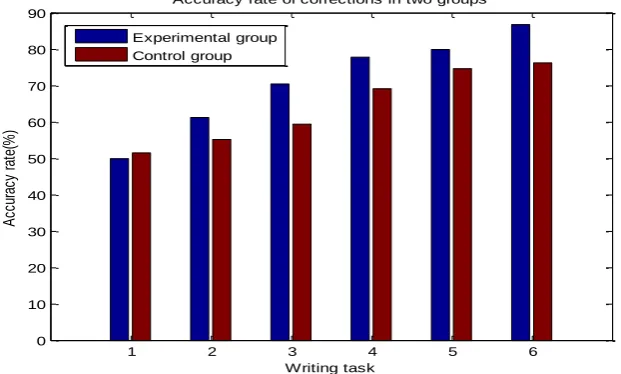
B. The Accuracy Rate of Corrections in Experimental Group and Control Group
1 2 3 4 5 6
0 10 20 30 40 50 60 70 80
Writing task
N
um
be
r o
f e
rro
rs
Comparison between two groups in total number of errors in writing tasks
Experimental group Control group
20 30 40 50 60 70 80 90
A
cc
ur
ac
y
ra
te
(%
)
Accuracy rate of corrections in two groups
corrections according to concordance evidence (Gaskell & Cobb, 2004; Gilmore, 2009). By comparing the online dictionary and corpora, we found that corpora are more useful in assisting learners make more accurate corrections in the long run. At the beginning, the experimental group may not be accustomed to using corpora for error correction and it may be a little hard for them to induce the right language patterns from long lists of corpus examples. While learners in the control group just adopt the traditional way of correcting errors, they needn’t spend long time in analyzing data. Thus the accuracy rate is a little higher in the first article. But with more practice in using corpora, the experimental group gradually become more experienced and skilled. In the following five articles, they have got higher accuracy rate than the control group. The results indicate that corpus examples are generally more useful in helping learners make right corrections.
Another thing that should be noted is that although participants are encouraged to rewrite some unsatisfactory phrases or sentences that are not highlighted by the teacher, no one has done this. What they have done is just correcting the highlighted parts. Some participants demonstrate that it is difficult to improve an unmarked piece, which is consistent with Chambers & O’Sullivan’s (2004) discovery.
C. The Positive Effects of Using Corpora in BFSU CQP Web for Error Correction
TABLE1
POSITIVE SIDES OF USING CORPORA IN BFSUCQPWEB
Category disagree(%) Agree(%) M Std.
Learn the meaning of words 27 73 4.00 1.25
learn the usage of words 7 93 5.13 0.83
Identify linguistic problems in writing autonomously
27 73 4.40 0.99
increase the language awareness 20 80 4.13 0.99
master grammatical knowledge 40 60 3.80 1.21
master usage of phrases 13 87 4.33 0.72
Incidentally learn other new words 20 80 4.40 0.99
Improve the content of writing 67 33 2.80 1.08
Increase confidence in writing 27 73 4.07 1.03
Improve overall writing quality 20 80 4.53 0.92
1. Completely disagree 2. disagree 3. Somewhat disagree 4. Somewhat agree 5. agree 6. Completely agree 1-3:disagree 4-6 agree
All the 15 participants in the experimental group finished the questionnaires. The results of the questionnaires show that a vast majority of learners in experimental group show positive attitudes toward corpora-assisted error correction. About 93% respondents agree that corpus use in writing is helpful to learn the usage of words since the concordance line can show long lists of authentic examples which can help learners discover language patterns better and 87% believe usages of phrases can be also mastered better by being constantly exposed to the expressions. 80% respondents believe that corpus use can increase their linguistic awareness, help them learn other new words incidentally and improve the overall writing quality. But when it comes to learning the meaning of words, only 73% participants agree and 27% think the dictionary may be more useful since learners can obtain the meaning directly without any attempts to guess or induce. As for learning grammar, 40% disagree. For some of them, it may be difficult to work out the grammatical rules from the concordance lines. And sometimes when they want to correct grammatical errors by consulting corpora, they may fail to get what they want. Thus they think it’s not very useful to learn grammar via corpus examples. Finally, only 33% participants find corpora useful in improving the content of the essay. Because we just focus on the lexico-grammatical errors in this study, the content is naturally ignored by learners. While evaluating learners’ error-correction work, we found the corrections about contents are hardly seen. They really learned nothing about how to improve the content by analyzing corpus examples. To change the present situation, the teacher should increase learners’ awareness of improving contents by reading concordance lines and the corpus selected for them should include the relevant genre relevant to the topic of the essay.
D. The Difficulties Learners Encountered in Corpora-assisted Error Correction
TABLE 2
DIFFICULTIES IN CORPORA-ASSISTED ERROR CORRECTION IN WRITING
Category disagree(%) agree(%) M Std.
new words in concordance lines 20 80 4.40 1.18
cut-off sentences 27 73 3.93 1.28
Too many examples in concordance 27 73 3.93 0.88
Limited examples in concordance 33 67 3.73 1.39
Lack of concordance technique 40 60 3.60 1.06
Lack of ability to induce rules 27 73 4.20 1.08
Time-consuming in analysing 13 87 4.73 0.96
Although many participants show positive attitudes toward corpus use, there are still some difficulties which make learners frustrated. About 87% participants report that it’s too time-consuming in analyzing data thus they sometimes draw conclusions just based on several examples, which may result in the wrong induction. New words in concordance lines also pose great difficulties to learners especially those with a small vocabulary. They feel frustrated while encountering frequently appeared unfamiliar words. In addition, 73% participants think it is a problem to have too many examples while 67% claim that too limited examples in concordance line may also make learners confused. Furthermore, cut-off sentences and lack of ability to induce rules are also considered as important factors resulting in learners’ wrong induction and inappropriate self-correction. Finally, there are still 67% respondents considering that a lack of concordance technique also cause trouble to them. A major reason is lack of training and corpus-based activities. Therefore, more training and well-planned concordance exercises should be provided to help them overcome the above difficulties.
E. The Overall Evaluation of Corpora-assisted Writing
TABLE 3
OVERALL EVALUATION OF CORPORA-ASSISTED WRITING
Category disagree(%) agree(%) M Std.
Corpora are better than the online dictionary for error correction in writing.
40 60 3.53 1.46
I will continue using it in future writing. 27 73 4.00 1.20
Overall, it’s useful reference resource for writing 100 0 5.07 0.70
1. Completely disagree 2. disagree 3. Somewhat disagree 4. Somewhat agree 5. agree 6. Completely agree 1-3:disagree 4-6 agree
Almost all respondents show different degree of agreement on that corpus is really useful resource for writing. Just as O’ Sullivan & Chambers (2006) indicate, corpora can be consulted at any stage of the writing process. For instance, it can be used to check whether an element of writing is correct, whether it expresses the desired meaning, and if not, to find alternatives which can precisely fulfil these functions (Aston, 2001; O’Sullivan & Chambers, 2006). Besides it, it’s also helpful in the context of error feedback and self-correction, which has been proved in this study. However, there are still 40% who disagree that corpus is better than the online dictionary since the dictionaries present definitions and even the rules of collocations directly. There are indeed some studies such as Dziemianko (2006) and Chan (2012) claiming that examples in dictionaries can provide information about collocation and colligation, but Frankenberg (2014, p.139) expressed that the best way for language comprehension is “a definition plus examples that specifically contain contextual clues to facilitate understanding rather than examples whose main function is to illustrate collocation and colligation” and the exemplification in dictionaries is not usually repeated, which is not helpful for language production. Thus learners who show negative attitudes to corpus use should be encouraged to develop the habit of using corpora to profit more from this kind of discovery learning since corpus use can also develop learners’ cognitive skills and ability to tackle problems on their own. But just as the students in Yoon & Hirvela (2004)’s say, as reference resources, dictionaries and corpora can sometimes complement each other. They can choose the appropriate type of material according to the given tasks. Finally, 73% respondents agree that they will continue using corpora in future writing because the authentic examples can help them produce more natural and accurate essays. In the meanwhile, the use of corpora can stimulate them to do autonomous learning. As for those who’re reluctant to go on using the corpora, teachers can provide more help for them and make them realize the great potential of corpus use.
V. CONCLUSIONS
enough to identify errors themselves, teachers should provide the necessary guidance to ensure the success of the corpora-assisted learning.
There are still some limitations of the present study. Firstly, it is just a small scale study with only 30 participants taking part in. More learners should be involved in the further study. Secondly, this study just focuses on lexico-grammatical errors in writing. Obviously besides simply checking lexico-grammatical errors in corpora, EFL learners can use corpora for many other learning purposes, but for Chinese lower-level learners of English, this may be the most practical use of corpora for foreign language writing in autonomous learning. However, the further study can try to focus on the content of writing exploring whether corpora can help learners improve their contents.
ACKNOWLEDGMENT
This work was supported by Southwest Petroleum University Science and Technology Foundation (Grant No. 2012XJR013) and Web Culture Project Sponsored by the Humanities and Social Science Research Base of the Sichuan Provincial Education Department. (Grant No. WLWH15-28).
REFERENCES [1] Aston, G. (2001). Learning with corpora. Houston: Athelstan.
[2] Bernardini, S. (2004). Corpora in the classroom: an overview and some reflections on future developments. In J. M. Sinclair (Ed.), How to use corpora in language teaching. Amsterdam, Netherlands: John Benjamins Publishing Company, 15-36. [3] Bloch, J. (2007). Technologies in the second language composition classroom. Ann Arbor, MI: University of Michigan Press. [4] Boulton. A. (2009a). Testing the limits of data-driven learning: language proficiency and training. ReCALL, 21(1), 37-51. [5] Boulton, A. (2009b). Data-driven learning: Reasonable fears and rational reassurance. Indian Journal of Applied Linguistics,
35(1), 81-106.
[6] Chambers, A. and O’Sullivan, Í. (2004). Corpus consultation and advanced learners’ writing skills in French. ReCALL, 16 (1), 158–172.
[7] Chan, A. (2012). Cantonese ESL learners’ use of grammatical information in a monolingual dictionary for determining the correct use of a target word. International Journal of Lexicography, 25(1), 68–94.
[8] Chang, W.L. & Sun, Y.C. (2009). Scaffolding and web concordancers as support for language learning. Computer Assisted Language Learning, 22(4), 283-302.
[9] Chang, J.Y. (2014). The use of general and specialized corpora as reference sources for academic English writing: A case study.
ReCALL, 26 (2), 243-259.
[10] Conrad, S. (2008). Myth 6: corpus-based research is too complicated to be useful for writing teachers. In J. M. Reid (Ed.),
Writing myths: Applying second language research to classroom teaching. Ann Arbor, MI: The University of Michigan Press, 115-139.
[11] Corder P. (1981). Error Analysis and Interlanguage. Oxford: Oxford University Press.
[12] Coxhead, A. and Byrd, P. (2007). Preparing writing teachers to teach the vocabulary and grammar of academic prose. Journal of Second Language Writing, 16, 129-147.
[13] Deng, L.M., Liu, H., Chen, P., Chen, Y., Zhang, Y.W. (2003). The systematic study on process approach and its implications for the teaching reforms of college English writing. Waiyu Jiaoxue [Foreign Language Teaching], 6, 58-62.
[14] Dziemianko, A. (2006). User-friendliness of verb syntax in pedagogical dictionaries of English. Tübingen: Max Niemeyer Verlag.
[15] Flowerdew, L. (2010). Using corpora for writing instruction. In McCarthy, M. and O’Keeffe, A. (eds.), The Routledge handbook of corpus linguistics. London: Routledge, 444-457.
[16] Frankenberg-Garcia, A. (2012). Learners’ use of corpus examples. International Journal of Lexicography, 25(3), 273-296. [17] Frankenberg-Garcia, A. (2014). The use of corpus examples for language comprehension and production. ReCALL, 26,
128-146.
[18] Gaskell, D. and Cobb, T. (2004). Can learners use concordance feedback for writing errors? System, 32 (3), 301-319. [19] Gilmore, A (2009). Using online corpora to develop students’ writing skills. ELT Journal, 63 (4), 363-372.
[20] Granath, S. (2009). Who benefits from learning how to use corpora? In K. Aijmer (Ed.), Corpora and language teaching. Amsterdam. Netherlands: John Benjamins, 47-65.
[21] Hardie, A.(2012). CQP web – Combining power, flexibility and usability in a corpus analysis tool. International Journal of Corpus Linguistics, 17( 3), 380-409.
[22] Huang, Z.P. (2014). The effects of paper-based DDL on the acquisition of lexico-grammatical patterns in L2 writing. ReCALL, 26, 163-183.
[23] Johns, T. (1991). Should you be persuaded: Two examples of data-driven learning. In: Johns, T. and King, P. (eds.), Classroom concordancing. English Language Research Journal, 4, 1-16.
[24] Kosem, I. (2008). User-friendly corpus tools for language teaching and learning. In: Frankenberg-Garcia (ed.), Proceedings of the 8th Teaching and Language Corpora conference. Lisbon: ISLA, 183-192.
[25] O’Sullivan, Í. and Chambers, A. (2006). Learners’ writing skills in French: Corpus consultation and learner evaluation. Journal of Second Language Writing, 15 (1), 49-68.
[26] Pérez-Paredes, P., Sánchez-Tornel, M. and Alcaraz Calero, J. M. (2012). Learners’ search patterns during corpus-based focus-on-form activities. International Journal of Corpus Linguistics, 17(4), 483–516.
[27] Schmidt, R. (2001). Attention. In P. Robinson (Ed.), Cognition and second language instruction. Cambridge: Cambridge University Press, 3-32.
[29] Todd, R. W. (2001). Induction from self-selected concordances and self-correction. System, 29 (1), 91-102.
[30] Tono, Y,Satake, Y & Miura, A. (2014). The effects of using corpora on revision tasks in L2 writing with coded error feedback.
ReCALL, 26 (2), 147-162.
[31] Xu, J.J. & Wu, L.P. (2014). Web-based fourth generation corpus analysis tools and the BFSU CQPweb case, Waiyu Dianhua Jiaoxue [Computer-assisted Foreing Language Education], 5, 10-15.
[32] Yoon, C. (2011) Concordancing in L2 writing class: An overview of research and issues. Journal of English for Academic Purposes, 10, 130-139.
[33] Yoon, H. (2008). More than a linguistic reference: The influence of corpus technology on L2 academic writing. Language Learning & Technology, 12(2), 31-48.
[34] Yoon, H. and Hirvela, A. (2004). ESL student attitudes toward corpus use in L2 writing. Journal of Second Language Writing,
13, (4), 257-283.
Qinqin Luo was born in Hubei, China in 1982. She received her Master degree in foreign language linguistics and applied linguistics from Huazhong University of Science and Technology in 2006. She is currently a lecturer in the School of Foreign Languages, Southwest Petroleum University, Chengdu, China. Her research interests include computer-assisted language teaching.