International Journal of Advances in Management and Economics
Available online at:
www.managementjournal.info
RESEARCH ARTICLE
Research on the Moderating Effect of Emotional Response on
Cultural Conflict from the Perspective of Cross-cultural
Differences
Ren Yuhuan*, Liu Yingxia
International Business School, Jinan University, China.
*Correspondent Author Email: [email protected]
Abstract: Based on the theory of social identity and cross-cultural conflict, this paper examines the influence mechanism of the cultural differences perceived by employees of multinational corporations on cultural conflicts. By gathering 322 surveys of employees of multinational companies in China, it is found that (1) Cross-cultural differences perceived by multinational enterprises’ employees have a positive influence on the occurrence of cultural conflicts within the company; (2) The employees' cultural identity to the organization mediates employees' perceived cross-cultural differences and cultural conflicts; (3) The moderating influence of employees’ emotional response on the mediation effect of employees' cultural identity is confirmed, ie. the emotional response of employees weakens the negative relationship between cross-cultural differences and cultural identity. This further enhances the positive role of cultural identity to mitigate cultural conflicts. This research expands the research perspective of cross-cultural conflicts and provides a new theoretical framework for cross-cultural conflict management. It provides new reflections on the cultural conflicts in multinational corporations from the perspective of management culture differences between home and host countries.
Keywords: Cross-cultural differences, Cultural identity, Cultural conflict, Emotional response.
Article Received: 10 Nov. 2018 Revised: 25 Nov. 2018 Accepted: 10 Dec. 2018
Introduction
In order to improve the success rate of transnational investment, transnational enterprises often attach great importance to the preliminary investigation and research in the process of transnational investment and make detailed and thorough planning, but fail to make a better investigation and planning of the cultural management in daily operation after investment, resulting in very prominent cultural conflicts.
In serious cases, the parent company transplants a good culture system to its subsidiaries, but it is misinterpreted by employees. For example, a Western European company once transferred its parent company's management system to a Chinese subsidiary; one of them was that if local employees believe that they are being treated unfairly by the management of the subsidiary company, they can secretly give
feedback to the parent company through special channels.
This practice, which was originally considered to be good to ensure that employees are treated fairly, has been used by local employees as a means of retaliation. In fact, more than 70% of complaints from subsidiaries was then proved to be fabricated or embarrassing.
this may undermine the efficiency and performance of the entire organization.
The problems caused by these cultural conflicts plague multinational corporations. Relevant statistics show that only about 30% of the failures of multinational enterprises are caused by policies, capital and technology, and the remaining 70% are caused by cultural differences [1]. Therefore, it is urgent that multinational corporations should pay more attention to the management of cultural conflicts caused by cross-cultural differences to help them win successful operations.
Many researchers and practitioners attribute the conflicts of foreign affiliates to cultural differences [2, 4] and begin to recognize the consistency between conflict management and contingency management. The effective utility of conflict can be exerted through effective conflict management [5].
In addition, more and more scholars found that emotional factors have become a very important consideration in enterprise management. However, in the past, most researchers focused on the impact of individual emotions on individual behaviors, but failed to delve into the interpersonal influences of emotions within organizations. Especially the positive impact of employees’ emotional interaction factors on mitigating cultural conflicts in conflict management.
This paper intends to carry out research on this deficiency, trying to explore the positive effects of emotional response on cultural conflicts caused by cultural differences, so as to better extend the conflict management theory.
Literature Review
When different cultures are integrated, there will exist relationship friction between employees due to their different cultural backgrounds. In addition, different cultural backgrounds also cause differences in employees' psychology and behavior, which further leads to cross-cultural conflicts. Domestic scholars believe that the enterprise cultural differences will lead to cultural cognitive conflicts. [6].
And some scholars have studied the relationship between dual cultural differences and corporate performance at the
national and organizational levels [7]. studied the influence of cultural differences on the knowledge transfer effect of multinational corporations from the perspective of power distance and uncertainty avoidance [8].
Due to the huge differences between Chinese and western cultures, the internal differences at the management level and the resulting inevitable cultural conflicts have brought great challenges to cross-border mergers and acquisitions and even affected the success or failure of their transnational operations.
Therefore, how to achieve cultural integration successfully has become a hot topic of scholars’ research. Previous studies have shown that differences in values, leadership styles and institutional environment are important factors influencing the success or failure of integration [9]. Recently, the research on cross-cultural integration mode has gradually increased. Conducted a dynamic study of the integration model, emphasizing the dynamic evolution path of learning-integration-innovation based on two companies’ mutual understanding and respecting of cultural differences [10].
Used models to study how culture affects peoples’ emotional intelligence in conflicts [11]. Foreign scholars [8, 12] studied the mediating role of emotional factors in the relationship of cultural values and personal conflict preferences.
Theoretical Hypothesis
Cultural Differences and Cultural Conflicts
Defines conflict as competition of groups or individuals in incompatible goals, scarce resources or access to the sources of power they need. In the workplace, this kind of competition is inevitable. Different employees may interfere with each other's work for the sake of promotion or in order to pursue different goals [13].
disagreements about the management styles and solutions to handle daily affairs between different parties.
All the irreconcilable beliefs, norms and practices within the organization can lead to the more complex management of multinational companies than domestic companies. Cultural differences between the home and host countries of transnational corporations complicate their internal interactions, thereby increasing the likelihood of conflicts among transnational corporations [2].
According to the social classification theory, it is less likely that team members with similar individual characteristics will have sharp conflict within the enterprise. On the contrary, for interdependent stakeholders, the higher the level of their heterogeneity (the question of what to do, who to do and how to do it), the more difficult it is to reach a consensus agreement [14.]
In the process of localization in the host country, the multinational subsidiaries have both infiltrated and differentiated design in the top management system compared with the parent company. As the transfer of technology and management become more and more frequent, more communication exchanging barriers between the parent and subsidiary companies have appeared. In addition, differences in perceptions, goals, and information between expatriate staff and local staff, foreign manager and local employees, local managers and the local workforce, as well as subsidiary management and headquarter management, competition and contradictions increased among members of the company.
These contradictions and barriers eventually led to conflicts between employees [15]. Clarke and Lipp believe that cross-cultural conflicts caused by cultural differences pose a relatively serious threat to the successful operation of enterprises. Therefore, the following assumptions are made
Hypothesis 1
The greater the cultural differences between the home country and the investment country of a multinational company, the greater the possibility of cultural conflicts
will happen within the enterprise operated in host country.
Cultural Differences and Cultural Identity
Cultural difference, that is, the relativity of culture, cultural group determines that culture is only applicable to a certain range. Due to differences in history, natural conditions, economic level, and social system, a rich cultural category has been formed [16]. Under different cultural environments, people's communication methods, thinking patterns, and values are all very different. As a common cultural phenomenon in culturology, cultural identity refers to the recognition and acceptance of different cultures in communication.
The premise of cultural identity is based on cognition, understanding and trust. Although previous studies have shown that cultural differences will bring opportunities and advantages in management and improve management of operation through cultural complementarity, the conflicts and collisions, relationship tensions and decision-making dilemmas caused by cultural differences have become more and more common.
Especially when there is a huge culture difference between the home country and the host country, cultural collisions and conflicts are most likely to occur. From the perspective of Hofstede's cultural value dimension, Western countries such as Europe and the United States advocate individualism, emphasizing individual freedom and personal Achievement, focusing on effective humanistic incentives in enterprises, while China is a typical country that advocates collectivism.
country through vertical information exchange with their superiors, leading to communication difficulties [17]. People in the culture of high uncertainty avoidance believe that the new management system and organization culture are risky, so they are not identified with the new organizational culture due to their subjective perception, resulting in different degrees of cognitive and emotional conflicts [8,18].
The enterprises in the Asian countries where the home country is located in Japan and South Korea have similar cultural origins to China since ancient times. Therefore, the cross-cultural differences are relatively small, which is conducive to overcoming the cognitive difficulties caused by cultural differences[ [19]. Therefore, the greater the cultural span of the multinationals’ home and host country, the higher the local employees’ inconsistency evaluation on the culture will be after the integration.
Thus, resulting in their low recognition of the integrated corporate culture. We examine the influence of cultural differences from five dimensions according to the five dimensions of Hofstede's cultural dimension theory, namely individualism and collectivism, power distance, uncertainty avoidance, masculinity versus femininity, and long-term orientation and short-term orientation. Cultural identity is divided into perceptual identity and behavioral identity. Therefore, the following assumptions are made.
Hypothesis
The greater the cultural difference between the home country and the investment country of a multinational, the lower the cultural recognition of the local employees to the parent company.
Cultural Identity and Cultural Conflict According to Tajfel's theory of social identity, members' perceived membership will have different influences on their attitudes or behaviors. This theory holds that the members’ identity in the group and group’s type are all important considerations when the members of the organization are in the process of self-defining. Members tend to acquire a positive sense of social identity when they belong to a group, while this sense of identity depends largely on the
relationship between the group and their own economic or emotional interests.
When members have a high sense of community social identity, they can feel the concern and support of the organization and make more rewards. When members have a low social identity to the group, they may choose to leave the organization and lead to organization’s internal conflicts. In addition, according to the theory of Western interpersonal conflict management, the higher the organizational identity of employees, the more harmonious the interpersonal relationship, the better it is to improve organizational cohesion and to form a coordinated and cooperative conflict management style, and avoid destructive interpersonal conflicts [20,21].
The cultural identity of employees is closely related to the identity of the organization. Ravasi and Schultz pointed out that organizational culture is default and self-issued behavior based on the common practices, which can be obtained through external comparison and conscious self-reflection. This process is just the process of organizational identity. In other words, organizational identity is often accompanied by cultural identity. The theory of social identity believes that cultural identity is entirely caused by ethnic identity. Taife and Turner believe that most people need a solid group identification to maintain their sense of well-being [22].
When employees have high ethnic identity for their organization, they will have good cultural identity. Employees show cultural identity by good management and self-lead during the working time, which can effectively reduce the cognitive and relationship conflicts, definitely weaken cooperation barriers among group members and significantly promote the mitigation and coordinated development of interpersonal tensions [23, 24]. If the employee's cultural identity with the organization is low, it indicates that the employee's recognition and satisfaction with the organization is reduced, which is likely to cause conflicts [25].
ethnic culture, thus they obtain a positive and optimistic self-concept. But with the penetration and integration of foreign cultures, employees may have some negative self-concepts due to the break of the balance of the original sense of belonging, leading to conflicts in values and behavioral norms [26]. Based on the theoretical arguments, we posit:
Hypothesis
The higher the cultural identities of local employees have to the multinational, the less likely the culture or management conflict within subsidiary company will happen. Cultural identity plays a mediating role in the cultural differences and cultural conflicts between the parent company and their subsidiaries in the host country.
The Moderating Effect of Emotional Response on the Mediating Effect of Cultural Identity
Affect is employees’ emotional response toward the integration process of multinational’s management system and cultural values. It can influence individual’s beliefs and attitudes [27], resulting in their consistency or inconsistency cognitive response. This study defines the emotional response as the members of the organization actively learn and adapt to the management system and cultural values and then generate emotional attachment to the organization. The emotional response in this paper refers to the positive emotional response of employees.
In the process of communicating with others, individuals often make emotional act first, others respond to the received behaviors of the former, so the former adjusts the emotional expression of themselves according to the reaction of others, thus forming Double Affective Interact between employees [28].
Although there exist huge cultural differences in multinational companies, which lead to a lower overall cultural identity of employees, more and more studies have found that emotion plays an increasingly important role at the employee or organizational level. In the long run, employees can better integrate into the organization through constant contact and understanding of corporate culture and institutional environment to alleviate
inadaptability, eliminating mutual misunderstandings by communication [29].
As organizational change progresses, change recipients’ effective emotional and behavioral responses to events will have a central role in it [30]. In organizational life, employees can have different perception and evaluation of enterprise’s decision-making behaviors according to their organization's identity positioning, thus forming an emotional attachment to organizational activities [31].
When a company makes structural adjustments and institutional changes, those employees who can quickly identify the difference of the new culture and the parent culture and actively coordinate the conflict between the two can better accept the new corporate culture. It means that these employees have strong cultural adaptability and emotional attachment to their company.
Therefore, when employees make positive and optimistic emotional responses (ie. high emotional response) to their company’s change, such as learning and comprehending new institutional design or business philosophy, it will help promote efficient communication between the upper and lower levels of the enterprise, reducing the low learning efficiency and interaction efficiency caused by cultural differences. The initiative integration and communication between peers can also break the original cognitive model, promote the formation of horizontal communication mode, avoid the inconsistency conflict between organizational communication and learning, and thus enhance the cultural identity of employees.
In addition, the positive emotional response of employees is consistent with previous research on emotional commitments. Emotional commitment is defined as the employee's emotional attachment to the organization, value and target identity, and the degree of commitment to the work. Employees who respond positively and emotionally will demonstrate loyalty to the company and are willing to accept cultural environment changes of the company [32, 33].
helpful to improve the identity of enterprise’s culture. On the contrary, when employees are passive or indifferent, they lack motivation to integrate into the new cultural environment and be resistant to the differences, even refusing to interact or communicate with peers or subordinates, but tend to maintain the status quo and ignore the existence of corporate culture differences. These practices will intensify internal contradictions and finally generate cultural cognition conflicts. Based on the theoretical arguments, we posit:
Hypothesis
Emotional response plays a moderating role in the mediating effect of cultural identity, that is, the positive emotional response of employees will weaken the negative correlation between cultural differences and cultural identity, thereby reducing the negative relationship between cultural identity and cultural conflict. The conceptual model of this paper is obtained, as shown in Fig.1.
Figure 1: Conceptual model
Research Design
Samples and Data Collection
This study conducted a questionnaire survey on employees of branches of multinational companies in China. The questionnaire contained basic demographic information. Before conducting this survey,preliminary examination was conducted by people from 20 categories of different social occupation to estimate the time required to complete the questionnaire and identify possible problems.
Exploratory factor analysis and reliability test were performed on the samples of the pre-test questionnaire. The test result shows that Cronbach's α of each conceptual scale is above 0.7, and the factor structure is also
ideal. All scales are designed in a seven-point Likert scale. The formal survey used both paper and electronic questionnaires, and 350 questionnaires were eventually collected. The invalid answer sheets are automatically filtered out by setting various screening rules, trap questions, etc. We manually excluded the questionnaires that had almost the same score for each item. Finally, we get 322 useful questionnaires.
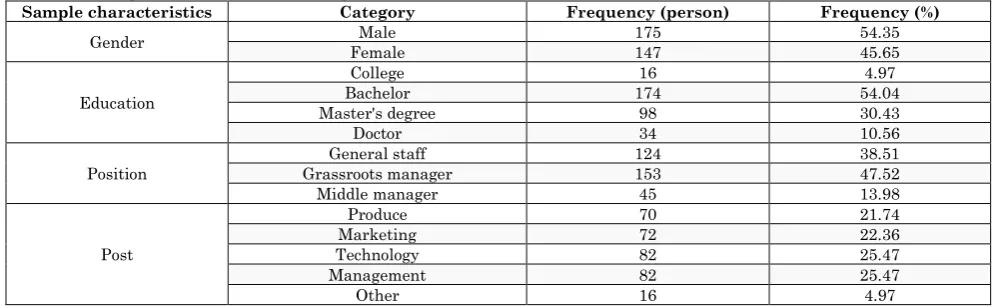
Table 1 summarizes the demographic data of the respondents. Most of the respondents have the bachelor degree or above it, they are mostly in management and technical positions, 47.52% of them are grassroots managers, and most employees have worked in the current unit for 4-5 years.
Table 1: Descriptive statistics of the sample structure
Sample characteristics Category Frequency (person) Frequency (%)
Gender Male 175 54.35
Female 147 45.65
Education
College 16 4.97
Bachelor 174 54.04
Master's degree 98 30.43
Doctor 34 10.56
Position
General staff 124 38.51
Grassroots manager 153 47.52
Middle manager 45 13.98
Post
Produce 70 21.74
Marketing 72 22.36
Technology 82 25.47
Management 82 25.47
Working years
0-1 years 17 5.28
2-3 years 76 23.6
4-5 years 113 35.09
6-10 years 96 29.81
11 years or more 20 6.21
Enterprise size
Less than 100 people 16 4.97
100-500 people 191 59.32
500-1000 people 94 29.19
More than 1000 people 21 6.52
Entry mode
Joint venture 109 33.85
Merger 136 42.24
Greenfield 77 23.91
Home country
Europe and America 65 20.19
Southeast Asia 41 12.73
Japan 51 15.84
Korea 94 29.19
Hong Kong, Macao and Taiwan
regions 71 22.05
Measurement of Variables
Cultural Differences Perceived by Employees
In transnational organizations, cultural differences manifest as differences in national culture and organizational culture. To facilitate research, we use cultural distances to replace the extent of cultural differences between organizations, including national cultural distances and organizational cultural distances. We refer to Robertson's [34] items of differences in individualism and collectivism, differences in power distance, uncertainty avoidance differences, male and feminist differences, and Wang’s [35] measurement scales of cultural differences, and some items are removed after factor loading analysis.
We finally got a total of 11 measurement items, such as comparison of collective
interests and personal interests, total
perception of cultural differences, etc. We adopted the 7-point Likert scale. The response scales ranged from 1, ‘‘strongly disagree,’’ to 7, ‘‘strongly agree’’ for all items that measured these five cultural dimensions. And the higher the score, the greater the cultural difference is.
Cultural Identity
According to the research of Hu [36], the definition of organizational culture identity includes three factors, organizational culture emotion, organizational culture cognition and organizational culture behavior. Combined with the research of Wang [37] and Hu [36], our items include You have a good understanding of the company's rules and regulations and are willing to implement; You like the company's brand identity and are willing to use the item with the logo.
Organizational Cultural Conflicts
The measurement items of Habib and Ghazi were adopted, and the items that were not suitable for our study were excluded [38] . Most researchers’ item scale measured from four levels: material culture, behavioral culture, institutional culture and spiritual culture. We measured from four levels to form a seven-item scale that fits our study. The specific items include there are differences between the Chinese and foreign leaders' behaviors; there are differences in the entrepreneurs between Chinese and their home country.
Emotional Response
The scale for measuring emotional response refers to. Meyer, developed measurement scales from three dimensions [39]. The scale of organizational commitment is often used to study employee attitudes toward the organization () and affective commitment to work (. This paper refers to the scale of emotional commitment developed by and adapts it to obtain our emotional response scale. Our scale includes three items, such as My Company gives me a strong sense of belonging.
Results
Reliability, Validity and Correlation Analysis
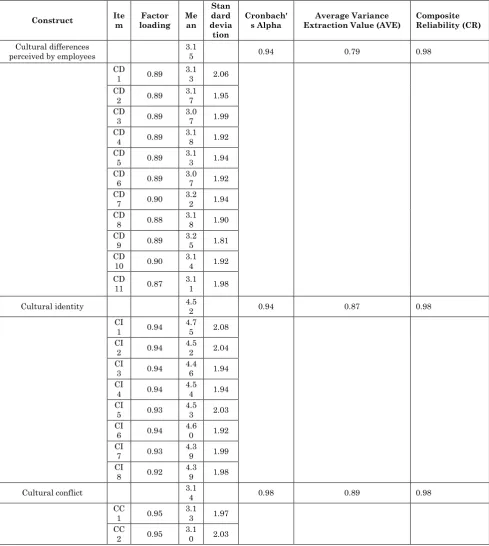
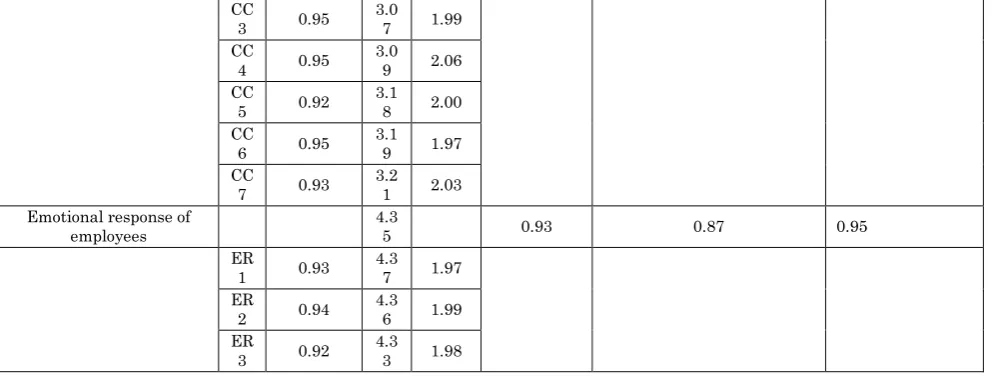
over 50%, and all values of CR exceed 0.7. Therefore, these results are consistent with the threshold suggested by Hair (2010) et al.
The reliability and validity of the study are acceptable. According to Table 3, the correlation analysis is carried out to make a preliminary estimation of the relationship between the variables. All the correlation coefficients in the model structure are significant, and the square-root of the construct’s AVE exceeds its correlations with other constructs in the model. The correlation coefficient ensures the necessity of the latent variable’s discriminant validity.
It can be seen from Table 3 that the cultural differences perceived by employees are negatively correlated with the cultural identity of the organization (r= −0.79, p < 0.01), and the employee's cultural identity to the organization is negatively correlated with cultural conflicts in the organization (r = 0.89, p <0.01), the employee's emotional response was positively correlated with their culture identity to organization (r = 0.87, p < 0.01), and was negatively correlated with organizational culture conflicts. These test results provide initial support for the relevant assumptions in this paper.
Table 2 Reliability and validity analysis Construct Ite
m
Factor loading
Me an
Stan dard devia tion
Cronbach' s Alpha
Average Variance Extraction Value (AVE)
Composite Reliability (CR) Cultural differences
perceived by employees 3.15 0.94 0.79 0.98
CD
1 0.89 3.13 2.06
CD
2 0.89
3.1
7 1.95 CD
3 0.89
3.0
7 1.99 CD
4 0.89
3.1
8 1.92 CD
5 0.89 3.13 1.94
CD
6 0.89 3.07 1.92
CD
7 0.90 3.22 1.94
CD
8 0.88 3.18 1.90
CD
9 0.89 3.25 1.81
CD
10 0.90
3.1
4 1.92 CD
11 0.87 3.11 1.98
Cultural identity 4.52 0.94 0.87 0.98
CI
1 0.94
4.7
5 2.08 CI
2 0.94
4.5
2 2.04 CI
3 0.94
4.4
6 1.94 CI
4 0.94
4.5
4 1.94 CI
5 0.93 4.53 2.03
CI
6 0.94
4.6
0 1.92 CI
7 0.93 4.39 1.99
CI
8 0.92 4.39 1.98
Cultural conflict 3.14 0.98 0.89 0.98
CC
1 0.95 3.13 1.97
CC
CC
3 0.95 3.07 1.99
CC
4 0.95 3.09 2.06
CC
5 0.92 3.18 2.00
CC
6 0.95
3.1
9 1.97 CC
7 0.93
3.2
1 2.03 Emotional response of
employees
4.3
5 0.93 0.87 0.95
ER
1 0.93
4.3
7 1.97 ER
2 0.94 4.36 1.99
ER
3 0.92
4.3
3 1.98
Analysis of Mediating Effects
We use the Smart PLS 3.0 software to conduct our partial least squares analysis because PLS analysis is more suitable to show moderation effect and can maximize the variance of the dependent variable interpreted by the independent variable instead of the empirical covariance matrix [40] .
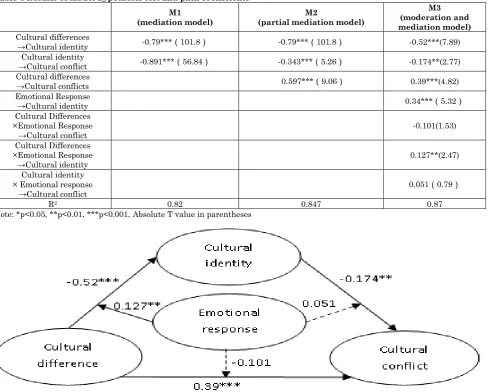
In addition, PLS method has loose requirements on the number of survey samples and residual distribution, which is very suitable for the construction and measurement of new theories. We further used PLS for bootstrap analysis by setting the number of samples to 2000, then the significance of the path coefficient is obtained [41], and we can judge whether the mediation effect is significant. Table 4 shows the path coefficients and hypothesis test results of three different research models. M1 is the median model. Cultural differences
Significantly affect cultural identity (β= -0.79, p < 0.001), and cultural identity significantly influence cultural conflicts (β= -0.891, p < 0.001), M2 is a partial mediation model, and the results show that cultural differences have a significant negative impact on cultural identity (β = -0.79, p < 0.001), hypothesis 1 and hypothesis 2 are supported. Secondly, the cultural differences perceived by employees in multinational corporations have a direct effect on cultural conflicts within the organization (β = 0.597, p < 0.001).
The results show that cultural identity has a significant and positive impact on the cultural conflict (β = -0.343, p < 0.001). As the results of M2 indicate that the direct effect of cultural differences on cultural conflicts in the organization is still significant, we conclude that cultural identity plays a partial mediating role in the model, so hypothesis 3 is supported.
Table 3 Latent variable correlations
Square-root of AVE Emotional Response Cultural Difference Cultural Identity
Cultural Conflict 0.94 (0.88) 0.81 (0.89)
Emotional Response 0.93 (0.89) 0.87
Cultural Difference 0.89 (0.79)
Cultural Identity 0.93
Note: Brackets represent negative numbers
Analysis of Moderating Effects
In view of the mediating effect of cultural identity between employee perceived cultural difference and cultural conflict, we will further examine whether the mediating effect of cultural identity is moderated by employees' emotional responses. Before testing moderated mediating effect, the first condition that must be met is that the total
effect of the mediation is supported, and the interaction of the moderator and the independent variable does not influence the dependent variable [42].
variables (β= -0.101, p>0.05).
The effect of emotional response on cultural identity was significantly positive (β= 0.34, p<0.001); the path coefficient of cultural difference × emotional response → cultural
identity was significant and positive,
indicating that the employee's emotional response has significantly moderate the negative influence of cultural differences on cultural identity.
While the path coefficient of cultural identity × emotional response→ cultural conflict is positive but not significant, indicating that emotional response does not have significant moderating effect on the relationship of cultural identity and cultural conflict. Since emotional response significantly moderate the negative relationship of cultural differences and cultural identity, we can conclude that the mediating effect of cultural identity is moderated by the employee's emotional response, thus hypothesis 4 is supported.
In order to further refine the moderating
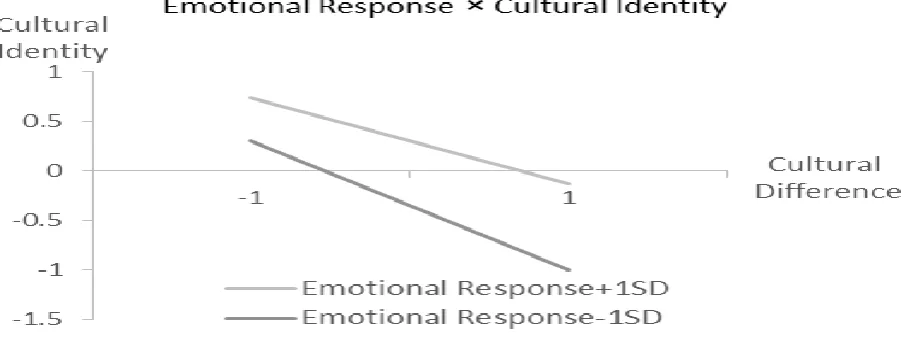
effect of emotional response on the mediating effect of cultural identity, we draw a picture to describe the different influence of emotional response at different level. We set the mean value as the benchmark and draw a line that is one standard deviation above the mean and another is one standard deviation below the mean value respectively, as is shown in Fig. 3.
It can be found that the higher the emotional response of local employees, the weaker the negative relationship between perceived cultural differences and cultural identity, and the less negative influence of cultural identity on cultural conflict will be. This means that emotional response weakens the negative impact of employee’s perceived cultural differences on their organizational cultural identity. In the case of high emotional response, cultural identity has in turn reduced cultural conflicts caused by cultural differences. Finally, a moderated mediation model is obtained, see Fig. 2.
Table 4 Results of model hypothesis test and path coefficients M1
(mediation model) (partial mediation model) M2
M3 (moderation and mediation model) Cultural differences
→Cultural identity -0.79***(101.8) -0.79***(101.8) -0.52***(7.89)
Cultural identity
→Cultural conflict -0.891***(56.84) -0.343***(5.26) -0.174**(2.77)
Cultural differences
→Cultural conflicts 0.597***(9.06) 0.39***(4.82)
Emotional Response
→Cultural identity 0.34***(5.32)
Cultural Differences ×Emotional Response
→Cultural conflict
-0.101(1.53)
Cultural Differences ×Emotional Response
→Cultural identity
0.127**(2.47)
Cultural identity × Emotional response
→Cultural conflict 0.051(0.79)
R2 0.82 0.847 0.87
Figure 2: Partial mediation and moderation model
Figure 1: The moderating effect of emotional response on cultural identity
Discussion and Conclusion
This article studies the multinational companies operating in China, and conducts surveys on their employees. We initially explore why cross-cultural conflicts exist at the branches of multinationals in the host country, such as employees’ misinterpretation and disagreement on management systems. And we find that cultural differences perceived by employees play an important role in this phenomenon. We use smart PLS 3.0 to build a structural equation model to examine the theoretical model.
A theoretical model is constructed to explain the influence mechanism of how local employees' perception of multinationals’ cultural differences between the home and host country and their cultural identity cause daily cultural conflicts, and the moderating effect of employees' emotional responses to this mechanism. The following conclusions are drawn. First, the cultural differences perceived by employees measured at different dimensions have a significant positive impact on multinationals’ cross-cultural conflicts. The differences on the management systems and cultural cognition are mainly caused by
The differences of employees’ cognition in collectivist and individualism, the power distance, the uncertainty avoidance, masculinity versus femininity, and the long-term orientation and short-long-term orientation. Second, local employees of transnational corporations who are influenced by the degree of their perceived cultural difference will change their cultural identity to the organization.
The greater the perceived cultural difference between the home country and the host country, the lower the employees’ cultural identity to the company, thus the internal cultural conflict of transnational corporations is followed.
Therefore, cultural identity plays a mediating role between cultural difference and cultural conflict. Third, employees’ positive emotional response to the organization can alleviate this conflict mechanism. Employees’ low cultural identity caused by cultural differences can be reduced if employees communicate more with other members of the organization when they have emotional attachment to the organization, which will be benefit to enhance their identity to the organization's target and Value orientation.
In turn, employees will show more loyalty to the company and are willing to adapt to the different cultural environment of the enterprise, thereby the organization’s interpersonal or management conflicts shall be reduced. From the above conclusions, the following inspiration can be drawn. Local employees' perception of the multinationals’ cultural differences between the home and host country lead to the daily cross-cultural conflicts of multinational corporations, but where there is conflict, there is integration.
is suggested to be established.
Therefore, for the managers of multinational corporations, the main challenge in the future will be how to coordinate and manage the personal emotions and rationality of the employees and set up the effective communication and knowledge exchange channels between the superiors and the subordinates, so as to provide more outstanding international services and create higher economic performance.
It is of first priority for managers to guide employees to adjust their emotions and improve employees' satisfaction with organizational atmosphere to improve management of interpersonal relationships and reduce the daily cultural conflicts. Employees with high emotional interaction and response to the organization culture should be given more care.
Mobilizing the enthusiasm of employees and playing their role in good knowledge exchange and institutional response can resolve interpersonal tensions and conquer conflict management headaches brought
about by cross-cultural differences. Future Research Directions
The research design and survey sample selection for this study still have room for further improvement. First, the emotional response of employees to the organization is constantly changing. This study adopts static methods for data collection and can only reflect the psychological state of employees at a certain point or a certain period, so it cannot reflect the dynamic process of employees' changing emotional response to the organization.
Second, the relationship between employees and their leaders will also have an important impact on cross-cultural conflicts. Future research can design cross-layer analysis models to better expand the conflict management theory. Researchers can take a longitudinal research method and conduct repeated and multiple measurements on variables to better observe the causal relationship between variables and their trends in the future.
References
1. Zheng Houjian (2015) Facing Cultural Differences and Developing Cultural Identity-Cultural Thinking in Global Management of Multinational Corporations[J].Journal of Hunan Business College, 1:45-49.
2. Ayoko OB, Hartel CEJ, Cullan VJ (2002) Resolving the puzzle of productive and destructive conflict in culturally heterogeneous workgroups: A communication accommodation theory approach [J]. International journal of conflict management, 13(2):165-195.
3. S Chevrier (2003) Cross-cultural management in multinational project groups, Journal of World Business, 38:141-149.
4. Vaara E, Tienari J, Santti R (2003) The International Match: Metaphors as Vehicles of Social Identity-Building in Cross-Border Mergers [J]. Human Relations, 56(4):419-451.
5. Chen Xiaohong, Zhao Ke (2010) an Empirical Study on the Relationship between Team Conflict, Conflict Management and Performance [J]. Nankai Management Review, 13(5): 31-35.
6. Rao Lihong, Wu Tingting (2016) Research on the Relationship between Cognitive Conflict, Emotional Conflict and Cultural Integration Effect after Transnational Mergers and Acquisitions [J]. Statistics and Decision, 5:186-188.
7. Li Zijie, Zhang Xuefeng (2010) National Cultural Differences, Organizational Culture Differences and Enterprise Performance-An Empirical Study Based on Sino-foreign Joint Ventures[J]. Finance and trade economy,9 :93-98.
8. Xu Xiaojun(2010) Research on the Influence of Cultural Differences on Knowledge Transfer of American-owned Multinational Corporation Headquarters[J]. Research Management, 31(4): 49-58.
9. Waldman DA, Javidan M (2009) Alternative forms of charismatic leadership in the integration of mergers and acquisitions [J]. Leadership Quarterly, 20(2):0-142.
Integration [J]. Comparative Management, 01.
11.Gunkel M, Schlaegel C, Taras V (2016) Cultural values, emotional intelligence, and conflict handling styles: A global study [J]. Journal of World Business, 51(4): S1090951616300074.
12.Mulki JP, Jaramillo F, Goad EA et al (2015) Regulation of emotions, interpersonal conflict, and job performance for salespeople [J]. Journal of Business Research, 68(3): 623-630.
13.Avruch K (2002) Cross-Cultural Conflict [J]. Lancet, 278 (719): 303.
14.Liu Wei, Zhang Xiangqian (2016) Analysis and Prospect of Team Conflict Theory [J]. Soft Science, 30(4): 80-84.
15.Pudelko M, Tenzer H (2011) Conflict in foreign subsidiaries of Japanese and western multinational corporations: The impact of cultural distance and differences in home-host country combinations [J]. Festschrift Für Betriebswirtschaft, 81(3):49-71.
16.Song Jing (2007) Cultural Differences and Cultural Management of Multinational Enterprises [D]. Hefei University of Technology.
17.Triandis HC (2000) Culture and Conflict [J]. International Journal of Psychology, 35(2):145-152.
18.Chen Wei, Yang Bai-Zhen, Jing Run-Tian et al (2010) Research on the Relationship between Parental Leadership, Conflict and Executive Strategy Decision-making Effect[J]. Nankai Management Review, 13(5): 4-11.
19.Pan Hua (2016) Research on Cross-Cultural Management Conflicts and Countermeasures of Sino-Korea Joint Ventures [J]. Shanghai Management Science, 38(2):1-6.
20.Blake RR, Mouton JS (1964) The Managerial Grid [M].Houston, T.X. Gulf. 21.Liu Yumei, Wei Xuhua, Chen Xiaohong
(2011) Research on the Relationship between Emotional Intelligence, Conflict Management and Perceptual Cohesion [J]. Research Management, 32(2): 88-96. 22.Taife H, Turner JC The social identity of
inter-group behavior. In S. Worchel & W. Austin, Psychology of Inter-group Relation, 7-24. Chicago: Nelson Hall.
23.Amason, Allen C (1996) Distinguishing the Effects of Functional and Dysfunctional Conflict on Strategic Decision Making: Resolving a Paradox for Top Management Teams [J]. Academy of Management Journal, 39:123-148.
24.Liu Wei, Zhang Xiangqian (2016) Analysis and Prospect of Team Conflict Theory [J]. Soft Science, 30(4): 80-84.
25.Wall VD, Nolan LL (1986) Perceptions of inequity, satisfaction, and conflict in task-oriented groups. [J]. Human Relations, 39(11): 1033-1051.
26.Chen Zhizhong, Zhang De (2011) Literature Review and Model Construction of Organizational Cultural Identity [J]. Modern Management Science, 3:3-5.
27.Chen Wei, Li Wenli, Ke Yulong (2016) Research on the Continuous Use of Social Media: Using Emotional Response as an Intermediary [J]. Management Review, 28(9):61-71.
28.Pan Xiaoyun (2011) Research on the Influence of Team Conflict on Team Members' Emotion-A Review of Foreign Theories and Empirical Research in China [J].Henan Social Sciences,19(1):131-135. 29.Li Zijie (2010) National Cultural
Differences, Organizational Cultural Differences and Enterprise Performance-An Empirical Study Based on Sino-foreign Joint Ventures[J].Finance and Trade Economics, 9:93-98.
30.Vuori T, Shaul Oreg, Jacob Goldenberg (2016) Resistance to Innovation: Its Sources and Manifestations [J]. Administrative Science Quarterly, 61(3). 31.Fryzel Barbara, Seppala Nina (2016) the
effect of CSR evaluations on affective attachment to CSR in different identity orientation firms [J]. Business Ethics: A European Review, 25(3):310-326.
32.Kou Meiling (2012) Research on the relationship between career management, emotional commitment and organizational citizenship behavior of local enterprises [D]. Shandong University.
34.Robertson Christopher J (2000) the Global Dispersion of Chinese Values: A Three-Country Study of Confucian Dynamism [J]. Management International Review, 3(40): 253-268.
35.Wang Yuanyuan (2008) Research on the Influence of Ethnic Cultural Differences in the International Transfer of Knowledge within Multinational Corporations [D]. Fudan University.
36.Hu Yan (2010) Research on the Relationship between Job Satisfaction and Turnover Intention in Organizational Culture Identity[D].Southwest University. 37.Wang Yanbin (2007) Exploring the method
of reducing subjective bias in social psychology, a measurement idea and scale design of organizational identity and its results [J]. Society, 6:189-210.
38.Habib G (1987) Measure of Manifest Conflict in International Joint Ventures [J]. Academy Of Management Journal, 30(4): 808-816.
39.Meyer JP, Allen NJ, Smith CA (1993) Commitment to organizations and occupations: Extension and test of a three-Component conceptualization [J]. Journal of Applied Psychology, 78: 538-551.
40.Lee H, Choi SY, Kang YS (2009) Formation of e-satisfaction and repurchase intention: moderating roles of computer self-efficacy and computer anxiety [J]. Expert Syst. Appl, 36 (4):7848-7859.
41.Hair Jr, JF Sarstedt M, Ringle CM, Mena JA (2012) an assessment of the use of partial least squares structural equation modeling in marketing research. J. Acad. Mark. Sci, 40 (3):414-433.