214 Address for correspondence
Dr. Rabia Mukhtar, Senior Registrar Dermatology Department, Unit 1 Jinnah Hospital, Lahore
Email: [email protected]
Original Article
Clinical spectrum of pediatric dermatoses at a
tertiary care unit
Introduction
Skin diseases are a major health problem in the pediatric age group and are associated with significant morbidity.1 They are common all
over the world as the skin of children is more prone to develop diseases.2 Skin diseases
constitute 30% of all outpatient visits to a pediatrician and 30% of all visits to a dermatologist involve children.1
There is variation in the pattern and presentation of dermatoses, with eczemas being the most common skin disorder in developed countries and infections and infestations in the developing countries.3
The evaluation for skin disorders is an important component of primary health care practice.4 Skin
is often a window to underlying systemic diseases and marker of hereditary syndromes.5
Childhood age may be a marker for environmental risks.6 We can judge status of
health, hygiene and personal cleanliness of people in society by seeing the prevalence of certain diseases in children of the community.7
Skin diseases in children are prevalent in rural areas as compared to urban areas due to poor socioeconomic status, overcrowding, poor personal hygiene, lack of general awareness, education, sanitation and specialized health facilities.8
The course of skin diseases in the pediatric age group varies. It can be short-lived or chronic and recurrent. The chronic dermatoses are associated Rabia Mukhtar, Nadia Ali Azfar, Lamees Mahmood Malik, Muhammad Jahangir, Tariq Rashid
Department of Dermatology, Unit I, Allama Iqbal Medical College/ Jinnah Hospital, Lahore
Abstract Objective To determine the clinical spectrum of pediatric dermatoses at a tertiary care unit.
Methods Three hundred and fifty cases aged up to 12 years, presenting to dermatology unit I, Jinnah Hospital, Lahore with skin diseases were enrolled over a period of 6 months. Detailed history and physical examination were done to diagnose the skin lesions. All the information was collected on a specially designed proforma.
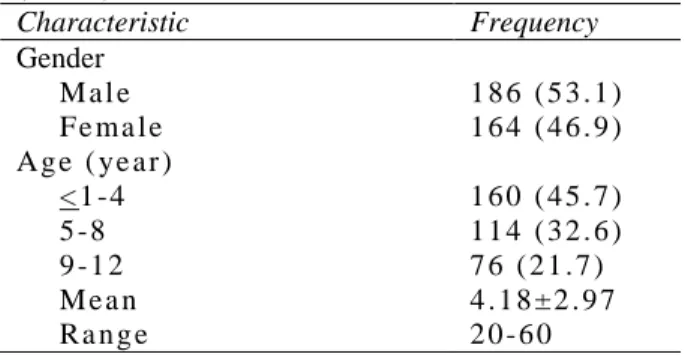
Results A total of 350 children with skin diseases, 186 (53.1%) males and 164 (46.9%) females were seen. The mean age of patients in the study was 4.18±2.97 years. Infections and infestations were the common dermatoses seen in 158 (45.1%) and 105 (30%) children, respectively. Eczema was present in 79 (22.6%) patients and diseases of sweat gland in 8 (2.3%).
Conclusion Infection and infestations were seen as the most common pediatric dermatoses.
Key words
215 with significant morbidity and psychological
impact.1
Pediatric dermatoses should be reviewed distinctly from adult dermatoses, as there are important differences in clinical presentation, treatment and prognosis.1
Skin diseases in children are encountered frequently and their characterization is essential for preparation of academic, research and health plan. The evaluation for skin disorders is important component of primary health care practices.9 The data about paediatric population
in our country are scarce. Few studies done for the paediatric population of 73.22 million are insufficient to predict any prevalence of dermatoses. Moreover, environment has profound effect on prevalence of dermatoses.6
The changing environmental factors (e.g. pollution, urbanization) are associated with various cutaneous diseases (e.g. eczemas). Therefore, it is expected that frequency of paediatric dermatoses has changed over last few years. Most of the time, children are treated by paediatricians rather than dermatologists. The results of the present study will be helpful for both the paediatrician and dermatologists by knowing the most frequent pediatric dermatoses and help in taking steps in the management of patients.
Methods
A cross-sectional study was done at Department of Dermatology Unit I, at Allama Iqbal Medical College/Jinnah Hospital, Lahore. Nonprobability consecutive sampling was done. The duration of study was six months. Children up to 12 years of age belonging to both sexes suffering from skin diseases presenting in outpatient department were included. Children with life threatening and serious conditions e.g. chronic liver disease, renal failure, as well as, those taking drugs
(steroids, antituberculous, anticancer) were excluded from the study. After informed consent from parents of children, detailed history and physical examination were done for the presence of dermatoses including infection, infestation, eczema and diseases of sweat glands. All the information was collected on a pre-designed proforma. All the collected data were entered into SPSS version 10 and analysed.
Results
216 Table 1 Demographic data of study population
(n=350).
Characteristic Frequency
Gender
M a l e 1 8 6 ( 5 3 . 1 ) F e ma l e 1 6 4 ( 4 6 . 9 ) A g e ( ye a r )
< 1 -4 1 6 0 ( 4 5 . 7 )
5 -8 1 1 4 ( 3 2 . 6 )
9 -1 2 7 6 ( 2 1 . 7 )
M e a n 4 . 1 8 ± 2 . 9 7
R a n g e 2 0 -6 0
Table 2 Frequency of different dermatoses (n=350).
Characteristic N (%)
Infections 158 (45.1)
Bacterial 28 (17.7)
Folliculitis 12 (42.9)
Impetigo 11 (39.3)
Furunculosis 5 (17.8)
Cellulitis 0
Viral 53 (33.5)
Warts 28 (52.8)
Molluscum contagiosum 11 (20.8)
Herpes simplex 7 (13.2)
Chicken pox 5 (9.4)
Measles 2 (3.8)
Herpes zoster 0 (0)
Dengue fever 0 (0)
Fungal 77 (48.7)
Tinea capitis 50 (64.9)
Tinea corporis 19 (24.7)
Tinea faciei 8 (10.4)
Pityriasis versicolor 0 (0)
Infestation 105 (30)
Scabies 96 (91.4)
Pediculosis capitis 9 (8.6)
Eczema 79 (22.6)
Seborrheic dermatitis 41 (51.9)
Pityriasis alba 12 (15.2)
Contact dermatitis 12 (15.2) Atopic dermatitis 8 (10.1) Diaper dermatitis 6 (7.6) Disease of sweet gland 8 (2.3)
patients, atopic dermatitis in 8 (10.1%) patients, and diaper dermatitis in 6 (7.6%) patients.
Discussion
The pattern of skin diseases in pediatric age group may vary from one country to another and within the same country from one state to
another due to various climatic, cultural and socio-economic factors.3 This study was
conducted in a tertiary care unit of Pakistan, with a large sample of 350 patients.
The mean age of the patients in our study was 4.18±2.97 years. The majority of the patients (45.7%) were of age group <1-4 years followed by age group 5-8 years (32.6%). This high frequency of patients with dermatoses in age group 1-4 years has also been noticed by Thakare et al.10 who observed that 54.4% patient
were of age group 1-4 years. However, in a large trial done by Balai et al.3 46,321 patients were
examined and only 2.16% patients were children up to five years of age. So, there is a variation of age groups in different studies.
There was a slight male dominance in our study i.e. 53.1% male patients. In the study by Thakare
et al.10 57.2% were males and 42.8 % were
females. Javed et al.11 also noted male
dominance, 65% males and 35% females. So male dominance is observed in these studies.
The most common dermatosis in our study was infection (45.1%) followed by infestation (30%) and then eczema (22.6%). When these results were compared to study by Thakare et al.10 out
of 710 patients infection (229) and infestation (100) were seen in 329 (46.33%) patients. Similar observations were made in other studies. Balai et al.3 observed that infection and
infestation were seen in 417 (40.60%) followed by eczematous (358, 34.86%) and hypersensitivity (10.22%) groups. Mostafa et al.12 again recorded high frequency of infections
and infestations. Out of 1860 patients, 949 (51.02%) had infections and 388 (20.9%) had infestations. Javed et al.11 conducted a study
217 infection and infestation can be attributed to the
fact that most of people belong to the rural community, low socioeconomic status, poor hygienic conditions and lack of education.
In our study, among infection group, fungal infection was the most common seen in 77 (48.7%) patients, followed by viral (53; 33.5%) and then bacterial (28; 17.7%) infection. However, Mostafa et al.12 reported bacterial
infection to be the most common entity, (436, 45.9%) followed by viral (304, 22.02%) and fungal infection (209, 32.03%). This is in accordance with study by Thakare et al.10 who
observed that out of infections (229, 32.2%), bacterial infection was again the most common (109, 47.6%) followed by viral (80; 34.93%) and then fungal (40, 17.5%). In another study conducted by Javed et al.3 fungal infections were
seen in 15.7% patients whereas bacterial infections constituted 8.2%. This variation in prevalence of dermatoses can be attributed to seasonal and climatic changes.3 Among fungal
infections in our study (77, 48.7%), tinea capitis was the most common (50, 64.9%) followed by tinea corporis (19, 24.7%). Balai et al.3 also
recorded tinea capitis in majority (47, 70.15%) of the cases followed by tinea faciei (7, 10.45%) and tinea corporis (7, 10.45%). Folliculitis (12, 42.9%) was the most common bacterial infection in our study followed by impetigo (11, 39.3%). However, impetigo was the most common bacterial infection seen in 410 (94%) patients study conducted by Mostafa et al.12 Similar
observation has been made in study conducted by Balai et al.3 impetigo was the commonest
entity seen in 84 (59.57%) patients followed by secondary pyoderma (38, 26.39%). In a study conducted by Javed et al.11 impetigo (58%),
furunculosis (26%), folliculitis (9%) and ecthyma (7%) were the bacterial infections in descending frequency. Among the viral disorders, warts were the most common (28, 52.8%) followed by molluscum contagiosum
(11, 20.8%) and herpes simplex (7, 13.2%). In study by Balai et al.3, out of viral infections (35,
3.40%), again molluscum contagiosum (21, 60%) was the commonest viral infection followed by warts (7, 20%). The variation among infective dermatoses can possibly be attributed to region of study, prevalent environmental factors, type of population studied and hygienic and nutritional status.3
Out of infestation group, scabies was the most common infestation (96, 91.4%) followed by pediculosis capitis (9, 8.6%). In study by Balai
et al.3 scabies was seen in 107 (10.42%) patients.
In another study conducted by Mostafa et al.12,
out of total of 1860 cases, infestations were seen in 388 (20.9%) cases and among these pediculosis capitis was the most frequent (325, 83.8%) followed by scabies (63, 16.2%). Javed
et al.11 also observed scabies (180, 21.7%) to be
the most frequent infestation. This high frequency of scabies can be attributed to sociocultural and environmental factors including overcrowding, poor sanitation, bad hygienic conditions, sharing of clothes and lack of education.
In our study seborrheic dermatitis was the most common (41, 51.2%) among the eczema group followed by contact dermatitis (12, 15.2%) and pityriasis alba (12, 15.2%) each. However, Balai
et al.3 recorded atopic dermatitis to be the
commonest (198, 55.31%) followed by seborrheic dermatitis (60, 16.76%) and pityriasis alba (29, 8.10%). Thakare et al.10 also found
atopic dermatitis to be the most common (38, 28.7%) followed by seborrheic dermatitis (31, 23.8%). The high frequency of seborrheic dermatitis in our study can be due to reason that majority of the patients belonged to age group <1-4 years and infantile type seborrheic dermatitis is 3 times as likely in children <2 years old. Sardana et al.9 also found infantile
218 compared to pityriasis alba and atopic
dermatitis. The incidence of eczema also depends upon environmental factors, season, genetic constitution and individual predisposition.3 Moreover, different degrees of
exposure to external factors and different levels of functional development of skin may give rise to differential prevalence of dermatoses among infants, toddlers and children.14
In our study, miliaria was present in 8 (2.3%) cases. However, miliaria was present in a little higher proportion in study by Thakare et al.10
(35, 4.92%).
This study had some limitations. This was a single center study, with a limited population size. The population covered only tertiary care unit. The results of the study may be different for rural areas. The effect of seasonal variation on pediatric dermatoses could not be assessed properly.
Conclusion
Pediatric dermatoses are very common. Infection and infestations are the most frequent dermatoses. The most common group of dermatoses was infection whereas scabies was the most frequent dermatosis seen. However, there is need to conduct multicenter studies in order to determine the true incidence of dermatoses as there is variation in data from different studies.
References
1. Jain N, Khandpur S. Pediatric dermatoses in India. Indian J Dermatol Venereol Leprol. 2010;76:451-4.
2. Hadiuzzaman M, Hasibur MR, Nahida I, Islam MS, Sabrina AM, Bhuyan MKJ. Prevalence of dermatoses in rural paediatric population. Community Based Med J. 2013;1:9-14.
3. Balai M, Khare AK, Gupta LK, Mittal A, Kuldeep CM. Pattern of pediatric dermatoses in a tertiary care centre of South-West Rajasthan. Indian J Dermatol. 2012;57:275-8.
4. Hayden GF. Skin diseases encountered in a pediatric clinic. Am J Dis Child. 1985;139:36-8.
5. Gupta P, Sarkar R. Common skin disorders and leprosy. In: Ghai OP, Gupta P, Paul VK, editors. Ghai Essential Pediatrics. 6th edn. New Delhi: CBS Publishers and Distributors; 2004. P. 627-63.
6. Mitra M, Mitra C, Gangopadhyay DN. Effect of environment on pediatric dermatoses. Indian J Dermatol. 2005;50:64-7.
7. Sharma NK, Garg BK, Goel M. Pattern of skin diseases in urban school children. Indian J Dermatol Venereol Leprol. 1986;52:330-1.
8. Saurabh S, Poopan B, Manmeet Kaur S. Epidemiology of dermatoses in children and adolescents in Punjab. J Pak Assoc Dermatol. 2012;22:224-9.
9. Sardana K, Mahajan S, Sarkar R, Mendiratta V, Bhushan P, Koranne RV. The spectrum of skin diseases among Indian children. Indian J Dermatol Venereol Leprol. 2009;26:6-13.
10. Thakare S, Singh A, Madnani A, Lakhar B. Scenario of pediatric dermatoses in rural population of Central India. Glob J Dermatol Venereol. 2013;1:7-10.
11. Javed M, Jairamani C. Pediatric dermatology: an audit at Hamdard University Hospital, Karachi. J Pak Assoc Dermatol. 2006;16:93-6.
12. Mostafa FF, Hassan AAD, Soliman MA, Nassar A, Deabes RH. Prevalence of skin diseases among children in AlShariqa Governate, Egypt. Egyptian Online J Dermatol. 2012;8:1-14.
13. William JV, Eichenfield LF, Burke BL, Eley MB, Friedlander SF. Prevalence of scalp scaling in prepubertal children. Pediatrics. 2005;115:e1-6.