AUSTRALIAN JOURNAL OF BASIC AND
Open Access Journal
Published BY AENSI Publication
© 2016 AENSI Publisher All rights reserved
This work is licensed under the Creative Commons Attribution International License (CC BY). http://creativecommons.org/licenses/by/4.0/
To Cite This Article: G. Murugadass, P. Sivakumar and R. Manikandan Wireless Sensor Networks. Aust. J. Basic & Appl. Sci.,
Secure a nd Scattered
Sensor Networks
1G. Murugadass, 2P. Sivakumar and 3R. Manikandan
1Research Scholar, Anna University, S.K.P. Engineering College, Tiruvannamalai, Tamilnadu, India 2
Professor of ECE, S.K.P. Engineering College, Tiruvannamalai, Tamilnadu, India.
3Research Scholar3, St Peters University, Department of CSE
Address For Correspondence:
G. Murugadass, Research Scholar, Anna University, S.K.P. Engineering College, Tiruvannamalai, Tamilnadu, India
A R T I C L E I N F O
Article history:
Received 04 December 2015 Accepted 22 January 2016 Available online 14 February 2016
Keywords:
Distributed data discovery and d issemination, security, wireless sensor networks, efficiency
After a wireless sensor network programs or parameters stored in the dissemination protocol, which facilitates configuration parameters to sensor referred to as data dissemination or which distribute large binaries to disseminating a binary file of tens several two-byte configuration parameters sensor nodes could be distributed sensor nodes through the wireless intervention.
In the literature, several data have been proposed for WSNs. Among Levis, 2008)and Drip (Tolle, G. and been included in the TinyOS distri the WSN is trustworthy and has no
AUSTRALIAN JOURNAL OF BASIC AND
APPLIED SCIENCES
ISSN:1991-8178 EISSN: 2309-8414 Journal home page: www.ajbasweb.com
© 2016 AENSI Publisher All rights reserved
Creative Commons Attribution International License (CC BY). http://creativecommons.org/licenses/by/4.0/
G. Murugadass, P. Sivakumar and R. Manikandan., Secure and Scattered Data Sighting and Dissemination in
Aust. J. Basic & Appl. Sci., 10(2): 114-124, 2016
Data Sighting a nd Dissemination
Manikandan
Research Scholar, Anna University, S.K.P. Engineering College, Tiruvannamalai, Tamilnadu, India Professor of ECE, S.K.P. Engineering College, Tiruvannamalai, Tamilnadu, India.
Department of CSE, Chennai, Tamilnadu, India.
Research Scholar, Anna University, S.K.P. Engineering College, Tiruvannamalai, Tamilnadu, India
A B S T R A C T
A Secure and scattered Data sighting and Dissemination
Networks (WSNs) is responsible for distributing a management commands and updating configuration parameters of the sensor nodes. All existing data dissemination and discovery protocols suffered by few drawbacks. The existing WSN is fully functioned in centralized approach in that only the base station can distribute data item if the base station get failure then the entire network get down.
suitable for growing multi-owner-multi-user WSNs. Second, those protocols were not designed with security in mind and hence adversaries can easily launch
to harm the entire network. In our paper we proposes the highly secure and distributed data discovery and dissemination protocol named DiDrip using HMAC hashing message authentication. In that the network owners to authorize
with different privileges to concurrently and directly disseminate
sensor nodes. Our theoretical analysis, it addresses a number of potential security vulnerabilities that we have identified. A Novel security analysis show DiDrip is provably secure. We also implement DiDrip in a trial a network
sensor nodes to show its high efficiency in practice.
INTRODUCTION
ork (WSN) is deployed, there is usually a need to update the sensor nodes. This can be achieved by the so-called acilitates a source to inject small programs, commands,
nodes. Note that it is different from the code dissemination or reprogramming protocols) (Hui, J.W. and D. Culle to reprogram the whole network of sensors. For tens of kilobytes requires a code dissemination protocol configuration parameters requires data discovery and dissemination protocol.
in a harsh environment, remotely disseminating such wireless channel is a more preferred and practical approach
discovery and dissemination protocols ( Dang, T., 2009; Among the proposed protocols, DHV (Dang, T., 2009 and D. Culler, 2005) are regarded as the state-of-the-art distributions. All proposed protocols assume that the operating
no adversary. However, in reality, adversaries exist and impose
Secure and Scattered Data Sighting and Dissemination in
Dissemination in Wireless
Research Scholar, Anna University, S.K.P. Engineering College, Tiruvannamalai, Tamilnadu, India.
Dissemination in Wireless Sensor distributing a management commands and updating configuration parameters of the sensor nodes. All existing data dissemination and discovery protocols suffered by few drawbacks. The existing WSN is fully ase station can distribute data item if the base station get failure then the entire network get down. Such an approach is not user WSNs. Second, those protocols were not saries can easily launch malicious node the highly secure and distributed DiDrip using HMAC hashing uthorize multiple network users disseminate data items to the Our theoretical analysis, it addresses a number of potential security security analysis show DiDrip is We also implement DiDrip in a trial a network of resource-limited
update buggy/old small called data discovery and commands, queries, and dissemination protocols (also Culler, 2004; He, D., 2012), or example, efficiently dissemination protocol while disseminating protocol. Considering the such small data to the approach than manual
normal operation of WSNs (He, D., 2013; Rahman, M., 2008). This issue has only been addressed recently by (He, D., 2013) which identifies the security vulnerabilities of Drip and proposes an effective solution.
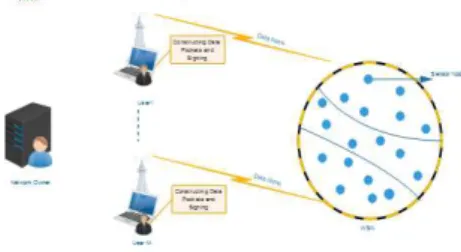
More importantly, all existing data discovery and dissemination protocols (He, D., 2013) employ the centralized approach in which, as shown in the top sub-figure in Fig. 1, data items can only be disseminated by the base station. Unfortunately, this approach suffers from the single point of failure as dissemination is impossible when the base station is not functioning or when the connection between the base station and a node is broken. In addition, the centralized approach is inefficient, non-scalable, and vulnerable to security attacks that can be launched anywhere along the communication path. Even worse, some WSNs do not have any base station at all. For example, for a WSN monitoring human trafficking in a country’s border or a WSN deployed in a remote area to monitor illicit crop cultivation, a base station becomes an attractive target to be attacked. For such networks, data dissemination is better to be carried out by authorized network users in a distributed manner.
Fig. 1: System overview of centralized and distributed data discovery and dissemination approaches.
Additionally, distributed data discovery and dissemination is an increasingly relevant matter in WSNs, especially in the emergent context of shared sensor networks, where sensing/ communication infrastructures from multiple owners will be shared by applications from multiple users. For example, large scale sensor networks are built in recent projects such as Geoss, NOPP and ORION (Levis, P., 2012). These networks are owned by multiple owners and used by various authorized third-party users. Moreover, it is expected that network owners and different users may have different privileges of dissemination. In this context, distributed data discovery and dissemination by networks owners and users with different privileges will be a crucial issue, for which efficient solutions are still missing. Motivated by the above observations, this paper has the following main contributions:
1) The need of distributed data discovery and dissemination protocols is not completely new, but previous work did not address this need. We study the functional requirements of such protocols, and set their design objectives. Also, we identify the security vulnerabilities in existing data discovery and dissemination protocols. 2) Based on the design objectives, we propose DiDrip. It is the first distributed data discovery and dissemination protocol, which allows network owners and authorized users to disseminate data items into WSNs without relying on the base station. Moreover, our extensive analysis demonstrates that DiDrip satisfies the security requirements of the protocols of its kind. In particular, we apply the provable security technique to formally prove the authenticity and integrity of the disseminated data items in DiDrip.
3) We demonstrate the efficiency of DiDrip in practice by implementing it in an experimental WSN with resource- limited sensor nodes. This is also the first implementation of a secure and distributed data discovery and dissemination protocol.
The rest of this paper is structured as follows. In Section II, we first survey the existing data discovery and dissemination protocols, and then discuss their security weaknesses. Section III describes the requirements for a secure and distributed data discovery and dissemination protocol. Section IV presents the network, trust and adversary models. Section V describes DiDrip in details. Section VI provides theoretical analysis of the security properties of DiDrip. Section VII describes the implementation and experimental results of DiDrip via real sensor platforms. Finally, Section VIII concludes this paper.
II. Security Vulnerabilities In Data Discovery And Dissemination: A. Review of Data Discovery and Dissemination:
The underlying algorithm of both DIP and Drip is Trick- le (Perrig, A., 2001). Initially, Trickle requires each node to periodically broadcast a summary of its stored data. When a node has received an older summary, it sends an update to that source. Once all nodes have consistent data, the broadcast interval is increased exponentially to save energy. However, if a node receives a new summary, it will broadcast this more quickly. In other words, Trickle can disseminate newly injected data very quickly. Among the existing protocols, Drip is the simplest one and it runs an independent instance of Trickle for each data item.
B. Security Vulnerabilities in Data Discovery and Dissemination:
An adversary can first place some intruder nodes in the network and then use them to alter the data being disseminated or forge a data item. This may result in some important parameters being erased or the entire network being rebooted with wrong data. For example, consider a new data item (key, version, data) being disseminated. When an intruder node receives this new data item, it can broadcast a malicious data item (key, version*, data*), where version* > version. If data* is set to 0, the parameter identified by key will be erased from all sensor nodes. Alternatively, if data* is different from data, all sensor nodes will update the parameter according to this forged data item. Note that the above attacks can also be launched if an adversary compromises some nodes and has access their key materials.
In addition, since nodes executing Trickle are required to forward all new data items that it receives, an adversary can launch denial-of-service (DoS) attacks to sensor nodes by injecting a large amount of bogus data items. As a result, the processing and energy resources of nodes are expended to process and forward these bogus data items, rather than on the intended functions. Any data discovery and dissemination protocol based on Trickle or its variants is vulnerable to such a DoS attack.
III. Requirements For Secure And Distributed Data Discovery And Dissemination:
A secure and distributed data discovery and dissemination protocol should satisfy the following requirements:
1) Distributed:
Multiple authorized users should be al- lowed to simultaneously disseminate data items into the WSN without relying on the base station.
2) Supporting different user privileges:
To provide flexibility, each user may be assigned a certain privilege level by the network owner. For example, a user can only disseminate data items to a set of sensor nodes with specific identities and/or in a specific localized area. Another example is that a user just has the privilege to disseminate data items identified by some specific keys.
3) Authenticity and integrity of data items:
A sensor node only accepts data items disseminated by authorized users. Also, a sensor should be able to ensure that received data items have not been modified during the dissemination process.
4) User accountability (i.e., user traceability or non- repudiation):
User accountability must be provided since bad user behaviors and insider attacks should be audited and pinpointed. That is, a sender should not be able to deny the distribution of a data item. At the same time, an adversary cannot impersonate any legitimate user even if it has compromised the network owner or the other legitimate users. In many applications, traceability is desirable as it enables collection of users’ activities. For example, from the dissemination record in sensor nodes, the network owner can find out who disseminates most data. This requires the sensor nodes to be able to associate each disseminated data with the corresponding user’s identity.
5) Node compromise tolerance:
The protocol should be resilient to node compromise attack no matter how many nodes have been compromised, as long as the subset of non-compromised nodes can still form a connected graph with the trusted source.
6) User collusion tolerance:
Even if an adversary has compromised some users, a benign node should not grant the adversary any privilege level beyond that of the compromised users.
7) DoS attacks resistance:
The functions of the WSN Should not be disrupted by DoS attacks.
8) Freshness:
A node should be able to differentiate whether an incoming data item is the newest version.
9) Low energy overhead:
Most sensor nodes have limited resources. Thus, it is very important that the security functions incur low energy overhead, which can be de-composed to communication and computation overhead.
10) Scalability:
population.
11) Dynamic participation:
New sensor nodes and users can be dynamically added to the network. In order to ensure the data discovery and dissemination security, each step of the existing data discovery and dissemination protocol runs should be identified and then protected. In other words, although code dissemination protocols may share the same security requirements as listed above, their security solutions need to be designed in accordance with their characteristics. Considering the well known open-source code dissemination protocol named Deluge [1] as an example. Deluge uses an epidemic protocol based on a page-by-page dissemination strategy for efficient advertisement of metadata. A code image is divided into fixed-size pages, and each page is further split into same-size packets. Due to such a way of decomposing code images into packets, our proposed protocol is not applicable for securing Deluge.
A Design Consideration of Secure and distributed data discovery and dissemination The primary challenge of providing security functions in WSNs is the limited capabilities of sensor nodes in terms of computation, energy and storage. For example, to provide authentication function to disseminated data, a commonly used solution is digital signature. That is, users digitally sign each packet individually and nodes need to verify the signature before processing it. However, such an asymmetric mechanism incurs significant computational and communication overhead and is not applicable to sensor nodes. To address this problem, TESLA and its various extensions have been proposed, which are based on the delayed disclosure of authentication keys, i.e., the key used to authenticate a message is disclosed in the next message. Unfortunately, due to the authentication delay, these mechanisms are vulnerable to a flooding attack which causes each sensor node to buffer all forged data items until the disclosed key is received.Another possible approach to authentication is by symmetric key cryptography. However, this approach is vulnerable to node compromise attack because once a node is compromised; the globally shared secret keys are revealed.
Here we choose digital signatures over other forms for update packet authentication. The simplest and the most efficient method is for the network owner to assign to each network user a public/private key pair that allow the user to digitally sign data items and thus authenticate itself to the sensor nodes. Here two hybrid approaches are proposed to reduce the computation and communication cost. These methods combine digital signature with efficient data Merkle hash tree and data hash chain, respectively. The main idea is that signature generation and verification is carried out over multiple packets instead of individual packet. In this way, the computation cost per packet is significantly reduced. Since elliptic curve cryptography (ECC) is computational and communication efficient compared with the traditional public key cryptography, DiDrip is based on ECC.
To prevent the network owner from impersonating users, user certificates are issued by a certificate authority of a public key infrastructure (PKI), e.g., local police office.
IV. Network, Trust a nd Threat Models: A. Network Model:
As shown in the bottom subfigure in Fig. 1, a general WSN comprises a large number of sensor nodes. It is administrated by the owner and accessible by many users. The sensor nodes are usually resource constrained with respect to memory space, computation capability, bandwidth, and power supply. Thus, a sensor node can only perform a limited number of public key cryptographic operations during the lifetime of its battery. The network users use some mobile devices to disseminate data items into the network. The network owner is responsible for generating keying materials. It can be offline and is assumed to be uncompromisable.
B. Trust Model:
Networks users are assigned dissemination privileges by the trusted authority in a PKI on behalf of the network owner. However, the network owner may, for various reasons, impersonate network users to disseminate data items.
C. Threat Model:
The adversary considered in this paper only aims to corrupt the disseminated data due to their importance. It is assumed to be computationally resourceful. It may launch either external or insider attacks. In external attacks, the adversary has no control of any sensor node in the network. Instead, it would eavesdrop for sensitive information, inject forged messages, launch replay attack, wormhole attacks, DoS attacks and impersonate valid sensor nodes. The communication channel may also be jammed by the adversary, but this can only last for a certain period of time after which the adversary will be detected and removed.
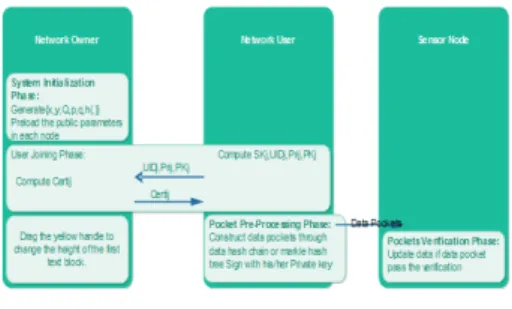
Fig. 2: Information processing flow in DiDrip.
V. DIDRIP:
Referring to the lower sub-figure in Fig. 1, DiDrip consists of four phases, system initialization, user joining, packet pre- processing and packet verification. For our basic protocol, in system initialization phase, the network owner creates its public and private keys, and then loads the public parameters on each node before the network deployment. In user joining phase, a user gets the dissemination privilege through register- ing to the network owner. In packet pre-processing phase, if a user enters to the network and wants to dissemination some data items, he/she will need to construct the data dissemination packets and then send them to the nodes. In packet verification phase, a node verifies each received packet. If the result is positive, it updates the data according to the received packet. In the following, each phase is described in detail. The notations used in the description are listed in Table I. The information processing flow of DiDrip is illustrated in Fig. 2.
Table I: Notations.
Notation Description
SIGk{M} The signature on message M with the key k
, or || Concatenation operator of the two bit streams
h(.) Public one-way cryptographic hash function
h(M) The hash value of message M
A. System Initialization Phase:
In this phase, an ECC is set up. The network owner carries out the following steps to derive a private key x and some public parameters {y, Q, p, q, h(.)}. It selects an elliptic curve E over GF (p), where p is a big prime number. Here Q denotes the base point of E while q is also a big prime number and represents the order of Q. It then selects the private key x GF (q) and computes the public key y = xQ. After that, the public parameters are preloaded in each node of the network. We consider 160-bit ECC as an example. In this case, y and Q are both 320 bits long while p and q are 160 bits long.
B. User Joining Phase:
This phase is invoked when a user with the identity U I Dj , say Uj , hopes to obtain data discovery and dissemination privilege. User Uj chooses the private key SKj GF (q) and computes the public key P Kj = SKj ·Q. Here the length of U I Dj is set to 2 bytes, in this case, it can support 65,536 users. Similarly, assume that 160-bit ECC is used, P Kj and SKj are 320 bits and 160 bits long, respectively. Then user Uj send a 3-tuple <U I Dj , P rij , P Kj > to the network owner, where P rij denotes the dissemination privilege of user Uj . Upon receiving this mes- sage, the network owner generates the certificate C ertj . A form of a certificate consists of the following contents: C ertj = {U I Dj , P Kj , P rij , SI Gx {h(U I Dj kP Kj kP rij )}, where the length of P rij is set to 6 bytes, thus the length of C ertj is 88 bytes.
C. Packet Pre-processing Phase:
With the method of Merkle hash tree, user Uj builds a Merkle hash tree from the n data items in the following way. All the data items are treated as the leaves of the tree. A new set of internal nodes at the upper level is formed; each internal node is computed as the hash value of the concatenation of two child nodes. This process is continued until the root node Hroot is formed, resulting in a Merkle hash tree with depth D = log2 (n). Before disseminating the n data items, user Uj signs the root node with his/her private key SKj and then transmits the advertisement packet P0 comprising user certificate C ertj Hroot and SI GSKj {Hroot }. Subsequently, user Uj disseminates each data item along with the appropriate internal nodes for verification purpose. Note that as described above, user certificate C ertj contains user identity information U I Dj and dissemination privilege P rij . Before the network deployment, the network owner assigns a pre- defined key to identify this advertisement packet.
D. Packet Verification Phase:
When a sensor node , say Sj , receives a packet either from an authorized user or from its one-hop neighbours, it first checks the packet’s key field
(1) If this is an advertisement packet (P0 ={C ertj , h(P1 ), SI GSK j {h(P1 )}} for the data hash chain method while P0 ={C ertj , root, SI GSK j {root}} for the Merkle hash tree method), node Sj first pays attention to the legality of the dissemination privilege P rij . For example, node Sj needs to check whether the identity of itself is included in the node identity set of P rij . If the result is positive, node Sj uses the public key y of the network owner to run an ECDSA verify operation to authenticate the certificate. If the certificate C ertj is valid, node Sj authenticates the signature. If yes, for the data hash chain method (respectively, the Merkle hash tree method), node Sj stores <U I Dj , H1 > (respectively, < U I Dj , root >) included in the advertisement packet; otherwise, node Sj simply discards the packet.
(2) Otherwise, it is a data packet Pi , where i = 1, 2, . . . , n). Node Sj executes the following procedure. For the data hash chain method, node Sj checks the authenticity and integrity of Pi by comparing the hash value of Pi with Hi which has been received in the same round and verified. If the result is positive and the version number is new, node Sj then updates the data identified by the key stored in Pi and replaces its stored <round, Hi > by <round, Hi+1 >(Hi+1 is included in packet Pi ); otherwise, Pi is discarded.
For Merkle hash tree method, node Sj checks the authenticity and integrity of Pi through the already verified root node received in the same round. If the result is positive and the version number is new, node Sj then updates the data identified by the key stored in Pi ; otherwise, Pi is discarded.
Remark:
To prevent the network owner from impersonating users, system initialization and issue of user certificates can be carried out by the certificate authority of a PKI rather than the network owner.
Comparing the two methods, the data hash chain method incurs less communication overhead than the Merkle hash tree method. In the data hash chain method, only one hash value of a packet is included in each packet. On the contrary, in the Merkle hash tree method, D (the tree depth) hash values are included in each packet. However, a limitation of the data hash tree method is that it just works well in networks with in-sequence packet delivery. Such a limitation does not exist in the Merkle hash tree method since it allows each packet to be immediately authenticated upon its arrival at a node. Therefore, the choice of each method depends on this characteristic of the WSNs.
E. Enhancements:
We can enhance the efficiency and security of DiDrip by adding additional mechanisms. Readers are referred to Appendix for details.
VI. Security Analysis Of Didrip:
In the following, we will analyze the security of DiDrip to verify that the security requirements mentioned in Section III are satisfied. Distributed: As described in Section V.B, in order to pass the signature verification of sensor nodes, each user has to submit his/her private key and dissemination privilege to the network owner for registration. In addition, as described above, an authorized users are able to carry out disseminating in a distributed manner.
Supporting Different User Privileges: Activities of net- work users can be restricted by setting user privilege P rij , which is contained in the user certificate. Since each user certificate is generated based on P rij , it will not pass the signature verification at sensor nodes if P rij is modified. Thus, only the network owner can modify P rij and then update the certificate accordingly.
packet h(P1 )) with his/her private key. Using the network owners public key, each sensor node can authenticate the user certificate and obtain the users public key. Then, using the users public key, each node can authenticate the root of the Merkle hash tree (rsp. the hash value of the first data packet h(P1 )). Subsequently, each node can authenticate other data packets based on the Merkle hash tree (rsp. the data hash chain). With the assumption that the network owner cannot be compromised, it is guaranteed that any forged or modified data items can be easily detected by the authentication process.
User accountability:
Users’ identities and their dissemination activities are exposed to sensor nodes. Thus, sensor nodes can report such records to the network owner periodically. Since each user certificate is generated according to the user identity, except the network owner, no one can modify the user identity contained in the user certificate which passes the authentication. Therefore, users cannot repudiate their activities.
Node Compromise and User Collusion tolerance: As described above, for basic protocol, only the public parameters are preloaded in each node. Even for the improved protocol, the public-key/dissemination-privilege pair of each network user is loaded into the nodes. Therefore, no matter how many sensor nodes are compromised, the adversary just obtains the public parameters and the public-key/dissemination-privilege pair of each user. Clearly, the adversary cannot launch any attack by compromising sensor nodes. As described in Sec- tion V, even if some users collude, a benign node will not grant any dissemination privilege that is beyond those of colluding users.
Resistance to DoS Attacks: there are DoS attacks against basic DiDrip by exploiting: (1) authentication delays, (2) the expensive signature verifications, and (3) the Trickle algorithm.
Firstly, with the use of Merkle hash tree or data hash chain, each node can efficiently authenticate a data packet by a few hash operations. Secondly, using the message specific puzzle approach, each node can efficiently verify a puzzle solution to filter a fake signature message and to forward a data packet using Trickle without waiting for signature verification. Therefore, all the above DoS attacks are defended.
DiDrip can successfully defeat all three types of DoS attacks even if there are compromised network users and
sensor nodes. Indeed, without the private key and the unreleased puzzle keys of the network users, even an inside attacker cannot forge any signature/data packets. Endurance of Freshness: If the privilege of a user allows him/her to disseminate data items to his/her own set of nodes, the version number in each item can ensure the freshness of DiDrip. On the other hand, if a node receives data items from multiple users, the version number can be replaced by a timestamp to indicate the freshness of a data item. More specifically, a timestamp is attached into the root of the Merkle hash tree (or the hash value of the first data packet).
Scalability:
Different from the centralized approaches, an authorized user can enter the network and then disseminate data items into the targeted sensor nodes. Moreover, as to be demonstrated by our experiments in a testbed with 24 TelosB motes in the next section, the security functions in our protocol have low impact on propagation delay. Note that the increase in propagation delay is dominated by the signature verification time incurred at the one-hop neighbouring nodes of the authorized user. Thus, the proposed protocol is efficient even in a large-scale WSN with thousands of sensor nodes. Also, as shown in Section V.B, our protocol can support a large number of users.
Also, as described above, DiDrip can achieve dynamic participation. Moreover, in the next section, our
implementation results will demonstrate DiDrip has low energy overhead.
In the following, we give the formal proof of the authenticity and integrity of the disseminated data items in DiDrip based on the three assumptions below Assumption 1: There exist pseudo-random functions which are polynomially indistinguishable from truly random func- tions.
Assumption 2:
There exist target collision-resistance (TCR) hash functions, where if for all probabilistic-polynomial- time (PPT) adversaries, say A, A have negligible probability in winning the following game: A first choose a message m, and then A are given a random function h(.). To win, A must output). Note that in our scheme, the TCR hash function can be implemented by the common hash functions, such as SHA-1.
Assumption 3:
ECC signature is existentially unforgeable under adaptive chosen-message attacks. Note that in our scheme, ECC signature can use the standard ECDSA of 160 bits.
Theorem 1:
Proof:
Our theorem follows from Theorem A.1 in (17), and thus here we only give a proof sketch briefly. To begin with, we assume ECC signature generation and verification guarantees authenticity and integrity of signed messages, and every receiver has obtained an authentic copy of the legitimate sender’s public key. And we also assume that h(.) is a TCR hash function. Therefore, here the security of DiDrip is proven based on the indistinguishability between pseudo-randomness and true randomness.
Firstly, there exists a PPT adversary A, which can defeat authenticity of data items in DiDrip. This means that A controls the communication links and manages, with non-negligible probability, to deliver a message m to a receiver R, such that the sender S has not sent m but R accepts m as authentic and coming from S. Then there is a PPT adversary B that uses A to break the indistinguishability between pseudo-randomness and true randomness with negligible advantage. That is, B gets access to h (as an oracle) and can tell with non-negligible probability if h is a pseudorandom function (P RF (.)) or if h is a totally random function.
To this end, B can query on inputs x of its choice and be answered with h(x). Hence firstly B simulates for A a network with a sender S and a receiver R. Then B works by running A in the way similar to that in [18]. Namely, B chooses a number l {1, . . ., n} at random, where n is the total number of packets to be sent in the data dissemination. Note that B hopes that A will forget the l-th packet Pl . B grants access to the oracle h, which is either P RF (.) or an ideal random function. B can adaptively query an arbitrarily chosen x to
the oracle and get the output which is either P RF (x) or a random value uniformly selected from {0, 1} . After performing many polynomial queries, B finally makes the decision of whether or not the oracle is PRF (.) or the ideal random function. As a result, B wins the game if the decision is correct.
We argue that B succeeds with non-negligible probability sketchily. If h is a truly random function then A has only negligible probability to successfully forget the packet Pl in the data items. Therefore, if h is random then B makes the wrong decision only with negligible probability. On the other hand, we have assumed that if the authentication is done using P RF (.) then A forges some packet with non-negligible probability . It follows that if h is P RF (.) then B makes the right decision with probability at least /l (which is also non-negligible).
Table II: The pros and cons of all related Protocols .
Protocol Description Advantage Disadvantage
Drip 4 Data discovery and dissemination Simplest approach
Without data security consideration with centralized
approach DiDrip 1 An implementation of basic DiDrip Attack resistance & based on the
distributed approach -
DiDrip 2 An implementation of DiDrip including the function of message specific puzzle More efficient then DiDrip 1 -
In addition, if the adversary A is able to cause a receiver R to accept a forged packet Pl , it implies the adversary A is However, according to Assumption 2, h(.) is a TCR hash function. Moreover, due to the unforgeability of ECC signature (Assumption 3), it is impossible that A hands R a forged initial packet from S (For data hash chain approach, A forges the signature SI GSKj (P1 ); For Merkle hash tree method, A forges the signature SI GSKj (root). Therefore, the above contradictions means also that the authenticity and integrity of data items in DiDrip.
VII.Implementation And Performance Evaluation:
We evaluate DiDrip by implementing all components on an experimental test-bed. Also, we choose Drip for performance comparison.
A. Implementation and Experimental Setup:
We have written programs that execute the functions of the network owner, user and sensor node. The network owner and user side programs are C programs using OpenSSL [19] and running on laptop PCs (with 2 GB RAM) under Ubuntu 11.04 environment with different computational power. Also, the sensor node side programs are written in nesC and run on resource-limited motes (MicaZ and TelosB). The MicaZ mote features an 8-bit 8-MHz Atmel microcontroller with 4- kB RAM, 128-kB ROM, and 512 kB of flash memory. Also, the TelosB mote has an 8-MHz CPU, 10-kB RAM, 48-kB ROM, 1MB of flash memory, and an 802.15.4/ZigBee radio. Our motes run TinyOS 2.x. Additionally, SHA-1 is used, and the key sizes of ECC are set to 128 bits, 160 bits and 192 bits, respectively. Throughout this paper, unless otherwise stated, all experiments on PCs (respectively, sensor nodes) were repeated one million times (respectively, one thousand times) for each measurement in order to obtain accurate average results.
tree) of a round of dissemination data, generation of the signature packet and all data packets. For obtaining version number of each data item, the DisseminatorC and DisseminatorP modules in the Drip nesC library has been modified to provide an interface called DisseminatorVersion. Moreover, the proposed hash tree method is implemented without and with using the message specific puzzle approach presented in Appendix, resulting in two implementations of DiDrip; DiDrip1 and DiDrip2. In DiDrip1, when a node receives a signature/data packet with a new version number, it authenticates the packet before in DiDrip2, a node only checks the puzzle solution in the packet before broadcasting the packets. We summarize the pros and cons of all related protocols in Table II.
Based on the design of DiDrip, we implement the verification function for signature and data packets based on the ECDSA verify function and SHA-1 hash function of TinyECC 2.0 library [20] and add them to the Drip nesC library. Also, in our experiment, when a network user (i.e., a laptop computer) disseminates data items, it first sends them to the serial port of a specific sensor node in the network which is referred to as repeater. Then, the repeater carries out the dissemination on behalf of the user using DiDrip.
Similar to [7], we use a circuit to accurately measure the power consumption of various cryptographic operations executed in a mote. The Tektronix TDS 3034C digital oscilloscope accurately measures the voltage Vr across the resistor. Denoting the battery voltage as Vb (which is 3 volts in our experiments), the voltage across the mote Vm is then Vb − Vr . Once Vr is measured, the current through the circuit I can be obtained by using Ohms law. The power consumed by the mote is then Vm I . By also measuring the execution time of the cryptographic operation, we can obtain the energy consumption of the operation by multiplying the power and execution time.
B. Evaluation Results:
The following metrics are used to evaluate DiDrip; memory overhead, execution time of cryptographic operations and propagation delay, and energy overhead. The memory over- head measures the required data space in the implementation. The propagation delay is defined as the time from construction of a data hash chain until the parameters on all sensor nodes corresponding to a round of disseminated data items are updated.
Table III shows the execution times of some important operations in DiDrip. For example, the execution times for the system initialization phase and signing a random 20-byte message (i.e., the output of SHA-1 function) are 1.608 ms and 0.6348 ms on a 1.8-GHz Laptop PC, respectively. Thus, if SHA-1 is used, generating a user certificate or signing a message takes 0.635 ms on a 1.8-GHz Laptop PC. Fig. 3 shows the execution times of SHA-1 hash function (extracted from TinyECC 2.0 [20]) on MicaZ and TelosB motes. The inputs to the hash function are randomly generated numbers with length varying from 24 bytes to 156 bytes in increments of 6 bytes. Note that, in our protocol, the hash function is applied to an entire packet. There are several reasons that, possibly, a packet contains a few tens of bytes. First, the advertisement packet has additional information such as certificate and signature. Second, with the Merkle hash tree method, each packet contains the disseminated data item along with the related internal nodes of the tree for verification purpose. Third, although several bytes is a typical size of a data item, sometimes a disseminated data item may be a bit larger. Moreover, for sensors with IEEE 802.15.4 compliant radios, the maximum payload size is 102 bytes for each packet. Therefore, we have chosen a wider range of input size to SHA-1 to provide readers a more complete picture of the performance. We perform the same experiment ten thousand times and take an average over them. For example, the execution times on a MicaZ mote for inputs of 54 bytes, 114 bytes, and 156 bytes are 9.6788 ms, 18.947 ms, and 28.0515 ms, respectively. Also, the execution times on a TelosB mote for inputs of 54 bytes, 114 bytes, and 156 bytes are 5.7263 ms, 10.7529 ms, and 15.629 ms, respectively.
Table III: Running Time for Each Phase of the Basic Protocol of DIDRIP (Except the sensor node Verification Phase ).
Time (µs) System
Initialization
User public/private key generation
Signing a 20-byte message
CPU=1.8 GHz 1608.0 1576.31 634.8
CPU=2.6GHz 1111.3 1092.12 435.4
CPU=3.1 GHz 931.1 915.18 372.3
To measure the execution time of public key cryptography, as shown in Table IV1 , we have implemented the ECC verifi cation operation (with a random 20-byte number as the output) of TinyECC 2.0 library [20] on MicaZ and TelosB motes. For example, it is measured that the signature verification times are 2.436 seconds and 3.955 seconds, which are 252 and 691 times longer than SHA-1 hash operation with a 54-byte random number as input on MicaZ and TelosB motes, respectively. It can be seen packet authentication based on the Merkle hash tree (or data hash chain) is much more efficient. Therefore, it is confirmed that DiDrip is suitable for sensor nodes with limited resources.
=6.7779 mA, Vm =2.8620 V, P =19.3983 mW. When a TelosB mote is used, Vr =38 mV, I =1.8664 mA, Vm =2.9620 V, P =5.5283 mW. With the exe- cution time obtained from Fig. 3, the energy onsumption on the motes due to the SHA-1 operation can be determined. For example, the energy consumption of SHA-1 operation with a random 54- byte number as input on MicaZ and TelosB motes are 0.18775 mJ and 0.03166 mJ, respectively. Also, the energy consumption of ECC signature verification operation on Mi- caZ and TelosB motes are 2835.2555 mJ and 1316.1777 mJ, respectively.
Next, the impact of security functions on the propagation delay is investigated in an experimental network as shown in Fig. 4. The network has 24 TelosB nodes arranged in a 4 × 6 grid. The distance between each node is about 35 cm, and the transmission power is configured to be the lowest level so that only one-hop neighbours are covered in the transmission range. The repeater is acted by the node locating at the vertex of the grid.
In the experiments, the packet delivery rate from the net- work user is 5 packets/s. The lengths of round and data fields in a data item are set to 4 bits and 2 bytes, respectively. A hash function with 8-byte truncated output is used to construct data hash chains. An ECC-160 signature is 40 bytes long.
Each experiment is repeated 20 times to obtain an average measurement. Figs. 5 and 6 plot the average propagation delays of Drip, DiDrip1, and DiDrip2 when the data hash chain and Merkle hash tree methods are employed, respectively. It can be seen that the propagation delay almost increases linearly with the number of data items per round for all three protocols. Moreover, the security functions in DiDrip2 have low impact on propagation delay. For these five experiments of the data hash chain method, DiDrip2 is just 3.448 s, 4.158 s, 3.222 s, 3.919 s and 2.855 s more than that of Drip, respectively. Note that the increase in propagation delay is dominated by the signature verification time incurred at the one-hop neighboring nodes of the base station. This is because each node carries out signature verification only after forwarding data packets (with valid puzzle solutions).
Table V shows the memory (ROM and RAM) usage of DiDrip2 (with the data hash chain method) on MicaZ and TelosB motes for the case of 4 data items per round. The code size of Drip and a set of verification functions from TinyECC (secp128r1, secp160r1 and secp192r1, which are implementations based on various elliptic curves according to the Standards for Efficient Cryptography Group) are included for comparison. For example, the size of DiDrip implementation corresponds to 26.18% and 56.82% of the RAM and ROM capacities of TelosB, respectively. Clearly, the ROM and RAM consumption of DiDrip is more than that of Drip because of the extra security functions. Moreover, it can be seen that majority of the increased ROM is due to TinyECC.
VIII. Conclusion and Future Work:
In this paper, we have identified the security vulnerabilities in data discovery and dissemination when used in WSNs, which have not been addressed in previous research. Also, some data discovery and dissemination protocols have been proposed, but none of these approaches support distributed operation. Therefore, in this paper, a secure and distributed data discovery and dissemination protocol named DiDrip has been proposed. Besides analyzing the security of DiDrip, this paper has also reported the evaluation results of DiDrip in an experimental network of resource-limited sensor nodes, which shows that DiDrip is feasible in practice. We have also given a formal proof of the authenticity and integrity of the disseminated data items in DiDrip. Also, due to the open nature of wireless channels, messages can be easily intercepted. Thus, in the future work, we will consider how to ensure data confidentiality in the design of secure and distributed data discovery and dissemination protocols.
REFERENCES
Ceriotti, M., 2009. “Monitoring heritage buildings with wireless sensor networks: The Torre Aquila deployment,” in Proc. IEEE IPSN, 277-288.
Dang, T., N. Bulusu, W. Feng and S. Park, 2009. “DHV: A code consisten- cy maintenance protocol for multi-hop wireless sensor networks,” in Proc. EWSN, 327-342.
Geoss. NOPP http://www.nopp.org/
He, D., C. Chen, S. Chan and J. Bu, 2012. “DiCode: DoS-resistant and distributed code dissemination in wireless sensor networks,” IEEE Trans. Wireless Commun., 11(5): 1946-1956.
He, D., S. Chan, S. Tang, M. Guizani, 2013. “Secure data discovery and dissemination based on hash tree for wireless sensor networks,” IEEE Trans. Wireless Commun., 12(9): 4638-4646.
Hui, J.W. and D. Culler, 2004. “The dynamic behavior of a data dissemination protocol for network programming at scale,” in Proc. ACM SenSys, 81-94.
Levis, P., N. Patel, D. Culler and S. Shenker, 2004. “Trickle: A self- regulating algorithm for code maintenance and propagation in wireless sensor networks,” in Proc. NSDI, 15-28.
433-444.
ORION, http://www.joiscience.org/ocean observing/advisors.
Perrig, A., R. Canetti, D. Song, J. Tygar, 2001. “Effcient and secure source authentication for multicast,” in Proc. NDSS, 35-46.
Rahman, M., N. Nasser, T. Taleb, 2008. “Pairing-based secure timing synchronization for heterogeneous sensor networks,” in Proc. IEEE GLOBECOM, 1-5.
Rahman, S., N. Nasser, T. Taleb, 2010. “Secure timing synchronization for heterogeneous sensor network using pairing over elliptic curve,” Wireless Communications and Mobile Computing, 10( 5): 662-671.