Model-Based Dependable Composition of Self-Adaptive Systems
Javier Cubo, Carlos Canal and Ernesto Pimentel
Dept. of Computer Science, University of Málaga, Campus de Teatinos, 29071, Málaga, Spain Email: {cubo,canal,ernesto}@lcc.uma.es, Web: http://www.lcc.uma.es/∼{cubo,canal,ernesto}
Keywords:self-adaptive, context-aware, SOA, transition systems, model transformation, dependable composition, adap-tation, evolution, fault tolerance, error recovery
Received:October 15, 2010
Building mobile and pervasive systems as a selection, composition, adaptation and evolution of pre-existing software entities may arise dynamically and continuously different issues related to inconsistencies, changes or faults. We pro-pose an approach to detect and handle these issues with the appropriate methodology in every case. This is performed by tackling three great challenges in software engineering related to self-adaptive systems: (i) their formalisation, by using model-based SOA, which bridge the business and software processes, (ii) their development and maintenance, by performing adaptation and/or evolution when inconsistencies or changes occur, and (iii) their monitoring to handle faults, by using error recovery techniques. We use an example based on an intelligent transportation system to validate our proposal.
Povzetek: Opisana je sestava prilagodljivih sistemov na osnovi modela.
1
Introduction
The increased usage of mobile and portable devices has given rise over the last few years to a new market of mo-bile and pervasive applications. These applications may be executed on either mobile computers (laptops, tabletPCs, etc.), or wireless hand-held devices (PDAs, smart phones, etc.), or embedded systems (PDAs, on-board computer, in-telligent transportation or buildings systems, etc.), or even use sensors or RFID tags. Their main goal is to provide connectivity and services at any time, adapting and moni-toring when required and improving the user experience. These systems are different to the traditional distributed computing systems. On one hand, a mobile system is able to change location allowing the communication via mo-bile devices. On the other hand, a pervasive application attempts to create an ambient intelligence environment to make the computing part of it and its enabling technolo-gies essentially transparent. This results in some new is-sues related to inconsistencies, changes or faults, which arise dynamically and continuously whilst composing ser-vices in these systems, and which have to be detected and handled. These issues can be classified into four main cat-egories [23]: (i) mismatch problems, (ii) requirement and configuration changes (iii) network and remote system fail-ures, and (iv) internal service errors. The first refers to the problems that may appear at different interoperabil-ity levels (i.e., signature, behavioural or protocol, qual-ity of service and semantic or conceptual levels), and the Software Adaptation paradigm tackles these problems in a non-intrusive way [8].The second is prompted by con-tinuous changes over time (new requirements or services fully created at run-time), and Software Evolution (or Soft-ware Maintenance) focuses on solving them in an intrusive-way [19]. The third and fourth are related to networks
(net-work connection break-off or remote host unavailable) and services (suspension of services during the execution or system run-time error) failures respectively, that are both addressed by Fault Tolerance (or Error Recovery) mecha-nisms [24]. Developing real-world mobile and pervasive systems handling all these faults is extremely complex and error-prone. Therefore, it is essential to determine an effec-tive methodology to develop this kind of system.
Self-adaptive software provides a broadly inclusive adaptation methodology that spans a wide range of
adap-tive behaviours [22]. One of the key aspects of
char-acteristics and requirements. There are two main classes of error recovery [24]:backward and forward error recov-ery. The former is based on rolling services back to the previous correct state in the presence of failure. The latter involves transforming the system services into any correct state, and relies on an exception handling mechanism.
Self-adaptive systems requires high reusability, depend-ability, robustness, adaptdepend-ability, and availability. In order to reduce efforts and costs, these systems may be developed
using existingCommercial-Off-The-Shelf (COTS)
compo-nents or (Web) services. In contrast to the traditional ap-proach in which software systems are implemented from scratch, COTS and services can be developed by different vendors using different languages and different computer platforms. Although the reuse of software has matured and has overcome some of the previously mentioned prob-lems, it has not become standard practice yet, since reusing components or services requires the selection, composi-tion, adaptation and evolution of prefabricated software parts, by means of their public interfaces, in order to solve different problems. Thus, it is desired to reduce the ef-fort of adapting and maintaining existing services in or-der to achieve a cost-effective and dependable development of self-adaptive systems. Component-Based Software En-gineering (CBSE) [25] and Service-Oriented Architecture (SOA) [13] promote software reuse by selecting and assem-bling pexisting software entities (COTS and services, re-spectively)1. These software development paradigms
al-low the building of fully working systems as efficiently as possible in order to improve the level of self-adaptive soft-ware reusability, dependability and adaptability [8]. On one hand, current industrial platforms using CBSE provide only some of the means to describe components at their signature level (e.g., CORBA’s IDL2). On the other hand, one way to implement SOA is using WSDL for describ-ing services, SOAP3for communication, UDDI for service registry and discovery, and BPEL [1] for service orchestra-tion. However, BPEL is not yet widely considered in cur-rent XML-based industrial service technology, which, in addition, only supports queries based on keywords and cat-egories. This may bring about erroneous executions and/or low-precision results in realistic and complex applications, as it neither handles the order in which the service mes-sages are exchanged with its environment, nor is it able to discover semantic capabilities of services (functionality) nor can it be adapted to a changing environment without human intervention. Therefore, behavioural descriptions, and multiple context and semantic (e.g., by means of on-tologies) information must be specified and managed in real-world services to avoid undesirable situations during their interaction, such as deadlocks or livelocks, and to im-prove their features (such as QoS). In this sense, our pro-posal tackles the need to support the variability of the adap-tation process in self-adaptive systems by using
context-1In the sequel, we use service to refer both terms.
2www.omg.org/technology/documents/formal/components.htm 3http://www.w3.org/TR/soap/
aware, semantic-based, model-based adaptation, and de-pendency analysis mechanisms.
Approach and Contributions.We propose an approach to detect and handle the different inconsistencies, changes or faults arisen in self-adaptive systems. This is performed by tackling three great challenges in software engineer-ing related to self-adaptive systems: (i) their formalisation, by using model-based SOA, which bridges the business and software processes, (ii) their development and main-tenance, by performing adaptation and/or evolution when required, and (iii) their monitoring to handle faults, by us-ing error recovery techniques.
In order to achieve these goals, we make the following contributions. Firstly (i) we develop a model transforma-tion process to allow us the discovery, compositransforma-tion, adapta-tion and maintenance of services. This process, according to the Model-Driven Architecture (MDA)4, takes a source model (BPEL or WF [10], both implemented as SOAs) and produces a target model (in our case transition systems), and vice versa. Secondly, (ii) we use software adaptation and evolution concern respectively with adapting or chang-ing the software durchang-ing its execution. Both paradigms typi-cally tackle the adapting and the evolving of software sepa-rately depending on the changes being made. However, we propose a model-based approach using self-adaptive tech-niques through both paradigms to reduce the effort and cost of modifying the system. In this way, our approach will as-sist respectively to the application developers and software designers to first apply software adaptation (non-intrusive way) when that paradigm may solve the problem, and only in the case it is not enough, software evolution (intrusive way) will be used. Finally, (iii) we combine both backward and forward error recovery techniques to maintain consis-tency, correctness, and coordination of changes, and to han-dle errors in self-adaptive systems. We have developed a prototype tool on Python, which implements our approach, integrated inside the toolbox ITACA [7]. ITACA5 (Inte-grated Toolbox for the Automatic Composition and Adap-tation of Web Services) is a toolbox under implemenAdap-tation at the University of Málaga for the automatic composi-tion and adaptacomposi-tion of services accessed through their in-terfaces. The toolbox fully covers an adaptation process which goes from behavioural model extraction from exist-ing service interface descriptions, to the final adaptor im-plementation.
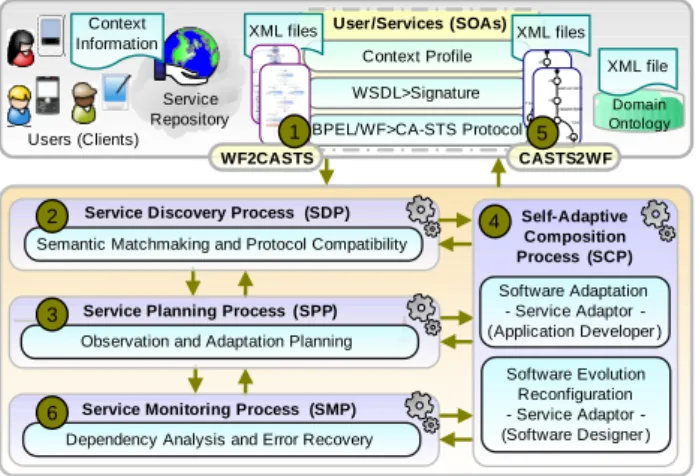
Figure 1 is an overview of our approach, which focuses on systems made up of a service repository, clients (con-sidered as services as well), and a shared domain ontol-ogy. When a user performs a request, e.g., from a mo-bile device, our process is executed. First, (1) abstract in-terface specifications (Context-Aware Symbolic Transition Systems, CA-STSs, presented in Section 3.1) are extracted from the BPEL or WF services, by means of our model transformation process (Section 3.2). Then, (2) a
ery process based on semantic and compatibility mecha-nisms finds the services satisfying that request, and iden-tifies possible mismatches and changes that will determine whether the services involved need adaptation and/or evo-lution (Section 4.1). If mismatches or changes occur, then (3) observation planning will determinewhen,where,what, andhow[6] to perform adaptation and/or evolution depend-ing on whether the changes are related to anticipated or unanticipated adaptation, respectively. Next, (4.a) in the case that adaptation is required, a CA-STS adaptor will be generated in a non-intrusive way (Section 4.1), and (4.b) if evolution is needed, then first the designer will have to modify the system in an intrusive way, and second the adaptor will be generated (Section 4.1). Then, (5) from the CA-STS adaptor, the corresponding BPEL or WF adaptor service is generated using our model transformation pro-cess (Section 4.1), and the whole system is deployed, al-lowing the BPEL or WF services to interact via the BPEL or WF adaptor. Finally, (6) a fault tolerance process han-dles exceptions raised by adaptive demand, returning back the system to any earlier stable situation, by using error re-covery techniques (Section 4.2).
Service Discovery Process (SDP)
Semantic Matchmaking and Protocol Compatibility Users (Clients)
Service Repository Context Information
Context Profile
User/Services (SOAs)
WSDL>Signature
BPEL/WF>CA-STS Protocol XML files XML files
T AU reqDoc! d:tdate T AU
reqSpec! d:tdate user!usr:tstring password!pwd:tstring c0 c1 c2 c3 c6
TAU reqDoc!
TAU reqSpec! d:tdate user!usr:tstring password!pwd:tstring c0 c1 c2 c3 c6
Domain Ontology
XML file
Service Monitoring Process (SMP)
Dependency Analysis and Error Recovery
Service Planning Process (SPP)
Observation and Adaptation Planning
Software Adaptation Service Adaptor -(Application Developer )
Software Evolution Reconfiguration Service Adaptor -(Software Designer )
Self-Adaptive Composition Process (SCP)
2
3
4
6
CASTS2WF WF2CASTS
1 5
Figure 1: Overview of our proposal
Outline. The remainder of this article is structured as fol-lows. In Section 2, we introduce a case study which will be used throughout this article for illustrative purposes. tion 3 presents our model-based SOA approach. In Sec-tion 4.1 the dependable composiSec-tion process is described. Sections 5 presents works related to model-based transfor-mation, and self-adaptive and error recovery techniques. Finally, Section 6 ends the article with a discussion about the evaluation of our approach and some concluding re-marks.
2
Motivating example: ITS
To illustrate our proposal, we describe a case study in which services connected to an Intelligent Transportation System (ITS) require and provide context-aware trans-portation facilities. We consider different scenarios where city users of transport (passengers or drivers) are interested in planning their route on their hand-held devices (mobile phones or onboard computer), by receiving data from a
Route service. In addition to the Route service, a Map ser-vice may also reply the user’s requests as the Route serser-vice is not available anymore. We consider two kind of users: 1) bus/metro passenger, and 2) drivers. The latter have two different profiles: driving a private vehicle (car), or a taxi. Users receive different results of their route, depending on their profiles. We assume services can respond to the users’ requests, but issues related to inconsistencies, changes or faults may arise at run-time, making it necessary to detect and handle them.
Passenger scenario. A passenger communicates with the system to obtain the best itinerary to a destination by bus/metro. The Route service response depends on certain context information,i.e., the passenger location and desti-nation, as well as the traffic or transport timetable, so the result may vary frequently.
Driver scenario. Let us imagine the Route service typi-cally calculates a route requested by drivers based on traf-fic congestion (considering vehicles that enter and leave an area). In a normal situation, a car/taxi driver can change the route dynamically on being advised by the ITS of rerouting alternatives. In this scenario, we describe three different cases:
- A)Drivers request that the Route service considers the context information related to the weather as a new require-ment to calculate the rerouting.
- B)From the previous case, vehicles driving in a spe-cific area discover a new Car Parking service provided by the context of the new environment, but not considered ini-tially by the system. Drivers would like to request this new service, so the ITS should include that service into the sys-tem.
- C)Considering the requirements of the two previous cases, we imagine that in a certain moment the connection with the Route service is lost. This service will be replaced automatically and quickly at run-time by another service with similar functions and considered at design-time by the system,i.e., the Map service, which will also help to guide the driver.
This case study presents a service-oriented pervasive
system with context-awareness features. Self-adaptive
3
Model-based SOA
In this section, we describe our formal model to specify services using Context-Aware Symbolic Transition Sys-tems (CA-STS). Different automata-based or Petri net-based models can be used to describe behavioural inter-faces. We have chosen CA-STS, which is based on transi-tion systems, because it is simple, graphical, and provides a good level of abstraction to tackle discovery, verification, composition, or adaptation issues [14, 15]. Furthermore, any formalism to describe dynamic behaviour may be ex-pressed in terms of a transition system [14]. Thus, our approach becomes general enough to be applied in other applications. In addition, we relate our interface model to implementation platforms. There exists several platforms or languages that can be used to develop services, such as UML6, BPEL or WF. First, we present the syntax and op-erational semantics of our interface model. Second, we de-scribe a textual grammar to abstract implementation details of WF activities, and define our transformation process to extract CA-STS specifications from WF services.
3.1
CA-STS Interface Model
We consider systems consisting of context-aware clients and services. We assume both client and service inter-faces are specified using context profiles, signatures and protocols. Context profiles define information which may change according to the client preferences and service en-vironment. Signatures correspond to operations profiles. Protocols are represented using transition systems. Client and services interact according to the operational semantics we will define later.
Context Profile, Signature and Protocol.
Acontextis defined as“the information that can be used to characterise the situation of an entity. An entity is a person, place, or object that is considered relevant to in-teraction between a user and an application including the user and application themselves” [12]. Context informa-tion can be represented in different ways and can be clas-sified in four main categories [17]: (i) user context: role, preferences, language, calendar, social situation or privi-leges, (ii) device/computing context: network connectivity, device capabilities or server load, (iii) time context: current time, day, year, month or season, and (iv) physical context: location, weather or temperature. For our purpose, we only need a simple representation where contexts in both clients and services are defined by context attributes with asso-ciated values. In addition, we differentiate between static context attributes (e.g., role, day, ...) and dynamic ones (e.g., network connectivity, current time, location, ...). Dy-namic attributes can change continuously at run-time, so they have to be dynamically evaluated during the service composition. Finally, both clients and services are char-acterised by public (e.g., weather, temperature, season, ...) and private (e.g., personal data, local resources, ...) context attributes. Thus, we represent and gather the service
con-6http://www.omg.org/technology/documents/formal/uml.htm
text information by using acontext profile, which is a set of tuples(CA,CV,CK,CT), where:CA is a context attribute (or simply context) with its corresponding valueCV,CK
determines ifCAis static or dynamic, andCT indicates if
CAis public or private. For instance, (user, driver, static, public), indicates that useris a public and static context which corresponds to the user profiledriveras value.
A signaturecorresponds to a set of operation profiles. This set is a disjoint union of provided and required oper-ations. An operation profile is the name of an operation, together with its argument types (input/output parameters) and its return type.
A protocol is represented using a Symbolic Transi-tion Graph (STG) [16] extended with value passing, con-text variables and conditions, that we call Concon-text-Aware Symbolic Transition System (CA-STS). Conditions spec-ify how applications should react (e.g., to context changes). We take advantage of using ontologies described in a spe-cific domain to capture and manage the semantic informa-tion of the services in a system by comparing concepts, such as context information, operation names, arguments and types. In this way, we can determine the relationship between the different concepts that belong to that domain.
Let us introduce the notion of variable, expression, and label required by our CA-STS protocol. We consider two kinds ofvariables, those representing regular variables or static context attributes, and those corresponding to dy-namic context attributes (named context variables). In or-der to distinguish between them, we will mark the context variables with the symbol “∼” over the specific variable. Anexpressionis defined as a variable or a term constructed with a function symbol f (an identifier) applied to a se-quence of expressions, i∈ f(F1, . . . ,Fn),Fi being
expres-sions.
Definition 1(CA-STS label). A label corresponding to a transition of a CA-STS is either an internal actionτ(tau) or a tuple(B,M,D,F)representing an event, where: B is a condition (boolean expression that manages both con-ditional choices and context changes), M is the operation name, D is the direction of operations (! and ? represent emission and reception, respectively), and F is a list of ex-pressions if the operation corresponds to an emission, or a list of variables if the operation is a reception.
Definition 2 (CA-STS Protocol). A Context-Aware Sym-bolic Transition System (CA-STS) Protocol is a tuple
(A,S,I,Fc,T), where: A is an alphabet which corresponds to the set of CA-STS labels associated to transitions, S is a set of states, I∈S is the initial state, Fc⊆S are correct final states (deadlock-free), and T ⊆S×A×S is the tran-sition function whose elements (s1,a,s2)∈T are usually denoted by s1−→a s2.
focus on the client shown in Figure 6. It has an inter-face (CPU,SIU,PU), whereCPU refers to the context
in-formation related to the user location (dynamic context attribute loc), user profile and device used by the client of the user (static context attributesuseranddev respec-tively), SIU is formed by all the operation profiles, such
aslu1 =reqR!dest,loc˜ ,user˜ , andPU is the protocol which indicates the CA-STS behaviour. For example,lu1 means that a client with the context informationlocanduser is-sues an emission looking for a route from his/her location to a destination, and then this client receives a possible routelu2 =getR?route, and so on. Note we have left out the return types of the arguments to simplify the notation. Initial and final states are depicted in CA-STSs using bul-let arrows and hollow states, respectively. Our proposal is suitable for synchronous systems where clients interact with services, such as mobile systems. We adopt a syn-chronous and binary communication model (explained in next section, Figure 3). Clients can execute several proto-cols simultaneously, i.e., concurrent interactions (in a bi-nary model). Client and service protocols can be instanti-ated several times.
At the user level, client and service interfaces can be specified by using: (i) context information into XML files for context profiles, (ii) WSDL for signatures, and (iii) business processes defined in industrial platforms, such as Abstract BPEL (ABPEL) [1] or WF workflows (AWF) [10], for protocols. We assume context information is inferred from the client requests (HTTP header of SOAP messages), thereby as a change occurs the new value of the context attribute is automatically sent to the corresponding service (controlled in rules presented in Figure 2). We also consider processes (clients and services) implemented as business processes which provide the WSDL and protocol descriptions.
Next, we define the CA-STS operational semantics.
Operational Semantics of CA-STS.
We formalise first the operational semantics for one CA-STS service, and second for the composition ofnCA-STS services. In the following, we use a pair⟨s,E⟩to represent an active states∈S and an environmentE. An environ-ment is a set of pairs ⟨x,v⟩where xis a variable, andv
is the corresponding value ofx(it can be also represented byE(x)). The functiontypereturns the type of a variable. We use boolean expressionsbto describe CA-STS condi-tions. Regular and context variables are evaluated in emis-sions and receptions (by considering the current value of the context,e.g., the current date), respectively. Therefore, two evaluation functions are used to compute expressions in an environment: (i)evevaluates regular variables or ex-pressions, and (ii)evcevaluates context variables changing
dynamically. We defineevas follows:
ev(E,x), {
E(x) if x is a regular variable x if x is a context variable
ev(E,f(v1, . . . ,vn)),f(ev(E,v1), . . . ,ev(E,vn))
Functionevcis defined in a similar way toev, only
con-sidering context variables, since we first applyevto eval-uate the regular variables: evc(E,x),E(x), wherexis a
context variable. We also define an environment overload-ing operation “⊘” in such a way that given an environment
E,E⊘ ⟨x,v⟩denotes a new environment, where the value corresponding toxisv.
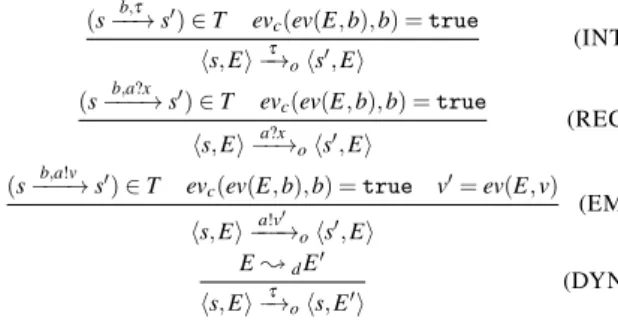
We present in Figure 2 the semantics of a CA-STS (−→o),
with three rules that formalise the meaning of each kind of CA-STS label: internal actionsτ (INT), emissions (EM), and receptions (REC); and one rule to simulate the dynamic update of the environment according to the context changes at run-time (DYN). Note that according to Definition 1,
b∈Bis a condition,a∈Mis an operation name, andx∈F
andv∈Fcorrespond to a list of variables and expressions, respectively. A conditionbmay contain regular and/or con-text variables and both of them must be evaluated in the environment of the source service (sender), because the de-cision is taken in the sender. However, evaluation of ex-pressionsvonly affects regular variables (rule EM), since context variables will be evaluated in the target service (re-ceiver) to consider the context values when the message is received (see rule COM in Figure 3). We assume that the dynamic modification of the environment will be de-termined by different external elements depending on the type of the context (e.g., user intervention, location update by means of a GPS, time or temperature update, and so on). Then, we model this situation by assuming a transition re-lation which indicates the environment update as a change occurs, denoted byE;dE′, whereE′(x)̸=E(x)only ifx
is a dynamic context variable, and in which case the new value ofxis automatically sent to the corresponding ser-vice.
(s−−→b,τ s′)∈T evc(ev(E,b),b) =true
⟨s,E⟩−→τ o⟨s′,E⟩
(INT)
(s−−−→b,a?x s′)∈T evc(ev(E,b),b) =true
⟨s,E⟩−−→a?x o⟨s′,E⟩
(REC)
(s−−−→b,a!v s′)∈T evc(ev(E,b),b) =true v′=ev(E,v)
⟨s,E⟩−−−→a!v′ o⟨s′,E⟩
(EM)
E;dE′
⟨s,E⟩−→τ o⟨s,E′⟩
(DYN)
Figure 2: Operational Semantics of one CA-STS
The operational semantics ofn(n>1) CA-STSs (−→c)
is formalised using two rules: a first synchronous commu-nication rule (COM, Figure 3) in which value-passing and variable substitutions rely on a late binding semantics [20] and where the environmentEis updated; and a second in-dependent evolution rule (INEτ, Figure 3). A list of pairs ⟨si,Ei⟩ is represented by [as1, . . . ,asn]. Rule COM uses
the functionevcto evaluate dynamically in the receiver the
con-text changes. Rule INEτ is executed in the case of an in-ternal service propagation that gives rise to either a state (related to the rule INT) or an environment (rule DYN) change. Thus, transitions−→c do not distinguish between
internal evolutions coming from either internal actions in services or dynamic updates in the environment.
i,j∈ {1..n} i̸=j type(x) =type(v) ⟨si,Ei⟩ a!v
−−→o⟨s′i,Ei⟩
⟨sj,Ej⟩−−→a?x o⟨s′j,Ej⟩ E′j=Ej⊘ ⟨x,evc(Ej,v)⟩
[as1, . . . ,⟨si,Ei⟩, . . . ,⟨sj,Ej⟩, . . . ,asn] a!v
−−→c
(COM)
[as1, . . . ,⟨s′i,Ei⟩, . . . ,⟨s′j,E′j⟩, . . . ,asn]
i∈ {1..n} ⟨si,Ei⟩−→τ o⟨s′i,Ei′⟩
[as1, . . . ,⟨si,Ei⟩, . . . ,asn]−→τ c[as1, . . . ,⟨s′i,Ei′⟩, . . . ,asn] (INEτ)
Figure 3: Operational Semantics ofnCA-STSs
Following, we present our model transformation process by using WF services as illustration purpose.
3.2
Model Transformation Process
To perform the service discovery, composition, adaptation and maintenance, we first need to define a textual notation to abstract and formalise services implemented in the WF platform. Second, we define our model transformation pro-cess.
Abstraction of WF Workflows.
To relate our model transformation process with realistic and complex examples, we use the WF platform, which be-longs to the .NET Framework 3.5 and is supported by Vi-sual Studio 2008. We have chosen WF because it makes the implementation of services easier thanks to its workflow-based graphical support and the automation of the code generation, and it is an useful and interesting alternative compared to the well-know BPEL. Nevertheless, we have also validated our proposal using BPEL as shown in [7]. In addition, the .NET Framework is widely used in many companies, and WF is increasingly prevalent in the soft-ware engineering community [26].
In order to illustrate the motivating example presented in Section 2, we use a representative kernel of the
WF activities, namelyCode,Sequence, Terminate,
Receive, Send, IfElse, While, andListenwith
EventDrivenactivities, that are general enough to de-scribe any service.
In Table 1, we formalise the textual grammar (left hand-side) defined for the WF activities considered (on the right hand-side the informal meaning of these activities is provided), which abstracts several implementation details. Our grammar considers as input textual workflows (defined in XML files) corresponding to the graphical description of the WF workflows, with WF activitiesA, whereC,Ciare
boolean conditions,I, Ii (inputs), O,Oi (outputs) are
pa-rameters of activities, andIdare service identifiers. The WF platform is capable of developing workflows in different scenarios, from simple sequential ones to realistic and complex state machine-based workflows involving hu-man interaction. The programming languages available in
A ::=Code executes code
|Terminate ends WF
|Receive(Id,Op[,O,I1,. . . ,In]) receives msg
|Send(Id,Op[,O1,. . . ,On,I]) sends msg
|Sequence(A1,A2) executesA1,A2
|IfElse((C1,A1),. . . ,(Cn,An),A) Aiif CiorA
|While(C,A) Awhile C
|Listen(E1,. . . ,En) fires one Ei
E::=EventDriven(Receive(Id,Op[,Ii]),A) Awhen Id
Table 1: Grammar for the WF abstract notation
the platform areVisual BasicandC#. Our examples have been implemented inC#.
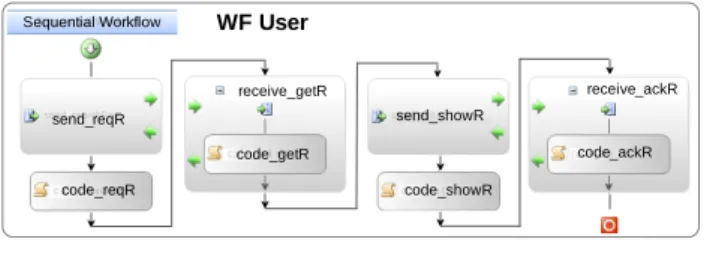
Example. We have designed WF workflows for the User Route request, and for the Route and Map services. WF provides a WSDL description for each WF workflow. For space reasons, in Figure 4 only the WF workflow that rep-resents the behaviour of the User Route request is shown.
WF User
send_reqR
code_reqR Sequential Workflow
send_showR
code_showR
code_ackR receive_ackR receive_getR
code_getR
Figure 4: WF workflow of the User’s request
Next, we present how we extract CA-STS specifications from WF services.
From WF to CA-STSs.
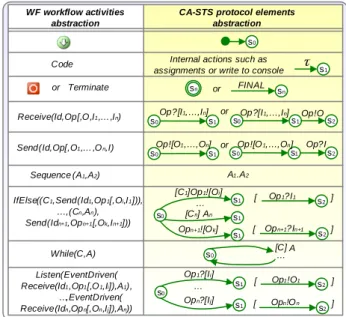
CA-STSs are used as an abstraction to focus on behavioural composition issues by describing service interfaces in a standard notation. These CA-STSs are automatically gen-erated from WF services. For each WF service, our model transformation process parses the three XML files corre-sponding to its context information, WSDL description, and WF workflow. A new XML file containing the in-formation about its context profile, signature, and CA-STS protocol is automatically generated. This XML corre-sponds to the behavioural interface of a CA-STS specifica-tion. This process has been implemented following the pat-terns of our transformation process presented in Figure 5.
Receive(Id,Op[,O,I1,…,In)
s0 s1
Op?[I1,…,In] Op!O
s0 s1 s2
Send(Id,Op[,O1,…,On,I)
s0 s1
Op?I
s0 s1 s2
Op?[I1,…,In]
Op![O1,…,On] Op![O1,…,On] or Terminate
s0
sn
Sequence (A1,A2)
or or Code
or FINAL sn WF workflow activities
abstraction
CA-STS protocol elements abstraction
Internal actions such as assignments or write to console
τ s1
A1.A2
IfElse((C1,Send(Id1,Op1[,Oi,I1])), …,(Cn,An),
Send(Idn+1,Opn+1[,Ok,In+1])) s0
… s1 s1
s1
[C1]Op1![Oi]
[Cn] An
Opn+1![Ok]
s2
s2
[
[ Op1?I1
Opn+1?In+1
]
]
While(C,A) s0 [C] A…
Listen(EventDriven( Receive(Id1,Op1[,O1,Ii]),A1),
…,EventDriven( Receive(Idn,Opn[,On,Ij]),An))
s0
… Op1?[Ii]
Opn?[Ij] s1 s1 s2 s2 [ [ Op1!O1
Opn!On
]
]
Figure 5: Patterns of our model transformation process from WF to CA-STS and vice versa
preserve the activities’ order, (v)IfElsecorresponds to an internal choice, (vi)While is translated as a looping behaviour, andListencorresponds to an external choice. Initial and final states in the CA-STS come respectively from the initial and final states that appear in the workflow. There is a single initial state that corresponds to the begin-ning of the workflow. Final states correspond either to a
Terminateor to the end of the workflow, so several final states may appear in the CA-STS because several branches in the workflow may lead to a final state.
Example. We apply the model transformation process to the WF services of our case study in order to obtain the cor-responding CA-STS specifications. Figure 6 shows the in-terfaces of the User (passenger or driver) and the Route and Map services modelled using our CA-STS interface model. Each interface has a context profile, a signature and a CA-STS protocol. Route Service User’s Protocol (U) u0 u1 Route Service Protocol (R) Context
Profile loc (dyn) user (static)
dev (static)
u2
u3
u4 lu1=reqR ! dest,lõc,usẽr
lu2=getR?route
lu3=showR!route,
dẽv
lu4=ackR?
r0
r1
r2 lr1=setR?dest,
loc,user
lr2=sendR !route
r3
r4 lr3=displayR?route,
dev
lr4=confirmR !
Map Service Map Service Protocol (M)
m0
m1
m2 lm1=setM?dest ,
loc,user
lm2=sendM!
route_map
m3
m4 lm3=displayM?
route _map,dev
lm4=confirmM!
Context Profile loc (dyn) user (static) traffic (dyn) dev (static) User
Figure 6: CA-STS of User and Route and Map services
4
Dependable composition of
self-adaptive SOA
This section presents our approach to tackle self-adaptive systems changing dynamically over time and must con-tinue offering services as inconsistencies, changes or faults occur. We aim to combine self-adaptive composition and error recovery techniques to perform adaptation and evolu-tion strategies and to handle errors, respectively.
4.1
Self-Adaptive Composition
Composing services relates to dealing with assembly of au-tonomous services given their interfaces. We need to ad-dress the specification of the composition, and to ensure the services are composed in a consistent way.
Firstly, our discovery process (SDP module in Figure 1) finds the most appropriate services for a user’s request. To do that, it is based on semantic matchmaking and protocol compatibility techniques [9]. The first is used to establish a ranked list of the services that better match the user’s re-quest, by comparing the semantic matching of the context profiles and all the operation profiles (names, arguments and types) w.r.t. an ontology defined in the ITS domain. The second checks if the services selected are compati-ble with the user at the protocol level. There exists dif-ferent notions of compatibility in synchronous communi-cation, such as opposite behaviours, unspecified reception, and freeness [4]. We have chosen the deadlock-freeness notion to illustrate our proposal, but other defi-nitions could also be used. This compatibility definition guarantees that all the interactions between two services are performed in a satisfactory way, leading to a correct final state.
unan-ticipated adaptation, such as new requirements or services fully created at run-time.
Then, self-adaptive techniques by combining both adap-tation and evolution paradigms (SCP module in Figure 1) supposes a contribution of the approach presented in this work, where the actors are the application developers and the software designers, respectively. We have made the distinction between software adaptation, where application developers generate third-party adaptors (using the adap-tation contract) in a non-intrusive way, and software evo-lution, where software designers modify the software enti-ties in an intrusive way and then an adaptor is generated. To perform this, we follow a two-process methodology, by modeling self-adaptive systems with a combination of an-ticipated and unanan-ticipated adaptation. First, the applica-tion developers, who do not have knowledge of the source code and documentation, take advantage of adaptors to au-tomatically adapt software when it is not necessary to mod-ify the code. When the first process is not enough to adapt the system to the new situation because changes in the re-quirements or an addition/removal of a service occur, then our approach help the software designers to perform evo-lution. Therefore, they select a minimal set of changes to adapt software, as they are familiar with such software sys-tem. Note that this intrusive way of adapting the system requires that the designer has knowledge not only about the system, but also about our approach.
From the (matching) tuples of sets of correspondences obtained in the discovery process, we can automatically generate an adaptation contract when any fault or change occurs during the service interaction. Moreover, we also want composition to distinguish between the available con-texts when translating the messages among services. Using a non-contextual approach, message correspondences are fixed. This prevents inconsistencies or changes in these connections being taken into account, and motivates the need for the new capabilities that our approach provides in order to achieve message translation depending on con-texts. Therefore, we define the adaptation contract between events in the CA-STS protocols by means of vectors ex-pressing interactions among service messages to specify the evolution of every service depending on its contexts. These interactions denote a service communication and are formalised throughsynchronisation vectors [2], which al-low messages with different names and even different num-bers of parameters to be synchronised. Each event appear-ing in one vector is executed by one service, and the over-all result corresponds to a synchronisation between over-all the services involved. A vector may involve any number of services.
Definition 3(Synchronisation Vector). A synchronisation vector (or vector for short) for a set of protocols Pi=
(Ai,Si,Ii,Fci,Ti), i∈ {1, ..,n}, is a tuple ⟨v1, . . . ,vn⟩with vi∈Ai∪{ε},εmeaning that a service does not participate in a synchronisation.
However, vectors are not sufficient to support more advanced adaptation scenarios such as contextual rules,
choice between vectors or, more generally, ordering (e.g., when one message in some service corresponds to several in another service, which requires the application of sev-eral vectors). The order in which vectors have to be ap-plied can be specified using different notations such as reg-ular expressions, Labelled Transition Systems (LTSs), or (Hierarchical) Message Sequence Charts (MSCs). Due to their readability and user friendliness, we chose to spec-ify adaptation contracts using LTSs whose labels are tu-ples. This tuple-LTS is made up of a set of tuples ⟨v,a⟩, where v is a vector on transitions and a indicates if v
has been executed, interrupted or not executed (values
can be successful_execution, int_execution
or not_executedrepresented withS,I andN, respec-tively). Therefore, this tuple-LTS is essential in some situa-tions in which faults, such as deadlocks or livelocks, can be avoided by applying some vectors in a specific order. If the order among correspondences between services does not matter, the tuple-LTS contains one state with all transitions looping on it.
Next, we introduce the formal notion of adaptation con-tract, which is used to model the composition of services making use of vectors and tuple-LTS.
Definition 4 (Adaptation Contract). An adaptation con-tract for a set of services W si, i∈1, ...,n, is defined as a couple(VW si,Tlts), where VW si is a set of vectors for ser-vices W si, and Tltsis a tuple-LTS that indicates the interac-tion order of the vectors VW si.
Finally, by using the adaptation contract and CA-STS services, we generate a third-party CA-STS adaptor, that is in charge of coordinating the services in the system w.r.t.
the set of interactions defined in the contract (according to the rule COM, Figure 3). For limitations of space and since it is not a new contribution of this article, the adaptor gen-eration is detailed in our previous works [7, 10]. Adaptor is platform independent, and it can be refinedw.r.t.a specific platform, such as the WF platform (using our transforma-tion process, Figure 5).
Next, we describe our fault tolerance process, which handles exceptions by using error recovery technique.
4.2
Error Recovery Mechanism
mechanisms to handle exceptions raised by adaptive de-mand, returning back the system to any earlier stable state. To do that, we define an error recovery algorithmbased on backward and forward error recovery, handling possible failures.
First, we need to define a data structure, called vector dependency, to track dependencies among the synchroni-sation vectors of an adaptation contract. We base this on the tuple-LTS previously generated to obtain the vector de-pendencies, since the tuple-LTS indicates the order of in-teractions of the vectors.
Definition 5 (Vector dependency). A vector dependency between two vectors v1and v2is a link relationship such
as v1 P
−→v2, where P can define both either functional or non-functional properties (such as temporal requirements or resources), and it must always be true to move from v1 to v2.
Then, we define aninteraction set, which is generated as a set of vector dependencies. This set is used to handle failures, by identifying all the vectors affected by these fail-ures. Thus, an interaction set contains all the vectors in the adaptation contract of the communication between services involved in the interaction.
Our algorithm is executed when any failure related to networks or services occurs, by performing the following steps: (1) identify the last vector to be executed in the inter-action set where the fail occurred, (2) change the status of all vectors of that interaction set whose events are directly involved in the error toint_execution, (3) change the status of all vectors related to other interaction sets which depended on the vectors involved in the failed interaction set toint_execution, (4) wait for a timeout if the ser-vice that provoked the error can be re-established, or swap the failed service with another service capable of perform-ing similar roles, (5) if there are not services to swap, then an exception will be triggered to all the vectors involved in the error and the execution will stop, otherwise (6) re-execute all vectors in the interaction set that are labeled as
int_executionand therefore change the value of those
vectors tosuccessful_execution.
Next, we illustrate both self-adaptive and error recovery processes by using the different scenarios described in our case study.
Example. Considering the full approach presented above, we address the scenarios of our case study ITS.
Firstly, common to all the scenarios, to illustrate the dis-covery process, we focus on the user’s request (passenger or driver). Our process selects Route and Map services in that order according to the semantic matchmaking, and two (matching) tuples of sets of correspondences between oper-ation profiles are returned and presented below (labelslu1,
lr1, etc., are represented in Figure 6).
MTU,R={(lu1,lr1),(lu2,lr2),(lu3,lr3),(lu4,lr4)}
MTU,M={(lu1,lm1),(lu2,lm2),(lu3,lm3),(lu4,lm4)}
Once our process has discovered the services, we need to handle the inconsistencies, changes or faults which have
arisen while composing services in our four scenarios.
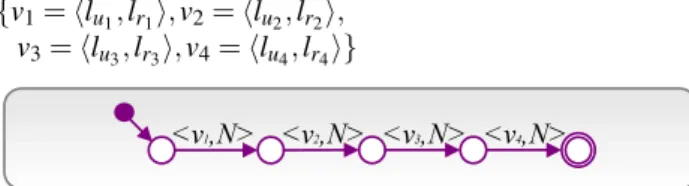
Passenger scenario. In this scenario, our self-adaptive process applies software adaptation due to the mismatch problems in the behavioural interfaces. An adaptor is gen-erated by means of the adaptation contract between the User (passenger) and the Route service. The contract is made up of the set of vectors presented below and the tuple-LTS depicted in Figure 7. The ITS knows at design-time the different contexts considered at run-time in this sce-nario, so it is enough with anticipated adaptation for the response given by the Route service.
{v1=⟨lu1,lr1⟩,v2=⟨lu2,lr2⟩,
v3=⟨lu3,lr3⟩,v4=⟨lu4,lr4⟩}
<v1,N> <v2,N> <v3,N> <v4,N>
Figure 7: Tuple-LTS indicating the interaction order be-tween the User and the Route service
It is worth mentioning that in every tuple⟨vi,a⟩,ais
al-ways initialised to N (not_executed), and during the composition process this value will change to either S
(successful_execution) when the vectorvi is
ex-ecuted or toIwhen it is interrupted (int_execution).
Driver scenario.Here we have three different cases.
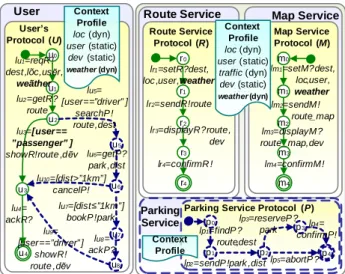
- A)and- B)Both cases needs unanticipated adaptation based on software evolution. Neither the new requirement (the context information related to weather) requested by drivers to obtain the rerouting, nor the new service (Parking service) provided at run-time by the driver location, were considered by the ITS at design-time. Therefore, the soft-ware designer has to modify the code of the Route service to include the weather in the context profile, and to incor-porate the new Car Parking service into the ITS. Our ap-proach will reconfigure dynamically the new full system to allow to the Users (drivers) to carry on communicating correctly with the Route service, and to discover the new service when they require it. The new CA-STS interfaces corresponding to the User and the Route, Map and Parking services are shown in Figure 8.
Note that the modifications are represented by dashed lines and bold text (e.g., weather). In addition, conditions have been added (e.g.,[user==“passenger”]inlu3) to de-termine that only user profile driver will request the parking service. The designer needs to know about the system and our approach to perform these kinds of modifications.
We continue focusing on the interaction between the User and Route service, but now also including the Parking service. Then, software adaptation is applied in the new service interfaces, by generating a new adaptation contract to avoid the new mismatches. Below we present the set of vectors (labels lu1, lr1, etc., are represented in Figure 8), and the tuple-LTS (Figure 9).
{v1=⟨lu1,lr1⟩,v2=⟨lu2,lr2⟩,v3=⟨lu3,lr3⟩,
v4=⟨lu4,lr4⟩,v5=⟨lu5,lp1⟩,v6=⟨lu6,lp2⟩,
v7=⟨lu7,lp3⟩,v8=⟨lu8,lp4⟩,v9=⟨lu9,lr3⟩,
Route Service
User’s Protocol (U)
u0
u1
Route Service Protocol (R) Context
Profile loc (dyn) user (static)
dev (static)
weather (dyn)
lu1=reqR !
dest ,lõc,usẽr,
weãther
lu2=getR? route
r0
r1
r2
lr1=setR?dest,
loc ,user,weather
lr2=sendR!route
r3
r4
lr3=displayR?route,
dev
lr4=confirmR !
Map Service
Map Service Protocol (M)
m0
m1
m2
lm1=setM?dest,
loc,user,
weather
lm2=sendM! route_map
m3
m4
lm3=displayM?
route_map,dev
lm4=confirmM! Context
Profile loc (dyn) user (static)
traffic (dyn) dev (static) weather (dyn) User u2 u3 u5 u6 u4 u7 u8
lu3=[user== ”passenger” ]
showR!route ,dẽv lu6=getP? park ,dist
lu4=
ackR? lu9=
[user==”driver” ] showR! route ,dẽv
lu7=[dist≤”1km”]
bookP !park
lu8= ackP? lu5=
[user==”driver” ] searchP ! route,dest
Parking Service
Parking Service Protocol (P) p0
p1
lp1=findP ? route,dest
p2 p3
lp2=sendP !park ,dist
lp3=reserveP ?
park
p4
lp4=
confirmP!
lp5=abortP ? Context
Profile lu10=[dist>”1km”]
cancelP!
Figure 8: CA-STS of User and Route, Map and Parking services after applying our process in A) and B)
<v1,N> <v2,N> <v5,N> <v6,N>
<v7,N> <v8,N>
<v9,N>
<v3,N> <v4,N>
<v10,N>
Figure 9: Tuple-LTS indicating the interaction order be-tween the User and the Route and Parking services
Finally, we can generate an adaptor for the interaction between the User and Route and Parking services.
- C)This case considers the modifications performed in the previous cases. Our error recovery algorithm is applied here, since a suspension of the Route service during the service interaction occurred.
Before performing our algorithm, we generate the vec-tor dependencies and the interaction sets corresponding to the communication between the User and the Route and Parking services, by means of the tuple-LTS presented in Figure 9.
{v1−−−−→Pv1,v2 v2,v2−−−−→Pv2,v3 v3,v2−−−−→Pv2,v5 v5, v3−−−−→Pv3,v4 v4,v5
Pv5,v6
−−−−→v6,v6 Pv6,v7
−−−−→v7,
v6 Pv6,v10
−−−−→v10,v7−−−−→Pv7,v8 v8,v8−−−−→Pv8,v9 v9,
v9 Pv9,v4
−−−−→v4,v10 Pv10,v4
−−−−→v4}
We assume propertiesPvi,vj are defined correctly
accord-ing to the requirements of the user’s request. The in-teraction sets are as follows: Iu,r ={v1,v2,v3,v4,v9}and Iu,p={v5,v6,v7,v8,v10}, corresponding to the
communi-cation of the User with the Route service and the User with the Parking service, respectively.
Now, to illustrate the algorithm, we assume that during the interaction between the User and the Route and Park-ing services, a failure occurs in vectorv4(of the previous
contract) corresponding to the confirmation of the Route service,i.e., the correspondence betweenlu4 =ackR? and
lr4 = con f irmR?). Therefore, our process changes to
int_execution all the vectors involved in that error,
and automatically selects another service previously con-sidered and discovered, i.e., the Map service, which re-places the Route service at run-time. This is possible be-cause the designer developed the ITS to support a possible connection loss of the Route service, so a reconfiguration of the system is unnecessary, which reduces effort and cost. A new adaptation contract (vectors and tuple-LTS), with its corresponding adaptor, is generated to solve the new mismatch problems in the interaction of the User and the Map and Parking services.
{v1=⟨lu1,lm1⟩,v2=⟨lu2,lm2⟩,v3=⟨lu3,lm3⟩,
v4=⟨lu4,lm4⟩,v5=⟨lu5,lp1⟩,v6=⟨lu6,lp2⟩,
v7=⟨lu7,lp3⟩,v8=⟨lu8,lp4⟩,v9=⟨lu9,lm3⟩,
v10=⟨lu10,lp5⟩}
The corresponding tuple-LTS is equivalent to that pre-sented in Figure 9, but replacing the synchronisation vec-tors v1,v2,v3,v4,v9 of the previous contract (with Route
service) with the vectorsv1,v2,v3,v4,v9related to the new
contract (with Map service).
5
Related work
This section compares our approach with related works in software composition, especially those which focus on model-based transformation, software adaptation and/or evolution, and error recovery.
With respect to the relationship between existing pro-gramming languages and platforms, the work presented in [5] outlines a methodology for the automated genera-tion of adaptors capable of solving behavioural mismatches between BPEL processes (some interaction scenarios can-not be resolved). In [3], the authors present techniques to provide semi-automated support for identification and res-olution of mismatches between service interfaces and pro-tocols, and generate adaptation behavioural specifications based on SCA architecture. Compared to these works, we generate WF adaptor services that consider not only signa-ture and protocol mismatches, but also context-aware and semantic issues. In addition, our approach is able to re-order messages among services when required, since our discovery process allows this facility automatically. This is necessary to ensure correct interaction in the case where communicating entities have messages which are not or-dered as required.
categorising features,when,where,what, andhow. As regards fault tolerance mechanisms, one of the most beneficial ways of applying fault tolerance is by associating its measures with system structuring units [24]. Structuring units, which decrease system complexity and make it easier for developers to apply fault tolerance, can be: distributed transactions and atomic actions. Distributed transactions use backward error recovery [18] as the main fault toler-ance measure in order to satisfy the ACID (atomicity, con-sistency, isolation, durability) properties. Transactions sup-pose a powerful abstraction to address failures occurring in closed systems. However, they impose highly severe con-straints over systems in open environments such as SOA (e.g., real-time systems do not have time to go back). In our approach, we use atomic actions, that allow program-mers to apply both backward and forward error recovery to satisfy certain properties for composing service as a failure occur. Forward error recovery uses appropriate exception handling without impacting on the autonomy of services whilst exploiting their possible support for dependability. In addition, to handle exceptions optimally, our error re-covery mechanism specifies that services return exceptions quickly, since notification delay can affect the SOA perfor-mance, especially in complex workflow systems.
Summarising, our approach combines efforts to detect and handle the different changes or faults arising in self-adaptive systems, by modelling SOA, performing adapta-tion and/or evoluadapta-tion when required, and monitoring fail-ures with error recovery techniques.
6
Discussion and conclusions
Self-adaptive software requires high dependability, robust-ness, adaptability, and availability. Our approach maintains system consistency and integrity by examining each change and removing those that render the system inconsistent or unsafe. We focus on the development and maintenance of reliable software systems through self-adaptive and er-ror recovery techniques. In addition, we give model-based SOA a push showing its usefulness to manage self-adaptive systems.
On one hand, in many occasions, the necessary effort to develop and maintain the reliable software intensive sys-tems can be solved by using third-party services. In fact, if we weigh up the cost-effectiveness in terms of the ef-fort required to adapt the system to changes occurred, the best solution is not modifying the code when it is not re-quired, because an intrusive way always requires a recon-figuration of the system that is less efficient, w.r.t. time required, than fixing mismatch problems between services by using an adaptor. Regarding this consideration, our pro-posal always performs with the least effort possible to adapt the system. This is illustrated in our case study, where our approach generated an adaptor in all the situations to fix mismatches and manage context changes. Only in a 50% of cases (driver scenarios A) and B)), our approach needed to modify the system and apply reconfiguration. In a 25%
of cases (driver scenario C)), it was necessary to apply error recovery mechanisms.
On the other hand, the development and maintenance of self-adaptive systems using a model-based SOA approach turns out cost-effective. First, because our self-adaptive system provides dependable services to the user, reduces the strong dependence on human resources, and reacts to different events more quickly, being capable of changing its behavior at run-time depending on the context informa-tion. Second, due to the model-based SOA facilities, such as integration, interoperability, flexibility, and incorporat-ing of new requirements. Therefore, our model transforma-tion process provides a level of abstractransforma-tion to tackle discov-ery, planning, monitoring, adaptation and evolution issues easily and independently of the development platform. Our case study consisted of two kinds of users (with two pro-files) and four services in total, so it was not difficult to manage. But, when an organization has a large number of services connected, the management of the service network can become extremely difficult, since all the services are directly connected, which can be unmanageable. In those cases, a model-based SOA may be even more beneficial. A first evaluation to check the scalability of our approach was obtained validating it in several examples with up to 10 ser-vices (a booking on-line system, a travel agency, an on-line computer material store, or the case study presented in this work) applied to the dependable composition of services implemented using indistinctly BPEL and WF. In a not far future, we hope that a wide number of companies adopt model-based SOA to definitively bridge the gap between business and information technology, by making the devel-opment and maintenance of large software projects more agile.
As regards future work, we plan to develop a full-scale system to check our approach that we successfully applied to a small-scale system. We also want to extend our pro-posal to deal with security properties in the vector depen-dencies, by improving the exception management in our fault tolerance mechanism, and tackling in further depth the quality of service. In addition, our approach has some limitations, such as the need of studying how to manage the complexity of the hand-code in case designers must modify the system.
Acknowledgement
This work is partially supported by the project TIN2008-05932 funded by the Spanish Ministry of Science and Innovation (MICINN) and FEDER. The authors are grateful to the anonymous referees who helped to improve the contents and quality of this article.
References
[1] T. Andrewset al.. Business Process Execution Language for Web Services (WSBPEL). 2005.
[2] A. Arnold. Finite Transition Systems. International Series in Com-puter Science. Prentice-Hall, 1994.
[4] L. Bordeaux, G. Salaün, D. Berardi, and M. Mecella. When are Two Web Services Compatible? InProc. of TES’04, vol. 3324 ofLNCS, 2004.
[5] A. Brogi and R. Popescu. Automated Generation of BPEL Adapters. InProc. of ICSOC’06, volume 4294 ofLNCS, 2006.
[6] J. Buckleyet al.Towards a Taxonomy of Software Change.Software Maintenance and Evolution: Research and Practice, 17, 2005. [7] J. Cámara, J.A. Martín, G. Salaün, J. Cubo, M. Ouederni, C. Canal,
and E. Pimentel. ITACA: An Integrated Toolbox for the Automatic Composition and Adaptation of Web Services. InProc. of ICSE’09, IEEE CS, 2009.
[8] C. Canal, P. Poizat, and G. Salaün. Model-Based Adaptation of Be-havioural Mismatching Components. IEEE Transactions on Soft-ware Engineering, 34, 2008.
[9] J. Cubo, C. Canal, and E. Pimentel. Context-Aware Service Discov-ery and Adaptation Based on Semantic Matchmaking. InProc. of ICIW’10. IEEE CS, 2010.
[10] J. Cuboet al. A Model-Based Approach to the Verification and Adaptation of WF/.NET Components. InProc. of FACS’07, vol. 215 ofENTCS, 2007.
[11] B. Dagenais and M.P. Robillard. Recommending Adaptive Changes for Framework Evolution. InProc. of ICSE’08, ACM, 2008. [12] A. Dey and G. Abowd. Towards a Better Understanding of Context
and Context-Awareness. InProc. of Workshop on the What, Who, Where, When and How of Context-Awareness, 2000.
[13] T. Erl.Service-Oriented Architecture (SOA): Concepts, Technology, and Design. Prentice Hall, 2005.
[14] H. Foster, S. Uchitel, and J. Kramer. LTSA-WS: A Tool for Model-based Verification of Web Service Compositions and Choreography. InProc. of ICSE’06, ACM, 2006.
[15] X. Fu, T. Bultan, and J. Su. Analysis of Interacting BPEL Web Services. InProc. of WWW’04, ACM, 2004.
[16] M. Hennessy and H. Lin. Symbolic Bisimulations.Theor. Comput. Sci., 138, 1995.
[17] S. Kouadri and B. Hirsbrunner. Towards a Context-Based Service Composition Framework. InProc. of ICWS’03, 2003.
[18] S. KumarGuptaet al.Backward Error Recovery Protocols in Dis-tributed Mobile Systems: A Survey.Journal of Theor. and Applied Inform. Technology, 4, 2008.
[19] T. Mens and S. Demeyer. Software Evolution. Springer-Verlag. 2008.
[20] R. Milner, J. Parrow, and D. Walker. Modal Logics for Mobile Pro-cesses.Theor. Comput. Sci., 114, 1993.
[21] O. Nierstraszet al.Model-Centric, Context-Aware Software Adap-tation. InSEAMS, vol. 5525 ofLNCS, 2009.
[22] P. Oreizyet al.An Architecture-Based Approach to Self-Adaptive Software.IEEE Intelligent Systems, 14, 1999.
[23] A. Gorbenko et al. Experimenting with Exception Propagation Mechanisms in Service-Oriented Architecture. InProc. of WEH’08, ACM, 2008.
[24] F. Tartanogluet al.Dependability in the Web Services Architecture. InADS, vol. 2677 ofLNCS, 2003.
[25] C. Szyperski. Component Software: Beyond Object-Oriented Pro-gramming. Adisson-Wesley, 2nd edition, 2003.