Transclusions in an
HTML-Based Environment
*
Josef Kolbitsch
1and Hermann Maurer
21Graz University of Technology, Austria
2Institute for Information Systems and Computer Media, Graz University of Technology, Austria
Transclusions are an advanced technique for the inclusion of existing content into new documents without the need to duplicate it. Although originally described in the early 1960s, transclusions have still not been made available to users and authors on the world wide web.
This paper describes the prototype implementation of a system that allows users to write articles that may contain transclusions. The system offers a simple web-based interface where users can compose new articles. With a simple button the user has the ability to insert a transclu-sion from any HTML page available on the world wide web.
While other approaches introduce new markups for the HTML specification, make use of technologies such as XML and XLink or employ authoring systems that internally support transclusions and can generate web pages as output, this implementation solely relies on the techniques provided by an HTML-based environment. Therefore HTML, Javascript, the Document Object Model, CGI scripts and HTTP are the core technologies utilised in the prototype.
Keywords: hypertext, transclusions, xanalogical struc-ture, authoring systems, publishing systems, web-based applications.
1. Introduction
In 1965, Ted Nelson presented “afile structure for the complex, the changing and the
indeter-minate”, in which he introduced the term
hyper-text(see20]). One of the fundamental concepts
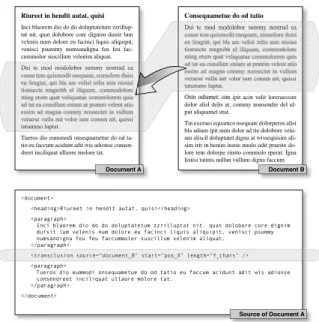
in Nelson’s notion of hypertext is a technique called transclusions. Transclusions allow au-thors to include portions of existing documents into their own articles without duplicating them. Basically, a transclusion in document A is a ref-erence to a portion of the content of a potentially
remote document B that is virtually included into document A(see Figure 1).
Fig. 1.Exemplary transclusion. Part of document B
(top right)is transcluded into document A(top left).
Bottom: the source code of document A does not contain the actual text of document 2, but only the data
required to retrieve it from the original document.
The following sub-sections discuss the back-ground of transclusions and their use in HTML. Section 2 addresses attempts to implement tran-sclusion. Our design and implementation of transclusions in HTML-based environments are detailed in section 3. Issues that were encoun-tered during the implementation are described
in section 4. Finally, section 5 discusses several aspects of our implementation.
1.1. Background of Transclusions
Transclusions are designed as complete replace-ment for allcut-and-pastemechanisms in use. Nelson argues that cut-and-paste is not what people actually want to do but that it is a re-striction imposed upon authors by the nature of paper. Writers actually do not want to make a copy of an existing document, cut out the piece they want to reuse and paste it in their docu-ment. They want to include the original content and let readers know what the source and the context of the quote is(e. g. ,21]).
Reference lists at the end of a scientific publi-cation, for instance, are usually not what is in-tended by writers and desired by readers. They are rather a pragmatic solution to the problem that both the source and the context of the quo-tation are lost by copying-and-pasting a portion of content printed on paper.
What used to be physical restrictions of paper was embraced by most computing systems in an attempt to resemble the work environments and common processes in offices(cf.,33]).
There-fore most current graphical operating systems make use of metaphors such as a desktop, fold-ers and documents; a document has to be put in exactly one folder; there is a clipboard, and content from a different document is included using copy-and-paste mechanisms(see23]).
1.2. Implications of Transclusions
Transclusions are, however, not only a mere re-placement for copy-and-paste. They assure that the original context of a quotation is preserved and can provide a visible link to the source of the transclusion. Ted Nelson’s approach to real-ising this functionality is based ontranspointing
windows(e. g. ,22]).
Moreover, authors of documents can be noti-fied when their articles are transcluded. Thus they can, for instance, find out about other researchers in the same area. Authors using transclusions, on the other hand, can be in-formed automatically about modifications in source documents(see14]).
Apart from obvious improvements in author-ing and publishauthor-ing systems, transclusions can also offer a solution to copyright issues expe-rienced today on the world wide web: authors include content into their documents by means of transclusions. Whenever a reader views a transclusion, a note about the rights associated with the transcluded content is added, and a mi-cropayment is made to the corresponding owner
(25]). Nelson names this modeltranscopyright (see24]).
1.3. Transclusions and HTML
The Hypertext Markup Language(HTML,7])
is a relatively simple language for describing platform-independent hypertext pages. In the early stages of its development, the focus of HTML was on style and graphical presenta-tion rather than on funcpresenta-tionality and underlying paradigms. Therefore, many innovative ideas such as bidirectional hyperlinks and issues al-ready known at that time including broken links were not considered in the implementation (e.
g. ,27]).
In principle, transclusions are used in HTML. Designated markups including<img>,<object> and <embed> incorporate content such as im-ages, Java applets and animations into HTML pages by means of linking. Thus, these el-ements basically make use of the concept of transclusions.
Transclusions in HTML are very limited,though. Only certain media such as images can be virtu-ally included, whereas textual content, in gen-eral, cannot be transcluded. Moreover, the tran-sclusion mechanisms available in HTML can only be applied to entire documents. Fine-grained transclusions such as a small spatial selection of an image are not implemented.
2. Attempts to Implement Transclusions
2.1. Xanadu
Transclusions are an integral part of Xanadu, Ted Nelson’s original hypertext system(e. g. ,
21]). Their implementation relies on a
docu-ment model, though, that is radically different from what is widely used today. In Xanadu, documents(versions)do not contain content but
references to the actual content. Content is both stored and referenced with the highest granular-ity possible – on the level of single characters. All content is retained in content repositories. Any document is made up of a list of references to content stored in the system, e. g. , a document consists of “characters 124 to 729 and 1276 to 1301 from the repository”. When content from document B is transcluded into document A, the corresponding references to the actual content in the repositories are added to the reference list of document A.
Thus, the creation and retrieval of transclusions in Xanadu are trivial list operations. Ted Nel-son also details a number of functions related to transclusions and the handling of situations in which documents are modified or large por-tions of documents are deleted (e. g. , 25]).
Basically, these functions can be seen as more complex list operations.
2.2. Proposal to Amend the HTML
Specification
Since the idea of transclusions is already present in HTML for media such as images and multi-media animations, a sensible approach to text-based transclusions is to introduce a new tag that allows users to transclude text. Therefore,28]
suggests an amendment to the HTML specifica-tion. A new markup,<text>, is proposed with the intention to offer an element of the same significance as<img>or<embed>.
The main attributes of the markup are the URI of the source document and the start position and length of the text to be transcluded. The web browser analyses the tag, loads the source document of the transclusion, extracts the por-tion of text given by the attributes of the<text> tag, and inserts it into the document. Thus, a transclusion is handled in a similar way as an inline image.
Although the proposal seems rational, it has not been accepted, and no web browser to date has the feature implemented.
2.3. Transclusions with IFrames and Embedded Objects
The recommendation for HTML 4 includes markups for inline frames and embedded ob-jects(e. g. ,7]). Both inline frames and
embed-ded objects define areas within a given HTML document that can be used to display potentially remote resources. Inline frames can merely contain HTML pages and images, whereas ob-jects may contain resources of arbitrary type. Transcluding document A into document B can, for instance, be achieved by inserting an <ob-ject>tag with a reference to document A into document B (16]). The capabilities of this
technique are rather limited, though. Only en-tire documents can be referenced. Moreover, the context is lost because a link from the doc-ument containing the embedded object to the source of the transclusion is not provided by these markups. Therefore this approach is not well suited for realising transclusions.
2.4. XML-Based Transclusions
The Extensible Markup Language, XML, is a flexible language for describing documents that contain structured information (see 31]).
In contrast to other markup languages such as HTML, where both syntax and semantics are determined, neither a set of tags nor the seman-tics are defined in XML. Therefore, XML per se does not contain a distinct markup for links; a separate linking language is used instead. XLink, the XML Linking Language(e.g.,30]),
provides a framework for describing the syntax and semantics of even complex linking struc-tures between resources. An XLink link typ-ically contains a number of attributes that de-scribe, for instance, what resource is to be loaded and when it is to be displayed.
Three attributes are essential for the implemen-tation of transclusions using XLink:
actuate: when the resource is to be loaded. When set toonLoad, the resource is loaded when the document containing the XLink link is loaded;
show: in which manner the resource is to be displayed. When set toembed, the resource is displayed practically instead of the XLink tag.
The skeleton of the XLink link shown in listing 1 transcludes the entire document source.xml into the document containing the link at the po-sition of the link. A similar approach to tran-sclusions in XML is described by29].
P\WUDQVFOXVLRQ
[POQVP\ ´KWWSZZZNROELWVFKRUJ´ [POQV[OLQN ´KWWSZZZZRUJ[OLQN´ [OLQNW\SH ´VLPSOH´
[OLQNKUHI ´VRXUFH[PO´ [OLQNDFWXDWH ´RQ/RDG´ [OLQNVKRZ ´HPEHG´!
Listing 1.Fragmentary transclusion with XLink.
With the XML Pointer Language (XPointer,
32])fragments of XML documents can be
iden-tified and addressed as well. Thus, a combi-nation of XML, XLink and XPointer can be employed to make the use of fine-grained tran-sclusions in XML-based environments possible
(see16; 15]).
2.5. Recent Projects Involving Transclusions
Currently, several mostly academic projects that experiment with transclusions exist. The fol-lowing paragraphs introduce three selected sys-tems.
The University of Nottingham, UK, has pro-posed a technology-based learning environment that adapts to its users(see19]). The
informa-tion retained in the system is organised in small “chunks” that are stored as XML files.
Since the system is adaptive, lessons are not static but assembled dynamically on the basis of a lesson plan. When a user requests a particular lesson, appropriate chunks of information are retrieved and included into a virtual document by means of transclusion. Thus, the system
facilitates the reuse of small pieces of informa-tion for a number of lessons or for students with various differing standards of knowledge. At the University of Bologna, Italy, researchers attempt to combine existing software products such as the Internet Explorer and Microsoft Word to offer a collaborative editing environ-ment for the world wide web(see3]). The
im-plemented tool, XanaWord, allows users to edit any web page they view in their web browser – even if they do not have write permissions for the resource.
Any page displayed in Internet Explorer can be opened with a word processor such as Mi-crosoft Word, where the user can make arbi-trary changes to the document. When the user saves the page, only the changes to the original document are stored in the XanaWord reposi-tory. Whenever a document is retrieved from the repository, the modifications made by the user and the content from the original resource are included in a dynamically generated document by means of transclusion. Finally, the dynamic document is sent to the user’s web browser. The Institute for Information Systems and Com-puter Media in Graz, Austria, proposed an envi-ronment capable of handling transclusions in various output document formats (see 14]).
The system includes three components:
the Latex typesetting system that allows users to create documents and save them in a num-ber of document formats including Postscript, PDF and HTML;
an extension to Latex that allows users to create transclusions; and
a Hyperwave Information Server (see 9])
that handles issues such as linking and ver-sioning.
3. Implementation
In contrast to several approaches to transclu-sions illustrated above, this project does not present a proposal but an actual implementa-tion of a system that lets users take advantage of transclusions. It is designed as part of a larger system that offers communities instruments to work actively with content from digital libraries and electronic encyclopaedias(see12]). Thus,
a prototype is implemented offering a tool for authoring new articles that can contain transclu-sions. It is available online at11].
3.1. Design Goals and Requirements
The environment for creating and retrieving transclusions aims at facilitating the reuse of information readily available on the Web – even by novice users. Therefore a number of design goals have to be taken into consideration:
ease of use: the tool for making transclu-sions must be as easy to use as traditional copy-and-paste mechanisms;
use of any document on the web: not only documents from a closed repository but ba-sically any web page may be the source of a transclusion;
level of granularity: any portion of text may be transcluded from a document, from a sin-gle character to the entire content of a page. Browser plug-ins or special software tools should not be required. Therefore, this implementation of transclusions solely relies on technologies available and widely utilised on the world wide web:
HTML: transclusions can be made from any HTML formatted document available on the web. Moreover, documents containing tran-sclusions are presented to the reader as tra-ditional HTML documents(see7]);
Javascript, DOM: internally, most current web browsers represent HTML pages as trees of objects. The underlying technology is the Document Object Model (DOM, 4;
5]). Javascript is used to access individual
objects in the DOM tree of the HTML page to be transcluded (see26; 6])and enables
fine-grained transclusions;
HTTP: documents containing transclusions are transmitted to the readers using the Hy-pertext Transport Protocol(see8]).
3.2. System Overview
Since the system for creating and retrieving transclusions consists of a number of compo-nents, a brief overview is given. The following description is made in the order of actions taken by a user in authoring and reading a document including transclusions.
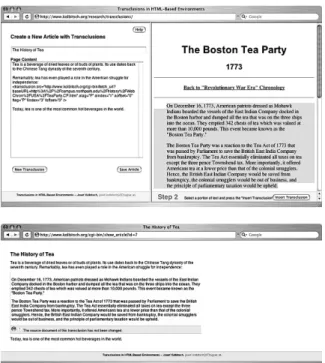
Two fundamental actions can be distinguished in the system: the creation of a transclusion when the article is authored, and its evalua-tion when the page containing the transclusion is to be displayed. When the user wants to create an article with a transclusion, the web browser presents a frameset with two frames. One frame contains a conventional area for au-thoring HTML content and an additional button for adding a transclusion. When the user presses this button, the URL of a page can be entered, an the corresponding page is loaded through an HTTP proxy application into the second frame. The user can either transclude content from this page or can use the second frame to browse to a different page – again through the HTTP proxy application. The document to be transcluded is complemented with a button that inserts the transclusion into the text area of the first frame, when pressed. An illustration of the two frames is given in Figure 5.
The user selects the portion of text to be tran-scluded in the second frame and presses the button to have the transclusion actually inserted into the article. The button calls a Javascript function that determines the start and end posi-tions of the selection made. Together with the URL of the page in the second frame, these val-ues are used to generate an intermediate markup that is inserted into the article(see section 3.4).
Whenever the article containing the transclusion is requested, a second CGI script is invoked. The script retrieves the contents of the article and the parameters of the transclusion tag from the database. The parameters defining the tran-sclusion are used to load the original page from its original location. If it is unchanged, the tran-scluded portion of the text is extracted from the original page, combined with the static text and sent to the web browser of the client(see Figure
5).
The next section gives a brief introduction to the architecture of the implementation and its components.
3.3. System Architecture
Our implementation of transclusions follows a classic client-server paradigm. A conven-tional HTTP server, a relaconven-tional database, sev-eral server-side CGI programs, a non-transpa-rent HTTP proxy application and client-side Javascript code are the main components of the system.
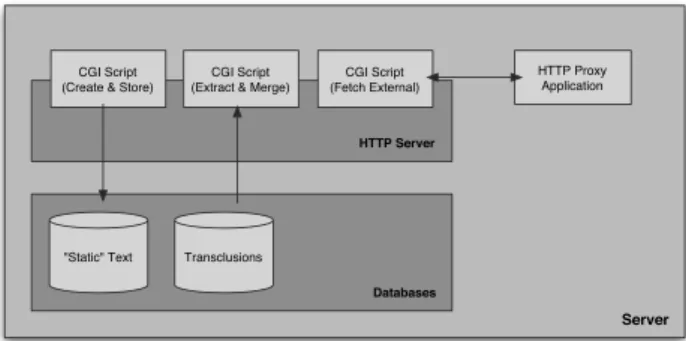
Fig. 2.Overview of the server-side components.
The CGI script “Create and Store” in Figure 2 receives the data submitted by users. It analyses the content of the article, extracts transclusions and stores both content and transclusions in the internal database of the system(see section 3.4).
The “Extract and Merge” script, on the other hand, reads the content of an article together with the information on the transclusion from the database, fetches the source document of the transclusion, assembles the complete article and sends it to the user(see section 3.5).
The third CGI script, “Fetch External”, is utilised during the authoring process for loading the
page to be transcluded. This programme is ba-sically necessary to insert a button and a small portion of Javascript code into the correspond-ing page (see section 4.1). It relies on a
spe-cialised, non-transparent proxy application de-veloped for this project.
In the current prototype implementation the re-lational database consists of only two tables. While one table contains the static content of the article, the other one stores detailed infor-mation on the transclusion as well as a rich set of metadata and a fingerprint of the source doc-ument.
3.4. Creating a Transclusion
As explained above, the interface for authoring new articles consists of a frameset with a frame for writing an article in an HTML form and a separate frame for displaying the content to be transcluded(Figure 5). When users wish to
in-sert a transclusion they select the portion of text with the pointer device and click on the button provided in the window.
The button calls a Javascript function which is essentially the only operation carried out on the client computer. It accesses the document ob-ject model to determine the exact start and end positions of the selection made by the user and generates an intermediate tag that is inserted into the article. The Javascript interface to se-lections provided by most browsers is somewhat peculiar in that it determines these start and end positions in the way the user actu ally marked the text. I. e. , theanchorof the selection is the position where the user clicked to indicate the beginning of the selection. Then, the user drags the mouse, for instance, to the end of the se-lection and releases the mouse button to denote
Listing 2.Syntax of an intermediate transclusion tag
the end of the selection. The end position is the
focus. In the following paragraphs, anchor and
focus are denoted by prefixes “a” and “f”. The syntax of the newly introduced <transclu-sion>markup with its seven parameters is rather complex(see listing 2). This level of detail is
required to be able to determine the exact start and end positions of transclusions, though. Val-ues in curly braces describe the type of attribute values:
src: the URL of the document to be tran-scluded;
atag,ftag: the names of the tags in which the transclusion starts and ends, e. g. , “P” for a paragraph;
aindex, findex: the index of the tags in which the transclusion starts and ends, e. g., the seventh paragraph in the document;
aoffset,foffset: the offset within the start and end tags, e.g., the transclusion starts at the second character of the seventh para-graph in the document.
The exemplary tag shown in listing 2, for in-stance, describes a transclusion that starts at the first character of the second H1 heading and ends at the 30th character of the fifth paragraph in the given document.
When the article containing the transclusion is saved by the user, the data is sent to the server,
Remote Server Client
Server New Article
Lorem ipsum dolor sit amet.
<transclusion>
Consectetuer adipiscing elit pelletesque curruminus.
Existing HTML Document
Curabitur ultrices. Quisque ac ligula. Suspendisse wise elit, tincidunt tempus, rhoncus et, tortor.
Include Information on Transclusions
Transclusions "Static" Text
CGI Script (Create & Store)
Javascript
CGI Script (Extract & Merge)
Submit form containing transclusion tag
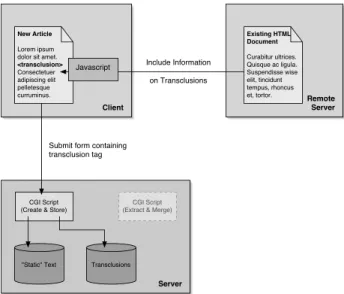
Fig. 3.Simplified scematic illustration of the process of creating a new article containing a transclusion.
and the “Create and Store” CGI program is in-voked(see Figure 3). It extracts the transclusion
from the article, determines the attributes of the transclusion and writes the information to the database. The <transclusion>markup in the original article is replaced with a transclusion object that refers to the transclusion stored in the database.
The source document of the transclusion is not stored in the internal repository. However, its URL, the creation and modification dates as well as an MD5 hash value of the entire page content are retained as fingerprint. These values are necessary to determine if the source docu-ment has changed when the transclusion is re-trieved.
It should be noted that, in contrast to28], where
an amendment to the HTML specification is suggested, the<transclusion>markup in this implementation is only used during the author-ing process. It is inserted when the user makes a transclusion, is evaluated by the system and re-placed by a transclusion object. When the page containing the transclusion is to be displayed, the transclusion object is replaced with the cor-responding content from the original page(see
below). Hence, the<transclusion>tag is only
visible within the system but not externally to the user.
3.5. Retrieving a Transclusion
The “logic” of our implementation mainly lies within the component that retrieves transclu-sions. Whenever an article is requested, its body is analysed for the presence of transclu-sion objects. For each transclutransclu-sion object the following steps have to be carried out(see also
Figure 4):
resolve the object and retrieve the informa-tion on both the transclusion and on the source document from the database;
check if the given URL of the source docu-ment can be loaded;
Remote Server Client
Server
New Article
Lorem ipsum dolor sit amet. Curabor ultrices. Consectetuer adipiscing elit pelletesque curruminus.
Existing HTML Document
Curabor ultrices. Quisque ac ligula. Suspendisse wise elit, tincidunt tempus, rhoncus et, tortor.
Transclusions "Static" Text
CGI Script (Extract & Merge)
CGI Script (Create & Store)
Get original document Send the document with the
transcluded text to the client
Fig. 4. Handling a request for a page containing a transclusion(simplification).
Fig. 5.Screenshots from a prototype of transclusions in an HTML-based authoring environment.
portion of text determined by the start and end positions of the transclusion;
replace the transclusion object in the article with the transcluded content;
if any of the operations above fails, insert an apologetic error message.
Every transclusion is formatted in a way that readers can distinguish between authentic and
transcluded content. In Figure 5, transcluded text is highlighted using a light-gray background. Transclusions are complemented with a hyper-link to the original source of the content.
4. Issues Encountered
During the implementation and evaluation of the prototype a number of difficulties were experi-enced. A few substantial issues are addressed in the following sections.
4.1. Javascript Restrictions
As described in section 3.4, our implementation relies on Javascript code that detects which por-tions of a document are selected by the user; when the user presses a button, the start and end positions of the selection are determined. Restrictions imposed by the security mecha-nisms of most modern web browsers (e. g. ,
18])prevent Javascript functions from
access-ing selections in “foreign” frames and docu-ments. This means that the button that reads the user’s selection has to be present in the same frame as the selection.
Since our premise was that transclusions can be made from any HTML document on the Web, we have to make sure that the Javascript code required is inserted in any page the user wants to transclude. The approach in the current im-plementation is to use a non-transparent proxy application. So when users enter the URL of the page they wish to transclude, the page is not loaded directly by the web browser, but by a CGI script on the server that acts as an HTTP proxy. The CGI script appends the demanded Javascript code and sends the document to the client.
4.2. Browser Specific Implementation
The function for accessing the user’s selection poses yet another problem. Different imple-mentations of the corresponding function ex-ist in the various web browsers available to-day. The Mozilla family accesses the selection through thedocument.getSelection()method, whereas Internet Explorer, for instance, uses a dedicated document.selectionobject (e. g. ,
10]).
Due to the use of thedocument.getSelection() method in our implementation, the prototype is only compatible with Mozilla-based browsers. With minor modifications in the client-side Javascript code, however, the prototype should work with a wide range of web browsers includ-ing Internet Explorer.
4.3. Modified Documents and Unavailable
Resources
Similar to broken links in web pages,documents that are modified and resources that become un-available can pose a problem for transclusions. One reason for this deficiency is the use of Uni-form Resource Locators on the world wide web
(URLs,2]).
URLs identify an objectanddescribe its phys-ical location. Defining the physphys-ical location of a document determines that only one instance of the document may exist at a time. Differ-ent resource idDiffer-entification and allocation mech-anisms allow for multiple locations of the same document, i. e. , several instances of the same document may exist in different physical loca-tions. When a resource with a certain object identifier is requested, it is retrieved from one of the locations that retain a copy(e. g. 27]).
This can, for instance, be the location with the fastest network connection, the one with the lowest load, or the one with the shortest dis-tance.
The design of Xanadu takes a similar approach, in which a resource may exist in several loca-tions(e. g. ,25]). Thus, when a transclusion is
requested and one instance of the source data be-comes unavailable, it is retrieved from another repository containing the same information. We propose an analogue mechanism that makes use of the Wayback Machine(e. g. ,13]), a very
large archive of currently about forty billion web pages, and local caching. When a transclusion is requested whose source document has un-dergone major changes or has become unavail-able, the Wayback machine is queried for the resource. The query includes the URL and the creation date of the transclusion as access date. Alternatively, a local cache or Google Cache can be employed. Local caching means that a copy of a resource has to be made when it is transcluded; the local copy is retained in an in-ternal repository of the system. In case of local caches, however, legal issues may arise. 1],
for instance, discusses whether services such as Google Cache are in conflict with German copyright laws.
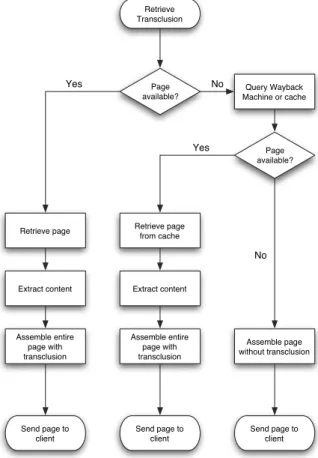
Figure 6 illustrates the suggested retrieval strat-egy for transclusions: when the original source of a transclusion is available and has not been changed, it is retrieved from the original loca-tion. Otherwise an attempt is made to load the page from the Wayback Machine or from a sim-ilar cache. If this attempt fails as well, the user
Fig. 6.Flow chart of a document retrieval strategy where the source document of a transclusion can
is notified that the transclusion cannot be made at this time.
5. Discussion
The implementation of transclusions in a purely HTML-based environment has shown interest-ing perspectives, and various aspects need to be investigated in detail and require further re-search. A few selected topics are pointed out in the following sections.
5.1. Robustness
The prototype we presented offers ease of use and relative overall stability. The robustness, however, can still be improved. Under certain conditions, for example, transclusions can be imprecise. Content transcluded from a docu-ment by the “Extract and Merge” component can be slightly different from what a user orig-inally selected – a few characters too many or too little are extracted.
An issue that generally affects the robustness of our implementation and demands in-depth analysis is modified content. The shortcoming partly arises from an optimization that improves the system performance. When modifications in the source document of a transclusion are to be detected, only the creation and modifi-cation dates as well as the content length in the HTTP header of the resource are scanned. Some servers do not return these values at all, though, and a small percentage of hosts return invalid date values. So if creation and modification dates or the content length are not available, the entire resource is retrieved and an MD5 hash value is generated. When the content to be re-trieved is very large, the system load is high or the network connection is slow, it might take too long to calculate the hash value. In this case, the process might terminate with a time-out signal, and the transclusion cannot be made.
As pointed out above, modifications in transclu-sion sources are a general problem. Especially dynamic content such as pages from a content management system or from a digital library can be critical. In many cases, these documents con-tain advertisements or other frequently chang-ing information such as references to the most
recent articles. Although the actual content of the document is not altered, the system com-ponent that analyses the state of transclusion sources would detect a modification.
It is desirable to have modifications in docu-ments and their importance – was only an ad-vertisement changed or has the meaning of the article changed – detected automatically. How-ever, this functionality is presently computa-tionally not feasible. 14]suggests leaving the
decision to the user: despite the modifications the content from the altered source document is transcluded, and the user has to determine if the transclusion and the context are still appropri-ate.
In any case, authors of modified transclusion sources should be notified that the content they virtually included into their articles might not be suitable anymore, and that it has to be reviewed.
5.2. Aspects of the Design
The design of the implementation, the use of a transclusion object in particular, open up excit-ing opportunities. Since the transclusion object is associated directly with the source document of a transclusion, it is possible to determine which other articles in our system include con-tent from the same source. This information indicates that the corresponding articles might deal with a similar topic and that they could be of interest for both authors and readers. More importantly, this information denotes hat the au-thors of these articles might work in a similar area. In a scientific setting, for instance, these authors can be researchers working on similar projects. Thus, information exchange can be enabled. From a more general perspective, col-laboration can be fostered and organisational knowledge management can be facilitated(e. g.
,17]).
Therefore we propose a simple function like
Which other articles transclude the same
doc-ument? orWho else uses the same document?
that can help readers and writers discover new information.
pointed out above. Hence, we propose another function that complements every article in the system:Which articles in the system transclude
this articleor simply put,Who transcludes ‘us’?
In a more sophisticated approach, the system could pro-actively point out resources and au-thors that are related to the article being dis-played.
5.3. Aspects of the Proxy Application
Our implementation relies on a non-transparent HTTP proxy application that makes it possible to insert a small portion of Javascript code into every page the user wishes to transclude. Al-though the application was initially intended for a very specific purpose, its design is so flexible that a whole range of other, largely unrelated applications become feasible.
Blacklisting of words and hyperlinks, highlight-ing of text and dynamic insertion of annota-tions are just a few simple examples. Advanced techniques may include dynamic adaptation of content, on-the-fly insertion of complementing information, etc.
These novel ideas need to be explored in detail. A comprehensive analysis and an evaluation of early results will be presented in a forthcoming publication.
6. Conclusion
This paper briefly outlined Ted Nelson’s notion of hypertext and one of its prime concepts – transclusions. Although HTML has been influ-enced by the notion of transclusions for the in-clusion of external objects such as images, they have not been implemented consistently. There-fore a number of proposals have been made on how to implement transclusions with the tech-nologies available today. A few of the most important approaches have been discussed. Based merely on the technologies provided by a web-based environment, we have designed a system that offers users to author articles that may contain transclusions. A first prototype utilises plain HTML, Javascript and server-side components including CGI scripts and a spe-cialised HTTP proxy application.
Although a number of issues were encountered during the implementation phase, we have been capable of collecting valuable results that make us confident that we can enhance the current prototype and increase its robustness and stabil-ity.
The innovative design of the transclusion struc-tures, as well as the architecture of system components, open up new perspectives and can lead to more advanced functionality. Facilitat-ing information discovery, pro-active dissemi-nation of related content and the stimulation of community-building are only a few possibilities among others.
With the infrastructure provided by the proxy application elaborate functionality such as au-tomatic highlighting of information, dynamic content adaptation and on-the-fly insertion of related data can be introduced. This concept can prove to be beneficial in numerous environ-ments including electronic encyclopaedias and digital libraries.
These ideas will be discussed thoroughly in a future paper.
7. Acknowledgements
The first author would like to thank Edmund Haselwanter for his valuable input on the Way-back Machine.
References
1] M. BAHR, The Wayback Machine und Google Cache
– eine Verletzung deutschen Urheberrechts?
http://www.jurpc.de/aufsatz/20020029.htm,
(2002)Accessed May 11th, 2005.
2] T. BERNERS-LEE,Universal Resource Identifiers in
WWW. A Unifying Syntax for the Expression of Names and Addresses of Objects on the Network as Used in the World-Wide-Web,Request for Com-ments 1630(1994). See also
http://www.w3.org/Addressing/rfc1630.txt.
3] A.DIIORIO ANDF. VITALI, A Xanalogical
Collab-orative Editing Environment, Proceedings of the Second International Workshop of Web Document Analysis(WDA2003),(2003)Edinburgh, UK,
Au-gust 2003. See also
4] L. WOOD ET AL., Document Object Model(DOM)
Level 1, Specification Version 1.0,
http://www.w3.org/TR/1998/REC-DOM-Level-1-19981001/, (1998) Accessed March
29th, 2005.
5] P. LE H´EGARET ET AL., W3C Document
Ob-ject Model (DOM), http://www.w3.org/DOM/,
(2005)Accessed March 29th, 2005.
6] ECMA, ECMAScript Language Specification, 3rd
Edition,Standard ECMA-262,(1999). See also
http://www.ecma-international.org/
publications/files/ECMA-ST/Ecma-262.pdf.c
7] D. RAGGETT ET AL., HTML 4.01 Specification,
http://www.w3.org/TR/html4/,(1999)
Accessed April 28th, 2005.
8] R. FIELDING ET AL., Hypertext Transfer
Pro-tocol – HTTP/1.1, Request for Comments
2616 (1999). See also
ftp://ftp.isi.edu/in-notes/rfc2616.txt.
9] Hyperwave,http://www.hyperwave.com/.
10] P.P. KOCH, JavaScript – Get selection,
http://www.quirksmode.org/js/
selected.html,(2004)Accessed May 10th, 2005.
11] Transclusions in HTML-Based Environments,
http://www.kolbitsch.org/research/ transclusions/.
12] J. KOLBITSCH, H. MAURER, Community Building
around Encyclopaedic Knowledge, (2005) to be
published.
13] R. KOMAN, How the Wayback Machine Works,
http://webservices.xml.com/lpt/a/ws/
2002/01/18/brewster.html, (2002) Accessed
May 10th, 2005.
14] H. KROTTMAIER, Transcluded Documents:
Advan-tages of Reusing Document Fragments, Proceed-ings of the 6th International ICCC/IFIP Conference on Electronic Publishing (ELPUB2002), (2002)
Karlovy Vary, Czech Republic, pp. 359–367.
See also http://hkrott.iicm.edu/docs/
publications/elpub-2002.pdf.
15] H. KROTTMAIER, D. HELIC, Issues of
Transclu-sions, Proceedings of the World Conference on E-Learning in Corporate, Government, Health-care, & Higher Education(E-Learn 2002),(2002)
Montreal, Canada, pp. 1730–1733. See also http://coronet.iicm.edu/denis/pubs/ elearn2002b.pdf.
16] H. KROTTMAIER, H. MAURER, Transclusions in
the 21st Century, Journal of Universal Com-puter Science, 12 (2001), pp. 1125–1136. See
alsohttp://www.jucs.org/jucs 7 12/
transclusions in the 21st/.
17] H. MAURER, K. TOCHTERMANN, On a New
Pow-erful Model for Knowledge Management and its Applications, Journal of Universal Com-puter Science, 1 (2002), pp. 85–96. See also
http://www.jucs.org/jucs 8 1/ on a new powerful/.
18] MICROSOFT CORPORATION, About
Cross-Frame Scripting and Security,
http://msdn.microsoft.com/workshop/ author/om/xframe scripting security.asp,
(2005)Accessed May 10th, 2005.
19] A. MOORE ET AL., Personally tailored teaching in
WHURLE using conditional translucion, Proceed-ings of the Twelfth ACM Conference on Hypertext and Hypermedia, (2001) Aarhus, Danmark, pp.
163–164.
20] T.H. NELSON, A File Structure for the Complex, the
Changing and the Indeterminate,Proceedings of the ACM 20th National Conference,(1965)Cleveland,
OH, U.S.A., pp. 84–100.
21] T.H. NELSON, Literary Machines, Mindful Press,
1981.
22] T.H. NELSON, The Heart of Connection:
Hyper-media Unified by Transclusion,Communications of the ACM, 8(1995), pp. 31–33.
23] T.H. NELSON, Generalized Links, Micropayment
and Transcopyright,http://www.almaden.ibm. com/almaden/npuc97/1996/tnelson.htm,
(1996)Accessed May 1st, 2003.
24] T.H. NELSON, Transcopyright: Pre-Permission for
Virtual Republishing,http://www.aus.xanadu. com/xanadu/transcopy.html,(1998)Accessed
May 3rd, 2005.
25] T.H. NELSON, Xanalogical Structure, Needed Now
More than Ever: Parallel Documents, Deep Links to Content, Deep Versioning and Deep Re-Use,
ACM Computing Surveys, 4es (1999). See also
http://xanadu.com.au/ted/XUsurvey/ xuDation.html.
26] NETSCAPE COMMUNICATIONS, JavaScript
De-veloper Central,http://developer.netscape. com/tech/javascript/,(2004)Accessed
Febru-ary 3rd, 2004.
27] A. PAM, Where World Wide Web Went Wrong,
Proceedings of the AUUG’95 & Asia-Pacific World Wide Web ’95 Conference & Exhibition,
(1995) Sydney, Australia. See also http://
www.csu.edu.au/special/conference/ apwww95/papers95/apam/apam.html.
28] A. PAM, Fine-Grained Transclusion in the
Hyper-text Markup Language, Internet Draft(1997). See
also
http://xanadu.com.au/archive/draft-pam-html-fine-trans-00.txt.
29] E. WILDE, D. LOWE, XML Linking Language. In
XPath, XLink, XPointer, and XML: A Practical Guide to Web Hyperlinking and Transclusion(E.
Wilde and D. Lowe),(2002)pp. 169–198.
Addison-Wesley Professional. See alsohttp: //search-webservices.techtarget.com/
searchWebServices/downloads/wilde-lowe 07.pdf.
30] S. DEROSE ET AL., XML Linking Language(XLink)
Version 1.0, http://www.w3.org/TR/xlink/,
31] W3C Extensible Markup Language (XML),
http://www.w3.org/XML/, (2003) Accessed
April 28th, 2005.
32] S. DEROSE ET AL., XML Pointer Language
(XPointer), http://www.w3.org/TR/xptr/, (2002)Accessed May 2nd, 2005.
33] M. YOCOM, Mac OS History,
http://www.macos.utah.edu/Documentation/
MacOSXClasses/macosxone/macintosh.html,
(2004)Accessed May 3rd, 2005.
Received:May, 2005
Accepted:February, 2006
Contact address:
Josef Kolbitsch Graz University of Technology Steyrergasse 30 8010 Graz, Austria e-mail:[email protected]
Hermann Maurer Institute for Information Systems and Computer Media Graz University of Technology Inffeldgasse 16c 8010 Graz, Austria e-mail:[email protected]
JOSEFKOLBITSCHis a PhD student at Graz University of Technology. His research interests include electronic encyclopaedias, digital libraries and hypermedia.