
Mobile Agent-Based Software
Systems Modeling Approaches:
A Comparative Study
Aissam Belghiat
1,3, Elhillali Kerkouche
2, Allaoua Chaoui
3and Mokhtar Beldjehem
41Department of Computer Science, University of 20 August 1955-Skikda, Algeria 2Department of Computer Science, University of Jijel, Algeria
3MISC Laboratory, Department of Computer Science, University of Constantine 2, Algeria 4University of Ottawa, Canada
Mobile agent-based applications are special type of software systems which take the advantages of mobile agents in order to provide a new beneficial paradigm to solve multiple complex problems in several fields and areas such as network management, e-commerce, e-learning, etc. Likewise, we notice lack of real ap-plications based on this paradigm and lack of serious evaluations of their modeling approaches. Hence, this paper provides a comparative study of modeling ap-proaches of mobile agent-based software systems. The objective is to give the reader an overview and a thor-ough understanding of the work that has been done and where the gaps in the research are.
ACM CCS (2012) Classification: Computing method-ologies → Artificial intelligence → Distributed artifi -cial intelligence → Mobile agents
Keywords: mobile agent, mobile agent-based applica-tion, UML, formal method
1. Introduction
The mobile agent paradigm is an extension of client/server and remote evaluation paradigms that it provides a new development way for distributed systems. Mobility is the novel con-cept that characterizes the paradigm. It is the migration capability of an agent from a host to another one where it resumes its execution to achieve a task. Mobile agents present several features that provide multiple advantages of this paradigm compared to others [1]. They have a heterogeneous nature, operate asynchronously, adapt dynamically and react autonomously to changes. Furthermore, mobile agents reduce
the network load and overcome its latency by acting locally. They are also robust, fault-toler-ant and they encapsulate communication proto-cols which facilitates their upgrading.
Despite these notable advantages, the paradigm
brings significant problems especially security threats which have arisen because a mobile code generated by one party will move to and exe-cute on an environment controlled by another party. This is posing multiple issues that must be taken into account, including authentication, authorization (or access control), intrusion
de-tection, etc. A mobile agent application can be
threatened by malicious agents, malicious plat-forms and third parties. Malicious agents can attack agents and hosts in order to trouble them
for behaving inappropriately. Analogously, ma -licious platforms can attack agents to do the same. Other attacks can be performed by some other entities in the network. In fact these secu-rity problems have hindered largely the devel-opment and maintenance of mobile agent para-digm, especially in critical applications such as e-commerce [2].
This article collects, categorizes and reviews the current modeling approaches of mobile agent-based software systems which have been developed in order to deal with the analysis and design phases of those systems. We have focused on the approaches based on UML (Uni-fied Modeling Language) [4] and considered as full languages since they cover multiple views of software systems. Furthermore, we provide a framework for the comparison of these lan-guages that consists of multiple features
identi-fied from a bibliographical review. A thorough
discussion is then carried out, that allows more comprehension of the pros and cons of multi-ple approaches in the literature. Consequently, readers could at the end of this article make their choices about using this or that approach or definitely proceed to define their own, based on a deep understanding.
The rest of the paper is organized as follows: in Section 2, we present some related work. In Section 3, we present some basic notions about agent technology to make the paper self-con-tained. In Section 4, we present our classifica-tion scheme of mobile agent-based software systems modeling approaches. In Section 5, we define a frame-work for comparing differ-ent languages. Finally, in Section 6, concluding remarks are drawn from the work and perspec-tives for further research are presented.
2. Related Work
Only few works are available in the literature which survey the techniques and tools for mod-eling mobile agent based software systems. Our paper is similar to some works, such as the one in [5] that provides a survey of exis-tent agent-oriented methodologies. It discusses what approaches have been followed to assist in all the phases of the life cycle of an agent-based application. It is noted that the researchers have worked on extending the existing meth-odologies to include the relevant aspects of the agents. These extensions have been carried out mainly in two areas: object oriented (OO) meth-odologies and knowledge engineering (KE) methodologies. Melomey et al. [6] present in their paper an evaluation of the approaches and methodologies already proposed to develop the mobile agent paradigm. Hence, they proposed a
number of required concepts to model mobility in order to overcome the limitations of the pro-posed approaches, and adequately model agent mobility. The authors in this paper mix between the modeling languages and methodologies. Belloni and Marcos [3] have surveyed multiple UML extensions for mobile agents modeling in order to define a unique UML extension which gathers and integrates the features of a large scale of such systems. Hachicha et al. [7] have reviewed multiple approaches which model mobile agent based applications with UML. Cervenka and Trencansky [8] have provided a survey on agent-oriented modeling techniques; however they have focused on methodologies and multi-agents systems. Melomey et al. [9] have provided a comparative study of some modeling languages for agent systems. The se-lected languages are actually not adequate to model mobile agents systems, but multi-agent systems. Bauer and Muller [10] have presented an overview of the existing approaches and methodologies for agent based applications. The modeling of mobile agents is not the cen-tral interest of this work.
Other approaches can be cited as well, but one issue here is worth noting, and this is the mix-ing of the concepts of modelmix-ing languages and methodologies in those contributions. Hence, in our paper, we have focused on modeling lan-guages because we believe that they represent the key of success of the paradigm since mobile agents are investigated in different domain ar-eas. We think also that methodologies cannot be general but rather adapted to specific situa-tions. So, surveying methodologies is beyond the scope of this paper. In addition, we con-sider only the applications with mobile agents
and static locations. Applications with dynamic
locations (mobile computing) are beyond the scope of this paper.
3. Mobile Agent-Based Software
Systems
3.1. Basic Concepts and Architecture A mobile agent-based software system involves
multiple agents (stationary or mobile) that inter-act and communicate between themselves in an adequate running environment (mobile-agent
platforms or servers) where the execution of the agent can take place and where different services and resources are provided. We pres-ent here the esspres-ential elempres-ents (factors) of this architecture [3]. Figure 1 shows the architecture of the mobile agent-based software systems.
● Agent: it is a software entity that executes tasks on behalf of someone (a person) or something (an organization or another agent) with some autonomy – i.e., its ac-tions could be not only determined by ex-ternal events or interactions, but also by its own motivation (or purpose).
● Stationary agent: it is an agent that ex-ecutes in the place where it started, i.e. it does not move.
● Mobile agent: it is an agent that can move from one node to another to accomplish its task. It may or may not return to its “home-node”.
● Agent platform: it is a software compo-nent where the agents can perform their tasks and where different services and re-sources are provided for them.
● Node: it is the infrastructure of execution environment on which mobile agents and mobile agent platforms are actually per-formed.
● Region: it is a logical network of places which have the same authority.
● Place: represents logical locations, pro-vided by mobile-agent platforms, where agents execute, and manipulate some local resources.
● Resources: represent non-autonomous en-tities, such as files, databases, and others, which can be used and shared by several agents.
This article collects, categorizes and reviews the current modeling approaches of mobile agent-based software systems which have been developed in order to deal with the analysis and design phases of those systems. We have focused on the approaches based on UML (Uni-fied Modeling Language) [4] and considered as full languages since they cover multiple views of software systems. Furthermore, we provide a framework for the comparison of these lan-guages that consists of multiple features
identi-fied from a bibliographical review. A thorough
discussion is then carried out, that allows more comprehension of the pros and cons of multi-ple approaches in the literature. Consequently, readers could at the end of this article make their choices about using this or that approach or definitely proceed to define their own, based on a deep understanding.
The rest of the paper is organized as follows: in Section 2, we present some related work. In Section 3, we present some basic notions about agent technology to make the paper self-con-tained. In Section 4, we present our classifica-tion scheme of mobile agent-based software systems modeling approaches. In Section 5, we define a frame-work for comparing differ-ent languages. Finally, in Section 6, concluding remarks are drawn from the work and perspec-tives for further research are presented.
2. Related Work
Only few works are available in the literature which survey the techniques and tools for mod-eling mobile agent based software systems. Our paper is similar to some works, such as the one in [5] that provides a survey of exis-tent agent-oriented methodologies. It discusses what approaches have been followed to assist in all the phases of the life cycle of an agent-based application. It is noted that the researchers have worked on extending the existing meth-odologies to include the relevant aspects of the agents. These extensions have been carried out mainly in two areas: object oriented (OO) meth-odologies and knowledge engineering (KE) methodologies. Melomey et al. [6] present in their paper an evaluation of the approaches and methodologies already proposed to develop the mobile agent paradigm. Hence, they proposed a
number of required concepts to model mobility in order to overcome the limitations of the pro-posed approaches, and adequately model agent mobility. The authors in this paper mix between the modeling languages and methodologies. Belloni and Marcos [3] have surveyed multiple UML extensions for mobile agents modeling in order to define a unique UML extension which gathers and integrates the features of a large scale of such systems. Hachicha et al. [7] have reviewed multiple approaches which model mobile agent based applications with UML. Cervenka and Trencansky [8] have provided a survey on agent-oriented modeling techniques; however they have focused on methodologies and multi-agents systems. Melomey et al. [9] have provided a comparative study of some modeling languages for agent systems. The se-lected languages are actually not adequate to model mobile agents systems, but multi-agent systems. Bauer and Muller [10] have presented an overview of the existing approaches and methodologies for agent based applications. The modeling of mobile agents is not the cen-tral interest of this work.
Other approaches can be cited as well, but one issue here is worth noting, and this is the mix-ing of the concepts of modelmix-ing languages and methodologies in those contributions. Hence, in our paper, we have focused on modeling lan-guages because we believe that they represent the key of success of the paradigm since mobile agents are investigated in different domain ar-eas. We think also that methodologies cannot be general but rather adapted to specific situa-tions. So, surveying methodologies is beyond the scope of this paper. In addition, we con-sider only the applications with mobile agents
and static locations. Applications with dynamic
locations (mobile computing) are beyond the scope of this paper.
3. Mobile Agent-Based Software
Systems
3.1. Basic Concepts and Architecture A mobile agent-based software system involves
multiple agents (stationary or mobile) that inter-act and communicate between themselves in an adequate running environment (mobile-agent
platforms or servers) where the execution of the agent can take place and where different services and resources are provided. We pres-ent here the esspres-ential elempres-ents (factors) of this architecture [3]. Figure 1 shows the architecture of the mobile agent-based software systems.
● Agent: it is a software entity that executes tasks on behalf of someone (a person) or something (an organization or another agent) with some autonomy – i.e., its ac-tions could be not only determined by ex-ternal events or interactions, but also by its own motivation (or purpose).
● Stationary agent: it is an agent that ex-ecutes in the place where it started, i.e. it does not move.
● Mobile agent: it is an agent that can move from one node to another to accomplish its task. It may or may not return to its “home-node”.
● Agent platform: it is a software compo-nent where the agents can perform their tasks and where different services and re-sources are provided for them.
● Node: it is the infrastructure of execution environment on which mobile agents and mobile agent platforms are actually per-formed.
● Region: it is a logical network of places which have the same authority.
● Place: represents logical locations, pro-vided by mobile-agent platforms, where agents execute, and manipulate some local resources.
● Resources: represent non-autonomous en-tities, such as files, databases, and others, which can be used and shared by several agents.
3.2. Mobile Agent Platforms and Applications
Proliferation of the mobile agent paradigm re-sults in a large number of platforms. This pro-vided multiple problems such as incompatibil-ities between different platforms of execution of mobile agents. It has become necessary to propose a standardization of the concepts and functionalities of the mobile agent platforms in order to ensure a high level of interoperability. Therefore, two standards have been developed by international organizations of
standardiza-tion to deal with these problems; the MASIF (Mobile Agent System Interoperability Facili
-ties Specification) standard [11] and the FIPA (Foundation for Intelligent Physical Agents)
standard [12].
There are several available platforms for mo-bile agent development. These include, but are
not limited to, Aglets [13], Ajanta [14], Grass
-hopper [15], Voyager [16], JADE [17], TAgent
[18], Tacoma [19]. Most mobile agent plat-forms consider Java as the agent programming language due to its portability. The emergence of suitable mobile agent platforms has encour-aged the industry to get interested in using mo-bile agent technology in order to develop its own products systems. These have been carried out in wide range domain areas such as [20] [1]: network management, telecommunication, electronic commerce, data mining, multime-dia, climate environment, weather, e-learning, semantic web services, parallel processing, hu-man tracking, geographic information systems and e-health monitoring systems.
3.3. Modeling Challenges and Shortcomings
Mobility is the novel concept, which character-izes mobile agent-based software systems. Its modeling represents a great challenge because it produces complicated dynamic reconfigura-tion of the system in quesreconfigura-tion during its exe-cution. Thus, providing an approach that has the capability of designing, this is not trivial. In fact, the approach must give answers to ques-tions that arise from the use of mobile agents
[21] such as: why does a mobile agent move from one host to another, when and where does it move and how does it reach the targeted host. Regarding security of mobile agents, multiple researches have delivered a number of mecha-nisms, which follow different ways in address-ing the aforementioned security issues. Some of these mechanisms have been embedded into mobile agent platforms to make them secure for network programming. Some other mecha-nisms can be specified by designers to enhance
the security of the application. Actually, several
modeling approaches provide security views which allow the description of different mech-anisms used in order to prevent vulnerability of the mobile agent applications. Such mech-anisms include, for instance: authentication of agents and mobile-agent systems, authorization and access control to resources. However, it is not really clear how one can define standard ideas for security modeling, because the mobile agents are applied in large number of domains which have different concerns (each domain has its own particularities).
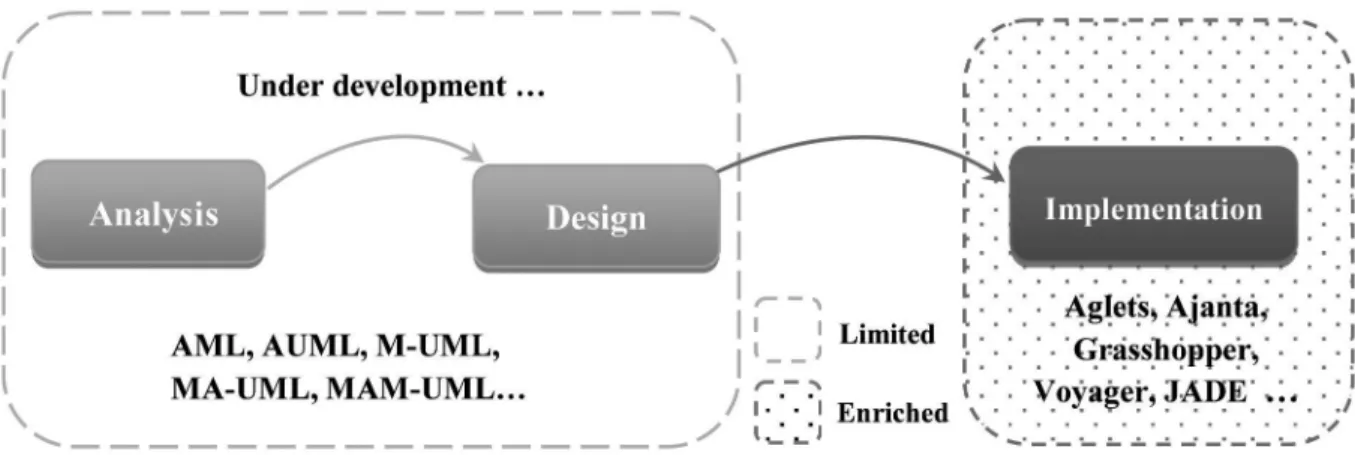
In object oriented systems, UML [4] has played an essential and decisive role in the success of this technology. In fact, using it, you can model all parts of development of an object oriented application, from its inception to its deploy-ment. Researchers have followed suitable ap-proaches in the antecedent paradigm for mobile agent modeling in order to define a modeling language that has the ability to play in the mo-bile agent paradigm the same role that UML is already playing in the object oriented paradigm. In general, the life cycle of development of mo-bile agent-based software systems is composed of three phases: the analysis phase, design
phase, and implementation phase. Actually,
in these systems the later phase has been en-riched recently in a satisfactory way by a great number of different platforms that support and implement the paradigm of mobile agents. In contrast, the proposed approaches for the anal-ysis and design of mobile agent-based software systems are not widespread, they are limited in scope and incomplete in themselves. Figure 2 represents the current development process life-cycle of mobile agent-based software systems.
4. On Classifying Mobile
Agent-Based Software Systems
Modeling Approaches
Researches on providing appropriate modeling techniques for mobile agent software systems are very restricted, and they need to be im-proved. In this section, several modeling ap-proaches are overviewed, and some others are just cited in order to cover large points of views on how to deal with such systems. Thus, we are able to classify existing mobile agent-based software systems modeling proposals in three large categories (see Figure 3):
● UML-based Approaches: these approaches
tackle the problem of modeling mobile agent applications using UML [4]; the standard language of object oriented par-adigm.
● Formal Approaches: these approaches
provide formal models for mobile agent
based-systems using formal methods.
● Hybrid Approaches: these approaches re -sult from a hybrid integration of the fea-tures of the previous two categories with other contributions.
4.1. UML-Based Approaches
In this field, researchers have tried to relate mo-bile agent paradigm to the object oriented para-digm by extending the de-facto standard of ob-ject oriented modeling to model mobile agents. In fact, UML [4] provides some mechanisms to extend itself. It offers stereotypes to create new UML elements, tagged values to create new kinds of properties and constraints to add new semantics to elements. Thus, based on the ex-pressivity and extensibility of UML, research-ers have adopted it and introduced to it the ap-propriate artefacts in order to support the new paradigm. So, we present here some proposals
3.2. Mobile Agent Platforms and Applications
Proliferation of the mobile agent paradigm re-sults in a large number of platforms. This pro-vided multiple problems such as incompatibil-ities between different platforms of execution of mobile agents. It has become necessary to propose a standardization of the concepts and functionalities of the mobile agent platforms in order to ensure a high level of interoperability. Therefore, two standards have been developed by international organizations of
standardiza-tion to deal with these problems; the MASIF (Mobile Agent System Interoperability Facili
-ties Specification) standard [11] and the FIPA (Foundation for Intelligent Physical Agents)
standard [12].
There are several available platforms for mo-bile agent development. These include, but are
not limited to, Aglets [13], Ajanta [14], Grass
-hopper [15], Voyager [16], JADE [17], TAgent
[18], Tacoma [19]. Most mobile agent plat-forms consider Java as the agent programming language due to its portability. The emergence of suitable mobile agent platforms has encour-aged the industry to get interested in using mo-bile agent technology in order to develop its own products systems. These have been carried out in wide range domain areas such as [20] [1]: network management, telecommunication, electronic commerce, data mining, multime-dia, climate environment, weather, e-learning, semantic web services, parallel processing, hu-man tracking, geographic information systems and e-health monitoring systems.
3.3. Modeling Challenges and Shortcomings
Mobility is the novel concept, which character-izes mobile agent-based software systems. Its modeling represents a great challenge because it produces complicated dynamic reconfigura-tion of the system in quesreconfigura-tion during its exe-cution. Thus, providing an approach that has the capability of designing, this is not trivial. In fact, the approach must give answers to ques-tions that arise from the use of mobile agents
[21] such as: why does a mobile agent move from one host to another, when and where does it move and how does it reach the targeted host. Regarding security of mobile agents, multiple researches have delivered a number of mecha-nisms, which follow different ways in address-ing the aforementioned security issues. Some of these mechanisms have been embedded into mobile agent platforms to make them secure for network programming. Some other mecha-nisms can be specified by designers to enhance
the security of the application. Actually, several
modeling approaches provide security views which allow the description of different mech-anisms used in order to prevent vulnerability of the mobile agent applications. Such mech-anisms include, for instance: authentication of agents and mobile-agent systems, authorization and access control to resources. However, it is not really clear how one can define standard ideas for security modeling, because the mobile agents are applied in large number of domains which have different concerns (each domain has its own particularities).
In object oriented systems, UML [4] has played an essential and decisive role in the success of this technology. In fact, using it, you can model all parts of development of an object oriented application, from its inception to its deploy-ment. Researchers have followed suitable ap-proaches in the antecedent paradigm for mobile agent modeling in order to define a modeling language that has the ability to play in the mo-bile agent paradigm the same role that UML is already playing in the object oriented paradigm. In general, the life cycle of development of mo-bile agent-based software systems is composed of three phases: the analysis phase, design
phase, and implementation phase. Actually,
in these systems the later phase has been en-riched recently in a satisfactory way by a great number of different platforms that support and implement the paradigm of mobile agents. In contrast, the proposed approaches for the anal-ysis and design of mobile agent-based software systems are not widespread, they are limited in scope and incomplete in themselves. Figure 2 represents the current development process life-cycle of mobile agent-based software systems.
4. On Classifying Mobile
Agent-Based Software Systems
Modeling Approaches
Researches on providing appropriate modeling techniques for mobile agent software systems are very restricted, and they need to be im-proved. In this section, several modeling ap-proaches are overviewed, and some others are just cited in order to cover large points of views on how to deal with such systems. Thus, we are able to classify existing mobile agent-based software systems modeling proposals in three large categories (see Figure 3):
● UML-based Approaches: these approaches
tackle the problem of modeling mobile agent applications using UML [4]; the standard language of object oriented par-adigm.
● Formal Approaches: these approaches
provide formal models for mobile agent
based-systems using formal methods.
● Hybrid Approaches: these approaches re -sult from a hybrid integration of the fea-tures of the previous two categories with other contributions.
4.1. UML-Based Approaches
In this field, researchers have tried to relate mo-bile agent paradigm to the object oriented para-digm by extending the de-facto standard of ob-ject oriented modeling to model mobile agents. In fact, UML [4] provides some mechanisms to extend itself. It offers stereotypes to create new UML elements, tagged values to create new kinds of properties and constraints to add new semantics to elements. Thus, based on the ex-pressivity and extensibility of UML, research-ers have adopted it and introduced to it the ap-propriate artefacts in order to support the new paradigm. So, we present here some proposals
that are qualified to be complete languages, i.e. which consider multiple views of the system.
● AUML (Agent UML): Bauer et al. [22]
pro-pose Agent UML (AUML) which can be
considered as the best-known UML-based
extension for agents. AUML offers the pos -sibility of describing the internal behavior of an agent as well as its external behavior.
The core parts of AUML are agent class di -agrams and interaction protocol di-agrams which extend respectively UML class di-agrams and sequence didi-agrams. It was initially developed to deal only with mut-li-agent systems, but its deployment and activity diagrams was extended thereafter [21], [23] to support modeling of the agent mobility. The novel notations introduced
by the AUML deployment diagram exten -sion facilitate the modeling of an agent mi-gration to different nodes and the locations concerned by the move. Furthermore, the
issue of time can be expressed by AUML
activity diagrams, i.e. when a mobile agent has to migrate. Multiple concepts and nota-tions have been developed in this language [24], but the essential features of mobile agent based applications are not taken into account. The mobility, for example, is stat-ically described and the security is entirely omitted.
● AML (Agent Modeling Language): Cer
-venka et al. [8], [25] introduce Agent Mod
-eling Language (AML); an extension of
UML that incorporates different concepts
and features of multi agent systems. AML
is currently considered as the most com-plete published agent-oriented modeling language. It covers modeling of the static structure, dynamics and behavior of
enti-ties in a multi-agent system. AML attempts
also to provide a modeling support for the mobility by recognizing and identifying the properties of the agent environment, host, and comportment (move and clone). The authors consider the mobility only at the implementation level when multi- -agent system is deployed. This makes it unsuitable for modeling real mobile agent based applications.
● MAM-UML (Mobile-Agent Modeling
with UML): Belloni and Marcos [3], [26]
propose Mobile-Agent Modeling with UML (MAM-UML) to define a unique
UML extension gathering and integrating the features of many UML extension-based approaches. The authors have defined a set of views and models (organizational, life cycle, interaction and mobility views)
ma-terialized by an UML profile called
MAM-UML. This profile describes in details multiple interesting features of a mobile agent-based application such as itinerary of a mobile agent, the different types of movement and the tasks plan.
● M-UML (Mobile UML): Saleh and El-Morr [27] propose a complete extension of UML1.4 standard called (M-UML), where all diagrams have been extended to deal with the modeling of mobile agent-based software systems. Throughout an illustrative example, the authors intro-duce and describe the extensions made in each diagram UML in order to model the aspects of mobility. The authors omit the security mechanisms and their modeling. The authors focus only on the modeling of mobility feature. The approach is ex-plained sufficiently, however its experi-mentation is not enough to judge its qual-ity.
● MA-UML (Mobile Agent UML): Hachicha
et al. [7] have proposed seven diagrams based on the extension of UML
state-chart and activity diagrams, and AUML
sequence diagram. The authors claim that their contribution tackles and surmounts multiple insufficiencies not covered by the other extensions. They have developed
also a software CASE Tool named MAMT (Mobile Agent Modeling Tool) [28] to sup
-port the use of MA-UML profile and the
automatic generation of Java code from its diagrams which will significantly sim-plify the modeling and implementation of mobile agent-based applications. We have
found suddenly that MA-UML is the last
developed language in the recent literature (which addresses different views of mobile agent-based applications). This shows that the research community has abandoned partially this field in spite of their benefi-cial effects.
In addition to these languages, some propos-als are very interesting. However, they rep-resent partial approaches since they do not address all the views of a mobile agent-based software. Klein et al. [29] propose an exten-sion to UML for mobile agents; however, their approach is limited to a specific mobile agent
platform (Grasshopper platform) and to a spe -cific class of mobile agent applications. In ad-dition, they do not provide mobility description for all views and aspects of systems. We may also cite the works of [30] through which the authors present an approach to model the spe-cific characterization of mobile agents by an extension of UML 1.5 activity diagrams. Bahri et al. [31] propose in their paper an extension of the most important UML 2.0 diagrams to model the mobile agent-based software systems with the objective to tackle the new concepts introduced by these systems such as migration, cloning and the locations. Kusek and Jezic [32] present a proposal for modeling agent mobility with UML sequence diagrams; they are focused on capturing agent creation, mobility paths and current agent location in order to model agent mobility.
Despite these approaches have tried to support
the modeling mechanism for mobile agent-based software systems, these techniques are brought often from the field of multi-agents sys-tems which concentrate more on the expression of the inter-agents relations. The expression of the mobility (and its results such as security) from the point of view of the distributed sys-tems is not described enough to provide a real, efficient and robust UML-based approaches for modeling mobile agent-based software systems as in object-oriented software systems with UML.
4.2. Formal Approaches
In software engineering, formal methods are a particular kind of mathematically based tech-niques for the specification, development and verification of software systems [33]. Using formal approaches, to specify and to verify the functioning of mobile agent software systems during the earliest phases of the development life cycle seems to be very attractive. It must contribute to the reliability and robustness of the design, due to the power of the appropriate
mathematical analysis. Actually, multiple for -malisms have been used for specifying mobile agents, which are inspired strongly by two ef-ficient formalisms; process algebras and petri nets. We recall some of them in this sub-section. In the context of process algebras, Milner [34]
proposed the π-calculus language for model -ing mobile agents. It offers the possibility of link movement in virtual linked processes to describe the mobility and a wide range of the proposed approaches are based on this formal-ism. Jezic and Lovrek [35] have presented an approach to formal specification and verifica-tion of agent migraverifica-tion and communicaverifica-tion in
a mobile agent network using the π-calculus
formalism. Fournet et al. [36] have proposed a calculus for mobile agents with a precise defi-nition for migration, failure, and failure detec-tion. They use the distributed join-calculus that
is as expressive as the asynchronous π-calcu -lus to encode their distributed calcu-lus. This last supports explicit locations and primitives for mobility, which allows expressing mobile agents moving between nodes. Oquendo [37]
proposes the π-ADL that has been designed in the ArchWare European Project (http://www.
arch-ware Oquendo.org/) to address specifica-tion of dynamic and mobile architectures. It is a theoretically well-founded formal language,
based on the higher-order typed π-calculus that
can be used for specifying static, dynamic and mobile architectures and is illustrated through case studies. Other papers propose formalisms for description of mobile agents. Schmitt &
Stefani [38] present a π-calculus extension to
specify the mobility of the agents. In the paper of Sewell et al. [39], an architecture of commu-nication between mobile agents is formalized
using a π-calculus extension. Bettini et al. [33] formalize the properties of mobile agent sys-tems, the properties of the agents are expressed dynamically according to the evolution of their
localizations. Cardelli and Gordon [40] have
proposed mobile ambient which is a calculus for describing the movement of processes and also devices. Other formal approaches for cap-turing the mobility are developed in [41] and [42].
that are qualified to be complete languages, i.e. which consider multiple views of the system.
● AUML (Agent UML): Bauer et al. [22]
pro-pose Agent UML (AUML) which can be
considered as the best-known UML-based
extension for agents. AUML offers the pos -sibility of describing the internal behavior of an agent as well as its external behavior.
The core parts of AUML are agent class di -agrams and interaction protocol di-agrams which extend respectively UML class di-agrams and sequence didi-agrams. It was initially developed to deal only with mut-li-agent systems, but its deployment and activity diagrams was extended thereafter [21], [23] to support modeling of the agent mobility. The novel notations introduced
by the AUML deployment diagram exten -sion facilitate the modeling of an agent mi-gration to different nodes and the locations concerned by the move. Furthermore, the
issue of time can be expressed by AUML
activity diagrams, i.e. when a mobile agent has to migrate. Multiple concepts and nota-tions have been developed in this language [24], but the essential features of mobile agent based applications are not taken into account. The mobility, for example, is stat-ically described and the security is entirely omitted.
● AML (Agent Modeling Language): Cer
-venka et al. [8], [25] introduce Agent Mod
-eling Language (AML); an extension of
UML that incorporates different concepts
and features of multi agent systems. AML
is currently considered as the most com-plete published agent-oriented modeling language. It covers modeling of the static structure, dynamics and behavior of
enti-ties in a multi-agent system. AML attempts
also to provide a modeling support for the mobility by recognizing and identifying the properties of the agent environment, host, and comportment (move and clone). The authors consider the mobility only at the implementation level when multi- -agent system is deployed. This makes it unsuitable for modeling real mobile agent based applications.
● MAM-UML (Mobile-Agent Modeling
with UML): Belloni and Marcos [3], [26]
propose Mobile-Agent Modeling with UML (MAM-UML) to define a unique
UML extension gathering and integrating the features of many UML extension-based approaches. The authors have defined a set of views and models (organizational, life cycle, interaction and mobility views)
ma-terialized by an UML profile called
MAM-UML. This profile describes in details multiple interesting features of a mobile agent-based application such as itinerary of a mobile agent, the different types of movement and the tasks plan.
● M-UML (Mobile UML): Saleh and El-Morr [27] propose a complete extension of UML1.4 standard called (M-UML), where all diagrams have been extended to deal with the modeling of mobile agent-based software systems. Throughout an illustrative example, the authors intro-duce and describe the extensions made in each diagram UML in order to model the aspects of mobility. The authors omit the security mechanisms and their modeling. The authors focus only on the modeling of mobility feature. The approach is ex-plained sufficiently, however its experi-mentation is not enough to judge its qual-ity.
● MA-UML (Mobile Agent UML): Hachicha
et al. [7] have proposed seven diagrams based on the extension of UML
state-chart and activity diagrams, and AUML
sequence diagram. The authors claim that their contribution tackles and surmounts multiple insufficiencies not covered by the other extensions. They have developed
also a software CASE Tool named MAMT (Mobile Agent Modeling Tool) [28] to sup
-port the use of MA-UML profile and the
automatic generation of Java code from its diagrams which will significantly sim-plify the modeling and implementation of mobile agent-based applications. We have
found suddenly that MA-UML is the last
developed language in the recent literature (which addresses different views of mobile agent-based applications). This shows that the research community has abandoned partially this field in spite of their benefi-cial effects.
In addition to these languages, some propos-als are very interesting. However, they rep-resent partial approaches since they do not address all the views of a mobile agent-based software. Klein et al. [29] propose an exten-sion to UML for mobile agents; however, their approach is limited to a specific mobile agent
platform (Grasshopper platform) and to a spe -cific class of mobile agent applications. In ad-dition, they do not provide mobility description for all views and aspects of systems. We may also cite the works of [30] through which the authors present an approach to model the spe-cific characterization of mobile agents by an extension of UML 1.5 activity diagrams. Bahri et al. [31] propose in their paper an extension of the most important UML 2.0 diagrams to model the mobile agent-based software systems with the objective to tackle the new concepts introduced by these systems such as migration, cloning and the locations. Kusek and Jezic [32] present a proposal for modeling agent mobility with UML sequence diagrams; they are focused on capturing agent creation, mobility paths and current agent location in order to model agent mobility.
Despite these approaches have tried to support
the modeling mechanism for mobile agent-based software systems, these techniques are brought often from the field of multi-agents sys-tems which concentrate more on the expression of the inter-agents relations. The expression of the mobility (and its results such as security) from the point of view of the distributed sys-tems is not described enough to provide a real, efficient and robust UML-based approaches for modeling mobile agent-based software systems as in object-oriented software systems with UML.
4.2. Formal Approaches
In software engineering, formal methods are a particular kind of mathematically based tech-niques for the specification, development and verification of software systems [33]. Using formal approaches, to specify and to verify the functioning of mobile agent software systems during the earliest phases of the development life cycle seems to be very attractive. It must contribute to the reliability and robustness of the design, due to the power of the appropriate
mathematical analysis. Actually, multiple for -malisms have been used for specifying mobile agents, which are inspired strongly by two ef-ficient formalisms; process algebras and petri nets. We recall some of them in this sub-section. In the context of process algebras, Milner [34]
proposed the π-calculus language for model -ing mobile agents. It offers the possibility of link movement in virtual linked processes to describe the mobility and a wide range of the proposed approaches are based on this formal-ism. Jezic and Lovrek [35] have presented an approach to formal specification and verifica-tion of agent migraverifica-tion and communicaverifica-tion in
a mobile agent network using the π-calculus
formalism. Fournet et al. [36] have proposed a calculus for mobile agents with a precise defi-nition for migration, failure, and failure detec-tion. They use the distributed join-calculus that
is as expressive as the asynchronous π-calcu -lus to encode their distributed calcu-lus. This last supports explicit locations and primitives for mobility, which allows expressing mobile agents moving between nodes. Oquendo [37]
proposes the π-ADL that has been designed in the ArchWare European Project (http://www.
arch-ware Oquendo.org/) to address specifica-tion of dynamic and mobile architectures. It is a theoretically well-founded formal language,
based on the higher-order typed π-calculus that
can be used for specifying static, dynamic and mobile architectures and is illustrated through case studies. Other papers propose formalisms for description of mobile agents. Schmitt &
Stefani [38] present a π-calculus extension to
specify the mobility of the agents. In the paper of Sewell et al. [39], an architecture of commu-nication between mobile agents is formalized
using a π-calculus extension. Bettini et al. [33] formalize the properties of mobile agent sys-tems, the properties of the agents are expressed dynamically according to the evolution of their
localizations. Cardelli and Gordon [40] have
proposed mobile ambient which is a calculus for describing the movement of processes and also devices. Other formal approaches for cap-turing the mobility are developed in [41] and [42].
representation of complex behavior of mobile
agents. In this context, Xu and Deng [43] have
tried to model mobile agents with higher level petri network. Xu et al. [44] have proposed in their paper an approach for formal modeling
of logical agent mobility (LAM) using predi -cate/transition (PrT) nets. They present a mo-bile agent system as a set of agent spaces that is explicitly abstracted to be a component, and agents could migrate from one space to another. They present a case study of modeling and ana-lyzing an information retrieval system with
mo-bile agents. Also, Xu and Shatz [45] have tried to design mobile agent using G-net model. It consists of using the high level Petri net G-net
model to design agents. This approach profits from the Petri net formalism which is a mature formal model in terms of graphical representa-tion, mathematical descriprepresenta-tion, and simulation tool.
4.3. Hybrid Approaches
The combination of visual modeling tools of mobile agent-based software systems and for-mal methods has received great attention lately. It provides powerful modeling languages for specifying and verifying these systems, taking into account the weaknesses of visual models in formal semantics due to their semi-formal character, and the weaknesses of formal mod-els in graphical notations. Hence, in his thesis, Bahri [46] proposes a hybrid approach to model mobile agent software systems; this approach is based on an UML extension and Petri Nested Nets formalism. It takes advantage of UML, and remedies its insufficiency in terms of se-mantics by using Nested Petri Nets in order to enable formal analysis of these models. Knapp et al. [47] have combined a semi-formal model-ing technique with formal semantics and refine-ment considering an extension of UML state
machines for mobile objects and MTLA [48].
Latella et al. [49] have proposed an extension of UML statecharts for mobile computations accompanied with formal semantics. Belghiat et al. [50] have proposed a combined approach
based on an extension of UML and the π-cal -culus for modeling and verifying mobile agent-based applications. Belghiat et al. [51] have also developed an automatic mapping between mobile class diagrams and OWL ontologies in
order to enable automatic reasoning on these systems.
There are also other approaches which propose to use design patterns to develop mobile agent software systems such as [52], [53] and [54]. In fact, many design patterns have been identified in the literature for mobile agents such as agent patterns and interaction patterns. Some of them are described using UML while others are not.
5. Comparison Framework
5.1. Comparison Criteria
As we said at the beginning of the article, we
will take interest only in modeling languages since other approaches are considered as partial contribution. In fact, to model the conceptual level of mobile agents-based software systems, multiple features and characteristics should be present in the tool developed to support anal-ysis and design of such systems. Furthermore, Chhetri et al. [55] have proposed an interest-ing ontology to describe the abstract concepts and inter-relationships required to model agent mobility in order to provide conceptual level
support for mobile agent applications. Analo -gously, Melomey et al. [6] have also proposed another ontology for the same purpose. Based on these two ontologies and by reviewing the literature essentially [3], [7], [28], and [56], we define some requirements which we believe they represent the key of success factors of each modeling approach developed for mobile agent-based applications.
● Internal structure; this feature illustrates the internal structure of each agent (includ-ing mobile agents) evolv(includ-ing in the applica-tion, i.e. its attributes such as pro-active-ness, reactiveness, autonomy, authority.
● Life cycle; this feature determines the be-havior of an agent; in other words, the mo-bility path (if it exists) and the tasks plan
(describes the plan of tasks execution of different agents at different locations).
● Execution needs; this feature illustrates the execution needs for each agent (including mobile agents) evolving in the application, e.g. the resources and services they need, and the roles they will play.
● Execution Environment; this feature de-scribes the environment of execution, i.e.
places, regions, and agent platforms.
● Mobility; this is the most important fea-ture that must be described in details by a modeling language. It is supported by the
migration, invocation and remote cloning
mechanisms and it is related to the itiner-ary, and location concepts.
● Interaction; this feature illustrates the in-teraction mechanisms adopted in different communication acts, e.g. communication
synchronous or asynchronous.
● Security; this feature has a major impact on the reliability of the software. The mod-eling language must allow describing the security mechanisms adopted, i.e. how to protect entities of the application from ma-licious use.
Other general features are inspired by the eval-uation surveys of modeling languages, espe-cially by the work of Berard [57].
● Supported tools; a good modeling
lan-guage must be supported by CASE tool to
facilitate their use and productivity.
● Theoretical foundation; a modeling lan-guage that has a solid theoretical founda-tion is considered as a powerful language.
● Simplicity and clarity; it is a feature that determines the acceptability of the lan-guage by users.
● Process (methodology); a methodology that accompanies a modeling language can enhance largely the development process.
5.2. Comparison Results
Table 1 illustrates the notation we have used in our comparison, which was inspired by Crane
and Dingel, 2005 [56].
Table 1. Legend of comparison.
Symbol Description
Unknown; not enough information to determine Presumably not supported
Definitely not supported
Partially supported Supported
Table 2 below summarizes the comparison of five chosen modeling languages which are de-fined to model mobile agent-based software systems.
Table 2. Comparison between different UML extensions for mobility.
Modeling languages AUML AML MAM-UML M-UML MA-UML
Basic features
Internal structure
Life cycle Execution needs Execution environment
Mobility Interaction
Security
Other features
Theoretical foundation
Simplicity and clarity Process (methodology)
representation of complex behavior of mobile
agents. In this context, Xu and Deng [43] have
tried to model mobile agents with higher level petri network. Xu et al. [44] have proposed in their paper an approach for formal modeling
of logical agent mobility (LAM) using predi -cate/transition (PrT) nets. They present a mo-bile agent system as a set of agent spaces that is explicitly abstracted to be a component, and agents could migrate from one space to another. They present a case study of modeling and ana-lyzing an information retrieval system with
mo-bile agents. Also, Xu and Shatz [45] have tried to design mobile agent using G-net model. It consists of using the high level Petri net G-net
model to design agents. This approach profits from the Petri net formalism which is a mature formal model in terms of graphical representa-tion, mathematical descriprepresenta-tion, and simulation tool.
4.3. Hybrid Approaches
The combination of visual modeling tools of mobile agent-based software systems and for-mal methods has received great attention lately. It provides powerful modeling languages for specifying and verifying these systems, taking into account the weaknesses of visual models in formal semantics due to their semi-formal character, and the weaknesses of formal mod-els in graphical notations. Hence, in his thesis, Bahri [46] proposes a hybrid approach to model mobile agent software systems; this approach is based on an UML extension and Petri Nested Nets formalism. It takes advantage of UML, and remedies its insufficiency in terms of se-mantics by using Nested Petri Nets in order to enable formal analysis of these models. Knapp et al. [47] have combined a semi-formal model-ing technique with formal semantics and refine-ment considering an extension of UML state
machines for mobile objects and MTLA [48].
Latella et al. [49] have proposed an extension of UML statecharts for mobile computations accompanied with formal semantics. Belghiat et al. [50] have proposed a combined approach
based on an extension of UML and the π-cal -culus for modeling and verifying mobile agent-based applications. Belghiat et al. [51] have also developed an automatic mapping between mobile class diagrams and OWL ontologies in
order to enable automatic reasoning on these systems.
There are also other approaches which propose to use design patterns to develop mobile agent software systems such as [52], [53] and [54]. In fact, many design patterns have been identified in the literature for mobile agents such as agent patterns and interaction patterns. Some of them are described using UML while others are not.
5. Comparison Framework
5.1. Comparison Criteria
As we said at the beginning of the article, we
will take interest only in modeling languages since other approaches are considered as partial contribution. In fact, to model the conceptual level of mobile agents-based software systems, multiple features and characteristics should be present in the tool developed to support anal-ysis and design of such systems. Furthermore, Chhetri et al. [55] have proposed an interest-ing ontology to describe the abstract concepts and inter-relationships required to model agent mobility in order to provide conceptual level
support for mobile agent applications. Analo -gously, Melomey et al. [6] have also proposed another ontology for the same purpose. Based on these two ontologies and by reviewing the literature essentially [3], [7], [28], and [56], we define some requirements which we believe they represent the key of success factors of each modeling approach developed for mobile agent-based applications.
● Internal structure; this feature illustrates the internal structure of each agent (includ-ing mobile agents) evolv(includ-ing in the applica-tion, i.e. its attributes such as pro-active-ness, reactiveness, autonomy, authority.
● Life cycle; this feature determines the be-havior of an agent; in other words, the mo-bility path (if it exists) and the tasks plan
(describes the plan of tasks execution of different agents at different locations).
● Execution needs; this feature illustrates the execution needs for each agent (including mobile agents) evolving in the application, e.g. the resources and services they need, and the roles they will play.
● Execution Environment; this feature de-scribes the environment of execution, i.e.
places, regions, and agent platforms.
● Mobility; this is the most important fea-ture that must be described in details by a modeling language. It is supported by the
migration, invocation and remote cloning
mechanisms and it is related to the itiner-ary, and location concepts.
● Interaction; this feature illustrates the in-teraction mechanisms adopted in different communication acts, e.g. communication
synchronous or asynchronous.
● Security; this feature has a major impact on the reliability of the software. The mod-eling language must allow describing the security mechanisms adopted, i.e. how to protect entities of the application from ma-licious use.
Other general features are inspired by the eval-uation surveys of modeling languages, espe-cially by the work of Berard [57].
● Supported tools; a good modeling
lan-guage must be supported by CASE tool to
facilitate their use and productivity.
● Theoretical foundation; a modeling lan-guage that has a solid theoretical founda-tion is considered as a powerful language.
● Simplicity and clarity; it is a feature that determines the acceptability of the lan-guage by users.
● Process (methodology); a methodology that accompanies a modeling language can enhance largely the development process.
5.2. Comparison Results
Table 1 illustrates the notation we have used in our comparison, which was inspired by Crane
and Dingel, 2005 [56].
Table 1. Legend of comparison.
Symbol Description
Unknown; not enough information to determine Presumably not supported
Definitely not supported
Partially supported Supported
Table 2 below summarizes the comparison of five chosen modeling languages which are de-fined to model mobile agent-based software systems.
Table 2. Comparison between different UML extensions for mobility.
Modeling languages AUML AML MAM-UML M-UML MA-UML
Basic features
Internal structure
Life cycle Execution needs Execution environment
Mobility Interaction
Security
Other features
Theoretical foundation
Simplicity and clarity Process (methodology)
● The security feature is partially supported
by MA-UML by adding some properties
(user authentication, user authorization, access rights, and authentication key) in its
“Mobile Agent Diagram” in order to spec-ify this feature. The other approaches do not support it at all.
● With regards to the general features which characterize a good language, there are many attempts to develop theoretical
foun-dation, especially for AUML and M-UML.
This is due to the importance given to enable the possibility of verification and reasoning about the diagrams of these lan-guages.
● The different languages are simple to use
except for MAM-UML. We cannot deter -mine its clarity due to the lack of the ex-perimentation (i.e. examples).
● No language between the above is com-bined with a process.
● AUML, AML and MA-UML are supported by CASE tools which facilitate the devel -opment of their diagrams. M-UML is pre-sumably not supported (although, there are attempts on their statechart diagram) while
MAM-UML is without any CASE tool.
In short, here is the resulting evaluation of the languages:
● We can judge that M-UML is the sim-plest and best adapted language for mo-bile agent-based software systems, which largely supports the modeling of new features (especially the mobility) of the paradigm and the discussion lines above motivate our opinion. We think that an ex-tension of M-UML, which takes into ac-count the above concerns, could present a complete and sufficient tool.
● MA-UML is also interesting for these sys -tems, but the missing provision of a mech-anism for modeling the architecture of the execution environment will hinder its practical use. In addition, there is a redun-dancy in representing information. In fact,
MA-UML proposes two diagrams “Itiner-ary Diagram” and “Navigation diagram”
to describe the same information which is
the agent travel planning. Also, the com -bined use of the “Navigation diagram”
and “Lifecycle diagram” makes the defi-nition of another diagram “MA Activity di-agram” redundant.
● We agree that the MAM-UML is very well
organized by its different views. However, this profile has not been experimented suf-ficiently and it does not provide illustrative examples, which hinders largely its usage by users.
● AUML and AML are not appropriate to
model mobile agent-based software sys-tems. It is clear that the two languages were developed firstly to model multi-agent
systems. After that, attempts were made to
add to them some features to model mo-bile agent-based software systems which, we have argued, are not sufficient.
6. Conclusion
In this paper we have presented a comparative framework of the modeling approaches of mo-bile agent-based software systems which im-proves the comprehension of previous work on
the topic. After a quick overview of the para -digm concepts and architecture, we present and identify challenges and shortcomings which need to be overcomed to model mobile agents-based systems and to develop powerful
model-ing tools for them. After that, we have proposed
to classify the approaches in three large cate-gories according to some factors: UML-based approaches, Formal approaches, and Hybrid approaches. We argue that the combination of visual (so-called informal) approaches which appeal to engineer’s attention, and formal ap-proaches, which are analyzable, are promising and likely upcoming approaches. Finally, some remarks must be drawn from our analysis and evaluation of the mobile agent paradigm and its modeling approaches:
● Mobile agents have generated consider-able excitement in the research commu-nity; but they have not translated into a significant number of real-world practical applications.
● There are certainly still more approaches for modeling mobile agent-based software systems and it is impossible to recall them here.
5.3. Comparison Discussion
The table above (Table 2) summarizes the mod-eling capabilities of each language with regard to different features that we have proposed to check. The following lines discuss the results of the comparison:
● Internal structure of mobile agents has
been taken into account entirely in MA-UML. Actually, a full diagram “Mobile Agent Diagram” is advocated to fully specify the internal structure of mobile agents evolved in the applications. It is an
extended version of AUML class diagram
which has additional properties for model-ing mobile agents (e.g. authentication, his-tory, itinerary). M-UML, in its turn, and to a lesser extent, proposes an extended ver-sion of class diagrams named as “Mobile Class Diagram” in order to describe the
internal structure of mobile agents. AUML and AML support the internal structure of only stationary agents while MAM-UML
does not support it at all.
● The lifecycle of mobile agents is
sup-ported in MAM-UML, MA-UML, and in M-UML. In fact, MAM-UML proposes a
full view “Life-cycle View” to capture the lifecycle of the mobile agent. The view is described by using of Interaction,
State-charts and Activity diagrams. MA-UML
and M-UML extend Statechart diagrams with new stereotypes and tagged values to describe all the states reached by the mo-bile agent during its lifetime. The feature is
omitted in AUML and AML.
● Execution needs are supported completely
by MAM-UML and partially supported by MA-UML. Actually, MAM-UML pro -vides a full view “Organizational View”
to describe the execution needs of mobile agents using Class and Object diagrams.
MA-UML takes into account this feature in
its “Mobile Agent Diagram”. The feature
is omitted in AUML, AML and M-UML. ● Execution Environment is supported by
AUML using an extended “deployment di-agram”. M-UML supports also this feature using an extended version of “component diagram” and “deployment diagram”.
MA-UML provides a full diagram
“Envi-ronment diagram” to design the environ-ment of execution, however, it represents only the static structure of the application and there is no mention about the
deploy-ment of agents. MAM-UML proposes in
its “Mobility View” to use deployment and component diagrams to design the ex-ecution environment. The exex-ecution envi-ronment is presumably not supported by
AML.
● The Mobility of mobile agents has been addressed in all the above proposed lan-guages with varying in-depth degrees. In fact, two extensions “activity diagram”
and “deployment diagram” have been
defined by AUML in order to permit the
modeling of mobile agent-based systems.
MAM-UML provides a full view “Mobil-ity View” to fully support the mobility fea-ture. M-UML provides a full support of the mobility; it defines multiple notations and concepts to model all aspects of mobility
at various views. MA-UML provides three
diagrams to model the mobility; the “Itin-erary diagram” to describe the tasks of the agent and the locations where they are performed. The “Navigation Diagram”
which is a variant use of a statechart di-agram to describe the mobile agent travel planning. The “lifecycle diagram” which is used to specify different states of the
mobile agent in different locations. AML
supports partially the mobility feature; it is
in the deployment phase where AML pro -poses some notations and elements in or-der to take into account the mobility; how-ever this is not sufficient because there are no details about modeling this important feature.
● Interaction feature for mobile agents is
supported in MAM-UML, M-UML and MA-UML. MAM-UML provides a full
view “Interaction View” to model this fea-ture; the view contains collaborations and interaction diagrams. M-UML provides two extensions “sequence diagram” and
“collaboration diagram” to model the
mobile interactions. MA-UML provides a
full diagram “Mobile Agent Sequence Di-agram” to model interactions between
dif-ferent mobile agents. AUML and AML do
● The security feature is partially supported
by MA-UML by adding some properties
(user authentication, user authorization, access rights, and authentication key) in its
“Mobile Agent Diagram” in order to spec-ify this feature. The other approaches do not support it at all.
● With regards to the general features which characterize a good language, there are many attempts to develop theoretical
foun-dation, especially for AUML and M-UML.
This is due to the importance given to enable the possibility of verification and reasoning about the diagrams of these lan-guages.
● The different languages are simple to use
except for MAM-UML. We cannot deter -mine its clarity due to the lack of the ex-perimentation (i.e. examples).
● No language between the above is com-bined with a process.
● AUML, AML and MA-UML are supported by CASE tools which facilitate the devel -opment of their diagrams. M-UML is pre-sumably not supported (although, there are attempts on their statechart diagram) while
MAM-UML is without any CASE tool.
In short, here is the resulting evaluation of the languages:
● We can judge that M-UML is the sim-plest and best adapted language for mo-bile agent-based software systems, which largely supports the modeling of new features (especially the mobility) of the paradigm and the discussion lines above motivate our opinion. We think that an ex-tension of M-UML, which takes into ac-count the above concerns, could present a complete and sufficient tool.
● MA-UML is also interesting for these sys -tems, but the missing provision of a mech-anism for modeling the architecture of the execution environment will hinder its practical use. In addition, there is a redun-dancy in representing information. In fact,
MA-UML proposes two diagrams “Itiner-ary Diagram” and “Navigation diagram”
to describe the same information which is
the agent travel planning. Also, the com -bined use of the “Navigation diagram”
and “Lifecycle diagram” makes the defi-nition of another diagram “MA Activity di-agram” redundant.
● We agree that the MAM-UML is very well
organized by its different views. However, this profile has not been experimented suf-ficiently and it does not provide illustrative examples, which hinders largely its usage by users.
● AUML and AML are not appropriate to
model mobile agent-based software sys-tems. It is clear that the two languages were developed firstly to model multi-agent
systems. After that, attempts were made to
add to them some features to model mo-bile agent-based software systems which, we have argued, are not sufficient.
6. Conclusion
In this paper we have presented a comparative framework of the modeling approaches of mo-bile agent-based software systems which im-proves the comprehension of previous work on
the topic. After a quick overview of the para -digm concepts and architecture, we present and identify challenges and shortcomings which need to be overcomed to model mobile agents-based systems and to develop powerful
model-ing tools for them. After that, we have proposed
to classify the approaches in three large cate-gories according to some factors: UML-based approaches, Formal approaches, and Hybrid approaches. We argue that the combination of visual (so-called informal) approaches which appeal to engineer’s attention, and formal ap-proaches, which are analyzable, are promising and likely upcoming approaches. Finally, some remarks must be drawn from our analysis and evaluation of the mobile agent paradigm and its modeling approaches:
● Mobile agents have generated consider-able excitement in the research commu-nity; but they have not translated into a significant number of real-world practical applications.
● There are certainly still more approaches for modeling mobile agent-based software systems and it is impossible to recall them here.
5.3. Comparison Discussion
The table above (Table 2) summarizes the mod-eling capabilities of each language with regard to different features that we have proposed to check. The following lines discuss the results of the comparison:
● Internal structure of mobile agents has
been taken into account entirely in MA-UML. Actually, a full diagram “Mobile Agent Diagram” is advocated to fully specify the internal structure of mobile agents evolved in the applications. It is an
extended version of AUML class diagram
which has additional properties for model-ing mobile agents (e.g. authentication, his-tory, itinerary). M-UML, in its turn, and to a lesser extent, proposes an extended ver-sion of class diagrams named as “Mobile Class Diagram” in order to describe the
internal structure of mobile agents. AUML and AML support the internal structure of only stationary agents while MAM-UML
does not support it at all.
● The lifecycle of mobile agents is
sup-ported in MAM-UML, MA-UML, and in M-UML. In fact, MAM-UML proposes a
full view “Life-cycle View” to capture the lifecycle of the mobile agent. The view is described by using of Interaction,
State-charts and Activity diagrams. MA-UML
and M-UML extend Statechart diagrams with new stereotypes and tagged values to describe all the states reached by the mo-bile agent during its lifetime. The feature is
omitted in AUML and AML.
● Execution needs are supported completely
by MAM-UML and partially supported by MA-UML. Actually, MAM-UML pro -vides a full view “Organizational View”
to describe the execution needs of mobile agents using Class and Object diagrams.
MA-UML takes into account this feature in
its “Mobile Agent Diagram”. The feature
is omitted in AUML, AML and M-UML. ● Execution Environment is supported by
AUML using an extended “deployment di-agram”. M-UML supports also this feature using an extended version of “component diagram” and “deployment diagram”.
MA-UML provides a full diagram
“Envi-ronment diagram” to design the environ-ment of execution, however, it represents only the static structure of the application and there is no mention about the
deploy-ment of agents. MAM-UML proposes in
its “Mobility View” to use deployment and component diagrams to design the ex-ecution environment. The exex-ecution envi-ronment is presumably not supported by
AML.
● The Mobility of mobile agents has been addressed in all the above proposed lan-guages with varying in-depth degrees. In fact, two extensions “activity diagram”
and “deployment diagram” have been
defined by AUML in order to permit the
modeling of mobile agent-based systems.
MAM-UML provides a full view “Mobil-ity View” to fully support the mobility fea-ture. M-UML provides a full support of the mobility; it defines multiple notations and concepts to model all aspects of mobility
at various views. MA-UML provides three
diagrams to model the mobility; the “Itin-erary diagram” to describe the tasks of the agent and the locations where they are performed. The “Navigation Diagram”
which is a variant use of a statechart di-agram to describe the mobile agent travel planning. The “lifecycle diagram” which is used to specify different states of the
mobile agent in different locations. AML
supports partially the mobility feature; it is
in the deployment phase where AML pro -poses some notations and elements in or-der to take into account the mobility; how-ever this is not sufficient because there are no details about modeling this important feature.
● Interaction feature for mobile agents is
supported in MAM-UML, M-UML and MA-UML. MAM-UML provides a full
view “Interaction View” to model this fea-ture; the view contains collaborations and interaction diagrams. M-UML provides two extensions “sequence diagram” and
“collaboration diagram” to model the
mobile interactions. MA-UML provides a
full diagram “Mobile Agent Sequence Di-agram” to model interactions between
dif-ferent mobile agents. AUML and AML do

![Table 1 illustrates the notation we have used in our comparison, which was inspired by Crane and Dingel, 2005 [56].](https://thumb-us.123doks.com/thumbv2/123dok_us/8038543.2128522/9.1785.1013.1512.846.1237/table-illustrates-notation-used-comparison-inspired-crane-dingel.webp)
