46
The Influence of Different Vegetable Oils on Some
ω
-3
Polyunsaturated Fatty Acids from Thigh and Abdominal Fat
of Broilers
Dragoş-Sorin Fota, Lavinia Ştef, Dan Drinceanu, Izabella Fota, Rodica Căpriţă,
Adrian Căpriţă
Banat’s University of Agricultural Sciences and Veterinary Medicine, 300645, Timişoara, Calea Aradului Nr.119, Romania
Abstract
Energy sources, especialy vegetable oils, added to the combined fodder can segnificantly modefy the fatty acids profile of the chicken feed, thus through its control the fatty acids profile of the carcases can be modefied, through enrichment in some fatty acids. In this respect an experiment was coduced on broilers, made up of three experimental groups, fed with a combined base fodder (corn and soybean meal) in which 2% of different energy sources were added (sunflower oil, soybean oil, linseed oil). At the end of the 42 days growing period, using gaz cromatography, the fatty acids profile, % of fatty acids in 100 g product (EPA,DPA, DHA), ∑ SFA, ∑ MUFA, ∑ PUFA from the studied cut pieces, were determined. The results obtained after statistc processing and interpretation of the data, showed the fact that regarding the fatty acids profile in chicken thigh and abdominal fat we can observe variations, what denotes that the fatty acids profile can be influenced by dietary factors, the quantity being yet determined by the participation % of the energy sources (vegetable oils), but also by the fatty acids content of the participating raw materials.
Keywords: essential fatty acids, ω -3 fatty acids, energetic sources, fatty acids profile, ω-3 enriched foods.
1. Introduction
In order to insure the energetic requirements of
different bird categories, and especially broilers, different energy sources are used (animal fat, vegetable oils). The main energy source introduced in combined broiler feed is sunflower oil, a source of low cost, but with an unbalanced fatty acids profile (1.220 g linoleic acid; 0.004 g linolenic acid for a ratio of 2% in CF).
Thus, the energy source’s profile influences the fatty acids profile in broiler carcasses. [1,2,3,4]. Chicken meat represents 50-60% of man’s total meat consumption because of the low cost and
* Corresponding author: Dragos-Sorin Fota,
high availability. Thus, the ω-3 fatty acids contribution is reduced in favor of the ω-6 one. The modern man’s eating habits have an unbalanced ω-6:ω-3 ratio (20-25:1 compared to the recommended 1-2:1), thus a reduced ω-3 fatty acids ratio in food. [5,6,7,8].
By enriching different types of food stuff with ω -3 fatty acids, man has tried to correct this ratio and, thus, a new segment has appeared on the market: the functional products.
47 2. Materials and methods
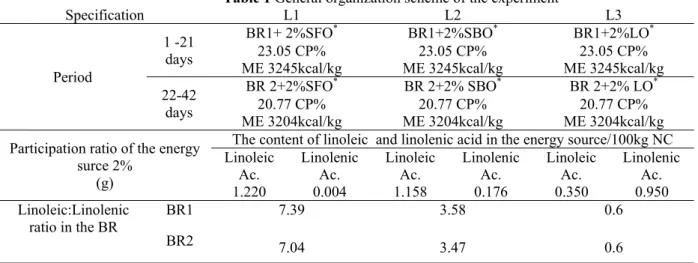
In order to study the effects that different energy sources have over the polyunsaturated fatty acids in broiler feed, an experiment was conducted according to the work ethic presented in table 1 and from which the following can be concluded:
The broilers from the three experimental groups have been fed with two types of combined fodder, using the same basic components that ensured in the 1-21 days period 22.9 % CP and 3235 kcal ME/kg and respectively 20% CP and 3224 kcal ME/kg in the second growth period,
from 22 to 42 days.
The differencing factor in the food stuff in experimental GROUPS was introduced in a 2% ratio of sunflower oil in L1, soybean oil in L2 and linseed oil in L3.
the profile of some fatty acids (EPA eicosapentaenoic acid, DPA docosapentaenoic acid and DHA docosahexaenoic acid) in broiler meat was determined with the help of the Gas Chromatoraphy. Lipids were extracted following the of FOLCH method. Fatty acid profiles of experimental fats, diets and meat were separated and identified by using a GCMS-QP
2010+SHIMAGZU gas chromatograph, equipped with a AT-5MS (30m x 0.32 mm inside diameter) capillary column of silica. The oven program was the following: 700C for 2 min., than it was heated to 1500C with a gradient of 100C/min. and than, a floor of 3 min., after that it was raised again to 2350C with a gradient of 40C/min. The temperature of the injector was 2600 C, injection mode split, split ratio 20. Helium was used as carrier gas.
The primary experimental data were statistically processed using the international software SPSS 16. (ANOVA), the Mann-Whitney test, the student test (MINITAB 15) in order to test the
significances of the differences and, for calculus, the Microsoft Office Excel software.
Table 1 General organization scheme of the experiment
Specification L1 L2 L3
Period
1 -21 days
BR1+ 2%SFO* BR1+2%SBO* BR1+2%LO*
23.05 CP%
ME 3245kcal/kg ME 3245kcal/kg 23.05 CP% ME 3245kcal/kg 23.05 CP% 22-42
days
BR 2+2%SFO* BR 2+2% SBO* BR 2+2% LO*
20.77 CP%
ME 3204kcal/kg ME 3204kcal/kg 20.77 CP% ME 3204kcal/kg 20.77 CP% Participation ratio of the energy
surce 2% (g)
The content of linoleic and linolenic acid in the energy source/100kg NC Linoleic
Ac. Linolenic Ac. Linoleic Ac. Linolenic Ac. Linoleic Ac. Linolenic Ac. 1.220 0.004 1.158 0.176 0.350 0.950 Linoleic:Linolenic
ratio in the BR BR1 7.39 3.58 0.6
BR2 7.04 3.47 0.6
ESTABLISHED INDICATORS
-establishing and characterizing the fatty acids profile in the concerned pieces (thigh muscles, thigh skin and abdominal fat);
- establishing the saturated, monounsaturated and polyunsaturated fatty acids quantity
3. Results and discussion
Introducing a 2% ratio of sunflower, soybean and linseed oil in the combined fodder structure for broilers in the three experimental lots modifies the polyunsaturated fatty acids ω -6:ω -3 ratio in food stuff. Thus, the most unbalanced ratio, of 7.04:1 was registered in experimental group L1, in which the lipid source was sunflower oil.
The most balanced ratio, of 0.60:1, was obtained in experimental group L3, the lipid source of which was linseed oil.
Fatty Acids Profile
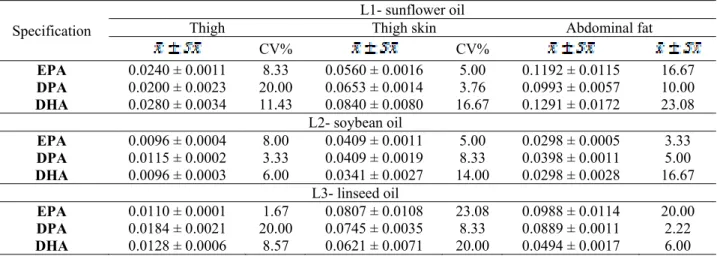
48 After the data’s statistic processing, significant differences were registered between the experimental groups regarding the EPA, DPA, DHA content in thigh muscles and skin as well as in abdominal fat, as shown in table 2.
Regarding the essential polyunsaturated fatty acids (ω-3) EPA (eicosapentaenoic acid), DPA (docosapentaenoic acid) and DHA (docosahexaenoic acid), in light of recent studies, it was demonstrated that they have a special importance through their protection role of the heart and circulatory system, as well as in the protection of the brain, and an important role in the fight against cancerigenous cells.
Significant differences regarding the EPA content were registered between L1 and L2 in thigh muscles and skin (p<0.01) and in abdominal fat (p<0.05).
Also, there were no significant statistic differences registered (p>0.05) regarding this acid by comparing the data of L1 and L3 in thigh skin and abdominal fat, with the exception of thigh muscle (p<0.01).
By statistically processing the data obtained from the groups L2 and L3, we could observe significant differences in abdominal fat (p<0.05), but there were no significant differences (p>0.05) in the other studied pieces (thigh muscles and skin).
Comparing the data obtained regarding DHA in all the experimental groups, we can conclude that:
There were significant differences (p<0.05) registered between the groups L1 and L2 in thigh skin and muscles and abdominal fat.
But, by comparing the data obtained from the groups L1 and L3, significant differences were registered in abdominal fat (p<0.05), but there were no statistical differences (p>0.05) registered in thigh muscles and skin.
Between the groups L2 and L3 there are statistical differences in thigh and abdominal fat (p<0.05), but there are no registered significant differences in thigh skin.
Regarding DHA, by comparing the data obtained in experimental groups, we can conclude that: Regarding this acid, statistic differences have been registered between the groups L1 and L2 in abdominal fat (p<0.05) and in thigh skin (p<0.01) but there were no statistical differences registered in thigh muscle (p>0.05).
By comparing the groups L1 and L3, there were no significant statistical differences registered (p>0.05) in any of the studied pieces.
Comparing the values obtained after statistical processing of the groups L2 and L3, significant differences are shown in abdominal fat (p<0.001), thigh skin (p<0.01).
The above data come to confirm the results obtained by [11], saying that different fat sources significantly modify the fat quality, and the fatty acids structure, respectively.
Table 2. Statistical indicators of fatty acids (EPA, DPA, DHA) in thigh and abdominal fat of the chicken from the experimental groups
Specification
L1- sunflower oil
Thigh Thigh skin Abdominal fat
CV% CV%
EPA 0.0240 ± 0.0011 8.33 0.0560 ± 0.0016 5.00 0.1192 ± 0.0115 16.67
DPA 0.0200 ± 0.0023 20.00 0.0653 ± 0.0014 3.76 0.0993 ± 0.0057 10.00
DHA 0.0280 ± 0.0034 11.43 0.0840 ± 0.0080 16.67 0.1291 ± 0.0172 23.08 L2- soybean oil
EPA 0.0096 ± 0.0004 8.00 0.0409 ± 0.0011 5.00 0.0298 ± 0.0005 3.33
DPA 0.0115 ± 0.0002 3.33 0.0409 ± 0.0019 8.33 0.0398 ± 0.0011 5.00
DHA 0.0096 ± 0.0003 6.00 0.0341 ± 0.0027 14.00 0.0298 ± 0.0028 16.67 L3- linseed oil
EPA 0.0110 ± 0.0001 1.67 0.0807 ± 0.0108 23.08 0.0988 ± 0.0114 20.00
DPA 0.0184 ± 0.0021 20.00 0.0745 ± 0.0035 8.33 0.0889 ± 0.0011 2.22
DHA 0.0128 ± 0.0006 8.57 0.0621 ± 0.0071 20.00 0.0494 ± 0.0017 6.00
49
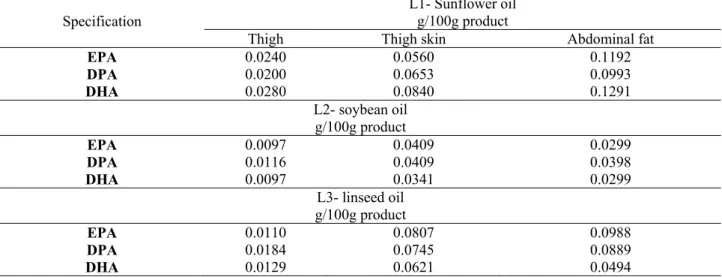
Table 3. Fatty acids content (EPA DPA DHA)/ 100 g product in the chicken from the experimental groups
Specification
L1- Sunflower oil g/100g product
Thigh Thigh skin Abdominal fat
EPA 0.0240 0.0560 0.1192
DPA 0.0200 0.0653 0.0993
DHA 0.0280 0.0840 0.1291
L2- soybean oil g/100g product
EPA 0.0097 0.0409 0.0299
DPA 0.0116 0.0409 0.0398
DHA 0.0097 0.0341 0.0299
L3- linseed oil g/100g product
EPA 0.0110 0.0807 0.0988
DPA 0.0184 0.0745 0.0889
DHA 0.0129 0.0621 0.0494
Eicosapentaenoic acid (EPA), docosapentaenoic acid (DPA) and docosahexaenoic acid (DHA). Are essential ω-3 fatty acids that are especially found in fish meat (salmon and shark) and, in small quantities, in chicken meat.
The highest values of these acids were registered by group L1 in abdominal fat (EPA 0.1192g/100 g product; DPA 0.0993g/100g product; DHA 0.1291g/100g product), followed by L3, in abdominal fat also (EPA 0.098g/100g product, DPA 0.0889g/100g product) and in thigh skin DHA 0.0621g/100g product.
The data are shown in table 3.
4. Conclusions
Most of the statistical differences appear in abdominal fat for all the studied fatty acids (EPA, DPA, DHA), between the group L1 (sunflower oil) and group L2 (soybean oil).
The less statistical differences regarding the three ω-3 fatty acids appear between the groups L1 (sunflower oil) and L3 (linseed oil) in thigh muscles and skin.
Regarding the content of fatty acids studied in 100 g product, the following can be concluded:
EPA. The highest quantity was registered in L1, in AF (0.1192/100g product) and the lowest value was registered in L2 for TM (0.0097g/100g product);
DPA. The highest quantity was registered for L1 in AF (0,0993/100g product) and the lowest value was registered for L2 in TM (0.0116g/100g product);
DHA. The highest quantity was determined for L1 in AF (0.1291g/100g product) and the lowest value for L2 in TM (0.0097g/100g product).
Acknowledgements
I would like to thank my wife, Izabella Fota and miss Miruna Dobândă for the support in translating this paper
References
1 Meluzzi A.., Siri F., Functional eggs: Fortification with n-3 PUFA, CLA and antioxidants. J. Food Sci. 2004, 14: 159-166
2 Bourre, J. M., „Where to find omega-3 fatty acids and how feeding animals with diet enriched in omega-3 fatty acids to increase nutritional value of derived products for human: what is actually useful?”, J. Nutr. Health Aging 2005 Jul-Aug; 9 (4), 232-42
3 Haug, A., Eich-Greatorex, S., Bernhoft, A., Jens P Wold, Harald Hetland, Olav A Christophersen, and Trine Sogn; Effect of dietary selenium and omega-3 fatty acids on muscle composition and quality in broilers, Lipids Health Dis Norvegia 2007
4 Mierliţă, D., Chereji, I., Maerescu, C., The effects of different fat sources on the performance of broiler chickens and on the fatty acid composition of selected tissues Vol 64, No 1-2: Bulletin of University of Agricultural Sciences and Veterinary Medicine Cluj-Napoca. Animal Science and Biotechnologies USAMV-CN, 2007, Vol 64, No 1-2
50 6 Simopoulos, A. P., Redefining dietary recommendations and food safety. World Rev. Nutr. Diet. 1998, 83, 219–222
7 Simopoulos, A. P., „Human Requirement for n-3 Polyunsaturated Fatty Acids”, Poultry Science, 2000, 79, 961-970
8 Simopoulos, A. P., and Visioli, F., ed., Mediterranean Diets Karger 2000 (S Karger, AG), Basel, Switzerland.
9 Fota, D. S., Drinceanu, D., Ştef L., Gergen, I, Alexa, E., Simiz, E., Baliga, I., Luca, I., The Effects of Different Fat Sources on Bioproductive Performances and Essential Fatty Acids Composition in Broiler Breast, Animal Sciences and Biotechnologies, 2010, 43 (1)
10 FotaD. S., Ştef, L., Drinceanu, D., Fota, I., Căpriţă, R., Simiz, E., The Effects of Different Fat sources on the Bioproductive Performances and the Essential Fatty Acids Composition of Thights and Abdominal Fat in Broilers, Lucrari Stiintifice- Seia Zootehnie, 2011, Vol. 56, in press