International Journal of Information Science and Management Vol. 17, No. 1, 2019, 83-95
Quality Evaluation of Academic Thesis Abstracts Based on ANSI / NISO Z39.14 (R2015) Standard: A Case Study
Maryam Karimi
M.A. Department of Medical Library and Information Sciences, Faculty of Paramedical
Sciences, Shahid Beheshti University of Medical Sciences, Tehran, Iran
Maryam Kazerani
Assistant Prof. Department of Medical Library and Information Sciences, Shahid
Beheshti University of Medical Sciences, Tehran, Iran
Corresponding Author: [email protected]
Maryam Shekofteh
Assistant Prof. Department of Medical Library and Information Sciences, Shahid Beheshti University of Medical Sciences,
Tehran, Iran [email protected]
Hassan Jahanihashemi
Associate Prof. Department of Children Growth Center, Qazvin University of Medical
Sciences, Qazvin, Iran [email protected]
Abstracts
Abstracts are regarded as valuable tools in assessing the relevance of documents during information retrieval. The determination of abstract compliance based on international standards is one of the methods which can be used for generating qualified information, reducing costs and establishing aligned coordination with international standards. Further, ANSI/NISO Z39.14 standard is one of the international standards presented by NISO committee which its final amendment was published in March 2015 and proposed some principles in terms of content and structural elements of different sources like theses. For this purpose, the present study aimed to evaluate the abstracts of Persian theses in different educational levels with ANSI/NISO Z39.14 standard at Shahid Beheshti University of Medical Sciences (SBMU) during 2010-2014. 386 Persian abstracts were selected from among the abstracts in master’s theses, PhD dissertations, Medical Doctorate(MD) and specialized medicine theses at different schools. The standard texts of ANSI/NISO Z39.14 (R2015) were used as the instrument including 15 structural and 5 content elements. Results indicated that there was a significant difference between the consistency of structural and content elements of the standards among the abstracts of the selected theses at different educational levels in different schools. The results suggest that an instructional and a coherent model should be developed, based on international and latest edition standards such as ANSI/NISOZ39.14 guideline for abstracts which are necessary to be followed by all centers in order to improve the style of writing abstracts.
Shahid Beheshti University of Medical Sciences Introduction
Statement of Problem
Generally, abstracts are the main elements to record scientific findings in various formats such as theses. Theses are considered as one of the primary sources of information and attracted a lot of attentions by the researchers in terms of structure and content since these primary sources of information are a foundation for subsequent information. Therefore, these features make theses a valuable source of information for anyone interested in that subject area. Theses are usually the basis for the publication of subsequent articles or books and they are regarded as the only accessible evidence of that scientific activity (Hansen, 1971). The determination of the abstract compliance with international standards is considered as one of the ways to optimize the information and create alignment and coordination with international standards. ANSI/ NISO Z39.14 (Guidelines for Abstracts), as one of these standards for abstracting was published by one of the subcommittees of an American National Standards Institute (ANSI) (Z39/ currently NISO), which is involved in the standardization of libraries and the activities related to the documents and publications, and offers guidelines for writing abstracts from different resources such as theses. Further, NISO standards can play a significant role in promoting the information exchange among the authors, publishers and distributors. In addition, NISO standards are guidelines for those who are publishing the information and providing tools to access, use or maintain the information. The Standard which was written in 1997 can help writers and editors to prepare useful abstracts, by describing the elements of abstract, forms, and appropriate styles. In the new version, the focus of the standard ANSI/NISO Z39.14 (R2015) is on the differences in the form and content of the informative abstracts, different parts of structured abstracts, electronic abstracts, and information retrieval from abstracts, and renaming the standards. The scope of this standard includes all abstracts prepared by the author or institutions which offer abstracting services. Further, this standard has recommendations for different parts of the abstract including type of abstract, bibliographical information, purpose, methodology, findings, conclusions, style such as the compliance with 300 word length for thesis abstract, using active verbs and full sentences, paragraphing in the structured and informative abstracts and avoiding unfamiliar terms and abbreviations, electronic format, the location of the abstract between the title page and body text, keywords and content like the purpose of study, methodology , findings, conclusions. In addition, it prevents from using title words for explaining the purpose(ANSI/NISO 2015) . Therefore, the present study aimed to evaluate the abstracts based on up-to-date international standards to avoid fragmentation and incoherence in the preparation of accurate abstracts at Shahid Beheshti University of Medical Sciences as one of the top universities1 in Iran.
The following research hypotheses were proposed and tested:
H1: There is a significant difference between thesis abstract in different educational levels in terms of the consistency of structural elements with ANSI / NISO Z39.14 standard.
H3: There is a significant difference in the consistency of structural elements of ANSI/NISO Z39.14 abstracting standards in thesis abstract of different schools at SBMU.
H4: There is a significant difference in the consistency of content elements of ANSI / NISO Z39.14 abstracting standards among thesis abstracts published in different schools of SBMU.
Literature Review
Korevaar, Cohen, Hooft & Bossuyt (2015 ) assessed the weaknesses of the abstracts in diagnostic accuracy studies, published in 12 high-impact journals in 2012, by using consort checklist. The findings showed that many of the abstracts are insufficiently informative; therefore, improving guidelines for such abstracts could help the transparency and completeness of reporting (Korevaar et al. 2015).
In another study, Hua, Deng, Kau, Jiang, He, & Walsh (2015) qualitatively evaluated the abstracts of randomized clinical trials in dental journals. Based on the results, interventions, objectives and conclusions were relatively well-written among 80% of the abstracts.
Further, Zeeneldin, Diyaa, Moneer, Elgammal & Buhoush (2014) reviewed the elements of 62 medical theses in terms of purpose, type of study, clinical trial phase, methodology, statistical analysis, results, limitations, satisfaction and IRB approval and indicated that indicated 76% and 24% of the studies were interventional and observational, respectively. No clear correlation was observed between questions and study purpose and both descriptive and analytical statistics were used. Most of the researches were related to cancers such as lymphoma, breast, leukemia, liver, bladder, lung and colon. Finally, the quality and quantity of MD theses could significantly improve over time.
Papi, Khalaji, Rizi, Shabani & Hassanzadeh (2014), in another study, entitled " The rate commitment to ISO 214 standard reported the highest and lowest commitment rates to ISO 214 standard in using third person pronouns (100%) and using active verbs (34/4%), respectively, among the Persian abstracts of approved research projects in Isfahan University of Medical Sciences. In addition, the highest commitment rates to ISO 214 standard (100%) in 2009 were related to the third person pronouns, starting the abstract with a sentence to explain the subject of the research, abstract placement, and including key words. However, the lowest commitment rate was observed in reporting research findings (16/7%) during 2001-2003. Moreover, various educational groups differed significantly only in commitment to study goals, providing research findings, and preventing from using abbreviations, signs, and acronyms. Furthermore, educational level of the corresponding author was significantly related to extracting the keywords from the text. No significant relationship was observed between other factors of ISO 214 standard and the educational level of the corresponding author.
inadequate reporting of the methods including 79.6% background, 65.6% evaluation and 65.6% data synthesis was reported. Based on the results, the quality of reporting systematic review abstracts in implantology journals should be improved more.
Ezema and Ugwu (2013), in his study, concluded that only three out of the eight State University Library have started ETD projects and this level of compliance is very low in order to promote the global visibility of Nigerian universities and enhance research dissemination.
Furthermore, Shabani, Askari, Homaei & Saadat (2011) studied the level of adherence to standards ISO 214 of Persian abstracts of general medicine at Arak University of Medical Sciences during 1999-2008" and reported the highest level of adherence (16.4%) in bibliographic information published in 2005. However, the findings were not mentioned in each abstract and a significant adherence to the standard was observed in different years except for the aim section.
Regarding the perspectives of studies on document abstracting, Alonso & Fernández (2010) recognized the systemization of models and conceptual apparatus which open up this type of research to semiotic and socio‐interactional outlooks as the big challenge in abstracting. Therefore, it is necessary to perform appropriate empirical research with efficient designs which can measure the efficiency of the abstracting and the productivity of a good abstract. The feedback of such studies should also be evaluated to explain and provide answers to all the elements and variables, which play a pivotal role in the realization and the acceptance of a quality abstract.
Cross & Oppenheim (2006), by focusing on the genre analysis of scientific abstracts, evaluated a number of abstracts in scientific papers in protozoology abstracted in CABI database. The method adopted in textual analysis of abstracts was based on reviewing the status of research in the scientific community, introducing the research by either describing the main features of the research or presenting its purpose, describing methodology, expressing the results expression, and providing practical results and recommendations. The results indicated that the authors of scientific abstracts presented their subjects with reference to the perspectives or "reality" in the world. All abstracts failed to follow the recommended guidelines although there was a general consistency with respect to semantic structure..
Finally, Dupuy, Khosrotehrani, Lebbé, Rybojad & Morel (2003) evaluated the quality of abstracts in clinical dermatology journals in terms of purpose, background, subject, interventions, measuring variables, findings and conclusions. Based on the results, the item of research background received the lowest score and the quality of unstructured abstracts was very low among the three journals, compared to structured abstracts.
Materials and Methodology
The corpus used in the present study included All Persian abstracts of 3861 theses of post-graduate studies including master, professional doctorate and doctor of Medicine in Shadi Beheshti University of Medical Sciences during 2010-2014. Then, using the formula:
α=0.05(95% confidence level) β = 0.2 (80% capacity)
(Carefully estimated) d=0.07 (10.7% relative error)
P = 0.65 (abstracting standards compliance is based on studies in various universities) (Makani, Vaez & Pourmohammad, 2015; Hiva, 2011)
386 abstract samples were selected based on stratified random sampling among the schools in master, professional doctorate, and Doctor of Medicine degree.
In the next procedure, the data were collected by the Checklist of ANSI / NISO Z39.14 standard text, including 15 structural components such as type of abstract,, bibliographic information (name of author / title / year), purpose,, methodology,, findings,, conclusion, the length of abstract,, the number of paragraphs , the use of active verbs,, the use of complete sentences,, the first sentence of abstracts, the use of unfamiliar terms and abbreviations, electronic format,, the position of the abstract to separate the title screen and main text, and keywords
Further, the second check-list included the following five components based on content: a. The purpose of this study is clearly stated in the abstract
b. Avoiding the use of words used for writing purpose c. The description of the methodology
d. The description of findings (Are the results briefly explained? Are data collection, correlation, observed effects, new events, hypothesis testing clearly stated?)
e. The discussion of the results related to the objectives (Are concepts related to the primary purpose of research, applications, suggestions, new relationships and hypothesis testing?).
After extracting the check-list related to the abstract of thesis, descriptive statistics, along with chi-square tests, ANOVA and Tukey post hoc test were used for data analysis Kolmogorov-Smirnov test was used to see whether the data were normally distributed or not. The results of Kruskal-Wallis test indicated that the data were far from normality. To compare compliance and non-compliance with any of the components of the structure and content of Degrees, Schools and 2010-2014 years of chi-square test, and to calculate the average total compliance with structural components and content Degrees, Schools and years 2010-2014 of analysis of variance (ANOVA) was used. To determine the highest and lowest difference in compliance and non-compliance with any of the components of the structure and content of Degrees, Schools and 2010-2014, Tukey's test was used. The results were presented in tables
386 ) 1 ( ) (
2 2 1 2 1
d
P P Z
Z
and graphs.
Data Analysis and Results
H1: There is a significant difference between thesis abstract in different educational levels in terms of the consistency of structural elements with ANSI / NISO Z39.14 standard.
Table 1
Descriptive statistics of structural elements based on educational level
Grade N Mean Std. Deviation Sig.
MS.s 89 17.44 .953
0.003
Ph.D & MD 136 17.24 .962
Residency 161 17.66 1.141
Total 386 17.46 1.052
The results of ANOVA in Table 1, there is a significant difference between structural elements score and different educational level using variance analysis (p=0.003). Further, based on Post-hoc test analysis, the difference is related to the PhD & MD and Residency.
H2: There is a significant difference in the consistency of content elements of ANSI / NISO Z39.14 abstracting standards among the theses in different educational levels.
Table 2
Descriptive statistics of content elements based on educational level
Grade N Mean Std.
Deviation Sig.
MS.s 89 6.31 1.062
0.017
Ph.D. & MD 136 5.95 .897
Residency 161 6.09 .900
Total 386 6.09 .946
As shown in Table a significant difference was observed between the scores in content elements and different educational level (p=0.017). Regarding the results of Post-hoc test, the difference is related to the theses abstracts of PhD, MD, and MS.c levels (Table 2).
Table 3
Descriptive statistics of structural elements in different schools
Faculty N Mean Std.
Deviation Sig.
Medicine 192 17.63 1.080
0.000
Dentistry 55 17.22 .809
pharmacy 32 16.91 1.201
Medical education 12 17.25 .754
Public health 16 18.00 .966
Nursing and Midwifery 26 17.12 .766
Paramedical sciences 15 17.40 1.242
Nutrition& food sciences 16 17.75 .775
Health, Safety and Environment (HSE) 6 16.50 .548
Rehabilitation sciences 8 17.25 .707
traditional medicine 8 18.13 1.458
Total 386 17.46 1.052
As illustrated in Table 3 there is a significant difference between structural elements score among different schools based on ANOVA results (p=0.000). Based on Post-hoc test, this difference is related to the theses abstracts published at the school of Traditional Medicine and the school of Health Sciences.
H4: There is a significant difference in the consistency of content elements of ANSI / NISO Z39.14 abstracting standards among thesis abstracts published in different schools of SBMU.
Table 4
Descriptive statistics of content elements in different schools
Faculty N Mean Std. Deviation Sig.
Medicine 192 6.09 .863
0.000
Dentistry 55 5.65 .775
pharmacy 32 6.38 .976
Medical education 12 5.58 .669
Public health 16 6.19 .911
Nursing and Midwifery 26 6.31 1.011
Paramedical sciences 15 7.07 1.387
Nutrition & food sciences 16 6.00 .894
Health, Safety and Environment (HSE) 6 5.33 .516
Rehabilitation sciences 8 6.63 .916
traditional medicine 8 6.25 1.389
Based on the results of ANOVA, there is a significant difference between the scores related to content elements among different schools (p=0.000) . Further, Post-hoc test indicated that the difference is related to the thesis abstracts published at the school of Health, Safety and Environment (HSE) and par medicine school.
Discussion
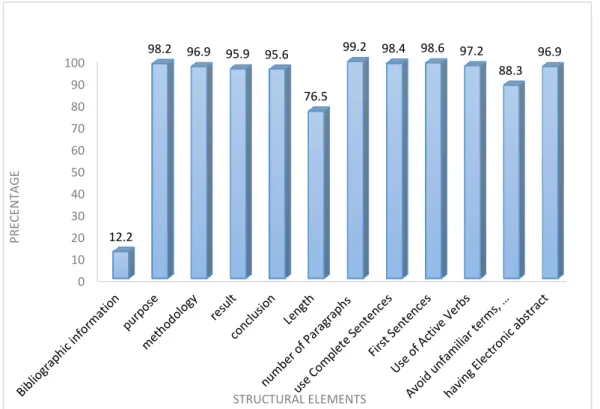
Based on the results, the greatest amount of structural consistency is related to the purpose, methodology, results and discussion, conclusion, paragraphing structured and informative abstracts, terminology, active verb use, electronic format and location, while the lowest consistency is related to bibliographic information, abstract length, unfamiliar terms, abbreviations, and keywords. The results are in line with Kiriakou's study which reported that 97.7% of the abstracts are structured abstracts and the highest level of consistency is related to the elements of purpose (97.9%), results (93.6%), and methodology (79.6%). In contrast, the lowest consistency is related to method, background (79.6 %), evaluation (65.6%) and data synthesis (65.6%) (Kiriakou et al. 2013).
Figure 1. The level of consistency of structural elements in thesis abstracts in SBMU
Figure 1 illustrates the level of consistency of structural elements among thesis abstracts in SBMU. The highest content consistency is related to purpose and findings, while the lowest consistency is related to methodology, conclusion, and the limitation for using title words in purpose section. Based on the studied abstracts, 83.2% are structured while 16.8% are informative. The finding is incongruent with Korevaar's findings. According to Korevaar et al. (2015), a large number of the diagnostic abstracts reported in high impact journals are informative.
From a structural perspective, 87.8% of the abstracts lack the elements of bibliographic 0
10 20 30 40 50 60 70 80 90 100
12.2
98.2 96.9 95.9 95.6
76.5
99.2 98.4 98.6 97.2 88.3
96.9
PR
ECE
N
TA
GE
information. Shabani et al. (2011) indicated the similar results in their study. The element of abstract length was consistent in 76.5% of the selected abstracts. According to the ANSI/NISO Z39.14 standard, the length of abstracts in documents with a large number of pages such as monographs and theses should be up to 300 words on a page (NISO 2015). In addition, Tenopir and Jacso (1993), in his study, emphasized that abstracts with the average 110 words are closer to ANSI standard.
Unfamiliar terms and abbreviations were used in 11.7% of the abstracts while the key words were excluded in 27.7% of the abstracts. According to ANSI / NISO Z39.14 standard, using unfamiliar terms and abbreviations in an abstract should be avoided; otherwise, it should be clarified by demystification. During abstracting, the author should select the words which represent the content because the selection of such words considerably affects the quality and quantity of indexing (ANSI/NISO 2015).
Based on writing style, the title has been used in the first sentence of the abstract in 98.6% of the abstracts while it has not been observed in 1.4%. According to Pao (1989), a good abstract the title of paper should not be repeated in a good abstract, and the sentences should not start with irrelevant phrases like "this study is the result ....", "this paper is an attempt on the way ...." or the “test for achieving its goal”, or “the author has been successful in …”.
The elements used in the present study like the use of active sentences was inconsistent with Papi et al. (2014) findings. Regarding the location of the abstract between first page and original text, our findings could follow ANSI / NISO Z39.14 standard(ANSI/NISO 2015).
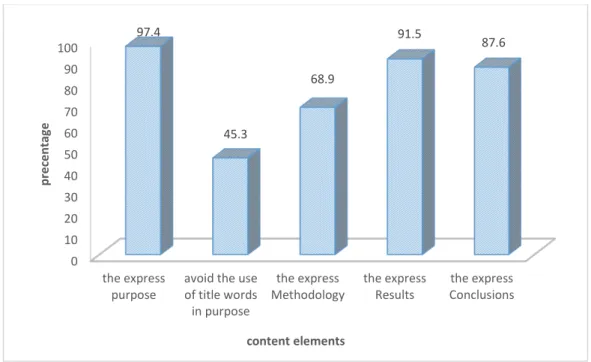
Figure 2. The level of consistency of content elements in thesis abstracts of SBMU
As illustrated in Figure 2, regarding content, the title words were used to define purpose in 45.3% of the abstracts, which is not consistent with the standards. Further, methodology, methods, research subjects and sample size, statistical software and practical plans have not been reported in 31.1% of the selected abstracts. These findings are incongruent with
0 10 20 30 40 50 60 70 80 90 100
the express purpose
avoid the use of title words in purpose
the express Methodology
the express Results
the express Conclusions
97.4
45.3
68.9
91.5
87.6
p
re
ce
n
tag
e
Kiriakou's findings which indicated over 80% consistency of these elements (Kiriakou et al. 2013).
Based on the results of ANOVA and chi-square test, the structural and content consistency of ANSI/NISO Z39.14 (R2015) standard indicated a significant deference was observed among different educational levels in writing thesis abstracts. The highest and lowest structural consistency was observed in the abstracts of theses in specialized and general medicine/professional doctorate level, respectively. The highest and lowest content consistency was related to the theses in masters and MD /Ph.D level, respectively. The highest and lowest structural consistency was related to those abstracts reported in school of traditional medicine and HSE, respectively. Regarding content, the highest and lowest consistency in thesis abstract was observed in school of paramedicine and school of HSE, respectively. These findings are consistent with Montajeb & Safizadeh (2012) findings. They reported that the consistency of nursing master theses with ISO standard (70.9%) was higher, compared to those abstracts in medicine doctorate, dentistry and pharmacy.
Conclusion
Regarding the results of the present study, the majority of the components had 50% compliance with the standards. Of course, the creation of some changes in writing patterns of Dissertation Abstracts can pave the way for obtaining an acceptable standard level. Writing an abstract based on maximum compliance with the updated standards can develop abstracting and indexing the abstracts in international databases. In addition, learning the instructions of abstracting is important for researchers and continuous and periodic training and assessment should be implemented accordingly. In order to improve the quality of abstracting, the following suggestions are presented:
Doing similar comparative research to evaluate the consistency of thesis abstracting based on international standards among medical schools with the same rank.
Conducting some studies to evaluate referencing on the basis of international standards
Compiling and publishing educational resources for abstracting based on ANSI/NISO Z39.14 (R2015) standard instructions and their distribution among students in higher education
Acknowledgement
The present study is based on the study presented for the partial fulfillment of the requirements for the thesis, entitled “Evaluation of thesis abstracts of Shahid Beheshti University of Medical Sciences based on ANSI/NISO Z39.14 (R2015) standard during 2010-2014" which was presented to the Department of Medical Library and Information Science , Paramedical School, Shahid Beheshti University of Medical Sciences.
Endnote
References
Alonso, M. I., & Fernández, L. M. M. (2010). Perspectives of studies on document abstracting. Journal of Documentation, 66(4), 563-584. doi: doi:10.1108/ 00220411011052957
ANSI/NISO. (2015). Guidelines for abstracts: An american national standard. Maryland: NISO Press.
Cleveland, A. D., & Cleveland, D. B. (2013). Introduction to indexing and abstracting. ABC-CLIO.
Cross, C., & Oppenheim, C. (2006). A genre analysis of scientific abstracts. Journal of Documentation, 62(4), 428-446. doi: doi:10.1108/00220410610700953
Dhanavandan, S. & Tamizhchelvan, M. (2014). A Study on Library and Information Science Journals: An Indian Perspective. SRELS Journal of Information Management, 51(2), 117-128.
Dupuy, A., Khosrotehrani, K., Lebbé, C., Rybojad M. & Morel P. (2003). Quality of abstracts in 3 clinical dermatology journals. Archives of Dermatology, 139(5), 589-593.
Ezema, I. J., & Ugwu, C. (2013). Electronic theses and dissertations in Nigeria university libraries: Status, challenges and strategies. The Electronic Library, 31(4), 493-507. Hanson, C. W. (1971). Introduction to science-information work. London: ASLIB.
Hiva, A., Abdollahi, L. (2011). Evaluation of compliance abstracts of journal articles Farsi Tehran University of Medical Sciences with ISO 214 & Vancouver's group guideline, in 1388. Payavard Salamat, 4(1-2), 54-61. [in Persian]
Hua, F., Deng, L., Kau, C. H., Jiang, H., He, H., & Walsh, T. (2015). Reporting quality of randomized controlled trial abstracts: survey of leading general dental journals. The Journal of the American Dental Association, 146(9), 669-678.
Kazempour, Z., & Ashrafirizi, H. (2010). Introduction to indexing and abstracting (Practical Guide). Tehran: Chapar. [in Persian]
Kiriakou, J., Pandis, N., Fleming, P. S., Madianos, P., & Polychronopoulou, A. (2013). Reporting quality of systematic review abstracts in leading oral implantology journals.
Journal of dentistry, 41(12), 1181-1187. doi: http://dx.doi.org/10.1016/j.jdent.2013 .09.006
Korevaar, D. A., Cohen, J. F., Hooft, L., & Bossuyt, P. M. (2015). Literature survey of high-impact journals revealed reporting weaknesses in abstracts of diagnostic accuracy studies.
Journal of Clinical Epidemiology, 68(6), 708-715. doi: 10.1016/j.jclinepi.2015.01.014 Makani, N., Vaez, R., Pourmohammad, A. (2015). A survey of Compliance of Persian
Abstracts of Research Articles in Medical Journals of Universities of Medical Sciences (Type 1) with the Vancouver Guideline and ISO 214 Standard. Journal of Kerman University of Medical Sciences, 22(3), 309-318. [in Persian].
6(1), 57-65. [in Persian].
Pao, M. L. (1989). Concepts of information retrieval. Englewood, Colo.: Libraries Unlimited Papi, A., Khalaji, D., Rizi, H. A., Shabani, A., & Hassanzadeh, A. (2014). The rate
commitment to ISO 214 standard among the persian abstracts of approved research projects at school of health management and medical informatics. Isfahan University of Medical Sciences, Isfahan, Iran. Journal of Education and Health Promotion, 3(1), 22-27. doi: 10.4103/2277-9531.131913
Shabani, A., Askari, E., Homaei, R., & Saadat, R. (2011). The level of adherence to abstracting standards (ISO 214) observed in Persian abstracts of general medicine theses in Arak University of Medical Sciences. Health Information Management, 8(3), 382-394. [in Persian].
Tenopir, C. & Jacso, P. (1993). Quality of abstracts. Online, 17(3), 44. Retrieved from https://eric.ed.gov/?id=EJ464332