Lucrări ştiinţifice Zootehnie şi Biotehnologii, vol. 42 (1) (2009), Timişoara
THE FUNCTION OF HYPOPHYSIS-THYROID SYSTEM IN
PATIENTS WITH ALCOHOLISM DEPENDING ON IODINE
SUFFICIENCY OF THE HUMAN BODY
FUNC
Ţ
IA SISTEMULUI HIPOFIZ
Ă
-TIROID
Ă
LA PACIEN
Ţ
I
CU ALCOOLISM
LARYSA ROSTOKA1, IVAN TURIANICA2, PETER CHLEBO2, MARTINA ČIŽMÁROVÁ2
1Uzhgorod National University, biochemistry and pharmacology department, Uzhgorod, Ukraine
2Slovak Agricultural University, human nutrition department, Nitra, Slovakia, Е-mail:
The aim of our investigation was to study the hypophysis- thyroid status of a body in patients with alcoholism, the inhabitants of various biogeochemical zones of the Transcarpathia, in the highlands – with expressed iodine deficiency and in the lowlands – with lower degree of iodine insufficiency. The content of thyroxin, triiodothyromine, thyrotropic hormone in blood serum has been defined by radioimmunologic method with the use of standard test- sets. The general iodine in the blood and urine has been studied by cerium-arsenide method. The peculiarities as to the influence of various ecologically iodine supply of the body upon TSH function of the hypophysis, hormone function of the thyroid gland, iodine reserves of the body both in practically healthy people and in alcoholism have been established. Alcoholism has been shown to be accompanied by the increased losses of iodine with urine and the depletion of the iodine reserves of the body, the increase of T3 level in blood serum both in lowlands and highlands of the Transcarpathia, it being characterized by different degrees of iodine deficiency complicating the existing iodine deficiency of the body. These findings may be good reasons for including iodine correction into the treatment of alcoholism.
Keywords: hypophysis-thyroid system, alcoholism, iodine-conditioned sufficiency,
hormone
Introduction
course of alcoholism, the abstinent syndrome, alcoholic intoxication and in the result – stable somatoneurological decay, psychological degradation remains to be topical. There is no common idea as to this point.
The hypophysis-thyroid system plays an important role in the regulation of the exchange of substances including the metabolism of proteins, fats and carbohydrates. Iodine deficiency in the environment results in the development of iodine insufficiency in bioobjects and in the marked impairment of the thyroid gland function, that plays the leading role in the hormone regulation of metabolism intensity and in bioenergetic reaction of the cells, in adaptation-trophic reactions of the body, in immunity regulation (ex. Rapa et al., 2000; Manz et al., 2002; Weber, 2002; Герасимов, 2003; Rostoka et al, 2003; 2007; Turianica et al., 2007). If one takes into the account that iodine as an ecological factor defines the iodine supply of the body and the function of the thyroid gland, and thus the thyroid regulation of metabolism, one cannot exclude its significant influence on the spreading, course, and efficiency in the treatment of alcoholism as well as on the stability of alkohol dependency in generat.
Alcoholism is known to result in the impairment of the exchange of proteins, fats and carbohydrates. The changes of protein biosynthesis and neuromediator metabolism lead to physical and psychological dependence, to emotional and volitional impairments, and further on cause the degradation of a personality (ex. Ahtee et al., 1980; Dubac et al., 1997; 1997 a; Морозов et al., 1983). Taking into consideration that thyroid gland hormones play the main role in the regulation of the exchange of proteins, fats, carbohydrates and energetic metabolism it is not excluded that patients with alcoholism show the impairments connected with the function of thyroid gland and the iodine sufficiency of the body (ex. Turianica et al., 2007).
That’s why we have carried out the investigation of hypophysis- thyroid status of a body in patients with alcoholism, the inhabitants of various biogeochemical zones of the Transcarpathia, in the Carpathian highlands – with expressed iodine deficiency and in the Tissa-Denube lowlands – with lower degree of iodine insufficiency.
Material and Methods
blood serum has been defined by radioimmunologic method with the use of standard test-sets. The general iodine (GI) in the blood serum (nmol/l) and urine (μg/daily) has been studied by cerium-arsenide method (ex. Barker et al., 1951; Степанов, 1965).
Statistical processing was carried out after a computer database was formed in Microsoft Excel by means of personal computer with calculation of Student’s t-test and means comparison.
Result and Discussion
It has been established that in people living permanently in mountainous zone with ecologically conditioned more expressed iodine insufficiency the hormone function of the thyroid gland is lower than in Tissa-Danube lowland, where the intensity of iodine deficiency is lessened. It is accompanied by the formation of lower T4 and T3 levels in blood in spite of the decreased level
of
iodine excretion with urine and increasing of TTG level in blood serum
(table 2).
People who live permanently in the Carpathians which is characterized with considerable iodine deficiency in the environment show lowering of the thyroid gland function (T3 and T4 levels that evidently stimulates TTG hypophysis function), the excretion of iodine with urine, probably it being the protective mechanism of economical use of iodine comparing with the indices in the inhabitants that permanently live under conditions of Tissa-Danube lowland with less expressed iodine deficiency. According to ICCID critiria the estimation of iodine deficiency severity as to mediane ioduria in the mountainous zone approaches the low bound of indices of moderate degree of severity of goitre endemia (22,6±1,53 μg/l) while in the lowland it reaches the upper bound (35,3±1,87 μg/l) (table 1, 2).
The patients with alcoholism that live permanently in the lowland biogeochemical zone of the Transcarpathia with less expressed ecologic iodine deficiency than in the mountains showed the increased level of TSH and T3 in blood serum on the background of its exhausted iodine with the urine as to the control data (table 1).
Table 1 Findings of hypophysis-thyroid system functional state in patients
with alcoholism in the Lowland zone
Finding Control n = 29
Alcoholism n = 14
Т3 (nmol/l) 1.02±0.07 1.35±0.09*
Т4 (nmol/l) 124±7.63 125±5.85
ТSH (nmol/l) 3.25±0.2 3.96±0.46*
GI blood (nmol/l) 465±11.8 326±13.3*
GI urine (μg/daily) 53.0±4.80 87.4±5.32*
*– The difference as to the control findings is reliable
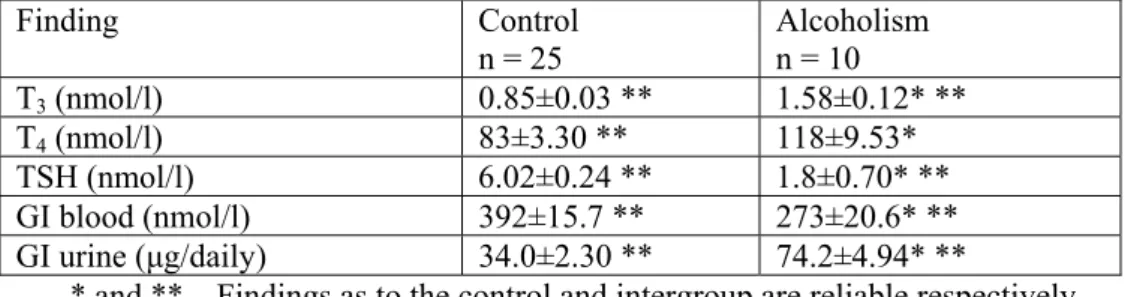
In patients with alcoholism inhabiting in more unfavorable as to the iodine zones the function of thyroid grand is being activated, the increased levels of T4 and T3 in serum being the indicator of it. The increase of T3 level is likely to be associated with the accelerated metabolic conversion of T3 in tissues which may result in the depletion of the thyroid gland. Alongside with this suppress of TSH function of the hypophysis and the enlarged losses of iodine microelement with the urine have been observed, this complicates its deficiency in the body as to the condition of practically healthy persons in the same zone (table 2).
Table 2 Findings of hypophysis-thyroid system functional state in patients
with alcoholism in Mountainous zone
Finding Control n = 25
Alcoholism n = 10
Т3 (nmol/l) 0.85±0.03 ** 1.58±0.12* **
Т4 (nmol/l) 83±3.30 ** 118±9.53*
ТSH (nmol/l) 6.02±0.24 ** 1.8±0.70* **
GI blood (nmol/l) 392±15.7 ** 273±20.6* **
GI urine (μg/daily) 34.0±2.30 ** 74.2±4.94* **
* and ** – Findings as to the control and intergroup are reliable respectively
It is necessary to point to the opposite direction of the hormone response of the hypophysis as to TSH production in patients with alcoholism in various biogeochemical zones of the Trancarpathia. If these patients in the lowland zones show the stimulation of TSH production of the hypophysis, then in case of ecologically conditioned more expressed iodine deficiency deep suppression of TSH function of the hypophysis with more than 3 times fall of TSH level in the blood serum as to the appropriate control and more than twice as to its level in the blood serum in patients with alcoholism inhabiting the lowland zone has been observed.
However, under condition of the different direction of TSH hormone production of the hypophysis in patients with alcoholism in the highlands the function of the thyroid gland as to the T4 production is activated which is likely to be associated with its stimulation by alcohol.
The established similar hormone tension of the thyroid gland in alcoholism especially under more expressed ecological iodine deficiency results in its rapid functional exhaustion with further probable complication of negative consequences which result in the transition from stimulation to impairments of the thyroid regulation of metabolism, to physical and intellectual degradation.
Patients with alcoholism in both biogeochemical zones with various degrees of iodine deficiency due to the excessive losses of iodine with the urine showed the formation of depleted iodine reserves of the blood. Thus, alcoholism stimulating excessive losses of iodine with the urine causes the depletion of iodine reserves in blood and consequently the iodine reserves of the body on the whole both in the lowlands and in the highlands. This is especially unfavourable for the patients inhabiting the mountainous zone where the highest deficiency incoming of iodine microelement with food and water in observed.
Conclusions
deficiency in the blood serum. These findings may be good reasons for the expediency as to including iodine correction into the treatment of alcoholism.
References
1. Ahtee, L., Atilla, L.M.J., Kiiantnaa, K., 1980, Brain catecholamines in rats selected for their alcohol behavior, Animal models in alcohol research, New York: Acad. Press, 51-57.
2. Barker, S.B., Humphrey, M.J., Soley, M.H., 1951, The clinical determination of protein-bound iodine, J. Clin. Invest, 30, 55-62.
3. Dubac, L., Deger, G., 1997, Алкоголізм: абстинентний синдром,
Медицинасвіту, 3, 9, 133-139.
4. Dubac, L., Deger, G., 1997, Alcoholism: hostra ta chronicna intoxikacia,
Medicina svitu, 3, 10, 186-193.
5. Manz, F., Bohmer, T., Gartner, R., Grossklaus, R., Klett, M., Schneider, R., 2002, Quantification of iodine supply: representative data on intake and urinary excretion of iodine from the German population in 1996, J. Ann Nutr. Metab., 46(3-4), 128-38.
6. Rapa, A., Martinello, D., Chiorboli, E., Sacco, F., Bona, G., 2000, Iodine deficiency in Italy. Italian Stady Group on Urinary Iodine of SITDP, Lancet, 354 (9178), 596-7.
7. Rostoka, L.M, Turyanitsa, I., Balint, L.I., Hluchy, S., 2007, The influence of iodinized oil on the function of hypophysis-thyroid system and the content of middle molecule peptides in healthy people depending on iodine supply of the body, Lucrari stiintifice/ Zootehnie si biotehnologii, 40 (1), 384–389.
8. Rostoka, L.M., Turjanitsa, I., Habanova, M. et al., 2003. Funkcia hypofýzo-tyreoidnej sústavy u ľudí v podmienkach environmentálneho jódového deficitu a korekcie. In Výživa a potraviny pre 3. tisícročie „Funkčné potraviny“. Nitra : SPU, 2003, 48-51.
9. Turianiсa, I., Angelovicova, M., Rostoka, L.et al., 2007, Enviromental iodine deficit and problems connected with it, Nitra, 211.
10. Weber, G., 2002, Neuropsiologic studies and cognitive function in congenital hypothyroid children, Pediatr. Res., 37, 6, 736-740.
11. Морозов, Г.В., Рожнов, В.Е., Бадаяна, Э.А., 1983, Алкоголізм, М.: Медицина, 432.
12. Герасимов, Г.А., 2003, Йодныйдефицитвстранах ВосточнойЕвропы иЦентральнойАзии – состояниепроблемыв 2003 году, Клин. Эндокринол., 1, 3, 5 – 12.
13. Степанов, Г.С., 1965, Определениесвязанногосбелкамийодавкрови,