http://www.sciencepublishinggroup.com/j/ajche doi: 10.11648/j.ajche.20180601.12
ISSN: 2330-8605 (Print); ISSN: 2330-8613 (Online)
Conference Paper
Study on the Determination Method of the Inclination of the
Large Height Chute
Jia Lan
1, Wang Dongxing
1, Zhou Duo
1, Liang Bing
2, *1
School of Chemistry and Environmental Engineering, Liaoning University of Technology, Jinzhou, China 2
School of Environmental Science and Engineering, Liaoning Technical University, Fuxin, China
Email address:
*
Corresponding author
To cite this article:
Jia Lan, Wang Dongxing, Zhou Duo, Liang Bing. Study on the Determination Method of the Inclination of the Large Height Chute. American Journal of Chemical Engineering. Vol. 6, No. 1, 2018, pp. 7-11. doi: 10.11648/j.ajche.20180601.12
Received: September 30, 2017; Accepted: October 25, 2017; Published: January 19, 2018
Abstract:
For a chute with a large elevation difference, it is important to choose the right inclination of chute, both to ensure the material will accelerate at a steady flow in the chute, and to meet the requirements of flow speed. In this situation the chute inclination cannot be determined according to conventional methods for a single factor, because in order to ensure the safety and environmental protection of the chute transportation, the chute inclination’s relationship to the moisture content of materials, the content of rock powder and a variety of other factors are considered. Through a theoretical analysis and experimental study, the results showed that the maximum water absorption in the moisture content, the water content and the inclination of the chute are proportional. Rock powder content and the relationship between the inclination tended to a logarithmic function relation curve. Put forward a formula for determining the chute inclination.Keywords:
Open-Pit Mine, Large Height Chute, Rock Powder Content, Moisture Content, Inclination1. Introduction
A chute is one of the most effective and economic ways to overcome height differences in mines. In the design of high-speed, large capacity continuous transport systems, the importance of chute tilt design must be considered to ensure the reliability of the entire operating system [1].
Open pit mine chute technology research began in the 1930s, and achieved some good results. In Russia, Γ. A. Lazovatsky conducted research on the application effects of mountain open-pit mining rock and ore chutes; in the United States, Dick, Stuart, Loar and others conducted systematic research and prepared a summary of the bulk solids handling chute design principles for the domestic Shenyang Coal Design and Research Institute of Sun Guomin; and Chi Yunhai, Yang Jianzhen and others provided an in-depth study on rational choices of chute geometry [2-4]. But there has been very little theoretical design research on chute applications for height differences of up to several hundred meters. On the basis of other research results, this paper uses
the backfill of Fushun West open pit as the research focus [5], and further studies the large height difference inclination design system used in backfilling large deep open pit mines. The application and design of large height difference chutes is the forefront of research at home and abroad. The inclination of the chute is the basis and core of chute design. Therefore, the experimental study on the inclination of the large height difference chute is extremely necessary and meaningful.
2. The Theoretical Foundation of Inclined
Inclination Design
2.1. Chute Inclination Design Principles
from a safety and environmental point of view, a smaller inclination is better. Therefore, in the premise of satisfying the flow, the principle of the inclination design of the chute is as small as possible.
2.2. The Relationship Between the Inclination of Chute and the Friction Inclination of Material
Figure 1. Force balance analysis.
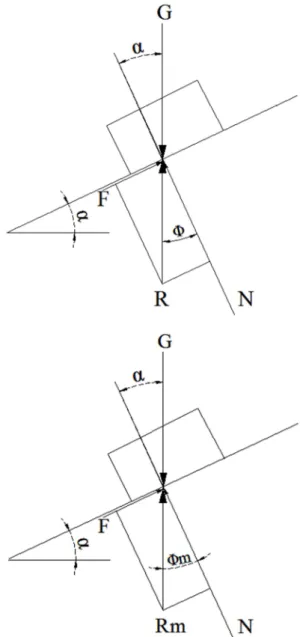
The sliding friction in the movement of materials in the chute is very complex, so analysing a piece of material can be meaningful. From the perspective of the balance of force, ensuring the object in the slope remains static, is the object gravity G, the normal reaction force N and static friction F, under the action of three balanced forces. The forces N and F are combined into a total reaction force R such that the object is balanced by forces G and R. The inclination between the force G and the normal line is the inclination inclination α of the slope, and the inclination between the force R and the normal is Ф. Because of the equilibrium condition of two forces, G and R must be reversed, so ф = α, (1). In this case,
the total reaction force R reaches the maximum value Rm. At the same time, the inclination ф also reaches the friction inclination фm, and фm = α (as shown in Figure 1). The chute inclination at which the critical equilibrium state descends is defined as the critical inclination α L = фm. Thus, for the object to move down the slope, it must be within α> Фm. Similarly, if the inclination of the chute is greater than the material friction inclination, the material will begin to slide down the chute. Under normal circumstances, the dynamic friction number f' is less than the static friction coefficient f; that is, f' <f, which shows that from a static start it is more laborious for the object to start sliding, but once the object is sliding, it's more efficient to keep things moving [6, 7]. Therefore, the critical inclination αL of the chute is 29° for the friction materials of Fushun West Open-pit Mine.
2.3. Slot Inclination Theory Calculation Method
When the massive backfill material flows in the chute, the movement states are either sliding, rolling, or sliding and rolling. The force acting on the single massive material is mainly the weight of the material itself, but also the supporting force of the chute, And the chute surface friction and air resistance (negligible). The stress analysis of a single stone is shown in Figure 2 [8].
Figure 2. Materials stress analysis.
According to Newton's second law, motion is given by equation (1)
G sin cos (1)
sin cos (2)
where: α is straight chute inclination; is the coefficient of dynamic friction between the material and the bottom plate, a as the material in the chute on the floor of the acceleration m/s2;
g is gravitational acceleration 9.81m/s2;
When the acceleration = 0 m/s2, the stones in the chute on the uniform motion, the equation of motion to meet:
α
tan =
f (3) arctgf
=
A theoretical deduction formula is that the chute inclination is the material and the chute wall between the determined dynamic friction coefficient; a common friction coefficient look-up table is as follows: When the chute is a natural surface, the ore = 1.3~1.7, coal = 0.7~0.8, the coefficient of friction between concrete and soil is 0.3~0.5, the coefficient of friction between concrete and rock is 0.5~0.8, and when there is wall lining, the values are 0.7~1.3 and 0.3~0.5 [9, 10].
3. Experimental Materials and Methods
3.1. Construction of the Experimental Model
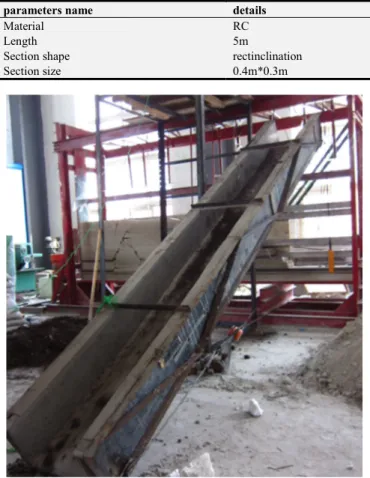
In general, the larger the model, the more it can reflect the prototype of the actual situation. But due to various conditions, the model is inadequate. Because of the limited laboratory conditions, the chute model length is taken as 5m. The parameters of the concrete chute model are shown in Table 1 below. The experimental model is shown in Figure 3.
Table 1. Experimental model parameters of chute.
parameters name details
Material RC
Length 5m
Section shape rectinclination
Section size 0.4m*0.3m
Figure 3. Experimental model diagram of chute.
3.2. Experimental Samples
Take FUSHUN east open-pit mine stripping, divide it into
several parts, and numbered the materials. In order to analyse the effect of moisture and particle size on the inclination of the chute, the raw materials (dry samples) were added to the water and fine sandstone with a particle size of <20mm powder and rock content of about 38%.
3.3. Single Factor Experiment
Theoretically, for a single-inclination chute, simply knowing the material and the chute coefficient of friction can determine the critical chute inclination. However, due to the diversity and complexity of the design factors of the inclination of the large chute, the critical inclination inclination cannot be used as the final chute inclination inclination, but only with the theoretical calculation value of the monolithic material. Using this experimental method, the influencing factors of the chute inclination design are verified. We determined the minimum chute inclination, which is the smallest chute inclination, for the material flow.
The friction characteristics of the material and the chute are the main determinants of the chute inclination design. Because of the influence of the external climate, material properties such as lithology, water content and particle size distribution will change, and these factors have a direct relationship with the material and chute friction coefficient. Therefore, the inclination of the chute cannot be calculated accurately by the above theoretical calculation formula. According to the two main factors of water content and powder rock content, reasonable inclination of chute is determined by the experimental method. The single factor test scheme is shown in Table 2 below.
Experiment 1: the moisture content of the slip material is 3%, the variation range of the powder rock content is 38% to 68%, and the influence of the content of the rock content of the sloughing material on the minimum inclination of the chute is investigated.
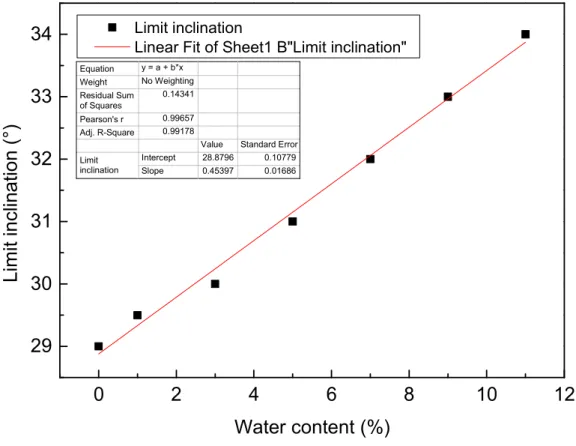
Experiment 2: the content of powder rock was 10%, and the range of water content of the test was 0% to 11%, and the influence of the water content of the sloughing material on the minimum inclination of the chute is investigated.
Table 2. Factors and levels of single factor test.
Level
Factor 1 2 3 4 5 6 7
Powder rock content (%) 38 43 48 53 58 63 68 water content (%) 0 1 3 5 7 9 11
4. The Experimental Results
Figure 4. Relationship between water content and chute inclination.
Figure 5. Powder rock content and chute inclination.
As exfoliation is affected by the external climate and fragile materials, the water content and the powder rock content are
the variables y(1
β
)=28.88+0.45β
(0< β ≤11%). The relationship between the content of powder rock and the0
2
4
6
8
10
12
29
30
31
32
33
34
Limit inclinationLinear Fit of Sheet1 B"Limit inclination"
L
im
it
i
n
c
lin
a
ti
o
n
(
°)
Water content (%)
Equation y = a + b*x Weight No Weighting
Residual Sum of Squares
0.14341
Pearson's r 0.99657 Adj. R-Square 0.99178
Value Standard Error
Limit inclination
Intercept 28.8796 0.10779 Slope 0.45397 0.01686
35
40
45
50
55
60
65
70
16
20
24
28
32
36
40
Limit inclination
Log3P1 Fit of Sheet1 B"Limit inclination"
L
im
it
i
n
c
lin
a
ti
o
n
(
°)
Powder rock content (%)
Model Log3P1
Equation y = a - b*ln(x+c) Reduced
Chi-Sqr
0.1345
Adj. R-Squar 0.94864
Value Standard Err
Limit inclination
a 22.17448 5.45295
b -3.05719 1.3771
inclination is a logarithmic function. The expression is
(
29)
ln 06 . 3 17 . 22
y(2
γ
)= +γ
− (0<γ
≤100%), when thecontent of silty rock is more than 58%, the inclination of the chute will not increase.
The chute inclination was used to determine the water content and powder was considered the content of the chute on the inclination. The minimum inclination of the chute formula is expressed as:
L
α
γ
β
α
min =y(1 )+y(2 )- (5)In which,
L
α is critical inclination of chute;
β
β
28.88 0.45y(1 )= + is the inclination of inclination
correction of the chute considering the moisture content of the material; y(2
γ
)=22.17+3.06ln(
γ
−29)
is the correction chute inclination considering the content of material is powder.5. Conclusion
Through the theoretical analysis and experimental research, the main conclusions are as follows:
(1) According to the relationship between the critical inclination inclination and the friction inclination of the backfill material, the kinetic equation is established according to Newton's second law. The theoretical formula of the inclination of the chute is deduced, which indicates that the chute inclination is determined by the dynamic friction coefficient between the material and the chute.
(2) The water content and the inclination of the chute are proportional. The relationship curve between the content of powdered rock and the inclination is a logarithmic function. When the content of powdered rock exceeds a certain value, the chute inclination no longer increases.
(3) Through the experiment, considering the influence of the three factors on the inclination of chute, such as the dynamic friction coefficient, moisture content and powdered rock content, the formula of the minimum inclination of the chute is put forward.
Fund Project
Open-pit mine large elevation difference chute transportation dust generation mechanism and regularity of dissipation (51604145) large open-air coal green mining theory and application (U1361211).
References
[1] SONG Ziling Jia Lan, Fan Jun et al. Rich deep sunken open pit backfilling process [J]. Science and technology leader, 2012, 30 (4): 51-54.
[2] Dick. Solid bulk material handling of the design principle of chute [J]. Journal of logistics technology, 1994 (4): 36-41. [3] Γ. A. Mountain in open mining engineering and application
effect of rock and ore chute [J]. Metal mines abroad, 1991 (11): 16-20.
[4] Ma Yundong, Jia Huiyan, Zhang Daming. Airtight negative pressure dust-control technology and application of transpersite in the coal conveyer belt system [J] Journal of coal science & engineering, 2008, vol.14, No.4.
[5] JIA Lan. Key techniques of fushun west open pit backfilling [D]. Fuxin, liaoning engineering technology university graduate school, 2013.57 71.
[6] CAO Luxia. Coal preparation plant transfer chute of technical transformation [J]. Journal of coal, 2009 (3): 24-27.
[7] ZHAO Hongze, ZHANG Ruixin, LIU Yun, et al. Optimization of mining sequence based on improved fuzzy analytic hierarchy process in surface mines [J]. Journal of Liaoning Technical University: Natural Science, 2014, 33(2):145-151. doi:10.3969/j.issn.1008-0562.2014.02.001.
[8] WANG Ruili, Xiong Wei, Sun Lijun, et al. Design and construction of water rubble-mound chute [J]. Port &waterway engineering, 2010, 9 (7): 137-139.
[9] WANG Ruili, Xiong Wei, Sun Lijun, et al. Stone bay arc chute mine coal preparation plant design [J]. Journal of coal engineering. 2005 (2): 18 to 19.