ISSN: 2374-2208(Print), 2374-2194(Online) Copyright © The Author(s). 2015. All Rights Reserved. Published by American Research Institute for Policy Development DOI: 10.15640/jibe.v3n2a1 URL: http://dx.doi.org/10.15640/ jibe.v3n2a1
Business in a Difficult Institutional Environment: The Afghanistan Post-911
Reconstruction
Fahim Youssofzai, M. Sc., Ph. D
1Abstract
This paper explores the subject of Afghanistan’s post-911 reconstruction and business development efforts. It adopts a strategic management perspective, highlighting Afghanistan’s general context; which is broadly affected by foreign interventions, civil wars, extremism, and international terrorism. It argues that business opportunities in Afghanistan are huge, but they remain unexploited because of the ongoing instability in this country. The paper suggests that besides the strategic behavior of the involved firms and proactive help of the international community, more effective national governance is needed to promote a favorable business climate. Stability in Afghanistan, this paper also argues, is a necessary condition for the stability and prosperity of the Central and Southern Asia, and the Middle East. Through a systematic and strategic analysis with concrete propositions, this paper intends to fill the gap in this area.
Keywords: Afghanistan, Business, Opportunities, Threats, Strategic Management.
1. Introduction
Adopting a strategic management perspective, this paper explores the subject of doing business in Afghanistan, a country that still offers huge business opportunities despite being devastated by foreign interventions, civil wars, extremism, and international terrorism for more than three decades. This paper suggests that, beyond Afghanitan’s stabilization, the promotion of legitimate and lawful business in this country is also a necessary condition for the stability and prosperity of Central and Southern Asia, and the Middle East. Recognizing the need for approaching Afghanistan’s complexity, which implies systematic and strategic analysis of this country’s ongoing challenges and opportunities, this paper hopes to fill the gap.
The first section reviews important methodological principles that help make sense of Afghanistan’s complexity. The second section summarizes the tumultuous contemporary history of Afghanistan, and pinpoints important sources of instability and crises in this country. The third section presents a strategic analysis of Afghanistan’s opportunities and challenges. The final section discusses “do’s” and “don’ts” of conducting business in Afghanistan.
I. A Brief Methodology Reminder
Numerous intertwined factors make it difficult to establish causal relationships about Afghanistan’s current business climate. Understanding the nature of complexity helps us to make sense of Afghanistan’s dynamic political, religious, military, social and economic knotting. “Complexity,” however, is defined in many ways, and the literature on this notion is abundant. I consider only those interpretations that bring clarity to the multi-dimensional and dynamic nature of Afghanistan’s puzzle.
1 Associate Professor (Strategic Management), Department of Management & Economics, RMC, Canada. Mailing address: P. O.
Box: 17 000, Stn. Forces, Kingston (Ontario). K7K 7B4. Phone: (613) 541 6000, ext. 6516 ; Fax: (613) 541 6315, Email:
According to Genelot (1992), a phenomenon is complex when it resides, in part, outside our comprehension and control. For Piaget (1967, 1970), “complex” is the opposite of “simple” and cannot easily be subjected to “reductionist” perspectives. For Yatchinovsky (1999), complex approach combines both subjective and objective perspectives; complex situations are those where cause/effect relations are not linear. According to Morin (1977), complexity implies examining the phenomenon from the perspective of the “whole,” not the “sum of its parts”. Each definition describes the situation in Afghanistan. Analysts have repeatedly recommended examining Afghanistan’s issues through a “multi-disciplinary” lens, implying “perspective-sharing” and “theoretical integration” (Carr, & Rugimbana, 2009, p. 98-99) – which means analyzing these issues through the complexity perpsective’s lenses.
In other words, looking at Afghanistan’s business issues through strategic management and organizational perspectives2, we can relate its complex current political, social, demographic, technological, and economic factors to critical decisions in this country, including those that firms must consider while doing business in this country.
From public policy and international relations viewpoints, besides the involved firms’ strategic decisions, good governance and proactive international involvements in Afghanistan have also their positive impacts on this conutry’s long term stabilization (Heinrich, 2013; World Bank, 2012; Taraki, 2010; Ahmadzai & Lockhart, 2008; Rashid, 2008). On the other hand, if the current climate continues to remain detrimental, then aside from the loss of business opportunities, Afghanistan’s instability may well result in more human suffering in Central and Southern Asia, leading to further global terrorism, narcotic production, and international drug trafficking (Gall, 2014; Youssofzai, 2011; Thomsen, 2011; Chaussodowski, 2010; Hopkirt, 1992; Habibi, 1985; Ghobaar, 1968).
A further important methodology reminder concerns data on Afghanistan. Finding reliable statistics on Afghanistan is generally difficult. The country’s Head of Central Statistics Organization admits a “… lack of updated information…” as Afghanistan’s data collection systems were “… put to a halt during the Soviet invasion in 1979 until the fall of the Taliban in 2001…” (Ghafouri, 2008, p. 1). On the other hand, even if acceptable data were available, their validity would be questioned by the main internal and external stakeholders, many of whom sharing different world views. Therefore, this paper uses statistical figures cautiously.
This brief research perspective and methodological recall is necessary to approach Afghanistan’s general environment.
II. A Strategic Analysis Of Afghanistan’s General Environment
This section presents a comprehensive analysis of Afghanistan’s general environment. It identifies the opportunities and challenges stemming from historic, socio-cultural, political, economic, legal, demographic, and technology dimensions facing the country. The remaining part of this section discusses each dimension in more detail.
II.1. A historic outlook
While the tragic event of 11 September 2001 projected Afghanistan in the world’s media spotlight, the country’s instability emerged long before this date. Over millenniums, the land now called Afghanistan has lived with waves of violence, invasions, and local population resistance. As an exceedingly strategic land, it has been envied by the world’s notorious powers and conquerors, including Persia, Alexander-The-Great, the Arabs, Mongols, Tsars, the British Empire, and the former Soviet Union. While many powerful militaries have adventured in, and temporarily conquered, Afghanistan to a greater or lesser extent, none has managed to annihilate popular resistance within its boundaries (Rashid, 2008 &2000; Dupree, 1980; Habibi, 1985 Ghobaar, 1968; Barry, 1984; Victor, 1983).
But with each military victory, the local population has paid the price of war’s burdens; through human suffering, killings, destroyed villages and infrastructure, ecologic disasters, and the loss of opportunities for socioeconomic development (Youssofzai, 2011). While Afghans may have won the wars militarily, they lost them politically and economically (Barry, 1984; Centlivres et al., 1984; Victor, 1983; Dupree, 1980).
2 Some classic and contemporary works include Ackoff (1970), Allison (1971), Andrews (1971), Ansoff (1965), Barnard (1938),
An important social consequence that persists is a general frustration among the Afghans, mixed with a thirst for justice and, somehow, revenge. Meanwhile, the miseries in Afghanistan have always created huge economic gains for a limited number of wartime opportunists.
Historically, Afghanistan has pursued neutrality, and was a founder of the ‘non-aligned countries’ during the Cold War era. After the Second World War, the country was gradually moving toward stability and prosperity (Barry, 1984; Victor, 1983; Dupree, 1980). But the country was swept suddenly into a profound crisis after a bloody coup d’état in April 1978, when a small number of Afghan communists, supported directly by the Soviet-Union’s spy agencies, undertook the unrealistic goal of transforming Afghanistan’s traditional society into a total communist society; while not sparing brutalities, random arrests, and massive killings (Tomsen, 2011; Barry, 1984; Centlivres et al., 1984; Victor, 1983; Shah, 1983; De Ponfilly, 1985; Dubois, 1989; Bazgar, 1987). One of the coup leaders, Hafizullah Amin, once declared that in the process of transforming the Afghan society to communism, it would have been sufficient if only one million Afghans had survived (from an approximate total population of 18 million at that time). Surprisingly, this coup met with general indifference from the West.
Consequently, hundreds of thousands of families were forced to take asylum in Pakistan and Iran, while multiple resistance groups arose across the country. Frustrated by the lack of popular support to its political aims, the communist regime further repressed Afghan villagers, thereby inflating the numbers of refugees and armed opponents to the point that the new regime faced imminent collapse.
To avoid the debacle, the leadership of the former Soviet-Union decided to invade Afghanistan militarily, politically, and economically on 27 December 1979. A new chapter of sorrow and pain began for Afghanistan’s villagers, intellectuals, artists, community leaders, and business people. The Red Army and its political affiliates pursued total war against Afghan’s villagers, while those who resisted were now called “rebels” by the invaders and their puppet regime in Kabul. Massive bombardments, random arrests, torture and killings persisted for most of a decade; which destroyed much of Afghanistan’s infrastructure, irrigation canals, harvests, and livestock. During the Soviet invasion, the Afghan communist regime’s secret police was excelling at helping the invaders. Its members were arresting and torturing Afghans perceived as “anti-revolutionaries,” “rebels,” or “western sympathizers”. Following arrest, the prisoners were then systematically massacred after being interrogated under terrible conditions (Centlivres et al., 1984; De Ponfilly, 1985; Bazgar, 1987; Barry, 1984).
These atrocities further multiplied the number of refugees in neighboring countries. In 1981, UNHCR puts forth the figure of four million Afghan refugees in Pakistan and Iran; rising to six million in 1986, which represented approximately one third of the total population of Afghanistan. As millions of Afghans were living in the improvised refugee camps, with abominable living conditions, international aid started to reach them timidly.
The Soviet occupation in Afghanistan persisted for ten years (1980-88), followed by a political vacuum and horrible civil war until the emergence of the Taliban in 1994. The Taliban movement originated in Kandahar, southeast of Afghanistan, in reaction to the anarchy, power vacuum, chaos, killings, and lootings of local warlord groups that arose during the post-communist era’s political vacum and civil war. Many warlord groups consisted of ex-communists and ex-Mujahedin party members - sponsored by regional power brokers who sought to extend their influence within Afghanistan - were belligerents of these fighting (Gall, 2014; Tomsen, 2011; Rashid; 2000, 2002 & 2008).
After each victory, the Taliban’s methods were similar: disarming the local population; imprisoning the opposing warlords if they were still present; dismantling “checkpoints” installed by warlords to ransom passengers; prohibiting music, movie, and TV; imposing ‘decent’ clothing codes for men and women; and establishing a rigid and conservative version of Islamic Sharia Law.
While these measures were relatively tolerated by the southern and eastern populations, they were often challenged by the northern and central populations of Afghanistan. Taliban casualties mounted during conflicts inflicted by their Northern Alliance rivals (who were now receiving sufficient military, political and financial support from Iran, Russia, India, and some Western sources). These casualties made the Taliban’s regime act with greater hostility. Over time, the more their measures were challenged by local populations, the more the Taliban became indifferent to the critics of international and human rights organizations.
Consequently, increasing allegations of human rights abuses committed by the Taliban in the northern and central Afghanistan were being reported. To these were added the Taliban alliance with newly formed Al-Qaeda networks, mainly composed of non-Afghan radical Islamists. Having witnessed the Taliban’s harsh regime, the citizens of Afghanistan became more disillusioned and disappointed by these new “peace messengers”. The Afghan public was realizing that the Taliban were not different from the other groups attempting to take power in Afghanistan since 1978. Eventually, in November 2001, the Taliban regime was overthrown by the US-led coalition in Afghanistan after it refused to hand over Osama Bin-Laden to the American authorities, following the events of 9/11.
The historical events summarized above are important for understanding the complexity of Afghanistan’s context. These events have deeply affected all internal dimensions of this country – including its contemporary social-cultural realities.
II.2 Socio-cultural dimensions
Ethnic groups such as Pushtuns, Tajiks, Hazaras, Uzbeks, Turkmens, Baluchs, Kirghizs, Qezelbaashs, Nouristanis, Aimaq, Gujors, Sikhs, and Hindus live in Afghanistan (Habibi, 1985; Barry, 1984; Victor, 1983; Dupree, 1980; p. 57-65; Ghobaar, 1968). Except for the last two, all groups are Muslims. Afghanistan’s principal languages are Pashto and Dari - both Indo-European languages (Dupree, 1980). The majority of Afghans are illiterate. In such a society, Afghan folklore and music play a critical role; they “…define ideal personality type, and describe ideal personal, in group and extra-group relations…” (Dupree, 1980, p. 112). Contrary to some myths, Afghan social and cultural values are very different from those demonstrated by the Taliban and their Jehadist friends. For the most part, tolerance, curiosity, independence, and hospitality constitute traditional cultural values of Afghanistan. During centuries, wars and crises in Afghanistan have affected this country’s social tissue. One can observe, for example, a higher inter-ethnic marriage rate – which makes it difficult to determine in some places of the country who is Pushtun, Tajik, Uzbeck, or Hazara.
An important recent social change to be mentioned is that, in reaction to unpopular regimes since 1978, common Afghans have learned to deal with the uncertainties of wars and crises. Meanwhile, they continue to hope for a better future. For instance, hope for a better future is reflected in the country’s low homicide rate. According to the UN Statistics Division (2014), between 2008 and 2010, the intentional homicide rate of males Afghans was 3.7 per 100 000 habitants while this rate for the females was 0.9.
Common Afghans love freedom and social justice; they are pugnacious, physically and emotionally, about their perceived legal rights. During the spring 2014 presidential elections in Afghanistan, several villagers with permanent blue ink on their fingers, a sign that they had voted in the general election, had their voting finger savagely amputated by illegal armed groups opposed to democracy in the country as a warning to others not to vote. Pointing his bandaged finger to the BBC camera, one victim was exclaiming he would continue to vote as long as he had nine more fingers.
In sum, through immense suffering over recent decades, most Afghans have developed an impressive degree of resilience. Far from being ‘insurgents,’ ‘drug dealers,’ or ‘dishonest,’ they reflect hard working people with strong bonds between families and friends. As a society, they share communal values of peace, justice, progress, and freedom. But there has been some gap between the common values shared in Afghan villages and the contemporary political systems imposed to these villages – especially during the communist era.
II.3. Political dimensions
It can be argued that the 1978 communist coup in Afghanistan is the main cause of contemporary political turmoils in this country and, to some extend, around the world today. From a domestic standpoint, the coup brought to Afghans a harsh decade (1980-1988) of war against a super power, the former Soviet Union. Moreover, the civil war (1992-1996) that followed the eventual defeat of the communist regime resulted in the Taliban rise to power. On the international consequences, one can argue that the coup not only inspired Soviet invasion in Afghanistan, but also the American led War-On-Terror that followed the 9/11 terrorist attacks in New York. The political changes that have arisen since 1978 have negatively affected the silent majority of Afghans who dream of freedom, justice, democracy, and prosperity. Meanwhile, those who profit from an absence of law and order are a small number of warlords, drug dealers, and past criminals. Having gained substential power in different Afghan institutions, these groups have repeatedly sabotaged the political efforts by local and international actors seeking to bring peace and stability in Afghanistan (Gall, 2014; Tomsen, 2011; Youssofzai, 2011; Rashid; 2000, 2002 & 2008).
To cite one example, in December 2001, internal and external stakeholders in Afghanistan met in Bonn, Germany - following the collapse of the Taliban regime - to plan the political stability of Afghanistan. These actors agreed to (i) a six-month interim administration led by Hamed Karzai, (ii) call for a Loya Jirga (grand assembly of all local and national influential leaders) to select a transitional government for an 18-month period, (iii) draft a new constitution, and (iv) organize general elections to elect a new administration for a 5-year term. The Bonn agreement brought relative political progress to Afghanistan. After 2002, the President and Members of Parliament were elected, while women and minority groups gained relatively more rights and power. Additionally, Afghanistan experienced greater freedom of speech, witnessed a massive reopening of schools, and experienced some trade liberalization. But these fragile gains were quickly diluted due to growing armed conflicts, terrorism, increased drug production and commerce, and endemic corruption within the country.
Inadequate political strategies, foreign countries negative direct interventions combined with weak and somehow indecisive adminnistrations during the post-Taliban era, are seen as the main sources of these problems. Fields and Ahmed (2011, p. 18-19) highlight in this regard “…the US …insistences to fashion a US-style democracy in Afghanistan,” while failing to address the warlord problem. According to these authors, instead of stabilizing Afghanistan, the US overemphasized the stabilization of Afghanistan’s surrounding regions, especially Iran, Russia and Pakistan. The other major mistake, add the authors, was to deny any future role to the Kabul regime’s opponents, including the Taliban. Profiting from the chaos, consequently, Taliban groups installed themselves as the main political authority in many rural Afghan villages, where the central government and international forces were reluctant to operate.
In his bestselling book, the Pakistani journalist Ahmad Rashid uses the metaphor “chaos” to describe the political disarray and confusion that has arisen in Afghanistan - mainly created by incoherent strategies applied by the United States, Pakistan, European Union, and the UN involvement in Afghanistan’s affairs. Rashid criticizes the U.S. “Magic Formula” that sought to win the war in Afghanistan through “advanced military technology and good intentions”. The United States, Pakistan and Afghanistan, “…have strategized with little regard for each other in pursuit of incongruous goals…” adds Ahmad Rashid (Rashid, 2008).
Consequetly, post-Taliban governmental agencies have been identified as nests of endemic corruption, nepotism, co-opting past criminals and warlords, and pillaging international aid. Corruption in Afghanistan goes beyond the local actors; foreigners are also accused to share the responsibility. For example, an expatriate member of the 2010 election commission “… was videotaped apparently soliciting a bribe to manipulate the results of Afghanistan's parliamentary election…” (Partlow and Zahori, 2010) (We will come back to the issue of corruption in the following sections). Conflicting and incoherent strategies by external players have also exacerbated the crises of Afghanistan (Amnesty International, 2014; Council on Foreign Relations, 2009; Gall, 2014; Rashid, 2000, 2002 & 2008; Tomsen, 2011).
Overall, post-Taliban regime has brought some political progress to Afghanistan. However, this progress has been overshadowed by endemic corruption, nepotism, and partisan amnesty of past criminals and warlords – against the wishes of the common Afghans. All of these problems affect, among others, the country’s emergent economic system.
II.4. Economic dimensions
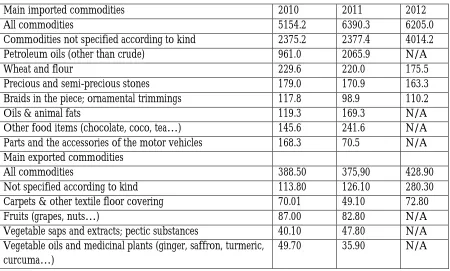
Afghanistan’s economic improvement since the end of the Taliban regime is undeniable. Table 1 presents the country’s main macroeconomic indicators while Table 2 offers important information about its trade balance. Afghanistan’s three main commercial partners since 2005 have been Pakistan (48% exports and 13.7% imports), India (18.7% exports and 12.6% imports), and Russia (8.8% exports and 12.6% imports) (UN Statistics Division, 2014). The economy of Afghanistan is also supported by natural factor endowments such as the country’s mineral reserves, estimated at three trillion dollars (Eleanor, 2011). Other positive signs of progress in Afghanistan’s economy include a relative optimism among Afghan populations and an entrepreneurial spirit held by many local Afghans, along with the regular transfer of foreign currency from the relatively important Afghan diaspora to their families in Afghanistan.
Still, Afghanistan’s economy is inherently fragile, and possibly transient. In fact, one can argue that the recent economic improvement is mainly due to an unprecedented level of international aid into Afghanistan. As a pivotal center in the international war against terrorism following 9/11, Afghanistan received an extraordinary amount ($26.7 billion) of international aid during the period 2001-2009 (Poole, 2011). In 2010-2011, excluding military and security sector expenditures, the country received another $15.7 billion US, approximately equal to the country’s total GDP (The World Bank, 2012). Another vulnerability of Afghanistan’s current economic system is that much of the cash is generated through drug production and its international sales, estimated at $200 billion dollars annually (Chaussodowsky, 2010).
Already, some economists are painting a gloomy picture for the country’s economy and its living standard. According to Afghanistan’s Head of the Private Sector Development, Afghanistan currently imports 96% of its good and services, while 40 % of its main source of export, fruits and other agricultural products, are spoiled due to deficiencies in local warehouses and refrigeration systems. One negative consequence is that investors are growingly discouraged; a high percentage of them either leave Afghanistan or delocalize because of the political uncertainty in the country (Afghanistan’s Vice Chief of Chamber of Commerce - Voice of America / Dari Service, 26 July 2014).
Table 1: Macroeconomic Indicators of Afghanistan (million US$)
Indicator 2005 2010 2011
GDP 6622 16078 18949
GDP Growth 9.90 3.35 5.70
GDP per Capias 240 512 586
Exchange Rate (Afghanis to US$) 50.41 45.27 49.04
Table 2: Afghanistan’s Top Imported & Exported Commodities in $US (millions)
Main imported commodities 2010 2011 2012
All commodities 5154.2 6390.3 6205.0
Commodities not specified according to kind 2375.2 2377.4 4014.2
Petroleum oils (other than crude) 961.0 2065.9 N/A
Wheat and flour 229.6 220.0 175.5
Precious and semi-precious stones 179.0 170.9 163.3
Braids in the piece; ornamental trimmings 117.8 98.9 110.2
Oils & animal fats 119.3 169.3 N/A
Other food items (chocolate, coco, tea…) 145.6 241.6 N/A
Parts and the accessories of the motor vehicles 168.3 70.5 N/A
Main exported commodities
All commodities 388.50 375,90 428.90
Not specified according to kind 113.80 126.10 280.30
Carpets & other textile floor covering 70.01 49.10 72.80
Fruits (grapes, nuts…) 87.00 82.80 N/A
Vegetable saps and extracts; pectic substances 40.10 47.80 N/A
Vegetable oils and medicinal plants (ginger, saffron, turmeric, curcuma…)
49.70 35.90 N/A
Source: Adapted from UN Statistics Division (http://data.un.org/CountryProfile.aspx)
The fact is that the country’s economy has experienced negative development after the international forces’ gradual withdrawal from the country in 2014. According to the World Bank (April, 2015), Afghanistan’s economic growth (an average of 9% during 2003-2009) is estimated to have fallen 2% in 2014 and 3.7% in 2013 - the main causes being political uncertainty, weak reform progress, decreases of investor and consumer confidence, and drawdown in international aid.
Another problem facing Afghan economic system is the unprecedented unequal distribution of wealth. Through Afghanistan’s wars and crises, a very small group of well-connected parvenus has become extremely rich, mainly because of the inappropriate disposal of public properties, stealing the international aid money, the arms trade, and the production and trade of drugs. This contrasts with the lifestyle of the vast majority of Afghanistan’s population, which lives in deep poverty and insecurity. Incoherent policies (security, political and economic) in the country have exacerbated this situation. Relatedly, a member of the Afghan parliament expressed the following remark:“… out of every US dollar spent by donors on Afghanistan’s reconstruction 80 cents find its way out of Afghanistan…” (Humanitarian News and Analysis, 2007). It is to be noticed that the country’s Minister of Planning resigned in 2004 because of the incoherent non-governmental organizations’ activities and their refusal to report their activities to his office. Later, he branded the aide community’s activities in Afghanistan as "economic terrorism,” accusing the NGOs of wasting vital Afghan aid money on their expensive lifestyles, being uncooperative with the Afghan government, and being involved in "corruption and embezzlement". The Minister of finance in 2008 also reacted to the aid agencies’ work in Afghanistan. According to him, these agencies“…are not coherent; they are not co-ordinated under one UN program.” In Afghanistan, added the Minister, “…every agency has a separate set of priorities and we do not know how capable they are because they are unaccountable..." (Pajhwok Afghan News, December 13; Xinhua, December 13; Reuters, December 12).
II.5. Legal environment
Drafting a new constitution in Afghanistan after the Bonn Agreement was expected to represent qualitative legal progress. With the help of the United Nations, a Jurisdictional Commission was assigned to rebuild the country’s jurisdictional system in accordance with Islamic codes, Afghan traditions, and international and human right principles. The new jurisdictional power of Afghanistan was expected to be independent and bestowed upon a national Supreme Court. In practice, successive governments have faced serious difficulties to enforce the new legal principles. The needs of Afghans in this regard have not been satisfied despite the enormous resource mobilization (Lau, 2002). According to Lau, the main problem in this domain is that the drafting process failed to include the largest opposition parties of Afghanistan, including the Taliban, and other groups excluded from the Bonn Agreement on Afghanistan.
In 2012 and 2013, Afghanistan was cited as the third most corrupt country in the world (Transparency International, 2012 & 2013) - with its jurisdictional system being identified as the most corrupted part of the Afghan government, followed by its education and health systems (BBC, Farsi Service, 2014). The main factor causing this corruption, according to Transparency International, is the lack of punishment bestowed upon the main agents of corruption. According to transparency international, just during 2013-2014, the people of Afghanistan had paid US$ 2 billion in bribes.
Assessing the Afghan government’s human rights performance since the fall of the Taliban regime until 2014, Amnesty International reports that despite relative improvements in education, women rights and the media, Afghanistan’s general human rights situation remained “desperate” in the sense that the country’s citizens continued to suffer from “…the effects of insecurity, poverty, impunity, lack of rule of law, endemic corruption, and a weak and corrupt justice system…” (Amnesty International, 2014a, p. 1). The ongoing armed conflict in the country is certainly a principal reason why “…progress in the area of human rights has been slow…” (Amnesty International, 2009). Meanwhile, pinpoints Amnesty, Afghanistan has known “too many missed opportunities”; the war continues in this country because the right things have not been done at the right time (Amnesty International, 2014b). In his bestselling book titled Descent Into Chaos, Ahmad Rashid draws the following general inferences about Afghanistan:
“…Initially, 9/11 would ensure that the world addressed the social integration and state failure in South and Central Asia…Afghanistan had to be rescued…Instead,…the US-led war on terrorism has left in its wake a far more unstable world than existed [before]…The international community had an extended window of opportunity for several years to help the Afghan people – they failed to take advantage of it…: The consequences of state failure in any single country are unimaginable. At stake in Afghanistan is not just the future of …the Afghan people yearning for stability, development, and education, but also the entire global alliance that is trying to keep Afghanistan together. At stake are the future of the United Nations, the North Atlantic Treaty Organization (NATO), the European Union, and of course America’s own power and prestige. It is difficult to imagine how NATO could survive as the West’s leading military alliance if the Taliban are not defeated in Afghanistan …. Yet the international community’s lukewarm commitment to Afghanistan after 9/11 has been matched only by its incompetence, incoherence, and conflicting strategies…” (Ahmad Rashid, 2008: pp. xxxvii - xxxiv).
In sum, the vast majority of common Afghans, victims of the past decades’ atrocities in Afghanistan, are disappointed when they see the actors of atrocities not brought to justice. They are outraged when they witness the actors of atrocities being appointed to Afghanistan’s highest positions, when they observe a number of them negotiating the country’s new democratic laws. This situation has seriously eroded trust. Yet, trust building is important: throughout the history of Afghanistan, common Afghans’ trust in their social and political institutions has been an essential component of Afghanistan’s stability, as well as the stability of its surrounding regions (Kuhzaad, 1947; Ghobaar, 1968; Reshtia, 1968; Barry, 1984; Habibi, 1985; Farhang, 1993; Rashid, 2008; Taraki, 2010; Dupree, 1980).
II.6. Demographic and technology environments
This rate is estimated at 4.4% for the urban population, and 2.7% for the rural population. For 2010 – 2015, female life expectancy is estimated at 49.5 years, while male life expectancy is estimated at 49 years (UN Statistics Division, 2014).
New technologies arrive fast in Afghanistan and heavily impact the lives of Afghans (Lemman, 2012). A Time Magazine’s article titled “How Afghanistan is on the Leading Edge of a Tech Revolution?” (Heinrich, 2013) eloquently informs us that “mobile banking has made a bigger advance in the country than in the rest of the world, including the U.S. — with potentially huge repercussions”. Despite the fact that Afghanistan’s banking system “is a corrupt mess, and the country’s financial institutions are not trusted”, there are some positives to these advances. For example, unimaginable some two to three years ago, an Afghan policeman can now use his mobile phone to verify if his salary was paid, and he can transfer money to other online accounts. The rate of mobile telephone subscribers has grown exponentially with the development of private satellites. While the number of telephone subscribers before the fall of the Taliban regime was less than 1% per 1000 inhabitants, it has since increased to 4.7% in 2005, 41.4% in 2010, and 54.3% in 2011 (UN Statistics Division, 2014).
The new technology has undoubtedly brought societal and economic benefits. For example, in the patriarchal society of Afghanistan, a growing number of young entrepreneurial women are now working from home in online service businesses. For those women lacking formal university education, the Internet has now become the main source of learning (Lemman, 2012). Through cost-effective educational pilot projects such as Software for Education, Entertainment, and Training Activities (SEETA); customized laptops have allowed school children, their parents, and teachers in Kabul a unique learning experience: access to customized digital libraries and language programs (SEETA, 2014).
Local technology start-ups are booming in Afghanistan despite it’s instability and uncertainties. Afghan IT entrepreneurs “…see their businesses as a foundation for stability and modernity…” (Lemmon, 2012). With the help of non-profit organizations and USAID, young Afghan female IT professionals can attend apprenticeships in Dubai or the US. The non-profit organization Bpeace’s CEO affirms:"…in 2004, the only Afghan women we were working with were in handicrafts, so we have seen the evolution of women moving from production into service businesses… The young generation coming up is computer literate. They are used to the Internet. They are used to mobile phones…" (Lemmon, 2012).
Meanwhile, in the absence of stability, technological advances have brought challenges to the Afghan society. For example, technological advances have reduced the number of labor intensive jobs in road construction projects. From a development perspective, this can be problematic, as keeping some labor-intensive projects helps to reduce unemployment rates. Another social problem has been the inappropriate use of the Internet, making some youth socially isolated and addicting others to pornographic consumption. Beyond the above problems, it is believed that access to the Internet and modern communication devices has helped terrorists and enemies of Afghanistan to increase the security challenges facing the country.
To summarize this section, Afghanistan offers huge opportunities (economic, political, and demographic) for both internal and external stakeholders. But the country also faces serious challenges. One New York Times reporter’s conclusion summarizes the situation: “…After thirteen years,…120 000 foreign troops deployed…, and tens thousands of lives lost, the fundamentals of Afghanistan’s predicament remain the same; a weak state, prey to the ambitions of its neighbors and extremist Islamists. The United States and its NATO allies are departing with the job only half done….The real enemy remains at large. The Taliban and Al-Qaeda will certainly seek to regain bases and territory in Afghanistan upon the departure of Western troops…” (Gall, 2014, p. 286). Benefiting from the opportunities of Afghanistan requires more effective and integrated efforts to stabilize this country. Developing a modern business environment can contribute in this regard.
III.Discussion: “Do’s” And “Don’ts” Of Doing Business In Afghanistan
By ‘stability’ of Afghanistan, we mean the end of armed conflicts, a relative reign of law and social justice, and favorable business infrastructure in this country. On the other hand, as the past decades' experience showed it, if the problems facing Afghanistan are not resolved, the ongoing instability of this country could lead to increased international terrorism, corruption, drug production and trafficking, and human rights disasters. Consequently, local and international actors need to define their strategies on the bases of real wants and needs of the “Common Afghans” (Youssofzai, 2011) as an important pre-condition toward changing the mentioned challenges into economic, social, and regional opportunities.
From within Afghanistan, better governance is a critical necessary condition towards achieving stability in this country. This means, among others, effective institution building, effective law and order enforcement mechanisms, active combatting corruption, removing the opportunity for former criminals and corrupted officials to assume high governmental positions, and boosting the physical infrastructure of Afghanistan.
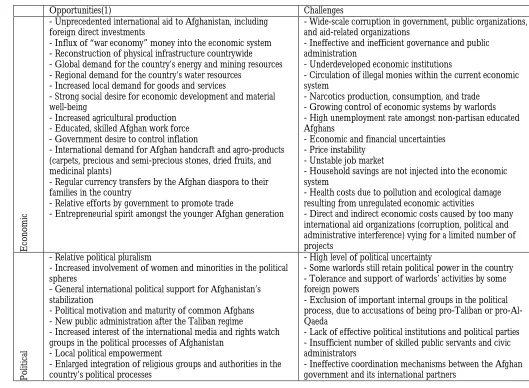
Firm-level strategies will be also an important contributor. Firms wishing to do business in Afghanistan need to make decisions based on well-considered management and organizational principles (Barnard, 1938; Simon, 1945; Drucker, 1954; Cyert & March, 1963; Thompson, 1967; Andrews, 1971) while considering the specificities of Afghanistan’s context, synthesized in the Appendix. Using the principles of strategic management, firms seeking to do business in Afghanistan need to know themselves through an objective assessment of their ‘strengths’ and ‘weaknesses’ (the above reference of management and organizational principles can be helpful in this regard). They must also know the specificities of Afghanistan’s general environment, through a dispassionate analysis of the ‘opportunities’ and the ‘threats’ of Afghanistan (synthesized in Table 4 in the Appendix). Finally, firms interested in doing business in Afghanistan must decide coherently - i.e., in accordance with their internal and external realities - in order to achieve their strategic objectives (which could be profit generation and/or long-run survival). Table 3 summarizes the strategic options for the firms wishing to do business in Afghanistan.
Table 3: Strategic Options for the Firms Wishing to do Business in Afghanistan
Strategic Choice Strategic Approach
“ S – T ” Strategies Use the company’s strengths to reduce environmental threats (Table 4) “ S – O ” Strategies Use the company’s strengths to exploit environmental opportunities (Table 4) “ W – T ” Strategies While being aware of the company’s weaknesses, decide which threats (Table 4)
to avoid
“ W – O ” Strategies While being aware of the company’s weaknesses, decide which opportunities (Table 4) to exploit
“ S ” = Strengths, “ W ” = Weaknesses, “ O ” = Opportunities, and “ T ” = Threats
In their day-to-day processes, concerned firms should not only increase their ‘strengths’ and decrease their ‘weaknesses’, but they also need to exploit the legal ‘opportunities’ offered in Afghanistan and avoid the ‘threats’ of this country. Being attentive to the ethnic and religious sensitivities is important in this regard – as it was elaborated in the above sections.
Given their centrality in the context of Afghanistan, it is important to further elaborate about the notions of “social responsibility” and “ethics” from a management perspective. The laissez-faire approach to business – which prefers a minimum of government intervention in economic spheres – argues that “…there is one and only one social responsibility of business—to use its resources and engage in activities designed to increase its profits so long as it stays within the rules of the game, which is to say, engages in open and free competition without deception or fraud… (Freedman, 1970, pp. 126-127). The “Bazaar-e-azaad” (free market) system adopted in Afghanistan by the post-Taliban regime mainly inspires from the “laissez-faire” approach. This approach is unlikely to work in Afghanistan, due to the realities of this country- elaborated in the above section.
Business in Afghanistan should first be economically responsible, which implies producing goods and services that are valuable for the consumers. Legal responsibilities oblige these businesses to respect Afghan government laws and regulations. Ethical responsibilities incite businesses to respect Afghan social values – including Islamic values - beyond governmental laws and regulations. By fulfilling such proactive discretionary actions, businesses can make relatively decent money and help Afghanistan towards stability. Businesses discretionary responsibilities are those that may or may not be fulfilled, such as providing day care to the employees, instituting positive discrimination towards women, or supplying charitable aide. Given that today’s discretionary responsibilities may become tomorrow’s ethical and legal responsibilities, argue the proponents of social responsibility, it is in the firms’ strategic interest to fulfill them before they become imposed by the government.
This paper has two shortcomings. Its findings remain general and do not show to specific firms involved in Afghanistan, how to fulfil exactly the suggested strategies summarized in Table 3 . Future research is needed to formulate more generic guidelines that will allow firms to assess their capabilities relative to Afghanistan’s context, and to recommend ways to implement their strategies. This paper’s second shortcoming is that, overall, it encourages activities of business in a highly uncertain and complex environment, a situation that only the risk-prone would like to face. Future research is required to study how specific firms who are active in Afghanistan and who make satisfactory profits succeed to manage complexity and uncertainties of this country.
Reference
Ackoff, R. L. (1970), A Concept of Corporate Planning, New York: Wiley.
Ahmadzai, A. Gh & Lockhart, C., (2008), Failed States: A Framework for Rebuilding a Fractured World: Oxford University Press, USA.
Allison, Graham T., (1971), Essence of Decision: Explaining the Cuban Missile Crisis, Little Brown, Boston, MA.
Amnesty International (2014a), AFGHANISTAN: SEVEN-POINT HUMAN RIGHTS AGENDA FOR PRESIDENT GHANI, Sept., http://www.amnesty.org/en/library/asset/ASA11/010/2014/en/31924afe-5ace-4052-bdb8-18204e9e0204/asa110102014en.pdf
- (2014b),Afghanistan: Too many missed opportunities: Human rights in Afghanistan under the Karzai administrationhttp://www.amnesty.org/en/library/info/ASA11/004/2014/en
-(2009), http://www.amnesty.org/en/region/afghanistan/report-2009
Andrews, K. J. (1971), The Concept of Corporate Strategy, Illinois: Richard-Irwin. Ansoff, H. I. (1965), Corporate Strategy, McGraw Hill, New York.
Barnard, C. I. (1938), The Functions of the Executive, Cambridge, Harvard University Press, Cambridge.
Barry, M. (1984), Le Royaume de l’insolence : La résistance afghane du Grand Mongol à l’invasion soviétique, Flammarion, Paris, France.
Bazgar, Sh. M. (1987), Afghanistan, la résistance au cœur, Paris, Denoël.
BBC (Farsi Service 28 Mai 2014), The People of Afghanistan Paid To Billions of Dollars Bribes in the Past 12 Months,
http://www.bbc.co.uk/persian/afghanistan/2014/05/140528_k02-afghanistan-corruption-new-report.shtml
Bourgeois, L.J. (1980), Strategy and Environment: A Conceptual Integration, Academy of Management Review, 5.1, p: 25-39.
Bower, J. L. (1972), Managing the Resource Allocation Process: A study of Corporate Planning and Investment, Irwin, Homewood, Illinois.
Braybrooke, D. & Ch. Lindblom. (1963), A Strategy of Decision: Policy Evaluation as a Social Process, The Free Press, Macmillan, New York.
Caroll, A. B. (1979), A Three Dimensional Conceptual Model of Corporate Performance, Academy of Management Review, Oct., pp. 497-505.
Carr, C. S. & Rugimbana, R. O., (2009), Marketing and development out of poverty: introduction to the special issue International Journal of Nonprofit and Voluntary Sector Marketing Int. J. Nonprofit Volunt. Sect. Mark. 14: 95– 100 .
Chaussodowsky, M. (2010), “The War is Worth waging”: Afghanistan’s Vast Reserves of Minerals and Natural Gas,
http://www.globalresearch.ca/the-war-is-worth-waging-afghanistan-s-vast-reserves-of-minerals-and-natural-gas/19769
Checkland, P., (1992), Systems Thinking, in Currie, W. L. & Galliers, B. (Eds), Building Management Information Systems, OXFORD University Press, Oxford, New York, p. 45-56.
Council on Foreign Relations (Aug. 2009), http://www.cfr.org/afghanistan/mcchrystals-initial-assessment-report-situation-afghanistan-august-2009/p20241
Crozier, M (1964), Le phénomène bureaucratique, Éditions d’organisation.
Cyert, R. M., and March, J. G. (1963), A Behavioral Theory of the Firm, Prentice Hall, New Jersey. Denadieu, G. (1985), L’approche systémique : De quoi s’agit-il ?, Arts et métiers Magazine, novembre. De Ponfilly, Ch. (1985), Le clandestine: dans la guerre des résistants afghans, Paris, Robert Laffond.
DiMaggio, P. J. & Powell, W. W. (1983), The Iron Cage Revised: Institutional Isomorphism and Collective Rationality in Organizational Fields, American Sociological Review, vol. 48, p: 147-160.
Drucker, P.(1954), The Practice of Management, Harper and Brothers, New York. Dubois, E. (1989), Afghanistan, terre brulée, Lausanne, Editions 24 heures. Dupree, L. (1980), Afghanistan, Oxford University Press.
Eisenhardt, K., and Bourgeois, L. J. (1988), Politics of strategic decision making in high velocity environments: Toward a mid-range theory, Academy of Management Journal, 31, p: 737-770.
Eleanor, N. (2011), Afghanistan's vast mineral deposits could lift it out of poverty, Global Development, 12 October,
http://www.theguardian.com/global-development/poverty-matters/2011/oct/12/afghanistan-transparency-vast-mineral-deposits
Farhang, MR. M. S (1993 – in Dari), Afghanistan in the Latest Five Centuries – Afghanistan-Dar-Panj-Qarn-e-Akheer Toms I, II & III, Muwassessa-e-Matbuaatee-e-Esmaaeleeaan, Qum.
Fields and Ahmed (2011), A Review of the 2001 Bonn Conference and Application to Road Ahead in Afghanistan, Institute for National Strategic Studies, Washington, D. C., Strategic Perspectives, No. 8.
Friedman, M. (1970), The Social Responsibility of Business Is to Increase Its Profits, The New York Time Magazine, Sept., pp. 126-127
Friedman, M. (1963), Capitalism and Freedom, p. 133, Chicago University Press.
Gall, C. (2014), The Wrong Enemy, America in Afghanistan: 2011-2014, HMH, Boston, New York. Genelot, D. (1992), Manager dans la complexité, réflexions à l’usage des dirigeants, INSEP Éditions, Paris.
Ghafouri, A. R. (2008), Managing Issues Addressing the Challenges of Using Administrative Data for Statistical Purpose, Central Statistics Organization, Afghanistan, Paper presented during the Seventh Management Seminar for the Heads of National Statistical Offices in Asia and the Pacific on 13 ‐ 15 October 2008, Shanghai, China
Ghobaar, MR. Gh. M (in Dari) (1968), Afghanistan in The Direction of History – Afghanistan-Dar-Massir-e-Taareekh, Kabul, Matba-e-Dawlati.
Habibi, Ab. H (in Dari) (1985), The History of Afghanistan After Islam – Taareekh-e-Afghanistan-Bad-Az-Islaam, Dunaay-e-Ketaab, 2nd. Ed., Teheran.
Heinrich (2013), How Afghanistan Is on the Leading Edge of a Tech Revolution? Time Magazine, March 02,
http://world.time.com/2013/03/02/how-afghanistan-is-on-the-leading-edge-of-a-tech-revolution/
Homans, G. C. (1950), The Human Group, Harcourt, Brace & World, New York.
Hopkirk, P. (1992), The Great Game, The Struggle for Empire in Central Asia, Kodansha USA.
Humanitarian News and Analysis (2007), Afghanistan: Gov’t questions effectiveness of foreign aid billions,
http://www.irinnews.org/report/72002/afghanistan-gov-t-questions-effectiveness-of-foreign-aid-billions
Kuhzaad, Ah. A (1947 – in Dari), History of Afghanistan – Taareekh-e-Afghanistan: tomes I & II, Anjoman-e-Taareekh, Matbaa-e-Omumi-e-Kabul.
Lau, M. (2002), Afghanistan’s Legal System and its Compatibility International Human Rights Standards, International Commission of Justice, Geneva.
Lemman, G. T. (2012), In the heart of Afghanistan, entrepreneurs innovate for peace, Fast Company Magazine,
http://www.fastcompany.com/3001733/heart-afghanistan-entrepreneurs-innovate-peace
Meyer, J. W. & B. Rowan (1977), Institutionalized Organizations: Formal Structure as Myth and Ceremony, American Journal of Sociology, 83, 1977, pp. 340-363.
(1987), Crafting Strategy, Harvard Business Review, July-August, p: 66-75. (1973), The Nature of Managerial Work, Harper & Row.
Morgan, G. (1980), Paradigms, Metaphors and Puzzle Solving In Organization Theory, Administrative Science Quarterly, p: 605-622.
Morin, E. (1977), La Methode, 1. La Nature De La Nature, Paris, Seuil.
Partlow, J. & Zahori, H. (2010), Adding to Afghan election woes, apparent bribe attempt caught on video, Washington
Post Staff Writer, Saturday, November 27
http://www.washingtonpost.com/wp-dyn/content/article/2010/11/27/AR2010112700945_pf.html
Piaget, J. (1967), Logique et connaissance scientifique, Paris Gallimard (enciclopédie de la pléiade : p. 1-132 & 1151-1271). (1970), La situation des sciences de l'homme dans le système des sciences, Épistémologie des sciences de l'homme, Paris, Gallimard, p : 15-130.
POLITICO (2010), http://www.politico.com/news/stories/0710/39432.html
Poole, L. (2011), Afghanistan: Tracking Major Resource Flows, 2002-2010, Conflict & the Military, January,
http://www.globalhumanitarianassistance.org/wp-content/uploads/2011/02/gha-Afghanistan-2011-major-resource-flows.pdf
Porter, M. E. (1996), What is Strategy? Harvard Business Review, Nov.- Dec., p: 61-78. (1990), The Competitive Advantage of Nations, New York, The Free Press.
(1985), Competitive Advantage: Creating and Sustaining Superior Performance, New York, The Free Press. (1980), Competitive Strategy, New York, Free Press.
(1979), How Competitive Forces Shape Strategy, Harvard Business Review, Vol. 57, No. 2, p: 137-145.
Quinn, R. E (1984), Applying the competing values approach to leadership: Towards an integrative model, in JG Hunt, R Stewart, CA Schriesheim & D Hosking (Eds.), Managers and Leaders: An International Perspective, Pergamon, New York.
Rashid, Ah. (2008), Descent Into Chaos, Viking.
(2000), Taliban: Militant Islam, Oil and Fundamentalism in Central Asia, Yale University Press. (2002), Jihad: The Rise of Militant Islam in Central Asia, Yale University Press.
Reshtia, S. Q (1968 – in Dari), Afghanistan in the 19th. Century – Afghanistan-Dar-Qarn-e-Nuzdah, 3d. Ed., Dawlatee Matbaa, Kabul.
Roethlisberger, F. (1977), The Elusive Phenomenon, Division of Research, Harvard University Press, Cambridge
Rumelt, R. P., Schendel, D. E. & Teece, D. J. (1994), (Eds.). Fundamental Issues in Strategy: A Research Agenda, Boston: Harvard Business School Press, p: 9-47.
Scott, R. W. (1992), Organizations: Rational, natural, and open systems, 3d. Ed., (Englewood Cliffs, NJ), Prentice-Hall. (1987), The Adolescence of Institutional Theory, Administrative Science Quarterly, 32, p: 493-511.
Scott, W. R. & Meyer, J. W. (1991), The rise of training programs in firms and agencies: An institutional perspective. Research in Organizational Behavior, 13, p: 297–326.
Selznick, P. (1957), Leadership in Administration, Harper and Row, New York.
SEETA (2014), Technology Set to Revolutionize Education in Afghanistan, 11 Aug., http://seeta.in/j/technology-set-ot-revolutionize-education-in-afghanistan.html
Shah, I. (1983), Caravane de rève, Éditions du Rocher.
Simon, H. T (1945), Administrative Behavior, The Free Press, New York.
Sirat, Ab-S. (2004), Speech delivered at the World Affairs Council in Orange County, CA, Source: http://afghanobserver.com/Articles/Sirat_WorldCouncil.htm
Taraki, R. (2010), (in Dari), The Internal and External Dimensions of War in Afghanistan, http://www.afghan-german.de/upload/Tahlilha_PDF/r_taraki_abad_darooni_wa_bironi_jange_afg.pdf
The World Bank (2015), Countries, Afghanistan Economic Context,
http://www.worldbank.org/en/country/afghanistan/overview
The World Bank (2012), Afghanistan in Transition: Looking Beyond 2014, Volume 1: Overview,http://siteresources.worldbank.org/INTAFGHANISTAN/Resources/Vol1Overview8Maypm.pf Thompson, J. D. (1967), Organizations in Action, McGraw-Hill, New York.
Transparency International, Country Profile: Afghanistan, Corruption Perception Index – 2012 & 2013,
http://www.transparency.org/cpi2012/results.
United Nation Assistance Mission in Afghanistan (2010),
http://www.un.org/News/Press/docs/2010/sc9889.doc.htm
UN Statistics Division (2014), Afghanistan, World’s Statistics Pocketbook (http://data.un.org/CountryProfile.aspx) Victor, J-Ch. (1983), La cite des murmures; L’enjeu afghan, Paris, J.C. Lattès.
Weber, M. (1947), The Theory of Social and Economic Organization, A.H. Henderson and Talcott Parsons, Eds., Glecoe, IL : Free Press.
Wheelen, T. L & Hunger, J. D. (2014) Strategic Management and Business Policy, Globalization, Innovation, and Sustainability, 14 th. Ed., Pearson.
Wheeler, J. (2010), Why should there be an Afghanistan?, http://www.tothepointnews.com/content/view/4134/2/ World Population Review (2014), Afghanistan, http://worldpopulationreview.com/countries/afghanistan-population/
Yatchinovsky, A. (1999), L’approche systémique pour gérer l’incertitude et la complexité, ESF éditeur, Paris.
Youssofzai, F. (2011), “Common Afghans”, A useful construct for achieving results in Afghanistan, International Journal of Humanities and Social Sciences, Vol. 1, No. 6, pp. 43-55.
Appendix
Table 4: Synthesis of Afghanistan’s Strategic Environmental Scanning
Opportunities(1) Challenges
E co n o m ic
- Unprecedented international aid to Afghanistan, including foreign direct investments
- Influx of “war economy” money into the economic system - Reconstruction of physical infrastructure countrywide - Global demand for the country’s energy and mining resources - Regional demand for the country’s water resources
- Increased local demand for goods and services
- Strong social desire for economic development and material well-being
- Increased agricultural production - Educated, skilled Afghan work force - Government desire to control inflation
- International demand for Afghan handcraft and agro-products (carpets, precious and semi-precious stones, dried fruits, and medicinal plants)
- Regular currency transfers by the Afghan diaspora to their families in the country
- Relative efforts by government to promote trade
- Entrepreneurial spirit amongst the younger Afghan generation
- Wide-scale corruption in government, public organizations, and aid-related organizations
- Ineffective and inefficient governance and public administration
- Underdeveloped economic institutions
- Circulation of illegal monies within the current economic system
- Narcotics production, consumption, and trade - Growing control of economic systems by warlords - High unemployment rate amongst non-partisan educated Afghans
- Economic and financial uncertainties - Price instability
- Unstable job market
- Household savings are not injected into the economic system
- Health costs due to pollution and ecological damage resulting from unregulated economic activities
- Direct and indirect economic costs caused by too many international aid organizations (corruption, political and administrative interference) vying for a limited number of projects P o lit ic al
- Relative political pluralism
- Increased involvement of women and minorities in the political spheres
- General international political support for Afghanistan’s stabilization
- Political motivation and maturity of common Afghans - New public administration after the Taliban regime
- Increased interest of the international media and rights watch groups in the political processes of Afghanistan
- Local political empowerment
- Enlarged integration of religious groups and authorities in the country’s political processes
- High level of political uncertainty
- Some warlords still retain political power in the country - Tolerance and support of warlords’ activities by some foreign powers
- Exclusion of important internal groups in the political process, due to accusations of being pro-Taliban or pro-Al-Qaeda
- Lack of effective political institutions and political parties - Insufficient number of skilled public servants and civic administrators
L
eg
al
- Approval of a new constitution based on respect of human rights, women’s rights, minority rights, and acceptance of other international principles
- Institution of modern jurisdictional and law enforcement systems
- Tolerance of national and international human rights groups in the country
- Efforts to institute property rights and business law in Afghanistan
- Powerful people act outside the law
- Acquisition of public and private properties grabbing by warlords and high-ranking officials
- Large-scale corruption in the country’s legal and police systems
- Difficulty of applying some aspects of the new constitution to Afghans’ daily lives
- Adoption of laws which favor warlords and past criminals (e.g., a general amnesty and lifetime immunity to all people involved in fighting over the past decades)
- Salary increases and generous retirement packages being awarded to high ranking officials and parliamentarians
S
o
ci
al
- Relative individual and media freedom
- Development of a middle class structure, especially among minority groups
- Social acceptance of minority group members and women who occupy prestigious positions in the country
- General fatigue amongst common Afghans for wars and conflicts, leading to popular rejection of extremism, terrorism, and suicide
- Social values based on modernity, individual freedom, education, progress, and well being
- Positive social effects due to the reconstruction of Afghanistan after the civil wars
- National and international social networking of Afghan families and communities
- Healthier levels of competition among social groups
- Foreign exploitation of Afghanistan’s social diversity - Popular belief that international aid will persist into the future
- Ongoing influence of neighboring countries’ cultural hegemonies on internal social groups
- Increasing materialism, decreasing spiritual values, and the loss of village solidarity
- Decreased inter-generational solidarity - Loss of concern for the public good
- Sustained reliance on tradition, ethnic affiliation, and charismatic leadership by some social groups
- Decreased value of hard working - Wide ranging reliance on charitable aid
- Over-reliance on foreign powers to resolve the country’s socioeconomic and politico-military problems
- Inflation of ‘fake’ titles (Doctor, Professor, Mawlawi, Engineer) D em o gr ap h ic
- Population growth
- High percentage of youth population
- Positive effects of dual citizenship (country visits, currency transfers)
- Benefits of international marriages
- Women and girls (> 50% of the country’s population) have received social, political and international recognition for their rights
- Involvement of the elderly in community activities and social-political advisory boards
- Three generations have been victims of wars - Lack of family planning
- Exodus of rural populations to mega urban centers - One of the largest refugee populations in the world, mainly in neighboring countries
- Negative effects of dual citizenship of Afghans (e.g., evading taxation)
- Lack of general population census or electronic national ID cards
- Neighboring countries’ citizen have obtained illegally Afghan ID papers and passport
T ec h n o lo gy
- Social and political progress resulting from the use of the Internet
- Progress in wireless telecommunications
- Increased use of technologies in goods and services production - Improved air and railway transportation
- Increased ‘ring-roads’ across the country - Improved agricultural technologies
- Increasing use of solar technologies for domestic and industrial uses
- Critical decrease in labor-intensive jobs - Over-reliance on technology in daily life
- Social isolation of younger members due to information technology
- Increased juvenile consumption of pornography through the internet and wireless services
- Use of modern telecommunication and internet technologies by terrorists and drug dealers
G lo b al / In te rn at io n al
- Increased recognition of Afghanistan’s place as a potential regional business Hobe
- Economic and financial gains of global interconnectedness coming from the surrounding regions of Afghanistan
- Positive effects of global War on terror (jobs, contracts to local enterprises…)
- Proxy Wars
- Increased global demand for opium and heroin
- Negative effects of the War on Terror (destroyed villages, infrastructure, and the collateral death of innocent citizens) - Risk of globalized extremism and terrorism