Volume 1, Issue 1, September 2012
Page 58
A
BSTRACTAvailability of specialists in internal medicine to serve the wider community, especially in the province of Banten is still very low, so as to obtain health care, patients have to queue up at a particular hospital. Expert systems as a branch of artificial intelligence course can be used as a solution to overcome the shortage of specialists in the field of medicine. In this study, we developed an application expert system for diagnosing the disease using inference techniques certainty factor with multiple premise rule, which allows a patient consultations to determine many of the symptoms, in order to obtain the final diagnosis according to the patient's level of conviction entered. Application was developed using the concept of web-based so it can be used at any time by the patient, to be able to detect early symptoms of the disease, prior to further examination by a specialist. Search results for the selected symptoms of the patient showing the value of certainty factor, and shows the percentage of convictions diagnosis performed at 90%.
Keywords: Internal disease, expert systems, certainty factor, multiple premises
1.
INTRODUCTION
An expert system is a branch of artificial intelligence was first developed in mid-1960. As an application of the scientific study of artificial intelligence, expert systems are able to use human knowledge through an inference engine to solve problems that require a person expertise. Because of its ability that can capture knowledge as well as ease of access from anywhere, even able to operate within the dangerous, expert systems are developed for a variety of purposes from all disciplines [1],[2].
In general, the application of expert systems are widely used in the health sector to make the diagnosis of certain diseases, such as HIV disease diagnosis expert system using Fuzzy C-Means [3], Hypotension diagnosis using the concept of Neuro-Fuzzy [4], low back pain in computer users diagnosis using fuzzy sets [5],[6], diabetes disease diagnosis using Mamdani fuzzy inference with fuzzy verdict mechanism [7], and diagnosis of asthma using machine learning methods [8].
In other areas, an expert system was developed to predict the customer satisfaction with a product based on design and color [9], predict tensile behavior of tailor welded blanks using artificial neural network [10], development and improvement of learning concepts using expert system application to create e-learning expert system [11] and mobile learning are combined with the concept of cloud computing [12], application development 'guru' spiritual uses the concept of an expert system to answer various questions about life and soul [13], and classification of types of industrial and home wastes using if-then-rule-based [14].
On the other hand, the use of expert system inference engine aims to form a final conclusion on the basis of knowledge. Some inference engines that can be used are fuzzy logic, neural networks, neuro-fuzzy concept if-then rule based, Bayesians reasoning, genetic algorithms, and even the certainty factor. For the use of certainty factor, at the beginning of its development, much criticized by scientists because they do not fit and are only used for specific needs and could not be used, however, now, the certainty factor began to be used again as an inference engine for its ability who is capable of forming an independent causal assumption [15] and able to handle the appearance of single or multiple rules to the resulting final conclusion [1].
Some expert system application, which uses the inference engine certainty factor among others: the level of water quality monitoring applications [16], similarity of facial expression detection for multimedia applications [17], evaluation of the success rate of teaching system [18], handling of duplicate data on the concept of data mining [19] and safety risk assessment process of enterprise information technology adoption [20].
The Use of Certainty Factor with Multiple
Rules for Diagnosing Internal Disease
Tb. Ai Munandar1, Suherman2 and Sumiati3
1,2,3
Informatics Eng. Department, Universitas Serang Raya
Volume 1, Issue 1, September 2012
Page 59
However, some applications are still developed using a combination of if-then rules and inference certainty factor to handle double the premise of connecting conjunctions, where inferences are affected in such patients answer "Yes" or "No" when choosing the symptoms are felt (for if-then-rules), and final value certainty factor combinations, less than optimal because it only take the lowest or the highest value of evidence, and then multiplied by the value of certainty factor rule in the existing knowledge base, so that the final value of the degree of confidence is determined by the size of the value of direct evidence (for certainty factor using connecting conjunctions).
This paper will discuss the use of the combined value of certainty factor of multiple rule without seeing the lowest or the highest value, so that the final value is more optimal results without relying on any of the evidence that exists, because all the evidence has the same potential to be able to determine the final decision.
2.
LITERATURE
REVIEW
2.1 Expert System
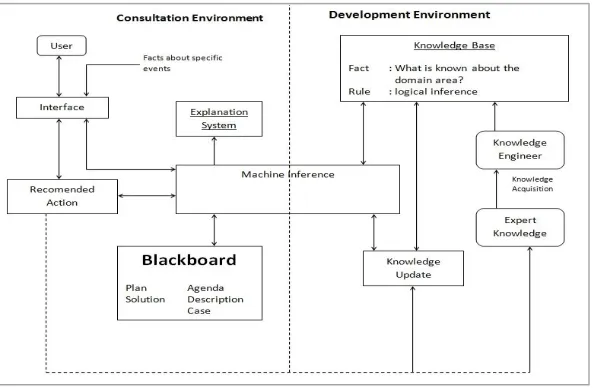
In the development of expert systems, basically there are several important components that must exist, namely, expertise, experts, transfer of expertise, inference, and the ability to explain the rules of the facts, theories, procedures, and rules of the problem in order to resolve problems [2], [21]. An expert system consists of two main parts (see Figure 1). First, the development environment, which is used by the manufacturer, to build an expert system components, and introduce knowledge into the knowledge base. Secondly, the environmental consultancy, which is used by the user, in order to acquire the knowledge and advice of the expert system, as if it were an actual consultation with experts. Inference engine are the most widely used, is a forward chaining and backward chaining, or a combination of both, however, they are sometimes combined with other methods to be more stable inference engine.
Figure 1 Expert System Environment
2.2 Internal Disease
Internal disease is kind of a disease that attacks the human internal organs. In medicine, known for some of the common diseases suffered by the patient, such as, liver disease, heart disease, pulmonary tuberculosis, gout, coronary heart disease, anemia, brain abscess, etc [22]. This research will discuss the ten types of internal disease, to include disease information, symptoms and rules into the knowledge base of expert system applications.
Each disease has several symptoms different or even the same. In this study, data on symptoms were found in each of these diseases, there is a common symptom of some other disease. This is what underlies the certainty factor used as a method of inference engine to determine the final decision will be.
Volume 1, Issue 1, September 2012
Page 60
2.3 Certainty Factor (CF)
The concept of certainty factor is proposed to accommodate the uncertainty of an expert who is often thought of analyzing information with phrases such as "May", "likely", "almost certainly" and so on. Notation certainty factor is described as follows:
CF[h,e]=M[h,e] – MD[h,e] (1)
Where, CF [h, e] depict the certainty factor and MB [h, e] describes the size of the confidence in the hypothesis h, if given evidence e (between 0 and 1), MD [h, e] describes the size of the distrust of hypothesis h, if given evidence e (between 0 and 1). There are three things that might happen to the hypotheses arising from existing evidence. First, the rules with single evidence e and a single hypothesis of h, where the notation certainty factor can be written as follows:
CF[h,e]=CF(e) x CF(rule) (2)
In practice, CF (rule) is determined by experts, whereas CF (e) is determined by the user, while consulting with the system. Second, rules with multi- evidence e and single hypothesis h. Notation certainty factor is determined by the interface used, could use a disjunction or conjunction. Notation on connective disjunction is written as follows:
IF e1 AND e2 ... AND en THEN h (CF rule) (3)
So that the calculation of the value of CF combination, defined by the following notation:
CF(h,e)=min[CF(e1),CF(e2),...,CF(en)]*CF(rule) (4) Meanwhile, for connecting conjunction, can be written as follows:
IF e1 OR e2 ... OR en THEN h (CF rule) (5)
So the calculation of the value of CF combination, defined by the following notation:
CF[h,e] = max[CF(e1),CF(e2),...,CF(en)]*CF(rule) (6)
Third, the combination of two rules with different evidence (e1 and e2) but refers to the same hypothesis. The equations for combining two CF are as follows:
In this study, the combination formulation CF calculations, using the formula 7.a, to calculate the value of CF dual premise, while for a single premise, we use the formula 4, the terms entered by the user CF ranges between (0 and 1).
3.
RESEARCH METHODThis study is divided into several steps of research, beginning with the stage of data collection and information symptoms of each disease. Once the symptoms of the information obtained, and then classified according to the type of disease. If there are some of the same symptoms for different diseases, the same symptoms are put together and then made a symptom code to be included in the knowledge base and are related to the type of illness. The next stage is the development of a knowledge base using MYSQL database engine and manufacturing expert system application. The next stage is the development of a knowledge base using MYSQL database engine and manufacturing expert system application, and then tested against some users to test the accuracy of the final result.
4.
RESULT
AND
DISCUSSION
Applications developed, designed by interactive condition, in which the user is not exposed to the type of question that requires an answer Yes or No. In the developed application, the user as if faced with a real doctor, with consultation on the page, the system will ask about body parts that feel certain symptoms. For example, if the user typed
(7.a)
(7.b)
Volume 1, Issue 1, September 2012
Page 61
the body "head", it will display some kind of symptoms that can be selected by the user, as well as other body parts. If the user has selected some of the symptoms, then the user is faced with the consultation page to give CF according to their beliefs. This CF value will be calculated according to the value of CF that exists in the knowledge base(see figure 2).
Figure 2 Flowchart Expert System Consulting Process
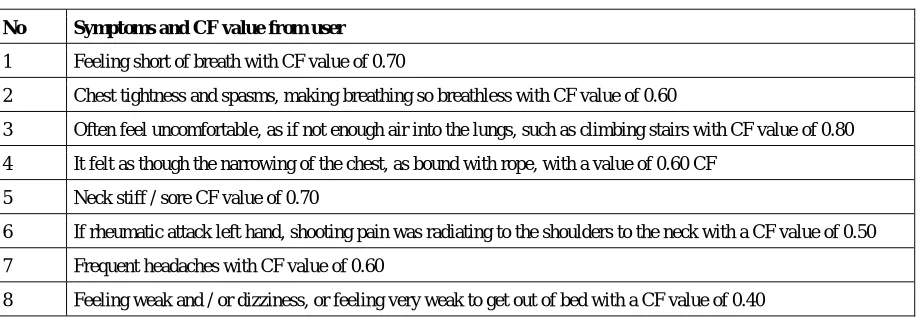
Selection of the symptoms can be done repeatedly during the user believes that there are many symptoms felt. If users already feel confident enough, then the user can simply perform a search end result. The system will make the process of inference to symptoms of CF are chosen with the value entered. For example, a user consultation as follows:
Table 1: Data of the selected user's symptoms
No Symptoms and CF value from user
1 Feeling short of breath with CF value of 0.70
2 Chest tightness and spasms, making breathing so breathless with CF value of 0.60
3 Often feel uncomfortable, as if not enough air into the lungs, such as climbing stairs with CF value of 0.80
4 It felt as though the narrowing of the chest, as bound with rope, with a value of 0.60 CF
5 Neck stiff / sore CF value of 0.70
6 If rheumatic attack left hand, shooting pain was radiating to the shoulders to the neck with a CF value of 0.50
7 Frequent headaches with CF value of 0.60
8 Feeling weak and / or dizziness, or feeling very weak to get out of bed with a CF value of 0.40
Based on the symptoms are selected, the system detects some types of diseases that meet these symptoms. For example, the symptoms 5 (CFg5 = 0.70) and symptoms 7 (CFg7 = 0.60), suggesting a brain abscess symptoms with each CF rule (CFR1 = 0.80) and (CFR2 = 0.70), so the value of CF combination is obtained as follows:
CF1 = CFg5 x CFR1 = 0.70 x 0.80 = 0.56
CF2 = CFg7 x CFR1 = 0.60 x 0.70 = 0.42
Since both values CF (CF1 and CF2) > 0, then we use the equation of 7.a, so its value is obtained as follows:
CFcomb = CF1 + CF2(1 – CF1)
= 0.56 + 0.42(1 – 0.56) = 0.74
Volume 1, Issue 1, September 2012
Page 62
CF1 = CFg1 x CFR2 = 0.70 x 0.50 = 0.35
CF2 = CFg7 x CFR1 = 0.60 x 0.60 = 0.36
CF3 = CFg8 x CFR3 = 0.40 x 0.60 = 0.24
CFcomb = CF1 + CF2(1 – CF1)
= 0.35 + 0.36(1 – 0.35) = 0.58
CFcomNew = CFcomb + CF3(1 – CFcomb)
= 0.58 + 0.24(1 – 0.58) = 0.68
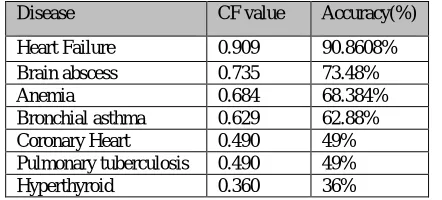
Overall, the value of CF following a search result, for all the symptoms that have been selected, based on the calculation expert system (see table 2)
Based on the eight symptoms experienced by the user during a consultation, the relationship is likely some type of disease suffered by the user is shown by Table 2. Highest CF value indicates that the type of disease is exactly what the truth is closer to the level of the best of search results the user perceived symptoms.
The number of emerging diagnostic results (see table 2) shows that the use of certainty factor, able to provide better decision than just using regular inference methods. It shows also that, any of your symptoms are associated with other diseases, and it requires the correct inference techniques to prevent a single diagnosis. With the advent of multiple diagnoses, a patient is able to know the type of the disease according to the degree of accuracy available
Table 2: CF combination value of expert systems search results
Disease CF value Accuracy(%)
Heart Failure 0.909 90.8608%
Brain abscess 0.735 73.48%
Anemia 0.684 68.384%
Bronchial asthma 0.629 62.88%
Coronary Heart 0.490 49%
Pulmonary tuberculosis 0.490 49%
Hyperthyroid 0.360 36%
5.
CONCLUSIONExpert system search results as shown in Table 2 indicate that any symptoms are selected by the user will be searching for all kinds of diseases that meet the symptoms. If found congruence, between the symptoms of the disease, then the system will calculate the value of CF combination in accordance with existing rules to the knowledge base and CF values entered by the user. The results displayed will be different because it depends on the selected symptoms. Highest confidence level will determine the best final decision; following a lower level of confidence in the final decision is the alternative to choose. Shape the final recommendations can be made up of more than two types of the disease, depending on the selection of user perceived symptoms.
The use of methods of certainty factor in expert systems, not only provide a single diagnosis, however, several other diagnostic possibilities associated with the symptoms experienced will be raised in accordance with the results of the calculation CF combination. Confidence level of 90% of search results..
R
EFERENCES[1]. Sutojo, J., Mulyanto, Edy., Suhartono, Vincent., 2011, Kecerdasan Buatan, Penerbit ANDI Publisher, Yogyakarta,
in bahasa
[2]. Kusumadewi, Sri., 2003,Artificial Intelligence : Teknik dan Aplikasinya, Penerbit Graha Ilmu, Yogyakarta, in bahasa
[3]. A, A, Imianvan., F, U, Anosike., C, J, Obi., 2011, An Expert System for The Intelligent Diagnosis of HIV Using Fuzzy Cluster Means Algorithm, Global Journal of Computer Science and Technology, Volume 11, Issue 12, Page : 73 - 80
Volume 1, Issue 1, September 2012
Page 63
[5]. Kadhim, Abbas, Mohammed., Alam, Afshar, M., Kaur, Harleen., 2011, Design and Implementation of Fuzzy Expert System for Back pain Diagnosis, International Journal Of Innovative Technology & Creative Engineering Vol.1 No.9, Page : 16 – 22
[6]. Mansour, Rasheed, Abdel, Osama., Kandil, A Diab, Olfat., 2011, The use of Knowledge Based Expert System Approach in Examining Causes of Low Back Pain in Computer users, European Journal of Scientific Research Vol.50 No.3, Page :352-362
[7]. Kalpana, M., Kumar, Senthil, A, V., 2011, Fuzzy Expert System for Diabetes using Fuzzy Verdict Mechanism,
International Journal of Advanced Networking and Applications Volume: 03, Issue: 02, Pages:1128-1134
[8]. Prasadl, BDCN., Prasad, Krishna, P, E, S, N., Sagar, Y., 2011, An Approach to Develop Expert Systems in Medical Diagnosis Using Machine Learning Algorithms (asthma) and a Performance Study, International Journal on Soft Computing ( IJSC ), Vol.2, No.1, Page : 26 – 33
[9]. Isakki,P., Rajagopalan, S,P., 2011, The Expert System Designed To Improve Customer Satisfaction, Advanced Computing: An International Journal, Vol.2, No.6, Page : 69 – 84
[10].Dhumal, Abhishek T., Narayanan, Ganesh, R., Kumar, Saravana, G., 2011, Simulation Based Expert System to Predict the Tensile Behaviour of Tailor Welded Blanks, International Journal of Advance Manufacturing Systems, Volume 13, Issue 1, Page : 159 – 181
[11].Kakoty, Sangeeta., Sarm, Shikhar Kr., 2011, Expert System Applications in E-learning Environment: Analysis on Current Trends and Future Prospects, International Journal of Internet Computing, Volume-I, Issue-1, Page : 90 – 93
[12].Asabere, Yaw, Nana., Enguah, Edusah, Samuel., 2012, Integration of Expert Systems in Mobile Learning, International Journal of Information and Communication Technology Research Volume 2, No. 1, Page : 55 – 61 [13].Shrivastava, Puja., Satpathy , Kumar, Susanta., Nagwanshi, Kumar, Kapil., 2011, Implementation of an Expert
System as Spiritual Guru for Personality Development, International Journal of Computer Theory and Engineering, Vol.3, No.1, Page : 116-121
[14].Dada,O, Joseph., Kochs, Hans-D., Petersen, Joerg., 2011, Web-Based Expert System for Classification of Industrial and Commercial Waste Products, Journal of Emerging Trends in Computing and Information Sciences Volume 2, No.6, Page : 257 – 262
[15].Lucas, P, J, F., 2001, Certainty-factor-like Structures in Bayesian Belief Networks, ELSEVIER SCIENCE, Knowledge-Based System 14, Page : 327 – 335
[16]. Ooshaksaraie, Leila., Basri, Ahmad, Ezlin, Noor., 2010, An Expert System Applied in Construction Water Quality Monitoring, American Journal of Environmental Sciences 7 (1): Page : 75-81
[17].Mo, Hiroshi., Satoh, Shin'ichi., 2000, Face Sequence Matching with Certainty Factor Evaluation, Paper for lAPR Workshop on Machine Vision Applications. Nov. 28-30. 2000, The University of Tokyo, Japan, Page : 553 – 556 [18].Chang, Ting-Yi., Cheng, Pei-Cheng., Chen, Yi-Ting., 2011, A teacher evaluation system based on association
rule and certainty factor inference: How to judge a course is successful or not?, Proceeding e-CASE & e-Tech International Conference, Page :1834 – 1854
[19].Tamilselvi, Jebamalar ,J.,Gifta, Brilly, C., 2011, Handling Duplicate Data in Data Warehouse for Data Mining, International Journal of Computer Applications Volume 15, No.4, Page : 7 – 15
[20].Gordon, Andrew, L.S., Belik, Ivan., Rahimi, Shahram., 2010, A Hybrid Expert System for IT Security Risk Assessment, Proceeding International Conference on Parallel and Distributed Processing Techniques and Applications (PDPTA'10), Page : 430 – 434
[21].Turban, Efraim, 1995, Decision Support and Expert System Management support System, 4th Edition, USA : Prentice-Hall
[22].Naga, S, Sholeh., 2012, Buku Panduan Lengkap Ilmu Penyakit Dalam, 1st Edition, Yogyakarta : DIVA Press. In bahasa.
AUTHOR
Volume 1, Issue 1, September 2012
Page 64
Suherman received the B.S and M.S degrees in Informatics Engineering from Sekolah Tinggi Sains dan Teknologi Indonesia (STT-INTEN) (B.S) in 2000 and STT Benarif (M.S) in 2010. During 2005 – now, he stayed in Universitas Serang Raya as a lecture, secretary of dean in Information Tech. Department, and Dean of Information Tech. Department (Now). His reseach interests are, artificial intelligence, digital image processing, software engiinering and enterprise information systems.