The Thirty-Third AAAI Conference on Artificial Intelligence (AAAI-19)
CompareLDA: A Topic Model for Document Comparison
Maksim Tkachenko, Hady W. Lauw
School of Information Systems Singapore Management University[email protected], [email protected]
Abstract
A number of real-world applications require comparison of entities based on their textual representations. In this work, we develop a topic model supervised by pairwise compar-isons of documents. Such a model seeks to yield topics that help to differentiate entities along some dimension of inter-est, which may vary from one application to another. While previous supervised topic models consider document labels in an independent and pointwise manner, our proposed
Compar-ative Latent Dirichlet Allocation (CompareLDA) learns
pre-dictive topic distributions that comply with the pairwise com-parison observations. To fit the model, we derive a maximum likelihood estimation method via augmented variational ap-proximation algorithm. Evaluation on several public datasets
underscores the strengths ofCompareLDAin modelling
doc-ument comparisons.
Introduction
Due to the abundance of text data, there is a need for ex-ploratory analysis of a text corpus. Topic model is a class of probabilistic models that “reduce” an input corpus into a manageable number of “topics”, where each topic congeals words that tend to co-occur with one another in documents, thus signifying some hidden semantics in the corpus. By identifying the topics that essentialize the corpus, and dis-cerning which ones predominate in a specific document, a topic model is a crucial tool for sensemaking.
Increasingly, there are real-world scenarios where the pur-pose of analyzing a corpus is to compare entities based on their textual representations (documents). For example, an-alysts may seek to explore why one country could achieve a better healthcare (alternatively economic, educational, etc.) outcome than another based on certain documents such as country reports. Funding agencies or scientists may seek a better understanding of what may get a grant proposal funded over another based on proposal contents. Among the products browsed by consumers, some are purchased while others are not. Among the purchases, some satisfy customers more than others. Thus, delving into product descriptions or reviews could reveal insights on consumer preferences.
An unsupervised topic model, such as Latent Dirichlet Allocation (LDA) (Blei, Ng, and Jordan 2003), is oriented
Copyright c2019, Association for the Advancement of Artificial
Intelligence (www.aaai.org). All rights reserved.
towards capturing topics that could reflect the word co-occurrences in the corpus well. In doing so, its topics tend to capture general semantics. For instance, a topic model based on country reports may well discover topics aligned to geographical or linguistic commonalities, which however may or may not bear direct relevance to the question at hand (e.g., healthcare outcomes). Topics based on grant propos-als may describe various scientific foci, though such topics may group competing proposals but may not be indicative of their likelihood of acceptance. In turn, product reviews may yield topics focused on brands or features, but such topics may coalesce opposing sentiment polarities as words with positive (e.g., “good”) or negative (e.g., “bad”) connotations tend to co-occur with similar words, e.g., “battery life”.
al-ways be appropriate. They may have been assigned by dif-ferent human subjects (with varying biases and scales), ren-dering direct comparison across human subjects inequitable. Proposed Approach and Contributions In a nutshell, our proposed model CompareLDA associates each topic with a distribution over words, and each document with a distribution over topics, as in a conventional topic model. In addition, a document topic proportion maps to a merit value that ranks documents. These entity merit values proba-bilistically determine the observed pairwise comparison out-comes. As a generative model,CompareLDAhas generative capacity over unobserved pairwise comparisons. This en-ables the model to learn even with relatively few observed comparisons, as we will see in the experiments. It also gen-eralizes to out-of-training documents whose topic distribu-tions and entity merit values could be inferred accordingly.
In this work, we make the following contributions.First, we investigate the utility of jointly modeling topics and pair-wise comparisons of documents within an integrated model, which is the first of its kind. We design the generative model for our proposed approach CompareLDA, and describe a learning algorithm to infer the parameters using variational inference and simulated annealing. Second, through com-prehensive experiments on public datasets, we showcase the value of supervising topic model with pairwise comparisons, against baselines such as sLDA that learns from pointwise supervision induced from the same inputs, as well as LDA that is not informed by any comparison-based supervision.
Related Work
Topic models (Hofmann 1999; Blei, Ng, and Jordan 2003) model associations between documents, topics, and words in a corpus. However, there may be auxiliary information that could reveal the core semantics in the corpus. Previ-ous works model this as supervision to align the topics ac-cordingly. The closest to our work is the pointwise sLDA (Mcauliffe and Blei 2008), which we use as a baseline to showcase the concept of pairwise comparison as opposed to pointwise supervision. There are yet others that pursue pointwise supervision, but explore other angles that are not directly comparable. (Lacoste-Julien, Sha, and Jordan 2009) introduces class-specific linear transformation to modify the topic distribution of a document, which would be applica-ble only to categorical labels but not continuous numeri-cal responses. (Zhu, Ahmed, and Xing 2012) explores max-margin learning. (Ramage et al. 2009b; 2009a) associate a document with multiple labels (e.g., tags).
There also exist previous work that leverage document-pair supervision, such as two documents being similar or being linked in a network (Chang and Blei 2009; Mei et al. 2008; Erosheva, Fienberg, and Lafferty 2004; Yang, Boyd-Graber, and Resnik 2016; Chang, Boyd-Boyd-Graber, and Blei 2009). In contrast, we are concerned with “merit-based rank-ing”, i.e., one document considered “better” than another.
Other topic models focus on idiosyncratic notions of “comparison” different from ours. For instance, (Tkachenko and Lauw 2014) models comparison between two named entities within the same document (sentence), whereas we compare two different documents. In turn, (Zhai, Velivelli,
and Yu 2004) compares two or more corpora, by finding shared topics and distinct topics between the corpora. Also focusing on corpora-level comparison, (Fang et al. 2012) seeks to identify contrasting opinions on specific topics.
Modeling pairwise comparison among documents is dif-ferent from modeling sentiments, essentially pointwise cate-gorical labels (Lin and He 2009). In some cases, a document has different sentiments represented by different sentences (Rahman and Wang 2016). It is also distinct from topic mod-els that seek to capture personalized preferences (Wang and Blei 2011; McAuley and Leskovec 2013) or preferences in pairwise comparisons (Ding, Ishwar, and Saligrama 2015).
Model
In this section, we describe the development of our approach
CompareLDA, as well as the methodology to fit the model
parameters through variational inference.
Overview
CompareLDA is a supervised topic model with non-linear
response. A response variable is associated with a pair of documents (each concerning an entity), and indicates the comparison result: which of the two entities is “better” or ranked higher than the other. The notion of comparison is latent, and may vary from application to application.
CompareLDAextends Latent Dirichlet Allocation (LDA).
It has the same basis assumption regarding the association of topics and words, but also a significant distinction in its in-corporation of pairwise comparisons (as we will see shortly). Each document is generated from a set of latent topics. A topic is an unknown distribution over the corpus vocabulary, which has to be inferred from the data. The documents in a corpus share the same set of topics, but mix them in dif-ferent proportions. The topics are associated with the words and essentially defined as distributions over the vocabulary. Each word is a sample from only one topic distribution.
We are given a set of entitiesD ={di}Ni=1. An entity is
represented by its textual form, a document. The notationdi
is used to refer to either entity or document. Furthermore, we assume that an oracle takes a pair of entities at a time,di
anddj, ‘glances’ at their documents, and makes a
compar-ison decision: which of the two entities is better according to some definition of merit, e.g., healthier, more likely to get funded, preferred by consumers. The decision would be based on the topics discussed in the text rather than on in-dividual words. The oracle makes M pairwise comparison decisions, providing the training data. CompareLDAseeks to reproduce this judging process by learning the topics, and inferring these topics for unseen documents.
Definition
CompareLDA unfolds the process in the following way.
Each entity is imbued with a latent merit value, inducing a pairwise comparison with another entity. Supposemiand mjare the respective merit values for a pair of entitiesdiand dj. Ifmi> mj, thendiis more likely, though not certainly,
θ K α
w |d| z π
N β
c M
η σ2
Figure 1:CompareLDAin plate notation.
To define the probability of winning in a comparison, we use the sigmoid function:
P(didj) =σ(mi−mj) =
1
1 +e−(mi−mj). (1)
The greater ismithanmj, the higher the probability thatdi
would be favored by the oracle, as the probability in Eq. 1 tends towards 1. When the merit values are similarmi ≈ mj, the probability reflects uncertainty in the outcome, i.e.,
P(didj)≈0.5.
Presumably, the oracle obtains the comparison informa-tion from the topics. For instance, preferred products or healthier countries may be associated with special qualities whose description manifests as topics. CompareLDA uses the empirical topic distributions of the texts, and transforms them into the entity merit values via a linear regression. Given a textdiwhere each wordwijis assigned to topiczij,
we calculate its empirical topic distributionz¯ias follows:
¯ zi =
1 |di|
|di|
X
j=1
zij. (2)
For some regression parametersη¯, we assume:
mi= ¯η·z¯i (3)
Note that for such merit values as defined above, the bias term is effectively redundant, as it vanishes when compari-son is concerned (Eq. 1).
The intuition behind regressing on topics is that some top-ics help to gain merit values (e.g., newly introduced product features), while others may decrease the merit values (e.g., discovered flaws). Considering the difference in the topic proportions of two products,z¯i−z¯j, we would be able to
draw the conclusion on which entity is likely the winner.
Generative Process
Here we summarize the generative process ofCompareLDA, whose plate notation is given in Figure 1.
1. We sampleKtopic distributions{θi}Ki=1from Dirichlet
distribution withαprior:
θi ∼Dirichlet(α).
2. We sample η¯, the transformation weights from K -dimensional Gaussian with zero mean andσ2variance:
¯
η∼ N(0, σ2).
3. For each document:
(a) We sample its topic proportion{πi}Ni=1from Dirichlet
distribution withβprior:
πi∼Dirichlet(β).
(b) For each wordwijin documentdiwe sample its topic
assignment variablezij:
zij∼Categorical(πi);
and based on the topic assignment the observed word: wij∼Categorical(θzij).
(c) We calculate empirical topic proportion ¯zi and
trans-form it to the entity merit valuemi:
mi= ¯η·z¯i= ¯η·
1 |di|
|di|
X
i=1
zij
.
4. For each pairwise comparison trialri, we sample the
win-nerci:
ci∼Bernoulli(σ(mri[1]−mri[2])).
ri is a pair of indices indicating which documents are
compared in the trial, andciindicates the winner for the
pair. Ifci = 1, then itemdri[1]is the winner, otherwise
dri[2]is.
The complete data likelihood for a set of enti-ties/documentsDand their corresponding pairwise compar-ison observations(R, C)is as follows:
P(D, Z,Θ,Π, R, C, η) = P(η|σ2)
K
Y
i=1
P(θi|α)
×
N
Y
i=1
P(πi|β)× N
Y
i=1
|di|
Y
j=1
P(zij|πi)P(wij|θzij)
×
M
Y
i=1
P(ci|mri[1], mri[2]) (4)
We consider the collapsed version of the likelihood by in-tegrating out the multinomial parameters.
P(D, Z, R, C, η) = Z
Θ
Z
Π
P(D, Z,Θ,Π, R, η)
= P(¯η|σ2)×
N
Y
i=1
P(zi·|β)×P(W|Z, α)
×
M
Y
i=1
P(ci|mri[1], mri[2]), (5)
where P(zi·|β) andP(W|Z, α) are Dirichlet-multinomial
Model Fitting
To find the maximizing latent parameters η¯ and Z for the posteriori distribution, we use variational approxi-mation algorithm to optimize the evidence lower bound L(Z, R, C, η).
log P(D, Z, R, C, η)≥L(Z, R, C, η) = log P(η|σ2)
+
N
X
i=1
hlog P(Zi|α)i+hlog P(W|Z, β)i
+
M
X
i=1
log P(ci|mri[1], mri[2])
+ H(q), (6)
whereh · i indicates expectation taken with respect to the variational distributionq(Z), andH(·)is the entropy oper-ator. We treatη¯as a model parameter.
We factorize the variational distribution into independent factors, one for eachzij. In most of the cases, assuming the
fully factorized distribution is enough to obtain the tractable closed-form update equations, where each factorized distri-bution will have the same form as their conjugate priors. However, due to non-linear interaction term between the en-tities, the update formulas are intractable. We additionally assume that eachq(zij)is an indicator probability
distribu-tion, which places all the probability mass on the one topic q(zij) =q(zij|vij) =I[zij=vij]. Essentially eachvij
repre-sents empirical topic assignment for wordwij.
q(Z|V) =
N
Y
i=1
|di|
Y
j=1
q(zij|vij) = N
Y
i=1
|di|
Y
j=1
I[zij=vij] (7)
Note that under this assumption, expectation operator does not change anyf(V):hf(V)i=f(V).
We use coordinate-ascent variational approximation, and maximize the evidence lower bound with respect toη¯andV, optimizing each parameter in turn. Further we assume that the document comparisons are configured in such a way that for anyi,ci= 1, to simplify the description of equations.
Optimizingη: With V fixed, we want to optimize the following objective:
f(¯η) = log P(¯η|σ2) +
M
X
i=1
log P(ci|mri[1], mri[2])
=−
K
X
i=1
η2
i
2σ2−
M
X
i=1
log1 +e−η¯·(v¯ri[1]−v¯ri[2]) (8)
where¯vi =
P|di|
j=1vij
/|di|. We develop a basic gradient
ascent algorithm, taking derivative off(¯η)with respect to ηj:
fη0j(¯η) =−
ηj σ2 −
M
X
i=1
(¯vri[1])j−(¯vri[2])j
1 +e−η¯·(v¯ri[1]−v¯ri[2])
. (9)
OptimizingV: Withη¯fixed, we seek the empirical topic assignments that maximize (6). As exhaustive search for
the optimal solution has exponential complexity and, there-fore, is infeasible for any reasonable datasets, we exploit the probabilistic nature of the model and develop Metropolis-Hastings (Metropolis-Hastings 1970) procedure for approximate op-timization. Metropolis-Hastings is a method for obtaining a sequence of random samples from a probability distri-bution for which direct sampling is difficult. In case of
CompareLDA, the procedure changes one word-topic
as-signmentvj as a time, eventually approximating the
prob-ability distribution of word-topic assignments for the whole corpus. We work with probability distribution induced by the empirical lower bound. Here we compute the difference be-tween two word-topic assignments, that are different only in one assignment, current assignmentvij = aand evaluated
assignmentvij =b(chosen at random).
Evij
a→b= log (β+ni(a)−1)−log (β+ni(b))
+ log (α+n(a, wij)−1)−log (α+n(b, wij))
−log (α|X|+n(a,·))−1) + log (α|X|+n(b,·))
+
M
X
k=1
log
1 +eη¯·(v¯rk[1]−v¯rk[2])+δi
I[rk[1]=i]−I[rk[2]=i]
−
M
X
k=1
log1 +eη¯·(v¯rk[1]−¯vrk[2]) (10)
where X is vocabulary, ni(z) is document-topic count, n(z, w) is term-topic count, n(z,·) = P
w∈Xn(z, w),
and δi = (ηb−ηa)/|di|. The acceptance probability γ= exp −Evij
a→b
then indicates how probable the evalu-ated sample is with respect to the current assignment, ac-cording to the approximated sample. If we attempt to move to an assignment which is more probable than the current one w.r.t the evidence lower bound, we always accept the move. If the move is taken towards the less probable assign-ment, it will be accepted withγprobability.
For the purpose of optimization, the Metropolis-Hastings algorithm can be converted to simulated annealing proce-dure, where acceptance probabilityγis reduced over time, to prevent the moves towards less probable states. We useγT1
as the probability of accepting a new assignment, whereT, a temperature, approaches0as the iteration count increases.
Experiments
Our experimental objective is to validate the efficacy of
CompareLDAin deriving topics that are well-aligned to
doc-ument comparisons. First, we investigate the utility of mod-eling pairwise comparisons as supervision on topic models, vis-`a-vis a baseline with pointwise supervision. Thereafter, we move to additional experiments and discussions, which shed light upon various aspects of the model.
Datasets
a part of the core semantics of the corpus. We identify three such corpora that yield five experimental datasets as follows. Wikipedia The first is a set of three datasets constructed from Wikipedia1 pages with country infobox and category.
The corpus contains 467 entities (countries and associations, e.g., BRICS, NATO). The page content is the document. As supervision, we induce three sets of pairwise compar-isons from Wikipedia’s lists of countries: by alcohol con-sumption (AC), by cigarette concon-sumption (CC), and by life expectancy (LE). Each list results in a different number of pairwise comparisons: 17,955 for AC, 16,290 for CC, and 16,653 for LE. Coupled with the text corpus, each set of pairwise comparisons constitute a dataset. Our intention is to study ifCompareLDAcould derive different topics from the same corpus, but with different pairwise comparisons.
Product Reviews The second dataset is from Ama-zon as described in (McAuley, Pandey, and Leskovec 2015; McAuley et al. 2015). Here, an entity is a review from the Electronics category. We assume that the reviews mention various features and qualities to illustrate the product’s in-trinsic merit. As supervision, we induce pairwise compar-isons based on the number of stars indicated by the reviews. The “positive” reviews (5 and 4 stars) are compared to the “negative” reviews (2 and 1 stars), i.e., positive “win” over negative. We sample 10,000 reviews at random to assemble the corpus. For this dataset, out of all the induced compar-isons, we randomly sample0.25%to simulate a realistic sce-nario of where only partial comparisons have been observed. The dataset contains 43,881 pairwise comparisons.
Movie Reviews The third dataset contains movie reviews (Pang and Lee 2005). We used the 4-star scale as described in (Pang and Lee 2005) to induce pairwise comparisons, i.e., a review with more stars “wins”. The intuition here is to dis-cover the topics that are aligned with what makes a good movie. As before for the Product Reviews corpus, we retain only0.25%of comparisons as supervision. The corpus con-tains 5,006 documents along with 21,965 comparisons.
Each dataset is split into training and testing folds in 80:20proportion respectively. Conservatively, comparisons that cross folds are ignored during training and evaluation. The corpora undergo the same preprocessing steps, i.e., re-moving short documents, punctuation, stop-words; the to-kens converted to their lemmas. For each dataset, we retain top 5000-term vocabulary selected by tf-idf.
Evaluation
To jointly model topics and pairwise comparisons, a method should be adept at both assigning topics to words and assess-ing the rankassess-ing among documents. We explore these respec-tive dimensions of evaluation.
Ranking To assess ranking quality, we report the rank-ing accuracy. For two entitiesdi anddj, we define a
func-tionf, where f(di, dj)returns1 ifdi is preferred overdj
in comparison,0when the preference betweendianddj is
not assumed, and−1whendj is preferred overdi. Given a
set of entitiesD={di}Mi=1and reference comparison
func-tionf (ground-truth) and its approximation g(prediction), 1
We used the Wikipedia dump dated 30 July 2018.
2 510 20 40 80
# of topics 45
50 55 60 65 70 75 80
A
cc
u
ra
cy
CompareLDA sLDA
(a) Accuracy
2 510 20 40 80
# of topics −1.25
−1.20
−1.15
−1.10
−1.05
−1.00
P
er
-w
or
d
H
el
d
-o
u
t
L
og
-l
ik
el
ih
o
o
d
×101
CompareLDA sLDA
(b) Log-likelihood
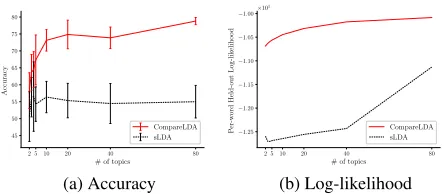
Figure 2: Wikipedia dataset ranked by alcohol consumption
we define the ranking accuracy (or accuracy) as follows:
A= PM
i=1
PM
j=1I[f(di,dj)=1]I[g(di,dj)=1]
PM
i=1
PM
j=1I[f(di,dj)=1]
(11)
When the approximation and reference functions are iden-tical, then approximation is good and A = 1. In case of complete disagreement, g(di, dj) 6= 1for everydi anddj
such thatf(di, dj) = 1, thenA= 0. The ranking accuracy
is closely related to Kendall’s Tau. While Kendall’s Tau is suitable for totally ordered sets, the proposed metric con-sider only items for which relative comparison make sense, and thus it is more appropriate in our study.
Topics Topic models are commonly evaluated by esti-mating probability of held-out documents. The intuition is that a better model will give rise to the likelihood of held-out documentsD.L = log P(P D|M)
d∈D|d|
is per-word log-likelihood for an LDA model with parametersM. To approximateL marginalized over all possible topic assignments, we use Chib-style estimator (Wallach et al. 2009).
Comparison to Baseline
As our proposedCompareLDAis the first topic model su-pervised by pairwise comparisons, our main baseline is the previous topic model supervised by pointwise response variables. Among such models (see Related Work), sLDA2
bases the prediction on empirical topic assignments, which makes the former an ideal baseline toCompareLDAthat also uses empirical topic assignments. sLDA predicts merit val-ues of documents directly via regression. When supervision is supplied in terms of pairwise comparisons, this model is not immediately applicable. Instead, it requires preprocess-ing to convert the pairwise comparisons into pointwise merit values for each document, which are then supplied to sLDA. For conversion, we employ the Bradley-Terry-Luce (BTL) model (Bradley and Terry 1952; Luce 2012) due to its simi-larity to the comparison component ofCompareLDA.
We evaluate both models by varying the number of topics (default is 80). The experiments are repeated 10 times with different random initializations. Figures 2 to 6 show the re-sults for the five datasets for both accuracy and likelihood.
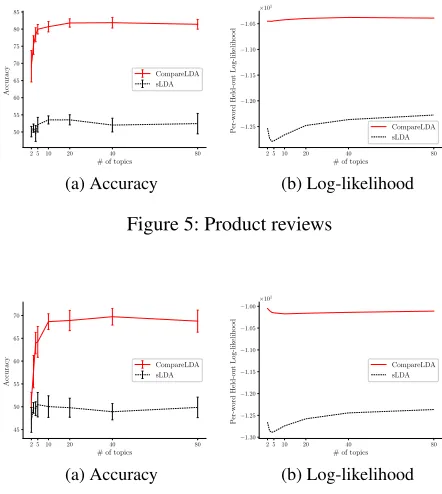
CompareLDA consistently outperforms sLDA on each
dataset with respect to both evaluation dimensions. For 2
2 510 20 40 80 # of topics
40 45 50 55 60 65 70 75 80 A cc u ra cy CompareLDA sLDA (a) Accuracy
2 510 20 40 80
# of topics −1.25
−1.20
−1.15
−1.10
−1.05
−1.00
P er -w or d H el d -o u t L og -l ik el ih o o d
×101
CompareLDA sLDA
(b) Log-likelihood
Figure 3: Wikipedia dataset ranked by cigarette consumption
2 510 20 40 80
# of topics 40 50 60 70 80 90 A cc u ra cy CompareLDA sLDA (a) Accuracy
2 510 20 40 80
# of topics −1.25
−1.20
−1.15
−1.10
−1.05
−1.00
P er -w or d H el d -o u t L og -l ik el ih o o d
×101
CompareLDA sLDA
(b) Log-likelihood
Figure 4: Wikipedia dataset ranked by life expectancy
instance, Figure 2(a) shows the ranking accuracy for the Wikipedia dataset ranked by alcohol consumption. In
gen-eralCompareLDAachieves better results as the number of
topics increases. The accuracy gap over sLDA increases sig-nificantly, when the number of topics hits 10 and beyond. Bars denote the standard deviation. The deviation tends to reduce as the number of topics increase. This reflects well
onCompareLDA, suggesting that supervision in the form of
pairwise comparisons helps to uncover the ranking structure.
CompareLDAdemonstrates better alignment of topics with
rankings, reaching higher than 75% accuracy. sLDA shows lower performance, hovering around 55%, which is close to random; this suggests that the regression objective does not fit the problem, when pairwise supervision is concerned.
In turn, Figure 2(b) shows that CompareLDA reaches significantly higher log-likelihood than sLDA as well. The log-likelihood plots show significant outperformance by
CompareLDAover sLDA even when the number of topics is
small. It seems that the regression objective interferes with the objective to infer “good” predictable topics.
The other Wikipedia datasets ranked by cigarette con-sumption (Figure 3) and life expectancy (Figure 4) show similar trends, evidence thatCompareLDAcould derive dif-ferent topic models from the same corpus by fitting difdif-ferent supervisions. For the review datasets (Figures 5 and 6), the outperformance is more vivid and starts with a few topics.
Amount of Supervision
We study the amount of supervision, as the number of com-parisons for the fully ordered set ofNelements is quadratic, O(N2), i.e., harder to obtain than independently labeling
2 510 20 40 80
# of topics 50 55 60 65 70 75 80 85 A cc u ra cy CompareLDA sLDA (a) Accuracy
2 510 20 40 80
# of topics −1.25
−1.20
−1.15
−1.10
−1.05
P er -w or d H el d -o u t L og -l ik el ih o o d
×101
CompareLDA sLDA
(b) Log-likelihood
Figure 5: Product reviews
2 510 20 40 80
# of topics 45 50 55 60 65 70 A cc u ra cy CompareLDA sLDA (a) Accuracy
2 510 20 40 80
# of topics −1.30
−1.25
−1.20
−1.15
−1.10
−1.05
−1.00
P er -w or d H el d -o u t L og -l ik el ih o o d
×101
CompareLDA sLDA
(b) Log-likelihood
Figure 6: Movie reviews
each document. Figure 7 shows the performance when the amount of supervision gradually increases from1%to100% on the Wikipedia dataset ranked by cigarette consumption for 80 topics (other rankings and topic counts show simi-lar results). Figure 7(a) shows that initially ranking accuracy grows fast as the amount of supervision increases. When5% of supervision is supplied, rankings accuracy remains stable. Figure 7(b) shows that log-likelihood remains stable regard-less of the amount of supervision. These results indicate that
CompareLDA does not require fully ordered set to fit the
model and, therefore, a small subset of comparisons may be used to achieve high ranking performance and topic quality.
Joint vs. Pipeline Models
One may improbably surmise that LDA may naturally align with document comparisons anyway, even without
super-1 5 super-10 20 40 100
% of Pairwise Comparisons 67.5
70.0 72.5 75.0 77.5 80.0 82.5
A cc u ra cy CompareLDA (a) Accuracy
1 5 10 20 40 100
% of Pairwise Comparisons −1.011
−1.010
−1.009
−1.008
−1.007
P er -w or d H el d -o u t L og -l ik el ih o o d
×101
CompareLDA
(b) Log-likelihood
Data CompareLDA LDA+BTL-R Wikipedia (AC) 78.8±0.8 75.4±1.6 Wikipedia (CC) 75.6±2.3 74.9±1.8 Wikipedia (LE) 85.7±2.3 84.0±1.8 Product Reviews 81.4±1.0 76.7±1.0 Movie Reviews 68.8±1.7 63.8±1.3 Table 1: Accuracy, AC Alcohol Consumption, CC -Cigarette Consumption, LE - Life Expectancy.
Data CompareLDA LDA(+BTL-R)
Wikipedia (AC) −10.084±.007 −10.084±.010 Wikipedia (CC) −10.085±.005 −10.084±.010 Wikipedia (LE) −10.081±.010 −10.084±.010 Product Reviews −10.391±.003 −10.389±.003 Movie Reviews −10.111±.004 −10.111±.002 Table 2: Loglikelihood, AC Alcohol Consumption, CC -Cigarette Consumption, LE - Life Expectancy
vision. To debunk this, we consider a decoupled form of
CompareLDA, which first discovers topics with LDA, and
then solves the comparison problem using the empirical topic assignments. To tackle the pairwise comparison, we introduce Bradley-Terry-Luce regression (BTL-R), which is similar toCompareLDA’s comparison modeling but done as a separate step. We refer to this pipeline as LDA+BTL-R.
Table 1 shows the ranking accuracy (and 95% confi-dence intervals). Bold typeface indicates statistically sig-nificant difference.CompareLDAshows better results than its pipeline equivalent on every dataset, with significant improvement on Wikipedia ranked by alcohol consump-tion and the review datasets. In turn, for the held-out log-likelihood, one may expect some decrease in performance due to additional objective to satisfy the comparison supervi-sion, whereas LDA (BTL-R part does not influence topic in-ference in this case) cares only about getting the topics right. Gratifyingly, Table 2 shows that in fact there is no signifi-cant difference between the topics derived byCompareLDA
and LDA, supporting thatCompareLDAcould align topics to comparisons well without hurting the likelihood.
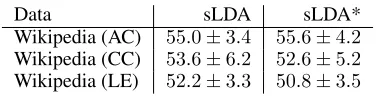
sLDA Supervision
As mentioned earlier, sLDA requires pointwise supervision. When the input is pairwise, we need a preprocessing step. In a scenario where some form of pointwise response exists, we could alternatively use that directly, e.g., the rank position in the list for the Wikipedia dataset. We look into whether the two forms of supervision affect the results much. sLDA* is supervised with the ranked list, whereas sLDA is supervised with comparisons. Table 3 shows that there is no signifi-cant difference for ranking accuracy between the two. The BTL transformation matters when we explore held-out log-likelihood on Wikipedia ranked by alcohol consumption (see Figure 4), where it helps to achieve significantly better per-formance. However, the differences for the other Wikipedia rankings are not significant. In any case, the form of sLDA
Data sLDA sLDA*
Wikipedia (AC) 55.0±3.4 55.6±4.2 Wikipedia (CC) 53.6±6.2 52.6±5.2 Wikipedia (LE) 52.2±3.3 50.8±3.5 Table 3: Accuracy, AC Alcohol Consumption, CC -Cigarette Consumption, LE - Life Expectancy
Data sLDA sLDA*
Wikipedia (AC) −11.132±.008 −12.367±.007 Wikipedia (CC) −12.370±.006 −12.368±.011 Wikipedia (LE) −12.374±.009 −12.373±.016 Table 4: Loglikelihood, AC Alcohol Consumption, CC -Cigarette Consumption, LE - Life Expectancy
supervision would not affect the earlier conclusions on the relative comparisons withCompareLDA.
Topics
To get a sense of the semantics reflected by the topics, we show 5 topics associated with top positive and top nega-tive η¯parameters. For Product Reviews (see Table 5), the ¯
η-positive topics tend to associate with words of positive connotations, e.g., great, well, good, recommend, love, etc. ¯
η-negative topics tend to talk about issues, problems, money, returns, and warranty.
Topη¯-positive Topics Topη¯-negative Topics work great well phone use
also everything since need easy good set recommend issue clear
product would one back new month work buy get warranty worked return is-sue problem year
picture great tv price good quality love amazing fea-ture best get really recom-mend got better
one would tried time re-view product work bought got money new first re-turned different try color great little look
came still perfect get easy could love easily really would want
device work adapter even connection get computer use unit time product well network car ca
one fan great two really also work air new room put purchased right got connector
year bought still first week working month warranty another one since would two completely last one use bought price year
well good model work still frame know used wanted made
one thing like money buy get even worth really could got make review cheap going
Table 5:CompareLDAtopics for Product Reviews
Conclusion
com-parison to align the topics learnt to the comcom-parison di-mension of interest. Experiments show that it helps to un-cover more conducive topics for assessing the relative merits between entities than baseline with pointwise supervision. Moreover, it learns well even with partial supervision as-suaging the need for many comparison labels.
Acknowledgments
This research is supported by the National Research Founda-tion, Prime Minister’s Office, Singapore under its NRF Fel-lowship Programme (Award No. NRF-NRFF2016-07).
References
Blei, D. M.; Ng, A. Y.; and Jordan, M. I. 2003. Latent dirichlet allocation. JMLR3(Jan).
Bradley, R. A., and Terry, M. E. 1952. Rank analysis of incomplete block designs: I. the method of paired compar-isons. Biometrika.
Chang, J., and Blei, D. M. 2009. Relational topic models for document networks. InAIStats, volume 9, 81–88. Chang, J.; Boyd-Graber, J.; and Blei, D. M. 2009. Connec-tions between the lines: augmenting social networks with text. InSIGKDD. ACM.
Ding, W.; Ishwar, P.; and Saligrama, V. 2015. A Topic Modeling Approach to Ranking. In Lebanon, G., and Vish-wanathan, S. V. N., eds.,Proceedings of the Eighteenth In-ternational Conference on Artificial Intelligence and Statis-tics, volume 38 ofProceedings of Machine Learning
Re-search, 214–222. PMLR.
Erosheva, E.; Fienberg, S.; and Lafferty, J. 2004. Mixed-membership models of scientific publications. Proceedings
of the National Academy of Sciences101(suppl 1).
Fang, Y.; Si, L.; Somasundaram, N.; and Yu, Z. 2012. Mining contrastive opinions on political texts using cross-perspective topic model. InProceedings of the 5th ACM
International Conference on Web Search and Data Mining,
63–72. ACM.
Hastings, W. K. 1970. Monte carlo sampling methods using markov chains and their applications. Biometrika.
Hofmann, T. 1999. Probabilistic latent semantic indexing.
InSIGIR. ACM.
Lacoste-Julien, S.; Sha, F.; and Jordan, M. I. 2009. Dis-cLDA: Discriminative learning for dimensionality reduction and classification. InNIPS.
Lin, C., and He, Y. 2009. Joint sentiment/topic model for sentiment analysis. InProceedings of the 18th ACM
con-ference on Information and Knowledge Management, 375–
384. ACM.
Luce, R. D. 2012.Individual choice behavior: A theoretical
analysis. Courier Dover Publications.
McAuley, J., and Leskovec, J. 2013. Hidden factors and hidden topics: understanding rating dimensions with review text. InProceedings of the 7th ACM conference on
Recom-mender systems, 165–172. ACM.
McAuley, J.; Targett, C.; Shi, Q.; and van den Hengel, A. 2015. Image-based recommendations on styles and substi-tutes. InSIGIR, 43–52.
McAuley, J.; Pandey, R.; and Leskovec, J. 2015. Inferring networks of substitutable and complementary products. In
KDD, 785–794.
Mcauliffe, J. D., and Blei, D. M. 2008. Supervised topic models. InNIPS.
Mei, Q.; Cai, D.; Zhang, D.; and Zhai, C. 2008. Topic modeling with network regularization. InWWW, 101–110. ACM.
Pang, B., and Lee, L. 2005. Seeing stars: Exploiting class re-lationships for sentiment categorization with respect to rat-ing scales. In Proceedings of the 43rd annual meeting on
association for computational linguistics, 115–124.
Associ-ation for ComputAssoci-ational Linguistics.
Rahman, M. M., and Wang, H. 2016. Hidden topic senti-ment model. InProceedings of the 25th International
Con-ference on World Wide Web, 155–165. International World
Wide Web Conferences Steering Committee.
Ramage, D.; Hall, D.; Nallapati, R.; and Manning, C. D. 2009a. Labeled LDA: A supervised topic model for credit attribution in multi-labeled corpora. InEMNLP. Association for Computational Linguistics.
Ramage, D.; Heymann, P.; Manning, C. D.; and Garcia-Molina, H. 2009b. Clustering the tagged web. InWSDM. ACM.
Tkachenko, M., and Lauw, H. W. 2014. Generative model-ing of entity comparisons in text. InCIKM. ACM.
Wallach, H. M.; Murray, I.; Salakhutdinov, R.; and Mimno, D. 2009. Evaluation methods for topic models. In Proceed-ings of the 26th annual international conference on machine
learning, 1105–1112. ACM.
Wang, C., and Blei, D. M. 2011. Collaborative topic model-ing for recommendmodel-ing scientific articles. InProceedings of the 17th ACM SIGKDD International Conference on
Knowl-edge Discovery and Data Mining, 448–456. ACM.
Yang, W.; Boyd-Graber, J.; and Resnik, P. 2016. A discrim-inative topic model using document network structure. In
ACL.
Zhai, C.; Velivelli, A.; and Yu, B. 2004. A cross-collection mixture model for comparative text mining. InSIGKDD. ACM.